4 272 résultats
1405Genève, Cramer & Philibert, 1750, un fort volume in 4 relié en plein veau marbré, dos orné de fers dorés, tranches rouges (reliure de l'époque), (quelques feuillets uniformément jaunis, 2 cachets de bibliothèque dans les marges de la page de titre), 23pp., (1pp. blanche), 680pp., 11pp., (1pp. - errata), 33 planches dépliantes numérotées 1 à 33 + 1 planche non numérotée - SOIT 34 PLANCHES DEPLIANTES
in-4, fogli 316 numerati, impressi in carattere corsivo, Illustrati con con centinaia di figure tecniche e geometriche nel testo. Legatura coeva p.pergamena flessibile, titolo manoscritto al dorso. Le due traduzioni delle quali Tartaglia si servì per la presente edizione sono quelle di Campano e di Zamberto. Euclide visse nel IV e III sec. a.C, fu discepolo di Platone e celebre matematico in Alessandria, detto ''il padre della geometria''. Stimata edizione, la cui prima versione apparve nel 1543. (Esemplare genuino, lievi arrossature della carta in qualche margine).. Thomas-Stanford, n. Manca ad Adams..
In-4°; 1 cb, pp.(14), 340, (36), antiporta calcografica; un rame al frontespizio, legni nel testo. Legatura coeva in piena pergamena con titolo in oro al dorso, tagli spruzzati in azzurro. Dorso parzialmente restaurato. Buon esemplare. Edizione originale delle sue lezioni di geometria cge Lecchi fece stampare nel periodo in cui insegnava matematica a Brera; l’intento didattico e quello storico sono svolti insieme, con il supporto di molte spiegazioni e esercizi. Lecchi (Milano 1702-1776 Milano) studiò nel collegio dei Gesuiti di Brera, insegnò filosofia e matematica. DBI ad vocem.
187353254London and New York, Macmillan and Co., 1873. 4to. Orig. full brown cloth, gilt spine, pictorial gilt frontcover. Near mint condition. Small embossed stamp at upper corner of title-page (David Dunlop ObservatoRy Library). In: ""Nature, a weekly illustrated Journal of Science."", Volume VIII, May 1873 to October 1873. XII,562 pp. (Entire volume offered). Riemann's paper: pp. 14-17 a. 36-37. Internally clean and fine, no traces of use.
187353254London and New York Macmillan and Co. 1873. 4to. Orig. full brown cloth gilt spine pictorial gilt frontcover. Near mint condition. Small embossed stamp at upper corner of title-page David Dunlop ObservatoRy Library. In: "Nature a weekly illustrated Journal of Science." Volume VIII May 1873 to October 1873. XII562 pp. Entire volume offered. Riemann's paper: pp. 14-17 a. 36-37. Internally clean and fine no traces of use. <br/><br/><em>First English translation of this milestone work on the foundations of geometry. It "is one of the key work from which derives the modern study of differential geometry and especially the study of manifolds of dimension greater than two. It was to prove central to the overthrow of Euclidean geometry as the source of geometrical ideas and to Einstein's general theory of relativity after 1915." Grattan-Guiness "Landmark Writings in Western Mathematics 1640-1940.It is a translation of Riemann's famous Habilitationsvortrag held in 1854 in secondary literature it is often misidentified as his Habilitationsschift but that was concerned with Fourier series and was delivered the year before. Riemann begins his lecture with a remark about a certain darkness that lies at the foundation of geometry. This darkness obscures the relations between that which geometry assumes i.e. the notion of space and the first principles of constructions in space. In Riemann's oponion one must take another approach towards this problem than the usual axiomatic method used ever since Euclid. The approach taken by Riemann is to a large extent guided by Gauss's work on the intrinsic geometry of surfaces; 'Disquisitiones generales circa superficies curvas' 1828. In this work Gauss showed that the curvature of a surface can be determined without reference to the ambient Euclidean space in which it lies i.e. that the curvature is an intrinsic property of the surface. Based on this Gauss showed several fundamental theorems about figures on the surface by referring only to the surface itself i.e. indicating that the surface itself is a space with its own geometry independent of the geometry of the ambient Euclidean space. Riemann argues that the true objects and properties of geometry are those which can be studied within the space itself and he defines a general n-dimensional space in a similar manner to the parametric representation of a surface. Riemann believed that we know space only locally he therefore bases his study of the geometry of such a general space or manifold as they are known today on the infinitesimal methods of calculus. This choice is a crucial departure from the classical axiomatic methods used by Euclid Lobachevsky and Bolyai. The notion of distance or metric on a manifold is a generalization of the usual Euclidean distance formula in n-dimensions. Particular choices of space and metric reveal both the hyperbolic geometries of Lobachevsky and Bolyai and elliptic or Riemannian geometry. Riemann's approach to geometry is of paramount importance this work "did more to change our ideas about geometry and physical space than any work on the subject since Euclid's Elements." Landmark Writings in Western Mathematics p.507. "The importance of this treatise is not confined to pure mathematics. Without it Einstein would not have been able to develop his general theory of relativity." Printing and the Mind of Man p.177. </em> hardcover
17590243Zürich, Heidegger, 1759. Erste deutsche Ausgabe. - Steck I, 3 u. I, 26; Poggendorff I, 1355; vgl. ADB 17, 552. - Titelblatt gestempelt. - Stellenweise etwas gebräunt oder braunfleckig. Der elsässische Physiker und Mathematiker Johann Heinrich Lambert (1728-1777), der sich sein Wissen vorwiegend autodidaktisch angeeignet hatte, gilt als bedeutendster Vertreter des deutschen Rationalismus nach Leibniz und vor Kant, mit dem er auch im Briefwechsel stand. Mit der "Perspektive", seiner ersten mathematischen Veröffentlichung, berücksichtigt Lambert als Mathematiker auch die Bedürfnisse der praktischen Anwendung und er begründet mit diesem Werk, noch vor Monge, die beschreibende Geometrie als eigenständige mathematische Disziplin. - Der 1. Teil dieser wichtigen Schrift zur Perspektivlehre, hier vorliegend in der seltenen 1. Ausgabe, angebunden der erst 15 Jahre später erschienene 2. Teil. - Gut erhaltenes Exemplar in einem dekorativen Einband im Stil der Zeit.
in-4 gr., ff. 57 n.n. compreso il magnifico titolo figurato con armi del cardinale Iacomo Nini al quale l'opera è dedicata da Matteo Gregorio de'Rossi. Leg. moderna in p. pergam. rigida. Completo di 51 tav. geometriche incise in rame n.t., testatine, finalini e titolo entro elaborata bordura architettonica e figure allegoriche. Sesta edizione (prima Roma, Paulini 1599) di questo celebre trattato sulla geometria euclidea e le sue applicazioni, di G. Pomodoro, astronomo e matematico veneziano (XVI secolo). "La geometria pratica del Pomodoro con le aggiunte dello Scala è un trattato d'agrimensura che trovo assai ben fatto" (Riccardi). Scala (1547-1599), matematico, ingegnere militare e architetto friulano, curò e ampliò il lavoro di Pomodoro. Bell'esemplare (antico timbro abraso al secondo f.).. Cat. Vinciana 1599. Riccardi, II, 201. Graesse V, 399. Olschki 7562..
162721055Nürnberg, Simon Halbmayer, 1625, 1623, 1626, 1627 (laut Chronogrammen am Schluß der Dedicationen). 4 statt 6 Bll., 296 SS., 8 Bll, 198 SS., 3 Bll., 6 Bll., 101 SS., 1 Bl., 83 SS., 2 Bll. mit 1 gest. Porträt, gestochene Titel (2 x in Holzschnitt wiederholt) und ca. 200 Holzschnitte im Text (Messinstrumente, Zirkel, Messungslinien in Landschaften und Städten sowie zahlreiche Diagramme und Schemata. Es fehlen im 1. Buch der Titel und ein Blatt der Dedikation. 4° (ca. 15, 5 x 19, 5 cm), Pergament der Zeit über 4 Bünden, Initialen "FIVG" und die Jahreszahl 1630 auf dem Vorderdeckel, blindgeprägte Wappensupralibros auf beiden Deckeln. Wappen der Familie von Grünthal. Einband etwas angegraut und leicht knittrig.
156323194Dillingen, Sebaldus Mayer, 1563. 8 (1 weißes) Bll., 121 num. Bll.mit zahlr. Textholzschnitten. Gr.-8°. Blingeprägtes braunes Ldr. der Zeit (ohne die Bindebänder, etw. berieben und bestoßen). [5 Warenabbildungen]
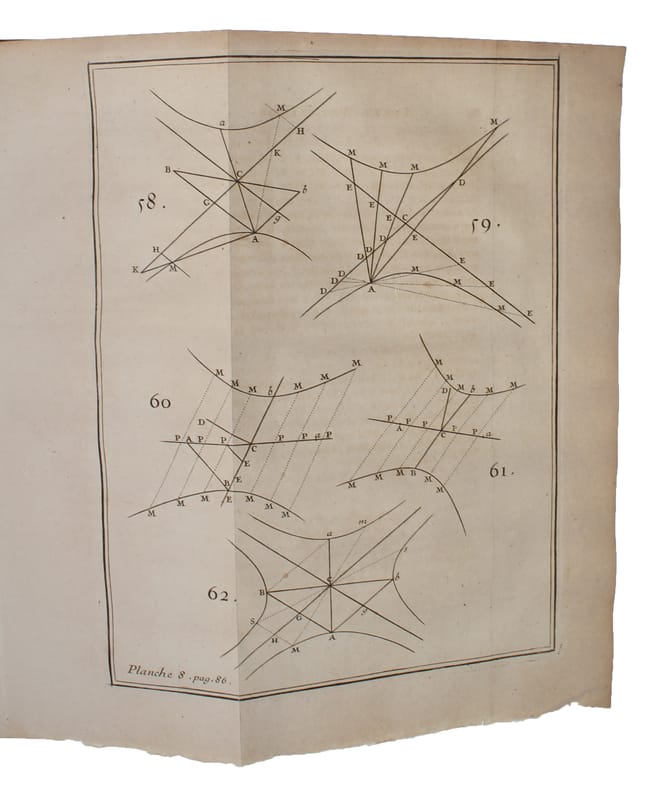
170748217Paris, Jean Boudot et Jean Boudet fils, 1707. 4to. Contemporary full calf. A bit of cracking to front hinges, so that cords are seen, but cover not loosening. Spine with 6 raised bands, richly gilt compartments. Wear to top of spine. Two small old paperlabels, one to upper compartment, one to frontcover. Covers slightly rubbed. (4),459,(5) pp. Large woodcut vignette on titlepage, 2 other vignettes, one engraved , one in woodcut. 32 folded engraved plates and one smaller folded plate (Fig. A). An old owners stamp on flyleaf. Internally clean and fine. A few tiny brownspots. Wide-margined and printed on good paper.
170748217Paris Jean Boudot et Jean Boudet fils 1707. 4to. Contemporary full calf. A bit of cracking to front hinges so that cords are seen but cover not loosening. Spine with 6 raised bands richly gilt compartments. Wear to top of spine. Two small old paperlabels one to upper compartment one to frontcover. Covers slightly rubbed. 44595 pp. Large woodcut vignette on titlepage 2 other vignettes one engraved one in woodcut. 32 folded engraved plates and one smaller folded plate Fig. A. An old owners stamp on flyleaf. Internally clean and fine. A few tiny brownspots. Wide-margined and printed on good paper. <br/><br/><em>Scarce first edition of l'Hôspital's second book - his second successfull textbook - the manuscript of which was left completed at his death in 1704. His first book "Analyse des infiniment petits pour l’intelligence des lignes courbes" 1696 was the first textbook of the differential calculus and his name lives on in the name of the rule for finding the limiting value of a fraction whose numerator and denominator tend to zero. His mathyematical teacher was Jean Bernoulli.The year in which Newton published the anti-Cartesian "Arithmeticus" there appeared in France a conspicuously successfull textbook on Cartesian geometry along the lines of that of Guisnée. This was the "Traité Analytique des Sections Coniques". a book which contains less original material than that of Guisnée but which is more extensive and closer to the modern manner of treatment. The work had been intended for publication at the time the authors famous calculus textbook appeared in 1696 but l'Hospital's illness apparently led to delay and it appeared posthumously in 1707. It is Cartesian in emphasis and although it consists of but one volume follows generally the tripartite plan of Lahire and Ozanam: first an algebraic quasi-analytic treatment of the Conic Sections along the lines of Apollonian theory; then an analytic study of the loci and finally a long section on the customary construction by conics of the roots of cubic and quartic polynominal equations. LHospital sometimes used two axes and seems to have recognized the interchangeability of these but he betrays some hesitation. In general L'Hospital like Descartes was more interested in analytic geometry as a measure of ecpressing loci algebraivcally than as a method of deriving the properties of a curve from its equation." Carl B. Boyer "History of Analytic geometry" pp. 150-154. </em> hardcover
[Agrimensura] (cm. 20,5) Bella piena pergamena originale, bel titolo calligrafato al dorso. cc.10nn., cc.344, cc.2, (con marca tipografica ed ultima bianca). Molte illustrazioni in xilografia n.t. di strumenti, schemi, figure ecc. Edizione originale molto rara e importante. Riccardi I 478: "opera interessantissima per la storia dell'aritmetica, ampiamente sviluppata ed applicata anche alla mercatanzia; e per quella della geometria pratica, trovandovisi la descrizione e l'uso degli strumenti allora conosciuti, fra i quali sono notevoli quelli che ora direbbersi di celerimensura". Cat. libri 2878:"This work is so scarce that it has escaped professor de morgan. It contains solution of several indeterminate problems.Amongst the Authors quoted by Forestani we find Galigai, Calandi, Lazzizio, Pagani, ecc." Vecchiolieve resturo al margine bianco del frontis ma esemplare molto bello e nitido. * Parenti prime edizioni 237; *Choix 6632; *Sotheran primo sopplimento 1149; *Brunet II 1341; *Graesse II 615.[f61] Libro
1826W107940Paris, Imprimerie Nationale 1826-1828 Ouvrage complet en 2 tomes, reliés en 1 volume : viii,400 + 123pp., Edition originale de 1826-1828, 28cm., reliure cart. d'amateur usée, quelques rousseurs occasionnelles, peu commun, [Augustin-Louis Cauchy, 1789-1857, était l'un des mathématiciens modernes les plus importants, ayant influencé fortement le développement des mathématiques au 19e siècle], W107940
Ouvrage complet en 2 tomes, reliés en 1 volume : viii,400 + 123pp., Edition originale de 1826-1828, 28cm., reliure cart. d'amateur usée, quelques rousseurs occasionnelles, peu commun, [Augustin-Louis Cauchy, 1789-1857, était l'un des mathématiciens modernes les plus importants, ayant influencé fortement le développement des mathématiques au 19e siècle], W107940
In-4°, (10cc), 46pp, 1carta ripiegata; 38pp, 4 carte di tavola, due ripiegate; 55pp, due carte di tavv, 16pp, 12pp, una carta ripiegata; 56pp, una carta ripiegata; 16pp, una carta ripiegata. Prima edizione, buone condizioni, legatura in pergamena con titolo manoscritto al dorso. La prima prefazione è di Dilherr, la seconda dell’autore. Poggendorff, II, col. 1133; Houzeau & Lancaster. Astronomie (1964 ed.), 9322, NUC pre-1956, NT In-4° (10cc), 46pp, 1 folded table; 38pp, 4 tables, two folded; 55pp, two folded tables; (2), 16pp, 12pp, one folded table; 56pp, one folded table; 16pp, one folded table. First edition, good copy, contemporary vellum binding, manuscript title at the spine. The first preface is by Dilherr, the second by the author The initial foreword is by Dilherr, the second one by the author. Poggendorff, II, col. 1133; Houzeau & Lancaster. Astronomie (1964 ed.), 9322, NUC pre-1956, NT"
3480P., Ganeau, 1722, un volume in 4 relié en pleine basane, dos orné de fers dorés (reliure de l'époque), (17), 12pp., 206pp., 104pp., 18 planches dépliantes
2 voll. in 4, pp. XX + 356 + 10 (pubbl. editoriale) con ritr. all'antip. di G. Monge e con atlante contenente 60 tavv. inc. all'acquaf di cui 3 doppie + frontespizio inciso. Tavv. inc. all'acquaf. da Ambroise Tardieu. M. pl. coeva con fr. oro. Marm. Edizione originale di questo importante trattato opera di Valle'e (1764 - 1864) appartenente ad una famiglia di ingegneri, allievo tra i preferiti di Gaspar Monge. Tra il 1808 e il 1839 fu responsabile di molti lavori e canali. Particolare importanza riveste Valle'e per aver applicato la geometria descrittiva nel disegno e nella produzione artistica.
In folio (mm 347x225); 8 carte non numerate, 792 pagine. Testo in caratteri tondo e corsivo inquadrato. Frontespizio in rosso e nero, vignetta in rame con le armi di Luigi XIV di Francia, dedicatario dell'opera; raffinati capilettera incisi entro vignette, testatine, finalini e numerosi diagrammi silografici nel testo. Legatura in piena pergamena settecentesca con dorso a cinque nervi. Rara edizione originale degli Elementi di Euclide commentati dal matematico bitontino, professore all'Università di Roma amico di Giovanni Alfonso Borelli e Matteo Ricci; questa edizione si inserisce nel vasto panorama seicentesco di revisione del testo euclideo. Esemplare in buono stato di conservazione; qualche lieve fioritura e alcune carte uniformemente brunite; un alone nella parte superiore, qualche piccolo restauro al frontespizio; camminamento di tarlo solo al marg. sup. da pag. 436 a 457 e da pag. 547 a 562. Difetti agli spigoli inf. della pergamena. Riccardi I, 603; Vinciana 1570 in nota.
1744002091Paris Jombert 1744
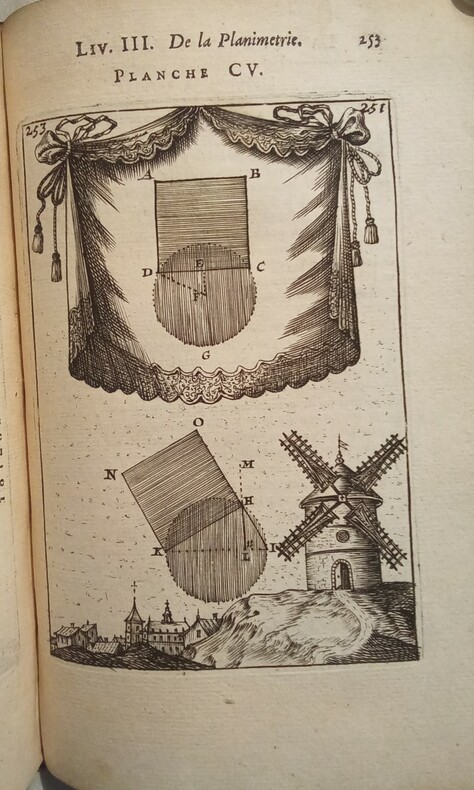
1702WOC-13631.Le Premier, enseigne les Éléments de la Géométrie Pratique, et donne toutes les notions de chaque terme concernant cette science. 2.Le Second explique la Trigonométie, ou la mesure des distances par les Instruments Géométriques, comme sont les Piquets, les Cordeaux, le Demicercle, le Quarré Géométrique, le Compas de Proportion, l'Astrobale, la Boussole, le Baston de Jacob, la Planchette, & aussi par le Sinus & les Logarithmes. 3.Le Troisième montre la Planimétrie, ou la mesure des superficies (ce que le vulgaire appelle l'Arpentage,) avec les Méthodes de transfigurer, d'augmenter, & de diviser toutes sortes de Terres, Bois, &c. 4.Le Quatrième regarde la Stereométrie, ou le Toise de toutes sortes de corps de telle capacité & figure qu'ils puissent eftre. Ouvrage enrichie de cinq cens planches gravées en taille-douce. Paris, Anisson, 1702. 4 volumes in-8 (22,3x3,5x14,5cm) reliure d'époque, plein veau, dos à nerfs ornés, pièces de titres, tranches carimin, petite fente sur la charnière du tome 1er et petit manque sur la coiffe supérieure, et tome 4: petite fente sur la charnière supérieure. (24)-346 (2)pp. + (12)-337pp. + (14)-359pp. + (10)-282pp.
In -8°, pp. (2), 112; mezza pergamena. Prima edizione in volume del trattato di Menelao Alessandrino (I sec. d.C.), considerato il primo trattato di trigonometria sferica che si conosca, e che contiene anche la dimostrazione del teorema ancor oggi noto come Teorema di Menelao. Una edizione precedente dei tre libri compare anche nell’insieme di testi curato da Francesco Maurolico, che tradusse Teodosio, Euclide, Autolico e appunto Menelao in un suo lavoro dedicato agli studi della sfera (Messina, 1558). Nel 1644 Mersenne ripubblica gli “Sphaericorum libri”, sempre in un volume che comprende altri scritti (“Universae geometriae...”, Parigi, Bertier: il volume è citato da Leopardi nella sua “Storia dell’astronomia”), e sulla base del volume precedentemente citato. La presente edizione era stata curata, su fonti non coincidenti con le edizioni rammentate, dal celebre astronomo Edmund Halley per la stampa universitaria oxfordiana, nel 1712. Ma l’edizione del ’12, stampata solo parzialmente, non fu completata se non nel ’58 come postuma, quando fu chiesto a George Costard e James Bradley, entrambi astronomi a Oxford di curare la pubblicazione del lavoro. Mancano, in questa copia, le otto pagine di prefazione di Costard, numerate a parte, mentre il trattato in sé è completo: la copia è perfettamente conforme a quella conservata nella biblioteca bodleiana di Oxford. Una copia, sempre conforme a questa, e qualificata come quella del 1713-14 è stata venduta nel 2005 da Sotheby’s, asta Macclesfield. First edition in a volume of the Menelaus Alexandrinus work, considered the first spheric trigonometry essay ever known, also containing the demonstration of the theorem still known after Menelaus name. An earlier edition of the three books was also published in a collection of texts edited by Francesco Maurolico, who translated Theodosius, Euclides, Autholicus and Menelaus in a work dedicated to sphere studies (Messina, 1558). In 1644 Mersenne republish the “Sphaericorum libri”, always in a volume including more works (“Universae geometriae…”, Paris, Bertier), based on the Maurolico’s work. The Oxford edition was edited, based on different sources than the Maurolico ones, by the famous astronomer Edmund Halley, in 1712. But that edition was never published, and it was only partially printed in 1713-14. Only in 1758 the book was completed by George Costard and James Bradley, both Oxford’s astronomers. In the present copy the eight introduction pages of Costard are missing, while the essay is complete: the copy is identical to the one kept by the Bodleian Library of Oxford. A copy, still similar to this one and qualified as the 1713-14’s one, was sold in 2005, at Sotheby’s, Macclesfield auction.
<p>24 cm, in 4°, rilegatura coeva in piena pergamena, titolo in oro al dorso; p. (8), 505, (1). Dedica del traduttore al cardinale D. Ippolito d'Este e nota dello stampatore. Bel frontespizio architettonico con figure allegoriche e molti capilettera xilografici ornati; 2 tavole ripiegate e molte figure e diagrammi xilografici anche a piena pagina ad opera del Franceschi con raffigurazioni geometriche, architettoniche, ingegneristiche ed astronomiche. In fine Tavola delle lunghezze, larghezze, parti e grandezza delle stelle e indici dell'opera. Frontespizio rifoderato al verso e restauro ai margini delle prime 8 carte. Margini superiore leggermente rifilato, senza perdita di testo. Piccolo ed antico restauro alla base del dorso. Nel complesso buon esemplare. Fowler 413; Riccardi, vol. II, 615; Cicognara, 720. </p>
Opera in 2 volumi di cm 11X16 legati in mezza pelle, sguardie, frontespizio del primo volume, 62 cc. non numerate, bianca, 940 pp., colophon con registro; frontespizio del secondo volume (Euclidis posteriores libri IX. Accessit liber XVI de solidorum regularium...) restaurato da una mancanza dovuta ad antica macchia d'inchiostro che aveva bucato la carta, 925 pp., al verso dell'ultima colophon e registro, una carta d'errata. Importante, preclara edizione dell'opera del Clavio sulla geometria euclidea. Troppo nota l'opera, universalmente conosciuto l'Autore detto "l'Euclide del XVI secolo". Ci si limita quindi ad una descrizione fisica dei volumi. Su carta ancor bianca e frusciante, il testo è inquadrato in doppia cornice; poche e chiare arrossature su alcune pagine, contenute, ininfluenti mende d'uso, margine in alcuni quinterni corto, qualche volta sfiorante la prima delle due cornici. Ma esemplare in belle condizioni, raro, essenziale. Le opere matematiche dei classici sono tutte ricercatissime, e questa presentata ha una caratteristica abbastanza peculiare, il formato in 8° piccolo, quindi una sorte di "tascabile". Eccezionale, completo, collazionato. Importante e raro.
1612953521Moguntiae [Mainz]: Anton Hierat. 1612. Quart, 33 x 20 cm. (Einband gebräunt und fleckig, die beiden Bindebänder erneuert, Titel mit handschriftlichem Besitzvermerk und an den Rändern mit Japanpapier verstärkt, innen teils stark gebräunt und feuchtigkeitsrandig) [16 Warenabbildungen] 6 Blatt, 596 Seiten, 14 Bl., 122 S., 1 weißes Blatt, 59, 20, 23 S. Ganzpergament der Zeit, vollständig restauriert und neu aufgezogen,
In -12°, pergamena, 8 tavv.