4 273 résultats
185942296London Richard Taylor and William Francis 1859. 4to. No wrappers as extracted from "Philosophical Transactions" Vol. 149 - Part I. Pp. 61-90. Clean and fine. <br/><br/><em>First appearance of this pathbreaking paper in which Cayley unites 'Metrical Geometry' and 'Projectice Geometry' by introducing "imaginary" elements to metrical properties."The fundamental notions in metrical geometry are the distance between two points and the angle between two lines. Replacing the concept of distance by another also involving "imaginary" elements Cayley provided the means for unifying Euclideangeometry and the common non-Euclidean gemoetries into one comprehensive theory."Bell in "Men of Mathematics".In non-Euclidean geometry prepared the way for Klein's splendid discovery that the geometry of Euclid and the non-Euclidean geometries of Lobatchewsky and Riemann are all threee merely different aspects of a more general kind of geometry which includes them as special cases.Dealing with the relations between metrical and projective geometry Klein remarks In "Entwicklung der Mathematik" Teil I p. 148: "Vor allem kommt für uns sein Cayley's berühmtes 'A Sixth Memoir upon Quantics" im betrachtt. Quantioc heisst soviwel "Form" d.h. homogenes Polynom von zwei drei oder mehr Variablen wonach man binäre tertiäre usw. Formen unterscheidet." </em> unknown
8279P., Courcier, 1806, un volume in 4 relié en demi-basane, dos orné de filets dorés (reliure de l'époque), 2 feuillets non chiffrés (faux-titre + titre), 111pp., (1pp.), 3 PLANCHES DEPLIANTES
Un volume (15x20,5 cm) di (2)-36 pagine con 14 figure nel testo. In lingua latina. Margini corti in alto. Timbretto di possesso e data di acquisto (30 gennaio 1815) al retro della prima carta bianca. Titolo con marca tipografica di Gorbin: Pandora, donna scoperchia un'anfora da cui escono animali. Motto: Sola remansit intus spes. Legatura moderna in tutta pergamena rigida con titolo manoscritto al dorso. Qualche fioritura, ma conservazione molto buona per questo raro trattato che De Merliers aveva pubblicato in francese nel 1573.
37410P., Bachelier, 1827, un volume in 4 relié en demi-basane, dos orné de fers et filets dorés, étiquette de titre rouge, tranches jaspées (reliure de l'époque), 20pp., 188pp., 28 PLANCHES DEPLIANTES
Formato cm 21x15 La sfera del mondo: pagine (12), 252 De le stelle fisse: pagine 30, 48, 25 - 93, (2). Rilegatura in piena pergamena coeva con titolo manoscritto al dorso. Legatura leggermente allentata. Manca il frontespizio sostituito da una riproduzione in fotocopia. All'interno lievi tracce di tarlatura, macchie, bruniture ed alcune annotazioni di antica mano. Le due opere sono rilegate insieme. Stato di conservazione complessivamente buono. Raccolta di due rare opere di astronomia del Piccolomini, stampate entrambe a Venezia dal Varisco nel 1579, riccamente corredate da figure ed illustrazioni geometrico - astronomiche.
41762Paris Chez Jacques Rollin - Charles-Antoine Jombert, Libraire 1753 in 4 (28,5x22) 2 volumes reliures plein veau fauve de l'époque, dos à nerfs ornés, pièces de titre de maroquin rouge, tranches teintées rouge, coiffes légèrement usées, petite restauration ancienne sur des mors. Tome 1: XXVII et 483 pages, avec 50 planches gravées dépliantes in fine. Tome 2: [1] 495 pages [1], avec 50 planches gravées dépliantes in fine. Alexandre Savérien, 1720-1805. Edition originale. Exemplaire bien complet des 101 planches dépliantes. Bel exemplaire ( Photographies sur demande / We can send pictures of this book on simple request )
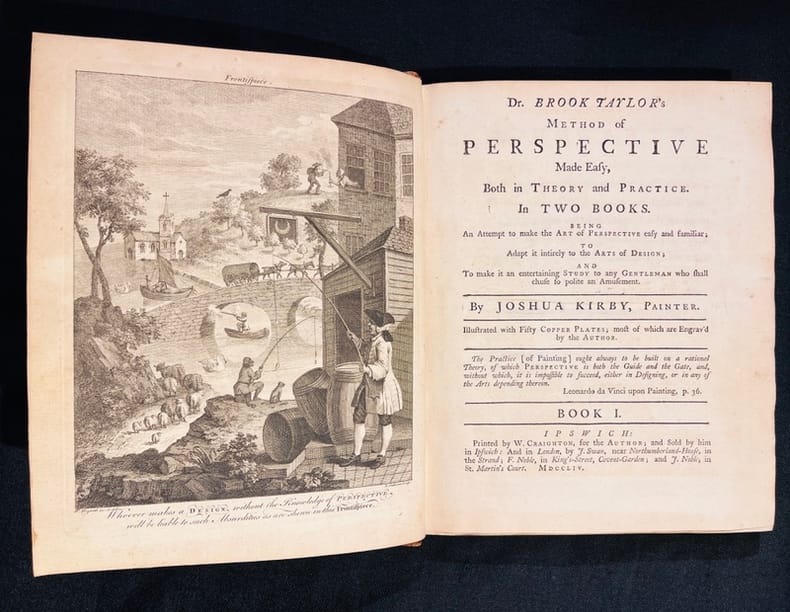
175421201Ipswich, W. Craighton for the author, 1754. In-4 de [4]-IV-XVI-[2]-78-[2]-84 pages, plein veau brun, dos à nerfs orné de filets dorés, pièce de titre en maroquin rouge, double filet d'encadrement doré sur les plats, roulette à froid sur les coupes.[]4; A4-[a4]-errata-B-L4; A-K4; L2.
[Figurato Agrimensura-Matematica] (cm.20,5) ottima piena pergamena molle sec. XVIII, titolo al dorso. -- cc. 6 nn., pp. 551 + 1p. con marca tipografica. Molte illustrazioni n.t. in xilografia di strumenti, schemi, figure ecc. Seconda edizione definitiva più completa della prima del 1603. Molto rara e importante per la vastità di argomenti e notizie. Vedi Riccardi I 478: "Opera interessantissima per la storia dell' aritmetica, ampiamente sviluppata ed applicata anche alla mercatanzia; e per quella della geometria pratica, trovandovisi la descrizione e l' uso degli strumenti allora conosciuti, fra i quali sono notevoli quelli che ora direbbersi celerimensura". Cat. Libri n° 2878-79: "This work is so scarce that it has escaped professor De Morgan. It contains solutions of several indeterminate problems. Amongst the authors quoted by Forestani we find Galigai, Calandri, Lazzisio, Pagani, ecc.". Vecchio restauro al margine del frontis con le prime 5 lettere di (Pratica) ridisegnate. Qualche lieve alone al margine delle prime carte ma esemplare bello nitido e marginoso. * Autori Italiani del '600 1551; * Sotheran Primo Suppl. 1150; * Graesse VIII 309.[f72] Libro
179788<p>RARE FIRST EDITION OF LORENZO MASCHERONI's TREATISE ABOUT THE USE OF THE COMPASS IN GEOMETRY</p><p>UNTRIMMED AND UNCUT COPY IN ORIGINAL PAPER WRAPPER</p><p>Mascheroni Lorenzo. <i>La geometria del compasso di Lorenzo Mascheroni. </i>Pavia : presso gli eredi di Pietro Galeazzi anno V della Repubblica francese 1797.</p><p>8to 223 x 130 mm original printer's wrappers; pp. 2 XVIII 264 14 leaves of folding plates woodcut decoration at title page friezes and headletters. </p><p>The principle of economy in geometric constructions</p><p>First edition of Mascheroni's most important work with a dedication in verse to Napoleon in which he proves that any geometrical construction of Euclidean geometry can be carried out by means of compasses alone admitting that a straight line is constructed once two of its points have been defined thus demonstrating how a certain principle of economics in geometric constructions proclaimed by all the great mathematicians of the past from Pappus to Descartes was regularly and violated by the use of two tools where only one was enough.</p><p>His approach was to first demonstrate how to use the compass alone to bisect a given arc of a circle add and subtract two given segments find the fourth proportional given three segments find the point of intersection of two given lines and the points of intersection between a given line and a circle.</p><p>At this point Mascheroni theoretically demonstrated how all constructions completed with ruler and compass can be considered as a composition of the elementary operations defined above and therefore obtained using only the compass. In the spirit of the Enlightenment this work is not meant to be just theoretical but is also designed to facilitate the construction of precision instruments. </p><p>Although some authors such as the Danish G. Mohr had sought before Mascheroni the solution of certain geometrical problems by using the compass alone he was able to deal with the subject of the geometry of the compass with such depth and in such a general way to make his forerunner forgotten.</p><p>Lorenzo Mascheroni 1750 - 1800 was an Italian mathematician scholar and academic who since 1778 taught physics and mathematics at the Bergamo seminary.</p><p>His most important contributions concern mathematical analysis with studies related to integral calculus and natural logarithms construction science with its original studies on arc-breaking calculus and geometry with the demonstration that solvable problems with row and compasses can also be solved with just the compass.</p><p>His name is also linked to the Euler-Mascheroni constant of which he calculated the first 32 decimal digits. The Euler – Mascheroni constant also called Euler's constant is a mathematical constant recurring in analysis and number theory usually denoted by the lowercase Greek letter gamma γ.</p><p>It is defined as the limiting difference between the harmonic series and the natural logarithm.</p><p>Napoleon whose passion for science and mathematics is known met Mascheroni in 1796 during the invasion northern Italy and was intrigued by his theories ion the use of the compasses becoming they say a great expert. "General we could expect from you everything but geometry lessons": with this sentence the mathematician Laplace and Lagrange welcomed Napoleon's explanations on Mascheroni's constructions whose book just a year after the Italian edition in 1798 was translated into French by Charette.</p><p>Conditions: Light marks of use along the text small warmholes never touching the text in general very good copy printed on strong paper untrimmed and uncut in its original paper wrapper.</p><p>References: RICCARDI P. "Biblioteca Matematica Italiana Milano 1952 vol. 1 134 9.1 "Pregiata e Rara".</p> Pietro Galeazzi paperback
In-4°, in brossura editoriale originale con titolo stampato, e invio autografo dell’autore a Mr le docteur Vacca. pp. 40. Inoltre: Prix Lobatchefsky (3° concorso), pp. (4), con autografo dell’autore”Forse a rivederci caro amico a Heidelberg”. E un opuscolo stampato in russo di geometria (pp. 6); e di Vassilief: Les Idees d’Auguste Comte sur la philosophie des mathematiques, estratto, pp. (16), con legatura in cartoncino azzurro. Vassilief (1855-1929) fu uno dei primi esponenti della scuola matematica russa, e presidente della Società di Fisica e MAtematica di Kazan. matematica mathematics fisica physics geometria scienza science russia vacca autografo russo
In 12° (15,4x9,6 cm); (24), 480 pp. e una c. di tav. più volte ripiegata (nella maggior parte degli esemplari, la grande tavola contenete i due “Quarré Naturele” e i due “Quarré Magique”, si trova ritagliata in quattro parti). Bella legatura coeva in piena pergamena con titolo, autore e stemma nobiliare araldico, abilmente chiosati al dorso. Tagli spruzzati in rosso. Esemplare in ottime condizioni di conservazione. Terza rara edizione (più rara sia della prima che della seconda ed altrettanto ricercata) di questo importante studio, del grande matematico, teologo e filosofo giansenista, acerrimo nemico dei gesuiti, Antoine Arnauld, soprannominato dai contemporanei “Le Grand Arnauld”, per distinguerlo da suo padre (Parigi, 5 febbraio 1612 – Bruxelles, 8 agosto 1694). Nel 1656 venne espulso dalla Sorbona per le questioni espresse nei suoi scritti “Lettre à une personne de condition” e nella “Lettre à un duc et pair” editi nel 1655. Questi scritti fornirono a Blasile Pascal, suo grande amico, materiali per le sue “Lettres provinciales”. Arnauld fino al 1668, quando si addivenne alla "pace della Chiesa", diresse la cosiddetta, resistenza di Port-Royal. Fra i primi ad adottare la filosofia di Cartesio, seppur con qualche riserva legata alle sue profonde credenze religiose, fu impegnato in diverse celebri dispute filosofiche. Da ricordare quella con Malebranche sui rapporti fra teologia e metafisica che si protrasse dal 1683 al 1685. Insieme a Pierre Nicole, fu autore di “La Logique ou l'art de penser” uno dei testi basi della Logica fino agli inizi del XX° secolo, conosciuta anche come “Port-Royale Logic”. Considerato uno dei più grandi matematici del suo tempo, la sua fama in questa materia, scemò nei secoli successivi a favore dei suoi scritti di logica e filosofici, per essere poi recuperato come matematico di primissimo piano, nel XX° secolo. “The Elements undertakes a reworking and reordering of the Euclidean theorems in the light of the contemporary literature and Pascal's influence. It bases its claim to originality and influence on the new order in which the theorems, many of them adapted from contemporary sources, are arranged. As mathematics, it is characterized by the mastery of the contemporary literature and by its clear and fresh exposition... It is interesting to compare Arnauld's order of theorems with such recent ones as that of Hilbert and Forder, whose aims are quite different...”. (DSB I p. 292). L’opera qui presentata è conosciuta anche come la “Geometrie de Port-Royale”. Le illustrazioni poste alla fine che vedono presenti 4 tavole con quadrati magici, sono usate per spiegare il trattato di Pascal, pubblicato alla fine dell’opera e spiegre la soluzione di uno dei problemi più famosi e più difficili dell'aritmetica, comunemente chiamato “les quarrez magiques”. Fermat e Pascal furono i primi matematici a interessarsi al problema dei quadrati magici. Pascal descrisse i risultati dei suoi studi all'amico Arnauld che li pubblicò in quest’opera. La geometrie di Arnauld è il frutto del lavoro in comune con l’amico Pascal, tanto che l’opera qui presentata, viene, comunemente, attribuita anche a Pascal. Nella lunga prefazione di Pierre Nicole si parla di Pascal senza nominarlo, come una delle grandi menti di questo secolo e di uno dei più geniali matematici per la sua apertura mentale. Nicole spiega come Arnauld sia partito da un piccolo saggio in cui Pascal, si era accontentato di sostituire le classiche dimostrazioni di alcuni problemi matematici di Euclide, sostituendole con dimostrazioni più acute e naturali. Come ci racconta Nicole, Arnould letto lo scritto dell’amico Pascal decise di presentare seguendo lo stesso spirito dell’amico ma con più metodo, tutto il corpo del pensiero pascaliano. J. Itard, nel suo famoso articolo dedicato alla “La Géométrie de Port-Royal”, nella rivista “L'enseignement mathématique” del marzo 1940, esaminando in dettaglio il contenuto del libro di Arnould, osserva che l'insegnamento della geometria in Francia, fu permanentemente influenzato, almeno fino a Legendre, dalle opinioni e dimostrazioni matematiche espresse da Arnould in questo libro. Rarissima terza edizione in buone-ottime condizioni di conservazione. Rif. Bibl.: Bibliotheae Casanatensis catalogus librorum, Tomus Primus, Romae, Salvioni, 1761, pag. 277; Klaas Hoogendoorn, Bibliography of the Exact Sciences in the Low Countries ca. 1470 to the Golden Age (1700), Brill, London, pag. 50 “First edition: Paris 1667; Second Edition: Paris 1683. So this is the third edition. There is a reissue of 1711”; ICCU IT\ICCU\BVEE\023016.
In-4°; pp. 12, 397, antiporta incisa su rame, nel testo numerose figure geometriche incise su legno, finalini.Riccardi I, 391 1. Legatura in piena pergamena con titolo manoscritto al dorso.
In -12°; (4), 168 pp.; pergamena coeva con nervi e tassello con titolo al dorso, 12 tavv. ripiegate, molte illustrazioni nel testo. E’ la ristampa dell’edizione euclidea di Mercatore che nel 1666 era stata pubblicata in forma anonima. It’s a re-print of the euclidean edition of Mercatore, published as anonymous in 1666.
21420P., Imprimerie Royale, 1727, un volume grand in 4 (26 cm x 19,5 cm) relié en plein veau marbré, dos orné de fers dorés, tranches rouges (reliure de l'époque), (13), 548pp., 1 PLANCHE DEPLIANTE
17801438Paris, Chez le Citoyen Jean, s.d. (ca 1780). In-folio - 26,5 x 40 cm. Cartonnage moderne plein papier à dos carré, pièce de titre de cuir marron sur le dos. 8 pp. ; 62 pl ; 14 pl. Exemplaire bien complet de ses 76 (62 +14) planches gravées et de son titre frontispice. Ouvrage très rare.
[700 Fig. Architettura] (cm. 32) Buona piena pergamena del XIX secolo, tagli marmorizzati. - Antiporta figurata, ritratto di Clemente XIV, Frontis + cc. 4 nn. + 4 tavv. f.t., + pp. 58 + 41 tavv. f.t. + pp. XXVIII con 10 tavv. f.t. (la prima posposta) Grande incisione al frontis e altre 2 a pag. 18 e 20. Tutte di ottima fattura e finemente incise in rame, l'antiporta e il ritratto sono firmati da Carlo Antonini. Le tavole illustrano esempi di prospettiva, ordini architettonici, capitelli, frontoni e addirittura caminetti alla maniera del Piranesi. Il testo contiene un saggio di geometria che sarà poi ristampato nelle edizioni successive, inoltre una vita del Vignola, un testo di prospettiva e un glossario dei termini architettonici. Comolli scrisse su questa edizione: "Gli amatori possono senza dubbio considerare questo libro come un ottimo corso elementare architettonico". Il successo di qiesto trattato si deve anche ai due curatori; l'Antonini come incisore e lo Stampani, architetto neoclassico, che lavorò molto in Russia e Polonia. Antiporta ritrattio e le prime 18 tavole sono state rimontate curiosamente su bella carta antica. Qualche lieve macchietta ad alcune tavole altrimenti esemplare bello e fresco, ben completo delle sue 57 tavole complessive. * Comolli IV 109; * Spinelli 36; * Fowler 380; * Berlin - Katalog 2639; * Riccardi I 88 (1/11); * Graesse VII 314; * Brunet V 1219. [F.81] Libro
ORD-1179Précédé d'un Traité de Cosmographie où est expliqué avec ordre tout ce qu'il y a de plus curieux dans la description de l'Univers, suivant les Mémoires & Obsrevations des plus habiles Astronomes & Géographes. Accompagné des figures nécessaires. Sixième édition, revue & corrigée. Paris. Guérin et Nyon. 1751. In-8 (145 x 222mm) pleine basane de l'époque, dos à 5 nerfs orné or, gardes peignées, tranches marbrés, 4ff.n.ch., 382 pages (il a été rajouté 2 pages 143 et 114 bis), bien complet des 49 planches hors texte, souvent rempliées, bandeau gravé en tête de la dédicace. Reliure très usagée, mors fendus aux extrémités, coiffes arasées, coins émoussés, mais reliure encore solide, bon état intérieur.
8044P., Bachelier, 1822, un volume in 4, broché, couverture muette bleue de l'époque (dos habilement restauré), 46pp., 426pp., (1), 12 PLANCHES DEPLIANTES
1669113<p>Renowned italian treatise on mathematic and Practical geometry</p><p>the use of the "Squadro Geometrico" Set Square </p><p>the multiplication "<em>per crocetta</em>" and the first mention of the <em>surveyor's cross</em></p><p> Feliciano Francesco<strong>.</strong> <em>Scala Grimaldelli libro di aritmetica e geometria speculatiua e pratticale di M. Francesco Feliciano Veronese. Diuiso in tre libri. Nel primo si tratta di cose pertinenti a Mercatanti . Nel secondo si tratta dell'arte maggiore di algebra .accresciuto in quest'vltima impressione di dottissimi problemi . Nel terzo & vltimo si dimostra il misurar della Terra . i nuovo ristampato e da molti errori corretto e accresciuto di molte cose da M. Filippo Macario Veronese . </em>Venetia : presso Gio. Giacomo Hertz 1669.</p><p>4to 188 x 120 mm contemporary paper board handwrtten titles at front board in sepia ink pp. 8 240 printer device with <em>Galleon</em> at title page xylographic head-letters head-pieces and end-pieces.</p><p> Last printed edition of this milestone in the history of mathematic </p><p>The <em>Scala Grmaldelli</em> is a work of outstanding importance in the history of mathematics and more than any other work influenced the teaching of this science in the sixteenth century.</p><p>The book deals with commercial arithmetic treatment of roots the rule of false position algebra and a section on practical geometry. </p><p>At leaf d2 <em>recto</em> Feliciano illustrates the method of multiplication "<em>Per Crocetta</em>" one of several methods that were in use in the Italian Renaissance.</p><p>It is noteworthy in the part dealing with practical geometry the constant use of the "Squadro Geometrico" geometric square which appears to have been practiced in Italy since the XV century.</p><p>The <em>Scala Grimaldelli</em> when first published was the first book describing the use of the <em>Surveyor's Cross</em> a simple instrument made of two bars forming a right-angled cross with sights at each end and used in setting out right angles in surveying an innovative tool at a time when long distances were often merely estimated by sight.</p><p>The book was so important in the teaching of elementary mathematics that he was reprintd in numerous editions including this last one in 1669 143 years after the original edition.</p><p>"Few books had greater influence on the subsequent teaching of elementary mathematics" Smith. </p><p>The symbology expressed in the title is fascinating: just as you need a ladder to attack a fortress and a lockpick to open a lock in the same way to approach complex mathematics you need this book.<!--endif--></p><p>Francesco Feliciano was a mathematician of Lazesio Veronese who lived in the second half of the century. XV and in the first quarter of the XVI. </p><p>He published in 1517 <em>Libro di abbaco</em> printed in several editions but he is best known for the book of arithmetic and speculative and practical geometry described here: <em>Scala Grimaldelli </em>1526 whose subsequent editions reached the end of the XVII century.</p><p> This important treatise disseminated outside Italy the ideas the notions and the methods in the field of arithmetic geometry algebra and their applications that were first exposed by Leonardo Pisano and then cultivated in italian schools.</p><p> Conditions: this book was meant to be heavily used so it's rare find a copy in good condition as despite few marls of use this copy in its original binding can be defined. </p><p> Provenance: I. Faded handwriten ownership signature at title page II. Contemporary handwrtten annotations and calculations on margins.</p><p> Reference: Honeyman IV 1288; Michel-Michel III-29; Riccardi II-22.</p> Giacomo Hertz
1665SC047Antwerpiae, I. Meursium, 1665. In-12o, XXIV+350+INDEX 9 p. et 6 planches hors-texte. Initiales, culs-de-lampe et dessins in-texte xylographies. Ex-libris imprime et manuscrit. Rel. XIXe pleine veau, dos a nerfs. Page de titre noircie, exemplaire propre. IIe edition, la premiere a 1654.
In -12°, 20 cc. 414 pp. (ma 388, la numerazione è sbagliata), 6 cc., 8 tavv. ripiegate, qualche foro di tarlo. Pergamena, con titolo ms al dorso. Terza edizione (la prima è del 1658, a Pisa), comprende gli “Elementa conica” di Apollonio: è anche l’ultima realizzata con Borelli ancora vivo. Third edition (the first is from 1658, in Pisa), it includes the “Elementa conica” of Apollonio. It’s also the last one printed with Borelli still alive.
2 volumes [6]-510 pages + [4]-428 pages, 32 planches demi chagrin havane, dos à nerfs 1876, 1876, in-8, 2 volumes [6]-510 pages + [4]-428 pages, 32 planches, demi chagrin havane, dos à nerfs, Rare édition des Oeuvres complètes du célèbre géomètre du XVIIe siècle Desargues procurée par l'historien et spécialiste de l'histoire des mathématiques, Noël Germinal Poudra (1794-1894). Relié in fine : POUDRA et HOSSARD, Question de probabilité résolue par la géométrie. Paris, J. Corréard, 1859. [4]-23 pages, une planche Exemplaire provenant de la bibliothèque de la Faculté catholique de Paris, avec cachet annulé ; et étiquette de la librairie de Henri Vieillard, dont sa veuve, Mme Vieillard, fit don à l'Institut Catholique en 1902. Légères épidermures au dos
In-8°; pp. 796, mancano le ultime due carte, legatura in mezza pelle con tassello al dorso, più tarda. Con molti legni e diagrammi nel testo. Seconda edizione, la prima del 1538, le Lucubrationes dell’umanista fiammingo rappresentano un’opera “enciclopedica” nel senso che raccolgono trattati nei diversi campi del sapere, di particolare interesse la sezione scientifica dedicata all’ottica, alla prospettiva, astronomia, geometria e matematica, anche per le molte illustrazioni. Sembra le la parola “enciclopedi” si trovi per la prima volta proprio sul frontespizio di quest’opera, sotto la forma di kiklopedia.
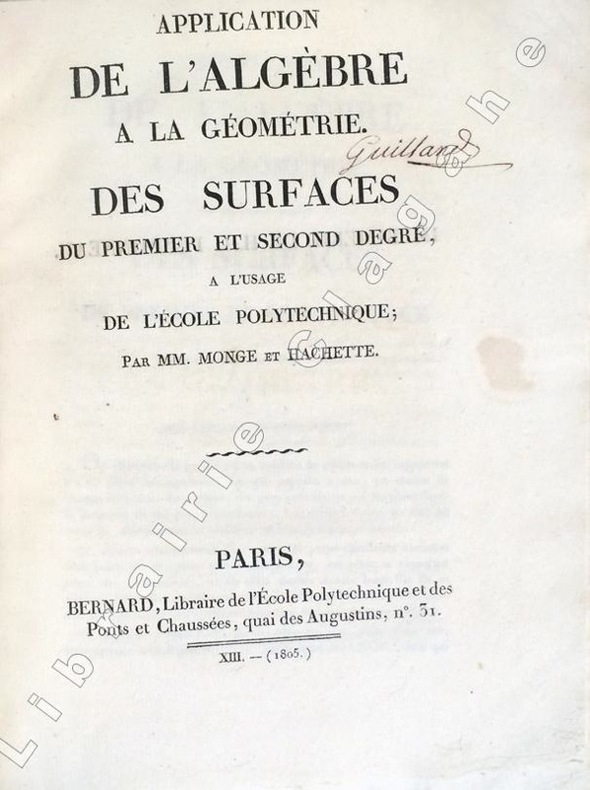
180517590Paris, Bernard (imprimerie de H.L. Perronneau), XIII-(1805) ; in-4, demi-basane marbré, dos lisse, titre en long (reliure moderne) ; (4), 56 pp., 1 planche hors texte gravée par Aubertin d'après L.J. Girard.
168815606Paris, Etienne Michallet (Imprimerie Estienne Chardon), 1688 ; in-8 ; plein veau havane marbré, dos à nerfs décoré et doré, titre doré, roulette dorée sur les coupes, tranches mouchetées de rouge (reliure de l'époque) ; 138 pp., (1) f. blanc, nombreuses figures dans le texte et 2 planches hors-texte gravées "Figure du Compas de proportion faite par Chapotot".