"EINSTEIN, ALBERT.Livre Rare Book
2 944 résultats
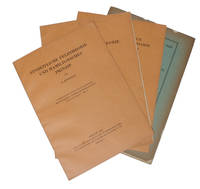
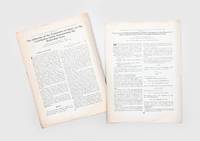
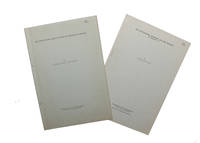
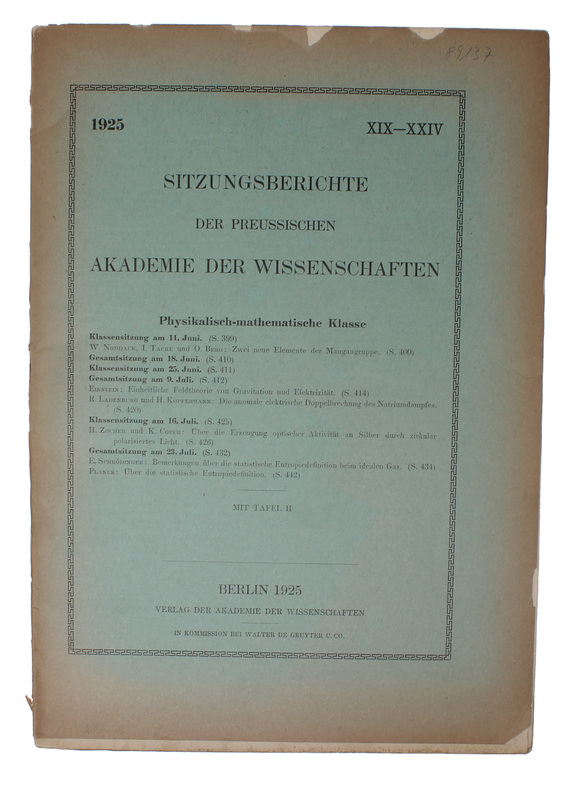
192559960Berlin, Königlich Akademie der Wissenschaften, 1925-1929. 1. Einheitliche Feldtheorie von Gravitation und Elektrizität., 1925, pp. 414-419. Uncut, unopened n the original printed wrappers. missing small parts of spine and upper part of front wrapper detached, otherwise fine. (Weil 147 / Boni 155).2. Neue Möglichkeit für eine einheitliche Feldtheorie von Gravitation und Elektrizität. Offprint: S. B. preuss. Akad. Wiss., 1928, pp.235-245. In the original yellow wrappers. Very fine and clean. (Weil 162/ Boni 175).3. Zur einheitlichen Feldtheorie. Offprint: S. B. preuss. Akad. Wiss., 1929, pp.2-7. In the original yellow wrappers. Very fine and clean. (Weil 165/ Boni 183).4. Einheitliche Feldtheorie und Hamiltonsches Prinzip. Offprint: S. B. preuss. Akad. Wiss., 1929, pp.156-159. In the original yellow wrappers. Very fine and clean. (Weil 166/ Boni 184).
192559960Berlin Königlich Akademie der Wissenschaften 1925-1929. 1. Einheitliche Feldtheorie von Gravitation und Elektrizität. 1925 pp. 414-419. Uncut unopened n the original printed wrappers. missing small parts of spine and upper part of front wrapper detached otherwise fine. Weil 147 / Boni 155.2. Neue Möglichkeit für eine einheitliche Feldtheorie von Gravitation und Elektrizität. Offprint: S. B. preuss. Akad. Wiss. 1928 pp.235-245. In the original yellow wrappers. Very fine and clean. Weil 162/ Boni 175.3. Zur einheitlichen Feldtheorie. Offprint: S. B. preuss. Akad. Wiss. 1929 pp.2-7. In the original yellow wrappers. Very fine and clean. Weil 165/ Boni 183.4. Einheitliche Feldtheorie und Hamiltonsches Prinzip. Offprint: S. B. preuss. Akad. Wiss. 1929 pp.156-159. In the original yellow wrappers. Very fine and clean. Weil 166/ Boni 184. <br/><br/><em>Fine collection three in offprint and one in the original printed wrappers of the four papers that together constitute Einstein's attempt towards creating a unified field theory: "a new theory of space with a view to unification of all forms of activity that fall within the sphere of physics giving them a common explanation" PMM416. The task of unifying nuclear electromagnetic and gravitational force is nowadays by many considered the holy grail of theoretical physics.Maxwell was the first to develop such a theory when he described the forces of electricity and magnetism as the single force electromagnetism. After Einstein had completed his general theory of relativity a field theory for gravitation he turned his attention towards generalizing his theory even further to include Maxwell's theory. Even though Einstein never succeeded in completing this task in the way that he finished his earlier theories he pioneered and explored many areas of this subject."It had been repeatedly observed that Einstein's general theory of relativity necessitated a pluralistic explanation of the universe. In 1925 he announced that he had resolved this difficulty but the announcement was premature. In 1928 he attacked the problem once more only to find that Riemann's conception of space on which the general theory was based would not permit of a common explanation of electromagnetic and gravitational phenomena. In a series of papers the present devoted to the development of 'A Uniform Theory of Gravitation and Electricity' he outlined a new theory of space with a view to unification of all forms of activity that fall within the sphere of physics giving them a common explanation. All that would then remain to complete a scientific unison is the correlation of the organic and inorganic".PMM 416Barchas 586Weil 147 162 165 & 166. </em> unknown
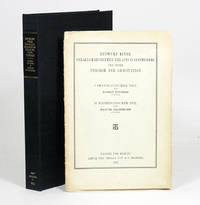
191662767Leipzig, Verlag von Johann Ambrosius Barth (Druck von Metzger & Wittig in Leipzig), 1916. Gr.-8°. 64 S., OKart.
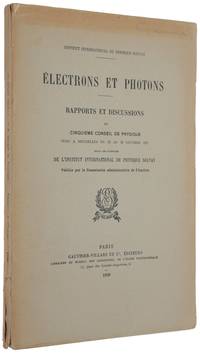
19286594Paris: Gauthier Villars 1928. First edition. <p>First edition rare in the original printed wrappers of the proceedings of the Fifth Solvay Congress 1927-the most celebrated of the Solvay conferences and the setting in which the Bohr-Einstein debate over the consistency and completeness of quantum mechanics first took public programmatic form. Convened under the banner "Electrons and Photons" the meeting brought together nearly all the principal architects of the old and the new quantum theory; seventeen of the twenty-nine participants were or became Nobel Prize laureates.</p>. The Bohr-Einstein Debate Begins. <p>First edition rare in the original printed wrappers of the proceedings of the fifth Solvay Congress where the debate between Bohr and Einstein on the consistency and completeness of quantum mechanics began. It was at this the most famous of the Solvay conferences that Einstein disenchanted with Heisenberg's uncertainly principle made his famous remark that "God does not play dice" to which Niels Bohr replied "Einstein stop telling God what to do!" Seventeen of the twenty-nine attendees which included nearly all the principal architects of the old and the new quantum theory were or became Nobel Prize winners. "The three and a half years since the fourth Solvay Conference . were marked by enormous progress in quantum physics. Partly based on discoveries and ideas that had been available already before 1924 − such as the Compton effect and matter waves − the new atomic theory had arisen which did more than throw new light on the difficulties discussed at the 1924 conference: quantum or wave mechanics went right to the heart of the problems posed by atomic phenomena. The two subjects put programmatically into the title of the fifth Solvay Conference − electrons and photons − designated the crucial points of interest because 'electrons' also stood for the smallest massive constituents of matter and they now became associated with waves and 'photons' a name given only recently in October 1926 by the physical chemist Gilbert N. Lewis to Einstein's light-quanta characterized the quantum-theoretical aspect of electromagnetic radiation. It was the declared intention of the Scientific Committee of the Institut International dePhysique Solvay to contribute by scientific reports and discussions about them to the clarification of the scientific concepts in the physics of the day. In retrospect one may indeed attribute an important success to the 1927 Solvay Conference in marking the completion of the ideas that had first been discussed in the international physics community sixteen years previously at the first Solvay Conference of 1911" Mehra & Rechenberg pp. 233-4. Following a 'Notice nécrologique' by Lorentz the present volume contains the following reports and discussions about them by the participants all articles in French: 'The Intensity of the Reflection of X-rays' by Bragg; 'Disagreement between Experience and the Electromagnetic Theory of Radiation' by Compton; 'The New Dynamics of Quanta' by de Broglie;<br /> 'The Mechanics of Quanta' by Born and Heisenberg; 'The Mechanics of Waves' by Schrödinger;<br /> 'The Quantum Postulate and the New Development of Atomic Theory' by Bohr. No copies located in auction records.</p> <br /> <p>In 1911 the Belgian industrialist Ernest Solvay invited a group of the world's most prominent physicists including Einstein Planck Lorentz Sommerfeld Rutherford and Marie Curie to participate in a scientific conference on the difficulties of reconciling classical physics with quantum theory. The conference "set the style for a new type of scientific meetings in which a select group of the most well informed experts in a given field would meet to discuss the problems at its frontiers and would seek to define the steps for their solution" Mehra Solvay Conferences p. xv. The first Solvay Conference-widely considered a turning point in the history of modern physics-was so successful that in the following year Solvay established a foundation now known as the International Solvay Institutes for Physics and Chemistry "to encourage the researches which would extend and deepen the knowledge of natural phenomena" ibid. and to sponsor further conferences. The next two Solvay Conferences met in 1913 and 1921; subsequent conferences have been held every three years except during wartime.</p> <br /> <p>"From amongst the members of the Scientific Committee of the 1927 Congress two had already played a leading role in 1911: the Chairman Hendrik Lorentz and Albert Einstein; the latter had presented then the most revolutionary report on the light quantum. In spring 1926 in the early stage of preparing for the new conference Lorentz again requested Einstein to write a report. The latter answered promptly: 'If you wish that I take over the report on quantum statistics I shall do so with pleasure; because without being in great difficulty I shall never say "no" to you' Einstein to Lorentz 1 May 1926 . On 17 June 1927 Einstein wrote to Lorentz: 'I recall having committed myself to you to give a report on quantum statistics at the Solvay Conference. After much reflection back and forth I came to the conclusion that I am not competent for giving such a report in a way which really corresponds to the state of the thing. The reason is that I have not been able to participate as intensively in the modern development of quantum theory as would be necessary for that purpose. This is in part because I have on the whole too little receptive talent for fully following the stormy developments in part also because I do not approve of the purely statistical way of thinking on which the new theory is founded .' As a substitute speaker for the topic assigned to him he proposed either Enrico Fermi from Italy or Paul Langevin from France. Ultimately however neither of them gave the report on Einstein's subject. Instead Niels Bohr agreed to contribute a report on a different topic: namely on his latest considerations on the problem of the interpretation of quantum mechanics.</p> <br /> <p>"The rapporteurs at the fifth Solvay Conference fell into three groups: the experimentalists Bragg and Compton; the theoreticians advocating the Gottingen-Cambridge-Copenhagen versions of quantum mechanics − Bohr Born and Heisenberg; and those of the wave-mechanical camp − de Broglie and Schrodinger.</p> <br /> <p>"The selection of Arthur Holly Compton seemed to be most appropriate because the Compton effect − discovered in late 1922 − had been one of the crucial results triggering the entire development which ended with the new atomic theory by providing Einstein's light-quantum hypothesis of 1905 a firm experimental foundation. Since its discovery and even more so after the refutation of the Bohr-Kramers-Slater theory of radiation . Einstein's fundamental light-quantum conception . became a physical reality. Compton's report dwelt on the conceptual consequences rather than on experimental details. In particular he addressed the questions of the aether and of electromagnetic waves on the one hand and the phenomena contradicting the classical wave concepts such as the photoelectric effect X-ray diffraction certain electron-recoil effects observed by C. T. R. Wilson and W. Bothe in 1923 and the individual interaction between radiation-quanta and electrons i.e. the Compton effect. Compton showed also in some detail how the Bohr-Kramers-Slater theory failed to account for these observations.</p> <br /> <p>"The report of William Lawrence Bragg a regular participant in the Solvay Conferences since 1913 appeared to address on first inspection less central points. However from his presentation of the material on reflection of X-rays one easily recognizes the strategy of the Scientific Committee of the Conference: Bragg had to take over the task of stressing those radiation phenomena that could be described by the wave theory namely the diffraction of X-rays by crystal lattices. Consequently he gave the story from Laue's discovery in 1912 over the subsequent work of his father William Henry Bragg and himself to the later investigations of Paul Ewald William Duane and others. Bragg demonstrated in detail how the old and the new wave theories worked to describe the phenomena of diffraction and refraction of X-rays. In the discussion of Bragg's report Hendrik Kramers presented at some length the recent development of the dispersion theory by himself and Ralph Kronig.</p> <br /> <p>"Both experimental reports served as a firm basis for the discussion of the theoretical concepts which provided the central theme of the conference. This significance was shown by the discussions immediately following them. Compton's talk especially gave rise to a lively exchange of ideas and arguments in which besides the experimentalists e.g. Bragg Madame Curie O. W. Richardson and C. T. R. Wilson almost all of the theoretical experts present participated i.e. Bohr Born Debye Dirac Ehrenfest Lorentz Pauli and Schrödinger − with one important exception: according to the published proceedings of the fifth Solvay Conference offered here Einstein remained silent after the presentations of Compton and Bragg .</p> <br /> <p>"The presentation of the theoretical reports at the Solvay Conference proceeded by following the historical order in which the ideas had been published between 1923 and 1926: thus de Broglie's talk came first then Born and Heisenberg's followed by Schrödinger's and finally Bohr's .</p> <br /> <p>"In the course of the year 1927 the Copenhagen physicists Heisenberg among them clarified their ideas on the interpretation of atomic phenomena. Although they admitted the existence and persistence of statistical relations in quantum mechanics they searched for − and succeeded in − formulating principles that in their opinion at least provided the deeper reason for these statistical features: the uncertainty relations and the complementarity principle. In spite of this difference in attitude toward what they regarded as truly fundamental and actually derived Heisenberg felt no difficulty in preparing a joint Solvay report together with his former teacher Max Born. Their report provided a view of the work performed in Göttingen and Cambridge in establishing quantum mechanics with chapters on matrix mechanics and its transformation into wave mechanics I the physical interpretation of the theory II and the uncertainty principle III. The balance in representing the main interests of the two authors was achieved insofar as Section II dealt with Born's statistical interpretation and Section III with Heisenberg's limitation on measurements in quantum mechanics. Moreover the Born-Heisenberg report also signaled the agreement reached by Heisenberg and Niels Bohr during the summer of 1927 .</p> <br /> <p>"Louis de Broglie entitled his report 'The new dynamics of quanta'; he covered the story from his first ideas on matter waves in 1923-24 to the advent of Schrödinger's equation in 1926 and on to the new pilot-wave theory in 1927. He further applied the pilot-wave theory to the problem of the hydrogen atom and claimed that the treatment yielded an easier understanding of the actual situation; finally he spoke about the experimental verification of matter waves obtained recently in the experiments of Clinton Joseph Davisson and Lester Halbert Germer and George Paget Thomson and Alexander Reid . Erwin Schrödinger on the other hand concentrated on the mathematical aspects of his wave-mechanical scheme the time-independent as well as the time-dependent equations the formal equivalence of wave mechanics to the Born-Heisenberg-Jordan matrix scheme and the relativistic wave equation. At the end of the conference Niels Bohr presented a modified version of his Como lecture under the title 'The Quantum Postulate and the New Development of Atomic Theory' .</p> <br /> <p>"Although the Born-Heisenberg and Schrödinger reports provoked only technical questions that of de Broglie and especially the one of Bohr stimulated some conceptual discussion. Thus Lorentz asked de Broglie how the old Sommerfeld quantum conditions could be obtained from the new matter-wave ideas and Pauli provided an appropriate calculation using the conservation law for the relativistic electric current; also Leon Brillouin illustrated some 'optical' applications of matter waves. Finally Bohr's report at the end provided the proper start for a very excited 'General Discussion of the New Ideas Put Forward.'</p> <br /> <p>"Upon an opening reflection of Hendrik Lorentz − who expressed some reservation with respect to the new pictures of electrons in quantum and wave-mechanics − and a technical illustration of Max Born for dealing with many-electron systems in the probability scheme Einstein addressed an elementary problem in the physical interpretation of the theory. He suggested in particular to consider an electron passing through a slit in a screen and to discuss the diffraction phenomena obtained. He claimed that 'with respect to quantum mechanics one can take two standpoints regarding its validity' namely:</p> <br /> <p>Interpretation I: The de Broglie-Schrodinger waves do not correspond to a single electron but to an electron cloud extended in space. The theory does not give then any information about an ensemble of an infinity of elementary processes.</p> <br /> <p>Interpretation II: The theory claims to be a complete theory of individual processes. Each particle which moves towards the screen as far as one can determine from its position and velocity is described by a de Broglie-Schrödinger wave packet of small length and small aperture. This wave packet is diffracted and after diffraction arrives partly at the film where it is registered in a resolved state Einstein in the present work pp. 254-5.</p> <br /> <p>"Evidently Interpretation II went beyond I and even included the latter; it also implied that the conservation laws especially for momentum were valid for individual atomic processes thus explaining the Bothe-Geiger experiment as well as other experiments. Still Einstein also objected to this interpretation because: 'If Ψ2 where Ψ is the wave function were simply considered as the probability for a particle to be at a place at the definite instant it might happen that one and the same elementary process would cause an action at two or more places on the screen' which would imply an action-at-a-distance hence a violation of the relativity postulate. The only way out of this difficulty had to be sought with de Broglie in further attempts to localize the microscopic particle. Einstein claimed further that the multidimensional phase space assumed for many-particle systems in quantum or wave mechanics and the corresponding permutation properties contradicted the new statistical results.</p> <br /> <p>"Although Lorentz tried to illuminate the statistical argument further Wolfgang Pauli contradicted Einstein by referring to the recent work of Paul Dirac Pascual Jordan and Oskar Klein on field quantization. He also refuted another argument of Einstein's that the range of forces in quantum mechanics might create problems by pointing to the work of Walter Heitler and Fritz London on molecular binding. Dirac at first supported Pauli's plea; then he stated his 'opinion about determinism and the significance of numbers which occur in the calculus of quantum theory' notably: 'In the classical theory one starts from certain numbers which completely specify the initial state of the system and one deduces certain numbers which specify the final state. This determination applies only to an isolated system' Dirac in the present work p. 261.</p> <br /> <p>"Now according to Bohr isolated systems are by definition unobservable because any observation must disturb the system; as a result already 'the classical deterministic theory cannot be defended.' Furthermore: 'In the quantum theory one starts from certain numbers from which one deduces certain other numbers . The perturbations which an observer inflicts on a system in order to observe it are directly subject to his control and are acts of his free will. It is exclusively the numbers which describe these acts of free choice that can be taken as initial numbers for a calculation in the quantum theory. Other numbers specifying the initial state of the system are fundamentally unobservable and do not appear in the quantum-theoretical treatment' Dirac loc. cit. .</p> <br /> <p>"After Dirac had illustrated his interpretation of the quantum-mechanical process and its observation in the case of a sample collision experiment Heisenberg remarked that he did 'not agree' with Dirac saying 'that in the experiment described nature makes a choice' because: 'Even if you place yourself very far from your scattering material and if you measure after a very long time you can obtain interference by taking two mirrors. If nature were to make a choice it would be difficult to imagine how the interference can be produced. Evidently we can say that nature's choice can never be known until the decisive experiment has been done; for this reason we cannot make any real objection to this choice because the expression "nature makes a choice" does not have any physical consequences. I would say as I have done in my latest paper that the observer himself makes the choice because it is not until the moment when the observation is made that the "choice" becomes a physical reality and that the phase relation in the waves i.e. the ability to interfere is destroyed' Heisenberg in the present work pp. 264-5 .</p> <br /> <p>"The differences in interpretation among the main pioneers of quantum mechanics that showed in this exchange notably between Bohr and Heisenberg and Dirac would become more pronounced in the future .</p> <br /> <p>"In the recollections of some participants of the fifth Solvay Conference the exchange between Bohr and Einstein on fundamental questions concerning the interpretation of quantum mechanics stands out vividly. Thus Bohr after more than twenty years wrote a detailed account of his 'Discussions with Einstein on Epistemological Problems in Atomic Theory' where he introduced the important part dealing with the 1927 exchange by saying: 'At the general discussions in Como we all missed the presence of Einstein but soon after in October 1927 I had the opportunity to meet him in Brussels at the Fifth Physical Conference of the Solvay Institute . At the Solvay meetings Einstein had from their beginning been a most prominent figure and several of us came to the Conference with great anticipations to learn his reaction to the latest stage of the development which to our view went far in clarifying the problems which he had himself from the outset elicited so ingeniously. During the discussions where the whole subject was reviewed by contributions from many sides Einstein expressed however a deep concern over the extent to which causal account in space and time was abandoned in quantum mechanics.'</p> <br /> <p>"The official discussions referred to above throw light on some of the exchanges on the questions that did interest Einstein although Bohr's participation in them does not seem to have been so active. For example no answer from Bohr to Einstein's analysis of the electron's passage through a slit or screen was recorded. Bohr just made some notes which are to be found in his files and as Louis de Broglie recalled: 'Also Einstein said hardly anything beyond presenting a very simple objection to the probability interpretation. Then he fell silent'. However Heisenberg took away quite a different impression from the conference and decades later he wrote enthusiastically: 'The discussions were soon focused upon a duel between Einstein and Bohr on the question as to what extent atomic theory in its present form could be considered to be the final solution of the difficulties which had been discussed for several decades. We generally met already at breakfast in the hotel and Einstein began to describe an ideal Gedanken experiment in which he thought the inner contradictions of the Copenhagen interpretation were especially clearly visible. Einstein Bohr and I walked together from the hotel to the conference building and I listened to the lively discussion between those two people whose philosophical attitudes were so different and from time to time I added a remark on the structure of the mathematical formalism. During the meeting and particularly in the pauses we younger people mostly Pauli and I tried to analyze Einstein's experiment and at lunch time the discussions continued between Bohr and the others from Copenhagen. Bohr had usually finished the complete analysis of the ideal experiment by late afternoon and would show it to Einstein at the supper table. Einstein had no good objection to this analysis but in his heart he was not convinced. Bohr's friend Ehrenfest who was also a close friend of Einstein said to him 'I am ashamed of you Einstein! You put yourself here just in the same position as your opponents in their futile attempts to refute your relativity theory."</p> <br /> <p>"Thus by piecing together the contemporary documents of 1927 with the later recollections of the participants a fairly consistent historical picture of the great epistemological debate between Bohr and Einstein has arisen. The fifth Solvay Conference would not end this debate however. Both participants returned to the problems involved again and again especially at the sixth Solvay Conference in 1930 and a few years later in 1935. Still quantum mechanics had already scored the main points in its favour. 'The most important success of the Brussels meeting was that we could see that against any objections against any attempts to disprove the theory we could get along with it' Heisenberg summarized the result in an interview in 1963 and added: 'At that time in 1927 it was practically Bohr Pauli and myself perhaps just the three of us. That very soon spread out'" Mehra & Rechenberg The Historical Development of Quantum Theory vol. 6 pp. 232-256.</p> <br /> <p>For an English translation and detailed analysis of the conference reports see Bacciagaluppi & Valentini Quantum Theory at the Crossroads. Reconsidering the 1927 Solvay Conference Cambridge 2009.</p> <br/> <br/> 8vo 255 x 165 mm pp. viii 289 with frontispiece portrait of Lorentz. Original printed wrappers spine ends slightly chipped upper margin of front wrapper sunned. Gauthier Villars unknown
1923171111001Princeton: Princeton University Press 1923. First Edition. Hardcover. Very Good. First American edition first printing. Near Fine with slight fade to spine cloth gilt stamping very sharp on front cover. Previous owner bookplate to front paste down with patch of abrasion at nearby gutter. Pages toned with several hinges just slightly over-opened. In a Very Good dust jacket with a large chip and tear at the top of the spine toning to spine and edges and several small edge tears. A very nice copy in the scarce dust jacket. Princeton University Press hardcover books
19312331Lancaster: Physical Review 1931. First Edition. Original wrappers. Fine. FIRST EDITION FIRST PRINTING IN ORIGINAL WRAPPERS of Einstein's paper outlining a thought experiment to suggest that the uncertainty principle requires the acknowledgement of an indeterminate past. "To Heisenberg at the 1920's only the prediction of the future was important and the mathematical theory assisted him to calculate the probability of the end-state given the initial state: the description of the intermediate development of the system between two objectively recorded or recordable states did not seem to correspond to physical reality. <br /> <br /> "On the other hand Einstein as a critic of quantum physics did not admit Heisenberg's standpoint especially that the indeterminacy principle does not refer to the past. In the paper 'Knowledge of Past and Future in Quantum Mechanics' 1931 Einstein proposed an imaginary experiment in which 'the possibility of describing the past path of one particle would lead to predictions as to the future behavior of a second particle of a kind not allowed in the quantum mechanics.' So Einstein concluded that 'the principle of the quantum mechanics must involve an indeterminacy in the description of past events which is analogous to the indeterminacy in the prediction of future events.'<br /> <br /> "This should be understood in the context of Einstein's argument against the 'completeness' of quantum physics just in the same way that the purpose of the EPR argument 1935 was to show that the 'completeness' of quantum physics would lead to absurdity. In other words Einstein did not positively assert the existence of indeterminate past events but only intended to deduce it as the necessary conclusion of the 'completeness' of quantum physics.<br /> <br /> "The problem of the 'indeterminate' past re-appeared about fifty years later in J. A. Wheeler's discussion of the 'delayed-choice' experiment. This experiment is not an imaginary but an actual one which uses one particle say photon instead of two particles in Einstein's case.<br /> <br /> "After confirming the fact that what we can say of past events is decided by delayed choices made in the near past and now Wheeler discusses the possibility that the phenomena called into being by the present decision can reach backward in time even to the earliest days of the universe. He says:<br /> <br /> 'To use other language we are dealing with an elementary act of creation. It reaches into the present from billions of years in the past. It is wrong to think of the past as "already existing" in all detail. The "past" is theory. The past has no existence except as it is recorded in the present. By deciding what questions our quantum registering equipment shall put in the present we have an undeniable choice in what we have the right to say about the past.'<br /> <br /> "The interpretation of the indeterminacy principle will be altered if we accept the concept of the past indeterminacy. Heisenberg originally considered this principle as the limit of the exactitude of two incommensurable quantities at the simultaneous measurement. But the indeterminacy of past events which have not been recorded have a connection not with their simultaneous measurability but rather with the definability of their historic routes. That the definition of the past route or history of a particle depends on the present choice of an experimenter is the meaning of the 'indeterminate past'" Yutaka Tanaka "The 'Individuality of a Quantum Event". Weil 178.<br /> <br /> IN: Physical Review pp. 780-781 Vol. 37 No. 6 March 15 1931. Octavo original wrappers; custom box. Only slight wear to wrappers. A rare fine copy in original wrappers without any library stamps. Physical Review unknown books
191619266Leipzig: J.A Barth 1916. FIRST SEPARATE EDITION. Original printed wrappers on rippled paper; wrappers and interior soiled and spotted mostly likely with minor water damage. From the library of Einstein protege Dr. Kurt Eisenmann with his siganture and stamps. First separate printing of Einstein’s classic paper. Not an offprint from the Annalen der Physik as is often thought but a completely new setting of type with significant and important additions and revisions including an introduction published here for the first time which was not in the journal issue. <br /> <br /> Printing & the Mind of Man 408; Weil 80a. J.A Barth unknown
1923171111001Princeton: Princeton University Press 1923. First Edition. Hardcover. Very Good. First American edition first printing. Near Fine with slight fade to spine cloth gilt stamping very sharp on front cover. Previous owner bookplate to front paste down with patch of abrasion at nearby gutter. Pages toned with several hinges just slightly over-opened. In a Very Good dust jacket with a large chip and tear at the top of the spine toning to spine and edges and several small edge tears. A very nice copy in the scarce dust jacket. Princeton University Press hardcover
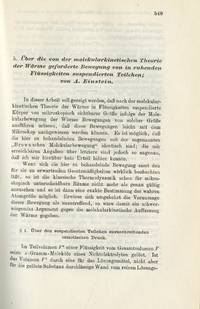
190532820546<p>FIRST EDITION. "On the Movement of Small Particles Suspended in a Stationary Liquid Demanded by the Molecular Kinetic Theory of Heat" appears here on pp. 549-560. This landmark paper on Brownian motion is one of the three great papers from 1905 Einstein <i>annus mirabilis</i>.</p><p>Although most physicists and chemists accepted the idea of atoms as a useful concept in 1905 many still questioned whether they actually existed. Einstein later claimed that "my major aim in this research was to find facts which would guarantee as much as possible the existence of atoms of finite size."</p><p>In 1827 botanist Robert Brown had used a microscope to look at dust grains floating in water. He found that the floating grains were moving about erratically a phenomenon that became known as "Brownian motion." In this paper Einstein proved the reality of these molecules and their motions by producing the first statistical physics analysis of Brownian motion. French physicist Jean Perrin used Einstein's results to experimentally determine the mass and the dimensions of atoms thereby conclusively verifying Dalton's atomic theory first proposed in 1808.</p><p>"Eventually the experimental evidence supporting Einstein's theory of Brownian motion became so compelling that the naysayers were forced to accept the existence of material atoms. His fundamental work on applying statistical methods to the random motions of Newtonian atoms also led to his insights into the photo electric effect through the discovery of a critical connection between his statistical theory of heat and the behavior of electromagnetic radiation. This was the first step in his goal to unify the two fields" APS.</p><br /><p>Complete issue removed from bound volume. Very good.</p>
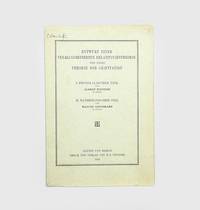
1913188059Leipzig and Berlin: B. G. Teubner 1913. Generalizing relativity First edition of Einstein's early articulation of general relativity his first paper to describe gravity as the curvature of spacetime containing "virtually all the essential features of his general theory of relativity" Norton p. 253. In 1912 Einstein's old school friend Marcel Grossman 1878-1936 secured him a professorship at ETH Zurich where they had both studied as undergraduates. The two men began a collaboration to provide a firmer mathematical foundation to Einstein's concept of gravity as a geometrical property of time and space. The two sections of the Entwurf outline the resulting theory in full complete with gravitational field equations relating the curvature of spacetime to the distribution of mass and energy within it. Einstein contributed the initial section focussing on physical theories while Grossman added the following section developing the more complex mathematical formulae. Michel Janssen editor of the Einstein Papers Project notes that the Entwurf "was published as a separatum in early 1913 and was reprinted the following year in Zeitschrift für Mathematik und Physik" p. 1. The Zeitschrift reprint includes an added section outlining the famed "Hole" argument. An offprint dated 1914 was published with the journal. Provenance: Edward Vermilye Huntington 1874-1952 the American academic who studied the foundations of mathematics at Harvard for 40 years with his signature on the front wrapper. Octavo. Device to title page formulae in the text. Original light green wrappers printed in black. Light rubbing chipping and creasing to wrappers contents clean: a very good copy indeed. Boni 50; Norman 693; Weil 58a. Michael Janssen "Einstein's First Systematic Exposition of General Relativity" 2004; John Norton "How Einstein found his field equations: 1912-1915" Historical Studies in the Physical Sciences vol. 14 no. 2 1984. unknown
1945180350Lancaster Pennsylvania: American Physical Society 1945 & 1946. His most significant later contribution to cosmology First editions offprint issues of the papers that introduced the Swiss-cheese model of the universe. Einstein and Straus revised the FLRW metric by suggesting that the universe is in fact inhomogeneous. "In two ground-breaking papers Einstein and Straus showed how galaxies fit into a Universe with zero pressure. This model helps to describe the universe observed today" Harwit p. 573. Quarto pp. 5. Disbound wire-stitched as issued. Nicks and creasing to extremities short closed tears to outer margins pp. 120-1 of Influence detached rear blank almost detached: in very good condition. Boni 252 & 252.1; Weil 216. Martin Harwit Astrophysical Concepts 2010. unknown
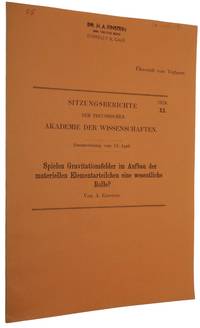
19196166Berlin: Verlag der Akademie der Wissenschaften In Kommission bei Walter de Gruyter Reichsdruckerei 1919. First edition. <p>First edition extremely rare author's presentation offprint 'Überreicht vom Verfasser' and the copy of Einstein's son Hans Albert of "Einstein's first attempt at a unified field theory" Pais Subtle is the Lord. Once Einstein completed work on the general theory of relativity at the end of 1915 "his attention shifted to the search for a unified theory of the electromagnetic and gravitational fields out of which he hoped to be able to explain the structure of matter. Quantum effects were to be derived from such a theory rather than postulated ad hoc. This remained his approach for the rest of his life" Cao Conceptual foundations of quantum field theory.</p>. EINSTEIN'S FIRST ATTEMPT AT A UNIFIED FIELD THEORY" PAIS<br /> HANS ALBERT EINSTEIN'S COPY OF THE PRESENTATION OFFPRINT. <p>First edition extremely rare author's presentation offprint 'Überreicht vom Verfasser' and the copy of Einstein's son Hans Albert of "Einstein's first attempt at a unified field theory" Pais Subtle is the Lord p. 287. Once Einstein completed work on the general theory of relativity at the end of 1915 "his attention shifted to the search for a unified theory of the electromagnetic and gravitational fields out of which he hoped to be able to explain the structure of matter. Quantum effects were to be derived from such a theory rather than postulated ad hoc. This remained his approach for the rest of his life" Cao Conceptual foundations of quantum field theory pp. 166-167. "As so often the case in relativity the story of quantum gravity begins with Einstein himself. Soon after the final formulation of general relativity he pointed out the need for a quantum modification of the theory. In his first paper on gravitational radiation the 1916 paper 'Näherungsweise Integration der Feldgleichungen der Gravitation' 'Approximate Integration of the Field Equations of Gravitation' Einstein argued that quantum effects must modify the general theory of relativity. Two years later he reiterated this conclusion the 1918 paper 'Über Gravitationswellen' 'On Gravitational Waves': 'As already emphasized in my previous paper the final result of this argument which demands a gravitational energy loss by a body due to its thermal agitation must arouse doubts about the universal validity of the theory. It appears that a fully developed quantum theory must also bring about a modification of the theory of gravitation.' Einstein writing in the 1919 paper offered here soon began to speculate whether gravitation plays a role in the atomistic structure of matter: 'There are reasons for thinking that the elementary formations which go to make up the atom are held together by gravitational forces. The above reflections show the possibility of a theoretical construction of matter out of the gravitational field and the electromagnetic field alone' In order to construct such a model of an 'elementary particle' Einstein shows that it is necessary to modify the original gravitational field equations .The major interest of this paper is that his attention now shifted from possible quantum modifications of general relativity to the search for a unified theory of the electromagnetic and gravitational fields on the basis of which he hoped to explain the structure of matter. Quantum effects are to be derived from such a theory rather than postulated ad hoc. Einstein remained committed to this approach for the rest of his life: the search for a 'natural' mathematical extension of the general theory in the hope that such a theory would somehow explain the quantization of matter and energy" Iyer and Bhawal Black Holes Gravitational Radiation and the Universe pp. 525-526. Einstein's work on unified field theory was inspired by James Clerk Maxwell's success in finding a unified theory of electricity and magnetism one of the greatest achievements of nineteenth century physics which showed that light was a form of electromagnetic wave and made possible modern inventios such as radio television and the telephone. Einstein continued his attempts to devise a unified theory of gravitation and electromagnetism for the rest of his life; his contributions in this area represent about a quarter of his entire research output and half his scientific production after 1920. Although he was ultimately unsuccessful a similar vision was realized in the decades after his death in the construction of the 'standard model' a unified theory of electromagnetism with the weak and strong nuclear forces which were unknown in Einstein's time and efforts to incorporate gravity into the model continue to this day. RBH lists three copies. OCLC lists only one copy none in US.</p> <br /> <p>Provenance: Hans Albert Einstein 1904-73 ink stamp and pencil notes on front wrapper. Hans Albert Einstein was a Swiss-American engineer and educator the second child and first son of physicists Albert Einstein and Mileva Marić. He was a long-time professor of hydraulic engineering at the University of California Berkeley.</p> <br /> <p>"As early as 1909 in his fundamental paper 'Zum gegenwärtigen Stand des Strahlungsproblems' 'On the current status of the radiation problem' which resulted from a discussion with Walter Ritz Einstein remarks 'dass des elektrische Elementarquantum e ein Fremdling ist in der Maxwell-Lorentzschen Elektrodynamik' 'that the electrical elementary quantum e is alien to Maxwell-Lorentz electrodynamics'. Einstein expressed the hope that 'die gleiche Modifikation der Theorie welche das Elementarquantum e als Konsequenz enthält auch die Quantenstruktur der Strahlung als Konsequenz enthalten wird' 'the same modification of the theory which contains the elementary quantum e as a consequence will also contain the quantum structure of radiation as a consequence'. Pauli 1949 in his review about 'Einstein's Contribution to Quantum theory' pointed out that though quantum theory later on deduced the quantum structure of radiation it has not solved Einstein's first problem and the elementary charge 'auch in der Quantenmechanik ein Fremdling geblieben ist' 'has also remained alien to quantum mechanics'. He emphasized that just this fact had been one of the strongest arguments to Einstein against the finality of the steps leading to quantum mechanics.</p> <br /> <p>"So during his Berlin years Einstein made it his task to find a synthesis of his general theory of relativity GRT and the then nascent quantum physics. In this connection he attributed logical primacy to the relevant relativistic field theory because it had reached a high degree of maturity in the GRT. After all Einstein's general-relativistic gravitation theory is the first theory on the fundamentals of physics working with genuinely non-linear equations and Einstein observed that such a nonlinearity is necessary for understanding the existence of the 'discrete field-quanta.' A linear theory allowing arbitrary superposition of fields would without further restrictions in the form of boundary and uniqueness conditions never lead to a discrete spectrum of solutions. But recourse to such restrictions means that the fields are held together by the operation of entities outside the scope of the theory .</p> <br /> <p>"In Einstein's view the problem of incorporating the elementary particles into field physics involved the question of finding field-theoretical models of electrons and protons which were the only known particles at that time. Einstein searched for solutions or general-relativistic field equations for the combined gravitational and electromagnetic fields representing mass and charge distributions with central symmetry and he hoped there would emerge self-consistent solutions only for discrete values of the mass and charge parameters i.e. for a 'particle spectrum.'</p> <br /> <p>"This 'Einstein particle problem' pursued ideas that had been developed already in the framework of the special theory of relativity and the Maxwell-Lorentz electrodynamics for instance in the nonlinear theory of the electromagnetic field by G. Mie and D. Hilbert. As an essential progress by the general-relativistic treatment Einstein regarded the genuine nonlinearity of the field equations which Mie and Hilbert had to introduce ad hoc and full consideration of the particle dynamics in the sense of the general-relativistic problem of motion. The generalizations of the Maxwell equations considered by Mie and Hilbert contain a too small number of components for the integrability conditions to determine the particle dynamics whereas the Einstein problem of motion in the GRT furnishers just this dynamics as a consequence of the integrability conditions for the field equations of gravitation. It is the GRT that with its metric field for the first time embraces inertia and gravity that is just those properties which are characteristic of all particles.</p> <br /> <p>"Einstein in fact succeeded in driving self-consistent gravitational and electromagnetic fields which can be interpreted as particle models of that kind. But his success depended on a weakening of his own equations of gravitation which physically amounts to the introduction of an additional hypothetical cosmical field of the 'Poincaré pressure.' By this weakening it becomes possible to set up self-consistent particle models with spherical symmetry for arbitrary centrosymmetric mass and charge distributions. In 1919 Einstein presented his result to the academy in his paper 'Spielen Gravitationsfelder im Aufbau der materiellen Elementarteilchen eine wesentliche Rolle' His answer to the question says that in his particle models the electrical field energy contributes ¾ and the gravitational energy ¼ of the total energy.</p> <br /> <p>"Einstein's first discourses on the particle problem in the GRT were closely related to the 1917/18 papers in which he laid the foundations of relativistic cosmology. In his Academy report 'Kosmologische Betrachtungen zur allgemeinen Relativitätstheorie' 'Cosmological considerations on the general theory of relativity' 1917 Einstein had by introducing the term λgμν with the 'cosmological constant' λ extended his equations of gravitation to his cosmological equations of gravitation</p> <br /> <p>Rμν - ½ gμνR λgμν = - κ Tμν . </p> <br /> <p>He could show that these equations permit as a particular solution with λ > 0 and constant positive mass density a statical model of the universe representing a closed spheric or elliptic three devotional Riemannian space .</p> <br /> <p>"In his paper of 1919 about the role of gravitation in the structure of elementary particles Einstein also interpreted the cosmological constant λ as the universal 'Poincaré' pressure' which according to a hypothesis of H. Poincaré is to guarantee the stability of Lorentz's electrons against their own repulsion forces. Einstein's ideas concerning this matter partly resulted from a controversial discussion with E. Schrödinger 1918 about the gravitational energy in the GRT and the structure of the energy tensor" Treder pp. 149-151.</p> <br /> <p>Indeed Schrödinger had pointed out another way of treating the cosmological constant: moving it from the left-hand side of equation where it represents a contribution to space-time curvature to the right-hand side where it represents a contribution to the energy-matter distribution. Then it would correspond physically to a kind of cosmic pressure. Schrödinger believed this might be the pressure postulated by Poincaré to maintain the stability of charged particles: an electric charge on the surface of a sphere creates a force pushing outwards so without any opposing force the charged sphere would explode outwards. </p> <br /> <p>Einstein never liked the cosmological constant. In the present paper he acknowledged that his introduction of the cosmological constant was "gravely detrimental to the formal beauty of the theory" Cambridge Companion to Einstein p. 257.</p> <br /> <p>Boni-Russ-L. 111; Schilpp 123; Weil 106. Treder 'Antimatter and the particle problem in Einstein's cosmology and field theory of elementary particles A historical essay on Einstein's work at the Akademie der Wissenschaften zu Berlin' Astronomische Nachrichten 296 1975 pp. 149-161.</p> <br/> <br/> Large 8vo 254 x 182 mm pp. 349-356. Original printed wrappers. A very fine copy. Verlag der Akademie der Wissenschaften, In Kommission bei Walter de Gruyter [Reichsdruckerei] unknown
193846475(Princeton, NJ.), Annals of Mathematics, 1938 a. 1940. Both papers in orig. printed wrappers. Offprints from ""Annals of Mathematics"", Vol. 39, No. 1, january, 1938 and Vol. 41, No. 2, April, 1940. Pp. 65-100 and pp. 455-464. Both clean and fine. This copy has belonged to Abraham Pais (1918-2000) - the famous Einstein scholar, theoretical physicist and Einsteins collegue at Princeton - and having his name on top of both frontwrappers ""A Pais"".
193846475Princeton NJ. Annals of Mathematics 1938 a. 1940. Both papers in orig. printed wrappers. Offprints from "Annals of Mathematics" Vol. 39 No. 1 january 1938 and Vol. 41 No. 2 April 1940. Pp. 65-100 and pp. 455-464. Both clean and fine. This copy has belonged to Abraham Pais 1918-2000 - the famous Einstein scholar theoretical physicist and Einsteins collegue at Princeton - and having his name on top of both frontwrappers "A Pais". <br/><br/><em>First editions in the scarce offprint versions of Einstein's last and highly important contributions to General relativity and in which is shown that the equation of motion follows directly from the field equation that defined the geometry."Einstein's last importent contribution to general relativity deals again with the problem of motion. It is the work done with Leopold Infeld and Banash Hoffmann on the N-body problem of motion. In these papers the gravitational field is no longer treated as external. Instead it and the motion of its singular sources are treated simultaneously. Anew approximationscheme is introduced in which the fields are no longer necessarily weak but in which the source velocities are small compared with the light velocity . The equations obtained have found use in situations where Newtonian interaction must be included. 'These equations are widely used in analyses of planetary orbits in the solarsystem. For example the Cal Tech Jet Propulsion Laboratory uses them in modified form to calculate ephmerides for high-precision tracking of planets and spacecraft."Pais "Subtle is the Lord" p. 290-91."The problem of the equation of motion of bodies is the following. The 1916 theory had a classical structure in the sense that there were both field equations the curvature of space-time is determined by the mass and motion of bodies in space-time and equations of motion of bodies the world line of small mass is a geodesic. Are these two statements really separate If the field equations were linear they indeed would be. They are not linear however and Einstein showed in the papers offered that if matter is represented by a point singularity of the metric field these singularities are located on world lines that are geodesics of space-time provided its metric satisfies the equation of general relativity."DSB.Weil: 202 a. 295 both with an asterix denoting a major paper. - Boni: 236 a. 236.1. </em> unknown
1923108095Princeton University Press 1923. 1st Edition. Hardcover. Very Good/Very Good. First edition with Published 1922 on copyright page and 1923 on title page very good in the very rare dust jacket which had some wear and chips. Short tear at bottom of rear free endpaper. Housed in a custom-made collector's slipcase. Princeton University Press hardcover books
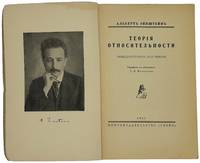
lom-MS001965In Russian. Short description: Einstein A. Teoriya otnositelnosti. Theory of Relativity. Public presentation. Translated from German by G.B. Itelson. Berlin: Slovo 1921. - 150 2 p. 1 sheet portrait. Publisher's cover. Format 215x140 mm. Lifetime edition of one of the founders of modern physics Nobel Prize winner Albert Einstein 1879-1955. First Russian edition. Please feel free to contact us for a detailed description of the copies available. SKUMS001965 kn_nat unknown
lom-MS001965In Russian. Short description: Einstein A. Teoriya otnositelnosti. [Theory of Relativity]. Public presentation. Translated from German by G.B. Itelson. Berlin: Slovo, 1921. - 150, [2] p., 1 sheet portrait. Publisher's cover. Format 215x140 mm. Lifetime edition of one of the founders of modern physics, Nobel Prize winner Albert Einstein (1879-1955). First Russian edition. Please feel free to contact us for a detailed description of the copies available. SKUMS001965 kn_nat
1923108095Princeton University Press 1923. 1st Edition. Hardcover. Very Good/Very Good. First edition with Published 1922 on copyright page and 1923 on title page very good in the very rare dust jacket which has some wear and chips and a big tear at rear panel. Previous owner's bookplate attached to front paste-down. Housed in a custom-made collector's slipcase. Princeton University Press hardcover
H4000Berlin Akademie der Wissenschaften 1918 In: Sitzungsberichte der Königl.Preuss. Akademie der Wissenschaften Band 1918/1. 4to. S.154-167; S.270-272 S.448-461. Weitere Berichte von: Born M.; u.a. Halbleinenband der Zeit leicht berieben Bibl.-Nr.am Rücken Original-Broschur miteingebunden unaufgeschnitten gutes Exemplar. unknown
H3984Berlin Akademie der Wissenschaften 1914 In: Sitzungsberichte der Königl.Preuss. Akademie der Wissenschaften Band 1914/2. 4to. S. 1030-1095. Anbei weiters: Planck Max: Eine veränderte Formulierung der Quantenhypothese. S.918-923. Schwarzschild K.: 1 Über Diffusion und Absorption in der Sonnenathmosphäre. S.1183-1200. 2 Über die Verschiebungen der Bande bei 3883 A im Sonnenspectrum. S.1201-1213. Halbleinenband der Zeit leicht berieben Bibl.-Nr.am Rücken Original-Broschur miteingebunden unaufgeschnitten gutes Exemplar. unknown
H4008Berlin Akademie der Wissenschaften 1926 In: Sitzungsberichte der Königl.Preuss. Akademie der Wissenschaften Band 1926. 4to. S.334-340. Anbei u.a.: Schrödinger E.: Die Energiestufen des idealen einatomigen Gasmodells. S.23-36; Planck Max: Über die Begründung des zweiten Hauptsatzes der Thermodynamik. S.453-466. Halbleinenband der Zeit leicht berieben Bibl.-Nr.am Rücken Original-Broschur miteingebunden unaufgeschnitten gutes Exemplar. The Einstein and Rupp articles are the heart of the Einstein-Rupp scandal perhaps the most famous of all scientific scandals. unknown
19132064Leipzig and Berlin: Teubner 1913. First edition. Original wrappers. Very Good. FIRST EDITION COMMERCIAL OFFPRINT ISSUE of Einstein's breakthrough work on general relativity: the famous "Entwurf" paper. "In this book Einstein and Grossman investigated curved space and curved time as they relate to a theory of gravity. They presented virtually all the elements of the general theory of relativity with the exception of one striking omission: gravitational field equations that were not generally covariant. Einstein soon reconciled himself to this lack of general covariance through the 'hole argument' which sought to establish that generally covariant gravitational field equations would be physically uninteresting. Einstein did not adopt the gravitational field equations until late in 1915 in his final formulations of the general theory. Here Einstein contributed the physics and Grossman the mathematics" Calaprice The Einstein Almanac 40. Weil 59a. Offprint from Zeitschrift für Mathematik und Physik volume 62. Leipzig and Berlin: Teubner 1913. Octavo original wrappers; custom box. Pencil notation on title. Small chips at spine ends. An outstanding copy without any of the cover-foxing so common with this issue. Teubner unknown books
19132064Leipzig and Berlin: Teubner 1913. First edition. Original wrappers. Very Good. FIRST EDITION COMMERCIAL OFFPRINT ISSUE of Einstein's breakthrough work on general relativity: the famous "Entwurf" paper. "In this book Einstein and Grossman investigated curved space and curved time as they relate to a theory of gravity. They presented virtually all the elements of the general theory of relativity with the exception of one striking omission: gravitational field equations that were not generally covariant. Einstein soon reconciled himself to this lack of general covariance through the 'hole argument' which sought to establish that generally covariant gravitational field equations would be physically uninteresting. Einstein did not adopt the gravitational field equations until late in 1915 in his final formulations of the general theory. Here Einstein contributed the physics and Grossman the mathematics" Calaprice The Einstein Almanac 40. Weil 59a. Offprint from Zeitschrift für Mathematik und Physik volume 62. Leipzig and Berlin: Teubner 1913. Octavo original wrappers; custom box. Pencil notation on title. Small chips at spine ends. An outstanding copy without any of the cover-foxing so common with this issue. Teubner unknown
19132139Zürich: Zürcher & Furrer 1913. First edition offprint. Original wrappers. Very Good. EXTREMELY RARE AUTHOR'S OFFPRINT "Überreicht von den Verfassern" IN ORIGINAL WRAPPERS OF THE FIRST PRINTING OF EINSTEIN AND GROSSMANN'S FURTHER DEVELOPMENT OF THE CRITICAL "ENTWURF" THEORY OF 1913. "Einstein returned from Prague to Zurich in the summer of 1912. He had by then already formulated the fundamental physical principles of the general relativity theory of gravitation and was now searching for their mathematical structure. At the E.T.H. the Swiss Federal Institute of Technology in Zurich where he now returned as professor of theoretical physics Einstein met again his old fiend and former fellow student Marcel Grossmann who was now a professor of mathematics and his colleague. With Grossmann and under his guidance Einstein studied the mathematical literature especially the theory of invariants and the absolute differential calculus of Chirstoffel Ricci Levi-Civita and others. Einstein developed the mathematical structure of his theory jointly with Grossmann and in his celebrated paper on the general theory of relativity in 1916 he acknowledged the help which his friend had given him. It was Grossmann's help which had Einstein said 'spared me not only the study of the relevant mathematical literature but who Grossmann also assisted me in searching for the field equations of gravitation.' This study of mathematical literature and the search for the proper mathematical tools led to several joint papers with Grossmann during Einstein's all too brief stay in Zurich. These papers contained the first attempts toward a generalized theory of relativity using new mathematical tools and gave full expression to Einstein's earlier physical insights" Jagdish The Golden Age of Theoretical Physics. The first of Einstein's papers to present his collaborative work with Grossmann the famous "Entwurf" paper appeared in the summer of 1913; the present paper based on a lecture given on September 9 1913 to the 96th annual meeting of the Swiss Society for Natural Sciences in Frauenfeld provides further details on the new generalized theory of relativity. The published paper contains more mathematics than in the given lecture. Weil 57. OFFPRINT FROM: Vierteljahrsschrift der Naturforschenden Gesellschaft vol. 58 pp. 284-290 Einstein; pp. 291-297 Grossmann. Zürich: Zürcher & Furrer 1913. Octavo original wrappers; custom box. Mild dampstaining to extreme top outer margin away from the text; crease down the center of issue. SCARCE. Zürcher & Furrer unknown books
1911432921911. <p>Einstein Albert 1879-1955. Berichtigung zu meiner Arbeit: "Eine neue Bestimmung der Moleküldimensionen." Offprint from Annalen der Physik 34 1911. 591-592pp. 224 x 146 mm. Original printed wrappers a little chipped splint in lower spine. Light toning but very good.</p> <p>First Edition Offprint Issue. Einstein's correction to his formula for the viscosity coefficient = 1 a key equation in his 1905 doctoral thesis in which he had presented a new theoretical method for determining molecular radii and Avogadro's number. In 1910 Jacques Bacelin a pupil of French physicist Jean-Baptiste Perrin obtained experimental results indicating a possible error in Einstein's formula. "That prompted Einstein after an unsuccessful attempt to find an error to ask his student and collaborator Ludwig Hopf to check his calculations and arguments . . . Hopf did find an error in the dissertation namely in the derivatives of some velocity components and obtained for a corrected coefficient 2.5 . . .In early 1911 Einstein submitted his correction for publication and recalculated Avogadro's number. He obtained a value of 6.56 x 10²³ per mole a value that is close to those derived from kinetic theory and Planck's black-body radiation theory" Duplantier pp. 216-217. Duplantier "Brownian motion ‘diverse and undulating'" in Einstein 1905-2005: Poincaré Seminar 2005 pp. 201-293. Pais Subtle is the Lord p. 92. Weil Albert Einstein Bibliography 41.</p> . unknown books