Einstein AlbertABAA

2 943 résultats
1930433141930. Offprint from Sitzungsberichte der preussischen Akademie der Wissenschaften 1930. Single sheet pp. 1-2. 256 x 184 mm. Upper edge a bit creased light toning but very good. First edition offprint issue. One of Einstein's last papers on Riemann metrics and distant parallelism written the year before he abandonded this approach to constructing a unified field theory. Pais Subtle is the Lord p. 347. Weil Albert Einstein Bibliography 173. unknown books
1932433001932. Offprint from Sitzungsberichte der Preussischen Akademie der Wissenschaften 32 1932. 31pp. 256 x 183 mm. Original printed wrappers a little chipped and darkened small splits in spine. Very good. First edition offprint issue. Einstein's work on semivectors "was stimulated by Ehrenfest's insistence on a better understanding of the relation between single-valued and double-valued representations of the Lorentz group . . . Einstein and Mayer went on to relate semivectors to the Dirac equation and to generalize the formalism to general relativity" Pais Subtle is the Lord pp. 451-452. Weil Albert Einstein Bibliography 186. unknown books
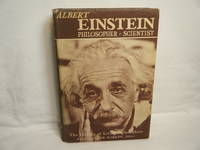
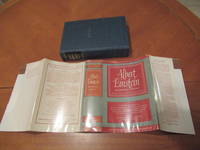
194938664The Library of Living Philosophers. Very Good in Very Good dust jacket. 1949. First Edition. Hardcover. First edition of Einstein's autobiography. Blue cloth. Bookplate to ffep. Glue darkening along hinges. Book is tight and square. Gilt unfaded. The clipped jacket shows wear along edges and shows general toning. ; The Library of Living Philosophers; Vol. 7; 8vo 8" - 9" tall . The Library of Living Philosophers hardcover
1968019130Crown Publishers. First Printing. No Statement Of Printing DJ Price Clipped But Exactly Same As First And Came With This Book Publisher's Address As 419 Fourth Avenue On Front And Rear Flaps.Clipped DJ in archival cover edge wear small chips. . Fine. Hardcover. 1st Edition. 1968. Crown Publishers hardcover
1932433001932. Offprint from Sitzungsberichte der Preussischen Akademie der Wissenschaften 32 1932. 31pp. 256 x 183 mm. Original printed wrappers a little chipped and darkened small splits in spine. Very good. First edition offprint issue. Einstein's work on semivectors "was stimulated by Ehrenfest's insistence on a better understanding of the relation between single-valued and double-valued representations of the Lorentz group . . . Einstein and Mayer went on to relate semivectors to the Dirac equation and to generalize the formalism to general relativity" Pais Subtle is the Lord pp. 451-452. Weil Albert Einstein Bibliography 186. unknown
1930433141930. Offprint from Sitzungsberichte der preussischen Akademie der Wissenschaften 1930. Single sheet pp. 1-2. 256 x 184 mm. Upper edge a bit creased light toning but very good. First edition offprint issue. One of Einstein's last papers on Riemann metrics and distant parallelism written the year before he abandonded this approach to constructing a unified field theory. Pais Subtle is the Lord p. 347. Weil Albert Einstein Bibliography 173. unknown
72537Braunschweig Friedrich Vierweg & Sohn; Berlin J. Springer 1924. 8vo 22.8 x 15.4 cm. 10 pp. Original printed wrappers. = First paper by the Indian physicist Satyendra Nath Bose 1894-1974 on thermal equilibrium in the radiation field in the presence of matter and second paper sent to Albert Einstein with the request to translate and publish it in a German physics journal. Einstein saw the importance of the paper but he disagreed with its contents and decided to add a lengthy comment. Subsequently Bose saw a way to circumvent Einstein's critique but never published this rebuttal. Nearly 50 years later Bose stated that he was disappointed by Einstein's remarks ".Bose had his own approach to quantum theory based on his views about the interconnectedness of spontaneous and induced emissions which formed the subject matter of his second and third papers. He did not agree with Einstein's proposal to treat them as independent physical processes. Stationary states in atoms have zero widths both in the old and the new quantum theories and therefore have infinite life-times whereas in reality they do decay and jump down to lower energy states with a finite life-time. What is the origin of these finite widths In Bose's view they are the consequence of the interaction between atom and environment as he attempted to show in his second and third papers. But Einstein did not agree and dismissed his views with the remark that in a world consisting of a single excited hydrogen atom and nothing else the atom would obviously emit a photon and come down to its ground-state! Einstein did not explain what would excite an atom in such a world. Bose was very disappointed by this simply because the world does have much more than a single hydrogen atom and inevitably every atom has an environment" Wali. Contained in: Zeitschrift für Physik volume 275-6. The complete issue in its original wrappers. Upper right corner somewhat bumped throughout. Rear wrapper slightly frayed at edges; minimal spotting at the fore and bottom edges. Volume number written on spine; otherwise a very good clean copy. Wali K. C. 2009. Satyendra Nath Bose: His Life and Times: Selected Works with Commentary p. xxvi. unknown
H4001Berlin Akademie der Wissenschaften 1919 In: Sitzungsberichte der Königl.Preuss. Akademie der Wissenschaften Band 1919/1. 4to. S.349-356; S.433.438. Halbleinenband der Zeit leicht berieben Bibl.-Nr.am Rücken Original-Broschur miteingebunden unaufgeschnitten gutes Exemplar. unknown
192088490Berlin, Julius Springer, 1920, in-8, 15 pp, Broché, couverture agrafée de l'éditeur, Édition originale de ce discours prononcé par Einstein (1879-1955) le 5 mai 1920 à la Reichsuniversität de Leyde, à l'occasion de son entrée en fonction en tant que professeur invité. Le savant y expose comment la conception ancienne de l'éther a laissé la place à la notion de gravitation. Cachet ex-libris du révolutionnaire Russe et bibliophile Marcel Bekus (1888-1939). Bon exemplaire. Couverture insolée, agrafes oxydées. Hans-Josef Küpper, Verzeichnis Der Wissenschaftlichen Publikationen Albert Einsteins von 1901-1922 [en ligne]. Weil, 111. Couverture rigide
19151200Braunschweig: Friedr. Vieweg & Sohn 1915. 1st Edition. FIRST EDITION FULL BOUND VOLUME OF THE EINSTEIN-DE HAAS EFFECT -- an experimental observation that illustrates the relationship between magnetism and angular momentum and in which a change in the magnetic moment causes the rotation of a free body. In this 1915 paper Albert Einstein and Wander de Haas report that changing the magnetization of a suspended iron rod by applying an external magnetic field leads to mechanical rotation of the rod - a result that still stands as a textbook illustration of the relationship between magnetism and angular momentum. Papers by Planck The Quantum Hypothesis for Molecules with Multiple Degrees of Freedom von Laue Warburg Siegbahn and Born are also present. <br /> <br /> Einstein had long contemplated Ampère's 1820 conjecture that magnetism is caused by the microscopic circular motions of electric charges. In light of this Einstein and de Haas devised an experiment to test not just Ampère's hypothesis but also "Lorentz's theory that the rotating particles are electrons. The aim of the experiment was to measure the torque generated by a reversal of the magnetization of an iron cylinder" Calaprice Einstein Almanac 52. <br /> <br /> In the experiment Einstein and de Haas designed "a magnetic material was suspended with the aid of a thin string inside a magnetic field coil. When the magnetic field was increased by the application of an electric current through the field coil the magnetic material is magnetized. In order to keep the total magnetic moment of the magnetic material constant the latter rotates. This classical Einstein-de Haas effect demonstrates that the spin angular momentum is of the same nature as the angular momentum of rotating bodies as conceived in classical mechanics" Ganzhorn Nature Communications 7 11443 2016. <br /> <br /> Einstein spoke enthusiastically of the experimental results he and de Haas has achieved stating that they had "given firm proof of the existence of Ampère's molecular currents" Pais Subtle is the Lord 245. <br /> <br /> ALSO INCLUDED: Papers by Planck "Die Quantenhypotese für Molekeln mit mehreren Freiheitsgraden" and "Bemerkung über die Entropiekonstante zweiatomiger Gase" as well as a paper by von Laue "Die Einsteinischen Energieschwankungen" CONDITION & DETAILS: Braunschweig: Friedr. Vieweg & Sohn. 8vo. Unobtrusive stamp on front paste down and title page. In-text figures throughout. Tightly bound in leather over marbled paper boards; gilt-lettered and tooled at the slightly faded spine. Unusually beautiful marbled paper edges. Bright and very clean throughout. Near fine. Friedr. Vieweg & Sohn hardcover
192232430Berlin: Sitzungsberichten der Preussischen Akademie der Wissenschaften 1922. First Thus. First Thus. Einstein Albert 1879-1955. Zur Theorie der Lichtfortpflanzung in dispergierenden Medien. Complete. Quarto. Offprint from Sitzungsberichten der Preussischen Akademie der Wissenschaften. Berlin: 1922. First edition in very fine condition. This superb offprint is a separate printing of the Prussian Academy's session reports here with independent pagination. A small number of such off prints were presented to the author by the publisher as voucher copies. References: Schilpp-Shields 162; Weil 120. This paper gives evidence that Einsteins ideas on the photon were not able to contradict classical theory. "Since after 1917 Einstein firmly believed that light-quanta were here to stay it is not surprising that he would look for new ways in which the existence of photons might lead to observable deviation from the classical picture. In this he did not succeed. At one point in 1921 he thought he had found a new quantum criterion but it soon turned out to be a false lead as demonstrated in this paper". An excellent example. "The early Offprints from "Sitzungsberichten." are called "Sonderabdruck" up to Weil No.165 including this. From Weil 166 they are called "Sonderausgabe.". - Before 161 up to 160 the Offprints do not have separate title and pagination the pagination follows the numbering in the periodical. From 166 the Offprint has both separate printed title and pagination. - So Weil Nos 161-165 is still "Abdruck" but with separate title and pagination. Sitzungsberichten der Preussischen Akademie der Wissenschaften unknown
Second English edition, 8vo, xiii, [3], 138, [2] + 8pp., of adverts, frontis., portrait of Einstein, ownership signature to front endpaper 'F.U.? Archibald, October 29. 1920', endpapers foxed, orig. red cloth, spine a little faded, small whitish stain to upper and lower cover.
197926555ABerlin, 1979. Doppelblatt, 5 (von ursprünglich 8) Original-Grafiken. Ca. 49,5 x 49,5 cm (Blattformat der Grafiken). Original-Halbleinenflügelmappe.
1951053640New York: Tudor Publishing Company 1951. 2nd Edition 1st Printing. Hardcover. Near Fine/Very Good DJ. Xvi 781 Pp. Blue Cloth Gilt. Second Edition With Bibliography Brought Up To 1951. Contains Einstein's Autobiography With Text In Both German And English; And Major Essays On Einstein Including An Important Discussion With Niels Bohr. Book Is Near Fine Gilt Brilliant Hinges Tight Touch Of Rubbing At Corners No Marks Or Bookplates. Dj With Light Usage Bright And Clean <br/> <br/> Tudor Publishing Company hardcover
190249501Leipzig, J. A. Barth, 1902. 8vo. Bound in contemporary half calf with five raised bands and gilt lettering to spine. In """"Annalen der Physik. Vierte Folge. Band 9."". Entire volume offered.
192338826Berlin, Verlag der Akademie der Wissenschaften, 1923. 4to. Uncut and partly unopened in orig. wrappers to issue XXVIII-XXIV of ""Sitzungsberichte der Preussischen Akademie der Wissenschaften"". Wrappers with nicks and tears, especilly frontwrapper with marginal loss. Die Energieschwankungen...pp. 350-354. - Bemerkung zu Quantenstatistik...pp. 355-58.- Bietet die Feldtheorie...pp. 359-364. - Zur Theorie der von glühende...pp. 334-348.
191438840Braunschweig Vieweg & Sohn 1914. Later full cloth. A stamp to the general titlepage. IX1072;414 pp. textillustrations. "Verhandlungen der Deutschen Physikalischen Gesellschaft im Jahre 1914. Sechzehnter Jahrgang. Hrsg. von Karl Scheel." Einstein paper pp. 820-828. Internally clean and fine. The whole volume offered <br/><br/><em>First edition. In this paper "Contributions to quantum theory" two considerations are given which are interrelated by a common goal inasmuch as it is attempted to derive two of the most importent achievementss of quantum theory viz. Planck's radiation law and Nernst's third law of thermodynamics in a new manner. The proofs do not involve Boltzmann's equation and are thus based enterely on macroscopic thermodynamics. They do introduce however the quantum hupothesis. Einstein points out that the alleged 'proofs' which try to derive the theorem of Nernst from the mere fact that the heat capacity of all substances goes to zero at absolute zero temterature are not genuine. Cornelius Lanczos.- Weil No 67. </em> hardcover
190347072Leipzig Johann Ambrosius Barth 1903. Contemp. hcloth. Handwritten paperlabel on spine. In: "Annalen der Physik. Vierte Folge. Band 11. Herausgegeben von Paul Drude.". VIII1144pp. and 6 plates. Entire volume offered. The Einstein paper: pp. 170-187. Faint signs of dampstains in outer margins on a few leaves. <br/><br/><em>First edition of Einsteins fourth paper. In his paper from 1902 Einstein "says in his introduction that nobody has yet succeeded in deriving the conditions of thermal equilibrium and of the second law of thermodynamics from probability considerations although Maxwell and Boltzmann came near to it. Willard Gibbs is not mentioned. In fact Einstein's paper was written in ignorance of Gibbs paper published 1901. In the present paper Einstein builds the theory on another basis not used by Gibbs namely on the consideration of a single system in course of time later called "Zeit-Gesamtheit" time assembly and proves that this is equivalent to a certain virtual assembly of many systems Gibb's micro-canonical assembly.Einstein at once proceeded to apply his theorems to a case of utmost importance namely to systems of a size suited for demonstrating the reality of molecules and the correctness of the kinetic theory of matter."Walter Alicke. First edition of Einsteins fourth paper. In his paper from 1902 Einstein "says in his introduction that nobody has yet succeeded in deriving the conditions of thermal equilibrium and of the second law of thermodynamics from probability considerations although Maxwell and Boltzmann came near to it. Willard Gibbs is not mentioned. In fact Einstein's paper was written in ignorance of Gibbs paper published 1901. In the present paper Einstein builds the theory on another basis not used by Gibbs namely on the consideration of a single system in course of time later called "Zeit-Gesamtheit" time assembly and proves that this is equivalent to a certain virtual assembly of many systems Gibb's micro-canonical assembly.Einstein at once proceeded to apply his theorems to a case of utmost importance namely to systems of a size suited for demonstrating the reality of molecules and the correctness of the kinetic theory of matter."Walter Alicke. - Weil No. 4 - Boni No 4. </em> hardcover
190249501Leipzig J. A. Barth 1902. 8vo. Bound in contemporary half calf with five raised bands and gilt lettering to spine. In ""Annalen der Physik. Vierte Folge. Band 9.". Entire volume offered. <br/><br/><em>First edition of Einstein's third paper in which he deals with the definitions of temperature and entropy for thermal equilibrium conditions and with the equipartition theorem.The volume contains 2 papers by Max Planck originally published in "Jubelband für H.A. Lorentz" und Jubelband für J. Bosscha: "Ueber die von einem elliptisch schwingenden Ion emitterte und absorbierte Energie;" und "Ueber die Verteilung der Energie zwischen Aether und Materie;" pp. 619-628 und pp. 629-641.Weil No 3. </em> hardcover
191238839Leipzig J.A. Barth 1912. Bound in two contemp. hcalf richly gilt spine and one later full cloth. A library stamp on the first volume. "Annalen der Physik. Vierte Folge. Band 37 und 38. Hrsg. von W. Wien und M. Planck." VIII1048;VIII1064 pp. 58 plates. Einstein papers: pp. 832-38 vol.37 pp. 881-84 Nachtrag vol. 38; pp. 443-458 vol. 38; p. 888 vol. 38; pp. 1059-1064 vol. 38; Planck: pp. 642-656. Internally fine and clean. Both volumes offered. <br/><br/><em>All papers first edition. In the first paper "Thermodynamical derivation of the photochemical equivalence" Einstein calls "the law of photochemical equivalence" the statement that the decomposition of one gram equivalent of any substance by a photochemical proces demands the radiation energy of 'Nhv' where N=the Avogadro number. In this paper he demonstrates how this law is deducible by purely thermodynamical arguments if certain olausible assumotions are made. Lanzos. - The second paper "Concerning the theory of a static gravitational field" states that the 'equivalence hypothesis' permits us to come to very definite conclusions about the behaviour of a static gravitational field. - The next Einstein paper gives an answer to J. Stark as Stark claimed priority to the photochemical equivalence law. - In the last paper "Relativity and Gravitation. Reply to a remark of M. Abraham" Einstein elaborates his answer to the critique of M. Abraham. - Weil Nos 46 1-2 a. 48. - Planck Akademie No 95. </em> hardcover
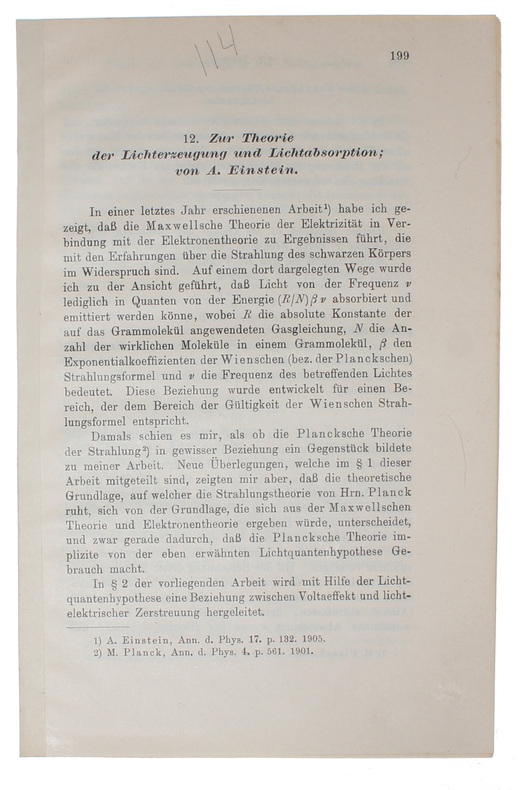
190646956Leipzig Johann Ambrosius Barth 1906. No wrappers. Extracted from "Annalen der Physik" Vierte Folge. Bd. 20. Pp. 199-206. Clean and fine. <br/><br/><em>First printing of one of the papers for which Einstein was awarded the Nobel Prize in 1921. It was for the papers "Ueber einen die Erzeugung und Verwandlung des Lichtes betreffenden heuristischen Gesichtspunkt" of 1905 and "Zur Theorie der Lichterzeugung. Theory of light emission and absorption the offered item that Einstein received the prize: "for his services to theoretical physics and especially for his discoveryof the law of the photoelectrical effect" - his reward was not based on relativity."The quantum theory has affected virtually every branch of physics. Its earliest and one of its most significant developments was Einstein's application of the theory to what is known as the 'photo-electrical effect'.Einstein explained this effext by suggesting that the classical view that light is emitted in the form of continous waves must be abandoned. The photo-electrical effect could be explained only as an example of quantum action where the waves of light or X-rays are emitted in minute particles or bullets. It is he size of the bullet the wave-lenght of the radiation which determines the number of electrons ejected. It was for this and not for the theory of relativity that Einstein was awarded the Nobel Prize in 1921. Einstein's two fundamental papers on this subject are "Ueber einem Erzeugung." 1905 and Zur Theorie der Lichterzeugung the paper offered here" PMM the note to 391.Weil: 12 with an asterix denoting a major paper - Boni:12. </em> unknown
191438840Braunschweig, Vieweg & Sohn, 1914. Later full cloth. A stamp to the general titlepage. IX,1072"414 pp., textillustrations. ""Verhandlungen der Deutschen Physikalischen Gesellschaft im Jahre 1914. Sechzehnter Jahrgang. Hrsg. von Karl Scheel."" Einstein paper pp. 820-828. Internally clean and fine. The whole volume offered
191238839Leipzig, J.A. Barth, 1912. Bound in two contemp. hcalf, richly gilt spine and one later full cloth. A library stamp on the first volume. ""Annalen der Physik. Vierte Folge. Band 37 (und) 38. Hrsg. von W. Wien und M. Planck."" VIII,1048"VIII,1064 pp., 5+8 plates. Einstein papers: pp. 832-38 (vol.37), pp. 881-84 (Nachtrag vol. 38) pp. 443-458 (vol. 38) p. 888 (vol. 38) pp. 1059-1064 (vol. 38)" Planck: pp. 642-656. Internally fine and clean. Both volumes offered.
190347072Leipzig, Johann Ambrosius Barth, 1903. Contemp. hcloth. Handwritten paperlabel on spine. In: ""Annalen der Physik. Vierte Folge. Band 11. Herausgegeben von Paul Drude."". VIII,1144pp. and 6 plates. (Entire volume offered). The Einstein paper: pp. 170-187. Faint signs of dampstains in outer margins on a few leaves.
190646956(Leipzig, Johann Ambrosius Barth, 1906). No wrappers. Extracted from ""Annalen der Physik"" Vierte Folge. Bd. 20. Pp. 199-206. Clean and fine.