2 944 résultats
193138732Berlin, Akademie der Wissenschaften, 1931-32. 4to. Both papers with orig. printed orange wrappers. Offprints (Sonderausgabe) ""Sitzungsberichten der Preussischen Akademie der Wissenschaften"". 19"10 pp. Fine and clean.
192146469Berlin, Julius Springer, 1921. Lex8vo. Orig. printed wrappers. Offprint/Sonderdruck from ""Der Festschrift der Kaiser Wilhelm Gesellschaft zur Förderung der Wissenschaften zu ihrem 10jährigen Jubiläum"". Pp. 50-52. A small tear to right margin (1 cm), otherwise fine and clean. At foot frontwrapper ""Nicht im Handel"".
192539308Paris, Gauthier-Villars et Cie, 1925. Small8vo. Uncut in orig. printed wrappers. Portrait. (4),56,(2) pp. + Publisher's Cat. (6 pp.). 2 leaves with an insignificant small loss of upper right corner. A fine copy.
192928362Berlin, Gruyter & Co., 1929. 4to. Orig. orange printed wrappers. Offprint/Sonderabdruck aus Sitzungsberichten...pp. (1)-8. Fine fresh copy.
191746895Leipzig, S. Hirzel, 1917. Royal8vo. Bound in contemporary half calf with gilt lettering to spine and 5 raised bands with ornaments in gilt. In ""Physikalische Zeitschrift"", Bd. 18, 1917. Spine and hinges with wear, otherwise a fine and clean copy. Pp. 121-128. [Entire volume: XI, (1), 604 pp. + 14 plates.
191138841Leipzig, J.A. Barth, 1911. Contemp. hcalf, spine gilt. ""Annalen der Physik. Vierte Folge. Band 34. Hrsg. von W.Wien und Max Planck."" VIII,1032 pp., 6 plates. Einstein papers: pp. 165-169" pp. 170-174 pp. 175-176 p. 590" pp. 591-592. Fine and clean. The whole volume offered.
190639057Leipzig, Johann Ambrosius Barth, 1906). Bound in a fine recent hmorocco. Gilt lettering on spine. ""Annalen der Physik"", Bd. 20, Heft 8, pp. 433-640. The Einstein paper pp. 627-633.
190338800Leipzig, Johann Ambrosius Barth, 1903. Contemp. hcloth. Some small nicks to spine. (=) Annalen der Physik. Vierte Folge. Band 11. Herausgegeben von Paul Drude."". VIII,1144pp. and 6 plates. The Einstein paper: pp. 170-187. Internally fine and clean.
191538835Braunschweig, Vieweg & Sohn, 1915. Contemp. hcalf, gilt. Spine with a few scratches and light wear to spine ends. ""Verhandlungen der Deutschen Physikalischen Gesellschaft im Jahre 1915. 17. Jahrgang. Im Auftrage der Gesellschaft herausgegeben von Karl Scheel."" VI,489 pp. textillustr. Einstein/Haas papers: pp. 152-170 a. p. 203 a. p. 420. - Planck paper: pp. 407-418 a. 418-19 a. 438-51. - Laue paper: pp. 198-202. Internally clean and fine. The whole volume offered.
190438818Leipzig, J.A. Barth, 1904. Contemp. hcloth, tears to hinges at upper part of spine. ""Annalen der Physik. Vierte Folge. Band 14. Herausgegeben von Paul Drude"". VIII,1040 pp. and 3 plates. The Einstein paper: pp. 354-362. Internally clean and fine. The whole volume offered.
191038842Leipzig, J.A. Barth, 1910. Contemp. hcalf. Spine gilt, a fs scratches to spine. VIII,1584 pp. and 6 plates. Einstein papers: pp. 1096: pp. 1105-1115" pp. 1275-1298. Fine and clean. The whole volume offered.
191138841Leipzig J.A. Barth 1911. Contemp. hcalf spine gilt. "Annalen der Physik. Vierte Folge. Band 34. Hrsg. von W.Wien und Max Planck." VIII1032 pp. 6 plates. Einstein papers: pp. 165-169; pp. 170-174; pp.; 175-176; p. 590; pp. 591-592. Fine and clean. The whole volume offered. <br/><br/><em>First edition of all 5 papers. In "Relation between elastic behaviour and specific heat of solid bodies with monatomic molecules" Einstein comments Sutherlands importent paper in Philosophical Magazine from 1910. Sutherland made the importent remark that the infrared eigenfrequencies of solid bodies have their origin possibly in the elastic vibrations of these bodies. Einstein impressed by this remark adds that electrically charged ions are the sources of optical vibrations whreas elastic vibrations are caused by the mutual motion of the entire molecule. Hence he prefers to test the hypothesis of Sutherland by solid bodies which are composed of monatomic molecules."Lanczos. - Weil Nos 38 39 this with an asterix denoting major work40 1-2 and 41. </em> unknown
190639057Leipzig Johann Ambrosius Barth 1906. Bound in a fine recent hmorocco. Gilt lettering on spine. "Annalen der Physik" Bd. 20 Heft 8 pp. 433-640. The Einstein paper pp. 627-633. <br/><br/><em>First edition of this paper in the periodical form in which Einstein shows that the conservation of mass is a special application of his energy principle E= Mc2 - "Einstein considers a weightless horizontal cylinder filled with electromagnetic radiation and closed to the external world. A certain amount of radiating energy E moves from the left end of the cylinder to the right end transferring a certain amount of momentum due to radiation pressure to the left end which translates the cylinder to the left. When the radiation arrives at the right end the motion stops. We now imagine that a practically massless body absorbs this radiation moves back to the left and deposits it to its original state. Then the body moves back to right end into its original position. Now a complete cycle has taken place the system is back in its original state but the center of mass has moved by a certain amount to the left. This process can be repeated any number of times with the result that a body all by itself without any external forces can change its centre of mass by an arbitrary amount in contradiction to all physical evidence. This conclusion is avoided if we assume that the energy E is associated with the mass M=E/c2 in which case the centre of mass remains permanently at rest in agreement with our ecpectations." Cornelius Lanczos. - Weil: 13. </em> unknown
192146469Berlin Julius Springer 1921. Lex8vo. Orig. printed wrappers. Offprint/Sonderdruck from "Der Festschrift der Kaiser Wilhelm Gesellschaft zur Förderung der Wissenschaften zu ihrem 10jährigen Jubiläum". Pp. 50-52. A small tear to right margin 1 cm otherwise fine and clean. At foot frontwrapper "Nicht im Handel". <br/><br/><em>First edition the offprint issue of this pioneerwork in globular cluster physics."In his paper on M13 Einstein 1921 concluded that the non-luminous mass contributes no higher order of magnitude to the total mass than does the luminous mass.To my knowledge this has been Einstein's only contact with globular clusters. As in other issues his claim still holds."Tom Richtler.Weil:117 - Boni:123. </em> unknown
190338800Leipzig Johann Ambrosius Barth 1903. Contemp. hcloth. Some small nicks to spine. = "Annalen der Physik. Vierte Folge. Band 11. Herausgegeben von Paul Drude.". VIII1144pp. and 6 plates. The Einstein paper: pp. 170-187. Internally fine and clean. <br/><br/><em>First edition of Einsteins fourth paper. In his paper from 1902 Einstein "says in his introduction that nobody has yet succeeded in deriving the conditions of thermal equilibrium and of the second law of thermodynamics from probability considerations although Maxwell and Boltzmann came near to it. Willard Gibbs is not mentioned. In fact Einstein's paper was written in ignorance of Gibbs paper published 1901. In the present paper Einstein builds the theory on another basis not used by Gibbs namely on the consideration of a single system in course of time later called "Zeit-Gesamtheit" time assembly and proves that this is equivalent to a certain virtual assembly of many systems Gibb's micro-canonical assembly.Einstein at once proceeded to apply his theorems to a case of utmost importance namely to systems of a size suited for demonstrating the reality of molecules and the correctness of the kinetic theory of matter."Walter Alicke. - Weil No. 4. </em> hardcover
193138732Berlin Akademie der Wissenschaften 1931-32. 4to. Both papers with orig. printed orange wrappers. Offprints Sonderausgabe "Sitzungsberichten der Preussischen Akademie der Wissenschaften". 19;10 pp. Fine and clean. <br/><br/><em>First edition. - Weil: 182 and 185. With asteerix denoting major paper. </em> unknown
191538835Braunschweig Vieweg & Sohn 1915. Contemp. hcalf gilt. Spine with a few scratches and light wear to spine ends. "Verhandlungen der Deutschen Physikalischen Gesellschaft im Jahre 1915. 17. Jahrgang. Im Auftrage der Gesellschaft herausgegeben von Karl Scheel." VI489 pp. textillustr. Einstein/Haas papers: pp. 152-170 a. p. 203 a. p. 420. - Planck paper: pp. 407-418 a. 418-19 a. 438-51. - Laue paper: pp. 198-202. Internally clean and fine. The whole volume offered. <br/><br/><em>All papers first edition. - In the papers by Einstein and Haas prooved the Ampere hypothesis that permanent magnetism is caused by the microscopic circular motions of electric charges. The experimental results was very close to the theoretical value and as such they gave a brilliant proof of the soundness of the hypothesis. </em> unknown
192539308Paris Gauthier-Villars et Cie 1925. Small8vo. Uncut in orig. printed wrappers. Portrait. 4562 pp. Publisher's Cat. 6 pp. 2 leaves with an insignificant small loss of upper right corner. A fine copy. <br/><br/><em>First French edition of the initials papers on Special Relativity. It is a translation of the 2 Einstein-papers which appeared in 1905 "Elektrodynamik bewegter Körper" and "Ist die Trägheit eines Körpers von seinem Energieinhalt abhängig ". Published in the series "Les Maitres de la Pensee scientifique". - Weil: 9 c - Schielpp-Schields: 189. - Boni-Laurence: 9 B and 10 B. </em> unknown
190438818Leipzig J.A. Barth 1904. Contemp. hcloth tears to hinges at upper part of spine. "Annalen der Physik. Vierte Folge. Band 14. Herausgegeben von Paul Drude". VIII1040 pp. and 3 plates. The Einstein paper: pp. 354-362. Internally clean and fine. The whole volume offered. <br/><br/><em>First edition of Einstein's fifth work. "It was in this last of his early series of papers before the announcement of the theory of relativity in 1905 that Einstein introduced a new theme. Einstein asked for the physical significance of the constant now known as Boltzmann's konstant 'k'.It was already well known from the theory of the ideal gas that 'k' was simply related to the gas constant 'R' and to Avogardo's number the number of molecules in a gram-molecular weight of any substance. Einstein showed that 'k' entered into still another basic equation of the statistical theory the expression for the mean square fluctuation of the energy about its average value. This meant that 'k' determines the thermal stability of a system.the paper contains the seeds of much of his later work.Walter Alicke. - Weil No 5. </em> hardcover
192928362Berlin Gruyter & Co. 1929. 4to. Orig. orange printed wrappers. Offprint/Sonderabdruck aus Sitzungsberichten.pp. 1-8. Fine fresh copy. <br/><br/><em>First edition in the rare Offprint still called "Abdruck" but having separate printed title and separate pagination. See Weil No. 165 where this is not mentioned.Weil No. 165 with an asterix denoting a major work. "The Unified Field-Theory is one of the last importent works by Einstein. This paper presents a new development which was immediate news; translations and abstracts of ite appeared at once besides numerous articles in general periodicals" W. Alicke.The early Offprints from "Sitzungsberichten." are called "Sonderabdruck" up to Weil No.165 including this. From Weil 166 they are called "Sonderausgabe.". - Before 161 up to 160 the Offprints do not have separate title and pagination the pagination follows the numbering in the periodical. From 166 the Offprint has both separate printed title and pagination. - So Weil Nos 161-165 is still "Abdruck" but with separate title and pagination. These facts are not mentioned in the bibliographies. </em> unknown
191746895Leipzig S. Hirzel 1917. Royal8vo. Bound in contemporary half calf with gilt lettering to spine and 5 raised bands with ornaments in gilt. In "Physikalische Zeitschrift" Bd. 18 1917. Spine and hinges with wear otherwise a fine and clean copy. Pp. 121-128. Entire volume: XI 1 604 pp. 14 plates. <br/><br/><em>The paper was first published in 1916 in Mitteilungen der Physikalischen Gesellschaft in Zürich but here for the first time in Physikalische Zeitschrift. All subsequent research on absorption and emission of radiation and the entire discovery of the maser later the laser was based on the research presented in the present paper. The paper is also notable for introducing the concept but not the name of the photon; Einstein argues that in the interaction of matter and radiation there must be in addition to the processes of absorption and spontaneous emission a third process of stimulated emission. If stimulated emission exists then he can derive the Planck distribution for blackbody radiation and without it the same argument implies the invalid Wien-distribution theory."In this paper he derived Planck's original quantum law from a different starting point he suggested that as well as spontaneous emission and absorption there could also take place the process of stimulated emission. In 1917 this seemed mainly of theoretical interest; forty years later it was utilized to provide the maser and laser of modern technology. In 1916 "Einstein came back once more to blackbody radiation and made further progress. In November 1916 he wrote to Besso: 'A splendid light has fallen on me about the absorption and emission of radiation'. His reasoning is divided into three papers two of which appeared in 1916 and the third one early in 1917 the two papers above - note that these are the two papers of Einstein on radiation theory cited by Weil as "principal works"; a third paper from 1916 is not. In these papers Einstein proposed a statistical theory of the interaction between atoms and photons gave a new demonstration of Planck's radiation theory and introduced the concept of 'stimulated emission' providing the basis for the discovery of masers and lasers " Bertolotti The History of the Laser."When Einstein returned to the radiation problem in 1916 the quantum theory had undergone a major change. Niels Bohr's papers had opened a new and fertile domain for the application of quantum concepts-the explanation of atomic structure and atomic spectra. In addition Bohr's work and its generalizations by Arnold Sommerfeld and others constituted a fresh approach to the foundations of the quantum theory of matter. Einstein's new work showed the influence of these ideas . He had found still another derivation of Planck's black-body radiation law an "astonishingly simple and general" one which he thought mightproperly be called "the derivation" 12 of this important law. It was based on statistical assumptions about the processes of absorption and emission of radiation and on Bohr's basic quantum hypothesis that atomic systems have a discrete set of possible stationary states. The proof turned on the requirement that absorption and emission of radiation both spontaneous and stimulated suffice to keep a gas of atoms in thermodynamic equilibrium. This paper introduced the concept of stimulated emission into the quantum theory and is therefore often described as the basis of laser physics. Einstein himself considered the most important contribution of this work to be not the new derivation of the distribution law but rather the arguments he presented for the directional character of energy quanta. DSB Weil No 91 with an asterix denoting major paper. </em> hardcover
191038842Leipzig J.A. Barth 1910. Contemp. hcalf. Spine gilt a fs scratches to spine. VIII1584 pp. and 6 plates. Einstein papers: pp. 1096: pp. 1105-1115; pp. 1275-1298. Fine and clean. The whole volume offered. <br/><br/><em>All three papers first edition. The purpose of "A theorem in probability and its application in the Theory of radiation" is to demonstrate that the failure of statistical mechanics with respect to the radiation law Rayleigh - Jeans law contradicted by experience cannot be removed by the conjecture that perhaps the individual statistical events should not follow the usual law of independence product of probabilities instead of assuming a certain interdependence between them. Lanczos. The second paper "Statistical investigation on of the motion of an oscillator in a radiation field" makes use of the results of the previous investigation. Einstein's aim is to demonstrate that the Rayleigh-jeans law of radiation contracdicted by the physical facts is an unavoidable consequence of statistics even if we avoid any kind of assumption which may be suspected of needing correction. Lanczos. The third paper "Theory of the opalescence of homogenous fluids and fluid mixtures near the critical state" is an importent investigation and one of the most difficult of all his papers to understand. The aim of the paper is to complement the work of Smoluchovski Ann. d. Physik25 1908 who gave a general explanation of the strong density fluctuations - and the opalescence thus generated - of two fluids near the critical state of mixture or a single fluid near the critical state of condensation on the basis of the kinetic theory of heat. he did notgive howeverthe quantitative details concerning the scattered light associated with this phenomenon. Lanczos. - Weil Nos 34 35 and 36 with an asterix denoting major work. </em> unknown
192033265-52Berlin E. S. Mittler for Julius Springer 1920. 15 1 pp. 8vo. Orig. wrappers. Berlin E. S. Mittler for Julius Springer 1920. First edition. Einstein discusses the concept of the aether in relation to his theory of relativity. This lecture examines the historical role of the aether in physics and its transformation under relativity. His conclusion is that relativity does not bring back the classical aether but introduces a new understanding of space as an active structured entity. The text of this speech delivered at Leiden University was also translated into French in 1921. The English translation appeared in Einstein's "Sidelights of Relativity" published at London in 1922. Einstein's manuscript is now kept in the Bibliotheca Bodmeriana Geneva. - Weil 111; Boni Russ and Laurence 115; Roller/Goodman I 354; Seelig 131; Schilpp-Shields 131. SCIENCE: PHYSICS ; Berlin, (E. S. Mittler for) Julius Springer unknown
1924js21524London: Methuen and Co 1924. second edition. Hardcover. Very Good/Very Good. a lovely copy of the 2nd edition. the jacket is shelf worn with a little loss at the top of the spine and fraying at the bottom. there is a previous owner's signature and place name. the paper is possibly a little darkened but no real foxing to talk of. square and neat binding. appears very little used. Our orders are shipped using tracked courier delivery services. Methuen and Co hardcover
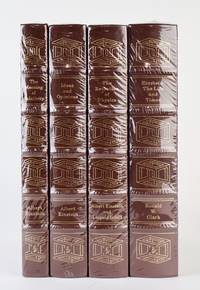
20041393704Norwalk CT: The Easton Press 2004. Collector's Editions. Hardcover. Octavos Four Volumes. Bound in brown genuine leather with bright gilt spine titles and gilt motifs on covers. Gilt text blocks. Paper endpapers silk ribbons. In publisher's shrinkwrap. MA consignment. Shelved above Science Fiction. 1393704. Shelved Dupont Bookstore. The Easton Press hardcover