EINSTEIN, AlbertBiblio.com
1 506 résultats
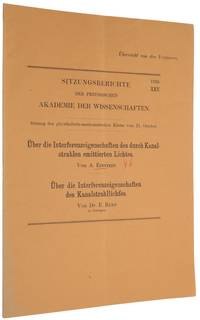
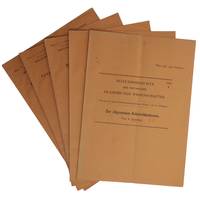
19236416Berlin: Akademie der Wissenschaften 1923. First edition. <p>First edition extremely rare author's presentation offprints "Überreicht vom Verfasser" from the library of the great German physicist Arnold Sommerfeld of Einstein's most important early publications on unified field theory. Einstein's work on unified field theory was inspired by James Clerk Maxwell's success in finding a unified theory of electricity and magnetism one of the greatest achievements of nineteenth-century physics. Einstein's contributions in this area represent about a quarter of his entire research output and half his scientific production after 1920. Such presentation offprints were issued in very small numbers unlike the commercially available separate printings which are common on the market.</p>. UNIFIED FIELD THEORY. <p>First edition extremely rare author's presentation offprints "Überreicht vom Verfasser" not to be confused with the much more common trade separates - see below from the library of the great German physicist Arnold Sommerfeld of Einstein's most important early publications on unified field theory. Einstein's work on unified field theory was inspired by James Clerk Maxwell's success in finding a unified theory of electricity and magnetism one of the greatest achievements of nineteenth-century physics which showed that light was a form of electromagnetic wave and made possible modern inventions such as radio television and the telephone. Einstein's contributions in this area represent about a quarter of his entire research output and half his scientific production after 1920. Although he was ultimately unsuccessful a similar vision was realized in the decades after his death in the construction of the 'standard model' a unified theory of electromagnetism with the weak and strong nuclear forces which were unknown in Einstein's time and efforts to incorporate gravity into the model continue to this day. 'Zur allgemeinen Relativitätstheorie' written on board ship during his return journey from Japan "gives us insight into the workings of Einstein's mind as it searched for a unified theory of gravitation and electromagnetism a search that would dominate his thinking for the rest of his life" Collected Papers 13 p. lxxvii. 'Einheitliche Feldtheorie von Gravitation und Elektrizität' was the first paper to use the term 'Unified Field Theory' in its title. In its opening paragraph Einstein wrote: "After incessant search during the last two years I now believe I have found the true solution" Pais Subtle is the Lord p. 343. The half-dozen papers Einstein had already written on unified field theory were reactions to the ideas of others such as Eddington Kaluza and Weyl; it was in this paper that Einstein put forward the first original approach of his own. "His theory rested in major part on the following arithmetical coincidence. In one of the customary ways of describing electromagnetism 6 field quantities are used. The metrical tensor of general relativity has a certain symmetry. Remove that symmetry and it will automatically contain not 10 but 16 field quantities. Use 10 combinations of these for gravitation and there will be 6 left over - just the number of field quantities with which to represent electromagnetism" Hoffmann Einstein p. 225. In 1928 Einstein embarked upon a new approach to a unified field theory involving what he called 'distant parallelism.' This was introduced in 'Riemann-Geometrie mit Aufrechterhaltung des Begriffes des Fernparallelismus' and 'Neue Möglichkeit für eine einheitliche Feldtheorie von Gravitation und Elektrizität.' By early 1929 he had solved the main problems involved in writing down field equations for his unified theory and presented his solution in 'Zur einheitlichen Feldtheorie'. "Einstein did propose in this last paper a set of field equations but added that 'further investigations will have to show whether these will give an interpretation of the physical qualities of space'. His attempt to derive his equations from a variational principle had to be withdrawn. Nevertheless in 1929 he had 'hardly any doubt' that he was on the right track" Pais p. 346. "Within three days the first printing of the journal offprint i.e. the commercial separate-a thousand copies-sold out and another thousand copies were soon printed. Soon thereafter Nature's News and Views section published a more accessible account of the work including a quote by Einstein: 'Now but only now we know that the force which moves electrons in their ellipses about the nuclei of atoms is the same force which moves our earth in its annual course about the sun and is the same force which brings to us the rays of light and heat which make life possible upon this planet.' With Einstein's 50th birthday approaching his new idea rapidly caught fire at least in the popular press. The New York Times published almost a dozen articles that year about distant parallelism rivaling its coverage of the 1919 eclipse results" Halpern. "In this frenzied unscientific atmosphere Einstein's new theory was hailed in the press as an outstanding scientific advance. Yet Einstein had stated in his article that it was still tentative; and soon he found he had to abandon it" Hoffman p. 226. Only paper III was present in the collection of presentation offprints of Einstein's son Hans Albert Christie's 2006 and in Einstein's own collection Christie's 2008; and no other copies of any of the offprints with "Überreicht vom Verfasser" can be identified on RBH. Similarly although several copies of each offprint can be found in institutional collections it is unclear how many are presentation offprints as the library records do not mention "Überreicht vom Verfasser".</p> <br /> <p>Provenance: Arnold Sommerfeld 1868-1951 his ink stamp on the front cover of III-V and characteristic numbering in red pencil on each - 40 45 47 48 49. "The son of a physician Sommerfeld was educated at the University of Königsberg. After teaching briefly at the universities of Göttingen Clausthal and Aachen he was appointed professor of physics at the University of Münich in 1906. Sommerfeld should have retired in 1936 in favour of his pupil Werner Heisenberg. Opposition from the Nazi party to Heisenberg's appointment prolonged Sommerfeld's tenure and it was not in fact until late 1939 that he finally retired to be succeeded not by Heisenberg but by Wilhelm Müller a Nazi aerodynamicist without a single publication in physics to his credit. Although Sommerfeld and Heisenberg were not Jewish they were regarded by the Nazis as Jewish sympathizers. Sommerfeld however survived the war and returned to his Münich chair in 1945 continuing to work at physics until he died in a car accident in 1951" Oxford Reference. "Arnold Sommerfeld was one of the most distinguished representatives of the transition period between classical and modern theoretical physics. The work of his youth was still firmly anchored in the conceptions of the nineteenth century; but when in the first decennium of the century the flood of new discoveries experimental and theoretical broke the dams of tradition he became a leader of the new movement and in combining the two ways of thinking he exerted a powerful influence on the younger generation. This combination of a classical mind to whom clarity of conception and mathematical rigour are essential with the adventurous spirit of a pioneer are the roots of his scientific success while his exceptional gift of communicating his ideas by spoken and written word made him a great teacher" Max Born p. 275. </p> <br /> <p>"Einstein's early work on the unification program after the completion of the theory of general relativity was by and large a reaction to approaches advanced by others. This is the case for the first geometrization of the electromagnetic field proposed in 1918 by Hermann Weyl; for the first exploration of a five-dimensional theory suggested by Theodor Kaluza in 1919; and for the first attempt to base a unified field theory on the concept of the affine connection rather than on the metric field as advanced by Arthur Eddington in 1921" Sauer pp. 289-90.</p> <br /> <p>Weyl 1885-1955 had introduced a new geometrical object into the theory that he called a "length connection" and he used it to establish a link between the geometrical structure given by the length connection and the electromagnetic field. Einstein was initially enthusiastic about Weyl's idea calling it "a first-class stroke of genius" but quickly found a serious objection to it showing that it implied that the wavelength of light emitted by a radiating atom would depend on the prehistory of that atom contrary to observation. Nevertheless in March 1921 Einstein elaborated on Weyl's theory in his paper 'Uber eine naheliegende Ergänzung des Fundamentes der allgemeinen Relativitätstheorie.'</p> <br /> <p>Another idea to which Einstein responded was put forward as early as 1919 by Theodor Kaluza 1885-1954 at the time Privatdozent in mathematics at the University of Königsberg; he introduced the concept of a fifth dimension to the underlying space-time manifold of general relativity and attempted to represent the electromagnetic field in terms of the additional components of the metric tensor. Einstein showed that for the equation of motion of an electron Kaluza's theory predicted that the influence of the gravitational field was larger by many orders of magnitude than any reasonable physical interpretation would allow for. Nevertheless Einstein later encouraged Kaluza to publish his idea and Einstein and Jakob Grommer 1879-1933 published a response to it in 1923 'Beweis der Nichtexistenz eines überall regulären zentrisch symmetrischen Feldes nach der Feld-Theorie von Kaluza'.</p> <br /> <p>A third approach toward a unified field theory was advanced most notably by Eddington 1882-1944 in the early twenties and was also taken up by Einstein. The idea was to base the theory on the concept of an affine connection as the fundamental mathematical quantity rather than on the metric tensor. The associated Ricci curvature of spacetime is not then in general a symmetric tensor and Eddington suggested that the anti-symmetric part of the curvature could be identified with the electromagnetic field the symmetric part being the usual metric. Eddington did not however provide the field equations that would determine the affine connection a problem Einstein addressed in 'Zur allgemeinen Relativitätstheorie' paper I. Einstein identified the symmetrized part of the Ricci tensor with the 'natural' metric of the theory and like Eddington he linked the antisymmetrized Ricci tensor to the electromagnetic field. Einstein's criticism of Eddington's approach focused on Eddington's failure to provide field equations that determine all forty connection coefficients and the derivation of such field equations became the focal point of the published paper. Lastly Einstein explicitly introduced a scale factor λ that mediates between the scale of the 'natural' metric defined by the Ricci tensor and that of the physical metric. </p> <br /> <p>"With Einstein's response to Weyl Kaluza and Eddington in the early twenties we find him reacting to approaches that had been advanced by others . The first original approach put forward by Einstein himself was published in a paper of 1925 paper II in which also the term 'unified field theory' appeared for the first time in a title. In that paper he explored a metric-affine approach i.e. he took both a metric tensor field and a linear affine connection at the same time as fundamental variables. Both connection and metric were assumed to be asymmetric. Parallel transport then again defines a Ricci tensor and a Riemann curvature scalar and Einstein defined tentative field equations in terms of a variational principle taking the Riemann scalar as a Lagrangian just as in standard general relativity. As regards the interpretation of the mathematical objects he tried to associate the gravitational and electromagnetic fields with the symmetric and anti-symmetric parts of the metric field. In his attempt to recover the known cases he could show that the metric was symmetric for the purely gravitational case and the usual compatibility condition for the Levi-Civita connection can be recovered. Maxwell's equations could be recovered in the limit of weak gravitational fields but only in a slightly different form that is not entirely equivalent to the original equations.</p> <br /> <p>"The basic problem of this approach seems to have been that Einstein did not know how to go on from here. Dealing with both an asymmetric metric tensor and an asymmetric connection opened up a vast field of possibilities inherent in the mathematical framework and many familiar results of the theory of Riemannian geometry no longer held. In particular verifying the existence of non-singular spherically symmetric charge distributions posed a formidable challenge. It was also unclear how to explicitly investigate the non-vacuum case beyond the first order approximation of weak gravitational fields. Einstein did not pursue this approach any longer in print but he did take it up once more twenty years later as his final approach toward a unified field theory working on it until his death" Sauer pp. 293-5.</p> <br /> <p>"At some point in May 1928 while convalescing at home in Berlin Einstein had an idea for what he thought was 'an entirely new way of realizing the general theory of relativity and that may be groundbreaking.' Key to this new approach was the notion of a field of mutually orthogonal normal vectors defined on the space-time manifold. This was a so-called n-Bein-Feld or in more modern terminology for n = 4 a field of tetrads. Such a theory admits the definition of a natural notion of distant parallelism by identifying vectors on this orthonormal frame field. Two vectors at distant points of the manifold are parallel by definition if they are represented by the same vector of the orthonormal frames at the respective points. The manifold also carries a Riemannian metric which can be expressed in terms of the tetrad field. Since the tetrad field determines the metric field but not the other way around the tetrads provide more degrees of freedom which Einstein hoped could be put to use to provide a representation of the electromagnetic field. </p> <br /> <p>"At Einstein's request on 7 June 1928 Max Planck presented a brief note on this 'Riemannian Geometry Retaining the Concept of Distant Parallelism' paper III to the Prussian Academy for publication in its Proceedings. Since Einstein was not sure at the time whether the notion of Fernparallelismus that is distant parallelism or teleparallelism and its associated geometric concepts were known in the mathematical literature he asked Planck to inquire among his mathematician colleagues whether any of this was known before submitting the paper for publication. Planck did not find the occasion to do as requested but nevertheless submitted the paper. </p> <br /> <p>"Only a week later Einstein realized how to put the geometry of distant parallelism to use for his project of a unified theory of both the gravitational and the electromagnetic fields. The idea was to postulate a variational principle for an invariant action integral that depended on the tetrad field as the dynamical variable. </p> <br /> <p>"From this perspective the problem presented itself as a fairly well-defined mathematical problem but posed difficulties of interpretation in terms of physical concepts. From the mathematical side the required invariance of the variational integral created a clearly defined problem. One needed to identify all possible invariants that can be constructed from the tetrads as well as a combination of these invariants that would be suitable as a Lagrangian for the variational integral. Second variation with respect to the tetrad field would produce differential equations that had to be associated with the known field equations of gravitation and electromagnetism in certain limiting cases. Third solutions for the differential equations had to be found. Finally Einstein later would become interested in finding identities that would be satisfied by the tetrads by virtue of general covariance or that might be postulated to derive field equations. As far as the physical interpretation was concerned the metric field would take on its old role as in the general theory namely corresponding to the gravitational field. But the electromagnetic field also had to be identified with quantities occurring in the geometric framework. </p> <br /> <p>"As a first step Einstein identified the relevant possible invariants to be constructed from the tetrads. He also realized that in addition to the possibility of constructing a metric-compatible Levi-Civita connection from the metric as well as the associated notion of parallel transport the tetrad field allowed the definition of another connection with its notion of parallelism. In contrast to the Levi-Civita connection the teleparallel connection is asymmetric and describes a geometry that has vanishing Riemann curvature. Instead it is characterized by the nonvanishing of a tensorial quantity constructed from the teleparallel connection that is now known as the torsion tensor. Taking the mathematical expression of torsion a third-rank tensor Einstein tentatively identified its contraction with the electromagnetic four-potential. And settling on what seemed to be the simplest invariant to be taken as a basis for a tentative field theory Einstein succeeded in deriving to first approximation in the field components both the gravitational field equations of general relativity as well as an equivalent version of the Maxwell equations. </p> <br /> <p>"Again a brief note on this work was presented by Planck to the Academy on 14 June 1928 and was published in July under the title 'New Possibility for a Unified Field Theory of Gravitation and Electricity' paper IV. These two notes mark the beginning of a search for a unified field theory in this teleparallel framework that would preoccupy Einstein for the next two or three years .</p> <br /> <p>"The new approach to unified field theory opened the possibility of finding solutions to long-standing problems and work along these lines continued with intense phases of calculation and collaboration partly done when Einstein withdrew from public life and spent extended periods of time in secluded residences in Scharbeutz and Gatow or later in Caputh. However in mid-December 1928 difficulties in working out the consequences of the new differential equations had piled up to such a point that Einstein reconsidered the basis of their derivation by means of Hamilton's principle. On 13 December he wrote to his collaborator Chaim Herman Müntz that he had a 'simple bold idea that will throw Hamilton's principle overboard'. Instead of trying to recover the Maxwell equations in some acceptable limit he would now 'put the cart before the horse' and 'choose the field equations in such a way that I can be certain that they will lead to the Maxwell equations'. But yet again things turned out to be more difficult and for a few days in late December he reverted to the 'old Hamilton method once again'. But over the New Year's break on another retreat in Gatow Einstein gave up again on the variational approach and derived field equations based instead on some identities. On 27 December he wrote to Müntz: 'EUREKA!' convinced that he had found a solution that was 'so splendid nothing nicer could be imagined'. </p> <br /> <p>"The new progress was written up in a brief paper completed by 5 January 1929. Einstein was exhausted but happy about this new paper 'lying finished in front of me compressed into seven pages under the title 'Unified Field Theory'.' To his son Eduard he wrote on the same day that he was 'very happy' because he had 'more or less completed my life's work'. The paper was submitted on 10 January 1929 for publication in the Prussian Academy's Proceedings and appeared under the somewhat less assertive title 'On Unified Field Theory' paper V. </p> <br /> <p>"When published the paper made a big splash in the press and received much public attention. A press release appeared in the New York Times on 11 January and reports followed on 12 January in the German and international press. The paper was reprinted in a record number of copies and Einstein wrote a popular exposition English translations of which appeared in the London Times and the New York Times as well as in the Observatory. In Britain Nature contacted Einstein for a copy in order to report on it a request that Einstein diverted to Eddington. The latter informed Einstein a little later about the craze that his latest publication had stirred in London where 'one of our great Department Stores in London Selfridges has pasted up in its window your paper six pages pasted up side-by-side so that passers-by can read it all through. Large crowds gather round to read it!'. </p> <br /> <p>"The paper is indeed a rather technical brief note as Einstein soon pointed out and 'no occasion for anybody to be excited about it' as there will be 'only a few mathematicians who will be inclined to read it'. In a letter to Karl Kerkhof he admitted that he himself might carry some responsibility for the excitement since he 'may have alluded to it in speaking with one or another of my friends'. Among them was Hans Reichenbach who reported on the new approach in a column in the Vossische Zeitung before Einstein's printed paper was actually issued and thereby caused a deep rift between them. In any case it soon became clear that the brief paper would not be the last word on the theory. Already the published version carried an addendum in which Einstein indicated a simpler way of looking at things" Collected Papers 16 pp. lxiv-lxix.</p> <br /> <p>"Einstein soon was to learn that the mathematical concept of distant parallelism was by no means new and had already been explored by mathematicians notably by Roland Weitzenböck and Élie Cartan. While immediately acknowledging the priority of others as far as the mathematics was concerned Einstein nevertheless held high hopes for his idea of formulating a unified field theory within this structure. For him the critical question was to find a field equation for the components of the dynamical tetrad fields. Each field of tetrads defines a metric tensor field. But the converse is not true since the metric tensor components can only fix ten of the sixteen components of a tetrad. The additional six degrees of freedom are just what would be needed so he thought to accommodate the six degrees of freedom of the Maxwell field in a unified description of gravitation and electromagnetism. </p> <br /> <p>"The story of the distant parallelism approach can be told largely as a story of attempts to find and justify a uniquely determined set of field equations for the tetrad components with the demand that solutions of those field equations be given a sensible physical interpretation. The distant parallelism approach in this respect shows a number of marked similarities with Einstein's search for general relativistic field equations of gravitation in the years 1912-15. In 1912 it had been the introduction of the metric tensor into the theory that had started Einstein's research and existing mathematical theorems had to be adapted to the theory. In 1928 it was the tetrad fields that allowed the investigation of a non-Euclidean geometry of vanishing curvature and similarly Einstein was made aware of existing mathematical results by mathematician colleagues. In both cases Einstein's research quickly focussed on finding a set of field equations for the dynamical variables and in both cases it was difficult to satisfy all heuristic requirements. In response to these difficulties Einstein changed back and forth between two different and complementary strategies each starting from one particular set of heuristic postulates. In both episodes Einstein at one point settled on a set of field equations that was justified more by physical considerations rather than by mathematical soundness. In both cases Einstein continued to work out consequences of the field equations as well as continued to find a satisfactory mathematical justification for these equations. And finally the demise of both theories came about by a combination of realizing more and more shortcomings of the theory and by discovering that an alternative approach promised to be more successful. However while in 1915 the more successful theory that Einstein substituted for his earlier so-called Entwurf theory was the final version of general relativity the successor approach to the distant parallelism episode turned out to be yet another attempt at a unified field theory" Sauer pp. 296-7.</p> <br /> <p>These author's presentation offprints are of extreme rarity and must be distinguished from other so-called 'offprints' of papers from the Berlin Sitzungsberichte many of which are commonly available on the market. The celebrated bookseller Ernst Weil 1919-1981 in the introduction to his Einstein bibliography wrote: "I have often been asked about the number of those offprints. It seems to be certain that there were few before 1914. They were given only to the author and mostly 'Überreicht vom Verfasser' Presented by the Author is printed on the wrapper. Later on I have no doubt many more offprints were made and also sold as such especially by the Berlin Academy." If the term 'offprint' means as we believe it should a separate printing of a journal article given only to the author for distribution to colleagues then 'offprints' were not commercially available. Although there is certainly some truth in Weil's remark in our view it requires clarification and explanation.</p> <br /> <p>Until about 1916 most of Einstein's papers were published in Annalen der Physik; from 1916 until he left Germany for the United States in 1933 most were published in the Berlin Sitzungsberichte. The Sitzungsberichte differed from other journals in which Einstein published in that it made separate printings of its papers commercially available. These separate printings have 'Sonderabdruck' printed on the front wrapper the usual German term for offprint but they are not offprints according to our definition. They were available to anyone; indeed a price list of these 'trade offprints' is printed on the rear wrapper. True author's presentation offprints can be distinguished from these trade separates by the presence of 'Überreicht vom Verfasser' on the front wrapper.</p> <br /> <p>In the period 1916 to 1919 or 1920 the Sitzungsberichte trade separates are themselves rare. After 1919 or 1920 however the trade separates become much more common although the author's presentation offprints are still very rare. The reason for this change is that it was only in 1919 that Einstein became famous among the general public.</p> <br /> <p>It might seem obvious that Einstein's fame dates from 1905 his 'annus mirabilis' in which he published his epoch-making papers on special relativity and the light quantum. However these works did not make him immediately well known even in the physics community - many physicists did not understand or accept his work and it was two or three years before his genius was fully accepted even by his colleagues. Einstein did not secure an academic position until 1908. Among the general public Einstein became well known only in late 1919 following the success of Eddington's expedition to observe the bending of light by the Sun which confirmed Einstein's general theory of relativity. This was front-page news and made Einstein universally famous. See Chapter 16 'The suddenly famous Doctor Einstein' in Pais Subtle is the Lord for an account of these events. Before 1919 the trade separates of Einstein's papers would probably only have been purchased by professional physicists; after 1919 everyone wanted a memento of the famous Dr. Einstein whether or not they understood anything of theoretical physics and the trade separates of his papers were printed and sold in far greater numbers than before to meet the demand. It is telling that when these post-1919 trade separates appear on the market they are often in mint condition - they were never read simply because their owners were unable to understand them.</p> <br /> <p>I. BRL 140; Weil 131. II. BRL 155; Weil 147. III. BRL 174; Weil 161. IV. BRL 175; Weil 162. V. BRL 183; Weil 165 cf. PMM 416. Born 'Arnold Johannes Wilhelm Sommerfeld 1868-1951' Obituary Notices of Fellows of the Royal Society 8 1952 pp. 275-296. Halpern 'Albert Einstein celebrity physicist' Physics Today 1 April 2019 pp. 38-45. Sauer 'Einstein's unified field theory program' Chapter 9 in: The Cambridge Companion to Einstein Janssen & Lehner eds. 2014.</p> <br/> <br/> 8vo 252 x 180 mm pp. 334-340; 341-351. Original printed wrappers portion of ink postmark stamp on lower cover just into text of publisher's advertisements light vertical crease for posting. Akademie der Wissenschaften unknown
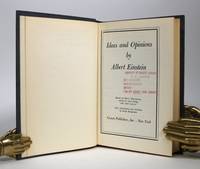
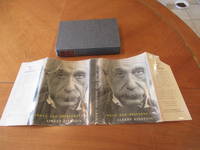
1968019130Crown Publishers. First Printing. No Statement Of Printing DJ Price Clipped But Exactly Same As First And Came With This Book Publisher's Address As 419 Fourth Avenue On Front And Rear Flaps.Clipped DJ in archival cover edge wear small chips. . Fine. Hardcover. 1st Edition. 1968. Crown Publishers hardcover
1954016895New York: Crown Publishers Inc 1954. 1st Edition. Hardcover. Near Fine/No Jacket. 8vo. Second printing stated. Orig. blue cloth. v 377 pp. Ex libris stamp of R.A. Javitch with his gift inscription to his brother to ffep. Spine slightly sunned light age toning to interior about fine overall. This volume gathers some of Einstein's most influential writings and speeches across his career as a theoretical physicist. Crown Publishers, Inc hardcover
1995Q-0517884402Crown 1995-06-06. Paperback. New. In shrink wrap. Looks like an interesting title! Crown paperback
1994Q-0679601058Modern Library 1994-06-21. Hardcover. New. In shrink wrap. Looks like an interesting title! Modern Library hardcover
1988Q-0517003937Bonanza Books 1988-12-12. Hardcover. New. New. In shrink wrap. Looks like an interesting title! Bonanza Books hardcover
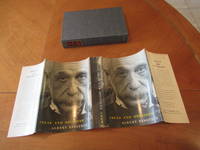
1954042205New York: Crown Publishers 1954. 1st Edition 1st Printing. Hardcover. Fine/Near Fine. Vii 377 Pp. Grey Cloth Spine Lettered In Gilt On Maroon Background. First Edition 1954 First Printing No Statement Of Printing Dj Priced $4.00 Publisher's Address As 49 Fourth Avenue On Front And Rear Flaps. Book Fine Spine Edges Crisp. Former Owner's Verified Signature With August 1954 Date No Other Marks. Dj Near Fine Touch Of Rubbing At Corners 1/4" Closed Tear At Bottom Of Front Spine Edge With Associated Rubbing And Another 1/4" Closed Tear At Top Of Rear Panel. Seldom Seen In This Condition Or Better. <br/> <br/> Crown Publishers hardcover
1954042247New York: Crown Publishers 1954. 1st Edition 1st Printing. Hardcover. Very Good/Good. Vii 377 Pp. Grey Cloth Spine Lettered In Gilt On Maroon Background. First Edition 1954 First Printing No Statement Of Printing Dj Priced $4.00. Book With Gilt Bright Just Slight Wear At Corners But Fraying Along Top And Bottom Edges Of Spine No Marks Aging To Outer Edges Of Page Block. Dj Very Good Small Chips At Corners 1 1/4" V-Chip At Bottom Of Rear Panel Removing 4 Letters In Title And Author's Name No Browning. <br/> <br/> Crown Publishers hardcover
1954044237New York: Crown Publishers 1954. 1st Edition 1st Printing. Hardcover. Near Fine/Very Good. Vii 377 Pp. Grey Cloth Spine Lettered In Gilt On Maroon Background. First Edition 1954 First Printing No Statement Of Printing Dj Price Clipped But Exactly Same As First And Came With This Book Publisher's Address As 419 Fourth Avenue On Front And Rear Flaps. Book Near Fine Spine Edges Bumped No Marks. Dj Good Rubbing At Corners With Small Losses 2 1/2" Closed Tear At Bottom Of Front Spine Edge 3 1/2" Tear Across Top Left Corner Of Rear Panel 1 1/4" Closed Tear Bottom Of Rear Panel No Loss Of Lettering Slight Fading Of Yellow Lettering On Spine Panel. <br/> <br/> Crown Publishers hardcover
19266414Berlin: Akademie der Wissenschaften 1926. First edition. <p>First edition very rare author's presentation offprint extremely rare author's presentation offprint not to be confused with the much more common trade separate - see below from the library of the great German physicist Arnold Sommerfeld of the notorious Einstein/Rupp experiments which demonstrated the wave-theory of light contrary to Einstein's expectations.</p>. SCIENTIFIC FRAUD: THE EINSTEIN-RUPP EXPERIMENTS. <p>First edition extremely rare author's presentation offprint not to be confused with the much more common trade separate - see below from the library of the great German physicist Arnold Sommerfeld of the notorious Einstein/Rupp experiments. "In the fall of 1926 Albert Einstein published the outline of two experiments in the Proceedings of the Berlin Academy. They addressed one of the most urgent questions in physics at the time: the experiments were to show if the emission of light was a process that was extended in time or if instead light emission occurred in an instantaneous act. Of course the first possibility would confirm a traditional oscillator-and-wave-like view whereas the second possibility would cohere well with Einstein's own ideas on light quanta. It is quite surprising that these experiments are so unfamiliar today. Apart from addressing a central question and being proposed by no lesser figure than Einstein they also circulated at a crucial moment in the history of quantum theory. Still the experiments are not mentioned in any of the standard Einstein biographies and there is no substantial treatment of them in histories of the quantum theory . The likely cause for this lack of attention is at least as surprising: the experiments were-supposedly-conducted by Emil Rupp yet a decade later Rupp was exposed as a scientific fraudster; the results obtained by Rupp in close consultation with Einstein and published back-to-back with the latter's theoretical paper were in the end generally believed to have been fabrications" Van Dongen. As Walter Gerlach of Stern-Gerlach fame said in an interview with Thomas Kuhn in 1963 "Rupp in the late twenties early thirties was regarded as the most important and most competent physicist. He did incredible things. . Later it turned out that everything that he had ever published everything was forged. This had gone on for ten years ten years!" Nevertheless "these experiments played a substantial role in developments in 1926. Most importantly they confirmed a wave picture of light when many including Einstein himself initially expected a particle-like instantaneous picture of light emission to be confirmed. After all only a few years before Compton scattering had been shown and as little as a year before the Einstein-Rupp experiments Walther Bothe and Hans Geiger had done the experiments that dismissed the BKS theory. But the experiments of Einstein and Rupp also influenced events in other ways. For instance their initial interpretation was most likely of direct importance for Max Born when he proposed the probabilistic interpretation of the wave function. The experiments further played a role in the thinking of Werner Heisenberg as he formulated his uncertainty relations . these experiments deserve renewed attention and their current obscure status is not warranted by their historical importance" Van Dongen. OCLC locates only three copies two in Switzerland one in Germany but it is unclear which of these if any are author's presentation offprints. The presentation offprint was not present in the collection of Einstein's son Hans Albert Christie's 2006 but it was in Einstein's own collection of his offprints Christie's 2008.</p> <br /> <p>Provenance: Arnold Sommerfeld 1868-1951 his characteristic numbering '46' in red pencil on front cover. "The son of a physician Sommerfeld was educated at the University of Königsberg. After teaching briefly at the universities of Göttingen Clausthal and Aachen he was appointed professor of physics at the University of Münich in 1906. Sommerfeld should have retired in 1936 in favour of his pupil Werner Heisenberg. Opposition from the Nazi party to Heisenberg's appointment prolonged Sommerfeld's tenure and it was not in fact until late 1939 that he finally retired to be succeeded not by Heisenberg but by Wilhelm Müller a Nazi aerodynamicist without a single publication in physics to his credit. Although Sommerfeld and Heisenberg were not Jewish they were regarded by the Nazis as Jewish sympathizers. Sommerfeld however survived the war and returned to his Münich chair in 1945 continuing to work at physics until he died in a car accident in 1951" Oxford Reference. "Arnold Sommerfeld was one of the most distinguished representatives of the transition period between classical and modern theoretical physics. The work of his youth was still firmly anchored in the conceptions of the nineteenth century; but when in the first decennium of the century the flood of new discoveries experimental and theoretical broke the dams of tradition he became a leader of the new movement and in combining the two ways of thinking he exerted a powerful influence on the younger generation. This combination of a classical mind to whom clarity of conception and mathematical rigour are essential with the adventurous spirit of a pioneer are the roots of his scientific success while his exceptional gift of communicating his ideas by spoken and written word made him a great teacher" Max Born p. 275. </p> <br /> <p>"Born in 1898 Rupp began his career in the 1920s studying canal rays beams of positive ions and atoms formed between an anode and cathode the latter punctured with holes or "canals" in a gas discharge tube. When these rays shoot through the canals and into a vacuum chamber the ions rapidly lose and gain charge emitting visible light that becomes less intense at the other end of the canal.</p> <br /> <p>"In his first experiments in the mid-1920s Rupp measured the coherence length of light - the distance over which the light maintains a consistent phase - emitted by hydrogen and mercury atoms in the canal rays. He measured these lengths as 62 centimeters for hydrogen and 15.2 centimeters for mercury. These were blockbuster results: A moving hydrogen atom was expected to stay coherent over a much smaller distance.</p> <br /> <p>"What's more Rupp's extra-long hydrogen canal ray seemed like it could be used to test one of physics' biggest questions at the time: Is light a particle or a wave Einstein had devised experiments to test if light was emitted instantaneously or over time but he needed a light with an extra-long coherence length - and only Rupp had achieved it.</p> <br /> <p>"After reading Rupp's 1926 paper Einstein published his own "Proposal for an Experiment on the Nature of the Elementary Process of Radiation Emission" and reached out to Rupp directly to discuss a collaboration. But because Rupp's boss at Heidelberg University the physicist Philipp Lenard was "a fervent anti-relativist - and anti-Semite" writes van Dongen Einstein chose to forgo a visit to the institution and sent instructions for Rupp to do the experiments on his own.</p> <br /> <p>"There were red flags from the start. In one instance Rupp appeared to have altered the mirrors in his interferometer the instrument he used to study interference just so into an arrangement that would obtain desired outcomes. In another instance when Einstein corrected the settings Rupp reported using for another instrument Rupp chalked the mistake up to a typo. There were other 'alarming discrepancies' in Rupp's calculations van Dongen writes and Einstein's letters show that he pushed back on several occasions. Each time Rupp responded with new results that perfectly explained the oddities Einstein questioned.</p> <br /> <p>"Initially Einstein expected to find that light was emitted instantaneously. But as the collaboration stretched on he began to expect the experiments would confirm the alternative the 'classical' theory. 'One of the reasons for his changing position likely was that that outcome had inadvertently already been corroborated by Rupp' van Dongen writes.</p> <br /> <p>"When Rupp furnished Einstein with a final set of results supporting the classical emission picture Einstein facilitated their publication in the proceedings of the Prussian Academy of Sciences. They were published back-to-back with a paper by Einstein explaining the theory behind the experiments in which Einstein cited Rupp's work. Einstein even helped Rupp draft his paper's abstract.</p> <br /> <p>"The association with Einstein rocketed Rupp to scientific prominence and in 1928 he accepted a position in the research labs of German electronics company AEG 'a kind of counterpart to General Electric' writes MIT physicist Anthony French in his 1999 retrospective of Rupp's case.</p> <br /> <p>"However scientists had begun voicing skepticism about Rupp's canal ray work. Among them were British spectroscopist Robert d'Escourt Atkinson who doubted Rupp's extraordinary coherence lengths and a researcher named Harald Straub who tried and failed to replicate Rupp's measurements in 1930. Rupp came down hard on Straub with a rebuttal sending photographs that supposedly showed his interference fields and forcefully defending his work in the same journal where Straub published his. Straub wrote that he had nothing else to add and the matter appeared settled.</p> <br /> <p>"But Rupp's reputation was bruised in the episode and his letters from the time indicate that his funding at AEG was drying up. He published work on electron scattering then took up experiments with positrons producing them by pounding lithium with protons. In a 1934 paper Rupp claimed to have accelerated protons at potential differences of 500 kV. This was impossible for him to have done - he simply did not have the requisite accelerator in his lab.</p> <br /> <p>"In December 1934 two of Rupp's fellow scientists at AEG brought the glaring problem to the attention of the institute's director who launched an investigation and subsequently fired Rupp. In January 1935 Rupp published the retraction statement appended to his doctor's note claiming he had no knowledge of or control over the fabrications. And later that year experimentalists Walther Gerlach and Eduard Rüchardt published 'On the Coherence Length of Light emitted by Canal Rays' which essentially confirmed that Rupp's early canal ray work was also erroneous. Amid this public humiliation Rupp experienced a nervous breakdown and spent time in a sanatorium. He never worked in physics again.</p> <br /> <p>"Einstein however escaped from the episode unscathed. Historians like van Dongen think his credulousness was an honest mistake underpinned by his desire to see his theories confirmed by experiments. Rupp's work and life are now a footnote but following his downfall it appears that German scientists mentioned his name often. According to French 'for a number of years afterward the word 'geruppt' became an epithet among German physicists to describe questionable work'" Jooss. </p> <br /> <p>This author's presentation offprint is of extreme rarity and must be distinguished from other so-called 'offprints' of papers from the Berlin Sitzungsberichte many of which are commonly available on the market. The celebrated bookseller Ernst Weil 1919-1981 in the introduction to his Einstein bibliography wrote: "I have often been asked about the number of those offprints. It seems to be certain that there were few before 1914. They were given only to the author and mostly 'Überreicht vom Verfasser' Presented by the Author is printed on the wrapper. Later on I have no doubt many more offprints were made and also sold as such especially by the Berlin Academy." If the term 'offprint' means as we believe it should a separate printing of a journal article given only to the author for distribution to colleagues then 'offprints' were not commercially available. Although there is certainly some truth in Weil's remark in our view it requires clarification and explanation.</p> <br /> <p>Until about 1916 most of Einstein's papers were published in Annalen der Physik; from 1916 until he left Germany for the United States in 1933 most were published in the Berlin Sitzungsberichte. The Sitzungsberichte differed from other journals in which Einstein published in that it made separate printings of its papers commercially available. These separate printings have 'Sonderabdruck' printed on the front wrapper the usual German term for offprint but they are not offprints according to our definition. They were available to anyone; indeed a price list of these 'trade offprints' is printed on the rear wrapper. True author's presentation offprints can be distinguished from these trade separates by the presence of 'Überreicht vom Verfasser' on the front wrapper.</p> <br /> <p>In the period 1916 to 1919 or 1920 the Sitzungsberichte trade separates are themselves rare. After 1919 or 1920 however the trade separates become much more common although the author's presentation offprints are still very rare. The reason for this change is that it was only in 1919 that Einstein became famous among the general public.</p> <br /> <p>It might seem obvious that Einstein's fame dates from 1905 his 'annus mirabilis' in which he published his epoch-making papers on special relativity and the light quantum. However these works did not make him immediately well known even in the physics community - many physicists did not understand or accept his work and it was two or three years before his genius was fully accepted even by his colleagues. Einstein did not secure an academic position until 1908. Among the general public Einstein became well known only in late 1919 following the success of Eddington's expedition to observe the bending of light by the Sun which confirmed Einstein's general theory of relativity. This was front-page news and made Einstein universally famous. See Chapter 16 'The suddenly famous Doctor Einstein' in Pais Subtle is the Lord for an account of these events. Before 1919 the trade separates of Einstein's papers would probably only have been purchased by professional physicists; after 1919 everyone wanted a memento of the famous Dr. Einstein whether or not they understood anything of theoretical physics and the trade separates of his papers were printed and sold in far greater numbers than before to meet the demand. It is telling that when these post-1919 trade separates appear on the market they are often in mint condition - they were never read simply because their owners were unable to understand them.</p> <br /> <p>BRL 160; Weil 153. Born 'Arnold Johannes Wilhelm Sommerfeld 1868-1951' Obituary Notices of Fellows of the Royal Society 8 1952 pp. 275-296. French 'The strange case of Emil Rupp' Physics in Perspective 1 1999 pp. 3-21. Joosse 'December 1934: Emil Rupp's research which fooled even Einstein is exposed as fraud' APS News Nov. 14 2023. Van Dongen 'Communicating the Heisenberg uncertainty relations: Niels Bohr complementarity and the Einstein-Rupp experiments' Scientia Danica. Series M Mathematica et physica 1: One Hundred Years of the Bohr Atom Proceedings 2015 pp. 310-343.</p> <br/> <br/> 8vo 252 x 180 mm pp. 334-340; 341-351. Original printed wrappers portion of ink postmark stamp on lower cover just into text of publisher's advertisements light vertical crease for posting. Akademie der Wissenschaften unknown
1997Q-1862041369Houghton Mifflin 1997-09-01. Hardcover. New. New. In shrink wrap. Looks like an interesting title! Houghton Mifflin hardcover
1926043114London: Methuen & Co. 1926. 1st Edition 1st Printing. Hardcover. Fine/No Jacket. Viii 124 Pp. Green Cloth White Spine Lettering. First Printing In Secondary Binding With White Lettering The First Binding Was Lettered In Gilt. Book Used But Still Fine No Rubbing Lettering Complete And Entirely Strong. Spanish Owner's Name With His 1948 Receipt From H. K. Lewin For The Book Laid In Loosely. Lacking The Scarce Dust Jacket. <br/> <br/> Methuen & Co. hardcover
1926043474London: Methuen & Co. 1926. 1st Edition 1st Printing. Hardcover. Near Fine/No Jacket. Viii 124 Pp. Green Cloth White Spine Lettering. First Printing In Secondary Binding With White Lettering The First Binding Was Lettered In Gilt. Book Used But Still Near Fine Very Slight Rubbing Lettering Complete With Some Wear Small Areas Of Lightening Of Color On Front Cover Darkening To Lower Corner Of Page "V" First Page Of Preface. No Marks. Lacking The Very Scarce Dust Jacket. <br/> <br/> Methuen & Co. hardcover
1926029292New York: E. P. Dutton and Company 1926. First American Edition 1st Printing. Hardcover. Very Good/Fair DJ. 124 Pp. Brown Cloth Gilt. First American Edition No Date Printing Statement Indicates 1926 British Sheets Were Used. Book Is Somewhat Worn And Has Small Areas Of Fraying At Corners Hinges Solid Small Previous Owner's Name On Front Free Endpaper. Dj Worn Bottom 40% Of Spine Chipped Away But Title And Author Remain Small Edge And Corner Chips. <br/> <br/> E. P. Dutton and Company hardcover
1902003205Leipzig: J. A. Barth 1902. Spine edges lightly rubbed; former owner's ink stamp on title page. First Edition. Contemporary Red Cloth. Very Good. J. A. Barth Hardcover
190249501Leipzig J. A. Barth 1902. 8vo. Bound in contemporary half calf with five raised bands and gilt lettering to spine. In ""Annalen der Physik. Vierte Folge. Band 9.". Entire volume offered. <br/><br/><em>First edition of Einstein's third paper in which he deals with the definitions of temperature and entropy for thermal equilibrium conditions and with the equipartition theorem.The volume contains 2 papers by Max Planck originally published in "Jubelband für H.A. Lorentz" und Jubelband für J. Bosscha: "Ueber die von einem elliptisch schwingenden Ion emitterte und absorbierte Energie;" und "Ueber die Verteilung der Energie zwischen Aether und Materie;" pp. 619-628 und pp. 629-641.Weil No 3. </em> hardcover
190238799Leipzig Ambrosius Barth 1902. Contemp. hcloth. First hinge broken. = "Annalen der Physik. Vierte Folge. Band 9." VIII1344 pp. and 5 plates. The Einstein Paper: pp. 417-435. Internally clean and fine. The whole volume offered. <br/><br/><em>First edition of Einstein's third paper. - Weil No 3. - The volume contains 2 papers by Max Planck originally published in "Jubelband für H.A. Lorentz" und Jubelband für J. Bosscha: "Ueber die von einem elliptisch schwingenden Ion emitterte und absorbierte Energie;" und "Ueber die Verteilung der Energie zwischen Aether und Materie;" pp. 619-628 und pp. 629-641. </em> hardcover
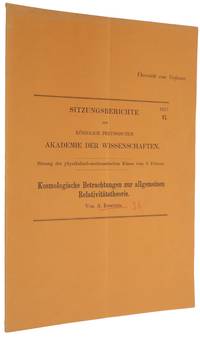
19176411Berlin: W. de Gruyter 1917. First edition. <p>First edition an extremely rare author's presentation offprint from the library of the eminent German physicist Arnold Sommerfeld of the groundbreaking paper that "laid the foundations of modern theories of the universe" O'Raifeartaigh. In this seminal work Einstein first applied the principles of general relativity to cosmology introducing the cosmological constant to allow for a static universe - a pivotal conceptual innovation that shaped modern theoretical physics. "There is little doubt that Einstein's 1917 paper 'Cosmological Considerations in the General Theory of Relativity' constituted a key milestone in 20th-century physics" ibid. This presentation offprint - issued in very limited numbers for private distribution by Einstein himself - is vastly scarcer than the commercially available separate printings which appear more regularly on the market.</p>. <p>LAID THE FOUNDATIONS OF MODERN THEORIES OF THE UNIVERSE</p> . <p>First edition extremely rare author's presentation offprint not to be confused with the more common trade separate - see below from the library of the great German physicist Arnold Sommerfeld of Einstein's 'cosmological constant' paper which "laid the foundations of modern theories of the universe" O'Raifeartaigh. "There is little doubt that Einstein's 1917 paper 'Cosmological Considerations in the General Theory of Relativity' constituted a key milestone in 20th century physics. As the first relativistic model of the universe the paper later known as 'Einstein's Static Universe' or the 'Einstein World' set the foundations of modern theoretical cosmology" O'Raifeartaigh et al. "It is generally agreed that the seeds of a revolution in theoretical cosmology were planted when Einstein completed his general theory of relativity in the fall of 1915. On 25 November he read to the Prussian Academy of Sciences the final communication which contained a consistent set of gravitational equations. One and a half years later in a paper announced on 8 February 1917 Einstein took the revolutionary step of exploring the consequences of his new theory for no less than the entire universe" Kragh p. 8. "The consequence of Einstein's version of Mach's principle is that at infinity the components of the metric tensor should degenerate: for an isotropic field the spatial components become zero whereas the timelike component goes to infinity. It turned out to be impossible to realize these conditions for centrally symmetric static fields. Einstein's way out was to postulate a universe that is spatially finite closed and static with a uniform mass distribution a universe in which no boundary conditions are needed. In order to do so however Einstein had to modify his field equations to include what became known as the 'cosmological constant'" Papers 6 p. xx. Max Born said of Einstein's conception "This suggestion of a finite but unbounded space is one of the greatest ideas about the nature of the worlds which has ever been conceived . It solved the mysterious fact why the system of stars did not disperse and thin out which it would do if space were infinite; it gave a physical meaning to Mach's principle which postulated that the law of inertia should not be regarded as a property of empty space but as an effect of the total system of stars; and it opened the way to the concept of the expanding universe" quoted in Clark p. 270. The 'Einstein world' described a static universe but in 1929 Edwin Hubble demonstrated that the universe is not static but expanding. Soon after Einstein rejected his cosmological constant as unnecessary and compromising the simplicity of his field equations. Nevertheless recent discoveries regarding dark matter and dark energy suggest that the cosmological constant may have a role to play in the explanation of the fact that the expansion of the universe appears to be accelerating. OCLC lists copies of this offprint at American Philosophical Society Burndy Huntington and University of Florida but it is unclear if any of these are author's presentation offprints rather than trade separates. We have been unable to locate any other presentation offprint on RBH - it was not present in the collection of Einstein's son Hans Albert Christie's 2006 nor in Einstein's own collection Christie's 2008. RBH lists only four copies of the trade separate in the last 75 years the last sold at Bonham's in 2022 for $15300.</p> <br /> <p>Provenance: Arnold Sommerfeld 1868-1951 his characteristic numbering '36' in red pencil on front wrapper. "The son of a physician Sommerfeld was educated at the University of Königsberg. After teaching briefly at the universities of Göttingen Clausthal and Aachen he was appointed professor of physics at the University of Münich in 1906. Sommerfeld should have retired in 1936 in favour of his pupil Werner Heisenberg. Opposition from the Nazi party to Heisenberg's appointment prolonged Sommerfeld's tenure and it was not in fact until late 1939 that he finally retired to be succeeded not by Heisenberg but by Wilhelm Müller a Nazi aerodynamicist without a single publication in physics to his credit. Although Sommerfeld and Heisenberg were not Jewish they were regarded by the Nazis as Jewish sympathizers. Sommerfeld however survived the war and returned to his Münich chair in 1945 continuing to work at physics until he died in a car accident in 1951" Oxford Reference. "Arnold Sommerfeld was one of the most distinguished representatives of the transition period between classical and modern theoretical physics. The work of his youth was still firmly anchored in the conceptions of the nineteenth century; but when in the first decennium of the century the flood of new discoveries experimental and theoretical broke the dams of tradition he became a leader of the new movement and in combining the two ways of thinking he exerted a powerful influence on the younger generation. This combination of a classical mind to whom clarity of conception and mathematical rigour are essential with the adventurous spirit of a pioneer are the roots of his scientific success while his exceptional gift of communicating his ideas by spoken and written word made him a great teacher" Max Born p. 275. </p> <br /> <p>"The new relativistic theory of the universe had conceptual roots far back in time especially in problems discussed by Newton in a famous correspondence with the Reverend Richard Bentley in 1692-93 first published as Four letters from Sir Isaac Newton to Doctor Bentley . London 1756. Newton considered the universe as an infinite container with an infinite number of stars but in that case it seemed impossible to define the gravitational force acting upon a body in a definite way. Later scientists sought to resolve the dilemma by keeping to Newton's idea of an infinite space but including a modification of his law of gravitation. In the mid-1890s two German theoreticians Carl von Neumann and Hugo Seeliger suggested independently that the amount of matter in the spatially infinite universe was finite. Although this led to a well-defined gravitational force it also led to a universe which would seem to collapse under the influence of gravitation as realized by Newton. To avoid this consequence Neumann and Seeliger proposed to change Newton's law of gravitation .</p> <br /> <p>"When Einstein attacked the cosmological problem he was much aware of the Newtonian anomaly and earlier attempts to solve it such as that of Neumann and Seeliger. He wrote: 'I shall conduct the reader over the road that I have myself travelled rather a rough and winding road because otherwise I cannot hope that he will take much interest in the result at the end of the journey. The conclusion I shall arrive at is that the field equations of gravitation which I have championed hitherto still need a slight modification so that on the basis of the general theory of relativity those fundamental difficulties may be avoided . which confronted the Newtonian theory.'</p> <br /> <p>"That the road to the cosmological theory had been rough and winding an intellectual tour de force was also what Einstein wrote to his friend the Dutch physicist Paul Ehrenfest. In early February 1917 Einstein told him that the work had exposed him 'to the danger of being confined in a madhouse.' The conceptual problem which Einstein faced was essentially the same as that Newton had struggled with namely to formulate boundary conditions for an infinite space. In December 1916 he argued in a letter to his friend Michele Besso that a homogeneous symmetrical distribution of matter throughout all of infinite space would not be sufficient to produce the stable universe that both he and Besso presupposed. 'Only the closedness of the universe can get rid of this dilemma' he wrote and added that his new idea was 'one of great scientific significance and not a product of my imagination.' Einstein's solution was to circumvent the problem which he could do by conceiving the universe as a spatially closed continuum in accordance with his general theory of relativity: 'If it were possible to regard the universe as a continuum which is finite closed with respect to its spatial dimension we should have no need at all of any such boundary conditions. We shall proceed to show that both the general postulate of relativity and the fact of the small stellar velocities are compatible with the hypothesis of a spatially finite universe; though certainly in order to carry through this idea we need a generalizing modification of the field equations of gravitation.' Einstein thus assumed the universe to be a spatially closed continuum 'spherical' in four dimensions. This model is also referred to as Einstein's 'cylinder' world: with two of the spatial dimensions suppressed the model universe can be pictured as a cylinder where the radius represents the space and the axis the time coordinate. Einstein was also and naturally so guided by the available empirical evidence. This suggested that the universe was indeed spatially finite that it was static and that it contained a finite amount of matter .</p> <br /> <p>"Apart from being influenced by the existing discussion of Newtonian cosmology Einstein was also motivated by the ideas of the famous Austrian physicist and philosopher Ernst Mach. According to Mach's principle proposed in the 1880s the laws of mechanics including the law of inertia should be seen as purely relational namely relative to the universe as a whole. Einstein's version of the principle was rather different; he tended to understand it in the sense that the space-time metric is determined by the masses of the universe and thus that the local dynamics is conditioned by the universe at large. In general Mach's principle is interpreted as the assumption that local inertial frames are determined by some average of the motion of the distant celestial objects. Originally Einstein believed that his relativistic theory of cosmology embodied Mach's principle but in his later years he concluded that the principle could not be harmonized with the general theory of relativity" Kragh pp. 7-9.</p> <br /> <p>"Only a year before publishing the present work Einstein had finally completed his great masterwork a new theory of gravity space and time known as the general theory of relativity. From a scientific point of view it is hardly surprising that Einstein quickly turned his attention to cosmology. A fundamental tenet of the general theory was that the geometric structure of a region of spacetime is not an independent self-determined entity but is determined by mass-energy. In modern notation that idea is expressed as the field equations</p> <br /> <p>Gμν = −κTμν 1</p> <br /> <p>where Gμν is a four-dimensional tensor that describes the geometry of a region of spacetime and Tμνis a four-dimensional tensor that describes the flux of mass-energy within that region the quantity κ is a constant known as the Einstein constant. Once Einstein had completed the theory it was natural for him to ask if general relativity could deliver a consistent model of all of spacetime-a plausible model of the universe as a whole. As he remarked in a letter to the Dutch astronomer Willem de Sitter 'For me though it was a burning question whether the relativity concept can be followed through to the finish or whether it leads to contradictions.'</p> <br /> <p>"Einstein soon found that assuming a universe with a static distribution of matter evidence to the contrary did not emerge until 1929 it was no easy task to obtain a satisfactory solution to the field equations for the case of the universe as a whole. The main difficulty was his insistence that a model of the cosmos should reflect both the principle of relativity which demanded that all frames of reference be equivalent and an assumption he later named Mach's principle-that the inertia of a body is determined entirely by the presence of other masses in the universe.</p> <br /> <p>"The outcome of those deliberations was Einstein's 'Cosmological considerations' paper of 1917. His ingenious breakthrough was to postulate that we inhabit a universe of closed spatial geometry. Relativity could deliver a satisfactory model of the known universe if it was assumed that the cosmos had the geometry of a three-dimensional sphere-unbounded spatially yet finite in content. However the Einstein universe came at a price. In his analysis Einstein found that a nonzero solution to the field equations could be obtained only if a new term was introduced to the equations according to:</p> <br /> <p>Gμν λgμν = −κTμν. 2</p> <br /> <p>To some the new term λgμν known as the 'cosmological constant' term marred the symmetry and simplicity of the original field equations. However general relativity certainly permitted the term; indeed Einstein had noted the possibility of such an extension to the field equations in his original exposition of 1916. Now the cosmological constant found an important application because it allowed a model of the universe that was consistent with Einstein's views on the relativity of inertia .</p> <br /> <p>"Einstein's analysis culminated in a simple relation between the cosmological constant λ the mean density of matter Ï and the radius of the cosmos R according to</p> <br /> <p>λ = κÏ/2= 1/R2. 3</p> <br /> <p>"One puzzling aspect of Einstein's 'Cosmological considerations' paper is that he made no attempt to estimate the size of his model universe from equation 3. After all even a rough approximation of the mean density of matter in the universe could have given some estimate of the cosmic radius R. Instead he merely declared at the end of the paper that the model was logically consistent: 'At any rate this view is logically consistent and from the standpoint of the general theory of relativity lies nearest at hand; whether from the standpoint of present astronomical knowledge it is tenable will not here be discussed' .</p> <br /> <p>"A second puzzle associated with the 'Cosmological considerations' paper is Einstein's failure to consider the stability of his model universe. After all the quantity Ï in equation 3 represented a mean value for the density of matter in the universe; one could expect a variation in that parameter from time to time which raises the question of the stability of the model against such perturbations. Indeed it was later shown that the Einstein universe is highly unstable against perturbations in matter density a slight increase in density would trigger an inexorable contraction while a slight decrease would result in a runaway expansion .</p> <br /> <p>"In 1929 American astronomer Edwin Hubble published the first evidence of a linear relation between the redshifts of the spiral nebulae and their radial distance. Many theorists viewed Hubble's results as evidence of a non-static universe and proposed a variety of relativistic time-varying models of the cosmos. Einstein himself lost little time in abandoning his static cosmology at that point. In the early 1930s he published two distinct models of the expanding universe one of positive spatial curvature and one of Euclidean geometry. In each case he also abandoned the cosmological constant stating that the term was both unsatisfactory it gave an unstable solution and redundant relativity could describe expanding models of the universe without the term .</p> <br /> <p>"Some years later the Russian scientist George Gamow reported in his memoirs that Einstein once described the cosmological constant as his 'biggest blunder' . It is intriguing to think that Einstein might have predicted the expansion of the universe many years before Hubble's observations had he not introduced the cosmological constant. However it must be remembered that Einstein's task in 1917 was to investigate whether relativity could describe the known universe that is a universe that was assumed to be static. If Einstein did make the 'biggest blunder' comment he may have been referring to his failure to notice the instability of his model" O'Raifeartaigh.</p> <br /> <p>"In the latter third of the twentieth century the situation in cosmology began to change dramatically. Theoretical cosmology became more and more closely associated with elementary particle theory and observational cosmology began to accumulate more and more data limiting the possibilities for and influencing the construction of cosmological models. The cosmological constant has had a dramatic rebirth with the accumulating observation evidence that rather than slowing down as current theories had predicted the expansion of the universe is actually accelerating with cosmic time. By an appropriate choice of sign and value for λ cosmological models with this property are easily constructed. The problem is to give a physical explanation for such a choice of λ. One favored explanation as of 2007 is that the λ-term in the field equations is actually the stress-energy-momentum tensor for 'dark energy' a hitherto unobserved component pervading the entire universe. If this explanation stands the test of time it may also turn out that the 'cosmological constant' is not constant but varies with cosmological time!" DSB.</p> <br /> <p>"Today the term cosmological constant has made a dramatic return to the field equations due to the observation of an acceleration in the expansion of the cosmos. It might therefore be argued that Einstein's real blunder was to abandon the term in the 1930s. However such a view is once again somewhat retrospective because evidence of an accelerated expansion was not known to him.</p> <br /> <p>"In recent years the Einstein universe has once more become a topic of interest in theoretical cosmology. In attempts to avoid the well-known problem of a big bang singularity some theorists have become interested in the possibility of a universe that inflates from a static Einstein universe a scenario known as the emergent universe. Whether the emergent universe will offer a plausible consistent description of the early universe is not yet known. But it is intriguing to think that like the cosmological constant the Einstein universe might yet make a dramatic comeback" O'Raifeartaigh.</p> <br /> <p>This author's presentation offprint is of extreme rarity and must be distinguished from other so-called 'offprints' of papers from the Berlin Sitzungsberichte many of which are commonly available on the market. The celebrated bookseller Ernst Weil 1919-1981 in the introduction to his Einstein bibliography wrote: "I have often been asked about the number of those offprints. It seems to be certain that there were few before 1914. They were given only to the author and mostly 'Ãœberreicht vom Verfasser' Presented by the Author is printed on the wrapper. Later on I have no doubt many more offprints were made and also sold as such especially by the Berlin Academy." If the term 'offprint' means as we believe it should a separate printing of a journal article given only to the author for distribution to colleagues then 'offprints' were not commercially available. Although there is certainly some truth in Weil's remark in our view it requires clarification and explanation.</p> <br /> <p>Until about 1916 most of Einstein's papers were published in Annalen der Physik; from 1916 until he left Germany for the United States in 1933 most were published in the Berlin Sitzungsberichte. The Sitzungsberichte differed from other journals in which Einstein published in that it made separate printings of its papers commercially available. These separate printings have 'Sonderabdruck' printed on the front wrapper the usual German term for offprint but they are not offprints according to our definition. They were available to anyone; indeed a price list of these 'trade offprints' is printed on the rear wrapper. True author's presentation offprints can be distinguished from these trade offprints by the presence of 'Ãœberreicht vom Verfasser' on the front wrapper as in the present offprint.</p> <br /> <p>In the period 1916 to 1919 or 1920 the Sitzungsberichte trade offprints are themselves rare: for example RBH list only three 'offprints' of Einstein's famous 1917 Sitzungsberichte paper 'Kosmologische Betrachtungen zur allgemeinen Relativitätstheorie' the auction records do not distinguish between trade and author's presentation offprints. After 1919 or 1920 however the trade offprints become much more common although the author's presentation offprints are still very rare. The reason for this change is that it was only in 1919 that Einstein became famous among the general public.</p> <br /> <p>It might seem obvious that Einstein's fame dates from 1905 his 'annus mirabilis' in which he published his epoch-making papers on special relativity and the light quantum. However these works did not make him immediately well known even in the physics community - many physicists did not understand or accept his work and it was two or three years before his genius was fully accepted even by his colleagues. Among the general public Einstein became well known only in late 1919 following the success of Eddington's expedition to observe the bending of light by the Sun which confirmed Einstein's general theory of relativity. This was front-page news and made Einstein universally famous. See Chapter 16 'The suddenly famous Doctor Einstein' in Pais Subtle is the Lord for an account of these events. Before 1919 the trade offprints of Einstein's papers would probably only have been purchased by professional physicists; after 1919 everyone wanted a memento of the famous Dr. Einstein whether or not they understood anything of theoretical physics and the trade offprints of his papers were printed and sold in far greater numbers than before to meet the demand. It is telling that when these post-1919 trade offprints appear on the market they are often in mint condition - they were never read simply because their owners were unable to understand them.</p> <br /> <p>In our view Einstein's author's presentation offprints are rare from any journal and any period though of course some are rarer than others. Before 1919 or 1920 the Sitzungsberichte trade offprints are also rare although not are rare as the author's presentation offprints; after 1919 or 1920 the trade offprints are much more common.</p> <br /> <p>BRL 96; Weil 92. Clark Einstein: The Life and Times 1971. Kragh Cosmology and Controversy 1996. O'Raifeartaigh O'Keeffe Nahm & Mitton 'Einstein's 1917 Static Model of the Universe: A Centennial Review' The European Physical Journal H 42 2017 pp. 431-74. O'Raifeartaigh 'Albert Einstein and the origins of modern cosmology' Physics Today 3 February 2017 .</p> <br/> <br/> 8vo 252 x 180mm pp. 142-152 1 blank. Original printed orange wrappers light vertical crease for posting small piece of paper adhered to rear wrapper. W. de Gruyter unknown
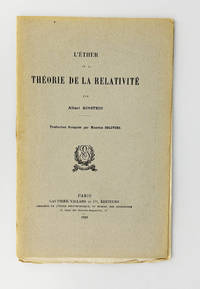
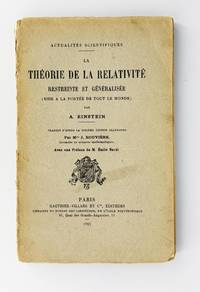
1921009631Paris: Gauthier-Villars 1921 8vo 22.5 cm 16 pp. Uncut in printed wrappers wrappers slightly sunned; ownership entry on the title page. French translation by Maurice Solovine of Einstein's well-known 1920 lecture on the concept of the ether delivered at the University of Leiden. In this brief but influential text Einstein revisits the notion of the ether in light of the general theory of relativity arguing that while the classical mechanical ether must be abandoned the relativistic description of space-time still allows one to speak of a form of 'ether' understood as the physical properties of space itself. A concise and important exposition of Einstein's evolving views on the foundations of relativity.Boni-Russ-Laurence 115.B. Gauthier-Villars paperback
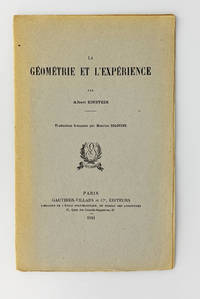
192143310Paris: Gauthier-Villars 1921. 19pp. 228 x 147 mm. Original printed wrappers foxed lower corner chipped. Some toning but very good. French translation by M. Solovine of Einstein's "Geometrie und Erfahrung". Weil 115b. Gauthier-Villars unknown
1921009632Paris: Gauthier-Villars 1921 8vo 22.5 cm 16 pp. Uncut in printed wrappers wrappers slightly sunned; ownership entry on the title page. French translation by Maurice Solovine of Einstein's well-known 1920 lecture on the concept of the ether delivered at the University of Leiden. In this brief but influential text Einstein revisits the notion of the ether in light of the general theory of relativity arguing that while the classical mechanical ether must be abandoned the relativistic description of space-time still allows one to speak of a form of 'ether' understood as the physical properties of space itself. A concise and important exposition of Einstein's evolving views on the foundations of relativity. Boni-Russ-Laurence 122.B. Gauthier-Villars paperback
19211014Paris: Gauthier-Villars 1921. 1st Edition. FIRST FRENCH EDITION OF A 1921 LECTURE BY EINSTEIN ON THE "GEOMETRIZATION OF PHYSICS AND RELATIVITY AND THE RELATION OF MATHEMATICS TO THE EXTERNAL WORLD" Dictionary of Scientific Biography 4 330. WEIL 115b. French translation by Maurice Solovince. <br /> <br /> In the same year in which he won the Nobel Prize 1921 Einstein delivered this paper as a lecture at "a commemorative session of the Prussian Academy of Sciences in honor of Frederick the Great" Calaprice Einstein Almanac 65. In "Geometrie und Erfahrung" Geometry and Experience Einstein advances his theory that space conforms to non-Euclidean principles of geometry -- a corollary of the Theory of Relativity - and as stated generally sums up his views on the "geometrization of physics and relativity and the relation of mathematics to the external world" DSB. <br /> <br /> It is in this lecture that Einstein also provides his famous answer to the puzzling question of why mathematics should be so well adapted to describing the external world: "Insofar as the laws of mathematics refer to the external world they are not certain; and insofar as they are certain they do not refer to reality" ibid. Calaprice put it like this: "He questioned whether human reasoning even without direct experience could lead to an understanding of the properties of real things merely through thought" Calaprice 1921. CONDITION & DETAILS: Paris Gauthier-Villars. 8vo. 9 x 5.75 inches; 225 x 143mm 2 19 1. Two in-text illustrations. Very slight soiling to the front wrap. Minor chipping lower right corner. Bright and clean throughout. See photos. Gauthier-Villars unknown
19502946629Buenos Aires.: Emecé. 1950. Hardcover. Cubierta deslucida. Good. 19 cm. 215 p. Encuadernación en tapa dura de editorial. Cubierta deslucida. Física.530.12 530 Emecé. hardcover
19122508Paris: Gauthier-Villars 1912. First edition. Original wrappers custom box. Very Good. RARE FIRST EDITION IN ORIGINAL WRAPPERS OF THE REPORTS FROM THE HISTORIC FIRST SOLVAY CONFERENCE "THE FIRST INTERNATIONAL CONFERENCE IN PHYSICS EVER ORGANIZED" AND A CRITICAL MOMENT IN THE BIRTH OF QUANTUM PHYSICS. In the short time that followed Planck's hypothesis of the universal constant that would bear his name the greatest minds in physics were largely at a loss about how to deal with the bizarre theoretical results that followed let alone the experimental results which confirmed them!. Much of the focus at the time was on black-body radiation including work by Planck himself as well as Lorentz Rayleigh and Jeans. However shortly before the first Solvay conference a young Einstein had also started investigating the related question of materials' specific heat. Kuhn. "The purpose of the first Solvay Conference was thus two-fold: first there was the need to examine whether classical theories molecular-kinetic theory and electrodynamics could in some undiscovered ways provide an explanation of the problem of black-body radiation and of the specific heat of polyatomic substances at low temperatures; secondly to consider phenomena in which the theory of quanta could be successfully used." Mehra.<br /> <br /> Underlying these questions was the more fundamental mystery of how to interpret the existence of the Planck constant. There were two camps both of which were represented at the conference. Planck's took the constant to indicate some fundamental constraint on the radiative processes of emission and absorption. For example "Sommerfeld introduced a version of the quantum hypothesis which he considered to be compatible with classical electrodynamics. He postulated that in 'every purely molecular process' a quantized quantity of action is exchanged." Staumann. Einstein's camp on the other hand took the quantum of action to represent the physicality of a perhaps pseudo-corpuscular theory of energy exchange - his photons of light.<br /> <br /> Although the debates that followed the lectures included in the proceedings did not rise to the famous heated exchange that Einstein would have with Bohr at the 1927 Solvay conference we do see some of the young Einstein's hotheadedness as he opens the debate following Planck's plenary lecture: "What I find strange about the way Mr. Planck applies Boltzmann's equation is that he introduces a state probability W without giving this quantity a physical definition. If one proceeds in such a way then to begin with Boltzmann's equation does not have a physical meaning." As translated by Straumann.<br /> <br /> It would take another 14 years for quantum mechanics to be fully formalized but the first Solvay conference represents a pivotal point in quantum history:<br /> <br /> "During 1911 the situation changed quickly. Articles that applied the quantum to other topics then outnumbered those on blackbody radiation for the first time and some were backed by impressive experimental evidence. In part because of that evidence physicists like Planck and Lorentz who had previously taken the constant h to be characteristic only of the radiation problem began to consider additional areas in which others had earlier staked quantum claims." Kuhn.<br /> <br /> Albert Einstein and the Solvay Conference:<br /> <br /> Among the most renown scientists of the day - including Ernest Rutherford Marie Curie and Max Planck - Einstein made quite an impression. At age 32 he was the second youngest participant in the conference. The youngest was British physicist Frederick Lindemann later to become scientific adviser to Winston Churchill.<br /> <br /> Although "Einstein had already published so many masterpieces none had actually been put to the test and his theories were looked on rather as tours de force than as definitive additions to knowledge. But his pre-eminence among the twelve greatest theoretical physicists of the day was clear to any unprejudiced observer." Frederick Lindemann quoted in Brian.<br /> <br /> References: Headline quote from the Solvay Institute website. Kuhn T. 1978 Black Body Theory and the Quantum Discontinuity 1894-1912. University of Chicago Press. Mehra J. 1975 The Solvay Conferences on Physics: Aspects of the Development of Physics Since 1911. Straumann N. 2011. On the first Solvay Congress in 1911. The European Physical Journal H 363 379-399. Denis Brian Einstein: A Life p.82.<br /> <br /> Paris: Gauthier-Villars 1912. Octavo original wrappers; custom box. Splits to top and bottom joint of upper wrapper two creases to front wrapper. Text in fine condition largely unopened. <br /> <br /> FIRST PRINTINGS IN ORIGINAL WRAPPERS ARE EXTREMELY SCARCE. Gauthier-Villars unknown
1921009633Paris: Gauthier-Villars 1921 12mo 19 cm XXII 120 pp. Printed wrappers wrappers slightly stained and frayed; small portions of paper missing from the spine; paper toned inside. Early French edition of Einstein's celebrated popular exposition of the theory of relativity intended to make the fundamental ideas of both the special and the general theory accessible to non-specialists. With a preface by the renowned mathematician Émile Borel who emphasizes the scientific importance of Einstein's work and its profound implications for modern physics. Einstein's text explains the essential concepts of space time motion gravitation and the structure of space-time in clear largely non-technical language presenting the empirical and conceptual foundations of relativity to a broad readership. The French translation was prepared by Maurice Solovine one of Einstein's close early collaborators and an important mediator of his ideas to the French-speaking public. Boni-Russ-Laurence 91.B. Gauthier-Villars paperback