1 506 résultats
1993R3215France: Éditions du Seuil Collection Science ouverte 1993 ÉPUISÉ mais DISPONIBLE. « La correspondance du couple s'étend de 1897 à 1903 peu après leur mariage. Ces lettres révèlent un Einstein peu connu optimiste confiant et heureux malgré les difficultés familiales et professionnelles qu'affronte le jeune couple. Mileva y montre une forte personnalité - « mon égal » dit Einstein qui admire sa maturité affective et intellectuelle. Elle contribuera de façon essentielle aux succès scientifiques d'Einstein.». Couverture souple. Comme neuf. Éditions du Seuil (Collection Science ouverte) paperback
1912011596Leipzig: Johann Ambrosius Barth 1912. In bound volume of Annalen der Physik. Vierte Folge Band 38 pp. 355-69. Volume also includes 1 Einstein "Nachtrag zu meiner Arbeit:: 'Thermodynamische Begrundung des photochemischen Aquivalentgesetzes" pp. 881-84; 2 "Antwort auf eine Bermerkung von J. Stark p. 888; and 3 "Relativitat und Gravitation Erwiderung auf eine Bermerkung von M. Abraham" pp. 1059-64. Paper label on spine top of which is worn; library bookplate; perforated stamp on half-title and title page. First Edition. Library Buckram. Good. Johann Ambrosius Barth Hardcover
1912008413Leipzig: Johann Ambrosius Barth 1912. Small pieces missing from spine; rear wrapper carefully reattached; ink stamp on front wrapper; small piece of paper stuck to first page. . First Edition. Original Printed Wrappers. Good. Johann Ambrosius Barth Paperback
191229311Leipzig Barth 1912. 8vo. Orig. printed wrappers. Backstrip taped. Kept in a cloth-box. In: "Annalen der Physik IV Bd. 38" pp. 355-369 and pp. 443-458. The whole issue present= Bd. 38 Heft 2 pp.249-472. <br/><br/><em>Both papers in first edition and they are considered as the first appearance of a Nonlinear Field Equation for Gravitation. - "Einstein published two remarkable memoirs in 1912 which were efforts to construct a complete theory of gravitation incorporating the equivalence principle. In these memoirs Einstein supposed that the gravitational field can be characterized completely by one function the local speed of light analogous to the Newtonian description where only the gravitational potential appears. By an extraordinary argument he extended the potential equation of Newton.In his second Memoir in 1912 he used the equivalence principle to show the influence of a static gravitational field on electromagnetic and thermal processes." DSB IV p.320 ff. - Weil No. 47 and 48. </em> hardcover
191249779Leipzig Barth1912. 8vo. No wrappers. In: "Annalen der Physik IV Bd. 38" No 7. Pp.249-472 a. 3 plates. Entire issue offered. Einstein's papers: pp. 355-369 and pp. 443-458. Clean and fine. <br/><br/><em>Both papers in first edition and they are considered as the first appearance of a Nonlinear Field Equation for Gravitation. "Einstein published two remarkable memoirs in 1912 which were efforts to construct a complete theory of gravitation incorporating the equivalence principle. In these memoirs Einstein supposed that the gravitational field can be characterized completely by one function the local speed of light analogous to the Newtonian description where only the gravitational potential appears. By an extraordinary argument he extended the potential equation of Newton.In his second Memoir in 1912 he used the equivalence principle to show the influence of a static gravitational field on electromagnetic and thermal processes." DSB IV p.320 ff. - Weil No. 47 and 48. </em> unknown
1954195551954. in German black ink. Signed “A. Einsteinâ€. A poem written by Einstein to his colleague and collaborator Ernst Straus and his son Daniel.<br /> <br /> “Dear Strausse both!<br /> <br /> My best wishes and greetings in poetic form.<br /> <br /> It brings even more happiness<br /> If it has been anticipated for so long<br /> also in one’s circle of friends<br /> the event is doubly appreciated. <br /> <br /> This is what I wish:<br /> Let Daniel be like his father<br /> thoroughly intelligent and not less joyous<br /> so few humans are like that.<br /> <br /> Many - alas - are born<br /> few are chosen<br /> to bring light and joy.<br /> Let such gift be his drive.<br /> <br /> Yours A. Einsteinâ€<br /> <br /> In German “Strauss†means bunch bouquet etc. or ostrich and “Strausse†is plural.<br /> <br /> Ernst G. Straus 1922-1983 was a mathematician who helped found the theories of Euclidean Ramsey theory and of the arithmetic properties of analytic functions. He was Einstein’s assistant and collaborator both at Princeton and afterwards when he moved to become a professor of mathematics at UCLA. His son Daniel is a professor of chemistry at Cal State San Jose. unknown
19539553SCPrinceton NJ: Princeton University Press 1953. 165 pp. Original gray cloth covers w/ gilt title on spine. Light pencil notes on pp. 1-5. Previous owner's name in pencil on fpde. DJ has some wear to edges. Light stains to front cover. Includes an index. Hard Cover. Very Good/Good-. Princeton University Press Hardcover
19698990293Cassell & Company 1969. This is an ex-library book and may have the usual library/used-book markings inside.This book has hardback covers. Clean from markings. In good all round condition. No dust jacket. Please note the Image in this listing is a stock photo and may not match the covers of the actual item750grams ISBN:0304924830 Cassell & Company hardcover
1920194005Munchen: Wolff 1920. Hardcover. Very Good. Cover has general wear. Bookblock has age toning. Interior pages have age toning. German language text. Green boards. 108 pgs illustrations. Wolff hardcover
1928374181928. Weil 162. Offprint from S. preuss. Akad. Wiss. unknown
192822775Berlin 1928. Orig. printed wrappers. Spine strengthend with matching paper. Fresh copy. Offprint/Sonderabdr. aus "Sitzungsberichte". pp. 1-6. <br/><br/><em>First edition. Weil No. 162. </em> unknown
192828363Berlin Gruyter u. Co. 1928. 4to. Orig. printed orange wrappers. Offprint/Sonderabdruck aus Sitzungsberichten.pp. 1-6. Fine fresh copy. <br/><br/><em>First edition in the rare Offprint still called "Abdruck" but having separate printed title and separate pagination. See Weil: 162 where this is not mentioned.Weil No. 162.The early Offprints from "Sitzungsberichten." are called "Sonderabdruck" up to Weil No.165 including this. From Weil 166 they are called "Sonderausgabe.". - Before 161 up to 160 the Offprints do not have separate title and pagination the pagination follows the numbering in the periodical. From 166 the Offprint has both separate printed title and pagination. - So Weil Nos 161-165 is still "Abdruck" but with separate title and pagination. These facts are not mentioned in the bibliographies. </em> unknown
192746076HB1927. Berlin Springer 1927. 4°. 1 Porträt S. 273-276. Original-Broschur geringfügig gebräunt. Kleine Rostflecken im Bund durch die Klammerheftung. Durchgehend schwacher Wasserrand in der unteren Außenecke. Sonst innen sauber und gut erhalten. Das Heft enthält außerdem den Erstdruck von Max von Laue: Aus Newtons Optik sowie weitere Beiträge. unknown
192746968Berlin Julius Springer 1927. Lex8vo. In "Die Naturwissenschaften" 15. jahrgang 1927. Entire volume offered bound in contemporary half calf with gilt lettering to spine. Minor wear to upper capitals otherwise a fine and clean copy. Einstein: Pp. 273-76; Born: Pp. 238-42; Planck: Pp. 529-31; Sommerfeld: Pp. 825-32; Frisch: Pp. 321-326; pp. 963-968. Entire volume: XXV1100016 pp. <br/><br/><em>First edition of all papers. The Einstein paper is his contribution to the Anniversary volume of Newton's death. Frisch received the Nobel Prize for his works on animal psychology and behaviour in 1975.Weil No 158. - Planck: Akademie No. 165 - K. v. </em> unknown
192746484Berlin Julius Springer 1927. 4to. Orig. printed wrappers. In "Die Naturwissenschaften" Heft 12 Fünfzehnter Jahrg. Seite 273-296 textillustrations. Einstein's paper pp. 273-276. With one plate portrait of Newton. Clean and fine. <br/><br/><em>First appearance of Einstein's Newton-paper which was later included in "Mein Weltbild" and its translation in "In the World as I see it"- Weil: 158 - Boni: 166.The issue contaions also a first-printing by Max von Laue "Aus Newtons Optik" pp. 276-280 textillustr. </em> unknown
192738844Berlin Julius Springer 1927. 4to. Contemp. hcloth. Spine a bit worn. "Die Naturwissenschaften. Hrsg. von Arnold Berliner. 15. jahrgang" XXIV1000 pp. Einstein paper: pp. 273-276 and 1 portrait of Newton. - Born Paper: pp. 238-242. - Planck paper: 529-531. - Sommerfeld paper 825-832 - von Frisch papers: pp. 321-326 and pp. 963-968. The whole volume offered. <br/><br/><em>All papers in first edition. The Einstein paper is his contribution to the Anniversary volume of Newton's death. - Weil No 158. - Planck: Akademie No. 165 - K. v. Frisch received the Nobel Prize for his works on animal psychology and behaviour in 1975. </em> hardcover
1923433181923. Offprint from Zeitschrift für Physik 16 1923. Single sheet unpaginated. 230 x 155 mm. One corner creased but very good. First edition offprint issue. Einstein's second response to Friedmann's groudbreaking paper on equations governing the expansion of space which made a valuable contribution to Einstein's theory of relativity and admitted the possibility of an expanding universe. Einstein at first believed that Friedmann's reasoning was incorrect then corrected his own objection in the present brief "Notiz" and called Friedmann's results "clarifying." Pais Subtle is the Lord p. 288. Weil Albert Einstein Bibliography 130. unknown
192349811Berlin Vieweg u. Sohn 1923. 8vo. Bound in contemporary full cloth. In "Zeitschrift für Physik. Hrsg. von Karl Scheel. 16. Band" entire volume offered. Embossed stamp to title page. P. 228. Entire volume: IV 2 409 pp. <br/><br/><em>First printing of Einstein commentary to Friedman's seminal papers in which he "introduced into cosmology two concepts of revolutionary importance the age og the world and the creation of the world"Kragh Cosmology and Controversy. Also contained in the volume are:BOTHE W.: Eichmethoden für Emanationselektrometer Über eine neue Sekundärstrahlung der Röntgenstrahlen. - First appearance of Bothe's early paper on the Compton effect which together with his later paper in Bd 32 Zeitschrift für Physik awarded him the Nobel Prize in Physics "for the coincidence method and his discoveries made therewith".PAULI JR. W. : Über die Gesetzmässigkeiten des anomalen Zeemaneffektes. LANDÉ A.: Zur Theorie der Röntgenspektren.HEISENBERG W. M. BORN.: Die Elektronenbahnen im angeregten Heliumatom.Weil 122 </em> hardcover
1915432951915. <p>Einstein Albert 1879-1955 and Wander Johann de Haas 1878-1960. Notiz zu unserer Arbeit "Experimenteller Nachweis der Ampèreschen Molekularströme." Offprint from Verhandlungen der Deutschen Physikalischen Gesellschaft 17 1915. 1 sheet p. 420. 228 x 156 mm. Original printed wrappers. Fine copy.</p> <p>First Edition Offprint Issue. In 1915 Einstein and Dutch physicist Wander Johannes de Haas conducted gyromagnetic experiments leading to the discovery of the Einstein-de Haas effect which corresponds to the mechanical rotation induced in a ferromagnetic cylinder suspended inside a coil when an impulse of electric current is sent through the coil. Einstein was very enthusiastic about the experimental results stating that he and de Haas had "given firm proof of the existence of Ampère's molecular currents" quoted in Pais Subtle is the Lord pp. 245-246. Einstein and de Haas published their results in a paper published earlier in 1915 see Weil 73; the present "Notiz" is a response to a communication from American physicist Samuel Jackson Barnett who had begun performing similar experiments in 1909 and obtained results complementing those of Einstein and de Haas. Weil Albert Einstein Bibliography 73n.</p> . unknown
192237430Berlin: Slowa 1922. 51 5pp. Original printed wrappers faded front hinge weak tears at spine. First edition in Russian of Weil 111; see Weil 111e. Slowa unknown
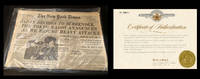
19451437New York: The New York Times 1945. 1st Edition. First edition of the August 14th 1945 issue of the New York Times complete with "Certificate of Authentication" by the Historic Newspaper Archives. The certificate is #379910; it is signed and includes the seal of the archive. Einstein's article appears in Calaprice's Einstein Almanac No. 244. The certificate will accompany the paper. <br /> <br /> Most assume that Einstein received the Nobel Prize for his theory of relativity and his famous equation E=mc2. However it was for neither. In 1921 Einstein won the Nobel Prize for discovering the photoelectric effect in 1905. This principle states that when sunlight shines on a metal it emits electrons from the surface of the material. The energy from sunlight photons then transfers to the atoms' electrons and knocks them loose. This discovery was so significant that it has influenced the development of many types of technology from electron microscopes to modern solar cells as we know them today. <br /> <br /> ALSO INCLUDED: An article by Lewis headlined: "Atoms Not Occult Einstein Declares; Physicist Explains Nuclear and Solar Energy but Refuses to Discuss Use in Bomb" <br /> <br /> ALSO INCLUDED: New York Time's announces Japan's surrender in 3 line large headline "Japan Decides To Surrender The Tokyo Radio Announces As We Resume Heavy Attacks". CONDITION: Historic Newspaper Archives see above has placed the issue in archival plastic and then into an Archive snap close bag. see photo By any measure this complete issue appears in very good condition. The New York Times unknown
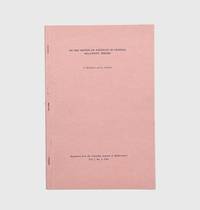
1949180348Ottowa: Canadian Mathematical Society 1949. Their final collaboration First edition offprint issue. Einstein and Infeld demonstrate that "field equations alone suffice as a basis for solving the problem of motion in general relativistic theory since the Einstein equations not only determine how particles must respond to gravitational forces but also contain the information necessary to describe those forces" Calaprice p. 323. Octavo pp. 34. Original orange wrappers wire-stitched as issued front cover lettered in black. Front wrapper lightly marked: a near-fine copy. Boni 259; Weil 223. Alice Calaprice An Einstein Encyclopedia 2015. unknown
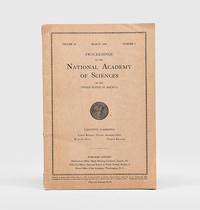
1932180272Easton Pennsylvania: Mack Printing Company 1932. Einstein revises his "biggest blunder" First edition journal issue of the paper in which Einstein rejected his 1917 cosmological constant and acknowledged the expansion of the universe. Drawing on Hubble's law Einstein and de Sitter proposed that the constant should be set equal to zero thereby offering a new model of the universe. "In 1917 Einstein had shown how to construct a universe that was static by introducing a 'cosmological constant' into his equations. This matched well with the idea current before Hubble's 1924 measurement of the distances to the nebulae of a small and static 'universe' that was confined to the stars of the Milky Way galaxy. Einstein's idea of a static universe suspended between gravity pulling inward and the cosmological constant making the universe expand was ruled out by Hubble's data" Kirshner pp. 9-12. In Einstein and de Sitter's revised model "the galaxies receded forever but the recession rate declines to zero as time approaches infinity. Some sources indicate that this is the first attempt to describe our universe rather than a mathematical abstraction of universes possible under general relativity. Shortly after Einstein formally renounced his cosmological constant and according to George Gamow called it 'the biggest blunder of my life'" Wenner. Einstein and de Sitter 1872-1934 were close collaborators in the 1920s at Leiden where de Sitter was chair of astronomy and Einstein was a visiting professor. De Sitter is also known for the concepts of De Sitter space and the De Sitter universe. Large octavo. Original brown wrappers covers printed in black. Short closed tears to spine a little loss to ends corners gently creased: a very good copy. Boni 214; Weil 184; Wenner p. 256. Robert P. Kirshner "Hubble's Diagram and Cosmic Expansion" Proceedings of the National Academy of Sciences of the United States of America vol. 101 no. 1 December 2003. unknown
19999293774Office Of Intl Criminal Justice 1999. This is an ex-library book and may have the usual library/used-book markings inside.This book has soft covers. Clean from markings. In fair condition suitable as a study copy. Library sticker on front cover. Please note the Image in this listing is a stock photo and may not match the covers of the actual item850grams ISBN:0942511891 Office Of Intl Criminal Justice paperback
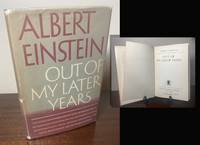
195033985New York: The Philosophical Library 1950. 1st Edition. 1st Edition. First Edition. Nicely Signed in fountain pen in black ink on the Title page and dated 1953.<br /> Original black cloth with gilt stamping on spine and front with Einstein's signature. A very good grey and maroon unclipped dustwrapper with some browning at the edges and some minor imperfections."1" at the base of the copyright page present<br /> Custom brown slipcase with E=MC2 embossed. <br /> <br /> Collects 60 essays some of which are published for the first time and on a wide variety of topics: science of course but also many societal issues such as education religion race relations war and peace and the Jewish people. An extremely nice copy. Weil p.42. <br /> <br /> Rare and desirable signed. The Philosophical Library unknown