NEWTON, Sir IsaacBiblio.com
13 069 résultats
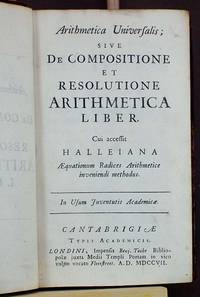
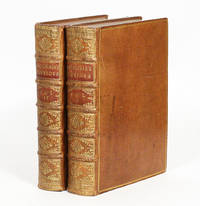
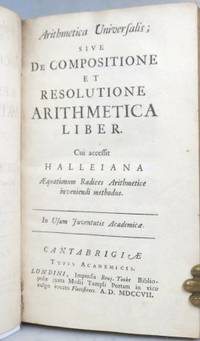
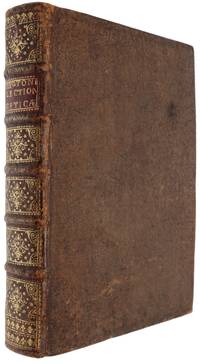
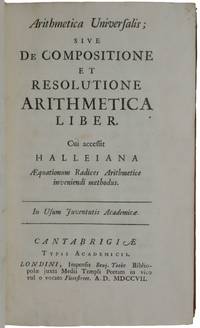
17074639Cambridge; London: Typis Academicus; Benjamin Tooke 1707. First edition. <p>First edition of Newton's treatise on algebra or 'universal arithmetic' his "most often read and republished mathematical work" Whiteside. Included are 'Newton's identities' providing expressions for the sums of the powers of the roots of any polynomial equation plus a rule providing an upper bound for the positive roots of a polynomial and a generalization to imaginary roots of René Descartes' 'Rule of Signs.'</p>. Hardcover. NEWTON'S TREATISE ON ALGEBRA. <p>First edition of Newton's treatise on algebra or 'universal arithmetic' his "most often read and republished mathematical work" Whiteside. "Included are 'Newton's identities' providing expressions for the sums of the ith powers of the roots of any polynomial equation for any integer i pp. 251-2 plus a rule providing an upper bound for the positive roots of a polynomial and a generalization to imaginary roots of René Descartes' Rule of Signs pp. 242-5" Parkinson p. 138. About this last rule for determining the number of imaginary roots of a polynomial which Newton offered without proof Gjertsen p. 35 notes: "Some idea of its originality . can be gathered from the fact that it was not until 1865 that the rule was derived in a rigorous manner by James Sylvester."</p> <br /> <p>Provenance: Jesuit College at Ghent ink inscription 'Bibliotheca Collegii Gandavensis Societatis Jesu.' and shelfmark on title; extensive marginal annotations by a well-informed contemporary reader. This reader was possibly the English Jesuit Christopher Maier 1697-1767. Born in Durham England Maier entered the Society of Jesus in 1715. He taught at Liège where he became interested in astronomy. In 1750 Maire was commissioned by Pope Benedict XIV to measure two degrees of the meridian from Rome to Rimini with fellow Jesuit Roger Boscovich with a view to mapping the Papal States; in turn they proved that the earth is an oblate spheroid as Newton had proposed in Principia publishing their results in Litteraria Expeditione 1755. Maier spent his final years at the English Jesuit College in Ghent.</p> <br /> <p>"In fulfillment of his obligations as Lucasian Professor Newton first lectured on algebra in 1672 and seems to have continued until 1683. Although the manuscript of the lectures in Cambridge University Library carries marginal dates from October 1673 to 1683 it should not be assumed that the lectures were ever delivered. There are no contemporary accounts of them and apart from Cotes who made a transcript of them in 1702 they seem to have been totally ignored. Whiteside Papers V p. 5 believes that they were composed 'over a period of but a few months' during the winter of 1683-4" Gjertsen pp. 33-4. The course of lectures stemmed from a project on which Newton had embarked in the autumn of 1669 thanks to the enthusiasm of John Collins: the revision of Mercator's Latin translation of Gerard Kinckhuysen's Dutch textbook on algebra Algebra ofte stel-konst 1661. Newton composed a manuscript 'Observations on Kinckhuysen' in 1670 see Whiteside Papers II and used it in the preparation of his lectures. He took the opportunity not only to extend Cartesian algebraic methods but also to restore the geometrical analysis of the ancients giving his lectures on algebra a strongly geometric flavor.</p> <br /> <p>"When Newton resigned his Lucasian professorship to his deputy William Whiston in December 1701 it was natural that the latter should wish to familiarize himself with the deposited lectures of his predecessor" Whiteside Papers V p. 8. Whiston later claimed in his Memoirs London: 1749 that Newton gave him his reluctant permission to publish the lectures. Whiston arranged with the London stationer to underwrite the expense of printing the deposited manuscript and then subsequently between September 1705 and the following June corrected both specimen and proof sheets as they emerged from the University Press. The completed editio princeps finally appeared in May 1707 priced at 4s. 6d. without Newton's name on the title page although references inside the work made no attempt to hide the author's identity. It included an appended tract by Halley on 'A new accurate and easy method for finding the roots of any equations generally without prior reduction' pp. 327-343. Publication of the work had been delayed by Newton who complained that the titles and headings were not his and that it contained numerous mistakes. Yet when he prepared a second edition in 1722 the changes he introduced were "primarily reorderings of his own manuscript not corrections of Whiston's additions" Westfall p. 649. In reality Newton's misgivings probably derived more from his reluctance to place before the public a relatively immature and poorly organized work and one that did not take into account the developments in the subject that had taken place in the quarter century since the manuscript was composed.</p> <br /> <p>For a book that was to become Newton's most often republished mathematical work the Arithmetica initially made little impact in Britain and was not even graced by a review in the Philosophical Transactions. On the Continent the reception accorded the lectures was more positive. "Leibniz unhesitatingly divining their author beneath the cloak of anonymity gave them a long review in the Acta Eruditorum of Leipzig in 1708. Written thirty years before he noted and now deservingly printed by William Whiston he assured the reader that 'you will find in this little book certain particularities that you will seek in vain in great tomes on analysis.' His close associate Johann Bernoulli despite some adverse remarks paid Newton the compliment in 1728 of basing his own course on the elements of algebra upon Newton's text. Perhaps partly in consequence of Newton's recent death in Britain too the book began about this time to arouse greater interest than when it was first issued in 1707" Hall p. 174.</p> <br /> <p>Despite the impressive contributions of the work to the theory of equations mentioned earlier it is difficult to pigeonhole the work as being either algebraic or geometric. From one point of view the Arithmetica can be seen as a fulfillment of the programme outlined by Descartes in the Géométrie because it teaches how geometrical problems and also arithmetical and mechanical ones can be translated into the language of algebra. Paradoxically however Newton criticized Descartes maintaining that at least in some cases Apollonian geometry is to be preferred to Cartesian algebra in the analysis of indeterminate problems. Modern analysts he complained had confused algebra and geometry: "The Ancients so assiduously distinguished them one from the other that they never introduced arithmetical terms into geometry. recent people by confusing both have lost the simplicity in which all elegance in geometry consists" Whiteside Papers V p. 429. The last section of the work 'The linear construction of equations' pp. 279-326 is particularly anti-Cartesian the term 'linear' in this context does not refer to straight lines but derives from Pappus. Newton here deals with the problem of constructing cubics third-degree equations that Descartes solved via the intersection of a circle and a parabola. Newton proposed instead to use a curve of degree higher than the conics as a means of construction namely the conchoid a fourth-degree curve. Newton regarded the conchoid as preferable because it has a mechanical construction and leads to a more elegant solution of the problem.</p> <br /> <p>William Whiston 1667-1752 was "a member of the first generation of Cambridge students to emulate Newton's method and principles. He went up to Cambridge in 1686 claimed to have attended one or two incomprehensible lectures by Newton on his Principia and was elected a Fellow of Clare Hall in 1691. After taking orders he left Cambridge for a while returning in 1700 when chosen by Newton to be his deputy as Lucasian Professor. About a year later upon Newton's resignation and commendation Whiston succeeded him. Aberrant theology was to be his downfall. While Newton and their common friend Dr Samuel Clarke kept private their doubts about Trinitarianism the Creed and the Thirty-nine Articles Whiston sought publicly to amend the errors of the Anglican faith; for this he was summoned before the heads of houses in the university and dismissed from his post in 1710" Hall p. 175.</p> <br /> <p>Babson 199; Wallis 277; D. Gjertsen Newton Handbook 1986; A. R. Hall Isaac Newton 1992; R. S. Westfall Never at Rest 1983.</p> <br/> <br/> 8vo pp. viii 343. Woodcut diagrams throughout. Former owner's signature F. Percy White Feb. 1920 on half-title partially erased. Contemporary mottled calf covers with floral border and corner fleurons in blind. / Hardcover. Typis Academicus; Benjamin Tooke unknown
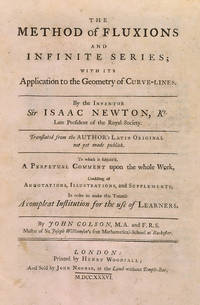
173614348London: Henry Woodfall 1736. FIRST EDITION. With engraved frontispiece interpolated leaf 143-144 and leaf containing errata on the recto publisher’s advertisements on the verso. Paneled sprinkled calf in a contemporary style; a large paper copy with very wide margins a few contemporary annotations. First edition of Newton’s treatise on the calculus a work of great importance and rarity. Ready for publication in 1671 Newton circulated the manuscript among his friends who urged him to establish priority by publishing his own work. He steadfastly refused and prior to his death entrusted it to Henry Pemberton who never had it published. It was not until 1736 that Method of fluxions was finally published in the present English translation by John Colson who added a lengthy commentary. The original Latin edition did not appear until 1779 in the Opera omnia.<br /> <br /> Babson 171; Gray 232; Wallis 232; Smith History of Mathematics I p. 404. Henry Woodfall unknown
17076325Cambridge and London: Typis Academicis; Benj. Tooke 1707. First edition. Very Good/William Whiston the successor to Newton's chair at Cambridge "extracted from Newton a somewhat reluctant permission to print" this remarkable "schoolbook" based on Newton's lecture notes Babson Catalogue. So reluctant in fact that Newton kept his name out of it and supposedly considered purchasing the press run in order to destroy it! He later republished it himself. Several new theorems are laid out including a formula to determine the number of imaginary roots of any equation. The rule is complicated and is offered without proof. Yet 180 years later the rule was proven by rigorous analysis. The text also includes Edmond Halley's "Aequationum radices arithmetice inveniendi methodus. Octavo 19cm; 8 343 1 pages the last page blank . Figure and diagrams in text. Running-title: Algebrae elementa. Editor's preface signed: G.W. i.e. William Whiston. In contemporary paneled calf rebacked with new burgundy morocco spine label. Edges of boards rubbed. Early ink ownership inscriptions on blank endleaves the contemporary autograph of Edward Harington and the 19th-century mathematician William Fleetwood Sheppard. Half-title present. References: Babson Newton Collection; 199; ESTC; T018645; Bowes and Bowes 277. Typis Academicis; Benj. Tooke hardcover books
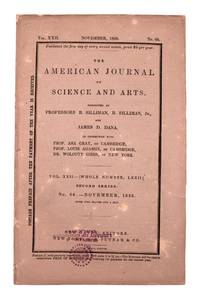
1856323434New York: G.P. Putnam & Co 1856. Three engraved plates folding engraved map woodcut text figures. 8vo. Original printed wrappers untrimmed; some occasional light marginal foxing wrappers chipped at head and foot of spine. Three engraved plates folding engraved map woodcut text figures. 8vo. The first appearance of the discovery of greenhouse gasses as delivered on Foote's behalf before the American Association for the Advancement of Science AAAS on August 23 1856 she was not a member although there were two women members by 1850 three years after its founding. Although in the early 19th Century Joseph Fourier suggested that the Earth's temperature was warmed by more than just the sun and Claude Pouillet suggested that water vapor and carbon dioxide must effect it it was Foote who provided the first experimental proof of the insulating effects of various gasses proving that increasing amounts of carbon dioxide in the air would increase the ground temperature.<br /> <br /> "Foote's paper demonstrated the interactions of the sun's rays on different gases through a series of experiments using an air pump four thermometers and two glass cylinders. First Foote placed two thermometers in each cylinder and using the air pump removed the air from one cylinder and condensed it in the other. Allowing both cylinders to reach the same temperature she then placed the cylinders with their thermometers in the sun to measure temperature variance once heated and under various states of moisture. She repeated this process with hydrogen common air and CO2 all heated after being exposed to the sun." McNeill<br /> <br /> Her work predates that of John Tyndall who presented a paper the relation between thermal radiation and various gasses in 1859 and that of Svante Arrhenius who quantified the effect of airborne carbon dioxide on the ground temperature of the Earth in his paper "On the Influence of Carbonic Acid in the Air upon the Temperature of the Ground" 1896 forty years after Foote.<br /> <br /> Eunice Newton Foote 1819-1888 was a scientist inventor and campaigner for the rights of women. She was a neighbor and friend of Elizabeth Cady Stanton and attended the 1848 Senaca Falls Convention the first women's right's convention where she and her husband signed the declaration of the legal rights of women and helped prepare the proceedings of the convention. Her scientific work was overlooked in preference to that of her male peers until more recently and the American Geophysical Union started a prize in her name in 2022 honoring discoveries in earth and life sciences. L. McNeill "This lady scientist defined the greenhouse effect but didn't get the credit because sexism" SmithsonianMag.com 5 December 2016; E. W. Reed American women in science before the Civil War 1992 2019 pages 64-68; R. P. Sorenson "Eunice Foote's pioneering research on CO2 and climate warming" Search and discovery American Association of Petroleum Geologists Tulsa no. 70092 31 January 2011; J. Perlin "Science knows no gender: Eunice Foote the woman who in 1856 discovered the cause of global warming" symposium UC Santa Barbara 17 May 2018; Baum Sr. Rudy M. 2016. "Future Calculations: The first climate change believer". Distillations. 2 2: 38-39 2018 G.P. Putnam & Co unknown
1779ASTTX.312<p>London: Thomas Tegg. 1779 First Edition. 32mo – 10.6cm 2 XVI 304pp. Including Table of the Hymns at rear. Full contemporary leather with bright gilt decoration and border ruling on front and rear covers spine with bright gilt title and ornate decoration original soft yellow endpapers all page edges gilt. Near Fine and complete – a Very Rare copy of the Olney Hymns showing the first publication of the hymn "Amazing Grace" p.38-39. This most unique and important copy is preserved in a custom full-leather clam shell box.</p><p>"Amazing Grace" is a Christian hymn written by English poet and clergyman John Newton 1725–1807 published in 1779. With a message that forgiveness and redemption are possible regardless of the sins people commit and that the soul can be delivered from despair through the mercy of God "Amazing Grace" is one of the most recognizable songs in the English-speaking world having been translated in over 50 languages.</p><p>Newton wrote the words from personal experience. He grew up without particular religious conviction but his life's path was formed by a variety of twists and coincidences that were often put into motion by his recalcitrant insubordination. He was pressed into the Royal Navy and became a sailor eventually participating in the slave trade. One night a terrible storm battered his vessel so severely that he became frightened enough to call out to God for mercy a moment that marked the beginning of his spiritual conversion. His career in slave trading lasted a few years more until he quit going to sea altogether and began studying theology.</p><p>Ordained in the Church of England in 1764 Newton became curate of Olney Buckinghamshire where he began to write hymns with poet William Cowper. "Amazing Grace" was written to illustrate a sermon on New Year's Day of 1773. It is unknown if there was any music accompanying the verses and it may have been chanted by the congregation without music. It debuted in print in 1779 in Newton and Cowper's Olney Hymns but it settled into relative obscurity in England. In the United States however "Amazing Grace" was used extensively during the Second Great Awakening in the early 19th century. It has been associated with more than 20 melodies but in 1835 it was joined to a tune named "New Britain" to which it is most frequently sung today.</p><p>Author Gilbert Chase writes that "Amazing Grace" is "without a doubt the most famous of all the folk hymns"1 and Jonathan Aitken a Newton biographer estimates that it is performed about 10 million times annually.2 It has had a significant influence in folk music and has become an emblematic African American spiritual. Its universal message has been a significant factor in its crossover into secular music. "Amazing Grace" saw a resurgence in popularity in the U.S. during the 1960s and has been recorded thousands of times during and since the 20th century sometimes appearing on popular music charts.</p> Thomas Tegg hardcover
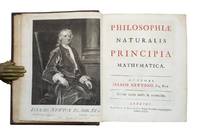
172669561London: Apud Guil. & Joh. Innys 1726. Full Description:<br> <br> NEWTON Sir Isaac. Philosophiæ naturalis principia mathematica. Editio tertia aucta & emendata. London: Apud Guil. & Joh. Innys 1726.<br> <br> Third edition. One of only 1250 copies printed. Quarto. 34 530 6 index pp. Engraved frontispiece portrait facing title by George Vertue after I. Vanderbank. Bound without the advertisement leaf. Numerous diagrams in the text and one engraving of cometary orbit on p. 506. Title printed in red and black. With the Royal Privilege printed on verso of the first leaf as in Babson copy 2.<br> <br> In full goatskin. Spine ruled and lettered in gilt. Boards paneled in blind. Inner hinges repaired. Some old ink manuscript notes on front flyleaf. Numerous instances of light early pencil marginalia and a few in ink. Some ghost dampstaining throughout. Previous owner's bookplate on front pastedown. Overall a very good copy.<br> <br> "This edition was the last published during the author's lifetime and the basis of all subsequent editions. It was edited by Henry Pemberton M.D. F.R.S. and contains a new preface by Newton and a large number of alterations the most important being the scholium on fluxions in which Leibnitz had been mentioned by name. This had been considered an acknowledgement of Leibnitz's independent discovery of the calculus. In omitting Leibnitz's name in this edition Newton was criticized as taking advantage of an opponent whose death had prevented any reply" Babson p. 12.<br> <br> Third edition of "the greatest work in the history of science" Printing and the Mind of Man. In the Principia Newton formulated the three laws of motion from which he derived the principle of universal gravitation "wherein all bodies of whatever mass attract one another in proportion to their masses and in inverse ratio as the square of the distance between them. This applies to dust particles as to the mightiest celestial bodies" Dibner.<br> <br> "Copernicus Galileo and Kepler had certainly shown the way; but where they described the phenomena they observed Newton explained the underlying universal laws. The Principia provided the great synthesis of the cosmos proving finally its physical unity. Newton showed that the important and dramatic aspects of nature that were subject to the universal law of gravitation could be explained in mathematical terms within a single physical theory.The same laws of gravitation and motion rule everywhere; for the first time a single mathematical law could explain the motion of objects on earth as well as the phenomena of the heavens. The whole cosmos is composed of inter-connecting parts influencing each other according to these laws. It was this grand conception that produced a general revolution in human thought equalled perhaps only by that following Darwin's Origin of Species" Printing and the Mind of Man 161 describing the first edition.<br> <br> Babson 13. Gray 9. Wallis 9.<br> <br> HBS 69561.<br> <br> $22500. Apud Guil. & Joh. Innys unknown
1803122898London: Printed for H.D. Symonds 1803. First complete edition in English of Sir Isaac Newton's Principia the greatest work of physics in the exceedingly rare original boards. Octavo 3 volumes bound in original boards uncut 54 folding copper-engraved plates of diagrams and figures all but one folding; 2 folding tables. with 22 folding. In near fine condition with light toning to the text. An exceptional example rare and desirable in the original boards. Housed in a custom clamshell box. "Newtons Principia is generally described as the greatest work in the history of science. Copernicus Galileo and Kepler had certainly shown the way; but where they described the phenomena they observed Newton explained the underlying universal laws. The Principia provided the greatest synthesis of the cosmos proving finally its physical unity. Newton showed that the important and dramatic aspects of nature that were subject to the universal law of gravitation could be explained in mathematical terms with a single physical theory. With him the separation of the natural and supernatural of sublunar and superlunar worlds disappeared. The same laws of gravitation and motion rule everywhere; for the first time a single mathematical law could explain the motion of objects on earth as well as the phenomena of the heavens. The whole cosmos is composed of inter-connecting parts influencing each other according to these laws. It was this grand conception that produced a general revolution in human thought equaled perhaps only by that following Darwins Origin of Species Newton is generally regarded as one of the greatest mathematicians of all time and the founder of mathematical physics" PMM 161. "It is perhaps the greatest intellectual stride that it has ever been granted to any man to make" Einstein. Printed for H.D. Symonds hardcover books
116359Cambridge & London Typis Academicis; Benj. Tooke 1707. . First edition; 8vo 20 x 12.5 cm; contemporary ownership inscription in ink to front endpapers contents fresh; contemporary sprinkled calf ruled in blind with floral tools in the corners red speckled edges spine lettered in gilt but rubbed with loss of the gilt joints ends of spine and hinges professionally conserved very good condition; 343 pp.<br /> First edition of Newton's treatise on algebra his 'most often read and republished mathematical work' Whiteside.<br /><br />'Sometime between the autumn of 1683 and early winter of 1684 Newton according to the statues of the Lucasian Chair deposited with the university his Lucasian Lectures on Algebra. The lectures bear dates from 1673 to 1683 but these were added in retrospect and it is highly unlikely that they were ever delivered to Cambridge students. From one point of view Arithmetica Universalis can be seen as a fulfilment of the program outlined by Descartes in Géometrie because it teaches how problems especially geometrical problems but also arithmetical and mechanical ones can be translated into the language of algebra which is here seen as the tool for problematic analysis; on the other hand Arithmetica Universalis contains two criticisms directed at Descartes' those being the preference for Apollonian geometry over Cartesian algebra in solving indeterminate problems and the argument that Descartes relied too heavily on algebraic criteria Guicciardini Isaac Newton on Mathematical Certainty and Method pp 61-62.<br /><br />By 1707 Newton had moved to London and his successor mathematician William Whiston took it upon himself to edit and publish the text. It is unclear how much say Newton had in this but he was unhappy with various aspects of the editing and typesetting and refused to have his name on the title page though in the end most of Whiston's changes would be retained in the 1722 edition seen through the press by Newton himself Cohen 'The Case of the Missing Author' in Isaac Newton's Natural Philosophy pp. 35-38.<br /> Cambridge & London, Typis Academicis; Benj. Tooke, 1707. unknown
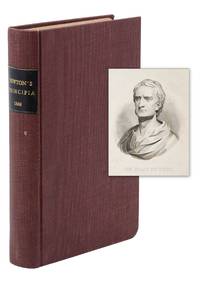
1848140949208New York: Daniel Adee 1848. First American Edition. Very Good. First American edition first printing with date 1848 on title page and publisher's address listed as 107 Fulton-Street. 4 v-viii 9-581 pp. illustrated with engraved frontispiece protected by tissue guard. Recently bound in maroon buckram title label to spine. Very Good with light wear to covers and slight bumping to lower corners; title label beginning to lift at one corner. Band of paper residue to front free endpaper. Light toning and moderate foxing to textblock edges and contents dampstain to outer textblock edge and outer margin throughout. Cohen pp. 347-352.<br /> <br /> <p>The first American edition of the foundational physics text first published in Latin in 1687. Andrew Motte's 1729 translation was reprinted in 1803 and 1819 in Britain but subsequent 19th century editions were printed only in the United States and Germany. The New York-based publisher Daniel Adee deposited a copyright for the Principia in 1846 then printed five issues between 1848 and 1850. A contemporary notice in the Scientific American declared:<br /> <br /> <p>"For a long time the 'Principia' was kept far out of the reach of the mere English Scholar as if Newton had written it exclusively for the classical student and philosopher. It was a scarce book when printed in the Latin language; it is now thanks to the spirit of an American publisher printed in our mother tongue and should find a place in every family library. Daniel Adee unknown
174595840London: Printed by James Bettenham for the Society for the Encouragement of Learning 1745. First edition in English of the mathematical appendixes to <span class="match">Newton</span>'s fundamental 1704 Opticks one of the greatest works of science ever published. Translated from the Latin by James Bettenham Professor of Mathematics at the University of Aberdeen. Quarto bound in contemporary calf gilt titles to the spine burgundy morocco spine label rebacked woodcut diagrams throughout the text engraved tailpiece. In very good condition with some light wear and browning to the text with wide margined text. Exceptionally rare and desirable first editions are scarce with only four appearing at auction in the last 90 years. English mathematician astronomer theologian author and physicist Sir Isaac Newton is widely considered one of the most influential scientists of all time and a key figure in the scientific revolution. In one of his most important works Philosophiae Naturalis Principia Mathematica Newton formulated the the laws of motion and universal gravitation that formed the dominant scientific viewpoint until being superseded by the theory of relativity. Considered one of the greatest works of science ever published Newton's second major book Opticks analyzes the fundamental nature of light by means of the refraction of light with prisms and lenses the diffraction of light by closely spaced sheets of glass and the behavior of color mixtures with spectral lights or pigment powders. Printed by James Bettenham for the Society for the Encouragement of Learning unknown books
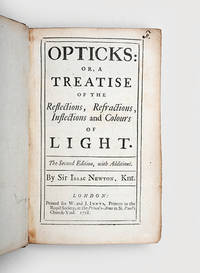
1718184239London: printed for W. and J. Innys 1718. His most important work on light with significant revisions Second edition second issue as usual of this seminal study which "did for light what Newton's Principia had done for gravitation namely place it on a scientific basis" Babson. Newton arrived at most of his innovative ideas on colour by about 1668 and Opticks was largely complete by 1692. However when he first expressed his theories in public they provoked hostile criticism. As a result Newton delayed publication until his most vocal critics - especially Robert Hooke - were dead. By the mid-1710s Opticks was established in Britain as the model for blending theoretical speculation and quantitative experimentation. Newton's aim was not to "explain the properties of light by hypotheses but to propose and prove them by reason and experiments" p. 1. The work's greatest achievement is showing that colour is a mathematically definable property. Newton demonstrates that white light is a mixture of infinitely varied coloured rays and that each ray is definable by the angle through which it is refracted. Other topics include colour circles theories of the rainbow and the phenomenon now known as Newton's rings. The textual revisions for this edition demonstrate the development of Newton's experimentation process. The first edition was published in 1704 followed by the Latin translation of 1706. This edition was the first in octavo format. It had a print run of 750 copies and within that two issues. The scarce first issue is dated 1717 on the title page and includes William Bowyer's name in the imprint; copies are recorded both with and without the cancel A2. The second issue as here has a cancel title dated 1718 and only the names of W. and J. Innys Printers to the Royal Society in the imprint; A2 the first two pages of the "Advertisement" is set as the cancel. Octavo 194 x 123 mm pp. viii 382 2 publisher's advertisement. With 12 folding engraved plates woodcut diagram on p. 330 tables in text woodcut head- and tailpieces and initials. Contemporary panelled calf spine with raised bands and early paper label edges sprinkled red. Ownership label of chemist Karol J. Mysels 1914-1998 laid in; occasional tiny marginal notations in contemporary ink to title page and p. 371 and in later pencil to pp. 323 and 328. Extremities restored spine label chipped and browned boards a little splayed contents toned and generally clean: a very good copy in an attractive period binding. Babson 134; ESTC T18663; Gray 176. hardcover
17422085Edinburgh: T.W. and T. Ruddimans 1742. First edition. Contemporary calf gilt. Fine. FIRST EDITION of MacLaurin's most important work including a strong defense of Isaac Newton and the first full presentation and development of Newton's calculus. The William Jones- Macclesfield copy. "Colin MacLaurin was a younger contemporary and to some extent a protégé of Isaac Newton and he wrote the first thorough systematic axiomatic development of the method of fluxions the Newtonian version of the calculus. MacLaurin's magnum opus the Treatise of Fluxions published in 1742 was begun as a response to Berkeley's Analyst. MacLaurin founded the method of fluxions on a limit concept drawn from the method of exhaustions in classical geometry avoiding the use of infinitesimals infinite processes and actually infinite quantities and avoiding any shifting of the hypothesis. In addition he went on in this treatise of over 760 pages to demonstrate that the method so founded would support the entire received structure of fluxions and the calculus and could deal effectively with all of the challenge problems then being exchanged between British and continental mathematicians" Oxford National Biography. Provenance: Williams Jones the great mathematician and champion and publisher of Newton with his signed manuscript note on p. 621: "His collection of some 15000 books was considered to be the most valuable mathematical library in England and was bequeathed to George Parker the second earl of Macclesfield." The Macclesfield copy with Macclesfield bookplates and embossed stamps in each volume. Edinburgh: T.W. and T. Ruddimans 1742. Quarto 234x175mm contemporary full calf with elaborately gilt-decorated spines. With half-title in volume 1. A little worming in lower margins of first few leaves of volume 2. An outstanding set with a distinguished provenance. T.W. and T. Ruddimans unknown books
38306Seattle: Marquand Editions 2013. Fine. One of 20 copies plus 5 artists proofs. This copy is one of the artist's proofs. This complicated and fascinating artist's book was described and exclaimed over by a number of reviewers and critics at its publication. Most simply it is a magician's case of graphic story books but in reality it is much more than that. Chris Byrne's obsessional graphic novel took a decade to realize and another two years to produce. He and designer Scott Newton worked with Paper Hammer Studios in Seattle to construct an audaciously ambitious bit of publishing magic. The Magician is an epic graphic novel a bookmaking tour de force a mesmerizing art object and the completion of over a decade-long obsession of author Chris Byrne. This enigmatic box of wonders houses a dozen separate publications printed and hand bound using a variety of techniques. Although individual works they are considered parts of the whole. The twelve books include Theogony Handmade Down the Head Mountain Man/She-Wolf Letterpress Flipbook 4-Ply Toilet Paper Moleskine The Magician Manual M'Phase Unfinished Versions Colophon and Curtains From Marquand Editions website. The magician's large case measuring a foot long and foot wide is custom-built with plywood and metal and sits atop casters. It is painted black and decorated by a white rope pattern that crisscrosses its width.<br /> <br /> Wrote art curator and critic Dan Nadel in 2013 about this production: "There is no single apt reference point for Chris Byrne's ingenious The Magician. It is a wunderkammer a Cornell-ian box a visual novel a conjurer's tool kit. Above all it's a moving multi-faceted graphic narrative. There's never been anything quite like it." <br /> <br /> From writer and editor Christina Geyer's review in FDLuxe in 2014: " Chris Byrne is indeed the author. In this case though author is a loaded word - and means much more than one who writes a story. For The Magician which Byrne began working on as an undergrad student in 1987 it refers to conceptualizing illustrating designing and storytelling. The novel - actually 12 stylistically different books in one box - sprang from Byrne's longtime fascination with semiotics and the language of signs. Thus began the idea of creating an alternative comic strip of sorts. It is in short a story about a hermaphroditic magician who was conceived in a public bathroom and who eventually creates the universe. 'It's an exploration of the realms of the unreal; Byrne says. 'It may even be a goof on the creation myth.' The books and their many visuals illustration and symbols are meant to be read. interacted with and interpreted deeply by the reader.The result is a high-design book and a collectible art object." <br /> <br /> In fine condition. Extra shipping costs will apply. ARTB/120821. Marquand Editions unknown
17531512210020London: Royal Society Great Britain; The Royal Society of London for Improving Natural Knowledge: 1753 - 1880; 1960 1753. Hardcover. Good. 0x0x0. A massive collection of the Philosophical Transactions of the Royal Society of London. 109 volume set in 102 volumes. Buckram red cloth. Original volumes begin with 1753 volumes: 48 50 part 1 53-56 59-61 63 67 69 71-74 76-84 86-87 89 93-95 97 135 137 140 160 166 167 169-171 end in 1880 vols. 181 186 191-192 197-198 216 1916; Also includes the Royal Society's facsimile reprint of volumes: 1-47 1665 - 1752 49 51-52 57-58 62 64 66 68 70 Index. University library stamps on front paste down title and some edges. Good binding and covers. Over 1053 plates and maps many are folding. <br> The Philosophical Transactions of the Royal Society was first published in 1665 to promote the discussion and diffusion of scientific knowledge. It was the world's first scientific journal and has lasting and significant influence. In the Philosophical Transactions peer review the scientific method and evidence based research were standardized. The discoveries described in this publication are of fundamental importance to the development of our modern world. Robert Boyle John Wilkins and Robert Hooke were some of the original 17th century English polymaths who established and contributed to the publication. Isaac Newton notably led the society which printed his first paper New Theory about Light and Colours in 1672. Notable articles in the original format contained in this set: Thomas Bayle's: An essay towards solving a problem in the Doctrine of Chances. Vol. 53 1763; Barrington's account of Mozart. Volume 60. 1770; Alessandro Volta. Del modo di render sensibilissima la piu debole Elettricita fia Naturale fia Artificiale. vol. 72. 1782; William Roy. The distance between Greenwich and Paris Observatories. Vol. 1783; Flinders. Concerning the Differences in the Magnetic Needle vol. 95. 1805; Benjamin Franklin. Physical and Meteorological Observations vol. 55. 1765; William Herschel. On the Proper Motion of the Sun and Solar System vol. 73. 1783. Printing and the Mind of Man 227; William Herschel. On Nebulous Stars. Volume 81. 1791; William Herschel. Account of a Comet. Volume 71. 1781. Other notable entries: Henry Cavendish's experiments William Hamilton's observations of an earthquake in Italy John Hunter David Rittenhouse's observation of the transit of Venus William Bartram's naturalist observations in America etc. <br> Please contact us if you would like a full list of contents. Note: Domestic shipping is included. International buyers please contact us before purchase. London: Royal Society (Great Britain); The Royal Society of London for Improving Natural Knowledge: 1753 - 1880; 1960 hardcover
170751058Cantabrigiæ Cambridge: Typis academicis; Londini London impensis Benj. Tooke 1707. First edition. 8vo. viii 343 1 pp. 19th century full diced calf spine with raised bands gilt lettered black label blind tooled borders to the boards ownership inscription of a William Fitton dated June 1800 to the half title another contemporary owner's inscription - that of a Philip Crampton the date cropped "180" mathemetical annotations to the front and rear leaves and in the margins at intervals within. Joints skilfully repaired some mild soiling to the front and rear leaves an attractive copy. A mathemetical text composed entirely in Latin by Newton and edited by William Whiston who had succeeded him as the Lucasian professor of Mathematics at Cambridge University in 1702. The two had become acquainted during the previous decade and Newton was impressed enough with his acolyte that he invited him to lecture at the university when he was occupied with his other work. It was Whiston who persuaded Newton to publish some of his lectures on algebra but Newton was dissatisfied with Whiston's editing and additions to the text - to the extent that he considered buying the entire stock of the book to prevent its appearance in public. That clearly didn't happen although Newton succeeded in having the book published anonymously and its relative scarcity in commerce suggests a truncated print run. The first ownership inscription is that of the Irish geologist William Fitton 1780-1861. The son of a Dublin lawyer his paternal grandfather had been a mathematical instrument maker. Fitton began his studies at Trinity College Dublin in 1794 and earned his B.A. in 1799 but continued studying there until 1803. He went on to study medicine at Edinburgh University becoming a doctor in 1810 and continued his medical studies in London and Cambridge during the following six years. Fitton's interest in geology and mineralogy were his true passions and after marrying into a wealthy family he was able to devote his studies exclusively to these subjects. He subsequently served as secretary and later as president of the Geological Society published numerous reviews and papers plus a small number of books including 'A Geological Sketch of the Vicinity of Hastings' in 1833. Fitton was awarded the Wollaston Medal the society's highest prize in 1852. The other inscription is almost certainly that of Sir Philip Crampton 1777-1858 an Irish surgeon who awarded many honours and held various senior positions in a long and illustrious career: "elected FRS in 1812. In 1813 he was appointed surgeon-general to the forces in Ireland and he was surgeon to the queen in Ireland a member of the senate of the Queen's University of Ireland and four times president of the Royal College of Surgeons in Ireland in 1811 1820 1844 and 1855. In 1839 he was created baronet" ODNB. Cantabrigiæ [Cambridge]: Typis academicis; Londini [London], impensis Benj. Tooke unknown
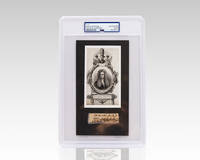
1700151722ca. 1700-1708. Autograph manuscript fragment on the Newton family lineage. England undated. A single leaf bearing autograph text in the hand of Sir Isaac Newton on both sides. 2.25 x 0.75 inches approx. 5.7 x 1.9 cm. Transcription recto: "Of the older family I am . whom I take to be my . of William Newton baptized 1541 whom ." Transcription verso: "for had by a . was next heir at law . infants and to that purpose . of her daughter with his ." A working genealogical note in Newton's hand evidently drawn from a longer document in which he traces a line of descent through one William Newton baptized 1541. The verso references questions of heirship and minor children suggesting the fragment formed part of Newton's private inquiry into the legal and lineal standing of the Newton family. Newton's documented genealogy situates him within the rural gentry of early modern England. He was born at Woolsthorpe Manor Lincolnshire to Isaac Newton a yeoman farmer who died before his son's birth and Hannah Ayscough daughter of a local clergyman. The paternal line can be traced to his grandfather Robert Newton also of Woolsthorpe indicating a family of modest landholding status. The maternal Ayscough line connected Newton to the educated clerical class a milieu that may have shaped his early intellectual formation. The present fragment though brief offers direct testimony of Newton's own engagement with the question of his ancestry and joins the small body of surviving manuscript material in which he records personal and familial concerns rather than scientific or theological matters. Condition: In good condition; minor wear consistent with age. The fragment has been archivally encapsulated by PSA/DNA together with a portrait of Newton and the corresponding authentication with the verso of the autograph remaining visible for examination. Authentication: PSA/DNA. Sir Isaac Newton 1642–1727 widely regarded as one of the most influential scientists in history established the foundational principles of classical mechanics in his Philosophiæ Naturalis Principia Mathematica wherein he articulated the three laws of motion and formulated the law of universal gravitation including the inverse-square relationship governing gravitational force. In addition to these achievements Newton independently developed the mathematical framework of calculus providing essential tools for the advancement of physics and mathematics. His extensive investigations into light and optics grounded in original experimentation significantly advanced contemporary understanding of the nature of light and color. Rejecting the long-standing authority of Aristotelian philosophy Newton instead championed an empirical experiment-based approach to scientific inquiry thereby helping to define the methodological foundations of modern science. unknown
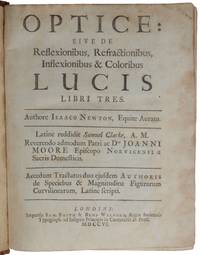
17066373London: Samuel Smith and Benjamin Walford 1706. First edition. <p>First Latin edition of the Opticks the extremely rare first issue with Ss1 in its original state. "Newton's Opticks did for light what his Principia had done for gravitation namely placed it on a scientific basis" Babson. This Latin edition is important for the seven new Queries it contains. In one of these Newton wrote that space is the 'Sensorium of God'. He later changed his mind cancelling the relevant leaf Ss1 in almost all copies although a copy in its uncancelled state found its way to Leibniz who ridiculed Newton's rash statement.</p>. <p>THE VERY RARE FIRST ISSUE WITH THE 'MISSING TANQUAM'</p> . <p>First Latin edition of the Opticks the extremely rare first issue with Ss1 in its original state cancelled in almost all copies. Of Newton's three greatest contributions to science - his theory of gravity his theories of light and colour and the invention of calculus - the first was published for the first time in the Principia 1687 and the other two in the Opticks 1704 "one of the supreme productions of the human mind" Andrade. "Newton's Opticks did for light what his Principia had done for gravitation namely placed it on a scientific basis" Babson p. 66."One of the supreme productions of the human mind" Andrade "All previous philosophers and mathematicians had been sure that white light is pure and simple regarding colors as modifications or qualifications of the white. Newton showed that the opposite is true . Natural white light far from being simple is a compound of many pure elementary colors which can be separated and recombined at will" PMM. The Optice contains translations not only of the Opticks itself but also of the two appended mathematical tracts Tractatus de quadratura curvarum and Enumeratio linearum tertii ordinis. The former is Newton's first publication of his method of fluxions or calculus which he developed in terms of 'prime and ultimate ratios' an early version of the theory of limits; it includes the first published statement of the general binomial theorem and of 'Taylor's theorem' on series expansions. The real importance of this Latin edition is the seven new 'Queries' it contains: "The Queries contain some of Newton's most influential and speculative writing" Gjertsen p. 519. The purpose of the original 16 queries in the Opticks was principally to compensate for the many years' delay between the writing of Opticks and its publication during which many discoveries had been made by Newton and others. Each of the new Queries with one exception is longer than the original 16 taken together. "In the new Queries Newton expressed fundamental views on the nature of light on the nature of bodies on the relation of God to the physical universe and on the presence in nature of a whole range of forces which furnish the activity necessary for the operation of the world and for its permanence. At the last moment he dared even a bit more and inserted three further speculative passages in the Addenda to the volume. The new Queries were the most informative of the speculations that Newton ever published." Westfall p. 644. "This edition is known in two states. In query 20 Newton had written of space: 'Annon spatium universuum sensorium est entis incorporei viventis et intelligentis' Is not infinite space the sensorium of a Being incorporeal living and intelligent. It must have struck Newton that to call space 'the sensorium of God' without any qualification was too bold a claim. Consequently he chose to substitute for page 315 a cancel in which he spoke of infinite space 'spatio infinito' as 'tanquam sensorio suo' which is as it were his sensorium. He failed however to modify the whole edition and copies with the missing tanquam been found in the Babson collection the Bodleian library and Cambridge University Library. But worse from Newton's point of view an uncancelled copy found its way to Leibniz who lost no time in accusing Newton of claiming that space is an organ of God" Gjertsen p. 413. Some of the other added Queries contain remarkably prescient speculations. Query 23 "was an extended version of the speculations on forces that Newton had once planned to insert in the Principia. Heavily indeed overwhelmingly chemical in content it was arguably the most advanced product of seventeenth-century chemistry" Westfall p. 644. "In a remarkable paragraph in Query 22 pp. 320-321 which did not survive into subsequent English editions he compared the force of attraction in proportion to size in particles of light and gross bodies by comparing velocities and radii of curvature of rays of light and projectiles. He concluded that the force of attraction in particles of light is more powerful by a factor of 1015 that is the short-range forces are immensely more powerful than gravity" ibid. p. 646.</p> <br /> <p>"Newton wrote most of the Opticks between 1687 and early 1692. He wrote Book I Parts I and II expounding his new theory of light and colour in 1687. He then appears to have set aside the Opticks for about three years but by the late summer or autumn of 1691 he had considered it - at least for a few months - to be complete. It is most likely that he carried out new research and wrote the remainder of the Opticks - that is Books II and III - in the winter or spring of 1692 or perhaps six months earlier. At some time between late August 1691 and late February 1692 Newton decided to revise the draft significantly. After this effort he brought it close to its published form except for the brief last book on diffraction which Newton called 'inflexion' and the queries which were not prepared for publication until shortly before publication in 1704.</p> <br /> <p>"The composition of Book II in 1690 or 1691 at first went very quickly. Newton made so few changes in the text that he was able to mark up the manuscript of the 'Discourse of Observations' from 1675 for his amanuensis to copy for the Opticks. This formed Parts I and II and much of Part III . After revising the 'Observations' Newton was confronted with a decision on how to end his book. At first he planned to follow this material with a new fourth book or part on diffraction but he was also toying with the idea of a speculative 'Fourth Book'. Newton soon reined in his more speculative tendencies and turned to more empirical optical investigations. He continued experiments on diffraction and also discovered an entirely new phenomenon: coloured rings produced in transparent thick plates. By the autumn of 1691 Newton had completed and written up his investigations of thick plates as Book IV Part I which together with his research on diffraction Book IV Part II was to form the concluding book of the Opticks.</p> <br /> <p>"Between late August 1691 and late February 1692 Newton removed the two parts of the new Book IV from the manuscript and set about revising them. The part on diffraction was troublesome and remained incomplete until shortly before publication. Within six months however he revised the part on the colours of thick plates incorporated it into Book III because of their affinity to those of thin films and essentially put it into its published state. During this revision Newton also introduced his theory of fits - an immaterial vibration to explain the physical cause of periodicity in light that replaced his earlier aetherial and corpuscular vibrations" Shapiro pp. 187-188. </p> <br /> <p>On 15 November 1702 according to a memorandum by the Scottish mathematician and Oxford Professor of Astronomy David Gregory Newton "promised Mr Roberts Mr Fatio Capt. Hally & me to publish his Quadratures his treatise of Light & his treatise of the Curves of the 2d Genre" i.e. cubic curves. The book appeared by 16 February 1704 when Newton presented a copy to the Royal Society" ibid. p. 196.</p> <br /> <p>In the published work "Newton presented his main discoveries and theories concerning light and color in logical order beginning with eight definitions and eight axioms . Eight propositions follow the first stating that 'Lights which differ in Colour differ also in Degrees of Refrangibility.' In appended experiments Newton discussed the appearance of a paper colored half red and half blue when viewed through a prism and showed that a given lens produces red and blue images respectively at different distances. The second proposition incorporates a variety of prism experiments as proof that 'The Light of the Sun consists of Rays differently refrangible.'</p> <br /> <p>"The figure given with experiment 10 of this series illustrates 'two Prisms tied together in the form of a Parallelopiped'. Under specified conditions sunlight entering a darkened room through a small hole F in the shutter would not be refracted by the parallelopiped and would emerge parallel to the incident beam from which it would pass by refraction through a third prism which would by refraction 'cast the usual Colours of the Prism upon the opposite Wall.' Turning the parallelopiped about its axis Newton found that the rays producing the several colors were successively 'taken out of the transmitted Light' by 'total Reflexion'; first 'the Rays which in the third Prism had suffered the greatest Refraction and painted the wall with violet and blew were . taken out of the transmitted Light the rest remaining' then the rays producing green yellow orange and red were 'taken out' as the parallelopiped was rotated yet further. Newton thus experimentally confirmed the 'experimentum crucis' showing that the light emerging from the two prisms 'is compounded of Rays differently Refrangible seeing that the more Refrangible Rays may be taken out while the less Refrangible remain' . In proposition 6 Newton showed that contrary to the opinions of previous writers the sine law of refraction actually holds for each single color. The first part of book I ends with Newton's remarks on the impossibility of improving telescopes by the use of color corrected lenses and his discussion of his consequent invention of the reflecting telescope.</p> <br /> <p>"In the second part of book I Newton dealt with colors produced by reflection and refraction or transmission and with the appearance of colored objects in relation to the color of the light illuminating them. He discussed colored pigments and their mixture and geometrically constructed a color wheel drawing an analogy between the primary colors in a compound color and the "seven Musical Tones or Intervals of the eight Sounds Sol la fa sol la mi fa sol."</p> <br /> <p>"Proposition 9 'Prob. IV. By the discovered Properties of Light to explain the Colours of the Rain-bow' is devoted to the theory of the rainbow. Descartes had developed a geometrical theory but had used a single index of refraction in his computation of the path of light through each raindrop. Newton's discovery of the difference in refrangibility of the different colors composing white light and their separation or dispersion as a consequence of refraction on the other hand permitted him to compute the radii of the bows for the separate colors. He used 108:81 as the index of refraction for red and 109:81 for violet and further took into consideration that the light of the sun does not proceed from a single point. He determined the widths of the primary and secondary bows to be 2°15' and 3°40' respectively and gave a formula for computing the radii of bows of any order n and hence for orders of the rainbow greater than 2 for any given index of refraction .</p> <br /> <p>"Book II which constitutes approximately one third of the Opticks is devoted largely to what would later be called interference effects growing out of the topics Newton first published in his 1675 letter to the Royal Society. Newton's discoveries in this regard would seem to have had their origin in the first experiment that he describes Book II Part 1 Observation 1; he had he reported compressed 'two Prisms hard together that their sides which by chance were a very little convex might somewhere touch one another' as in the figure provided for Experiment 10 of Book I Part 1. He found 'the place in which they touched' to be 'absolutely transparent' as if there had been one 'continued piece of Glass' even though there was total reflection from the rest of the surface; but 'it appeared like a black or dark spot by reason that little or no sensible light was reflected from thence as from other places' . Rotating the two prisms around their common axis Observation 2 produced 'many slender Arcs of Colours' which the prisms being rotated further 'were compleated into Circles or Rings.' In Observation 4 Newton wrote that 'To observe more nicely the order of the Colours . I took two Object-glasses the one a Plano-convex for a fourteen Foot Telescope and the other a large double Convex for one of about fifty Foot; and upon this laying the other with its plane side downwards I pressed them slowly together to make the Colours successively emerge in the middle of the Circles and then slowly lifted the upper Glass from the lower to make them successively vanish again in the same place.' It was thus evident that there was a direct correlation between particular colors of rings and the thickness of the layer of the entrapped air . Furthermore as he noted in Observation 13 'the Circles which the red Light made' were 'manifestly bigger than those which were made by the blue and violet' . He concluded that the rings visible in white light represented a superimposition of the rings of the several colors and that the alternation of light and dark rings for each color must indicate a succession of regions of reflection and transmission of light produced by the thin layer of air between the two glasses . </p> <br /> <p>"Book II Part 2 of the Opticks has a nomogram in which Newton summarized his measures and computations and demonstrated the agreement of his analysis of the ring phenomenon with his earlier conclusions drawn from his prism experiments - 'that whiteness is a dissimilar mixture of all Colours and that Light is a mixture of Rays endued with all those Colours.' The experiments of Book II further confirmed Newton's earlier findings 'that every Ray have its proper and constant degree of Refrangibility connate with it according to which its refraction is ever justly and regularly perform'd' from which he argued that 'it follows that the colorifick Dispositions of Rays are also connate with them and immutable.' The colors of the physical universe are thus derived 'only from the various Mixtures or Separations of Rays by virtue of their different Refrangibility or Reflexibility'; the study of color thus becomes 'a Speculation as truly mathematical as any other part of Opticks.' </p> <br /> <p>"In Part 3 of Book II Newton analyzed 'the permanent Colours of natural Bodies and the Analogy between them and the Colours of thin transparent Plates.' He concluded that the smallest possible subdivisions of matter must be transparent and their dimensions optically determinable. A table accompanying Proposition 10 gives the refractive powers of a variety of substances 'in respect of . Densities.' Proposition 12 contains Newton's conception of 'fits': 'Every Ray of Light in its passage through any refracting Surface is put into a certain transient Constitution or State which in the progress of the Ray returns at equal Intervals and disposes the Ray at every return to be easily transmitted through the next refracting Surface and between the returns to be easily reflected by it.' The succeeding definition is more specific: 'The returns of the disposition of any Ray to be reflected I will call its Fits of easy Reflection and those of its disposition to be transmitted its Fits of easy Transmission and the space it passes between every return and the next return the Interval of its Fits.' The 'fits' of easy reflection and of easy refraction could thus be described as a numerical sequence; if reflection occurs at distances 0 2 4 6 8 . from some central point then refraction or transmission must occur at distances 1 3 5 7 9 . Newton did not attempt to explain this periodicity stating that 'I do not here enquire' into the question of 'what kind of action or disposition this is' . Newton thus integrated the periodicity of light into his theoretical work . His work was moreover based upon extraordinarily accurate measurements - so much so that when Thomas Young 1773-1829 devised an explanation of Newton's rings based on the revived wave theory of light and the new principle of interference he used Newton's own data to compute the wavelengths and wave numbers of the principal colors in the visible spectrum and attained results that are in close agreement with those generally accepted today.</p> <br /> <p>"In Part 4 of Book II Newton addressed himself to 'the Reflexions and Colours of thick transparent polish'd Plates.' This book ends with an analysis of halos around the sun and moon and the computation of their size based on the assumption that they are produced by clouds of water or by hail. This led him to the series of eleven observations that begin the third and final book 'concerning the Inflexions of the Rays of Light and the Colours made thereby' in which Newton took up the class of optical phenomena previously studied by Grimaldi in which 'fringes' are produced at the edges of the shadows of objects illuminated by light 'let into a dark Room through a very small hole.' Newton discussed such fringes surrounding the projected shadows of a hair the edge of a knife and a narrow slit" DSB.</p> <br /> <p>"Since Newton published the Opticks without a complete investigation into diffraction which he had hoped would support a corpuscular theory of light in which light corpuscles were acted on by short-range forces of matter" Shapiro p. 196 "Newton concluded the first edition of the Opticks with a set of sixteen queries introduced 'in order to a further search to be made by others.' He had at one time hoped he might carry the investigations further but was 'interrupted' and wrote that he could not 'now think of taking these things into farther Consideration.' In the eighteenth century and after these queries were considered the most important feature of the Opticks . The original sixteen queries at once go beyond mere experiments on diffraction phenomena. In Query 1 Newton suggested that bodies act on light at a distance to bend the rays; and in Queries 2 and 3 he attempted to link differences in refrangibility with differences in 'flexibility' and the bending that may produce color fringes. In Query 4 he inquired into a single principle that by 'acting variously in various Circumstances' may produce reflection refraction and inflection suggesting that the bending in reflection and refraction begins before the rays 'arrive at the Bodies.' Query 5 concerns the mutual interaction of bodies and light the heat of bodies being said to consist of having 'their parts put into a vibrating motion'; while in Query 6 Newton proposed a reason why black bodies 'conceive heat more easily from Light than those of other Colours.' He then discussed the action between light and 'sulphureous' bodies the causes of heat in friction percussion putrefaction and so forth and defined fire in Query 9 and flame in Query 10 discussing various chemical operations. In Query 11 he extended his speculations on heat and vapors to sun and stars. The last four queries 12 to 16 of the original set deal with vision associated with 'Vibrations' excited by 'the Rays of Light' which cause sight by 'being propagated along the solid Fibres of the optick Nerves into the Brain.' In Query 13 specific wavelengths are associated with each of several colors. In Query 15 Newton discussed binocular vision along with other aspects of seeing while in Query 16 he took up the phenomenon of persistence of vision" DSB.</p> <br /> <p>Newton appended to the Opticks two mathematical tracts of which the first Tractatus de quadratura curvarum is Newton's first published account of the calculus of fluxions. In Newton's time finding the 'quadrature' of a curve meant finding the area enclosed or subtended by it which for us is a problem of integral calculus and for Newton one of the 'inverse method of fluxions'. Newton wrote three extended treatises on fluxions. The first of these 'De analysi per aequationes numero terminorum infinitas' was composed in 1669 and treats Newton's general methods of infinite series. It was not published until 1711 when William Jones included it along with a number of other tracts in his Analysis per quantitatum series. In 'De analysi' however Newton "did not explicitly make use of the fluxionary notation or idea. Instead he used the infinitely small both geometrically and analytically in a manner similar to that found in Barrow and Fermat and extended its applicability by the use of the binomial theorem" Boyer The Concept of Calculus p. 191. It was in the second of Newton's calculus treatises 'De methodus fluxionum' composed in 1671 but not published until 1736 that he first "introduced his characteristic notation and conceptions. Here he regarded his variable quantities as generated by the continuous motion of points lines and planes rather than as aggregates of infinitesimal elements the view which had appeared in 'De analysi'. . In the 'Methodus fluxionum' Newton stated clearly the fundamental problem of the calculus: the relation of quantities being given to find the relation of the fluxions of these; and conversely" ibid. pp. 192-3 i.e. the processes that we call differentiation and integration.</p> <br /> <p>De quadratura was the first of Newton's treatises on fluxions to be published but the last to be composed so that it represents his most mature view of the subject. It was prompted by a letter from David Gregory on 7 November 1691 sending Newton "my method of squaring figures published three years ago but now clarified by examples. If only I might be allowed to know your method too which as I have subsequently gathered differs little from mine." "De quadratura contained the first published statement of the binomial theorem discovered by Newton some forty years before. The text of De quadratura in its published form is in two parts. In the first part Newton in the manner of De analysi demonstrated how infinite series could be deployed to determine the quadrature and rectification of curves. In the second part he returned to the topic of fluxions discussed at greater length in his then unpublished De methodis eventually published as The method of fluxions and infinite series in 1736" Gjertsen p. 579. But perhaps "Newton's most important achievement in his 'De quadratura' was the first explicit enunciation of the Taylor expansion of a general function - Newton deduced the particular 'Maclaurin' form in his Corollary 3 by successive differentiation it would seem and then passed to the general theorem in his Corollary 4" Papers VII pp. 18-19. The expansion was rediscovered by Brook Taylor in 1715.</p> <br /> <p>The second appended mathematical treatise Enumeratio linearum tertii ordinis was composed in summer 1695 although it was based on researches carried out intermittently over the previous three decades. "In some ways the Enumeratio is the most original of Newton's mathematical works. It had no predecessors met with no rivals claiming to have anticipated the results or few even who acknowledged its results" Gjertsen p. 187. Since the inception of analytic geometry - most notably with Descartes's Géométrie 1637 which Newton carefully studied in its Latin translation 1659-61 - European mathematicians became interested in the algebraic representation of plane curves. As Descartes showed and John Wallis further developed conic sections can be represented by second-degree polynomial equations in two variables in Cartesian coordinates as we would say nowadays and they can be divided into circle parabola ellipse and hyperbola. The question naturally arises of how to move a step further and study the graphs of third-degree polynomials. In the Enumeratio Newton gave a classification of cubic curves analogous to the classification of conic sections. He identified 72 species of cubic curves mostly classified in terms of the properties of their diameters and asymptotes. There are in fact 78 species: four were added by James Stirling in his Lineae tertii ordinis Newtonianae 1717 and the remaining two by François Nicole and Nicolas I Bernoulli in the 1730s. Newton uses oblique Cartesian axes something Descartes did not do and has no qualms in using negative coordinates a novelty at the time. Newton also demonstrates deep geometrical insights stating a general theorem according to which all cubic curves can be obtained by centrally projecting the five 'divergent parabolas' very much as all conics can be obtained by projecting the circle; this was proved by Nicole and Alexis-Claude Clairaut in 1731. In the final section of the work Newton shows how the real roots of polynomial equations of degree up to 9 can be found from the points of intersection of cubic curves with lines conics or other cubic curves. Newton gave almost no proofs of his claims but Stirling revealed the methods Newton had used: algebra and infinite series. Newton's published treatise is "a marvellous epitome of results whose subtleties were only just becoming to be understood by mathematicians in the last decade of Newton's life half a century after their initial discovery" Papers VII p. 588 n1.</p> <br /> <p>Gjertsen p. 520 summarizes the content of the seven new Queries added to the Optice as follows:</p> <br /> <br /> 17-18: Double refraction<br /> 19: The 'Phenomena of Light' are not to be explained by 'new Modifications of the Rays'<br /> 20: Objections to wave theory of light and to a dense fluid medium; rejection of hypotheses in natural philosophy; limits of mechanism and a list of fundamental questions; space is the Sensorium of God<br /> 21: Rays of light are 'very small Bodies emitted from Shining substances' a view which allows many of the properties of light to be explained<br /> 22: Bodies and light are interconvertible<br /> 23: Small particles of bodies capable of acting at a distance as can be seen in a number of chemical and physical processes; evidence for the view that 'All Bodies seem to be composed of hard Particles'; Hauksbee's experiments; motion and its need of certain active principles; matter also made in the beginning by God from 'solid massy hard impenetrable moveable Particles' in need of 'certain active Principles'; examples of the divine providence in the universe.<br /> <br /> <p>In Query 20 "the refutation of wave theories of light led Newton into an argument against the possibility of a dense Cartesian ether filling the heavens and thence into an explication of his ultimate objection against conventional mechanical philosophies their tendency to make nature self-sufficient and thus to dispense with God. Some ancient philosophers he argued took atoms the void and the gravity of atoms as the first principles of their philosophy and attributed gravity to some other cause than matter.</p> <br /> <p>'Latter Philosophers banish the Consideration of such a Cause out of natural Philosophy feigning Hypotheses for explaining all things mechanically and referring other Causes to Metaphysicks: Whereas the main Business of natural Philosophy is to argue from Phenomena without feigning Hypotheses and to deduce Causes from Effects till we come to the very first Cause which certainly is not mechanical; and not only to unfold the Mechanism of the World but chiefly to resolve these and such like Questions. What is there in places empty of Matter and whence is it that the Sun and Planets gravitate towards one another without dense Matter between them Whence is it that Nature doth nothing in vain; and whence arises all that Order and Beauty which we see in the World . . . How do the Motions of the Body follow from the Will and whence is the Instinct in Animals Is not infinite Space the Sensorium of a Being Annon Spatium Universum Sensorium est Entis incorporeal living and intelligent who sees the things themselves intimately and thoroughly perceives them and comprehends them wholly by their immediate presence to himself .'</p> <br /> <p>"David Gregory who held an extensive discussion of the new Queries with Newton on 21 December 1705 recorded the interpretation of this passage in a memorandum.</p> <br /> <p>'His Doubt was whether he should put the last Quaere thus. What the space that is empty of body is filled with. The plain truth is that he believes God to be omnipresent in the literal sense; And that as we are sensible of Objects when their Images are brought home within the brain so God must be sensible of every thing being intimately present with every thing: for he supposes that as God is present in space where there is no body he is present in space where a body is also present. But if this way of proposing this his notion be too bold he thinks of doing it thus. What Cause did the Ancients assign of Gravity. He believes that they reckoned God the Cause of it nothing els that is no body being the cause; since every body is heavy.'</p> <br /> <p>"At the last moment after the last moment really Newton decided that he had indeed been too bold. He tried to recall the whole edition; and from all the copies he could lay his hands on he cut out the relevant page and pasted in a new one which asserted not that infinite space is the sensorium of God but that 'there is a Being incorporeal living intelligent omnipresent who in infinite Space as it were in his Sensory tanquam Sensorio suo sees the things themselves intimately .' Alas he failed to alter every copy and one of the originals made its way to Leibniz who did not fail to hold up to ridicule the concept of space as the sensorium of God. In its initial form the passage recalled 'De gravitatione' the beginning of Newton's rebellion against Cartesian philosophy because of its atheistical tendencies. Following the implications of the rebellion he had traveled far. In the Latin edition of the Opticks he gave the fullest exposition of his own conception of nature he would ever put in print before in his old age he tried to placate critics by seeming retreats to more conventional positions.</p> <br /> <p>"In addition to its importance for Newton's philosophy the Latin edition of the Opticks also provided the occasion for a graceful personal relation. Abraham De Moivre saw it through the press. Every evening according to the story Newton would wait for him in a coffeehouse where De Moivre would go as soon as he finished the mathematical lessons with which he supported himself. Newton would take him home and the two would spend the evening in philosophical discussion. De Moivre was one of the young men in London disciples really with whom Newton found companionship possible in a way it had never been in Cambridge. Another young disciple Samuel Clarke translated the Opticks into Latin and received £500 for his pains: £100 for each of his five children" Westfall pp. 646-8.</p> <br /> <p>Babson 137; Honeyman 2326; Poggendorff II 277; Wallis 179. Gjertsen The Newton Handbook 1986. Shapiro 'Newton's Optics' pp. 165-198 in: The Oxford Handbook of the History of Physics Buchwald & Fox eds. 2013. Westfall Never at Rest 1980.</p> <br/> <br/> 4to mm pp. xiv 348 2 24 2 43 recte 47 with 19 engraved plates. Contemporary calf. Samuel Smith and Benjamin Walford unknown
1803327150London: Symonds 1803. hardcover. near fine. 3 volumes. 55 folding copper engravings and small engravings throughout the text frontispiece copperplate portrait of Isaac Newton in volume 1. 8vo handsomely rebound in full dark brown calf with blind-stamped design on covers and spine black leather spine labels. Some scattered age toning and spotting; neat small ownership name at top of title pages and half titles. London: H. D. Symonds 1803. A scarce set in a handsome binding.<br/> <br/> Symonds unknown
198889310U. S. S. Gatling DD671 Reunion Association c1988. Presumed First Edition First printing -- presumably only a few were produced. Comb binding. Good. Louis R. Lawson Original artwork. 2 157 3 pages. Illustrations. Bibliography. Clear plastic covers front and back. Rare perhaps now unique surviving copy. Eugene P. Woodward assembled each volume prepared for sale from the original materials submitted to him. All monies realized by the sale of this memoir were earmarked for the use of the Reunion association. USS Gatling DD-671 was a Fletcher-class destroyer of the United States Navy named after Richard Jordan Gatling the inventor of the Gatling gun. Gatling was laid down 3 March 1943 by the Federal Shipbuilding and Drydock Company Kearny New Jersey; launched 20 June 1943; sponsored by Mrs. John W. Gatling wife of the inventor's grandson; and commissioned 19 August 1943 at New York Navy Yard. After shakedown out of Bermuda and alteration at New York early November the new destroyer called at Norfolk Virginia to conduct training cruises for crews of destroyers still under construction. On 19 November 1943 Gatling proceeded to Trinidad British West Indies to escort aircraft carrier Langley to Norfolk. Gatling stood out from Norfolk 3 December escorting Intrepid through the Panama Canal to San Francisco California arriving 22 December. The next day she sailed for Pearl Harbor. On 16 January 1944 Gatling sortied with the Fast Carrier Task Force then Fifth Fleet's TF 58 also known as Third Fleet's TF 38 to support the forthcoming invasion of the Marshall Islands; thereafter Gatling was continuously with the carrier task forces as they struck Japanese outposts and finally hit the heart of Japan itself. In February the first carrier strikes against Truk occurred. Gatling provided fire support during the raid and screened the flattops during raids on the Marianas a few days later. In March she joined in the attack on Emirau Island and at the beginning of April in the air strikes against the Palau Archipelago. Steaming south to strike Hollandia Wake Airfield Sawar Airfield and Sarmi Western New Guinea the task force supported Army landings at Aitape Tanahmerah Bay and Humboldt Bay from 21 to 26 April. During this action Gatling stood radar picket duty and directed fighter planes. After new attacks on Truk late April 1944 Gatling supported the invasion and occupation of the Marianas from 10 June to 5 July. In the Battle of the Philippine Sea 19 and 20 July Gatling was credited with shooting down or aiding in the destruction of six Japanese planes. Late that month carrier task forces again struck the Palaus and blasted Yap and Ulithi. In early August the Bonin Islands became targets for Gatling guns and in September the carriers she guarded repeatedly struck Japanese targets in the Philippines. October saw attacks against Okinawa beginning on 10 October and against Formosa Luzon and the Visayas from ll-23 October. On 24 October after enemy bombs had sunk the light aircraft carrier Princeton in the Battle of the Sibuyan Sea Gatling rescued over 300 of the vessel's survivors. For heroism in saving these men four Gatling crewmen were awarded the Navy and Marine Corps Medal and 16 others received the Bronze Star. Gatling landed the survivors at Ulithi and rejoined the carrier task force for November and December strikes against the Philippines. After powerful Typhoon Cobra in which three destroyers capsized Gatling searched for survivors and helped to save over 100 men from the sea. At Christmas 1944 the destroyer returned to Ulithi. The task force sortied 29 December to strike Formosa and Luzon during January 1945. Hoping to locate and destroy a Japanese fleet in that area Admiral William Halsey took the task force into the South China Sea 10 January and hit targets in Indochina and on the China coast. In the middle of February the carriers launched initial attacks against Honsh with Tokyo as their main target. As part of a picket line over 30 miles in advance of the main forces Gatling was once within 40 miles 64 km of Honsh . On 19 and 20 February as part of Destroyer Division 99 DesDiv 99 she escorted North Carolina and Indianapolis to Iwo Jima to support the gallant Marines who were fighting to wrest that volcanic fortress from Japan to become a base for B-29s damaged over the home islands. Rejoining the carrier task force Gatling aided in new strikes against Honsh and Okinawa in late February and early March. She returned to Iwo Jima independently and throughout March blasted Japanese shore batteries to support the invasion. During this duty the versatile and busy destroyer saved the entire crew of a B-29 bomber forced down while returning from a mission against Nagoya. On 29 March 1945 she stood out from Iwo Jima escorting transports carrying victorious marines to Guam. The destroyer then sailed to the United States for well-earned overhaul and repairs arriving San Francisco 18 April. After repairs and refresher training Gatling escorted New Jersey and Biloxi to Eniwetok bombarding Wake Island en route. Continuing to escort New Jersey she arrived at Guam 9 August. There the news came that Japan had accepted the provisions of the Potsdam Declaration and agreed to surrender. Gatling now headed for Japan escorting transports bearing the 4th Marine Division as the 3d Fleet rendezvoused off Japan. On 3 September 1945 Gatling steamed into Tokyo Bay as a unit of the Allied Naval Occupation Forces of Japan. During her aggressive career in World War II Gatling traveled over 175000 miles and fired 77 tons of high explosives from her guns. She sank two enemy ships and splashed eight Japanese planes either as kills or assists. In addition to her other rescue missions preserving the lives of over 400 sailors she saved 37 aviators forced to ditch at sea. Finally these heroic exploits through two busy battle-filled years were accomplished without the loss of a single man from enemy action sickness or accident. Gatling decommissioned 16 July 1946 and entered the Atlantic Reserve Fleet at Charleston South Carolina. U. S. S. Gatling (DD671) Reunion Association unknown
17296375London: William Innys for the Royal Society 1729. First edition. <p>First edition in the original Latin of Newton's Cambridge lectures on optics-his earliest systematic exposition of the mathematical theory of light and colour delivered as Lucasian Professor and published here for the first time from his manuscripts. These lectures form the foundation of Newton's later Opticks 1704 but include substantial mathematical content omitted from that more accessible English version. Notably they contain Newton's formulation of the compound nature of white light a cornerstone of modern optical theory.</p>. <p>EDITIO PRINCEPS OF NEWTON'S CAMBRIDGE LECTURES ON OPTICS</p> . <p>First edition of the complete text in the original Latin of Newton's inaugural lectures as the second Lucasian professor of mathematics at Cambridge and the first publication of his lectures on his new mathematical science of colour including his discovery of the compound nature of white light. It was from this material that Newton composed his Opticks of 1704 although in the Opticks he left out the specifically mathematical parts of the lectures which are included here. Newton "was obliged by the statutes of the post to lecture and to deposit the lectures in the University Library. For the period 1670-72 Newton lectured on optics and deposited the lectures in the ULC in October 1674. At one time Newton seemed to be contemplating publishing the lectures together with the mathematical work De methodis but by May 1672 he had decided otherwise and wrote to Collins: 'I have now determined otherwise of them; finding already by the little use I have made of the Presse that I shall not enjoy my former serene liberty till I have done with it' Correspondence I p 161. Consequently . the lectures remained unpublished until after his death as did the De methodis" Gjertsen pp. 409-410. Following Newton's death in March 1727 his followers decided to publish the lectures both in the original Latin and in English. In fact only Part I on the mathematical theory of reflection and refraction was translated and published in English in 1728; part II on colours was omitted. The present Latin edition which includes both parts is thus the editio princeps of the complete series of Newton's lectures including the first publication of his lectures on colours. Based on a copy belonging to David Gregory it was discovered during the printing that there were discrepancies between Gregory's copy and the copy deposited by Newton in the ULC which necessitated the inclusion of a five-page 'Addenda and Corrigenda'. "Today we can appreciate the Lectiones as an invaluable document of Newton's investigations of optics that reveals his ideas in the midst of his most productive period of research. In the inevitable comparison with the Opticks 1704 which recounts research for the most part carried out twenty to thirty years earlier and since refined - sometimes overrefined - the lectures must be judged neither as carefully developed nor as polished. But whatever polish it may lack is more than compensated for by its vitality as Newton boldly attempts in the following pages to create a new mathematical science of color" Shapiro p. 25. Since the Lectiones "was his first and most comprehensive account of his theory of color he naturally drew upon it in his later writings. It served as the immediate source for his 'New theory of light and colors' 1672 in the Philosophical Transactions his first public statement of his theory outside the Cambridge lecture halls. And twenty years later it remained the foundation for the 'definitive' statement of his theory in Book I of the Opticks" ibid. p. 1. This was the only separate edition of Newton's complete lectures: the text was published six more times in the eighteenth century in various collections of Newton's works.</p> <br /> <p>Provenance: 'Ex-libris Dutour' on front free endpaper followed by a price; some marginal notes in Latin.</p> <br /> <p>"Upon his appointment as Isaac Barrow's successor to the Lucasian chair in the late autumn of 1669 Newton was confronted with developing a series of lectures to begin the following January. In a natural extension to Barrow's prior series of optical lectures published as Lectiones XVIII 1669 he took the opportunity to make the first formal presentation of his new mathematical science of color. The Lucasian Professor was required to give one lecture for about one hour each week during the term and to submit annually not fewer than ten of those lectures to the Vice-Chancellor for deposit in the University Library for public use. Newton complied with this regulation somewhat tardily in October 1674 when he delivered to the Vice-Chancellor his Optica divided into two parts with a total of thirty-one lectures. According to the marginal annotations the first lecture of Part I was delivered in January 1670 at the beginning of Lent term and Lecture 9 of Part I and Lectures 4 and 14 of Part II opened the Michaelmas terms beginning in October of 1670 1671 and 1672" Shapiro p. 16.</p> <br /> <p>As noted above by the winter of 1671-2 Newton had decided to publish the Optica together with his mathematical treatise De methodis serierum et fluxionum the latter was not actually published until 1736. However following the publication of his 'New theory of light and colours' in the Philosophical Transactions a few months later Newton changed his mind: his 'New theory' had resulted in controversy which he was loathe to encourage by further publications. "In September 1672 Newton had decided to recast his theory in a more formal structure 'in imitation of the Method by wch Mathematicians are wont to prove their doctrines.' The next year in outlining his restructured theory for Christiaan Huygens he recognized that it needed a more rigorous proof . Instead Newton was planning a work very much like the later Opticks . In this newly projected work the sections of the Optica on color were to be extensively rewritten and its mathematical part omitted. There is no evidence that Newton wrote such a discourse during this period but when in the early 1690s he eventually composed the Opticks he in essence followed the plan he had proposed in the mid-1670s . When after still another postponement the Opticks was finally published in 1704 Newton felt it necessary to warn that 'If any other Papers writ on this Subject are got out of my Hands they are imperfect and were perhaps written before I had tried all the Experiments here set down and fully satisfied my self about the Laws of Refractions and Composition of Colours I have here Published what I think proper to come abroad.' He is here inter alia surely referring to his Optica deposited thirty years earlier in the Cambridge University Library . During his lifetime Newton's disavowal was respected by eager members of the Newtonian circle but an English translation of Part I appeared in 1728 the year after his death followed in the next year by the editio princeps of the complete Latin text of the Optica . The editor of the Latin edition emphasized the significance of the geometrical demonstrations and philosophical arguments in Part I because in the Opticks Newton 'seems to have been as careful as possible not to mix geometrical demonstrations with philosophical arguments and when it was necessary to set forth a mathematical proposition its demonstration scarcely ever occurs' . He also perceptively recognized that with respect to color 'many things are found in each with the same meaning but are explained in a different manner'" ibid. pp. 21-23.</p> <br /> <p>"After briefly paying tribute to Barrow and deriding efforts to improve refracting telescopes by the use of nonspherical lenses Newton devotes the first two lectures of Part I to laying the foundations for the whole of the Lectures: a demonstration that direct sunlight consists of rays that differ in their degree of refrangibility. Virtually the entire burden of his demonstration is borne by an analysis of the elongated spectrum formed by passing a narrow beam of sunlight through a prism. Newton's major insight and the key to his demonstration was to recognize that when a prism is placed symmetrically with respect to the incident and emergent beams or at minimum deviation the sun's image would be circular rather than elongated if all rays were refracted equally. An exact solution for the shape of the sun's image with monochromatic rays is exceedingly difficult involving a finite source and aperture and rays incident out of the principal plane; but he is able to demonstrate that under particular conditions such as with a point aperture the image is nearly circular. This was sufficient for his purpose for he had found the spectrum's length to be five times its breadth thus making small deviations from the assumed condition inconsequential.</p> <br /> <p>"Newton begins Lecture 2 by describing the shape of the spectrum to be an oblong bounded by straight edges and semicircular ends and he argues formed by innumerable overlapping circular images of the sun each consisting of rays of a different refrangibility . The thrust of the remainder of the lecture describes how to decrease the effective size of the source and thus the circular images and to approach the ideal spectrum - a straight line with no breadth - formed by a point source. By this mode of demonstration culminating in the observation of Venus's spectrum he makes the actually observed shape of the sun's spectrum inessential to his proof that its elongation is caused by unequal refrangibility ibid. pp. 26-27.</p> <br /> <p>"Newton begins his 'dissertation on the measure of refractions' which constitutes the next three lectures with an explanation of Descartes's sine law of refraction which he extends - without experimental demonstration - to rays of each color . Next in two lemmas he derives the equations for his preferred method to measure the index of refraction that of minimum deviation in prisms one of his most important contributions to quantitative experimental optics . Newton opens Lecture 10 by extending the method of minimum deviation to fluids with the use of a hollow prism with glass sides and he illustrates this method by a measurement of the mean index of refraction of water . He then advances to the next phase of his investigation of refraction: to determine the indices of refraction of the extreme rays or the chromatic dispersion . When the prism is placed at minimum deviation for the mean refrangible rays he measure the length of the spectrum and thereby determines the angular dispersion. He presents a simple measurement and calculation for the dispersion of glass .</p> <br /> <p>"Newton concludes his 'dissertation on the measures of refraction' in Lecture 11 by setting forth a dispersion law which serves as the foundation for the rest of the Lectures. He freely admits that it is a purely theoretical construct that he has not yet experimentally tested. Though he presents his dispersion law solely in mathematical terms without any mechanical interpretation it is evidently a modification of Descartes's projectile model for a single sort of ray extended to apply to polychromatic rays. It represents the very ideal of a rational optics for the indices of refraction of rays of every color in any medium can be determined with only a single measurement as Newton illustrates with water .</p> <br /> <p>"In Lectures 12 and 13 on refraction at a single plane surface Newton attempts to uncover the physical implications of the laws of refraction the sine law and his dispersion law by a thorough mathematical analysis. Since that dispersion law was so tenuously founded and is the starting point for much of his analysis these lectures are now as notable for their mathematical analyses as for their contributions to optics.</p> <br /> <p>"Lecture 12 is . devoted to the single problem in Proposition 3 of determining the position of a luminous point viewed obliquely across a plane reflecting surface. Newton's recognition here that there are two image points effectively begins the study of astigmatism . Lecture 13 . studies a natural extension of Proposition 3: to determine the shape of the extended image of a point source due to the varying index of refraction when the point is viewed across a plane surface. He elegantly demonstrates that the images of the point lie on a Dioclean cissoid .</p> <br /> <p>"In the next two pairs of Lectures 14 15 and 16 17 Newton continues his attempt to create a rational science of color by investigating the variation of angular dispersion as the index of refractions and hence the chromatic dispersion of the refracting media vary . The brief Lecture 18 treats refraction in prisms .</p> <br /> <p>"Section 4 on refraction at curved surfaces the conclusion of the mathematical part of the Optica is its highpoint an intimate blend of mathematics and physics consistently yielding novel interesting results . He effectively begins this section in Proposition 29 by determining the image point in a form equivalent to the Gaussian formula for paraxial rays incident upon a single spherical surface; and then in Proposition 30 he extends this result to any curved surface by substituting the center of curvature determined in Lemma 9 in the immediate neighborhood of the incident rays for the center of the spherical surface. In Proposition 31 Newton applies many of the newly wrought mathematical methods such as series expansions and the determination of extrema to find the longitudinal spherical aberration for rays incident on the plane face of a plano-convex lens and then the circle of least confusion. Because of its algebraic formulation this proposition is particularly accessible to the modern reader and provides a fine example of Newton's application of mathematics to physics. In the next proposition he elegantly derives the location of the primary image point or caustic locus for rays obliquely incident upon a spherical surface while also noting the existence and location of the secondary image point. Proposition 33 extends this result to any curved refracting surface. In Proposition 34 he presents his own solution to a problem posed and solved by Descartes: to find the aplanatic surface a Cartesian oval that refracts rays perfectly from a given point to a given point. Pursuing the Cartesian theme in Propositions 35 and 36 he derives the radii of the primary and secondary rainbows and then moving beyond all his contemporaries he generalizes his solution to bows of any order. And to conclude Newton in Proposition 37 calculates the chromatic aberration to show that it is much more enormous - some 1500 times greater - than spherical aberration and once again stresses the significance of his discovery of unequal refrangibility for practical optics" ibid. pp. 36-41.</p> <br /> <p>In Part II Newton begins the 'dissertation on colors' by reiterating his inaugural remarks on the defects of contemporary telescopes and the impediment presented by chromatic aberration and in prelude to his own theory he vigorously attacks both Aristotelian and more recent modification theories of colour. He then presents his theory in five propositions. The first proposition that to differently refrangible rays there correspond different colors had already been established in Part I. Its converse states that different colors are unequally refracted. "To demonstrate this he introduces his crossed-prism experiments where spectra cast on a second transverse prism become inclined to their original orientation because the blue end is always refracted more than the red. Initially he places the second prism transverse to the first one to minimize the unequal incidence arising from the refraction of the first prism; but by passing the refracted rays through two holes far apart so that they fall on the second prism at very nearly the same angle of incidence he eliminated the requirement for any particular orientation of the second prism and arrives at an experimental arrangement virtually identical to the experimentum crucis of the 'New theory' .</p> <br /> <p>"Proposition 2 on the immutability of monochromatic colors is established by first separating the spectral colors from one another and then demonstrating that the more completely they are separated the smaller are their changes after additional refractions. He first separates the colors with two parallel prisms and observes some color change because the adjacent colors are still intermingled but when he adds two more prisms he is unable to detect any further sensible change .</p> <br /> <p>"In Lectures 4-7 Newton carries out the first part of his demonstration of Proposition 3 that white light in particular sunlight is composed of rays of every color by showing five different ways to make white from a mixture of spectral colors: i colors from three prisms are cast onto a screen where they are mixed; ii one face of a prism is covered with an opaque paper with six slits each functioning as one of the prisms in the preceding experiment and then the colors from the various slits mix on a screen; iii light scattered from a screen on which a spectrum has been projected is received on a second screen where the scattered rays mix; iv the colors dispersed by a prism are transmitted through a lens and brought together at its focus; v in a variant of the preceding way a mirror is substituted for the lens. He also illustrates the compound nature of white by a mixture of colored powders and by a froth of soap bubbles .</p> <br /> <p>"Newton now applies himself to the second and more difficult part of his demonstration of Proposition 3 namely to show that the sun's direct light is compounded of colors even before they are apparent. He bases his demonstration on the phenomenon of total reflection for as he discovered the critical angle of reflection varies for each color. In the first and simplest experiment a beam of sunlight is partially reflected and partially refracted at the base of a prism. As the prism is rotated the colors are totally reflected in sequence and the reflected and transmitted beams change color until when the red rays are at last totally reflected and the transmitted beam vanishes the reflective beam is restored to white. Newton argues implicitly appealing to the emission theory of light that this reveals that the colors are in the rays as they arrive from the sun since they preserve and exhibit the same color whether they are reflected refracted. Furthermore this shows that reflected light is compound since white is restored when the last color red is totally reflected. To make this interpretation still more certain he introduces three variants of this basic experiment one of which is an exact analog of the experimentum crucis but with total reflection replacing the second refraction . Newton concludes the proof of Proposition 3 by briefly explaining why the sun's light is yellowish rather than white and then by showing that black is compounded from all colors grey from white and black and all other compound colors from the painter's primaries red yellow and blue. Despite the need for some restrictions and the brevity of its demonstration Proposition 4 that spectral colors can be compounded from their neighbouring colors is an important contribution to the theory of compound colors and displays Newton's keen experimental skill.</p> <br /> <p>"Newton now turns to his fifth and final proposition that natural bodies derive their color from the sort of rays they reflect most. By the principle of color immutability the color of a ray cannot be changed my reflection so that bodies can appear only the color of the rays illuminating them. To explain why all bodies are not therefore the same color in daylight as this principle alone would demand he adds that bodies reflect more of their own daylight color than others. After demonstrating this by illuminating various bodies with monochromatic light he moves beyond this phenomenological account and attributes two distinct powers to bodies: to reflect rays and to transmit them. These rays are complementary for the rays that are not reflected pass through the body and he illustrates this with the colors of such substances as gold leaf which reflects yellow light and transmits blue. Newton did recognize that most bodies are not of this sort but are the same color all around and to explain this he introduces a third power - and a new concept in optics - selective absorption .</p> <br /> <p>"In the concluding section of the Optica Newton considers the colors generated by refractions at curved surfaces namely lenses the eye and raindrops or the rainbow. He first describes the chromatic aberration of a plano-convex lens and gives a simple physical derivation and numerical estimate of its magnitude. Observing that the eye is a lens of sorts which should likewise suffer from chromatic aberration he presents a simple experimental demonstration of its existence. In the last article of Lecture 14 and in all of Lecture 15 Newton indulges in the sort of speculative or hypothetical natural philosophy that he frequently and vigorously decried yet could not always resist. Exhibiting a firm command of Cartesian natural philosophy he explains the cause of the colored circles or coronas that Descartes saw around a candle after he had pressed his eye shut for a long time. While Newton recognizes that an infinity of causes may be devised to explain these colored circles he ascribes them to refractions in wrinkles impressed on the cornea and invoking the principles of hydrostatics rejects Descartes's own suggestion that they are impressed on the crystalline lens. He concludes the Optica in Lecture 16 with a far more notable achievement an explanation of the dimensions and colors of the rainbow based on the mathematical results derived in Part I" ibid. pp. 28-36.</p> <br /> <p>Babson 155; Wallis 191; ESTC t18664. Gjertsen The Newton Handbook 1986. Shapiro ed. The Optical Papers of Isaac Newton Vol. 1 The Optical Lectures 1670-1672 1984.</p> <br/> <br/> 4to 221 x 165 mm pp xii 144 145-152 153-291 5 Addenda and corrigenda with 24 folding engraved plates some spotting scattered foxing. Contemporary marbled sheep spine gilt in compartments red morocco spine label marbled endpapers red edges a little rubbed minor abrasion to upper board. William Innys for the Royal Society unknown
17521862Spain 1752. 18th-century manuscript. Text in Spanish. 24 handwritten pages in ink in three different hands. Later binding of blank paper using old material. Tiny wormholes at the lower edge of the pages on the first 7 leaves not affecting the legibility. Occasional foxing ink ghosting. Water stains on the last 2 leaves. Overall in fine condition. 18th-century manuscript. Text in Spanish. 24 handwritten pages in ink in three different hands. ff 12. <p><br /> 18th-Century Spanish manuscript about the Spanish involvement in the French Geodesic Mission of 1735 and the Ellipsoid Model of the Earth.<br /> <p><p><br /> The manuscript is an interesting collection of contemporary reports proving the importance of the Spanish role performed by Jorge Juan y Santacilia and Antonio de Ulloa in the so-called French Geodesic Mission 1735 with a particular focus on the polemic over the shape of the Earth. The quotations are conjugated with connecting texts by an anonymous author.<br /> <p><p><br /> One of the important scientific disputes of the late 17th early 18th century was the debate on the shape of the Earth. The assumption of the spherical shape was dominating until the late 17th century when Sir Isaac Newton determined that the Earth was oblate a spheroid stretched over the Equator however at the same time Giovanni Domenico Cassini and his son Jacques supposed that the Earth was prolate stretched along the poles. Eventually in 1735 two expeditions were sent by Louis XV and the French Academy to the Arctic Circle Lapland and to the Equator Ecuador and Peru to gain certainty by measuring the meridian arcs at polar and equatorial latitudes. The equatorial mission was accompanied by two Spanish geographers Jorge Juan y Santacilia and Antonio de Ulloa thus it became the first major international scientific expedition. The findings of the missions confirmed Newton’s hypothesis that the Earth was oblate a rotational ellipsoid.<br /> <p><p><br /> The first part of the manuscript is a lengthy citation of an early Spanish report on the equatorial mission published in the Mercurio histórico y político February 1745; pp. 99–107 which is followed by further references and quotations related to the geographer’s their work and the figure of the Earth such as Benito Jerónimo Feijóo y Montenegro’s Theatro critico universal 1751 Bernardo’s de Ulloa’s Antonio’s father Restablecimento de las fabricas y comercio español 1749 and articles from the Journal de Trévoux or the Gaceta de Zaragoza. The second part is Diego de Torres Villarroel’s 1693–1770 study Prevenciones in: Libros en que estan reatados. Vol. IV.; 1752 in which de Torres the almanac writer and professor of mathematics of a dubious repute opposes the findings of the missions and Newton’s hypothesis of the oblate Earth.<br /> <p><p><br /> Antonio de Ulloa 1716–1795 was a Spanish scientist and explorer the first Spanish governor of Louisiana who is also credited as the discoverer of the element platinum. De Ulloa was a Fellow of the Royal Society and a foreign member of the Royal Swedish Academy of Sciences. His associate Spanish scientist in the Geodesic Mission to Peru was Jorge Juan y Santacilia 1713–1773 who during the mission also measured the heights of the mountains of the Andes. Jorge Juan was the founder of the Real Observatorio de Madrid Royal Observatory of Madrid and he became a Fellow of the Royal Society too. Their co-written memoirs were published in Spanish from 1748 on and their books were very soon translated into French English and German.<br /> <p><p><br /> Literature: Lafuente A.; Mazuecos A.: Gentlemen of the Fixed Point: Science Politics and Adventure in the Geodesic Expedition to the Viceroyalty of Peru in the XVIII Century. pp. 171–203. Retrieved on July 8 2020 from Mayboudi L. S.: chapter 5.1 In: Geometry Creation and Import With COMSOL Multiphysics. Dulles VA USA: Mercury Learning & Information 2019.; Richardson D.; et al: The International Encyclopedia of Geography People the Earth Environment and Technology: Chichester UK; Hoboken NJ: John Wiley & Sons 2017.<br /> <p>. unknown
119780Monte Carlo: Taschen 1999. Signed limited edition of this landmark in the field of photography. Elephant folio original cloth illustrated throughout original publisher's stand. Signed by Helmut Newton on the title page. Edited by June Newton supported with a Philippe Starck bookstand and containing over 400 images it covers every aspect of Newton’s outstanding career chronicling his groundbreaking fashion photography definitive nudes and celebrity portraiture. With the original shipping box. An exceptional example. “Of all the thousands of iconic books produced by TASCHEN their greatest accomplishment is photographer Helmut Newton’s Sumo. The sheer size and scale was an achievement in itself as it is the largest and most expensive book of the 20th century. In order to produce such a book one needs vision and courage not to mention the technical side of manufacturing and marketing" Michael Chow. Taschen hardcover
198718974EMunich: Schirmer / Mosel 1987. First Edition. From the library of the great film director and art collector Billy Wilder signed and inscribed by the author / photographer Helmut Newton to Mr. Wilder and his wife Audrey. Inscribed on the title page: “For Billy and Audrey with love from Helmut. See page 147 for the only interesting photo in this book. Berlin 25.5.1987.†And on the front flyleaf Newton writes to the Wilders: “Fur der Herr und Frau Professor.†Newton’s inscription about page 147 refers to his black & white portrait of Billy and Audrey Wilder taken in Los Angeles in 1985 showing Billy reclining on a chaise looking into the camera and playfully pulling down a long double strand of pearls which Audrey is wearing as she stands next to the chaise looking down at Billy. Oversize art book format. Text in German. Fine copy in a fine dust jacket. A collection of provocative photographs of film celebrities and art social music and literary personalities and self-portraits by Helmut Newton in full-color and in black & white. With terrific images of Andy Warhol Salvador Dali David Hockney Jeanne Moreau Karl Lagerfeld Catharine Deneuve including the cover photo Paloma Picasso David Bowie Sting Marianne Faithful Mick Jagger Raquel Welch Jacqueline Bisset Veruschka Jack Nicholson Mickey Rourke Debra Winger Timothy Leary Julian Schnabel Anjelica Huston John Huston Darryl Hannah and more. Billy Wilder’s legendary status in Hollywood as a director screenwriter and producer includes such classic films as Ninotchka Sunset Boulevard Double Indemnity The Lost Weekend Stalag 17 Some Like it Hot The Seven Year Itch The Apartment and The Fortune Cookie. Schirmer / Mosel unknown books
198718974EMunich: Schirmer / Mosel 1987. First Edition. From the library of the great film director and art collector Billy Wilder signed and inscribed by the author / photographer Helmut Newton to Mr. Wilder and his wife Audrey. Inscribed on the title page: “For Billy and Audrey with love from Helmut. See page 147 for the only interesting photo in this book. Berlin 25.5.1987.†And on the front flyleaf Newton writes to the Wilders: “Fur der Herr und Frau Professor.†Newton’s inscription about page 147 refers to his black & white portrait of Billy and Audrey Wilder taken in Los Angeles in 1985 showing Billy reclining on a chaise looking into the camera and playfully pulling down a long double strand of pearls which Audrey is wearing as she stands next to the chaise looking down at Billy. Oversize art book format. Text in German. Fine copy in a fine dust jacket. A collection of provocative photographs of film celebrities and art social music and literary personalities and self-portraits by Helmut Newton in full-color and in black & white. With terrific images of Andy Warhol Salvador Dali David Hockney Jeanne Moreau Karl Lagerfeld Catharine Deneuve including the cover photo Paloma Picasso David Bowie Sting Marianne Faithful Mick Jagger Raquel Welch Jacqueline Bisset Veruschka Jack Nicholson Mickey Rourke Debra Winger Timothy Leary Julian Schnabel Anjelica Huston John Huston Darryl Hannah and more. Billy Wilder’s legendary status in Hollywood as a director screenwriter and producer includes such classic films as Ninotchka Sunset Boulevard Double Indemnity The Lost Weekend Stalag 17 Some Like it Hot The Seven Year Itch The Apartment and The Fortune Cookie. Schirmer / Mosel unknown
1972550383New York: Random House 1972. Hardcover. Near Fine/Near Fine. First edition. Introduction by Franz Schurmann. Near fine with the spine ends a touch bumped a few tiny spots and small subtle splash mark on the foredge in near fine dust jacket with the rear flap creased small chip at the bottom of the spine and some wear at the corners. Inscribed by Newton to Franz Schurmann who wrote the book's introduction: "To Franz all power to the people - from Huey - P.S. Thanks you for all your help - love you."<br /> <br /> Schurmann taught at the University of California Berkeley for nearly 40 years founded the Berkeley Faculty Peace Committee in 1964 and was an expert on China according to his The New York Times obituary which called his book Ideology and Organization in Communist China 1968 "one of the first significant accounts of life inside Mao’s China." In Schurmann's introduction he compares China's revolution to that of the Black Panthers who evolved from "a political weapon of self-defense by Black People" into a "growing party with a vision reaching out to the entire world . who want power identity and respect for their own race" typified by their leader Newton who is "no longer the Minister of Defense but the Servant of the People."<br /> <br /> An especially nice association in a book seldom found signed. Random House hardcover