NEWTON, IsaacBiblio.com
13 069 résultats
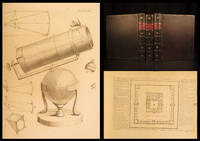
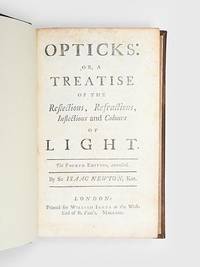
1730187897London: Printed for William Innys 1730. The definitive edition of Newton's second great work Fourth edition the final edition to be revised and approved by Newton himself. The Opticks is Newton's definitive study of light the basis for the corpuscular theory of light rays that remained dominant into the 19th century. The Opticks's greatest achievement is showing that colour is a mathematically definable property. Newton demonstrates that white light is a mixture of infinitely varied coloured rays and that each ray is definable by the angle through which it is refracted. Other topics include colour circles theories of the rainbow and the phenomenon now known as Newton's rings. In his later years Newton made a sustained effort to tidy up his scientific legacy. This edition of the Opticks was published three years after his death by his long-time publisher drawing on corrections "by the Author's own Hand" preface. In those three years Newtonian devotees had published the Optical Lectures 1728 that he had delivered at Cambridge in the 1660s making public a work that he had only circulated in manuscript among close friends. The Lectures employed a more mathematical analysis of colour theory than did the Opticks and Innys' fourth edition harmonizes the two works by cross-referencing philosophical propositions in the latter with geometrical demonstrations in the former. Octavo 195 x 123 mm pp. viii 382 2. Complete with terminal advertisement leaf and 12 folding plates. Wood-engraved initials head- and tailpieces. Twentieth-century calf spine ruled and decorated in blind and with red morocco label marbled endpapers edges sprinkled red. Minimal foxing to contents paper flaw to lower outer corner of K1 text unaffected plates crisp: a very good copy indeed. Babson 136; ESTC T69138; Gray 178; Wallis 178. unknown
1870110127New York: Robert Carter and Brothers 1870. Rare early edition of this work by Newton. Octavo original cloth illustrated. Presentation copy inscribed by Moody on the front free endpaper "To John Syme D.L. Moody My dear Brother be useful be earnest be fruitful and the blessing of God will rest on you." In good condition. Signatures of the legendary evangelist are rare especially with such a lengthy inscription. Dwight Lyman Moody also known as D. L. Moody was an evangelist and publisher connected with the Holiness Movement who founded the Moody Church Northfield School and Mount Hermon School in Massachusetts Moody Bible Institute and Moody Publishers. One of his most famous quotes was "Faith makes all things possible. Love makes all things easy." Moody gave up his lucrative boot and shoe business to devote his life to revivalism working first in the Civil War with union troops through YMCA in the United States Christian commission. In Chicago he built one of the major evangelical centers in the nation which it is still active. Working with singer Ira Sankey he toured the country and Britain Europe drawing large crowds with a dynamic speaking style that preached God's love and friendship kindness and forgiveness rather than hellfire and condemnation. Robert Carter and Brothers hardcover books
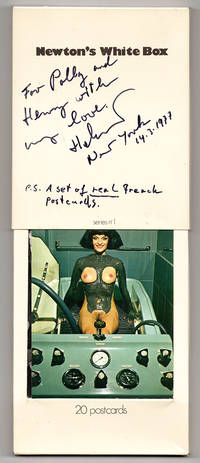
6004Paris: Xavier Moreau ca. 1975. 8vo 8†x 5†white paperboard box with slip-off lid. 20 color and black & white postcards 6†x 4.25†loosely inserted in an internal tray; titles in French printed on verso of postcards. Inscribed on front panel of lid in black ink: “For Polly and Henry with my love. Helmet New York. 14. 3. 1977. P. S. A set of real French postcards.â€. <p>A presentation copy of an early and exceedingly rare Newton publication comprising twenty erotic postcards reproducing his photographs inscribed to the noted fashion editor and stylist Polly Allen Mellen and her husband.</p> <br /> <br /> <p>First and only edition. This is one of only two examples that we have been able to trace. The other copy which appeared in the trade in 2014 was inscribed by Newton in 1976 to Rudi Gernreich 1922–1985—an innovator of twentieth century fashion best known for his scandalous “monokini†or topless female swimsuit. Although identified as “Series No. 1†on the lid no other series of Newton’s postcards is known.</p> <br /> <br /> <p>Born in Berlin Helmut Newton 1920–2004 was known for his radical edgy and provocative photography. As documented in these photos Newton preferred working outside the studio and often shot his models outdoors and in elegant mansions villas and hotels. Newton pushed the boundaries of the fashion industry of his day with his often-sinister erotically-charged imagery—leading some feminists to criticize his work. He began working for Vogue in the ‘50s and soon—like Richard Avedon and Norman Parkinson—became one of the magazine’s foremost photographers. While 1976 saw Newton’s first recorded publication White Women the present postcards are variously dated from 1971 to 1975 evidently indicating publication prior to White Women. Newton’s first group exhibition—at Emily Lowe Gallery New York City—and his first solo show at Galerie Nikon in Paris were both held in 1975. It is possible that White Box was published in connection with the latter. In any case it is not listed among the photographer’s known publications on the website of the Helmut Newton Foundation.</p> <br /> <br /> <p>Polly Allen Mellen 1924– is a fashion editor and stylist who worked for Harper's Bazaar under Diana Vreeland and later Vogue under Vreeland and Grace Mirabella—her career spanning over sixty years. She served as a nurse's aide during WWII and moved to New York in 1949. At Harper’s Bazaar she met her future longtime collaborator Richard Avedon who initially found Mellen “too noisy.†In time however Avedon would describe her as “the most creative sittings editor I ever worked with.†Nicolas Ghesquiere has suggested that Mellen’s work at Harper’s and later Vogue came to “define a new more modern ethos about clothes and how women wore them. With an almost playful daring the ethos brimmed with a kind of strong smart unabashedly celebratory feminine independence—as well as an artful element of provocation and extravagance—that Mellen herself embodied and drew upon in her collaborations†Ghesquiere Polly Mellen. Over the course of her career Mellen worked with such photographers as Newton Avedon Arthur Elgort Irving Penn Steven Meisel and Mario Testino. Polly and Henry Wigglesworth Mellen 1920–2014 married in 1965.</p> <br /> <br /> <p>No copies recorded in OCLC. Apart from the copy offered by Peter Harrington in 2014 we find no other copies recorded no sales records nor any other mention of White Box.</p> <br /> <br /> <p>REFERENCES: Ghesquiere Nicolas “Polly Mellen†2010 at Interview Magazine online; Warren Lynne. Encyclopedia of Twentieth-Century Photography Vol. 3 New York: Routledge 2006 p. 1159; “Helmut Newton†at the International Center of Photography online; “Polly Mellen styled the controversial Bathhouse Series & Nastassja Kinski†2014 at A.G. Nauta Couture online.</p> Paris: Xavier Moreau, [ca. 1975] unknown
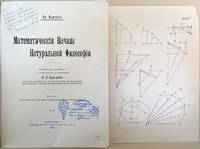
191546310Petrograd: M. M.Stasiulevicha 1915. <p>Newton Isaac 1643-1727. Matematicheskiye nachala natural'noy filosofii. Translated from Latin with notes and explanations by Aleksei N. Krylov. 2 vols. vi 276; 4 277-620pp. 36 plates. Petrograd: M. M. Stasyulevich 1915-16. Original printed wrappers spines restored edges of wrappers repaired front wrapper of Vol. 1 a bit creased a few tiny chips. Library stamps on titles and last pages of both volumes some ink lines in the margins. Very good.</p> <p> First Edition in Russian of Newton's Philosophiae naturalis principia mathematica 1687 made by Russian naval engineer and applied mathematician Aleksei Nikolaevich Krylov 1863-1945 who became internationally famous for his works on magnetic compasses ship floodability hydrodynamics and computational mathematics. He built the first machine in Russia for integrating ordinary differential equations and in 1931 published a paper on what is now called "Krylov subspace" dealing with computation of the characteristic polynomial coefficients of a given matrix.</p> <p> The first volume of Krylov's translation of the Principia unlike many Russian books of the period was printed on good-quality paper; the second volume however was printed on paper of lesser quality. The edition does not include information on the number of copies printed but it was likely a small edition. OCLC cites four copies in Western libraries-Stanford Huntington University of Oklahoma and Paris-BIUSJ-Mathematiques. Not in A Descriptive Catalogue of the Grace K. Babson Collection of the Works of Sir Isaac Newton.</p> . M. M.Stasiulevicha unknown
1870110127New York: Robert Carter and Brothers 1870. Rare early edition of this work by Newton. Octavo original cloth illustrated. Presentation copy inscribed by Moody on the front free endpaper "To John Syme D.L. Moody My dear Brother be useful be earnest be fruitful and the blessing of God will rest on you." In good condition. Signatures of the legendary evangelist are rare especially with such a lengthy inscription. Dwight Lyman Moody also known as D. L. Moody was an evangelist and publisher connected with the Holiness Movement who founded the Moody Church Northfield School and Mount Hermon School in Massachusetts Moody Bible Institute and Moody Publishers. One of his most famous quotes was “Faith makes all things possible. Love makes all things easy.“ Moody gave up his lucrative boot and shoe business to devote his life to revivalism working first in the Civil War with union troops through YMCA in the United States Christian commission. In Chicago he built one of the major evangelical centers in the nation which it is still active. Working with singer Ira Sankey he toured the country and Britain Europe drawing large crowds with a dynamic speaking style that preached God's love and friendship kindness and forgiveness rather than hellfire and condemnation. Robert Carter and Brothers hardcover
178225494<p><strong>1782 Isaac NEWTON Works OPTICS Ancient Kingdoms Gravity Mundi Systemate Horsley</strong></p><p><em>"Whence arises all that order and beauty we see in the world" </em></p><p>― Isaac Newton<em> Opticks</em></p><p>Few names in the course of the history of science have been as influential as Isaac Newton. His works such as '<em>Opticks'</em> summarized great discoveries and theories concerning light and color reflections color wheel invention of the telescope early theories of the rainbow and Newtonian rings – <strong><u>one of the greatest works on optics</u></strong>. '<em>Opticks'</em> in addition to his other famous treatises were published together in the 1782 collected works of Newton by Samuel Horsley. </p><p>This set of three volumes from the Horsley collected edition includes not only '<em>Opticks'</em> but works such as "<em>Chronology of Ancient Kingdoms</em>" correspondence with Boyle on gravity and "<em>De mundi systemate</em>" or "<em>Systems of the World".</em></p><p>Item number: #25493</p><p>Price: $4950</p><p>NEWTON Isaac</p><p><strong><em>Opera Quae Exstant Omnia</em></strong></p><p>Londini: Excudebat Joannes Nichols 1782-1785.</p><p><u>Details</u>: </p><p><!-- if !supportLists-->· <!--endif-->Collation: 3 volumes</p><p><!-- if !supportLists-->o <!--endif-->Vol. III – 10 174 5 180-242 3 246-437 8 4-48</p><p><!-- if !supportLists-->§ <!--endif-->plates no.2-11</p><p><!-- if !supportLists-->o <!--endif-->Vol. IV – 9 6-264 5 270-617p</p><p><!-- if !supportLists-->§ <!--endif-->12 plates</p><p><!-- if !supportLists-->o <!--endif-->Vol. V – 11 550p</p><p><!-- if !supportLists-->§ <!--endif-->3 folding plates</p><p><!-- if !supportLists-->· <!--endif-->Language: English</p><p><!-- if !supportLists-->· <!--endif-->Binding: Modern Leather; tight and secure</p><p><!-- if !supportLists-->· <!--endif-->Size: ~12in X 9.75in 30.5cm x 24.5cm</p><p>Our Guarantee:</p><p>Very Fast. Very Safe. Free Shipping Worldwide.</p><p>Customer satisfaction is our priority! Notify us with 7 days of receiving and we will offer a full refund without reservation!</p><p>163</p> Joannes Nichols hardcover
1744109523Lausanne and Geneva: Aoud Marcum-Michaelem Bousquet & Socios 1744. First edition of the first collected edition of <span class="match">Newton</span>'s writings which has been hailed as "a fine piece of bookmaking" Babson. Quarto bound in contemporary velum contains 64 folding engraved plates; 2 folding letterpress tables. In very good condition. Small stamps to the spine and title pages. Rare in contemporary binding. English mathematician astronomer theologian author and physicist Sir Isaac Newton is widely considered one of the most influential scientists of all time and a key figure in the scientific revolution. In one of his most important works Philosophiae Naturalis Principia Mathematica Newton formulated the the laws of motion and universal gravitation that formed the dominant scientific viewpoint until being superseded by the theory of relativity. Aoud Marcum-Michaelem Bousquet & Socios unknown books
170247776Oxoniae Oxford E Theatro Sheldoniano 1702. Folio. Contemporary full calf raised bands rectangular blindtooled frames and central panel "mirror" on covers Cambridge-style binding. leather at joints cracked but cords intact so that covers not loose. Corners a bit bumped. Light wear to spine ends. Spine a bit rubbed. Pastedowns and flyleaves with browning. Title-page with large engraved vignette Sheldon Theater. 124942 pp. With numerous textdiagrams. Very light browning to titlepage and a few marginal brownspots to last leaf a fine clean copy printed on good paper with wide margins.On the verso of the title-page is pasted the book plate of Sir William Baird of Newbaith. He habitually pasted his armorial bookplate on the verso of the title-pages of the books in his large and fine library. <br/><br/><em>First edition of the first text book of astronomy based on Newtonian principles. Apart from its importance in the remodeling of astronomy in conformity with physical theory the work is of the utmost importance as a source book - it contains the FIRST PRINTING OF NEWTON'S PAPER ON LUNAR THEORY "Lunae Theoria Newtoniana" pp. 332-336 as well as the FIRST EXPOSITION OF NEWTON'S CLASSICAL SCHOLIA which Newton himself considered an important part of his philosophy.Gregory a Scottish mathematician who taught at Edinburgh and Oxford was one of Newton's closest friends and associates. Newton thought highly of his work and communicated for insertion it in his Lunar Theory. He also permitted Gregory to use the material of that which is known as his "Classical Scholia" which are incorporated into Gregory's preface. "Newtonian scholars have long been aware of a set of draft Scholia to Propositions IV to IX of Book III of the "Principia". These were composed in the 1690's as part of an unimplemented plan for a second edition of the work. Since they describe supposed anticipation of Newton's doctrines in the thought of Greco-Roman antiquity they have been known as the 'classical' Scholia. Newton's thoughts on these matters were not however kept completely concealed. HE PERMITTED DAVID GREGORY TO USE THE MATERIAL EXTENSIVELY in a long historical preface to his "Astronomiae Physicae & Geometricae Elementa" 1702 IF WITHOUT ATTRIBUTION. It was also available to Maclaurin for his much later work." McGuire & Rattansi in "Newton and the Pipes of Pan" 1966."It was the first textbook composed on gravitational principles and remodeling astronomy in conformity with physical theory. Newton thought highly of it and communicated for insertion in it p. 332 his 'lunar theory' long the guide of practical astronomers in determining the Moon's motions. The discussion in the preface in which the doctrine of gravitation was brought into credit on the score of its antiquity likewise emanated from Newton." DNB."His thick folio text on foundations of astronomy Astronomiae.elementa 1702 is a well-documented but unimaginative attempt to graft the gravitational synthesis propounded in the first book and especially the third book of Newton's Principia onto the findings of traditional astronomy. While respected as a source book it is now chiefly remembered for the remarks by Newton on the prisca sapientia of the ancients and their "knowledge" of the inverse-square law of universal gravitation and for the Latin version of Newton's short paper on lunar theory which it reproduces." DSB.Babson No. 71. - Houzeau & Lancaster 9240. </em> hardcover
198418973ENew York: Xavier Moreau 1984. First Edition. From the library of the great film director and art collector Billy Wilder signed and inscribed by the author / photographer Helmut Newton to Mr. Wilder and his wife Audrey. Inscribed on the title page: “For Billy and Audrey Wilder in admiration. Helmut Newton Hollywood 6.2.1985.†Oversize art book format. Fine copy in a fine dust jacket. A collection of sexy and provocative fashion photographs by Helmut Newton in full-color and in black & white. Accompanied by a chronological journal of text by Newton in which he describes the photo shoot’s setting the models the highs and the lows and his creative impressions. Billy Wilder’s legendary status in Hollywood as a director screenwriter and producer includes such classic films as Ninotchka Sunset Boulevard Double Indemnity The Lost Weekend Stalag 17 Some Like it Hot The Seven Year Itch The Apartment and The Fortune Cookie. The Newtons and the Wilders were close friends. Besides being one of the greatest film directors Wilder was one of the great collectors of modern art. In 1989 Wilder decided to auction a portion of his art collection which brought 32.6 million dollars. Xavier Moreau unknown books
198418973ENew York: Xavier Moreau 1984. First Edition. From the library of the great film director and art collector Billy Wilder signed and inscribed by the author / photographer Helmut Newton to Mr. Wilder and his wife Audrey. Inscribed on the title page: “For Billy and Audrey Wilder in admiration. Helmut Newton Hollywood 6.2.1985.†Oversize art book format. Fine copy in a fine dust jacket. A collection of sexy and provocative fashion photographs by Helmut Newton in full-color and in black & white. Accompanied by a chronological journal of text by Newton in which he describes the photo shoot’s setting the models the highs and the lows and his creative impressions. Billy Wilder’s legendary status in Hollywood as a director screenwriter and producer includes such classic films as Ninotchka Sunset Boulevard Double Indemnity The Lost Weekend Stalag 17 Some Like it Hot The Seven Year Itch The Apartment and The Fortune Cookie. The Newtons and the Wilders were close friends. Besides being one of the greatest film directors Wilder was one of the great collectors of modern art. In 1989 Wilder decided to auction a portion of his art collection which brought 32.6 million dollars. Xavier Moreau unknown
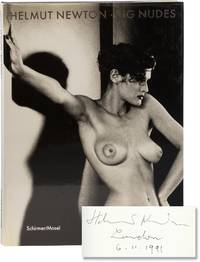
1990166006Munich: Schirmer / Mosel 1990. First Edition. Hardcover. First Edition. Boldly INSCRIBED by Helmut Newton on the title page: "For - / Congratulations !! / Helmut Newton / London / 6.11.1991."<br /> <br /> Fine and unread in a Near Fine lightly rubbed dust jacket.<br /> <br /> Oversize volume shipping billed at cost. Schirmer / Mosel unknown
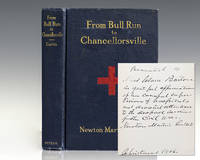
1906122593New York & London: G. P. Putnam's Sons 1906. First edition of Union Major-General Newton Martin Curtis's memoirs; lengthily inscribed by him to American Civil War nursing pioneer Clara Barton. Octavo original cloth with gilt titles to the spine and front panel illustrated with four tissue-guarded engraved portraits including frontispiece of Major-General Curtis. Association copy inscribed by the author on the front free endpaper "Presented to Miss Clara Barton in grateful appreciation of her careful supervision of hospitals and devoted attention to the disabled soldiers of the Civil War. Newton Marin Curtis Christmas 1906." The recipient Clara Barton took the lead in developing a program to care for soldiers wounded in the American Civil War. At the time of the inscription Barton had just resigned from her position as president of the American Red Cross and was working on her autobiography The Story of My Childhood which was published in 1907. An exceptional association. Newton Martin Curtis was a Union officer during the American Civil War and a member of the United States House of Representatives from New York. On May 15 1861 Curtis volunteered in the Union Army as a captain in Company G of the 16th New York Infantry. He fought in the Peninsula Campaign and was wounded in a minor engagement at West Point Virginia. On October 23 1862 he transferred to the 142nd New York Volunteer Infantry serving as lieutenant colonel until his promotion to colonel on January 21 1865. As commander of the 142nd New York Infantry he fought in the Bermuda Hundred Campaign of May 1864. He took command of the 1st Brigade 2nd Division X Corps during the Siege of Petersburg. Curtis received a brevet promotion to brigadier general on October 28 1864 for his actions at the Battle of New Market Heights. G. P. Putnam's Sons hardcover books
174492332Lausanne and Geneva: Aoud Marcum-Michaelem Bousquet & Socios 1744. First edition of the first collected edition of <span class="match">Newton</span>'s writings which has been hailed as "a fine piece of bookmaking" Babson. Quarto bound in contemporary velum contains 64 folding engraved plates; 2 folding letterpress tables. In very good condition wide margins. Rare in contemporary binding. English mathematician astronomer theologian author and physicist Sir Isaac Newton is widely considered one of the most influential scientists of all time and a key figure in the scientific revolution. In one of his most important works Philosophiae Naturalis Principia Mathematica Newton formulated the the laws of motion and universal gravitation that formed the dominant scientific viewpoint until being superseded by the theory of relativity. Aoud Marcum-Michaelem Bousquet & Socios unknown books
182219114Glasgow: Andreae et Joannis M. Duncan 1822. FIRST GLASGOW EDITION. Numerous text diagrams and illustrations. Contemporary calf all covers with blind-stamped floral border within gilt floral borders within gilt-lined borders spines in compartments with gilt decoration spine labels; first few leaves of each volume spotted otherwise an excellent set. First Glasgow reprint of the first Jesuit edition printed in Geneva from 1739-1742. This edition of Newton’s Principia was edited by John Martin Frederick Wright of Trinity College who contributed additional commentary. Babson notes that Glasgow’s printing of this edition of the complete text was a great credit to the university whereas Cambridge was “satisfied with reprints of the first three sections of the first book.â€<br /> <br /> Babson 32; Gray 17; Wallis 17. Andreae et Joannis M. Duncan unknown
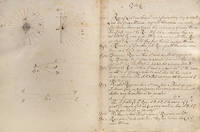
115619England late 18th century. . 100-leaf manuscript rectos and most versos filled wax seal remnants to front pastedown leaves wavy at the edges some spotting and marks to contents; contemporary calf-backed blue paper boards gilt floral tools to spine compartments binding marked and worn with spine cords partially exposed and loss of the blue paper morocco label lacking naphthalene smell good condition housed in a black cloth folding case.<br /> An unusual late 18th century manuscript on classical physics that cites Isaac Newton Blaise Pascal William Harvey Henry Power and others.<br /><br />The text approximately 200 pages presents an ordered and detailed account of a number of related topics: optics; hydrostatics and pneumatics; mechanics including simple machines such as the lever and screw the behaviour of descending bodies and pendulums; phosphorus and its chemical transformations; and fortifications and architecture. The notes are dense but generally neat and legible with carefully prepared diagrams so this seems to be a fair copy rather than a working notebook. <br /><br />Newton is cited in the section on light and colour: 'What Sir I.N. has said by way of in the last edit of his Opticks will appear to be an established truth from most if not all the following examples some of which he mentions himself". And Harvey in a short section on chemical transformations: "Harvey had says he the opportunity as well as the curiosity upon several occasions to examine the weight of when some of them taken up in places very distant from one another.'.<br /><br />The origin of much of the material is unclear though the long section on hydrostaticks was taken from Hydrostatical and Pneumatical Lectures by Roger Cotes 1682-1716 originally published privately in 1738 and with a second edition at Cambridge in 1747. <br /><br />Cotes was 'probably the most talented British mathematician of the generation after Newton'. He was nominated as the first Plumian professor of astronomy at Cambridge in 1706 and 'his appointment was favoured by his influential mentor Richard Bentley master of Trinity; by Newton's successor as Lucasian professor William Whiston who claimed to be in mathematics "a child to Mr Cotes" Whiston 133; and by Newton himself. In 1709 Cotes became heavily involved in the work for which he is best remembered namely the revisions for the second edition of Newton's Philosophia naturalis principia mathematica the first being out of print' Oxford Dictionary of National Biography. Cotes died young and Newton was reported to have said that 'if he had lived we might have known something'. A number of Cotes's lectures and mathematical analyses were published posthumously by his executor Robert Smith the Hydrostatical and Pneumatical Lectures being one of them. It is tempting to question whether other portions of the present manuscript are also based on Cotes's work and further academic scrutiny might be fruitful.<br /> England, late 18th century. hardcover
1964mon0000084822The Connecticut Historical Socie 1964T. hardcover. Like New. in x in x in. The Connecticut Historical Socie hardcover
1831254561London 1831. Miniature globe in turned walnut case with domed lid. 1.5 inch diameter. 12 hand colored globe gores with original varnish and metal pins at each pole which enable the globe to spin in the case. Cartouche set in north Pacific. Stains along the equator in the Pacific.<br/><br/> This terrestrial globe is the smallest version made by Newton and Berry Sumira p. 189. Wonderful detail included for such a small globe. The track of Captain Cook's final voyage of 1776 is shown when Captain Clarke and Gore sail to the Bering Sea after Cook is murdered. John Newton 1759-1844 is the founding member of this family firm. Miles Berry joined the firm in 1803. They also made planetaria and mechanical models. An excellent example of a pocket globe.<br/><br/> unknown books
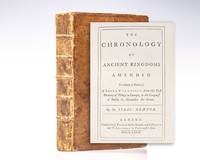
1728149863London: Printed for J. Tonson in the Strand and J. Osborn and T. Longman in Pater-noster Row 1728. First edition of Newton's ambitious attempt to reconstruct and rationalize the timelines of ancient history. Quarto bound in full contemporary Cambridge calf ruled and tooled in blind with speckled panels gilt turn-ins ordinary paper issue illustrated with 3 folding engravings. From the library of Harvard University professor Owen Gingerich. Owen Gingerich 1930–2023 was an American astronomer and historian of science renowned for his scholarship on early modern astronomy particularly his meticulous census of De revolutionibus that illuminated how Copernicus’s work was read and received in the sixteenth century. A longtime professor at Harvard and a senior astronomer at the Smithsonian Astrophysical Observatory Gingerich helped bridge scientific and humanistic inquiry demonstrating how historical context shapes the development and interpretation of scientific ideas. In very good condition. The Chronology of Ancient Kingdoms Amended published posthumously in 1728 was Isaac Newton’s ambitious attempt to reorganize and compress the timelines of ancient history by applying critical philology comparative mythology and astronomical calculation. Seeking to reconcile classical sources with biblical chronology Newton argued that the conventional dating of Egyptian Greek and Near Eastern kingdoms was excessively long and he used evidence such as eclipse records regnal lists and mythic genealogies to propose a shorter more unified ancient past. Although modern historians largely rejected Newton’s revised dates the work was significant for revealing the breadth of his intellectual pursuits beyond physics and mathematics and for illustrating how early Enlightenment thinkers employed scientific reasoning to interrogate historical and scriptural authority. Printed for J. Tonson in the Strand, and J. Osborn and T. Longman in Pater-noster Row unknown
17440811695Lausanne and Geneva: Apud Marcum-Michaelem Bousquet & Socios 1744. First Edition. Three-Quarter Leather. Very Good/No Dust Jacket. 64 Copper Engraved Plates 2 Letterpress Plates. 4to - over 9¾" - 12" tall. Three volumes bound in 3/4 leather over speckled paper boards red leather title bands with gilt titilng and ruling to spine 4to 3 Volumes: Vol. I: 8 xxviii 420 2pp.- Vol. II: 4 vi 423pp - Vol. III: 2 vi 566 1pp. Illustrated with 66 plates total; 64 copper plate engravings plus 2 letterpress tables. Titles in red and black each with engraved vignette of Newton’s portrait with allegorical frame of cherubs and scientific instruments - inscribed with motto "NOVIORA CECINIT". Published post-houmously as part of the larger 8 volume collected works of Newton. These three volumes comprise the gathering of many of Newton's most famous and notable works and are often considered as the first collected edition -- typically these volumes are considered complete unto themselves and commonly found separate. Condition: these three volumes have at one time been professionally preserved with the spines and outer hinges professionally reinforced and tactifully restored. General light shelfwear and rubbing to the boards edges corners rubbed with light bumping outer hinges restored revealing similar rubbing in the past. Bindings are tight with text pages showing just minor light browning typical of the era. A nice and collectible first edition of Newton's famous Opuscula Mathematica Philosophica et Philologica and a solid example of publishing output during the 'Age of Reason Apud Marcum-Michaelem Bousquet & Socios unknown
1740102648?Paris, Debure?, 1740, in-4, XXX-[2]-148-[2] pp, Veau havane marbrée, dos à nerfs orné de caissons dorés, pièce de titre rouge, tranches rouges, Édition originale de la traduction française par Buffon dont le nom n'est mentionné que dans les Extraits des registres de l'Académie royale des sciences, in fine. Elle est traduite sur la traduction anglaise de John Colson parue en 1736 (sans son commentaire), elle-même traduite sur l'édition originale en latin de Newton qui ne fut jamais publiée. Elle est illustrée de figures en noir dans le texte. Dans sa longue préface, il explique vouloir donner un "Newton clair, plus traitable, & à la portée du commun des géomètres", donne une courte notice historique des mathématiques pré-newtoniennes, critique sévèrement ses rivaux, notamment lorsqu'il évoque la controverse avec Liebniz et expose la méthode de calcul de Newton. Dans cet ouvrage le célèbre physicien anglais expose sa méthode de calcul infinitésimal dans sa première partie, lui donne une notation propre et propose ses applications dans la seconde. Bien que cet ouvrage fut relativement confidentiel lors de sa rédaction et sa première circulation via manuscrits, il est aujourd'hui reconnu comme fondamental dans l'histoire des mathématiques. Petits manques et épidermures, quelques taches. Complet de son errata. Gray, 236; Babson, 173. Couverture rigide
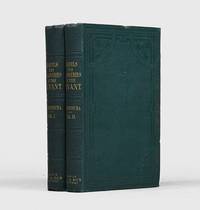
1865152733London: Day & Son Limited 1865. Presentation copy with letter First edition presentation copy inscribed on the front free endpaper of vol. I "Gaisford from the author Feb 1866" and with a 6-page autograph letter signed from the author loosely inserted. The letter headed British Museum 10 January 1852 details Newton leaving his position in the British Museum to take up a role as vice-consul at Mytilene. "My dear Sir you will probably be surprised to hear that I am going to leave the British Museum and also England. I have for some time wishes to exchange my present location for one where I could have more leisure time for literary pursuits & a warmer climate for my health has suffered from residence in London. After a good deal of deliberation I thought that if I could get a small Consulship in the Levant when the official duties were not very heavy I should be enabled to pursue archaeology by the study of remains in situ". Newton goes on to detail the circumstances of his being awarded the position. The recipient of the volumes was a member of the Gaisford family headed by the classical scholar and Dean of Christ Church Cathedral in Oxford Thomas Gaisford 1779-1855 to whom the letter is probably addressed Newton notes his hope to visit Oxford soon. Thomas Gaisford was deceased by the time of the book's presentation and consequently the recipient of the volumes is likely one of his seven children who would have paired them with the letter. The volumes originate from the Gaisford family home of Howth Castle near Dublin. Newton worked as vice-consul at Mytilene from 1852 to early 1853 then as acting consul at Rhodes from April 1853 to January 1854. In both positions he was authorized to undertake considerable archaeological excavations and purchases for the British Museum which he followed by excavations in Kalymnos in 1854 and 1855 financed by Lord Stratford de Redcliffe the British ambassador at Constantinople. The present book gives his account of these travels and excavations. On his return he became the first keeper of Greek and Roman Antiquities at the Museum in 1861. He was closely involved in the foundation of three highly influential archaeological institutions: the Society for the Promotion of Hellenic Studies to which he gave an inaugural address in June 1879; the Egypt Exploration Fund founded in 1882; and the British School at Athens opened in November 1886. 2 vols tall octavo. Folding map frontispiece to each 12 lithographic plates from photographs by Francis Bedford after drawings by Newton and his wife 20 plates one of which folding the majority etched after photographs by Colnaghi and Spackman 2 double- and 2 full-page maps one double- and 2 full-page plans numerous wood-engraved illustrations to the text. Original green pebble-grain cloth spines lettered in gilt blind panelling to covers pale yellow endpapers. Obituary of Newton mounted to front pastedown of vol. I with another for his friend Reginald Stuart Poole loosely inserted. Very light rubbing and peripheral bumping cloth still bright and fresh without wear and with joints and hinges intact light foxing to contents as usual some leaves unopened towards end of vol. I. An excellent copy. Atabey 869; Blackmer 1193; Gernsheim Incunabula of British Photographic Literature 284. hardcover
174039297Paris, De Bure, 1740. 4to. Contemporary half calf, raised bands, richly gilt spine and and red speckled edges. Leather title-label to spine. Corners neatly repaired. Title in red/black. (2), III-XXX, (2) Errata, 148 pp., many diagrams. The ""Preface"" and the first 18 leaves of the text with a foxing to lower margin and right corners. The ""Preface"" is an historical account of Newton's method ""la sublime méthode"", written by Buffon. Without the leaf ""Extrait des Registres"".
174039297Paris De Bure 1740. 4to. Contemporary half calf raised bands richly gilt spine and and red speckled edges. Leather title-label to spine. Corners neatly repaired. Title in red/black. 2 III-XXX 2 Errata 148 pp. many diagrams. The "Preface" and the first 18 leaves of the text with a foxing to lower margin and right corners. The "Preface" is an historical account of Newton's method "la sublime méthode" written by Buffon. Without the leaf "Extrait des Registres". <br/><br/><em>The influential first French edition of Newton's important work which constitutes the most extensive description of the mathematical method he used in his famous "Principia" the method of infinitesimals which was already written about 1671 but not published until 1736 i.e. posthumously with the title "Method of Fluxions and Infinite Series.". In this work "Newton stated clearly the fundamental problem of the calculus: the relation of quantities being given to find the relation of the fluxions of these and conversely. In conformity with this problem and the new notation Newton then gave examples of his method.In this book Newton introduced his characteristic notation and conceptions. He regarded his variable quantities as generated by the continuous motion of points lines and planes rather than as aggregates of infinitesimal elements the view which had appeared in "De analysi".The rate of generation Newton called a "fluxion" designating it by means of a letter with a dot over it a "pricked letter" the quantity generates he called a "fluent". Boyer The History of the Calculus.Colson in his preface to the first edition from 1736 says: "I gladly embraced the opportunity that was put into my hands of publishing this posthumous work because I found it had been composed with that view and design. And that my own Country-men might first enjoy the benefit of this publication I resolved upon giving it an English translation with some additional remarks of my own I thought it highly injurious to the memory and reputation of the real Author as well as invidious to the glory of our own Nation that so curious and useful a piece should be any longer suppress'd and confined to a few private hands which ought to be communicated to all the learned World for general Instruction.It was through the French translations of his works that Newton came to play the seminal role as the most important of mathematicians that he did in France and particularly the years around 1740 when the present work appeared in French for the first time were seminal to the scientific development in France where the likes of Voltaire had only just made the nation acquinted with the work of the great mathematician. Gray No 236. Babson No 173. </em> hardcover
1719SS13189London:: Printed for B. Creake . . . J. Sackfield . . .; And sold by W. Mears . . . 1719. 1719. Sm. 4to. xxii 201 5 pp. 10 folding engraved copperplates 5 figs. pp. 24 54 75 112 half-title is a publisher's ad for Boerhaave rear publisher's ads 2 ff. head and tail-pieces; title edges chipped. With errata. Title p.101 perforated stamp and with a rubber stamp on verso of the John Crerar Library eight plates with the ex-library rubber stamp on versos; waterstained throughout. WITH FREQUENT EARLY INK CORRECTIONAL NOTES. Modern half blind-stamped dark calf gilt spine title raised bands marbled paper over boards new endleaves bindery ticket at rear: Pat M. Bruno. Inscription on recto of front blank verso is ad for Boerhaave book "W. --- 1720 Power." SPURIOUS EDITION OF DESAGULIERS' FAMOUS PRIVATE LECTURES CONTAINING NOTES ON BOYLE'S AIR PUMP AND NEWTON ON COLOR THEORY. FIRST ENLARGED EDITION early issue without "All carefully Examined and Corrected by Mr. Desaguliers" on title which otherwise is re-titled "Lectures of Experimental Philosophy". Includes: Sir Isaac Newton's Colours. Proposition. Lights which differ in Colour differ also in Degrees of Refrangibility. Initially published without the author's permission and then by evidence of the printed Preface agreed to issue the book with an erratum. / There are multiple forms of this edition as different copies collate differently Andrade Kenney Honeyman copies. The Honeyman copy called a second edition has two title-pages and the Preface by Desaguliers with an imprint of 1719. There are also differences in the title-pages. The fiasco of the unauthorized edition is the cause of the various issue differences. "Perhaps Dawson hoped . . . to ingratiate himself with his patron but instead he incurred the wrath of the lecturer. Immediately Desaguliers became aware of the book which he called 'ill put together sadly transcrib'd and worse corrected' he approached the booksellers. He found that two-thirds of the imprint had already been sold by Messrs Mears Creake and Sackfield but they paid him ten guineas 'to pacifie me'. They also promised to insert into all remaining copies a preface that Desaguliers would write together with a substantial errata. The preface follows the Dawson dedication in some copies of the book entitled A System of Experimental Philosophy but precedes it in another version called Lectures in Experimental Philosophy." See: Carpenter pp. 34-5 119. / Contents: Mechanical experiments Mechanical powers & definitions; How to make a heavy Body seem to rise it self; gravity balance leaver pulley wheel axle wedge screw laws of nature hydrostatics; Description of Robert Boyle's Air-Pump uses & experiments; How to make an air vacuum; Barometers Thermometers Hydrometers; Catoptrichs; Dioptrichs; Sir Isaac Newton's Colours; Condensing Engine; "Rowley's Horary being a machine to represent the Motion of the Moon about the Earth and the Earth Venus and Mercury about the Sun." / The preface written by Desaguliers himself explains that this volume of lectures was released "before I designed to publish them." He then retells how Paul Dawson "took a copy of the lectures . . . that they may be service to him when he went thro' my courses and they were afterwards sold and published without my knowledge." He obtained a copy of the text and made numerous corrections :: thus the micro-print 1 ½ page errata. The he invites the owner to annotate the book throughout "before he begins to read the lectures." And indeed the owner named Powers did annotate this copy :: clear evidence he read that Preface. A2-3. / The DNB asserts that Desaguliers "held in great esteem by Sir Isaac Newton" "is said to have been the first to deliver learned lectures to general audiences. Lectures by him at his London house were widely attended and were made attractive by experiments." In addition it mentions that Paul Dawson was responsible for the work and that Desaguliers himself "disavowed" himself of the edition. :: DNB pp. 850-1. / Nicholas A Hans describes the types of persons attending Desaguliers' lectures: "merchants craftsmen and clerks and his private audiences consisted of gentlemen and courtiers and included ladies as well." :: Nicholas A Hans New Trends in Education in the Eighteenth Century 1951 p. 141. / Westfall says of Desaguliers he "became a fixture at the meetings of the Royal Society where he carried out sets of experiments intimately related to various aspects of Newtonian natural philosophy. Some of his experiments such as the transmission of heat through a vacuum influenced Newton's views and other found their way into the third edition of the Principia." :: Never at Rest pp. 685-6. / Writing for the DSB A. Rupert Hall points out that Desaguliers did not produce his own version of these lectures until 1734 "when he took occasion to denounce this unauthorized version. . ." :: DSB IV pp. 43-6. / John Theophilus Desaguliers 1683-1744 born at La Rochelle emigrated to England in 1685 as a Huguenot refugee hidden in a tub at 2-years of age studied at Oxford he became a Fellow of the Royal Society in 1714. As the Society's experimenter and a close friend of Newton he often verified Newton's theories through experimentation. "In 1717 he published Physico-Mechanical Lectures an eighty-page abstract of the twenty-two lectures of his course. Although not authorized by Desaguliers the present work is the first full account of his lectures edited by his student Paul Dawson. Primarily of interest as a textbook of Newtonian physics many chemical topics are included. The first issue appeared with the title A System of Experimental Philosophy." / REFERENCES: Bakken title: "Lectures of experimental philosophy . . . 1719" pp. 52-3; Goodison English Barometers 1680-1860 p. 369; Keynes Boyle 366 pp. 122-9; Roy G. Neville I p. 354 second issue; Poggendorff I 554; Wellcome II p. 451; Wheeler 249. Not in Babson Barchas Gray or Verne L. Roberts catalogues. See: DSB IV p. 45; Taylor Mathematical Practitioners 1714-1840 35; Audrey T. Carpenter John Theophilus Desaguliers: A Natural Philosopher Engineer and Freemason in Newtonian England Bloomsbury Academic 2011. FULL TITLE: A System of Experimental Philosophy Prov'd by Mechanicks wherein the principles and laws of Physicks Mechanicks Hydrostaticks and Opticks are demonstrated and explained at large by a great number of curious experiments. . . To which is added Sir Isaac Newton's colours: the description of the condensing engine with its apparatus: and Rowley's Horary; a machine representing the motion of the Moon about the Earth; Venus and Mercury about the Sun according to the Copernican System. Printed for B. Creake, . . . J. Sackfield . . .; And sold by W. Mears, . . . 1719. hardcover books
1813143137London: Printed for G. Kearsley J. Walker J. Stockdale R. Lea E. Jeffery & 10 others 1813. A "vastly ambitious survey" First edition of this extensively illustrated Georgian encyclopedia a "vastly ambitious survey of human genius learning and industry" ODNB here presenting particularly nicely in contemporary red morocco. 12 vols octavo 232 x 145 mm. Illustrated throughout with engravings many with contemporary hand colouring. Contemporary red straight-grain morocco spines lettered and tooled in gilt covers with foliate border in gilt and blind gilt turn-ins grey endpapers gilt edges. Contemporary ownership signature to half-titles pencilled doodle to front free endpaper of vol. I. Bumping at head of contents of vol. IV. A very handsome set the bindings without wear and the contents clean. unknown