13 069 résultats
056522London: Excudebat Joannes Nichols. 1779-1785. Commentariis illustrabat Samuel Horsley. 5 volumes complete quarto format b/w illus. uniformly bound in early 19th-century full brown calf with gilt trim and spine lettering nicely marbled edges light foxing on the endpapers but the text paper is clean. Lacking the half-title pages which were not bound into this set. A former private bookplate and a former institutional bookplate inside the covers and a faint but very neat embossed blindstamp of the former institutional library on the bottom margin of the titlepages. Brunet IV 48. ESTC T18649. Contents: Vol.1 xxii 592 1p. with two double-folded tables. Vol. 2 xxviii 459 1p. Vol 3 437 48p. with 14 plates. Vol.4 617p. with 12 plates page 617 is misnumbered 609. Vol. 5 vii 550p. with 3 double-folded plates. This was the first collected edition of his Latin/English works. Excudebat Joannes Nichols unknown
17693016<p>1769. Hardcover. Very Good/No Dust Jacket. Printed for W. Johnston; London 1769; translated by Mr. Ralphson and Revised and Corrected by Mr. Cunn; to which is added a Treatise upon the Measures of Ratios by James Maguire the whole Illustrated and Explained in a series of Notes by the Rev. Theak</p> hardcover
19721295541972. First Edition. Signed. NEWTON Huey P. To Die for the People. The Writings of Huey P. Newton. New York: Random House 1972. Octavo original black cloth gilt original dust jacket; housed in a custom half morocco clamshell box. $8200.First edition of this early collection of writings by Newton co-founder of the Black Panther Party whose ""flamboyance vision and passion came to symbolize an entire era"" boldly inscribed by him ""For R my own voice and the voice of the People finding the clarity of our situation From Huey"" with 16 pages of illustrations in original dust jacket.Newton who co-founded the Black Panther Party in 1966 with Bobby Seale was ""one of the most charismatic symbols of black anger in the late 1960s"" New York Times. Newton's ""flamboyance vision and passion came to symbolize an entire era"" ANB. At news of his death in 1989 Seale recalled how the Party was formed. ""'It came right out of Huey Newton's head' he said. 'Huey was the theoretician. And I'm the one who stayed on Huey egging him on to get something going'"" Washington Post. Their defining ""Ten-Point Program"" featured herein demanded prison reform ""education that teaches us our true history"" and called for the ""end to police brutality."" The Black Panther Party was early targeted by the FBI and J. Edgar Hoover ""who in 1968 declared that the Panthers were the number one threat to the internal security of the nation and then set out to devastate them in a series of sudden raids"" Rolling Stone. ""First Edition"" stated on copyright page. With introductory essay by Franz Schurmann. Includes over 30 speeches mandates resolutions eulogies and public statements along with 16 pages of black-and-white photographic illustrations. Blockson 4198. Book with mild offsetting to endpapers a few slight marks to cloth; dust jacket fresh and bright with very mild wear to spine ends. A nearly fine copy. hardcover
19287168New York: Robert H. Dodd 1928. First Edition. Hardcovers in slipcases with chemises. Fine/Very Good; Slipcases With Occasional Wear. Title continues: Compiled from Original Sources and Illustrated by Photo-Intaglio Reproductions of Important Maps Plans Views and Documents in Public and Private Collections.<p>Complete in six thick 4to volumes. Varying pagination. With maps documents photographs engravings and facsimiles of charters ordinances proclamations handbills broadsides surveys plans portraits and more. Many printed in color. The second volume is mostly concerned with Manhattan Island cartography including 96 plates some of which are double-page. The final volume contains an addendum an extensive bibliography by Victor H. Paltsits and an index to the entire work.<p>Top edges gilt others uncut. Publisher's half-vellum gilt lettering on spine over blue cloth boards with gilt device on front board. Housed in original dark blue chemises within slipcases. Chemises Good to Near Fine with slight darkening to spines; Vol. V chemise with a quarter-inch perforation on spine. Please see photo. Some slipcases with only occasional minor wear; the most egregious shown in photo with split starting and a slit at top edge. One of 360 copies printed on English handmade paper. Withal a superb set. With hundreds of maps views and architectural illustrations assembled from countless original sources Stokes' sweeping survey presents detailed chronologies and summaries of events and the personages involved up to 1909. A splendid set exceptional in the bright condition at-hand. HOWES S1026 "the most elaborate and comprehensive history of Manhattan". Robert H. Dodd hardcover
18552091202133212831Bell and Daldy 1855. Soft Cover. Fine. Volume: 1 Bell and Daldy paperback
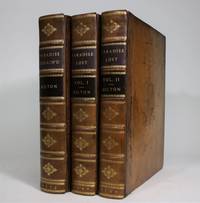
1749008729London: Printed for J. and R. Tonson and S. Draper 1749. Hardcover. Near Fine. 4to. 3 Vols. Volume 3 dated 1752. Full brown calf original boards rebacked with new matching spines and elegant leather labels lxi 5 16 12 459pp; 444pp unpaginated index; 8690pp 2. Handsomely engraved with 18 engravings incl. frontis of Milton in each volume. Bookplate of George Granville Leveson II Earl Gower 1786-1861 and member of the Order of the Garter Britain's 3rd highest royal / military honour. Light foxing gilt device of Order of Garter on upper font boards. Boards a bit scuffed however a near fine binding. The first and second volume cover Milton's Paradise Lost with criticism and annotations from various authors. Volume three contains Paradise Regain'd with Milton's other minor poems. ESTC T133434. book 1-6 Vol. 1 7 engravings w/ frontis of milton book 7-12 7 engravings w/ frontis Paradise regained dated 1752 5 engravings frontis Printed for J. and R. Tonson and S. Draper hardcover
1220Twelve folding engraved plates. 4 p.l. 382 pp. one leaf of ads. 8vo cont. calf small portions of ends of spine & one corner carefully repaired spine gilt red morocco lettering piece on spine. London: W. Innys 1730. Fourth edition and the final edition to be revised by Newton of this great classic. It contains the complete set of 31 Queries which reveal some of Newton's most influential and speculative writing. Fine crisp copy. Contemporary armorial bookplate of Edward Powell. ❧ Babson 136. unknown books
176519374Cambridge: J. Bentham 1765. FIRST EDITION. The first ten pages contain a list of subscribers mainly from Oxford and Cambridge and a corrigenda. With12 folding plates. Bound in old boards rebacked a clean and crisp copy uncut. First edition of this rather rare series of excerpts from Newton’s Principia. “Although there is no mention of it in the book itself the annotators were John Jebb M.D. Rector of Ovington Robert Thorp Archdeacon of Northumberland and Francis Wollaston Rector of Chislehurt†Babson.<br /> <br /> In addition to the myriad of books explaining the mathematics of Newton’s masterpiece published in the hundred years following the first edition the public clamored for copies and excerpts from the book itself. Jebb 1736-1786 was a medical doctor and a Fellow of the Royal Society. Thorp 1783-1862 succeeded his father as rector of Chillingham and in 1792 was created archdeacon of Northumberland. In addition to this work he published a translation of the Principia in English Mathematical principles of natural philosophy London 1777. Wollaston 1738-1826 a mathematician and son of the astronomer Francis Wollaston was a Fellow of the Royal Society.<br /> <br /> Babson 15; Wallis 20. J. Bentham unknown
1220Twelve folding engraved plates. 4 p.l. 382 pp. one leaf of ads. 8vo cont. calf small portions of ends of spine & one corner carefully repaired spine gilt red morocco lettering piece on spine. London: W. Innys 1730.<br/> <br/> Fourth edition and the final edition to be revised by Newton of this great classic. It contains the complete set of 31 Queries which reveal some of Newton’s most influential and speculative writing. Fine crisp copy. Contemporary armorial bookplate of Edward Powell. <br/> <br/> ⧠Babson 136. unknown
17225823London: Benji & Sam. Tooke 1722. Second edition. <p>Second edition but the first authorised and edited by Newton probably with the assistance of John Machin of his treatise on algebra or 'universal arithmetic' his "most often read and republished mathematical work" Whiteside. "Included are 'Newton's identities' providing expressions for the sums of the ith powers of the roots of any polynomial equation for any integer i plus a rule providing an upper bound for the positive roots of a polynomial and a generalization to imaginary roots of René Descartes' Rule of Signs" Parkinson.</p>. NEWTON'S ALGEBRA - THE FIRST EDITION AUTHORISED AND EDITED BY NEWTON. <p>Second edition but the first authorised and edited by Newton probably with the assistance of John Machin - see below of his treatise on algebra or 'universal arithmetic' his "most often read and republished mathematical work" Whiteside Papers V p. xiv. "Included are 'Newton's identities' providing expressions for the sums of the ith powers of the roots of any polynomial equation for any integer i pp. 251-2 plus a rule providing an upper bound for the positive roots of a polynomial and a generalization to imaginary roots of René Descartes' Rule of Signs pp. 242-5" Parkinson p. 138. About this last rule for determining the number of imaginary roots of a polynomial which Newton offered without proof Gjertsen p. 35 notes: "Some idea of its originality . can be gathered from the fact that it was not until 1865 that the rule was derived in a rigorous manner by James Sylvester." The work is a printed version of lectures Newton prepared in the period 1672-83. Although the editor of the first edition William Whiston later claimed that he had Newton's permission to print the lectures Newton was far from satisfied with the result complaining that the titles and headings were not his and that it contained numerous mistakes. His real concern was that "an unfinished text composed so long before should now be presented to the world as though it represented his latest researches into the structure and applications of algebra" Papers V p. 11 and that Whiston had "too faithfully and impercipiently followed the parent manuscript incorporating in his princeps edition its several inconsistencies and lapses into error without in the main even bringing them to the reader's notice . In his private library copy of the edition Newton corrected many minor misprints inserted more appropriate running heads 'Multiplicatio' 'Divisio' 'Extractio Radicum' 'De Forma Aequationis' 'Reductio Aequationum' 'Resolutio Quaestionum Arithmeticarum Geometricarum' and the like and on the Arithmetica page 279 deleted an unwarranted half-title 'Aequationum Constructio linearis'; more radically he mapped out a large-scale reordering of the sixty-one geometrical problems comprising its central portion seeking to grade them into a more logical sequence and in increasing levels of difficulty while in the concluding section on the 'curvilinear ' construction of equations he pared away all not directly needed flesh reducing it to two skeletal conchoidal neuses now denuded of their proof. That last savage act of butchery apart all these improvements were incorporated in the Latin revise - future parent and rightfully so of all subsequent editions - which he himself brought to publication in 1722" ibid. pp. 13-14. Babson notes that "This edition was the last issued during Newton's lifetime and is almost as rare as the first." In commerce this edition is in fact much rarer than the first: ABPC/RBH list only two other copies of this edition since 1975 but ten of the first.</p> <br /> <p>"In fulfilment of his obligations as Lucasian Professor Newton first lectured on algebra in 1672 and seems to have continued until 1683. Although the manuscript of the lectures in Cambridge University Library carries marginal dates from October 1673 to 1683 it should not be assumed that the lectures were ever delivered. There are no contemporary accounts of them and apart from Cotes who made a transcript of them in 1702 they seem to have been totally ignored. Whiteside Papers V p. 5 believes that they were composed 'over a period of but a few months' during the winter of 1683-4" Gjertsen pp. 33-4.</p> <br /> <p>The Arithmetica "derives partly in its discussion of the elemental algebraic operations and of the reduction and exact solution of equations from Newton's earlier unpublished 'Observations' on the introduction to Cartesian algebra presented by Gerard Kinckhuysen in his 1661 Stelkonst partly in its techniques for delimiting the number and nature real or complex of the roots of equations and for reducing these by factorization from his own independent researches as a young postgraduate student into the theory of equations and partly in its approximate geometrical construction of cubics from his previously elaborated 'Problems for construing aequations'. Apart from novelties in detail and the fabrication of new illustrative 'questions' what is most notable is Newton's developing awareness - still far from completely expressed - of the fundamental structural equivalence which exists between the elements constants and free variables and their functional relationships of algebra and those given lines and undetermined line-lengths and their coordinate interconnections of geometry and his deepening grasp of the still more general isomorphism which permits a two-way 'translation' between mathematical 'speech' and the 'language' of exact science in all its manifestations. His guiding doctrine that algebra is 'universal arithmetick' embroiders a theme stated briefly in an opening phrase of his 1671 treatise on infinite series and fluxions and expounded in a geometrical context earlier still in preface to James Gregory's study of universal mathematical principles. Now also however he reaches tentatively forward to Barrow's notion that algebra is in its essence the abstract logic of relationships between quantities in divorce from their particular setting and hence to be developed as an independent metamathematical system" Papers V pp. 3-4.</p> <br /> <p>"We may reasonably conjecture that pressure was in some manner put upon Newton in late 1683 to fulfil however tardily his statutory obligation annually to deposit a fair copy of ten of his lecture scripts and be all but sure that the arrival in Cambridge the next spring of his young amanuensis Humphrey Newton able to take over from Isaac the dreary time-consuming chore of rewriting his much cancelled and corrected worksheets in legible and coherent form gave him new heart to codify and expand his previous mathematical investigations. But these surmises remain as unproved and essentially undemonstrable as the plausible suggestion that it was Edmond Halley's famous first visit to Cambridge in the late summer of 1684 to talk about the unsolved problem of elliptical planetary motion which provoked him abruptly to relinquish his restructuring of the Arithmetica. We may guess still more tenuously that the appearance in mid-1685 of John Wallis' voluminous Treatise of Algebra Both Historical and Practical would have long deterred Newton from making any efforts to have his own rival studies made publicly available. In later years certainly he grew increasingly soured with the often cumbersome computations and techniques of Cartesian algebra - at one point indeed if we may believe David Gregory he qualified it as 'the Analysis of the Bunglers in Mathematicks - and we may be certain that his reluctance during 1705-6 to have Whiston edit the deposited text of his algebraic lectures was not merely the manifestation of a growing personal antagonism to his successor in the Lucasian chair" ibid. pp. xi-xii.</p> <br /> <p>"When Newton resigned his Lucasian professorship to his deputy William Whiston in December 1701 it was natural that the latter should wish to familiarize himself with the deposited lectures of his predecessor. Whiston did not hesitate to introduce portions of Newton's earlier optical lectures concerning the mathematical theory of the rainbow into his own Lucasian Praelectiones physico-mathematica in the spring of 1706 and about that time also he turned his attention to the succeeding ones on algebra and began to consider their publication. In the meantime rumours began to spread in both Oxford and London that 'Newton's friends solicit him to publish a Treatise of Algebra which he wrote long since. If such ill-founded whispers penetrated to Cambridge Whiston ignored them and went quietly ahead arranging with the London stationer to underwrite the expense of printing the deposited manuscript and then subsequently between September 1705 and the following June correcting both specimen and proof sheets as they emerged from the compositor's bench at the University Press. In February 1706 David Gregory accurately noted in his memoranda that 'Its talked that there is now printing at Cambridge Elements or Principles of Algebra written long since by Sir Isaac Newton but withdrew his added remark that it was 'lately revised by him' when he saw Newton in London in July and was given a first-hand account of the history of the 'Algebra that is printing and near printed at Cambridge'. Though as Whiston was later to announce publicly Newton had given his reluctant approval for the edition . Despite its minor inconsistencies and confusions Gregory's report vividly conveys Newton's concern that an unfinished text composed so long before should now be presented to the world as though it represented his latest researches into the structure and applications of algebra" pp. 8-11.</p> <br /> <p>For a book that was to become Newton's most often republished mathematical work the Arithmetica initially made little impact in Britain and was not even graced by a review in the Philosophical Transactions. On the Continent the reception accorded the lectures was more positive. "Leibniz unhesitatingly divining their author beneath the cloak of anonymity gave them a long review in the Acta Eruditorum of Leipzig in 1708. Written thirty years before he noted and now deservingly printed by William Whiston he assured the reader that 'you will find in this little book certain particularities that you will seek in vain in great tomes on analysis.' His close associate Johann Bernoulli despite some adverse remarks paid Newton the compliment in 1728 of basing his own course on the elements of algebra upon Newton's text. Perhaps partly in consequence of Newton's recent death in Britain too the book began about this time to arouse greater interest than when it was first issued in 1707" Hall p. 174.</p> <br /> <p>Despite the impressive contributions of the work to the theory of equations mentioned earlier it is difficult to pigeonhole the work as being either algebraic or geometric. From one point of view the Arithmetica can be seen as a fulfillment of the programme outlined by Descartes in the Géométrie because it teaches how geometrical problems and also arithmetical and mechanical ones can be translated into the language of algebra. Paradoxically however Newton criticized Descartes maintaining that at least in some cases Apollonian geometry is to be preferred to Cartesian algebra in the analysis of indeterminate problems. Modern analysts he complained had confused algebra and geometry: "The Ancients so assiduously distinguished them one from the other that they never introduced arithmetical terms into geometry. recent people by confusing both have lost the simplicity in which all elegance in geometry consists" Papers V p. 429. The last section of the work 'The linear construction of equations' pp. 279-326 is particularly anti-Cartesian the term 'linear' in this context does not refer to straight lines but derives from Pappus. Newton here deals with the problem of constructing cubics third-degree equations that Descartes solved via the intersection of a circle and a parabola. Newton proposed instead to use a curve of degree higher than the conics as a means of construction namely the conchoid a fourth-degree curve. Newton regarded the conchoid as preferable because it has a mechanical construction and leads to a more elegant solution of the problem.</p> <br /> <p>The present 1722 revision is "the standard text of the Arithmetica published much as before 'Impensis Benj. & Sam. Tooke'. It appeared to Newton's first editor that 'that acute Mathematician Mr. John Machin Professor of Astronomy at Gresham College . and one of the Secretaries of the Royal Society published this Work again by the Author's later Desire or Permission; I lay no claim to it' Whiston Memoirs; John Conduitt's memorandum King's College Cambridge. Keynes MS 130.5 again adds the clarification that 'Machin overlooked the press for which Sir I intended to have given him 100 Guineas but he made him wait 3 years for a preface & then did not write one'. Elsewhere Keynes MS 130.6 2 Conduitt noted that 'Sir I. told me that Machin understood his Principia better than anybody that Halley was the best Astronomer but Machin the best Geometer'. Newton's active stage-managing of the 1722 revise can be documented in several ways: most notably a stray autograph sentence on an otherwise clean folio page now ULC. Add. 3960.7: 95 differs by only a single trivial adverb from an inserted footnote clarifying the reference to the unimplemented 'Regulae post docendae' on page 52 of the deposited copy. The ubiquitous presence of its author's editorial hand was not missed by W. J. 's Gravesande when he came to reissue the Arithmetica ten years later: 'Secunda vice liber in lucem prodiit Londini 1722; sed in statu perfectiore ut quis facile percipiat non omnino foetum abdicasse virum Celeberrimum; ordo propositionum non tantum mutatus est sed in ipsis solutionibus & demonstrationibus correctiones multae reperiuntur non nisi ipsi Auctori tribuendae'" ibid. p. 14 n 60.</p> <br /> <p>"Benjamin Tooke the London publisher and printer he was Queen's printer had eight books published at the Cambridge Press all of them by Whiston between 1702 and 1712. There are two London printer's ornaments used in this volume pp. 283 & 289 and nowhere else but we know that the woodcuts for the illustrations in the 1707 edition were delivered to Cambridge possibly from London 6d. was paid for the parcel. So far as one can tell the woodcuts are identical and we must assume they had been reclaimed by Tooke. Unfortunately we have no letters from Newton about the printing history of this volume" Macclesfield sale catalogue.</p> <br /> <p>Babson 200; Macclesfield 1520; Wallis 278. Gjertsen Newton Handbook 1986. Hall Isaac Newton 1992. Westfall Never at Rest 1983.</p> <br/> <br/> 8vo pp. iv 332 including half-title with list of books on verso woodcut diagrams throughout ink name of Newton on half-title ink inscription identifying Newton as author and another Whiston as editor on title slightly browned. Contemporary panelled calf ink signature of former owner Robert Andrews on front free endpaper corners and edges rubbed joints splitting spine rubbed. Benji & Sam. Tooke unknown
44270London : John Newton 60 Chancery Lane 1839. Celestial miniature table globe 4¾-inch 12 cms. in diameter printed gores over a plaster base brass half meridian on original turned rosewood support and triform stand with ball feet in white. A fine example. A very rare miniature celestial table globe in fine condition with a pictorial depiction of the constellations. John Newton 1759-1844 was the founder of a firm of globe makers in London established in the 1780s and continuing on with the involvement of Newton's sons throughout the nineteenth century. unknown
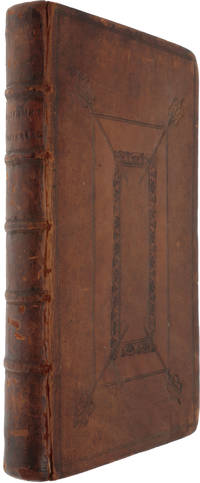
1730035995London: William Innys 1730. 4th Edition 1st Printing. Hardcover. Near Fine. New Calf Spine And Tips Over Marbled Paper Covered Boards New Endpapers. Two Preliminary Blanks Title Advertisements To First Second And Fourth Editions382 Pp 12 Folding Plates And Two Pages Of Publisher's Ads At Rear. Page Block 19.5 Cm Text Block 6.5" X 3 1/2" From Top To Bottom Of Printed Area Including Page Running Headings Tall. Top Edge Of Page Block Is Dark Grey Or Black Fore Edge And Bottom Edge Red All Polished. Leaves 7 5/8" Tall; Binding 7 3/4" X 5 3/16". The Last And Best Edition Prepared By Newton Corrected From The Third Edition By Newton; In This Fourth Edition Of 1730 There Are 31 Queries And It Is The Famous "31St Query" That Over The Next Two Hundred Years Stimulated A Great Deal Of Speculation And Development On Theories Of Chemical Affinity. The Publishers Have Added To This Edition Several Citations From The Lectiones Opticae 1669-1671 To Show Where Demonstrations Omitted From The Opticks May Be Found. Unusually Well Preserved Binding Fine Contents Clean Some Tiny Foxing Spots Mainly In Margins And Mainly Towards Beginning Of Book; Very Slight Wear To Edges Of Page Block. . <br/> <br/> William Innys hardcover
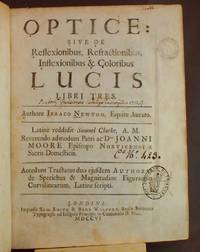
17066324London: Samuel Smith & Benjamin Walford 1706. First Latin edition. Very Good/The Latin edition of Newton's 1704 Opticks was intended for the broader pan-European "Republic of Letters" and it was the first printing to carry Newton's name on the title. This is the edition that inspired Emelie du Chatelet and Voltaire and through them the whole of Europe. It is a compendium of Newton's main discoveries concerning light and color including the spectrum of sunlight the color circle the reflecting telescope and interference effects that is the so-called 'Newton's rings'. In expansion of the 1704 English text the Latin edition presents seven added "Quaestiones" which are partly devoted to Newton's support for the "corpuscular" or particle theory of light. The collation of this copy corresponds to the copy in the Babson Collection catalogue with "Pp" consisting of a single leaf and with pages 21-24 repeated in the Tractatus. . Quarto 26 cm; 14 348 2 24 2 24 21-43 1 pages 19 folded leaves of engraved plates with errata corrigenda and addenda. Ss1 a cancel. In original calf with blind-ruled border rebacked with corners built up. Spine with gilding and leather title label. Speckled edges. Old library stamps on title page along with early ownership inscriptions. References: Bowes and Bowes #179; Babson Collection 137; Norman 1589. Samuel Smith & Benjamin Walford, hardcover books
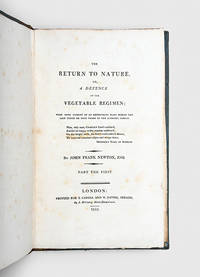
1811164685London: printed for T. Cadell and W. Davies by J. McCreery 1811. The root of the Shelleys' vegetarianism First edition of this pioneering work of vegetarianism in which the author advocates for the medical and intellectual benefits of a meat-free diet. It was a great influence on fellow vegetarian Percy Bysshe Shelley as well as on Mary Shelley's depiction of the Creature as a herbivore in Frankenstein. This is a particularly well-preserved copy in the original boards. Newton 1767-1837 promoted a diet of fruit vegetables raisins bread eggs milk and potatoes and he drank only distilled water because of his belief that the Thames was contaminated with animal fat. Unlike his mentor William Lambe 1765-1847 Newton was not a vegan. He inspired several significant figures to adopt a vegetarian diet including the physician John Snow 1813-1858 and Percy Shelley whose Vindication of Natural Diet 1813 echoed Newton's ideas. "It is from his meeting with John Newton in November 1812 that Shelley's proselytising vegetarianism dates. From Newton's book he drew many of his arguments" Crook and Guiton p. 77. The two men differed in the fact that Newton was mainly concerned with the scientific benefits rather than the moral implications of vegetarianism. "Though not a doctor Newton regarded The Return to Nature principally as a work of medicine; he had himself found relief from chronic asthma through vegetarianism and was anxious to impart to others the knowledge of its benefits in a number of diseases" ibid. However "in one of his most surprising and emphatic passages" Newton ventures into a diatribe against "the monster syphilis with all its gorgon terrors" and explains his hope that vegetarianism could cause it to "be driven from the earth" p. 131. This was expanded upon by Shelley in his own writing through his emphasis on the immorality of consuming flesh in all its guises along with his link between a carnivorous diet and alcoholism. He made use of the allegory of Prometheus; it was only through the unnatural theft of fire that humans gained the ability to transform meat from bloody flesh into something fit for consumption. Newton was also an occasional guest of Mary Shelley's father William Godwin a fellow proponent of the vegetarian diet. Presumably it was because Newton's ideas filtered through Shelley and Godwin that Mary Shelley decided to describe the Creature in Frankenstein as a vegetarian: "My food is not that of man; I do not destroy the lamb and the kid to glut my appetite; acorns and berries afford me sufficient nourishment. The picture I present to you is peaceful and human." The Return to Nature is rare in commerce particularly so in original boards. We can trace just one copy thus at auction which appeared over 50 years ago. Octavo. Uncut in original brown paper-backed blue boards printed paper spine label. Dedication leaf misbound following introduction. Head of spine crumpled corners worn light foxing to boards and contents but otherwise very crisp initial leaves creased at upper margin leaf A3 partially loose at lower cord and consequently standing proud: a very good copy. Nora Crook & Derek Guiton Shelley's Venomed Melody 2010. hardcover
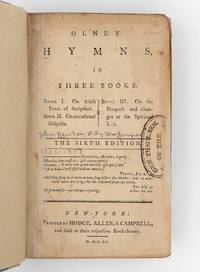
1790374363New York: Printed by Hodge Allen & Campbell and sold at their respective book-stores 1790. Second American edition. vi 1 8-348. 12mo. Recent paper backed boards. Repairs at gutter of title and first leaf. Bookplate and ink stamp of General Theological Seminary. Second American edition. vi 1 8-348. 12mo. Olney Hymns was published in London in 1779 but it was not until publication in the United States the they hymn flourished. The first American printing of Amazing Grace appeared within the New York 1787 edition of Olney Hymns Evans 20588 followed by the New York 1789 edition of the Psalms of David . for the Use of the Dutch Reformed Church Evans 21688. The present 1790 reprinting of the 1787 edition by Hodge Allen and Campbell followed with Amazing Grace appearing on pp. 48-9.<br /> <br /> ESTC records only two other examples of this 1790 edition AAS and NYHS and we find no example of either the first or second American Olney Hymns in the auction records for over a century. Evans 22734; ESTC W26651. On Amazing Grace see D. Bruce Hindmarsh "'Amazing Grace': The History of a Hymn and a Cultural Icon" in: Sing Them Over Again to Me: Hymns and Hymnbooks in America ed. Noll and Blumhofer 2006 Printed by Hodge, Allen, & Campbell, and sold at their respective book-stores unknown
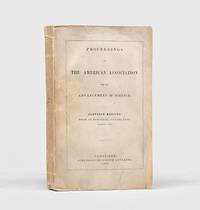
1858155260Cambridge: Joseph Lovering 1858. One of only two known papers by the author Uncommon first edition of the first article by a woman published in the Proceedings of the AAAS: a well-preserved copy in the original wrappers with the ownership signature of American ornithologist George N. Lawrence 1806-1895 listed as a member of the AAAS on p. xxxviii of this volume. The American scientist inventor and women's rights campaigner Eunice Newton Foote 1819-1888 is best remembered for her discovery of the absorption of thermal radiation by carbon dioxide and water vapour: namely the greenhouse effect. Her famous paper on the topic was presented to the AAAS in August 1856 read on her behalf by Joseph Henry first Secretary of the Smithsonian and published shortly after in the American Journal of Science and Arts. This is Foote's second paper which provides an early experimental description of the effect of a pressure-driven change on the static electricity of air with reference to observations by Humboldt Sabine and de Saussure. It was presented to the AAAS on 14 August 1857 again read by Joseph Henry on her behalf. Its first appearance in print was in the Proceedings; abbreviated versions later appeared in the American Journal of Science and Arts and in the Philosophical Magazine. In Mary Creese's landmark study of American and British women scientists from 1800 to 1900 she noted that of the approximately 3400 scientific publications authored by women in the period - less than 1% of the total published - there were "just 16 papers by American women in physics over the whole century. Only two pre-date 1889 and they are the two papers by Eunice Foote" Jackson p. 117. John Perlin author and visiting scholar at the UCSB Physics department which hosted a 2019 exhibition on Foote remarked that she was "the only woman to be published in serious physics journals until Madame Curie" quoted in Jacobs. Octavo. Five folding plates one engraved with astronomical illustrations the rest featuring diagrams and graphs and two engraved plates numerous illustrations in text. Original buff printed wrappers. Faint pencilled signature "Geo. N. Lawrence" along upper edge of front cover pencilled number at centre of spine. Wrappers expertly restored spine ends chipped contents crisp and clean: a very good copy. Roland Jackson "Eunice Foote John Tyndall and a Question of Priority" Notes and Records 74 2019 pp. 105-18; Tom Jacobs "More than a Historical Foote Note" UCSB's The Current 6 November 2019 available online. unknown
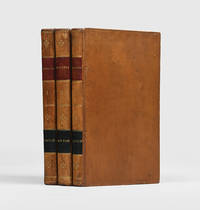
1819183664London: Printed for Sherwood Neely and Jones; and Davis and Dickson 1819. The Newtonian ascendancy A handsomely bound edition bringing together Newton's masterpiece with several works refining Newtonian theory and an early draft of the Principia itself. This translation of the Principia together with the Laws of the Moon's Motion by John Machin c. 1686-1751 is drawn from the first edition in English published in 1729. William Davis 1771-1807 originally brought out the three-volume edition in 1803 revising and extending Motte's translation to cover the remaining third of Newton's text. This is thus only the second edition of a complete translation of the Principia into English. No further edition was published until the "modernized" version brought out by the University of California Press in 1934 and no entirely new translation was made until 1999. This edition pairs these works with the Short Comment on and Defence of The Principia 1770 by William Emerson 1701-1782 and Newton's own System of the World written 1685. By the turn of the 19th century the Principia's theory of gravity had become widely accepted in scientific circles and Davis's edition "made this available to a number of generations of nineteenth-century students" ODNB. 3 vols octavo 212 x 127 mm. Engraved portrait frontispiece and 56 plates 8 of which folding. Extensive tables and formulae in the text. Contemporary calf spines lettered decorated and ruled in gilt and with red and black morocco labels covers panelled in blind light brown coated endpapers edges sprinkled brown. Spine ends restored. Light bumping and wear minor browning and offsetting to contents: a very good copy. Babson 22; Grey 25; Wallis 25. unknown
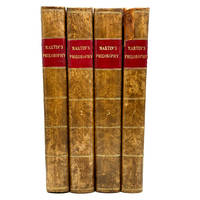
17715136166113<p><strong>NEWTON MARTIN Benjamin</strong><strong>.</strong> <em>Philosophia Britannica: Or A New and Comprehensive System of the Newtonian Philosophy Astronomy and Geography; In a Course of Twelve Lectures; With Notes; Containing the Physical Mechanical Geometrical and Experimental Proofs and Illustrations of All the Principal Propositions in Every Branch of Natural Science: Also a Particular Account of the Invention Structure Improvement and Uses of All the Considerable Instruments Engines and Machines; With New Calculations Relating to Their Nature Power and Operation.</em></p><p>London: Printed for W. Strahan; J. & F. Rivington; W. Johnston; Hawes & Co.; T. Carnan and F. Newbery; B. Collins; W. Frederick; and sold by the Author at his House in Fleet-Street 1771. Third edition. Complete in four volumes. Three text volumes plus a separate atlas volume of plates. Quarto. Approximately 8.5" x 5.5". Vol. I: xxx 333pp 3 ads; Vol. II: xiv 390pp 2 ads; Vol. III: x 405pp index. Atlas volume with 81 engraved copperplates the majority folding. Contemporary or near-contemporary half marbled calf over marbled boards with one repair to the upper spine of Vol. IV. Bindings sound and well-aligned. Engraved plates clean and strong with no losses; folds supple and correctly opening. Text generally clean throughout with manuscript annotations on the versos of the plates linking them to the relevant portions of text. Overall Very Good to Very Good.</p><p>Third and expanded edition of Benjamin Martin's monumental exposition of Newtonian natural philosophy combining physics astronomy geography mechanics and experimental science into a single unified system. The work includes extensive treatment of optics celestial motion gravitation hydrostatics pneumatics electricity and the mechanical powers alongside detailed explanations of contemporary scientific instruments and experimental apparatus. The separate atlas volume contains 81 finely engraved plates illustrating astronomical systems orreries telescopes microscopes air pumps electrical machines engines survey instruments and mechanical demonstrations.</p><p>This third edition represents the fully mature state of Martin's project as a practical synthesis of Newtonian science for broad professional use in the later eighteenth century. Unlike earlier editions which often survive without the full engraved apparatus this issue consolidates the theoretical text and the mechanical-visual program into a coherent instructional system. The separate atlas format allows for larger clearer mechanical and astronomical engravings than the inline plates of earlier printings making this edition particularly well suited for institutional reference in the history of science technology and scientific pedagogy.</p> Printed for W. Strahan; J. & F. Rivington; W. Johnston; Hawes & Co.; T. Carnan and F. Newbery; B. Collins; W. Frederick hardcover
1404JC028<p><strong>SIVE DE Reflexionibus Refractionibus Inflexionibus & Coloribus LUCIS </strong>LIBRI TRES. Authore Isaaco Newton Equite Aurio. Latine reddidit Samuel Clarke. S. T. P. Editio Secunda auctior. LONDINI. Impensis Gul. & Joh. Innys Regiae Societatis Typographorum ad Insignia Principis in Areâ Occidentali D. Pauli. MDCCIXI 1719.</p>_x000d_<p>In 4º de 195x12 cm com ix 415 págs. Encadernação da época inteira de pele com ferros a ouro na lombada e ferros a ouro rolados com motivos florais nas esquadrias das pastas e nos super-libris. Corte das folhas marmoreado. Acondicionado em estojo de pele.</p>_x000d_<p>Ilustrado com 12 gravuras desdobráveis abertas em chapa de metal com todas as figuras geométricas do estudo da reflexão da refracção e do estudo do arco-íris e das cores.</p>_x000d_<p>Exemplar com título de posse manuscrito e rasurado no pé da folha de rosto.</p>_x000d_<p>Segunda edição deste tratado um dos grandes livros da história da ciência.</p>_x000d_<p>Newton produziu muitas explicações para os mais variados problemas. Este livro Óptica de Newton fez pela Luz e pela Óptica o que o seu Principia tinha feito pela Gravidade ou seja colocou a Luz numa base científica diz E. W. Brown. Contém uma acumulação de fenômenos ópticos desde o seu primeiro trabalho uma pequena memória sobre Transação Filosófica 1672 até este livro editado 33 anos mais tarde.</p>_x000d_<p>EN In 4º 195x12 cm. ix 415 pags.</p>_x000d_<p>Contemporary full calf binding gilt at spine and gilt tooled at boards in floral frames. Marbled edges. Packed in case in the style of a tobacco case finished in full calf.</p>_x000d_<p>Illustrated with 12 folding plates containing the graphics from the study of the light reflection and refraction and the explanation of the rainbow.</p>_x000d_<p>Copy with ownership title erased at bottom of title page.</p>_x000d_<p>2nd Latin edition of Newton's 'Optics: or a Treatise of the Reflections Refractions Inflections and Colours of Light. London 1704'. One of the greatest books in the history of science.</p>_x000d_<p>Newton found out many explanations to many problems. This book Newtons Optics did for Optics and Light what his Principia did for Gravitation namely it gave Light a scientific basis says E.W. Brown. It contains an accumulation of optical phenomena from his first paper a short memoir in Philosophical Transaction 1672 to the above book Optics 33 years later.</p>_x000d_<p>Referências/References: </p>_x000d_<p>Gray 180; Babson 138; Wallis 180; British Lybrary: General Reference Collection 59.g.19</p> M-11-C-11 hardcover
Par feue Madame la Marquise Du Chastellet. L'opera afferma le leggi del moto di Newton, che costituiscono il fondamento della meccanica classica, anche la legge della gravitazione universale di Newton e una derivazione delle leggi del moto planetario di Keplero (che Keplero ottenne per primo empiricamente). Il Principia è "giustamente considerato come una delle opere più importanti nella storia della scienza". 2 volumi in 4to, mm. 260x205; [4], 438, [2 bl.] pagg., 9 incisioni; [4], 180, 297, [3] pag., 5 incisioni. Legatura in tutto vitello maculato coevo, piccole spellature alle punte e qualche taglietto sui dorsi. Tagli rossi. Prima edizione della traduzione francese di uno dei capolavori di Newton, illustrata con 14 incisioni (9 nel primo volume e 5 nel secondo), e vari elementi ornamentali. Molto raro. Cfr. Brunet, v. 4, c. 49. Codice inv.1031199
1209Twelve folding engraved plates. 1 leaf of ads 1 p.l. xi 1 415 pp. 1 p. of ads. 8vo 18th-cent. speckled calf carefully rebacked by Aquarius double gilt fillet round sides spine richly gilt red morocco lettering piece on spine. London: G. & J. Innys 1719. Second edition in Latin and an influential book on the Continent. Newton published this edition in Latin to reach the Continental audience which had been little influenced by his optical experiments. The edition served its purpose and caused numerous demonstrations of his theory of colors to be performed in Paris. Newton's optical theories began to spread significantly outside Great Britain as a result of this book. See Westfall's Never at Rest pp. 794-95. A very good copy with the signature dated 14 Mar. 1822 of Stephen Peter Rigaud 1774-1839 historian of science astronomer and Savilian professor of geometry at Oxford. Stamp of the Radcliffe Observatory on verso of title. With the bookplate of William A. Cole the distinguished collector and bibliographer of chemistry. ❧ Babson 138. unknown books
186449256London: Sold by R.H. Porter 1864 1902 1905 1907. Sole editions. Four parts bound in two volumes. Large 8vo. xl 525 3 527-532; vi 665 1 96 4 pp. Expertly bound in recent quarter red morocco over marbled boards spines with raised bands gilt lettered black labels lettered direct to another and with a gilt device repeated to the others the original printed wrappers to all four parts bound in at the rear of volume II adjacent to the first wrapper is a 3 pp. autograph letter signed from Newton addressed to "My dear Edge" on Magdalen College Cambridge headed paper parts II and III feature tipped in handwritten notes presenting them "with the editor's compliments" parts II and IV also come with letters from Newton to the original recipient's son finally the set is complemented with two pieces of interesting egg related printed ephemera. Photogravure portrait frontispiece 21 chromolithograph plates of bird eggs numbered I-XXI 16 lithograph plates tinted chromolithographic or uncoloured depicting birds nests and landscapes lettered A-P and a folding colour map of Lapland. John Wolley 1823-1859 was an ornithologist and egg collector first becoming interested in the subject whilst studying at Cambridge. Over time he became something of an expert on the Dodo and later on the Great Auk. His studies led to travels in Europe and Scandinavia and it was during one of these trips in the 1850s that he interviewed the men that had killed the last of the Great Auk species the previous decade. Wolley fell ill after one of these foreign trips and eventually passed away at the tender age of 36. On his demise his notes and remaining egg collection passed to his close friend Alfred Newton who painstakingly edited and published Wolley's notes over the next half century. Alfred Newton 1829-1907 became one of the pre-eminent ornithologists of the age being one of the founders of the British Ornithologists' Union in 1858 and ascending to the chair of Zoology and Comparative Anatomy at Cambridge in 1866 a post that he held until his death. In these later decades Newton also edited or contributed to many other important ornithological works such as editions of Yarrell's Birds the Encyclopaedia Britannica and his own Dictionary of Birds four volumes 1893-96 but his editorship of Wolley's work was by far his crowning achievement in print. The first letter is dated September 1864 and is evidently written to James Thomas Edge 1827-1894 originally James Thomas Hurt he took his mother's maiden name early in his adult life. Newton explains that he had asked Van Voorst to send Edge a copy of the work but that the publisher had ignored his instruction to inscribe the volume with his wishes. This omission prompted Newton's belated letter which had been delayed due to a summer long bird watching trip to Spitsbergen. The later letters are both addressed to Edge's son Thomas Lewis Kekewich Edge 1856-1931 the first of these references the senior Edge's collection - the importance of certain pieces within it and the need to ticket them. Newton's final letter is dated March 1907 just three months prior to his death. He is glad that Edge has had "the 4th and last part of this book and seems to like it" and commends an extract that Edge had quoted from his father's journal in a previous letter apparently confirming a conclusion John Wolley had also come to. Interestingly Wolley's father Francis also changed surname during his adult life - taking on his wife's maiden name. Prior to becoming a Wolley Francis' surname had been Hurt. Thus it transpires that as well as sharing a keen interest in ornithology and oology John Wolley and James Thomas Edge were second cousins. The ephemera comprises an 1865 printed sale notice from the auctioneer J.C. Stevens offering a "Rare & Remarkable Egg" of a bird "presumed to be quite extinct" which he states was "probably the Dinornis ingens of Owen". Richard Owen had been sent a fragment of an unusual bone that had been excavated in New Zealand in the late 1830s. After studying it for several years he came to the conclusion that it was almost certainly a part of a bone from a giant flightless bird which he named Dinornis novaezealandiae more commonly known by its Maori name of Moa which had long since been extinct. Also inserted is a 24 pp. sale catalogue of eggs dated 1858 offered by the same auctioneer the eggs collected by John Wolley himself in Lapland the previous year. A handsome set of a what is ordinarily an uncommon work this set rendered unique with its the family association letters from the editor and the related ephemera. London: Sold by R.H. Porter unknown
Rilegatura mezza pelle con scritte e decorazioni dorate su costa Buone condizioni (alcuni segni di ingallimento delle pagine per l'età del libro).
171938274London, Impensis Gul. & Joh. Innys, 1719 (colophon: Londini: Ex Officina Gulielmi Bowyer, 1718). 8vo. Contemp. full calf. Corners, fronthinge and spineends professionally repaired. Inner hinges reinforced. Gilt lineborders on back. Titlelabel in red leather with gilt lettering. Old owners name stamped on titlepage (small).Instead of htitle is bound ""Catalogus Librorum prostantium apud Gul. & Joh. Innys"" (1 leaf), the Cataloque is furthermore bound at end, but with a different typography. (2),XI,(1),415 pp. and 12 folded engraved plates. Very light brownning to a few margins. Printed on good paper, in general fine and clean internally.
171938274London Impensis Gul. & Joh. Innys 1719 colophon: Londini: Ex Officina Gulielmi Bowyer 1718. 8vo. Contemp. full calf. Corners fronthinge and spineends professionally repaired. Inner hinges reinforced. Gilt lineborders on back. Titlelabel in red leather with gilt lettering. Old owners name stamped on titlepage small.Instead of htitle is bound "Catalogus Librorum prostantium apud Gul. & Joh. Innys" 1 leaf the Cataloque is furthermore bound at end but with a different typography. 2XI1415 pp. and 12 folded engraved plates. Very light brownning to a few margins. Printed on good paper in general fine and clean internally. <br/><br/><em>Scarce second Latin edition of Newton's "Optics: or a Treatise of the Reflections Refractions Inflections and Colours of Light. London 1704." one of the great books in the history of science. "Newton's Optics did for Light what his Principia had done for Gravitation namely placed it on a scientific basis." E.W. Brown. The translation was brought to light "At the request of Newton Dr. Samuel Clarke prepared a Latin edition of his Optics which appeared 1706 and he was generously presented by Sir Isaac with GBP 500 or GBP 100 for each of his five children as a token of the appreciation and gratitude of the author. DeMoivre is said to have secured and taken charge of this translation and to have spared neither time nor trouble in the task. Newton met him every evening at a coffe-house and when they have finished their work he took De Moivre home with him to spend the evening in philosophical conversation."Brewster in his "Newton" 1855"."In the accumulation of optical phenomena from his first paper the short memoir in Philosophical Transaction 1672 until the above book the Optics. 33 years later Newton had gathered explanations to many problems. The rainbow is fully explained and also "Newton's rings" produced by pressing the flat side of a plano-convex glass against a double convex lens of long focal lenght producing rings of alternating brightness and darkness; his explanation was not valid as he did not know optical interference. He speculated on the double refraction of Icelandic spar." Dibner in Heralds of Science No 148 - G.J. Gray No 180. </em> hardcover