178 résultats
177027703PARIS BASSET 1770 une vue d'optique en couleurs, GRAVÉE A L'EAU-FORTE ET AQUARELLÉE SUR PAPIER DE FORMAT: 30 x 46,5 cm., 1770 PARIS Basset Editeur,
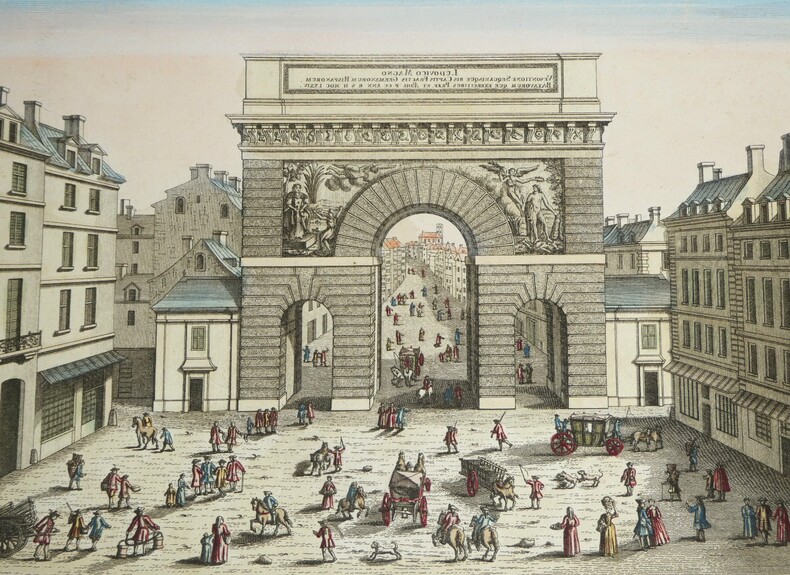
1740boz_002983Vue d'optique, Gravure rehaussée, La Porte St Martin sortant de Paris Vue d'optique de La Porte St Martin sortant de Paris, avec légende. « Vue d'Optique Représentant La Porte St Martin sortant de Paris » « Sti Martini Portae Prospectus Lutetia Egredienti » Gravure rehaussée à l'aquarelle à la main d'époque. Marges partiellement conservées. Chez Daumont, à Paris, rue St Martin. Dimensions de la feuille : 43,5 x 31,6 cm Dimensions à la cuve : 42 x 31,1 cm État : Voir photos et description pour plus de détails. Apparues vers 1740, ces estampes étaient spécifiquement conçues pour être visionnées à travers un appareil appelé "zograscope" ou une lanterne magique. La perspective : Le dessin accentue volontairement les lignes de fuite pour créer une illusion de profondeur saisissante. L'inversion : Le titre en haut de la gravure est souvent imprimé à l'envers (en miroir) pour apparaître correctement une fois reflété dans le miroir de l'appareil d'optique. L'usage : Véritable ancêtre de la 3D, elles permettaient aux curieux de l'époque de "voyager" immobile à travers l'Europe et le monde.
178927748PARIS Lamy 1789 une vue en noir, GRAVÉE en taille-douce SUR PAPIER vergé DE FORMAT: 53 x 35 cm., intitulée : "Vue de la Salpétrière [à Paris] prise du Boulevard". Sous le tr. c. : "Dessiné par Savard. Gravé par Duparc". No. 14.,[H. 0m208 x L. 0m341] pour la gravure elle-même, Appartient à : [Planches pour : Voyage pittoresque de la France, Paris, Lamy, 1781-1796
175023701(vers 1750) Format 260 x 400 mm, avec marges 340 x 480 mm.
175023698(vers 1750) Format 220 x 365 mm, avec marges 320 x 460 mm.
174227676Paris Chereau 1742 une vue d'optique en couleurs, GRAVÉE A L'EAU-FORTE ET AQUARELLÉE SUR PAPIER DE FORMAT: 35 x 52 cm., 1742 PARIS Chereau Editeur,
178427526Paris Née François Denis 1784 Une Gravure originale , technique : Eau-forte, en noir sur papier vergé crème, format de la gravure : 35 cm de haut par 52,5 cm de large, PARIS. «VUE DE LA GRANDE COLONNADE DU LOUVRE": [estampe] par MEUNIER Pinxit. - gravé par Née François Denis. Département de Paris N°82, [entre 1781 et 1796] [Paris], Née François Denis Editeur,
1790279411790 une Vue d'optique en couleurs. Dimensions de l'image: 44,5 x 25,5 cm (dimension totale), GRAVÉE A L'EAU-FORTE ET AQUARELLÉE, Gravure originale. Vue d'optique rehaussée en couleurs à l'aquarelle, représentant des bateaux du 18ème au milieu d'une tempète, par SARASIN Pinxit., LA CHAUSSÉE Sculptsit., sans date (1790) sans lieu ni Editeur,
176618808London and Paris: a Londres ches Wichnyther A Paris chez J. Chereau rue St. Jacques au dessus de la Fontaine St. Severin aux 2 Colonnes No. 257 1766. Engraving with original colour. Printed on laid paper. In good condition with mild soiling and creasing. A beautiful Vue d'Optique with strong early colour depicting the old Palace of Westminster where the Lords and Commons met.<br/> <br/> An interesting late 18th century view of Westminster prior to the great fire of 1834 which brought into being the present Houses of Parliament. Westminster had been a royal residence until Henry VIII left it after a fire to reside at Whitehall. After that the Houses of Parliament met there. During the eighteenth century "vues d'optique" or "perspective views" became extremely popular in England and Europe. Like other optical prints they capitalized on a connoisseur market eager for the latest novelty. English publishers such as John Bowles and Robert Sayer had great success with these optical views which quickly developed into a collecting craze that swept through print shops on both sides of the Channel. "Vues d'optiques" were specifically designed to create the illusion of perspective when viewed with a zograscope or perspective glass. These viewing devices used a series of reflecting mirrors to enhance the illusion of depth in the print creating a veritable "view" for the onlooker. Typically these prints depicted city or landscape views and were horizontal in format. They had roughly the same dimensions and were sold with heavy opaque colouring so as to show the tints when viewed through the lens. In their heyday optical prints were a technical revolution; they could be seen in almost every fashionable drawing room and were enjoyed by the poorer classes in print shops or at traveling fairs. For a small fee the citizens of Europe and England could travel the world without leaving their village. The "vue d'optique" was the first medium to bring the visible appearance of the wider world to a large European public. Ironically the artists and engravers who created these prints rarely had first hand knowledge of the scenes depicted hence the views were often not as accurate as they were advertised to be. As a result of their constant handling optical prints such as these are rare especially in good condition. They are not only beautiful images but a fascinating glimpse into the history of printmaking.<br/> <br/> Clayton The English Print 1688-1802 140-141. a Londres ches Wichnyther (?) A Paris chez J. Chereau rue St. Jacques au dessus de la Fontaine St. Severin aux 2 Colonnes No. 25 unknown
1760103861760. Engraving with original colour. Printed on laid paper. In good condition with the exception of some creases within the image. Sides have been remargined with laid paper and bottom edge is trimmed within the platemark. Surface soiling within image. Image size: 11 x 16 1/4 inches. A wonderful "vue d'optique" of Somerset House on the Strand in London.<br/> <br/> During the eighteenth century "vues d'optique" or "perspective views" became extremely popular in England and Europe. Like other optical prints they capitalized on a connoisseur market eager for the latest novelty. English publishers such as John Bowles and Robert Sayer had great success with these optical views which quickly developed into a collecting craze that swept through print shops on both sides of the Channel. "Vues d'optiques" were specifically designed to create the illusion of perspective when viewed with a zograscope or perspective glass. These viewing devices used a series of reflecting mirrors to enhance the illusion of depth in the print creating a veritable "view" for the onlooker. Typically these prints depicted city or landscape views and were horizontal in format. They had roughly the same dimensions and were sold with heavy opaque colouring so as to show the tints when viewed through the lens. In their heyday optical prints were a technical revolution; they could be seen in almost every fashionable drawing room and were enjoyed by the poorer classes in print shops or at traveling fairs. For a small fee the citizens of Europe and England could travel the world without leaving their village. The "vue d'optique" was the first medium to bring the visible appearance of the wider world to a large European public. Ironically the artists and engravers who created these prints rarely had first hand knowledge of the scenes depicted hence the views were often not as accurate as they were advertised to be. As a result of their constant handling optical prints such as these are rare especially in good condition. They are not only beautiful images but a fascinating glimpse into the history of printmaking.<br/> <br/> Clayton The English Print 1688-1802 140-141. unknown
176010384Paris: chez Daumont rue St. Martin 1760. Engraving with original colour. Printed on watermarked laid paper. In excellent condition with the exception of some surface soiling in the upper section of the image. Image size: 8 7/8 x 15 13/16 inches. A wonderful "vue d'optique" of St. Mary's Church in London<br/> <br/> During the eighteenth century "vues d'optique" or "perspective views" became extremely popular in England and Europe. Like other optical prints they capitalized on a connoisseur market eager for the latest novelty. English publishers such as John Bowles and Robert Sayer had great success with these optical views which quickly developed into a collecting craze that swept through print shops on both sides of the Channel. "Vues d'optiques" were specifically designed to create the illusion of perspective when viewed with a zograscope or perspective glass. These viewing devices used a series of reflecting mirrors to enhance the illusion of depth in the print creating a veritable "view" for the onlooker. Typically these prints depicted city or landscape views and were horizontal in format. They had roughly the same dimensions and were sold with heavy opaque colouring so as to show the tints when viewed through the lens. In their heyday optical prints were a technical revolution; they could be seen in almost every fashionable drawing room and were enjoyed by the poorer classes in print shops or at traveling fairs. For a small fee the citizens of Europe and England could travel the world without leaving their village. The "vue d'optique" was the first medium to bring the visible appearance of the wider world to a large European public. Ironically the artists and engravers who created these prints rarely had first hand knowledge of the scenes depicted hence the views were often not as accurate as they were advertised to be. As a result of their constant handling optical prints such as these are rare especially in good condition. They are not only beautiful images but a fascinating glimpse into the history of printmaking.<br/> <br/> Clayton The English Print 1688-1802 140-141. chez Daumont rue St. Martin unknown
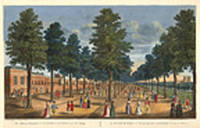
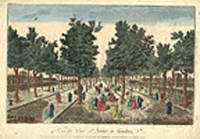
180010694London: Printed for Bowles & Carver No. 69 St. Pauls Church Yard 1800. Engraving with beautiful hand-colour. In excellent condition with the exception of tape on the verso of sheet. Image size: 9 3/8 x 15 3/4 inches. Vue d'Optique of the Royal Palace in St. James' Park in London<br/> <br/> During the eighteenth century "vues d'optique" or "perspective views" became extremely popular in England and Europe. Like other optical prints they capitalized on a connoisseur market eager for the latest novelty. English publishers such as John Bowles and Robert Sayer had great success with these optical views which quickly developed into a collecting craze that swept through print shops on both sides of the Channel. "Vues d'optiques" were specifically designed to create the illusion of perspective when viewed with a zograscope or perspective glass. These viewing devices used a series of reflecting mirrors to enhance the illusion of depth in the print creating a veritable "view" for the onlooker. Typically these prints depicted city or landscape views and were horizontal in format. They had roughly the same dimensions and were sold with heavy opaque colouring so as to show the tints when viewed through the lens. In their heyday optical prints were a technical revolution; they could be seen in almost every fashionable drawing room and were enjoyed by the poorer classes in print shops or at traveling fairs. For a small fee the citizens of Europe and England could travel the world without leaving their village. The "vue d'optique" was the first medium to bring the visible appearance of the wider world to a large European public. Ironically the artists and engravers who created these prints rarely had first hand knowledge of the scenes depicted hence the views were often not as accurate as they were advertised to be. As a result of their constant handling optical prints such as these are rare especially in good condition. They are not only beautiful images but a fascinating glimpse into the history of printmaking.<br/> <br/> Clayton The English Print 1688-1802 140-141. Printed for Bowles & Carver, No. 69 St. Pauls Church Yard unknown
178010559Paris: Chez. Daumont rue St. Martin. Presentement chés Lachaussée rue S. Jacques 1780. Engraving with original colour. Printed on wove paper. This is a later copy of the earlier print of St. James' published by Daumont. In good condition with the exception of some scattered brown marks. Trimmed within the platemark. Image size: 9 1/4 x 14 1/2 inches. Vue d'Optique of St. James' Park in London<br/> <br/> During the eighteenth century "vues d'optique" or "perspective views" became extremely popular in England and Europe. Like other optical prints they capitalized on a connoisseur market eager for the latest novelty. English publishers such as John Bowles and Robert Sayer had great success with these optical views which quickly developed into a collecting craze that swept through print shops on both sides of the Channel. "Vues d'optiques" were specifically designed to create the illusion of perspective when viewed with a zograscope or perspective glass. These viewing devices used a series of reflecting mirrors to enhance the illusion of depth in the print creating a veritable "view" for the onlooker. Typically these prints depicted city or landscape views and were horizontal in format. They had roughly the same dimensions and were sold with heavy opaque colouring so as to show the tints when viewed through the lens. In their heyday optical prints were a technical revolution; they could be seen in almost every fashionable drawing room and were enjoyed by the poorer classes in print shops or at traveling fairs. For a small fee the citizens of Europe and England could travel the world without leaving their village. The "vue d'optique" was the first medium to bring the visible appearance of the wider world to a large European public. Ironically the artists and engravers who created these prints rarely had first hand knowledge of the scenes depicted hence the views were often not as accurate as they were advertised to be. As a result of their constant handling optical prints such as these are rare especially in good condition. They are not only beautiful images but a fascinating glimpse into the history of printmaking.<br/> <br/> Clayton The English Print 1688-1802 140-141. Chez. Daumont rue St. Martin. Presentement chés Lachaussée rue S. Jacques unknown
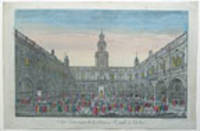
177015059Paris: Chez Daumont rue St. Martin 1770. Engraving with beautiful early colour. Printed on watermarked laid paper. In excellent condition with the exception of being trimmed within the platemark on the lower margin. Small tear on upper margin. Small puncture mark on left margin. Image size: 10 1/8 x 16 1/8 inches. This is a beautiful perspective view of the courtyard of the Royal Stock Exchange in London published by a Parisian printseller at the close of the eighteenth century.<br/> <br/> During the eighteenth century "vues d'optique" or "perspective views" became extremely popular in England and Europe. Like other optical prints they capitalized on a connoisseur market eager for the latest novelty. English publishers such as John Bowles and Robert Sayer had great success with these optical views which quickly developed into a collecting craze that swept through print shops on both sides of the Channel. "Vues d'optiques" were specifically designed to create the illusion of perspective when viewed with a zograscope or perspective glass. These viewing devices used a series of reflecting mirrors to enhance the illusion of depth in the print creating a veritable "view" for the onlooker. Typically these prints depicted city or landscape views and were horizontal in format. They had roughly the same dimensions and were sold with heavy opaque colouring so as to show the tints when viewed through the lens. In their heyday optical prints were a technical revolution; they could be seen in almost every fashionable drawing room and were enjoyed by the poorer classes in print shops or at traveling fairs. For a small fee the citizens of Europe and England could travel the world without leaving their village. The "vue d'optique" was the first medium to bring the visible appearance of the wider world to a large European public. Ironically the artists and engravers who created these prints rarely had first hand knowledge of the scenes depicted hence the views were often not as accurate as they were advertised to be. As a result of their constant handling optical prints such as these are rare especially in good condition. They are not only beautiful images but a fascinating glimpse into the history of printmaking.<br/> <br/> Clayton The English Print 1688-1802 140-141. Chez Daumont rue St. Martin unknown
176828697NALLIERS 1768 un papier, manuscrit à l'encre brune de 4 pages, sur papier vergé ligné crème filigrané "à la fleur de Lys" , format : 24,5 x 19 cm, cachet fiscal en noir en haut de 1ère page : "G. DE POITIERS - deux Sols", signé en bas de la 4ème page : JEAN BAPTISTE BELLOTEAU SEUL JUGE CIVIL CRIMINEL ET DE POLICE DE NALLIERS ET LISTEAU - JACQUES DE LAUSPITAU GREFFIER ORDINAIRE AU PARQUET ET AUDITOIRE DE CETTE COUR, INTERROGATOIRE DE LOUIS FLORISSON, LABOUREUR DEMEURANT AU BOURG DE NALLIERS, DEVANT JEAN BAPTISTE BELLOTEAU SEUL JUGE CIVIL CRIMINEL ET DE POLICE DE NALLIERS ET LISTEAU, (A LA REQUETE DE PIERRE NOULLEAU ET FRANCOIS MICHON GARDES VERDIERS) : EN VUE DE POURSUITE POUR PACAGE DE BESTIAUX DANS LES "PRISES RAIMOND", BAGARRE A COUP DE BATONS ET COUPS DE POING CONTRE LES GARDES VERDIERS, NALLIERS, LE 10 MAY 1768,
1740boz_001764Vue d'optique, Gravure rehaussée, Vue du Palais du Luxembourg prise du jardin à Paris Vue d'optique du Palais du Luxembourg prise du jardin à Paris, avec titre écrit à l'envers et légende. « Vue du Palais du Luxembourg prise du jardin » Gravure rehaussée à l'aquarelle à la main d'époque. Marges conservées. Chez Basset, à Paris. Dimensions de la feuille : 49,3 x 34,8 cm Dimensions à la cuve : 44 x 31,5 cm État : Voir photos et description pour plus de détails. Apparues vers 1740, ces estampes étaient spécifiquement conçues pour être visionnées à travers un appareil appelé "zograscope" ou une lanterne magique. La perspective : Le dessin accentue volontairement les lignes de fuite pour créer une illusion de profondeur saisissante. L'inversion : Le titre en haut de la gravure est souvent imprimé à l'envers (en miroir) pour apparaître correctement une fois reflété dans le miroir de l'appareil d'optique. L'usage : Véritable ancêtre de la 3D, elles permettaient aux curieux de l'époque de "voyager" immobile à travers l'Europe et le monde.
178124012(vers 1781) Format 15 x 21 cm, avec vitre et cadre doré et passe partout 26 x 32 cm..
1790135554Augsburg, ca. 1790. Format (Bildbereich): 25,5 x 38,5 cm. Blattgröße: 36,5 x 49,5 cm.
1761053Vue d'optique Estampe « Vue du palais royale de Porticy a six milles de Naples vis a vis le Mt Vesuve. Il est batie sur la ruines de la fameuse ville d'Herculiane découte », 1761-1780, Chez Mondhare. La feuille mesure 32,5 x 41,5 cm, le dessin mesure 24,5 x 41,5 cm et pèse 0,300 kg (c). Très Bon état général, rousseur dans la partie basse, un manque dans la marge.
1765055Vue d'optique Estampe « Vue perspective de l'Isle de Candie dans la mer méditerranée » 1765, Chez Basset, Sous verre. L’encadrement mesure 29 x 43 cm, le dessin mesure 26 x 40 cm et pèse 1,000 kg (c). Bon état général, plusieurs petites taches, un fêle sur le verre.
178052923Paris, Daumont, o. J. (um 1780). Altkolor. Kupferstich (Blattgröße 32,4 x 46,7 cm, Ansicht 25,1 x 39,2 cm).
176114002London & Paris: Wichnyther y Cherenau 1761. 315x445mm. 12½x17½". Grabado. London chés Wichnyther et à Paris chés Chereau 1761. 275 x 400mm. Grabado al cobre en talla dulce. Coloreado a mano de época. Vista óptica del Palacio Real de Aranjuez en Madrid. Copia invertida de una estampa publicada en París por Jacques-Gabriel Huquier. Aquí la leyenda está equivocada ya que la vista corresponde al palacio de Aranjuez y no al monasterio de los Jerónimos de Madrid. Wichnyther y Cherenau unknown
173027188paris rüe Saint Jacques Rigaud 1730 Une gravure Originale à l'eau-forte et au burin en noir : Format : 34,5 centimètres de haut par 54,5 centimètres de large, sur papier blanc, tirée des "vues de Versailles (qui en comprend douze) des Maisons Royales" de Jean-Baptiste Rigaud, Dessiné et Gravé par J. Rigaud. 1730 Se vend chez L'auteur à paris rüe Saint Jacques Editeur,
173527189paris rüe Saint Jacques Rigaud 1735 Une gravure Originale à l'eau-forte et au burin en noir : Format : 34,5 centimètres de haut par 54,5 centimètres de large, sur papier blanc, Numéro; Bas, droite; en partie basse de la cuvette, à droite, inscription imprimée encre noire; 48. Exécution-Adresse; Bas, gauche; en partie basse, à gauche, inscription imprimée encre noire; J.Rigaud In.Sculp. Exécution-Adresse; Bas, droite; en partie basse à droite, inscription imprimée encre noire; Avec Privilege du Roi. tirée des "vues de Versailles (qui en comprend douze) des Maisons Royales" de Jean-Baptiste Rigaud, Dessiné et Gravé par J. Rigaud. 1730 Se vend chez L'auteur à paris rüe Saint Jacques Editeur,
175027721LONDRES 1750 une vue d'optique en couleurs, GRAVÉE A L'EAU-FORTE ET AQUARELLE SUR PAPIER DE FORMAT: 44,5 x 29 cm., 1750 Londres Publish'd according Act of Parliament, sans nom d'Editeur,