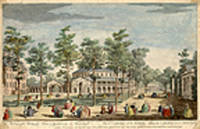
178 résultats
175024354nantes 1750 Une gravure Originale sur cuivre, Format : 16 x 32 cm, sur papier blanc, collée sur carton, 1750
1760281001760. Print. Very good overall. St. Paul's Cathedral dominates the engraving with tree dotted hills in the distance. River and foreground packed with vessels. Hand colored copper engraving trimmed with fabulous hand color. 16 3/8 x 10" mark in upper left corner otherwise very pleasant. unknown
176027965Augsburg: L'Academic Imperiale des Arts 1760. Print. Otherwise very good condition. A view of Westminster over the water with the bridge and many vessels in the foreground. Fine original hand color. 11.5 x 15.75" some rusted pin holes in the margin where the print was hung. L'Academic Imperiale des Arts unknown
176618808London and Paris: a Londres ches Wichnyther A Paris chez J. Chereau rue St. Jacques au dessus de la Fontaine St. Severin aux 2 Colonnes No. 257 1766. Engraving with original colour. Printed on laid paper. In good condition with mild soiling and creasing. A beautiful Vue d'Optique with strong early colour depicting the old Palace of Westminster where the Lords and Commons met.<br/> <br/>An interesting late 18th century view of Westminster prior to the great fire of 1834 which brought into being the present Houses of Parliament. Westminster had been a royal residence until Henry VIII left it after a fire to reside at Whitehall. After that the Houses of Parliament met there. During the eighteenth century "vues d'optique" or "perspective views" became extremely popular in England and Europe. Like other optical prints they capitalized on a connoisseur market eager for the latest novelty. English publishers such as John Bowles and Robert Sayer had great success with these optical views which quickly developed into a collecting craze that swept through print shops on both sides of the Channel. "Vues d'optiques" were specifically designed to create the illusion of perspective when viewed with a zograscope or perspective glass. These viewing devices used a series of reflecting mirrors to enhance the illusion of depth in the print creating a veritable "view" for the onlooker. Typically these prints depicted city or landscape views and were horizontal in format. They had roughly the same dimensions and were sold with heavy opaque colouring so as to show the tints when viewed through the lens. In their heyday optical prints were a technical revolution; they could be seen in almost every fashionable drawing room and were enjoyed by the poorer classes in print shops or at traveling fairs. For a small fee the citizens of Europe and England could travel the world without leaving their village. The "vue d'optique" was the first medium to bring the visible appearance of the wider world to a large European public. Ironically the artists and engravers who created these prints rarely had first hand knowledge of the scenes depicted hence the views were often not as accurate as they were advertised to be. As a result of their constant handling optical prints such as these are rare especially in good condition. They are not only beautiful images but a fascinating glimpse into the history of printmaking.<br/> <br/>Clayton The English Print 1688-1802 140-141. a Londres ches Wichnyther (?) A Paris chez J. Chereau rue St. Jacques au dessus de la Fontaine St. Severin aux 2 Colonnes No. 25 unknown books
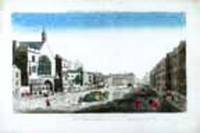
1760103861760. Engraving with original colour. Printed on laid paper. In good condition with the exception of some creases within the image. Sides have been remargined with laid paper and bottom edge is trimmed within the platemark. Surface soiling within image. Image size: 11 x 16 1/4 inches. A wonderful "vue d'optique" of Somerset House on the Strand in London.<br/> <br/>During the eighteenth century "vues d'optique" or "perspective views" became extremely popular in England and Europe. Like other optical prints they capitalized on a connoisseur market eager for the latest novelty. English publishers such as John Bowles and Robert Sayer had great success with these optical views which quickly developed into a collecting craze that swept through print shops on both sides of the Channel. "Vues d'optiques" were specifically designed to create the illusion of perspective when viewed with a zograscope or perspective glass. These viewing devices used a series of reflecting mirrors to enhance the illusion of depth in the print creating a veritable "view" for the onlooker. Typically these prints depicted city or landscape views and were horizontal in format. They had roughly the same dimensions and were sold with heavy opaque colouring so as to show the tints when viewed through the lens. In their heyday optical prints were a technical revolution; they could be seen in almost every fashionable drawing room and were enjoyed by the poorer classes in print shops or at traveling fairs. For a small fee the citizens of Europe and England could travel the world without leaving their village. The "vue d'optique" was the first medium to bring the visible appearance of the wider world to a large European public. Ironically the artists and engravers who created these prints rarely had first hand knowledge of the scenes depicted hence the views were often not as accurate as they were advertised to be. As a result of their constant handling optical prints such as these are rare especially in good condition. They are not only beautiful images but a fascinating glimpse into the history of printmaking.<br/> <br/>Clayton The English Print 1688-1802 140-141. unknown books
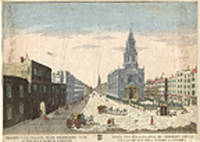
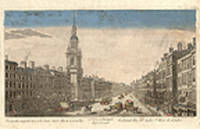
176010384Paris: chez Daumont rue St. Martin 1760. Engraving with original colour. Printed on watermarked laid paper. In excellent condition with the exception of some surface soiling in the upper section of the image. Image size: 8 7/8 x 15 13/16 inches. A wonderful "vue d'optique" of St. Mary's Church in London<br/> <br/>During the eighteenth century "vues d'optique" or "perspective views" became extremely popular in England and Europe. Like other optical prints they capitalized on a connoisseur market eager for the latest novelty. English publishers such as John Bowles and Robert Sayer had great success with these optical views which quickly developed into a collecting craze that swept through print shops on both sides of the Channel. "Vues d'optiques" were specifically designed to create the illusion of perspective when viewed with a zograscope or perspective glass. These viewing devices used a series of reflecting mirrors to enhance the illusion of depth in the print creating a veritable "view" for the onlooker. Typically these prints depicted city or landscape views and were horizontal in format. They had roughly the same dimensions and were sold with heavy opaque colouring so as to show the tints when viewed through the lens. In their heyday optical prints were a technical revolution; they could be seen in almost every fashionable drawing room and were enjoyed by the poorer classes in print shops or at traveling fairs. For a small fee the citizens of Europe and England could travel the world without leaving their village. The "vue d'optique" was the first medium to bring the visible appearance of the wider world to a large European public. Ironically the artists and engravers who created these prints rarely had first hand knowledge of the scenes depicted hence the views were often not as accurate as they were advertised to be. As a result of their constant handling optical prints such as these are rare especially in good condition. They are not only beautiful images but a fascinating glimpse into the history of printmaking.<br/> <br/>Clayton The English Print 1688-1802 140-141. chez Daumont rue St. Martin unknown books
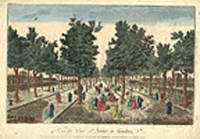
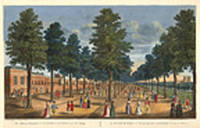
178010559Paris: Chez. Daumont rue St. Martin. Presentement chés Lachaussée rue S. Jacques 1780. Engraving with original colour. Printed on wove paper. This is a later copy of the earlier print of St. James' published by Daumont. In good condition with the exception of some scattered brown marks. Trimmed within the platemark. Image size: 9 1/4 x 14 1/2 inches. Vue d'Optique of St. James' Park in London<br/> <br/>During the eighteenth century "vues d'optique" or "perspective views" became extremely popular in England and Europe. Like other optical prints they capitalized on a connoisseur market eager for the latest novelty. English publishers such as John Bowles and Robert Sayer had great success with these optical views which quickly developed into a collecting craze that swept through print shops on both sides of the Channel. "Vues d'optiques" were specifically designed to create the illusion of perspective when viewed with a zograscope or perspective glass. These viewing devices used a series of reflecting mirrors to enhance the illusion of depth in the print creating a veritable "view" for the onlooker. Typically these prints depicted city or landscape views and were horizontal in format. They had roughly the same dimensions and were sold with heavy opaque colouring so as to show the tints when viewed through the lens. In their heyday optical prints were a technical revolution; they could be seen in almost every fashionable drawing room and were enjoyed by the poorer classes in print shops or at traveling fairs. For a small fee the citizens of Europe and England could travel the world without leaving their village. The "vue d'optique" was the first medium to bring the visible appearance of the wider world to a large European public. Ironically the artists and engravers who created these prints rarely had first hand knowledge of the scenes depicted hence the views were often not as accurate as they were advertised to be. As a result of their constant handling optical prints such as these are rare especially in good condition. They are not only beautiful images but a fascinating glimpse into the history of printmaking.<br/> <br/>Clayton The English Print 1688-1802 140-141. Chez. Daumont rue St. Martin. Presentement chés Lachaussée rue S. Jacques unknown books
177027191Paris Jacques Chéreau 1770 Une Lithographie originale "vue d'optique" en couleurs (réhaussée). GRAVÉE A L'EAU-FORTE ET AQUARELLÉE, Format : 31 centimètres de haut par 49 centimètres de large, sur papier sur vergé crème, titre, En haut au centre : Caractères d'imprimerie à l'envers. : "Vue du port de Rochefort" , Vue d'optique gravée par Jacques Chéreau (1688-1776) rue St Jacques Paris vers 1770,
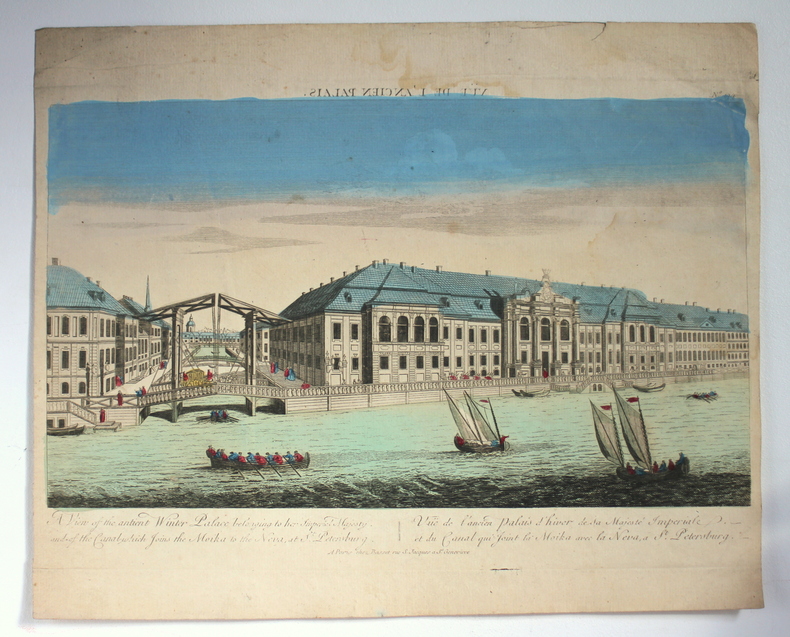
1790047Vue d'optique Estampe « Vue de l'ancien palais d'hiver de sa majesté impériale et du canal qui joint la moika avec la Neva a St Petersburg »,Chez Basset XVIIIème, la Feuille mesure 33 x 40 cm, le dessin mesure 27 x 40 cm et pèse 0.300 kg. Très Bon état général, trace de mouillure claire en haut a droite.
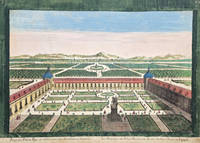
175014000Paris 1750. 315x445mm. 12½x17½". Grabado. Paris 1750. 315 x 445mm. Grabado al cobre. Coloreado a mano de época. Vista óptica del conjunto arquitectónico que mandó construir el Conde Duque de Olivares para retiro de Felipe IV y como un lugar de recreo para la corte. Compuesto por más de 20 pabellones bellos jardines suntuosas fuentes y un gran estanque hoy sólo se conserva el Salón de Baile Casón del Buen Retiro el Salón de Reinos Museo del Ejército y parte de los jardines Parque del Retiro. unknown
175023695(vers 1750) Format 240 x 440 mm, avec marges 320 x 460 mm.
175023694(vers 1750) Format 240 x 440 mm, avec marges 320 x 460 mm.
175023693(vers 1750) Format 240 x 440 mm, avec marges 320 x 460 mm.
177015059Paris: Chez Daumont rue St. Martin 1770. Engraving with beautiful early colour. Printed on watermarked laid paper. In excellent condition with the exception of being trimmed within the platemark on the lower margin. Small tear on upper margin. Small puncture mark on left margin. Image size: 10 1/8 x 16 1/8 inches. This is a beautiful perspective view of the courtyard of the Royal Stock Exchange in London published by a Parisian printseller at the close of the eighteenth century.<br/> <br/>During the eighteenth century "vues d'optique" or "perspective views" became extremely popular in England and Europe. Like other optical prints they capitalized on a connoisseur market eager for the latest novelty. English publishers such as John Bowles and Robert Sayer had great success with these optical views which quickly developed into a collecting craze that swept through print shops on both sides of the Channel. "Vues d'optiques" were specifically designed to create the illusion of perspective when viewed with a zograscope or perspective glass. These viewing devices used a series of reflecting mirrors to enhance the illusion of depth in the print creating a veritable "view" for the onlooker. Typically these prints depicted city or landscape views and were horizontal in format. They had roughly the same dimensions and were sold with heavy opaque colouring so as to show the tints when viewed through the lens. In their heyday optical prints were a technical revolution; they could be seen in almost every fashionable drawing room and were enjoyed by the poorer classes in print shops or at traveling fairs. For a small fee the citizens of Europe and England could travel the world without leaving their village. The "vue d'optique" was the first medium to bring the visible appearance of the wider world to a large European public. Ironically the artists and engravers who created these prints rarely had first hand knowledge of the scenes depicted hence the views were often not as accurate as they were advertised to be. As a result of their constant handling optical prints such as these are rare especially in good condition. They are not only beautiful images but a fascinating glimpse into the history of printmaking.<br/> <br/>Clayton The English Print 1688-1802 140-141. Chez Daumont rue St. Martin unknown books
17605888London c. 1760. Copper engraving 25 x 40 cms bilingual title in English and French with Dutch translation in a contemporary hand beneath original hand-colour copyright date given under Hogarths Act as 1760 trivial soiling blank verso. Print unknown
1790135543[Cesare Bassano: Giuseppe Remondini], ca. 1790. Format (Bildbereich): 28 x 41 cm. Platte: 31,5 x 42,7 cm. Blattgröße: 38 x 53 cm.
179021143Paris Mondhare 1790 une Vue d'optique en couleurs. Dimensions de l'image: 36,5 x 19,6 cm, 51 x 34 cm (dimension totale), GRAVÉE A L'EAU-FORTE ET AQUARELLÉE, Gravure originale. Vue d'optique rehaussée en couleurs à l'aquarelle, représentant une vue perspective des bassins du port de Nantes, avec devant le bout de l'ile Gloriette, à droite les chantiers de construction du quai de la Fosse et à gauche l'ile Mabon, sans date (1790) Paris chez Mondhare, rue saint Jacques Editeur,
172924011(1729). Format (16 x 20 cm), avec vitre et cadre doré moderne (27 x 31 cm).
17221219631722 A Paris, rue de la Harpe, Chez Laurent d'Houry - M.DCC.XXII (1722) - In-duodecimo, reliure plein cuir brun, dos à cinq nerfs, caissons et titre en doré, petit signet vert - 668 pages
180010694London: Printed for Bowles & Carver No. 69 St. Pauls Church Yard 1800. Engraving with beautiful hand-colour. In excellent condition with the exception of tape on the verso of sheet. Image size: 9 3/8 x 15 3/4 inches. Vue d'Optique of the Royal Palace in St. James' Park in London<br/> <br/>During the eighteenth century "vues d'optique" or "perspective views" became extremely popular in England and Europe. Like other optical prints they capitalized on a connoisseur market eager for the latest novelty. English publishers such as John Bowles and Robert Sayer had great success with these optical views which quickly developed into a collecting craze that swept through print shops on both sides of the Channel. "Vues d'optiques" were specifically designed to create the illusion of perspective when viewed with a zograscope or perspective glass. These viewing devices used a series of reflecting mirrors to enhance the illusion of depth in the print creating a veritable "view" for the onlooker. Typically these prints depicted city or landscape views and were horizontal in format. They had roughly the same dimensions and were sold with heavy opaque colouring so as to show the tints when viewed through the lens. In their heyday optical prints were a technical revolution; they could be seen in almost every fashionable drawing room and were enjoyed by the poorer classes in print shops or at traveling fairs. For a small fee the citizens of Europe and England could travel the world without leaving their village. The "vue d'optique" was the first medium to bring the visible appearance of the wider world to a large European public. Ironically the artists and engravers who created these prints rarely had first hand knowledge of the scenes depicted hence the views were often not as accurate as they were advertised to be. As a result of their constant handling optical prints such as these are rare especially in good condition. They are not only beautiful images but a fascinating glimpse into the history of printmaking.<br/> <br/>Clayton The English Print 1688-1802 140-141. Printed for Bowles & Carver, No. 69 St. Pauls Church Yard unknown books
175327967London 1753. Print. Very good condition. A very early view. The gatehouse of St. James's Palace is on the left. Finely hand colored with the sky in eggshell blue and the people's dress delicately filled in. <br /> 9 3/8 x 15 1/4" on paper 12 3/4 x 18 3/4" unknown
175110664London: Printed for & Sold by Rob. Sayer at the Golden Buck opposite Fetter Lane Fleet Street. & Hen. Overton at the White Horse without Newgate 1751. Engraved by N. Parr after Canaleti. Engraving with original colour. Printed on laid paper. In good condition with the exception of being trimmed within the platemark. Corners are stained. Image size: 9 3/16 x 15 3/16 inches. A beautiful Vue d'Optique of the Rotunda House at Ranelagh.<br/> <br/> During the eighteenth century "vues d'optique" or "perspective views" became extremely popular in England and Europe. Like other optical prints they capitalized on a connoisseur market eager for the latest novelty. English publishers such as John Bowles and Robert Sayer had great success with these optical views which quickly developed into a collecting craze that swept through print shops on both sides of the Channel. "Vues d'optiques" were specifically designed to create the illusion of perspective when viewed with a zograscope or perspective glass. These viewing devices used a series of reflecting mirrors to enhance the illusion of depth in the print creating a veritable "view" for the onlooker. Typically these prints depicted city or landscape views and were horizontal in format. They had roughly the same dimensions and were sold with heavy opaque colouring so as to show the tints when viewed through the lens. In their heyday optical prints were a technical revolution; they could be seen in almost every fashionable drawing room and were enjoyed by the poorer classes in print shops or at traveling fairs. For a small fee the citizens of Europe and England could travel the world without leaving their village. The "vue d'optique" was the first medium to bring the visible appearance of the wider world to a large European public. Ironically the artists and engravers who created these prints rarely had first hand knowledge of the scenes depicted hence the views were often not as accurate as they were advertised to be. As a result of their constant handling optical prints such as these are rare especially in good condition. They are not only beautiful images but a fascinating glimpse into the history of printmaking.<br/> <br/> Clayton The English Print 1688-1802 140-141. Printed for & Sold by Rob. Sayer at the Golden Buck, opposite Fetter Lane, Fleet Street. & Hen. Overton at the White Horse witho unknown
175110664London: Printed for & Sold by Rob. Sayer at the Golden Buck opposite Fetter Lane Fleet Street. & Hen. Overton at the White Horse without Newgate 1751. Engraved by N. Parr after Canaleti. Engraving with original colour. Printed on laid paper. In good condition with the exception of being trimmed within the platemark. Corners are stained. Image size: 9 3/16 x 15 3/16 inches. A beautiful Vue d'Optique of the Rotunda House at Ranelagh.<br/> <br/>During the eighteenth century "vues d'optique" or "perspective views" became extremely popular in England and Europe. Like other optical prints they capitalized on a connoisseur market eager for the latest novelty. English publishers such as John Bowles and Robert Sayer had great success with these optical views which quickly developed into a collecting craze that swept through print shops on both sides of the Channel. "Vues d'optiques" were specifically designed to create the illusion of perspective when viewed with a zograscope or perspective glass. These viewing devices used a series of reflecting mirrors to enhance the illusion of depth in the print creating a veritable "view" for the onlooker. Typically these prints depicted city or landscape views and were horizontal in format. They had roughly the same dimensions and were sold with heavy opaque colouring so as to show the tints when viewed through the lens. In their heyday optical prints were a technical revolution; they could be seen in almost every fashionable drawing room and were enjoyed by the poorer classes in print shops or at traveling fairs. For a small fee the citizens of Europe and England could travel the world without leaving their village. The "vue d'optique" was the first medium to bring the visible appearance of the wider world to a large European public. Ironically the artists and engravers who created these prints rarely had first hand knowledge of the scenes depicted hence the views were often not as accurate as they were advertised to be. As a result of their constant handling optical prints such as these are rare especially in good condition. They are not only beautiful images but a fascinating glimpse into the history of printmaking.<br/> <br/>Clayton The English Print 1688-1802 140-141. Printed for & Sold by Rob. Sayer at the Golden Buck, opposite Fetter Lane, Fleet Street. & Hen. Overton at the White Horse witho unknown books
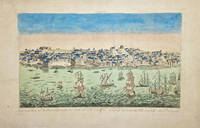
176014001London 1760. 315x445mm. 12½x17½". Grabado. London 1760. 287 x 448mm. Grabado al cobre. Coloreado a mano de época. Vista óptica de la ciudad de Lisboa Portugal desde el río. Publicado según acta del Parlamento en 1760. Se trata de la reedición de un grabado de Henry Overton II publicado originalmente en Londres por Robert Sayer en 1752. El mapa pertenece a una de las ediciones realizadas tras el terremoto de Lisboa de 1755. Suele identificarse como una edición londinense pero por sus características puede que haya sido impreso en París al estilo de Maillet de la misma época probablemente imitando las ediciones inglesas. Este mismo grabado fue copiado en muchas ediciones posteriores solo o en libros siendo una de las vistas más conocidas de Lisboa antes del Terremoto. unknown
173112933Augsburg, Gabriel Bodenehr d.Ä., um 1731. Kupferstich. Blattgröße: 19,5 x 36 cm, Druckspiegel: 16 x 32,5 cm. [2 Warenabbildungen]