44 913 résultats
London, 1837 + London, 1840. Five volumes 8vo. Bound in five contemporary, uniform brown half calf bindings (The Philosophy...-volumes slightly darker brown) with raised bands and gilt spines. Marbled edges. A bit of light edge-wear, but overall very fine and fresh. Some marginal pencil markings to first part of vol. 1 of ""The Philosophy..."", otherwise also internally very nice and clean. All five volumes with the same engraved amorial bookplate to inside of front boards. A very nice, uniform set of the five volumes that make up the two works. XXXVI, 437, (3)" XI, (1), VI pp., pp. (7)-534, (2) XII, 624 pp. + CXX, 523, (1) " IV, 586 pp. + folded plate.
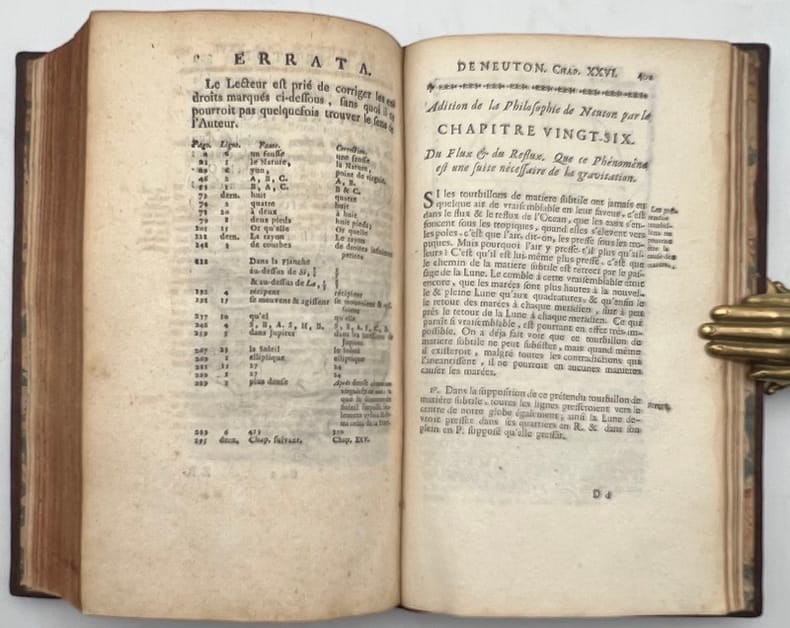
- Chez jacques Rollin & Chez Charles Antoine Jombert, A Paris 1751, In-4 (20,5x26,5cm), (2) xij (2) 503pp. et (4) iv, 636pp., relié. - Edition originale française, rare, dans la traduction de Esprit Pézenas, illustrée de 2 vignettes de titre et 78 planches dépliantes repprésentant des instruments utilisés pour des démonstration de physique. Exemplaire aux armes non identifiées. Reliure en pleine basane porphyre d'époque. Dos à nerfs orné. Pièce de titre de veau beige, pièce de tomaison de basane brune. Un manque en queue du tome I. Léger manque dans le caisson de tête du tome II et dans le caisson de queue. Fente aux mors supérieurs en queue des 2 tomes, sur 1cm. Coins avec des pertes de cuir, de même qu'en bordures. L'emploi de l'acide pour réaliser la marbrure du porphyre a provoqué certaines altérations du cuir, notamment sur le dos, où l'or apparaît en relief et certaines épidermures des plats. Cependant bon exemplaire. Principal exposé de la physique de Newton dont Desaguliers propage les idées dans son ouvrage, idées tant scientifiques que philosophiques et politiques. Il est le premier à percevoir l'ampleur de la révolution newtonienne tant pour la physique que pour la représentation du monde. Il assista Isaac Newton qui devint son ami dans ses travaux expérimentaux de 1713 à 1727 en étant démonstrateur de la Royal Society, année de la mort de Newton. Habile expérimentateur, Il ouvrit ensuite son propre cours privé que la famille royale fréquentait. Les préfaces des deux volumes exposent les enjeux de la physique du 18ème siècle : le développement de la physique expérimentale à coté de la mécanique analytique dans le premier, les débats préliminaires à la naissance du concept d'énergie dans le second. Desaguliers explique qu'il fait des expériences, non pour montrer des curiosités mais pour démontrer des lois, à la manière des mathématiciens, mais sans utiliser le formalisme mathématique qui rebute de nombreuses personnes. Sa méthode, copiée sur celle de Keill, consiste à bâtir ses leçons en raisonnant par étapes : partir de propositions simples, les prouver par des expériences et non par des démonstrations, puis élaborer des propositions plus complexes qui seront ensuite confirmées par des expérimentations. Il convient de ne pas présenter les expériences comme « autant de phénomènes curieux » mais d'en « faire usage pour prouver une suite de propositions philosophiques dans un ordre mathématique » autrement dit, de ne pas faire un « Cours d'Expériences » mais un « Cours de Physique Expérimentale ». Les leçons de Desaguliers portent sur la mécanique et l'hydrostatique. Les leçons concernant l'hydrostatique sont illustrées par des descriptions très précises de dispositifs variés et d'usages divers : les cloches de plongeurs, la machine de Marly ou les machines de Mr Richard Newsham pour éteindre les incendies (qu'on retrouve dans les planches). Auditeur des cours de Desaguliers, l'abbé Nollet s'en inspirera pour rédiger ses leçons de physique expérimentale, mais qui eux, porteront davantage sur l'électricité et l'optique. [ENGLISH DESCRIPTION ON DEMAND]
18491309372Stuttgart, Expedition der Wochenbände, 1846 - 1849. Zus. etwa 11500 S. m. sehr zahlr. Abb., einige Taf. Ppbde (Kanten etwas beschabt, jew. Etikett a. Fuß u. Stempel verso Titel, durchgehend braunfleckig; 9 Bände durchgehend nässespurig u. wellig; einige Bl. m. Knitterspuren; 1 Bd stärker beschabt).
5988P., Courcier, 1807, un volume grand in 4 (20,5 cm x 26,5 cm), relié plein veau glacé, dos orné de fers et filets dorés, filets dorés sur les plats, toutes tranches dorées, armes de l'Académie de Paris sur les plats (reliure de l'époque), 20pp., (1), 502pp.
165189641Pierre DAVID | Paris 1651 | 10.6 x 16.8 cm | 4 volumes reliés en 1
3980P., Desprez, 1663, un volume in 12 relié en pleine basane, dos orné de fers dorés, tranches mouchetées (reliure de l'époque), (14), 232pp., (4), 2 PLANCHES DEPLIANTES
17385783A Amsterdam, chez Etienne Ledet & Compagnie, 1738. In-8 de 1 frontispice gravé, 2 portraits, (6)-XII-(2)-399-(1)-(400 à) 410-(6) pp., veau brun, dos orné à nerfs, pièce de titre en maroquin rouge (reliure de l'époque).
1667156P., Savreux, 1667, un volume in 4 relié en plein veau, dos orné de fers dorés, tranches mouchetées, armes sur les plats (reliure de l'époque), (petit accroc à la coiffe sans gravité, mouillures marginales sans gravité aux trois derniers feuillets), (12), 345pp., 4 PLANCHES REPRESENTANT DES CARRES MAGIQUES, (1-errata), figures dans le texte
20202081502111900463Chinese book office 2020. Soft Cover. Fine. Size: Hardcover Chinese book office paperback
Pont-à-Mousson, I & Gaspard Bernard, 1630; in-4, VI-264 pp., reliure plein vélin d'époque, dos lisse. Brunet I, 358 ; Graesse 208 ; Beaupré 413-414. Ouvrage bien complet de la très belle page de titre gravée et de ses 133 gravures placées dans et en hors-texte. (14 planches pleines pages). Seconde édition, refondue et augmentée, du Recueil de plusieurs machines militaires et feux artificiels du lorrain Jean Appier Hanzelet, imprimeur et graveur, paru en 1620. De nombreuses machines de guerre sont ici représentées pour la première fois ; le livre traite aussi longuement des feux d'artifice. Son surnom Hanzelet, diminutif d’Hans et synonyme de « Petit Jean », lui fut donné pour le distinguer de son père ; ce dernier, Jean Appier, ingénieur des Ducs Charles III et Henri II, contribua à l’établissement des fortifications de Nancy. Hanzelet était établi comme imprimeur à Pont-à-Mousson vers 1620 ; il était en même temps un graveur remarquable. Il perdit sa charge d’imprimeur en 1628 après avoir édité un ouvrage d’un professeur de l’université sans le visa du recteur. Il fut ensuite nommé « Maistres des feux artificiels » (ingénieur des poudres et directeur de l’artillerie) par le Duc Charles IV de Lorraine. Celui qui, pour Dom Calmet, était un « esprit fort inventif et habile ouvrier en différents genres » serait mort en Italie en 1647.
167454695Hafniae (Copenhagen), Petrus Haubold, 1674. 4to. Contemporary full mottled calf with five raised bands to richly gilt spine. Upper and lower part of spine worn and restored. Some overall wear and a bit of worming. Internally evenly browned. Contemporary notes in neat hand to front free end-paper and additional information about contents in same hand to title-page. Title-page printed in red/black. (8), 200 pp. + engraved plate depicting snow crystals.
176226629Berlin Stettin und Leipzig Johann Heinrich Rüdigern 1762-75. 4to. Bound in 13 fine uniform full calf raised bands gilt backs. Remains of paperlabels on backs. Top of spine on one volume frayed. Small rubber stamp on titles. A few brownspots. A good copy. Having in all 374 of 585 fine engraved plates 1 plate supplied in xerox-copy. Plates measure around 37x24cm. <br/><br/><em>First German edition of one of the main works of the 18th century in the fields of crafts and technology as it is a translation of the famous series "Description des Arts et Metiers" issued by Academie Royale des Sciences 1760-75. The French edition was published in folio. Band 1: Kohlenbrennen Lichtziehen Ankerschmieden Nadler Papiermacher. 31 plates and 1 table;Band 2: Eisenhämmer. Teil 1-2 Wachsziehen Pergamentmachen Leder-Vergoldung Schieferbrüche. 22 plates; Band 3: Eisenhämmer. Teil 3-4 Spielkartenherstellung Seidenfärberei Pappenmacher. 29 plates 1 plate supplied in xerox-copy; Band 4: Böttcherkunst Weißgerber Ziegelstreichen Zuckersieden Silber affinieren. 30 plates; Band 5: Messingherstellung Tuchmacherkunst Lohgerberei. 33 plates. Band 6: Tuchfrisierkunst Saffianleder-Herstellung Leder auf ungarische Art Weißgerber Hutmacher Dachdecker. 19 plates; Band Band 7: Tapetenweberei Kalkbrennerkunst Ziegelstreichen in Holland Ziegelhütten Ball- und Raquettenmacher. 30 plates and 1 table; Band 8: Perückenmacherkunst Müller Nudelmacher und Bäcker. 15 plates; Band 9: Schuster Schlösserkunst. 48 plates; Band 10: Steinkohlenbergbau Indigobereiter. 22 plates; Band 11: Eisenbergwerke und Hüttenwerke in der Steiermark Leimsiederei Fischerei Teil 1. 25 plates and 1 table; Band 12: Fischerei Teil 2. 50 plates; Band 13: Fischerei Teil 3 Porzellanherstellung. 23 plates and 1 engr. frontisp.; Band 14: Glasmalerei und Glasarbeiten. Mit 13 von 14 Tafeln; Band 15: Wollenzeugfabrikant. 17 plates; Band 16: Seifensider Leinwandhandel Schneiderhandwerk Leinenmanufaktur Tabaksmanufaktur. 27 plates; Band 17: Bleiarbeiter mathematische und astronomische Instrumente Baumwoll-Samtfabrikation. 38 plates; Band 18: Stickerkunst Siebmacher Riemer und Sattler mit Kutschenbau Drahtzieherei Stahlblattmacher. 51 plates Band 19: Schiffbaukunst. 18 plates and 1 engr. frontisp.;Band 20: Zinngießerkunst. 32 plates; Band 21: der Strumpfwirkerstuhl und sein Gebrauch. 14 plates. </em> hardcover
Hafniae (Copenhagen), Petrus Haubold, 1674. 4to. Contemporary full mottled calf with five raised bands to richly gilt spine. Upper and lower part of spine worn and restored. Some overall wear and a bit of worming. Internally evenly browned. Contemporary notes in neat hand to front free end-paper and additional information about contents in same hand to title-page. Title-page printed in red/black. (8), 200 pp. + engraved plate depicting snow crystals.
- Chez Thomas Herissant, A Paris 1759, In-12 (10x17,2cm), (4) xvj, 419pp. et xvj, 402pp. (1) et xxvj (1) 498pp. (4), 3 volumes reliés. - Rare first edition, illustrated with 4 pictures in the first volume and 6, including 5 folded pictures, in the third. Translated from German with the translators notes. Half title common to the 3 volumes: Treatises on physics, natural history, mineralogy and metallurgy. Bound in contemporary, full, granite-patterned brown sheep. Spine in decorated compartments. Title pieces in red morocco, gilt volume labels at the bottom. Signs of rubbing, especially on the joints. Slight accident to the lower joint at the bottom of volume 3, narrow split to the upper joint at the top of volume 1 of 0.5cm. Very pale and scattered foxing. Beautiful copy. Considered the father of modern geology and the founder of stratigraphy (the study of the earth's strata), Lehmann (1719-1767) was a mineralogist and geologist renowned for his work. From 1750, his essay on the formation of metals allowed him to be commissioned by the Prussian Academy of Sciences for a study of the mines throughout Prussia. Lehmann drew his work from L'art des mines, whose many terms entered geological literature. In 1767, he was invited by the Imperial Russian Academy of Sciences where he became Professor of Chemistry and Director of the Imperial Science Museum. He remains famous for his precise description of the earth's various layers of stratified rock. [FRENCH VERSION FOLLOWS] Edition originale, rare, et illustrée de 4 figures dans le premier volume et 6 dont 5 dépliantes dans le troisième tome. Traduit de l'Allemand avec des notes du traducteur. Faux-titre commun aux 3 volumes : Traités de physique, d'histoire naturelle, de minéralogie et de métallurgie. Reliure en pleine basane brune granitée d'époque. Dos à nerfs orné. Pièces de titre en maroquin rouge, tomaisons dorées en queue. Traces de frottement, notamment aux mors. Légers accidents au mors inférieur du tome 3 en queue, étroite fente au mors supérieur en tête du tome 1 sur 0,5cm. Rousseurs très pâles éparses. Bel exemplaire. Considéré comme le père de la géologie moderne et le fondateur de la stratigraphie (étude des strates de la terre), Lehmann (1719-1767) fut un minéralogiste et un géologue réputé pour ses travaux. Dès 1750, son essai sur la formation des métaux lui permit d'être missionné par l'Académie des sciences de Prusse pour une étude des mines sur l'ensemble de la Prusse. Lehmann en tira son ouvrage de L'art des mines, dont de nombreux termes sont entrés dans la littérature de la géologie. En 1767, il fut invité par l'Académie impériale des sciences de Russie où ildevint professeur de chimie et Directeur du musée impérial des sciences. Il est démeuré célèbre pour sa description précise des différentes couches de roches stratifiées de la terre.
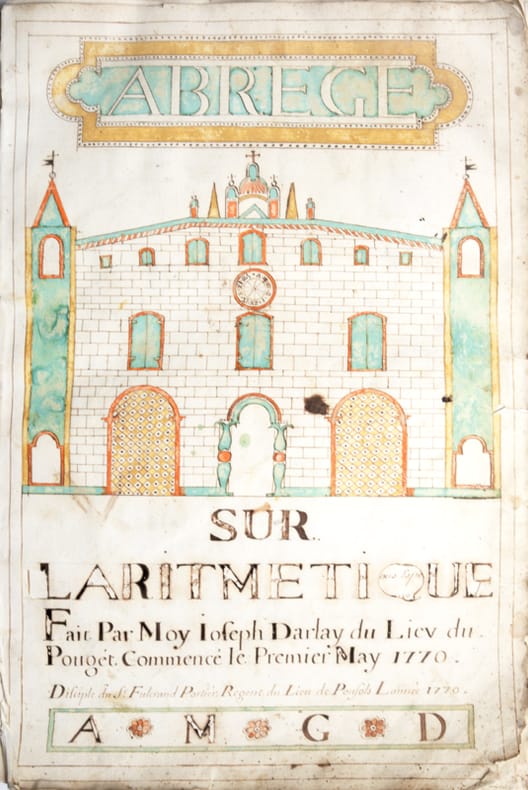
177042912Le Pouget, , 1770. In-folio manuscrit (29 x 42 cm) de (38) ff., vélin (reliure de l’époque).
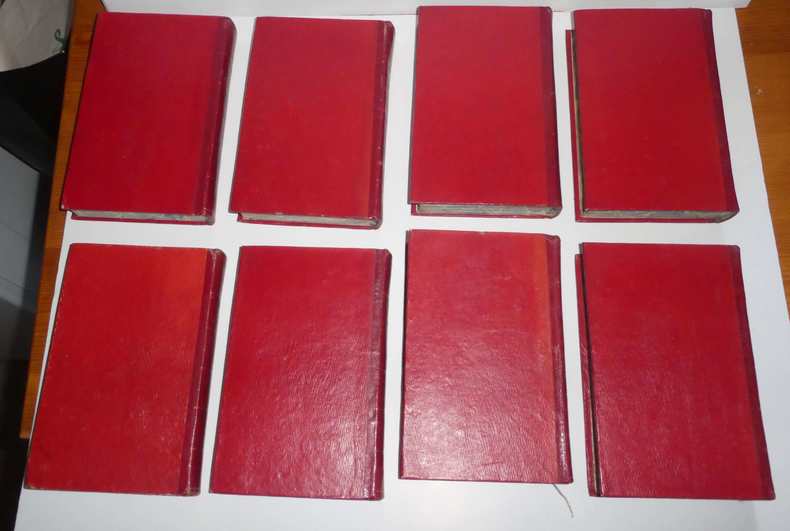
234809 parties en 8 volumes reliés demi-maroquin rouge à grain long, dos lisse, titre doré, filets dorés, tranches marbrées. Volume 1 : XVI, 209 p. - De la planche 1 à 58 en tout 60 planches se décomposant comme suit : 58 planches + planche 33bis et planche 54bis. Volume 2 : 2 f, 236 p. – De la planche 59 à la planche 116 - 59 planches se décomposant comme suit : 57 planches + planche 83bis et planche 112 bis. Volume 3 : 265 p. – De la planche 117 à la planche 172 – 59 planches se décomposant comme suit : 55 planches + 120bis, 123bis, 129bis, 148 bis, erreur de numérotation de la planche 163. Volume 4 : 266 p. – De la planche 173 à 231 – 59 planches se décomposant comme suit : 58 planches + planche 231bis. Volume 5 : 2f, 280 p. – De la planche 232 à 291 – 59 planches (inversion de numérotation sur les 3 premières planches). Volume 6 : 271 p. – De la planche 292 à 349 - 59 planches soit 57 planches + planche 307 bis et planche 333 bis. Le volume 7 porte le titre : Flore médicale, partie élémentaire par J.L. M. Poiret, iconographie végétale par P.J.F. Turpin. Paris. CLF Panckoucke. 1819. 6f., VIII, 278 p., 3 f., 40 planches.Le volume 8 comprend deux ouvrage réunis en un, il porte pour la première partie le titre : Flore médicale, partie élémentaire par J.L. M. Poiret, iconographie végétale par P.J.F. Turpin. Tome septième deuxième partie. Paris. CLF Panckoucke. 1819. 74 p. + 3 p. + 4 p. (Description de l’Égypte extraite du moniteur) 24 planches. La seconde partie à sa page de titre propre et porte en fait trois titres, celui général de La Flore Médicale, le titre : Partie élémentaire par J.L. M. Poiret, iconographie végétale par P.J.F. Turpin. Et le titre particulier : Essai d’une iconographie élémentaire et philosophique des végétaux avec un texte explicatif par JLF Turpin. Paris. CLF Panckoucke. 1820. 199 p. + deux tableaux dépliants, déchirure sur un tableau. Rousseurs éparses. Il s’agit ici de l’édition originale de ce célèbre ouvrage qui se présente en 8 volumes reliés comprenant au final 9 parties. Ici bien complet de ses 424 planches attendues collationnées en regard du texte correspondant. L’ensemble en reliure uniforme du premier tiers du XIXe siècle. Dans les deux derniers volumes les serpentes sont aléatoires. Rousseurs éparses n’affectant que très rarement (moins d’une quinzaine) les planches. Rousseurs un plus développées dans les deux derniers volumes. Une tache noire sur un dos. Rare et très bel ensemble nonobstant les rousseurs éparses. « Les planches ont été réalisées selon une technique particulière, mise au point en Angleterre dans le dernier quart du XVIIIe siècle et particulièrement utilisée au début du XIXe siècle pour l’illustration des ouvrages de botanique, la gravure au pointillé (stipple engraving). La gravure au pointillé était spécialement adaptée à l’impression en couleur, après encrage à la poupée. Ce minuscule tampon permettait d’appliquer chaque couleur sur les zones correspondantes de la plaque, imprimée en un unique passage sous presse. Chacune des planches a ensuite été minutieusement colorée à la main pour restituer tous les détails nécessaires à l’identification botanique ». (Sandrine Painsard – Le blog des bibliothèques de lettres, sciences humaines et sociales de Poitiers).
175166681chez Jacques Rollin chez Charles Antoine Jombert | à Paris 1751 | 20.50 x 26.50 cm | relié
2056Toulouse, Douladoure, 1853, un volume in 8 relié en demi-basane bordeaux, dos orné de filets dorés (reliure de l'époque), (dos légèrement passé), 164pp., 2 planches dépliantes
1965mon0000121503PROGRESS PUB. 1965-01-01. Hardcover. Good. 2.5000 in x 8.5000 in x 5.9000 in. No DJ. Mild shelf wear and fading to both volumes. Former owner's name on inside cover otherwise pages clean. Cup mark on volume one's cover. PROGRESS PUB. hardcover
1734D4425Paris: Par La Compagnie des Libraires 1734. Hardcover. Very Good. Three volumes comprising Vol. III parts I to III of Memoires de lAcadémie Royale des Sciences depuis 1666 jusquà 1699. Paris: Par La Compagnie des Libraires 1733-1734. Part I: 231pp.; Part II: 294pp.; Part III: 215pp. 97 engraved folding plates depicting animals and skeletal diagrams. Engraved portrait frontispiece of Claude Perrault in first volume. Contemporary French calf spines gilt edges red; some occasional browning; repairs to joints some rubbing. Unidentified armorial bookplate to front pastedown beneath monogrammed bookplate D.P. with chipmunk and two mice. A later reduced format edition of Perraults Memoires of 1671-1676 Perraults study of this nature was first published in 1669 with the results of investigations of five animals and later expanded with studies of over forty animals. Prior to 1670 most descriptions of animals paid little attention to their internal structure and there were very few images in natural history encyclopedias that depicted skeletons or muscles. That changed with the establishment of the Académie des Sciences in Paris in 1666 by Jean-Baptiste Colbert with the approval of King Louis XIV. The Academy functioned with neither statutes nor regulations until 1699. At that time the Academy used the term mathématique to encompass the fields that are now called astronomy mathematics and physics and the term physique to encompass the fields that are now called anatomy botany zoology and chemistry. In January 1699 Louis reorganized the Academy giving it first regulations. The effect was to give the King more control over their activities in exchange for becoming an official institution under his protection with the new name Académie Royale des Sciences. One of the original academicians the physician Claude Perrault organized regular sessions at which participants could dissect deceased animals from Louis XIVs royal menagerie and record all they observed. Lions chameleons bears gazelles wolves ostriches crocodiles monkeys eagles tigers porcupines and salamanders among some were all laid open by the academics scalpels. These superb folding plates record in great detail the pioneering work at the Academy. These three volumes in three parts focus on the transformative and foundational years of the French Royal Academy of Sciences and Claude Perraults efforts which had made comparative anatomy a vital tool for the classifying naturalist. <br/><br/> Par La Compagnie des Libraires hardcover books
1734D4425Paris: Par La Compagnie des Libraires 1734. Hardcover. Very Good. Three volumes comprising Vol. III parts I to III of Memoires de lAcadémie Royale des Sciences depuis 1666 jusquà 1699. Paris: Par La Compagnie des Libraires 1733-1734. Part I: 231pp.; Part II: 294pp.; Part III: 215pp. 97 engraved folding plates depicting animals and skeletal diagrams. Engraved portrait frontispiece of Claude Perrault in first volume. Contemporary French calf spines gilt edges red; some occasional browning; repairs to joints some rubbing. Unidentified armorial bookplate to front pastedown beneath monogrammed bookplate D.P. with chipmunk and two mice. A later reduced format edition of Perraults Memoires of 1671-1676 Perraults study of this nature was first published in 1669 with the results of investigations of five animals and later expanded with studies of over forty animals. Prior to 1670 most descriptions of animals paid little attention to their internal structure and there were very few images in natural history encyclopedias that depicted skeletons or muscles. That changed with the establishment of the Académie des Sciences in Paris in 1666 by Jean-Baptiste Colbert with the approval of King Louis XIV. The Academy functioned with neither statutes nor regulations until 1699. At that time the Academy used the term mathématique to encompass the fields that are now called astronomy mathematics and physics and the term physique to encompass the fields that are now called anatomy botany zoology and chemistry. In January 1699 Louis reorganized the Academy giving it first regulations. The effect was to give the King more control over their activities in exchange for becoming an official institution under his protection with the new name Académie Royale des Sciences. One of the original academicians the physician Claude Perrault organized regular sessions at which participants could dissect deceased animals from Louis XIVs royal menagerie and record all they observed. Lions chameleons bears gazelles wolves ostriches crocodiles monkeys eagles tigers porcupines and salamanders among some were all laid open by the academics scalpels. These superb folding plates record in great detail the pioneering work at the Academy. These three volumes in three parts focus on the transformative and foundational years of the French Royal Academy of Sciences and Claude Perraults efforts which had made comparative anatomy a vital tool for the classifying naturalist. <br/><br/> Par La Compagnie des Libraires hardcover
174014160Paris: de L’Imprimerie Royale 1740. Complete with errata’s and original blank leaves two of three finely engraved frontispieces chapter vignettes ornamental head and tail pieces and 82 folding plates. Full mottled calf rebacked the corners a bit worn. Interior is lightly toned with some browning on the preliminaries and last leaves. Generally this is an excellent set. First editions of these three volumes from a series published by the Academy of Sciences. It is a summary of the activities and inventions that have been made and contains the most important discoveries of the time. These periodicals which were at the forefront of scientific development during the Enlightenment contain works produced by an elite class of French scientist for the years 1722 1731 and 1740. Each volume provided an overview of advancements in math and science for each year and the writings therein shaped the world’s understanding of physics mathematics astronomy anatomy and other fields of science. They further provide invaluable historical data such as meteorological and astrological records for each year. <br /> <br /> The memoirs for 1722 include data recorded on both a lunar and solar eclipse as well as other astronomical observations by Jacques Cassini 1677-1756 best know for completing his fathers work on determining the meridian of Paris. The distinguished astronomer provided further research on lunar eclipses in the memoirs of 1731 where he is in great company alongside distinguished mathematicians Alexis-Claude Clairaut 1713-1765 Pierre Bouguer 1698-1758 known for his work in physics photometry and hydrography and the foremost proponent of the Newtonian movement in France Pierre de Maupertuis 1698-1759. Of special note in the 1731 memoirs is Maupertuis’s ballistic arithmetic which was used to try to better understand the movement of the earth and its gravity. Too an article by Clairaut on new formulas for finding the center of gravity. These articles contributed greatly to a better understanding of the earth’s shape and the mechanics of its rotation particularly Bouguer’s essay on the tendency of objects set in motion to move in a curvilinear fashion. The 1740 edition contains Cassini De Thury’s De la Maridienne de Paris. which was an important step in the process of mapping the shape of the earth. Cassini 1714-1784 representing the third generation of the distinguished family of astronomers was the first to question <br /> <br /> <br /> Picard’s measurements which had been used to map the Maridian of Paris. Clairaut’s essay on integral calculus in the same volume which established the existence of an integrating factor for linear differential equations was an important step in the history of mathematics and Mairan’s treatise on reflection and refraction of light and the human eye was essential to the advancement of optics. Mairan 1678-1771 would set the foundation for optical theory with this treatise. de L’Imprimerie Royale unknown
8681P., Imprimerie royale, 1694 (LA HIRE), 1692 (observatons physiques et mathématiques envoyées des INDES et de la CHINE), 1694 (Observations faites à la CHINE), un volume in 4 (20cm x 26cm) relié en plein veau marbré, dos orné de fers dorés (fleurs de lys), ARMES DE LOUIS XIV sur les plats, tranches rouges (reliure de l'époque), 8pp., 202pp. (mal chiffrés 302), figures dans le texte (LA HIRE) ; (3), 113pp. (observations physiques et mathématiques envoyées des INDES et de la CHINE ; 20pp. (observations faites à la CHINE)
179962602Kiøbenhavn, Thiele, 1781 - 1799. 4to. Uniformly bound, uncut, in recent blue boards. Stamp to title-page in vol. 1 (Det Kongelige Danske Videnskabernes Selskab). Washed. A very nice and clean copy. XII, 640, (20) pp. 19 plates VIII, (4), 603, (13) pp. + 17 plates XII, 576, (1) pp. + 18 plates XII, 621 pp. + 7 plates XII, 670 pp. + 10 plates.
1803172548Modena u. Verona, 1782-1803. 4°. M. 122 gef. Kpfr.-Taf., 8 gef. Tab. u. zahlr. Textkpfrn. Hldrbde. d. Zt. m. Rsch. u. Rsign. Einbde. leicht berieben u. bestoßen. Rücken teils m. leichten Läsuren, einige m. Rsign. Jeweils 5 Bde. uniform geb. St. a. bzw. verso Tit. Etwas gebräunt, insgesamt wohlerhalten.