ACADEMIE ROYALE DES SCIENCES [AUZOUT, FRENICLE, HUYGENS, MARIOTTE, PICARD, ROBERVAL, ROMER]Biblio.com

44 913 résultats
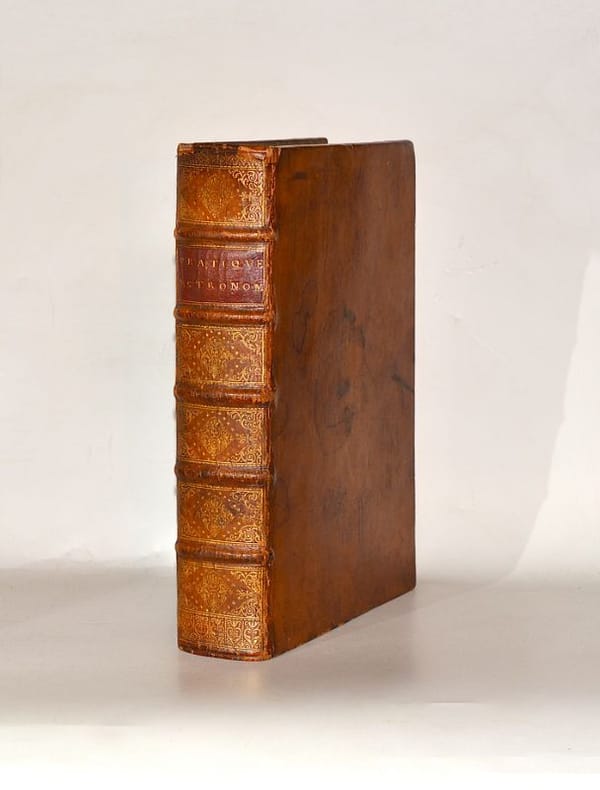
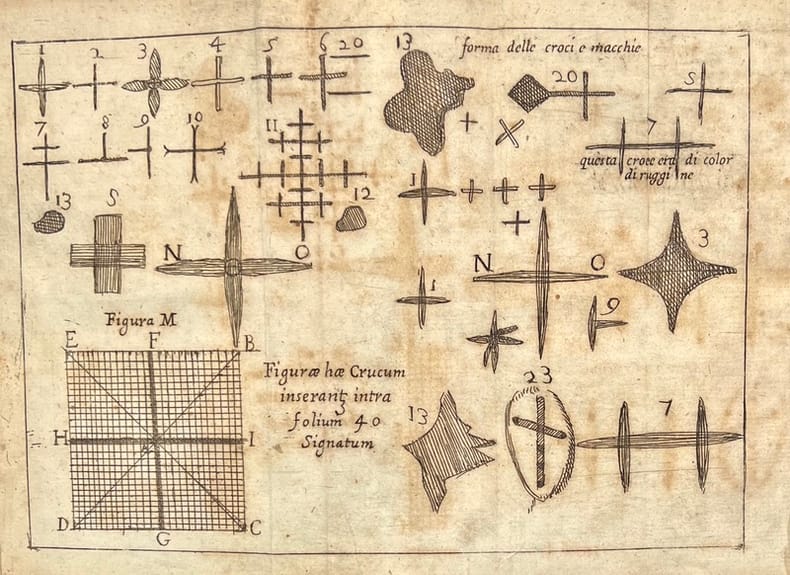
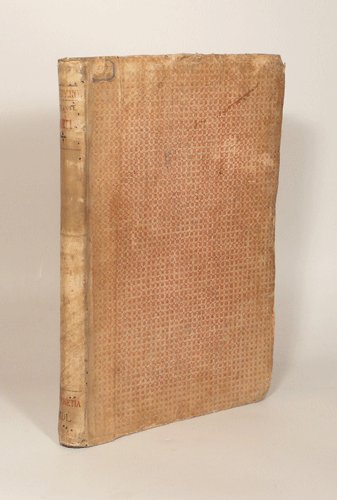
16934565Paris: L'Imprimerie Royale 1693. First edition. <p>First edition a fine copy in its Royal presentation binding of this remarkable union of major texts on mathematics and physics by the leading scientists of seventeenth-century France. Especially important are nine treatises by Roberval comprising the principal corpus of his published works. They include his independent discovery of the geometry of indivisibles his foundation work on kinematic geometry and his treatise on the composition of movements. </p>. Hardcover. A ROYAL PRESENTATION BINDING. <p>First edition of this superb collection of thirty-one treatises by the leading scientists of seventeenth-century France almost all of which are published here for the first time. This is one of the earliest important publications of the Académie des Sciences and one of the most magnificent and the present copy was probably intended for presentation: it is bound in contemporary calf with the arms of Louis XIV on each cover. Founded on 22 December 1666 one of the principal functions of the Académie was to facilitate publication of the works of its members. Frenicle and Roberval were founding members as was Huygens and without the assistance of the Académie it is likely that many of their works would have remained unpublished only two works by Frenicle and two by Roberval were published in their lifetimes. After the death of Frenicle and Roberval in 1675 their books and manuscripts were entrusted to the astronomer Jean Picard; eight treatises by Huygens were also sent to Picard for publication in this collection. After Picard's death in 1682 publication of the works was brought to fruition by Philippe de la Hire. La Hire also included in the Divers ouvrages five treatises by Picard himself including an unusual 37-page work on dioptrics one by Mariotte and two each by Auzout and Rømer. The most important work in the volume is probably Roberval's Traité des indivisibles composed around the same time as Cavalieri's Geometria indivisibilibus 1635 but independent of it and published here for the first time. The treatises by Frenicle a close correspondent of Fermat treat topics in number theory and related fields. See below for a full list of contents.</p> <br /> <p>Gilles Personne de Roberval 1602-75 arrived in Paris in 1628 and put himself in contact with the Mersenne circle. "Mersenne especially always held Roberval in the highest esteem. In 1632 Roberval became professor of philosophy at the Collège de Maître Gervais. On 24 June 1634 he was proclaimed the winner in the triennial competition for the Ramus chair a position that he kept for the rest of his life at the Collège Royal in Paris where at the end of 1655 he also succeeded to Gassendi's chair of mathematics. In 1666 Roberval was one of the charter members of the Académie des Sciences in Paris . He himself published only two works: Traité de méchanique 1636 and Aristarchi Samii de mundi systemate 1644. A rather full collection of his treatises and letters was published in the Divers ouvrages de mathématique et de physique par messieurs de I'Académie royale des sciences 1693 but since few of his other writings were published in the following period Roberval was for long eclipsed by Fermat Pascal and above all by Descartes his irreconcilable adversary.</p> <br /> <p>"Roberval was one of the leading proponents of the geometry of infinitesimals which he claimed to have taken directly from Archimedes without having known the work of Cavalieri. Moreover in supposing that the constituent elements of a figure possess the same dimensions as the figure itself Roberval came closer to the integral calculus than did Cavalieri although Roberval's reasoning in this matter was not free from imprecision. The numerous results that he obtained in this area are collected in the Divers ouvrages under the title of Traité des indivisibles. One of the first important findings was in modern terms the definite integration of the rational power which he most probably completed around 1636 although by what manner we are not certain. The other important result was the integration of the sine . the most famous of his works in this domain concerns the cycloid. Roberval introduced the "compagne" "partner" of the original cycloidal curve and appears to have succeeded before the end of 1636 in the quadrature of the latter and in the cubature of the solid that it generates in turning around its base .</p> <br /> <p>"On account of his method of the "composition of Movements" Roberval may be called the founder of kinematic geometry. This procedure had three applications-the fundamental and most famous being the construction of tangents. "By means of the specific properties of the curved line" he stated "examine the various movements made by the point which describes it at the location where you wish to draw the tangent: from all these movements compose a single one; draw the line of direction of the composed movement and you will have the tangent of the curved line." Roberval conceived this remarkably intuitive method during his earliest research on the cycloid before 1636. At first he kept the invention secret but he finally taught it between 1639 and 1644; his disciple François du Verdus recorded his lessons in Observations sur la composition des mouvemens et sur le moyen de trouver les touchantes des lignes courbes . In the second place he also applied this procedure to comparison of the lengths of curves a subject almost untouched since antiquity . The third application consisted in determining extrema .</p> <br /> <p>"Roberval composed a treatise on algebra De recognitione aequationum and another on analytic geometry De geometrica planarum et cubicarum aequationum resolutione. Before 1632 he had studied the "logistica speciosa" of Viète; but the first treatise which probably preceded Descartes's Géométrie contains only the rudiments of the theory of equations. On the other hand in 1636 he had already resorted to algebra in search of a tangent. By revealing the details of such works he would have assured himself a more prominent place in the history of analytic geometry and even in that of differential calculus .</p> <br /> <p>"In 1647 Roberval wrote to Torricelli: "We have constructed a mechanics which is new from its foundations to its roof having rejected save for a small number the ancient stones with which it had been built" p. 301 . around 1669 Roberval wrote Projet d'un livre de mechanique traitant des mouvemens composez . Roberval dreamed certainly with too great temerity of a vast physical theory based uniquely on the composition of motions" DSB.</p> <br /> <p>Bernard Frenicle de Bessy 1605-75 was an accomplished amateur mathematician who corresponded with Descartes Huygens Mersenne and perhaps most importantly Fermat. "Frenicle de Bessy is best known for his contributions to number theory. In fact Fermat in a letter to Roberval writes: 'For some time M Frenicle has given me the desire to discover the mysteries of numbers an area in which he is highly versed' . He solved many of the problems posed by Fermat but he did more than find numerical solutions for he also put forward new ideas and posed further questions" Mactutor. </p> <br /> <p>In "Méthode pour trouver la solution des problèmes par les exclusions Frenicle says that in his opinion arithmetic has as its object the finding of solutions in integers of indeterminate problems. He applied his method of exclusion to problems concerning rational right triangles e.g. he discussed right triangles the difference or sum of whose legs is given . The most important of these works by Frenicle is the treatise Des quarrez ou tables magiques. These squares which are of Chinese origin and to which the Arabs were so partial reached the Occident not later than the fifteenth century. Frenicle pointed out that the number of magic squares increased enormously with the order by writing down 880 magic squares of the fourth order and gave a process for writing down magic squares of even order" DSB. </p> <br /> <p>In 1666 Jean Picard 1620-82 "was named a founding member of the Académie Royale des Sciences and even before its opening participated in several astronomical observations. In collaboration with Adrien Auzout he perfected the movable-wire micrometer and utilized it to measure the diameters of the sun the moon and the planets. During the summer of 1667 he applied the astronomical telescope to the instruments used in making angular measurements-quadrants and sectors-and was aware that this innovation greatly expanded the possibilities of astronomical observation. The making of meridian observations by the method of corresponding heights which he suggested in 1669 was not put into practice until after his death. Yet when the Academy decided to remeasure an arc of meridian in order to obtain a more accurate figure for the earth's radius Picard was placed in charge of the operation . it was primarily through the use of instruments fitted with telescopes quadrants and sectors for angular measurements that Picard attained a precision thirty to forty times greater than that achieved previously . This increased precision made possible a great advance in the determination of geographical coordinates and in cartography and enabled Newton in 1684 to arrive at a striking confirmation of the accuracy of his principle of gravitation .</p> <br /> <p>"In 1673 Picard moved into the Paris observatory and collaborated with Cassini Romer and later Philippe de La Hire on the institution's regular program of observations. He also joined many missions away from the observatory. The first of these enabled him to provide more precise data on the coordinates of various French cities 1672-1674; others conducted from 1679 to 1681 with La Hire had the purpose of establishing the bases of the principal triangulation of a new map of France. The results of these geodesic observations were published in 1693 by La Hire pp. 368-370 of the present work" DSB. "In 1692 William Molyneux who was familiar with Isaac Barrow's Lectiones XVIII published his Dioptrica nova which was a practical treatise on lenses and telescopes. He independently arrived at Huygens's rule for images in thin lenses though in a slightly different form and stated less generally. In the following year Jean Picard's posthumous writings on dioptrics pp. 375-412 also contained a similar rule for thin lenses as well as a series of equations for thick lenses. Picard had read and admired the Lectiones XVIII shortly after it had appeared" Feingold Before Newton: The Life and Times of Isaac Barrow 1990 p. 151.</p> <br /> <p>Adrien Auzout 1622-91 made a significant contribution to the final development of the micrometer and to the replacement of open sights by telescopic sights . By the summer of 1666 Auzout and Picard were making systematic observations with fully developed micrometers. In a letter sent on 28 December 1666 to Henry Oldenburg the first secretary of the Royal Society of London Auzout explained how his new micrometer with two parallel wires either of silk of silver one of which could be moved by a screw could be used to calculate the diameters of the planets and the parallax of the moon. His treatise Du micrometre pp. 413-422 appears to be the first published account of Auzout's work.</p> <br /> <p>Of the eight works by Christiaan Huygens 1629-95 in the present volume all appear here for the first time except for his treatise on gravity De la cause de la pesanteur which was first published three years earlier as an appendix to the Traitéde la lumière. </p> <br /> <p>Most of these works were reprinted at The Hague in 1731 in quarto format in three separate volumes. </p> <br /> <p>CONTENTS</p> <br /> <p>FRENICLE: Méthode pour trouver la solution des Problèmes par les exclusions 1-44; Abregé des Combinaisons 45-64; Des Quarrez magiques 423-483; Table générale des Quarrez magiques de quatre de coste 484-507</p> <br /> <p>ROBERVAL: Observations sur la composition des mouvements & sur le moyen de trouver les touchantes des lignes courbes 69-111; Projet d'un livre de Méchanique traitant des mouvements composez 112-113; De Recognitione aequationum 114-135; De Geometrica planarum & cubicarum equationum resolutio 136-189</p> <br /> <p>Traité des Indivisbles 190-245; De Trochoide ejusque spatio 246-278; Epistola Aegedii Personerii de Roberval ad R. P. Mersennum 278-282; Epistola Evangelista Torricellii ad Robervallium 283-284; Epistola Aegedii Personerii de Roberval ad Evangelistam Torricellium 284-302</p> <br /> <p>HUYGENS: De la cause de la pesanteur 305-312; Démonstration de l'equilibre de la balance 313-316; De potentiis fila funesque trahentibus 317-319; Nouvelle force mouvante par le moyen de la poudre a canon & de l'air 320-321; Constructio loci ad Hyperbolam per Asymptotos 322-325; Demonstratio regula de maximis et minimis 326-330; Regula ad inveniendas Tangentes curvarum 330-335; Construction d'un problème d'Optique 336</p> <br /> <p>PICARD: De la pratique des grands Cadrans par le calcul 341-365; De mensuris 366-368; Mésures prises sur les originaux & comparés avec le pied du Chastelet de Paris 368-370; De mensura liquidorum & aridorum 370-374; Fragments de Dioptrique 375-412</p> <br /> <p>AUZOUT: Du micromètre 413-422</p> <br /> <p>MARIOTTE: Règles pour les jets d'eau & de la depense qui se fait par différens ajustages selon les diverses élévations des reservoirs 508-516</p> <br /> <p>RØMER: De crassitie & viribus tuborum in aqua-ductibus secundum diversae fontium altitudines diversaequae tuborum diametros 516-517; Experimenta circa altitudines & amplitudeines projectionis corporum gravium institute cum argento vivo 517-518.</p> <br/> <br/> Folio 365 x 240 mm pp. viii last leaf blank 518 2 colophon with numerous woodcut diagrams and illustrations in text. Contemporary mottled calf with the arms of Louis XIV in the centre of each cover Olivier 2494 fer 10 and with his monogram in each spine compartment hinges with some wear and top capital chipped an entirely unrestored copy in its original state. / Hardcover. L'Imprimerie Royale unknown
005670Le 16 d'aoust 1717 à 9 heures du soir. In-quarto (275 X 210 mm) veau havane glacé de l'époque, dos à nerfs, caissons dorés ornés aux petits fers, pièce de titre maroquin grenat, coupes et coiffes filetées, chasses ornées d'une roulette dorée, tranches rouges (Reliure de l'époque) ; (1) f. de titre, 732 pages, (1) f. blanc, 68 feuillets, (1) f. blanc. Petit manque et petites restaurations à la coiffe supérieure, quelques taches sur les plats.
166143134Rome, Blasio Deversin [Imprimerie de Vitale Mascardi], 1661. Petit in-8 de [4] ff. n. ch. (titre, dédicace), 103 pp., avec une figure dans le texte et une planche dépliante hors texte, demi-basane havane, dos lisse orné de volutes dorées en long, tranches mouchetées (reliure du XIXe siècle).
173560222Paris, chez Gabriel Martin, 1735. 4to (262 x 210 mm). Uniformly bound in seven nice contemporary full calf bindings with five raised bands and richly gilt spines. Light wear to extremities. Vol. 4 with lower compartment of spine missing part of the leather. Internally with light occassional marginal miscolouring. Vol. 5 with damp stain affecting lower outer corner of first 14 leaves. An overall fine complete set with all half titles and 433 plates (1-429, plus 105*, 177*, 329* and 2 additional plates numbered 341, but 197-8 on one sheet). Vol 1: VIII, (4), 215 pp + 67 folded plates. Vol 2: (4), V, (3), 192 pp + 73 folded plates (numbered 68 to 139)Vol 3: (4), V, (3), 205 pp. + 75 folded plates (numbered 140 to 214)Vol 4: (4), V, (3), 239 pp. + 81 folded plates (numbered 215 to 295). Vol 5: (4), V, (3), 173 pp. + 66 folded plates (numbered 296 to 360). Vol 6: (4), V, (3), 196, (35) pp. + 69 folded plates (numbered 361 to 429)
Paris, chez Gabriel Martin, 1735. 4to (262 x 210 mm). Uniformly bound in seven nice contemporary full calf bindings with five raised bands and richly gilt spines. Light wear to extremities. Vol. 4 with lower compartment of spine missing part of the leather. Internally with light occassional marginal miscolouring. Vol. 5 with damp stain affecting lower outer corner of first 14 leaves. An overall fine complete set with all half titles and 433 plates (1-429, plus 105*, 177*, 329* and 2 additional plates numbered 341, but 197-8 on one sheet). Vol 1: VIII, (4), 215 pp + 67 folded plates. Vol 2: (4), V, (3), 192 pp + 73 folded plates (numbered 68 to 139)Vol 3: (4), V, (3), 205 pp. + 75 folded plates (numbered 140 to 214)Vol 4: (4), V, (3), 239 pp. + 81 folded plates (numbered 215 to 295). Vol 5: (4), V, (3), 173 pp. + 66 folded plates (numbered 296 to 360). Vol 6: (4), V, (3), 196, (35) pp. + 69 folded plates (numbered 361 to 429)
19962091502135700647Chinese Book Bureau Touhou Bookstore 1996. Soft Cover. Fine. The book is in fine condition. Chinese Book Bureau Touhou Bookstore paperback
1913183513Paris, Quesneville, 1876-1913. 4°. M. einigen Abb. bzw. Taf. Hldr. u. Hlwd. M. hs. Rsch. Einbde. angestaubt u. berieben. Einige angerissen. Einige Deckel/Bind. lose. Drei Rücken fehlen. Vors. angeschmutzt u. m. St. Tit. u. einige S. m. St. Wenige S. qualitätsbedingt m. kl. Randläsuren. Teils etwas stockfl.
707Vienne, Bernardi, 1759, un volume in 4 relié en demi-basane havane, dos orné de fers à froid et de filets dorés, (reliure début XIXème), (quelques rousseurs, 1 mors très légèrement fendu), (2 - titre, monitum), 16pp. (epistola), 10 feuillets non chiffrés (avertissement, 322pp., 2 feuillets non chiffrés (index, errata), 4 planches dépliantes
118131aafSolothurn, Jent & Gaßmann / Lithographie von H. Nicolet, Neuchâtel in der Schweiz, 1840 - 1841 (Text), in-8° (21:14 cm) und gr.-folio (47,5:32 cm). (Textbd.:) XII + 326 S. + 1 Bl. (Errata) + Atlasbd. mit 18 getönten lith. Tafeln, davon 14 mit lith. transparentem Deckblatt mit Legende (Überdrucke), zus. 32 Tafeln, Ex Libris im Textband: ‘Emil Baechler’, Textbd.: Hldr. d. Zt. / Atlas: Mod. Hldr. mit eingebundenem lith. Umschlag.
19912091202133213041Hanayama Bungei Publishing Company 1991. Soft Cover. Fine. Number of books: 40 books in total Hanayama Bungei Publishing Company paperback
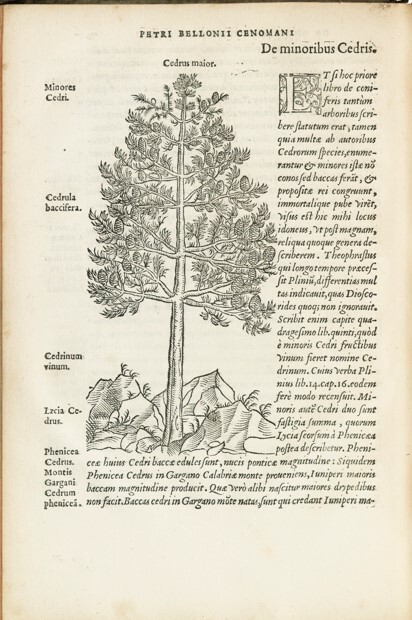
YTB-75P., Apud Gulielmum Cavellat, 1553. In-4 de (8) ff., 32 ff.; 8 gravures sur bois. Vélin moucheté, dos à nerfs orné, tranches rouges. Reliure de l’époque. 230 x 157 mm. EDITION ORIGINALE DE L’UN DES TOUS PREMIERS TRAITES SUR LES CONIFERES ILLUSTRE DE JOLIES GRAVURES SUR BOIS, œuvre de Pierre Belon, naturaliste et médecin français (Cérans, Sarthe, 1517- Paris 1564). First edition. The first work on coniferous trees and one of the first botanical books to cover a single species. Belon was the first to name all cone-bearing trees 'coniferae' a term which was followed by Gesner. Descriptions are given of the various species, including their locations, and he cites authorities such as Dioscorides. The work contains illustrations of Cedrus major, Picæ arboris figura, Pinus, Icon Pinastri, Laricis figura, Sapini arboris delineatio, Abies foemina, and Cupressus. Pierre Belon (1517-1564) was one of the most orginal naturalist of the Renaissance. "He was one of the first explorer-naturalists and between 1546 and 1550 he undertook long voyages through Greece, Asia, Judaea, Egypt, Arabia and other foreign countries. He looked at the world as an analyst devoted to detail. He succeeded in winning the confidence of the great and was famous during his lifetime" (DSB). The woodcuts are excellent. Ce précieux volume est précédé d’une autre édition originale très rare de Pierre Belon sur les antiquités égyptiennes : « De admirabili operum antiquorum et rerum suspicendarum praestantia liber primus. De medicato funere, seu cadavere condito & lugubri defunctorum eilatione. Liber secundus. De medicamentis nonnullis. servandi cadaveris vim obtinentibus. Liber tertius Ad rever, & illustriss D. Fran. Gard. Turnonium, Parisiis, 1553 », in-4 de 8 ff., 54 ff. et 4 ff. Ce curieux ouvrage traite des différentes cérémonies funéraires des anciens et des modernes, de l'embaumement des corps, de l'usage de la "momie" comme médicament, et de divers autres médicaments ou substances (cèdre, "naphta", nitre.) Il explique l'utilisation du bitume que les anciens Egyptiens utilisaient pour la momification des cadavres. Son action contre la putréfaction a incité les médecins à l'utiliser en thérapeutique. Apothicaire du Cardinal de Tournon, Pierre Belon a voyagé de 1546 à 1550 en Grèce, en Turquie, en Egypte, en Judée et en Arabie. Il en rapporta un grand nombre d'observations sur l'histoire naturelle. EXEMPLAIRE CONSERVE DANS SA RELIURE DE L’EPOQUE.
182253396Bechet | à Paris 1822 | 30 x 43 cm | relié
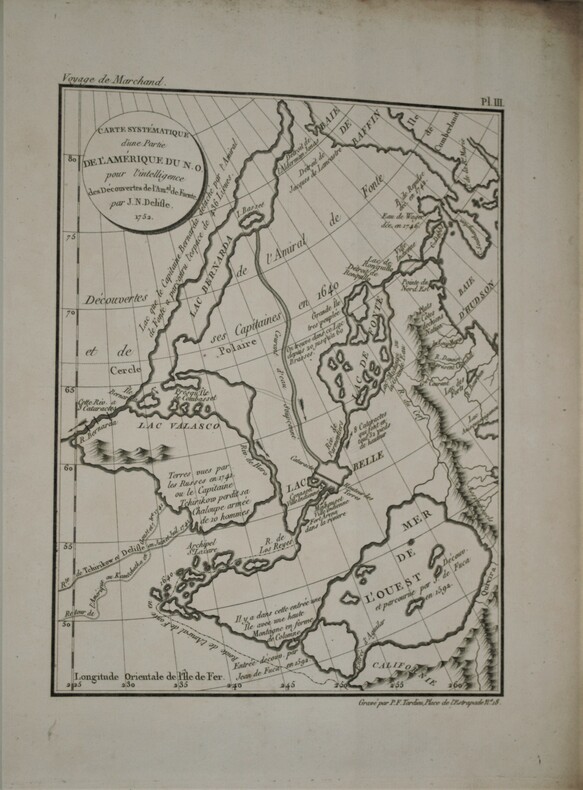
1798PHO-657Paris, De l’Imprimerie de la République, An VI-An VIII [1798-1800]. In-4 (28x22 pour les T.I et II,31,5x24 pour le T .IV) ,xii, cxliv, 628, [3] ; xvi, 676, [2] ;[xi], 431, [1];[2],viii, 158pp, relié couverture d’attente éditeur en cartonnage beige chiné , non rogné , le tome IV n’étant pas ouvert ,défauts d’usage , papier à grandes marges et bruni aux bords ,mouillures au tome III , quelques rousseurs ,tome II reliure demi cuir sous emboîtage à l’identique.Tome I,III et IV premier tirage , Tome II ,1841, ,édition originale remise en vente en 1841 avec un titre de relai portant la mention fictive , "nouvelle édition"(quelques exemplaire imprimés en 1798 n'avaient pas trouver preneur) .L’illustration comprend 16 planches dépliantes gravées sur cuivre, numérotées de I à XV, dont une planche notée VI bis, toutes réunies dans le 4éme tome . Les 15 cartes gravées par Bouclet, Collin, Tardieu, Fortier, etc., levées pour les côtes nord-ouest de l’Amérique du Nord, les îles des Marquesas de Mendoça (îles Marquises), les îles Tupaya (dans l’actuelle Polynésie française), la baie de Tchinkîtâné (actuelle Sitka Sound, près de la ville de Sitka en Alaska), les îles de la Reine-Charlotte (archipel canadien au large de la Colombie-Britannique), les îles Sandwich (Hawaï), le détroit de Magellan, le détroit entre les îles Banca et Billiton (actuelle Belitung) en Indonésie, etc., et une jolie planche à caractère ethnographique (n°V) représentant des échasses de Whûtahô, une des îles de l’archipel des Marquises. Le tome I renferme un tableau dépliant donnant les concordances de mots français avec la langue de Wahîtahô et le tome IV les Observations sur la division hydrographique du Globe .
1747406461Hamburg u. Leipzig, Grund u. Holle, 1747-81. M. 3 gest. Ktn., teils wiederhol. gest. Tit.-Vign. u. 51 (v. 53?) gef. Kpfr.-Taf. Versch. geb. (34 Ldrbde. d. Zt. m. Rsch. u. Rverg., 6 Hldrbdn. d. Zt., 3 Prgtbde. d. Zt. u. 4 Ppbde. d. Zt. Rücken teilw. beschabt, angerissen u. bestoßen bzw. mit geringen Fehlstellen. Einige Bde. m. alter Rsign. Teils m. Stempeln. Fehlbindung beim "Neuen Magazin", dort fehlen d. Stücke 97-99, die Stücke 103-106 sind doppelt vorhanden (im jeweiligen Band mit eingeb.).
- De l'Imprimerie de Monsieur, Paris 1783, in-8 (13x20,5cm), xxxviij (2) 623 pp. et (4) 659 pp. et (4) 611 pp. et xvj (32 tableaux + 12 planches dépliantes) 80 pp., 4 volumes reliés. - Cristallographie, ou Description des formes propres à tous les corps du règne minéral, Dans l'état de Combinaison saline, pierreuse ou métallique [Cristallography] tDe l'Imprimerie de Monsieur | Paris 1783 | 8vo (13 x 20.5 cm) | xxxviij (2) 623 pp and (4) 659 pp and (4) 611 pp and xvj (32 tables + 12 folding plates) 80 pp | contemporary sheep First edition under this title, partly original as it is significantly expanded. The very first edition appeared in 1772 under the title Essai de cristallographie ou description des figures géométriques, propres à différens corps du règne minéral, connus vulgairement sous le nom de cristaux, composed of one single volume. This copy is complete with its 32 tables and 12 folding plates, which present more than 450 crystalline forms. Contemporary light brown marbled sheep, spine in five compartments with gilt compartments and fleurons, red and green morocco title and volume labels, a few joints and headpieces skilfully repaired, marbled endpapers and pastedowns, all edges red. Bookshop labels to pastedowns. A very good and rare copy. [FRENCH VERSION FOLLOWS] Edition originale sous ce titre, largement augmentée. La toute première édition est parue en 1772 sous le titre d'Essai de cristallographie ou description des figures géométriques, propres à différens corps du règne minéral, connus vulgairement sous le nom de cristaux, et ne se constituait que d'un seul et unique volume. Notre exemplaire est bien complet de ses 32 tableaux et 12 planches dépliantes, décrivant plus de 450 formes cristallines. Reliures de l'époque en pleine basane blonde marbrée, dos à cinq nerfs ornés de caissons et fleurons dorés ainsi que de pièces de titre et de tomaison de maroquin rouge et vert, certains mors et coiffes habilement restaurés, gardes et contreplats de papier à la cuve, toutes tranches rouges. Etiquette de librairie encollée sur chacun des contreplats. Bel et rare exemplaire.
186759854Deuxième édition revue, considérablement augmentée et enrichie d'un magnifique Atlas de plus de 300 planches gravées et coloriées, 17 volumes in-8 reliure de l'époque demi-chagrin à coins rouge (les 3 derniers volumes de planches, marqués "Table" pour "Tables méthodiques des Planches du Dictionnaire" en dos, sont légèrement plus profonds), dos à 5 nerfs, toutes tranches peignées, Au Bureau Principal de l'Editeur, Paris, 1867-1869, 2 ff., VIII-694 pp. ; 2 ff., 808 pp. ; 2 ff. 752 pp. ; 2 ff., 768 pp. ; 2 ff., 816 pp. ; 2 ff., 804 pp. ; 2 ff., 792 pp. ; 2 ff., 807 pp. ; 2 ff. 784 pp. ; 2 ff., 784 pp. ; 2 ff., 784 pp. ; 2 ff., 752 pp. ; 2 ff., 746 pp. ; 2 ff., 604 pp. ; Table I : 21 pp. et 140 planches hors texte ; Table II : 26 pp. et 103 planches hors texte ; Table III : 29 pp. et 97 planches hors texte (soit un total de 340 planches hors texte sous serpentes, la quasi totalité rehaussées en couleurs à de très rares exceptions près, à savoir la baleine franche, ainsi que les planches d'anatomie et de fossiles, comme il est habituel)
177360413Paris, Didot le jeune, 1773. Large 12mo (167 x 98 mm). In a nice contemporary full mottled calf binding with five raised bands. Spine richly gilt. Boards with gilt frame and edges of boards gilt. Occassional very light browning and a very vague damp-stain in lower outer corner affecting some pages. An overall very nice copy. XXIV, 248, (4)
19932081502111907122Hanayama bungei 1993. Soft Cover. Fine. Size: A4 hardcover book Hanayama bungei paperback
1636P., Jombert, 1740, un volume in 4 relié en pleine veau marbré, dos orné de fers dorés, tranches rouges (reliure de l'époque), (tache brune sans gravité sur le second plat), 19pp., 1pp., 509pp., 2pp., 26 planches dépliantes
1966220763Wien, (Hölder), 1885-1966. M. mehr. Portr. u. Ktn., zahlr. Textabb. u. Taf. Bis Bd. 45 einheitl. Hlwdbde. m. goldgepr. Rtit. Davon einige Mehrfachbde. St. a. od. verso Tit. bzw. auf Vorsatz od. Umschl. Kl. Sign. a. Innendeckel. Einbde. zum Teil stärker bestoßen. Bei Bd. 21 ist d. 1. Lage am Rand leicht eingerissen. Ab Bd. 46 in OBr. Bd. 53 in 2 OBr. Bd. 48, 51 vord. Umschl. lose. Bd. 46 fehlt vord. Umsch. Bd. 31 fehlt Taf. 11. Bd. 22/23 u. 24/25 jeweils auf Rücken als Einzelbde. bezeichnet.
15500033071550 Venise, Francesco Marcolini, juillet 1550. Petit in-folio (225 X 322) demi-vélin ivoire, plats de papier dominoté, auteur, titre, lieu d'édition et date calligraphiés au dos en rouge et noir (reliure XVIIIe) ; A-Z4, Aa-Cc4 : 104 feuillets. A partir des figures des philosophes (page 64) il est donné un même numéro pour deux pages. Nombreuses restaurations aux premiers feuillets, l'encadrement architectural du portrait de l'auteur est masqué par un feuillet de doublure, marges du feuillet 43/44 rognées.
1925000514Damascus: al- Matba'a al- Haditha 1925 Book. As New. Hardcover. 4to - over 9¾ - 12" tall. A comprehensive work by a well-known scholar and politician from Damasscus about the city including the political social and the other aspects during the Ottoman synasty in the last period. Six volumes 4to. in Arabic printed between 1343 and 1347 AH. 1925 and 1927 AD. in Damascus. 309 317 271 310 308 425 p. in later fine bindings. al- Matba'a al- Haditha hardcover
In-4°; pp. (16), 1177, (3). Dedica a Papa Clemente VIII. Legatura in piena pergamena molle con titolo manoscritto al dorso. Al frontespizio una nota manoscritta coeva recita "Expensis Regiis Villalpandus"; accanto al titolo timbro a inchiostro della biblioteca Borghese. Edizione originale di quest’opera enciclopedica, che fu poi messo all'indice. Fu ristampato in successive edizioni solo a Praga e Francoforte, con privilegi che esplicitamente vengono ottenuti grazie alle censura di una parte del testo. L'opera è strutturata in ventitre colloqui, tra il teologo, il cavaliere e il filosofo, ciascuno dei quali ha un argomento, ad esempio Meteora, Lapides, Metalla, Herbae, Plantae, Ignis ecc.; vi si tratta tra l’altro di fossili, vulcanologia, biologia, entomologia ecc.; molti i riferimenti all'Orbe Novo, in particolare al Messico e al Giappone con l'esplicito richiamo a Xavier, Froes e agli altri viaggiatori Gesuiti. Il libro è concepito come un Museo di rarità di scienze naturali. Evidentemente il Maiolo non esita a descrivere scrupolosamente anche molti aspetti esoterici e soprannaturali, tanto da incorrere nella censura: sono questi gli anni del processo a Giordano Bruno. Il Maioli voleva con questa voluminosa opera condensare tutto il sapere dei suoi tempi, e in particolare censisce le ultime scoperte, siano esse stata fatte per invenzione e sperimentazione, siano esse dei rari ritrovamenti in natura nelle terre che in quegli anni venivano per la prima volta esplorate. cfr. Weeler Gift cat. 70 : "Properties of the load stone p.780, Ethiopian magnet said to repel iron p. 781, Magnetic clock of Gerbert (Pope Sylvester II) p.783. Il Maioli oltre ad interessarsi di scienze naturali fu Canonista, nacque ad Asti verso il 1520, vescovo di Volturara dal 1572, morì 1598. Edizione successive di questa opera sono anche citate in: Krivatsy 7287; Caillet 7023; Hozenav Lancaster 2867; Wellcome I 3994. Ex-libris Mario Carmenati.
183760345London, 1837 + London, 1840. Five volumes 8vo. Bound in five contemporary, uniform brown half calf bindings (The Philosophy...-volumes slightly darker brown) with raised bands and gilt spines. Marbled edges. A bit of light edge-wear, but overall very fine and fresh. Some marginal pencil markings to first part of vol. 1 of ""The Philosophy..."", otherwise also internally very nice and clean. All five volumes with the same engraved amorial bookplate to inside of front boards. A very nice, uniform set of the five volumes that make up the two works. XXXVI, 437, (3)" XI, (1), VI pp., pp. (7)-534, (2) XII, 624 pp. + CXX, 523, (1)" IV, 586 pp. + folded plate.
176256316Königsberg und Leipzig Kanter Berlin Stettin Leipzig Rüdigern 1762-75. 4to. Bound in 13 uniform contemp. full calf. Raised bands. Richly gilt spines. Titlelabels with gilt lettering. On all boards the gilt monogram on red background of King Christian VII. A stamp on title-pages. Around 6000 pp. 4 folded tables and 366 folded engraved plates 1 plate in xerox-copy. Occassionally a few minor brownspots but fine and clean. <br/><br/><em>First German edition of this importent collection of books on crafts which is a translation of "Descriptions des Arts et Métiers." published in French between 1761 and 1788. The full French series comprises 113 parts cahiers in 27 folio volumes along with three supplements and "provide detailed accounts of a wide range of handcraft and manufacturing processes carried out in France at that time. The volumes are well-illustrated with precise engravings by Jean Elie Bertrand 1737-1779 a noted typographer from Neuchâtel where the printing was done. Many of them provide the background for shorter articles in Diderot's Encyclopedia which was appearing at much the same time. The project had its origin in request from Colbert in 1675 to the Academy Royal des Sciences for detailed accounts of various mechanic arts to be prepared and for new machines to be reported upon. This led to the formation of the Bignon Commission under Abbé Bignon. René-Antoine Ferchault de Réaumur 1683-1757 became editor soon after he joined the Academy. He inherited number of drawings the earliest prepared in 1693 and an illustrated manuscript on printing type and book binding which had been prepared in 1704. It was left to Réaumur's successor Duhamel du Monceau to bring about the publication of the series probably as the result of the competition from the Encyclopedia." Wikipedia.Brunet II618 ff. only French editions - Graesse II 367 only the French editions. - Fromm 7040. </em> hardcover