35 947 résultats
5676Tome 1er : Le Pêcher ; Tome II : Le Cerisier ; Grenoble, Prud'homme, 1866-1870. Trois volumes in 8, 439, 368 pp."On joint : [MORTILLET] - Quarante poires pour les dix mois de Juillet à Mai. Monographie divisée en quatre séries de dix poires dont la maturation s'effectue pendant chacun des mois de Juillet à Mai contenant le nom et la synonymie des poires, leur description et celle de l'arbre ; le mode de culture ; l'indication de l'origine et l'époque de la cueillette du fruit avec la silhouette de chacun dessinée d'après nature et de grandeur naturelle ; suivie de considérations générales sur la culture et la taille du poirier, par M.P. de M*** Deuxième édition augmentée de la Description d'une série de poires à cuire et à compote ; imprimé avec luxe. Grenoble, Prud'homme, 1860. In 8, 128 pp."
5499P., Colas, 1810. In 8 broché, couverture muette de l'époque, XXIV-459 pp. (quelques traces de mouillures pâles).
7502P., Colas, 1810. In 8 broché, couverture muette de l'époque, XXIV-459 pp. (quelques traces de mouillures pâles).
Barcelona, por Juan Francisco Piferrer, 1827 - 1829 [y] Madrid, Imprenta de Villalpando, 1806 - 1807 (para los tomos V y VI). Doce tomos encuadernados en seis volúmenes en 8vo.; VIII-XVI-150 pp. +1 h., XV-156 pp. + 1 h., 166 pp. + 1 h., VIII-156 pp. + frontispicio grabado, XII - 224 pp., 1 h. + frontispicio grabado, XII - 224 pp. + VIII - 160 pp. + VIII - 181 pp. + XII - 200 pp. + VIII-200 pp. + XVI - 184 pp. + VIII - 213 pp. Encuadernación en piel marbreada de la época, con tejuelos. Ligerísimas diferencias ornamentales en el volúmen que contiene los tomos V y VI.
8542P., Lambert, 1769. In 8 demi-chagrin à coins, dos à nerfs, tête dorée (reliure moderne signée J. Faki), (2 ff.)-126 pp. + feuillet de privilège. Avec III planches dépliantes.
17105011Paris, J. Moreau, 1710. In-12, frontispice, [26]-368-[4] + 274-[8] pages, plein veau brun, dos à nerfs orné de filets et fleurons dorés, étiquette de titre rouge (fente de 8mm. à un mors, manque 8mm. en marge ext. de la page de titre, sans manque aucun de texte). Exemplaire parfaitement établi.
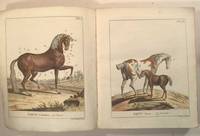
1779522781779. ANIMAL HUSBANDRY. DER PRAKTISCHEN GEISCHICHTE EUROPAISCHER NATURPRODUKTE. Nurenberg: auf Kosten der Stiebnerschen Buchdruckeren 1779-1782. 7 parts numbers 1-7 bound in one volume. 288pp. continuous pagination between parts. 14 engravings of horses asses bulls cows sheep and goats all with contemporary hand-coloring. 4to. green paper wrappers hand-lettered paper label to spine. A near fine copy remarkably clean with minimal foxing and slight thumbing to edges of some leaves. The plates are bright and fresh and sensitively colored. unknown books
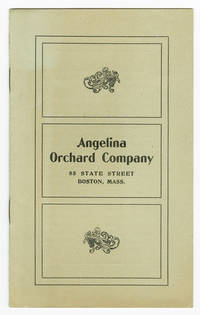
1902WRCAM56268Boston: Poole Printing Co. 1902. 16pp. plus two promotional pieces laid in one a folded broadside the other 4pp. on a folded sheet. Original light green printed wrappers. Light wear. Near fine. An unrecorded promotional pamphlet and related ephemera touting the advantages of investing in the ill-fated Angelina Orchard Company near Lufkin in Angelina County Texas. Around 1900 the group of Boston investors who printed this pamphlet established the town of Manton in East Texas which was designed to support their commercial fruit farm on the Texas and New Orleans Railroad. The present pamphlet sets forth the details of the available land for purchase highlights the advantages of growing fruit in East Texas prints testimonials from others in support of the area and enumerates the legal protections for landowners in Texas. The inside rear wrapper is printed with a list of mean temperatures for the area from 1901. Laid into the pamphlet is a sample contract and a separate promotional detailing real estate and insurance offerings from the company. <br> <br> "The Angelina Orchard Company incorporated around 1901 with a capital stock of $130000.bought 12500 acres of cutover timberland near the site of what is now Southland Paper Mills for growing and processing fruit. The idea of raising fruit as an economic venture in Angelina County may have been fostered by the Lufkin TRIBUNE and the Houston POST which published articles early in the century advertising East Texas as a good peach-growing area. The author of these articles an industrial agent for several railroad lines had reportedly also sent out thousands of folders promoting this idea. About 1902 the Angelina Orchard Company planted 500 of its 12500 acres in peach trees 350 in pear and 150 in plum. The company planned to plant 500 more acres a year until the entire tract was under cultivation. The farm was envisioned as a community and business center. The company built tenant houses for orchard employees a commissary a school and a church. Also planned were a canning factory a sawmill more tenant houses and a spur railroad. The plans were short-lived however. Manager Fred Brunsterman was shot during an argument in a Lufkin bank vault. The company then employed two different managers but profits never met the original expectations. The last manager attempted to make money by raising cotton potatoes and cantaloupes with no more success than the peaches had brought cotton was then selling for twenty- five to fifty dollars a bale. The Manton orchard failed. The stockholders sold the land and what timber was left" - HANDBOOK OF TEXAS. No copies in OCLC or auction history. Megan Biesele "Manton Tx." in HANDBOOK OF TEXAS online. Poole Printing Co. unknown books
193646478Washington: U. S. Government Printing Office 1936. 1936. RESETTLEMENT ADMINISTRATION. First edition. Color pictorial wrappers 2 28 pp. illustrated mostly from photographs illustrations and diagrams. Surprisingly rare publication on the New Deal Resettlement Administration which was created May 1 1935 to resettle destitute or low-income families from rural and urban areas and administer projects to resolve soil erosion stream pollution seacoast erosion reforestation forestation and flood control. Although the Civilian Conservation Corps CCC the Army Corps of Engineers flood control Works and the Soil Erosion Service had been carrying out some of these activities the Resettlement Administration RA was dedicated to providing financial aid and grants for farm families and conservation work. The RA proved very controversial due to the emphasis on cooperation and collective work as the means to improve American rural life but even after successfully planting thousands of acres creating 1900 miles of firebreaks improving streams and infrastructure Conservatives denouncing the "Socialist" tendencies eventually forced Tugwell to resign in Dec. 1936 and the RA came to an end. Much of the programs goals and administration were later folded into the Farm Security Administration in 1937. See: Leslie Gene Hunter Greenbelt Maryland: "A City on a Hill" Maryland Historical Magazine Vol. 63 No. 2 1968; "Resettlement Administration" RA 1935 "The Living New Deal" UC Berkeley Dept. of Geography 2019. Slightly skewed from misalignment when originally stapled else a very good copy of a surprisingly scarce publication. U. S. Government Printing Office, 1936]. unknown
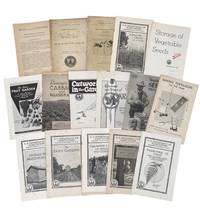
1898232571898. Federal Agricultural PolicyEnvironmental ManagementUSDA Archive of 17 United States Department of Agriculture Farmers' Bulletins and federal publications issued between 1898 and 1949 documenting the federal government's expanding role in agricultural science land management and homesteading during the Progressive Era and the decades surrounding the Dust Bowl. These bulletins document the federal government's expanding role in agricultural production and were a crucial part of the print system through which the United State Department of Agriculture translated experiment-station research into practical directions for farmers and rural households. Several carry the red distribution stamp "Sent by Harry R. Sheppard Member of Congress" preserving the congressional channels through which USDA advice circulated alongside the wider extension network. The bulletins were handed out free of charge through congressional offices agricultural colleges and rural postal networks reaching millions of farm households and implementing federal agricultural policy at the local level. The publications represented here emerged from the legislature introduced by the Morrill Acts the Hatch Act and the Smith-Lever Act of 1914 which created the federal system linking agricultural research land-grant universities and cooperative extension services. <br /> <br /> The earliest publications in this archive address plant disease and propagation showing the USDA's early emphasis on scientific control of crop failure and the standardization of cultivation practices. By the interwar and wartime decades the scope of instruction had widened to include vegetable production seed storage sweet potato preservation cabbage disease fern eradication from pasture lands brush and stump clearing and the control of Johnson grass alongside household and regional titles such as The Home Fruit Garden in the Pacific Coast States and Arizona and Production of Maple Syrup and Sugar. These pamphlets show the department addressing both market agriculture and domestic food production moving between specialized technical subjects such as seed treatment and broader guidance on gardens storage and rural land use.<br /> <br /> Archive of 17 titles including:<br /> <br /> • The Grain Smuts: How They Are Caused and How to Prevent Them 1898<br /> • The Propagation of Plants 1902 reprinted 1924<br /> • Prevent Storage Rots of Sweet Potatoes 1934<br /> • Eradication of Ferns from Pasture Lands in the Eastern United States 1915 revised 1936<br /> • Production of Maple Sirup and Sugar 1924 revised 1937<br /> • Production of Spinach 1938<br /> • Culture and Uses of Okra 1905 revised 1928 1940<br /> • Clearing Land of Brush and Stumps 1927 revised 1929 1941<br /> • The Home Fruit Garden in the Pacific Coast States and Arizona 1942<br /> • Vegetable Seed Treatments 1940 revised 1942<br /> • Mixing Fertilizers on the Farm 1949<br /> <br /> Additional publications address crop storage weed control fertilizer preparation and home food production showing how USDA printing linked plant pathology environmental management and household economy within a single federal instructional program across the first half of the twentieth century. Seventeen pamphlets and booklets printed in staple-bound or pamphlet format many with illustrated wrappers. Paper toned with scattered edge wear creasing rubbing and light soiling; earlier bulletins show heavier age and use and several mid-century pamphlets retain congressional distribution stamps. Overall good condition. A solid working archive of USDA extension printing that traces the federal government's practical involvement in American farming horticulture and home economics from 1898 to 1949. unknown
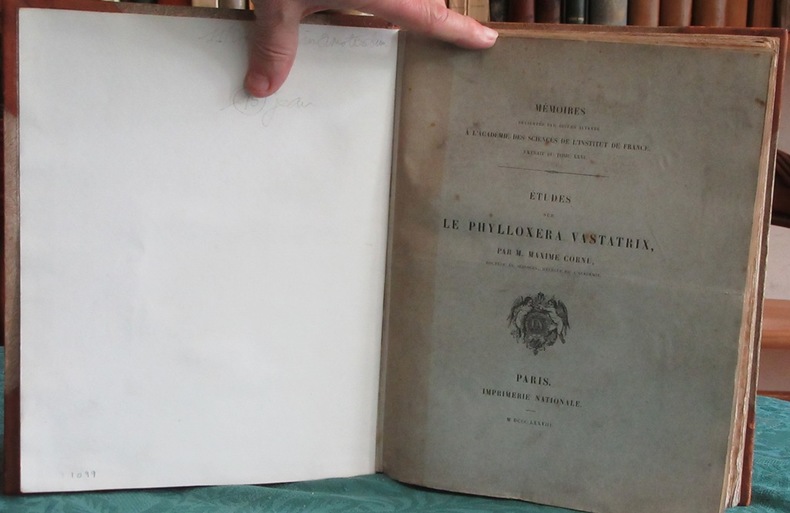
187818651Mémoires présentés par divers savants à l'académie des sciences de l'institut de France. Extrait du tome xxvi. Edition originale par Maxime Cornu.Paris, imprimerie nationale, 1878. 357 pages. 24 planches hors texte, certaines en couleurs, sous serpentes. Quelques annotations au crayon. Un des ouvrages les plus recherchés sur le sujet.Reliure demi basane havane à coins. Dos à petits nerfs ornés. Couvertures conservées. Pièce de titre en maroquin. Quelques rousseurs en fin d'ouvrage. Bon état. Format in-8°(24x16).
First edition, part I all published, 8vo (190 x 115 mm), [12], 116pp., with the half-title and half-title, 5pp. list of subscribers, original boards, uncut, spine a little chipped, but still a very nice copy. This private botanical garden was originally opened by William Curtis in 1779 at Lambeth, but due to smoke pollution, he moved the plants to the larger gardens in Brompton. According to the Survey of London, "in 1789 William Curtis, the author of Flora Londinensis and the founder of The Botanical Magazine, took over from Rubergall as tenant and moved the botanical garden which he had opened in Lambeth in 1779 to this spot. The Brompton Botanic Garden, as it was known, covered about three and a half acres, almost exactly conforming to the area which is now occupied by the streets and houses on the hospital's estate, while the remaining four and a half acres to the north were used for experiments in agriculture. After Curtis's death in 1799 his partner William Salisbury kept the garden here until 1808 when he moved it to Sloane Street, Chelsea. He continued to use the ground at Brompton for a nursery, however, until 1829 when he was succeeded there by David Ramsay, whose establishment was known as the Queen's Elm or Swan Lane nursery." Rare; JISC locating just 3 copies (Oxford, Kew and Royal Horticultural Society Libraries).
2 Vols., 8vo (203 x 120 mm), xx, 516; [6], 528, [40]pp., one engraved plate, some browning from turn-ins, cont. full tree calf, joints a little worn, flat spines richly tooled in gilt, red and green morocco lettering pieces on spines, an attractive set in a contemporary binding. First edition of this abridgement of the author's most import book, The Modern Husbandman, which appeared in installments, ending in 1744. Provenance: Small neat ink stamp of the Lawes Agricultural Library to the front paste-down. Rothamsted, p.53; Perkins, 560.
3 Parts in 2 vols., 4to (278 x 210 mm), parts I & II second edition, part III first edition, x, [2], 204, 130, [2, blank], vi, [2], 86; xv1, 368, xlivpp., engraved portrait and title page to vol. I a little foxed, cont. calf calf, marbled boards, corners rubbed, rebacked, spines lettered direct. "The work is full of detail without neglecting general principles, plentifully illustrated with tables, and ample in its treatment of later periods, though rather insufficient, in the light of modern knowledge, for the earliest period. Particular attention is given to the national debt and to Pitt's financial administration."?Palgrave. Provenance: With the armorial bookplate of Arthur Young (1741-1820) English writer on agriculture, economics and social statistics; latterly from the Royal Agriculture Society Library. Palgrave III, p.403; Goldsmiths'-Kress no. 14444 & 13065.
1905172858Gand, 1872-1905. Jeder Bd. vollständig mit jeweils zwischen 9 u. 12 chromolith. Taf. u. einigen s/w Taf. Hlwd- bzw. Hldrbde. d. Zt. m. Rtit. Einbde. stark bestoßen u. angeschmutzt bzw. fleckig. 1874 Rücken m. Fehlstelle. 1880 sind S. u. Taf. teilw. etwas braunfl. u. Einbd. beschäd. 1905 Einbd. wellig, fleckig u. etwas eingerissen.
1861189921Salzburg, Duyle, 1852-1861. Jg. 2-3, 5 Ppbde. d. Zt. Einbde. stark bestoßen u. angeschmutzt. Jg. 3 u. 5 Einbd. stark beschäd. u. m. Nässespuren. Jg. 4, 6, 7/8 u. 10/11 marmor. Ppbde. d. Zt. Berieben u. etwas braunfl. Jg. 4 m. schwachem Nässerand.
18302221# AUTEUR: # ILLUSTRATEUR: Tardieu # ÉDITEUR: Roret - libraire - rue Hautefeuille - au coin de celle du Battoir -Paris # ANNÉE ÉDITION: 1830 # COUVERTURE: Cartonnage éditeur rose - dos plat - titre doré # DÉTAILS: In 12° relié 30pp (table méthodique d'après Olivier et table alphabétique des planches) + 110 planches gravées finement coloriées (3 en noir d'anatomie pl.2,3,4 et une, ruche en livre pl.56). Etiquette de la librairie Joseph Targe, rue Lafont à Lyon, sur le verso du 1er plat. # PHOTOS visibles sur www.latourinfernal.com
18492210# AUTEUR: D'Orbigny Charles # ÉDITEUR: Renard - Martinet et Cie # ANNÉE ÉDITION: 1849 # COUVERTURE: 1/2 chagrin noir - dos à nerfs et titre dorés # DÉTAILS: Grand in 8° relié 2ff + 83 planches en couleurs + 27pp. Tome 3 seul de l'atlas. Rousseurs sur le texte (tables méthodiques des planches) et sur les planches 3 et 5 (zoophytes) # PHOTOS visibles sur www.latourinfernal.com
758P. Deterville, 1805. 3 volumes fort in-4, d'environ 2700 pages. Demi basane brune de l'époque, dos lisse orné (important manque de cuir sur le haut du tome 3, charnières faibles et épidermées pour le tome 1. Bel état intérieur.
170958927Verlag: Friedrich Groschuff, Leipzig, 1709. 12° , 8 Blatt, 1054 Seiten, 2 Zwischentitel, mit sehr vielen Textholzschnitte, 27 Blatt Register., Ex-Libris auf Vorsatzblatt Gebundene Ausgabe, Vollpergamentband, +++ es fehlt das Titelblatt +++ sonst Exemplar in gutem Erhaltungszustand
95858À Paris, Chez Desaint, 1766 2 tomes en 1 vol. in-8, XXXIII-[1]-583 pp. (pagination continue), veau havane glacé, dos orné à nerfs, tranches marbrées (rel. de l'époque).
239385Paris, Nicolas Chesneau, 1575 petit in-4, [8] ff. n. ch. (titre, préface, poésies liminaires, table des chapitres), 248 pp., [12] ff. n. ch. d'index, d'errata et de privilège, ff. 187-190 reliés par erreur après la p. 196, et f. 191-192 après la p. 200, basane brique, dos à nerfs, tranches mouchetées (reliure du XIXe). Dos légèrement insolé et passé.
4282Revues, Tête de Collection, In-8 Brochées - Le consortium breton N° 1(02/1927) à 18 (06/1928), Repris par Le Foyer Breton N° 19 (3 è Trimestre 1928) à 44 (2 è trimestre 01933) + 46 (4 è T. 1933), 49 (3 è T. 1934), 52 (2 è T. 1935) à 54 (4 è T. 1935) & 59 (1 er T. 1937) - Nombreuses illustrations et dessins - Environ 80 pages par fascicule - Propre.
Revues, Tête de Collection, In-8 Brochées - Le consortium breton N° 1(02/1927) à 18 (06/1928), Repris par Le Foyer Breton N° 19 (3 è Trimestre 1928) à 44 (2 è trimestre 01933) + 46 (4 è T. 1933), 49 (3 è T. 1934), 52 (2 è T. 1935) à 54 (4 è T. 1935) & 59 (1 er T. 1937) - Nombreuses illustrations et dessins - Environ 80 pages par fascicule - Propre. Rare ensemble de cette pécieuse revue sur la Bretagne
1782170589A Paris De l'imprimerie de Ph.-Pierres, imprimeur ordinaire du Roi. 1782 414p 1 volume IN8. Reliure d'époque en plein veau. Dos à nerfs orné avec pièce de titre en maroquin rouge.Coins émoussés. Ouvrage orné de 22 planches gravées h.t.