23 948 résultats
19484432Cambridge & Coph., 1948-1981. 4to. Bound in 72 solid hcloth. (1980 a.1981 undbound).
Cambridge & Coph., 1948-1981. 4to. Bound in 72 solid hcloth. (1980 a.1981 undbound).
157121033Venedig, Vincenzo Valgrisi, 1571. 32 Bll. mit Druckermarke auf dem Titel. 509 SS. mit 1 doppelblattgroßen Holzschnitt-Plan (Therme des Diocletian). Fol., Pappband des 17. Jhdts. mit blindgeprägtem Arabeskenmedaillon und Initialen »I.V.P.« auf den Deckeln. Rücken neues, helles Leder über 6 Bünden. Der ungewöhnliche Pappband wurde mit feinem hellgrauem Papier bezogen, um den Eindruck eines Schweinslederbandes entstehen zu lassen. Einband etwas angestaubt und bestoßen.
140314aafBern, Schmid, Francke & Co., (les cartes: Établ. Wurster, Randegger et Cie à Winterthur), 1883 + (Texte explic.:) 1898, in-4to, IV + 77 p. + 2 planches (portraits de Alph. Favre & Léon du Pasquier) + 4 cartes pliées à l’échelle 1:250’000 (56x75 cm), les 4 cartes lithographiées et coloriées sont montées sur toile et signées , Eidg. Stabsbureau’. Le figuré du terrain est un report de la carte de l’Etat major fédéral, chaque carte avec titre manuscrit sur pièce de titre au dos, bon état, volume de texte avec exlibris Peter E, Obergfell, texte relié en d.-toile, les 4 cartes dans leur emboitage en carton avec renforcements en toile, plats et coins légèr. usés, sinon bon état.
SHL-37Paris, F.-G. Levrault, 1823. A Paris, chez F.-G. Levrault, Libraire-Editeur, rue des Fossés M. Le Prince, n° 31 et rue des Juifs, n° 33 à Strasbourg, 1823. Imprimerie de Cellot, rue du Colombier, n° 30], 1 vol.In-8°, demi-maroquin grenat, dos à nerfs orné de palmettes dorés, p.de t. de maroquin noir, titre doré (rel. attribuée à J.-M. Durand) : couv. imprimées ornées un large encadrement de dentelle conservées - fx-t. - titre - 2 ff.impr.n.ch. [Dédicace] - XVI [Préface] - 633 pp. -1 f.impr.n.ch. [Errata] - 1 pl. h.-t. face p. 118 [Coupe transversale de la chaîne des Pyrénées, destinée à représenter la dégradation qu'on présume qu'elle a éprouvée]. La carte manque comme à la plupart des exemplaires "La plupart des exemplaires connus sont incomplets de la carte. Seuls quinze exemplaires complets sont recensés dans des collections privées. La grande carte dépliante manque souvent." Provenance manuscrite au fx-t. "Gasté". Bel exemplaire, défauts minimes : Qq brunissures claires sans grande gravité, notes au crayon de papier aux pp. 428-430, restauration angulaire inf. aux derniers ff. (à partir de la p.602 de la Table sans atteinte au texte) & à la couv. inf. RARE ET RECHERCHÉ. J. Labarère le cite dans Les Vingt Livres Pyrénéistes les plus rares, N° XX. Un livre fondamental dans l'histoire de la géologie pyrénéenne. Quérard, II, p. 139 ; Cent Ans, I, 112 ; VI, 56-61 ; Labarère, I, N° 381 ; Dendaletche - 439.
1932187067Paris, Société Géologique de France, 1842-1932. M. zahlr. Tab.,Taf., Ktn. u. Portr. Hldrbde. d. Zt. m. goldgepr. Rtit. Einbandkanten leicht bestoßen. Rücken teilw. gelockert, berieben od. eingerissen. Teilweise vereinzelt Bleistiftanstreichungen. St. u. Sign. a. Tit. Papier teilw. altersbed. braunfl. Bd. 1 (1830) Ppbd. d. Zt. m. Rsign. u. St. Bd. 13 (1842) fehlt 1 Taf.; Sér. 2/7 fehlen S. 631-634; Sér. 2/19 fehlen S. 1005-1008. Sér. 4 Tome 19/20; 21/22, 23-30 u. Sér. 5 Tome 1 ohne Sitzungsprotokolle (comte rendu sommaire). Réunion Extraordinaire a Chambery du 12 au 27 août 1844 OBr. Unbeschn. Ex. Umschlag m. Fehlst. u. teils lose, angestaubt.
1895ALPI0161Wien, Ed. Hölzel 1895. 34 x 26,5 cm. Textband : IV, [8] Bl., 152 S., [24] Bl., 90 Textbilder; Atlasband : 132 Atlastafeln (38 Lichtdrucke, 10 Photolithogr., 84 Autotypien). Orig.-Halblederbände mit Einbandgoldprägung, umlaufender Rotschnitt. Leder an den Kanten etw. berieben, Tafelband im Bund etwas gelockert. Im Text sauber u. fleckenfrei. - Differenzbesteuert Dem Geographen Friedrich Simony (1813-1896) ist die Erschließung des Dachsteingebietes zu verdanken. Die vorliegende Publikation stellt die Krönung seiner Lebensarbeit dar. Die Abbildungen (insbesondere) des Atlasbandes sind von bestechender Detailtreue und Unmittelbarkeit; derartiges kann durch die heute gebräuchlichen Reproduktionsverfahren nicht mehr erreicht werden (Kollateralschaden der Digitalisierung).-
140719aafBasel, Benno Schwabe, 1878, gr. in-4°, 1 Titelblatt + 17 farblithographische Doppeltafeln (Topogr. Anstalt von Wurster, Randegger, in Winterthur), Textband: XIV + 346 S. + 246 S. (am Anfang 3 Bl. aus dem Einband gelöst), Rund-Stempel ,U.E.S. Library 1922’ auf Titelblatt, Original-Leinenband. (XXè), (Reliure en toile , pièce de titre au dos. (Umschlag vorne leicht fleckig).
1941163349Königsberg, Koch, 1861-1941. 4°. Teils m. Taf. u. Abb. Hlwd. u. OBr. Einige Jgge. zusammengebunden. Teils berieben u. angeschmutzt bzw. fleckig. Einige Einbde. angerissen. Wenige Umschl. fehlen. Wenige Jgge. m. wasserrandig. Einige Buchbl. gelockert bzw. lose. Teils m. St. u. Sign. bzw. Exlibris. Einige Bde. etwas stockfl. Einige S. m. Randläsuren. Teils unaufgeschn.
181858946ABGöttingen, Röwer, 1811 - 1818. Mit 5 gest. Titelblättern jeweils mit Vignette, 18 (12 gefalt.) Kupfertafeln, 4 (3 gefalt.) kolor. Kupferkarten und 13 (12 gefalt.) Tabellen. Spätere marmorierte Pappbände mit Lederrückenschild.
1904150378Washington, G.P.O. 1882-1904. In nahezu einheitl. OLwdbdn. m. Rtit. u. Rücken- od. Deckelsign. Teilw. m. Bibl.-St. a. Tit. Einbde. bestoßen u. leicht angestaubt. Schnitt häufig angeschmutzt od. selten auch stockfl. Es fehlen: Jg. 1880/81 Taf. 8, 9; Jg. 1882/83 Taf. 1; Jg. 1884/85 Taf. 27; Jg. 1900/01 (2) Taf. 10 u. 41. Jg. 1881/82 liegt Taf. 24 lose bei,ebenso in Jg. 1885/86 Taf. 8 u. in Jg. 1887/88 Taf. 1. In Jg. 1889/90 (2) sind Seiten u. Ktn. teilw. lose. In 1890/91 (2) sind ebenfalls einige Seiten lose. Bei Jg. 1896/97 (4) u. 1897/98 (5) ist d. Buchbl. gebrochen, daher zahlr. Seiten lose. 1897/98 (6) u. 1898/99 (6) ist jeweils d. Einbd. verblichen u. fleckig. 1899/1900 (6) Einbd. stark stockfl.
178310731Altenburg, Richter, 1783. XLVIII, 222 S., 1 Bl., 60 S., 2 Bll. (Anzeigen) mit 1 Kupfertitelvignette. 2 mehrfach gefalt. Kupfertafeln. 8°. Mod. Pp. mit Rückenschild.
137083aafXX Jhd., 28x14 cm, (mappe),
17748911BBBerlin und Stettin, J. Pauli, 1774-1778. Insg. 4 gestoch. Frontispiz-Porträts, 4 (wiederholte) gestoch. Titelvignetten, 1 gef. Tabelle und 163 altkolor. (20 gef.) Kupfertafeln. Kollation: Frontispiz, Titelvign., 24 (3 gef.) Taf., 2 Bll., XXXXII, 764 S. - Frontispiz, Titelvign., 50 (6 gef.) Taf., XXXII (1 Bl.), 690 S. - Frontispiz, Titelvign., 45 (6 gef.) Taf., XX (1 Bl.), 706 S. - Frontispiz, Titelvign., 44 (5 gef.) Taf., XXIV, 702 S. Lederbände der Zeit mit goldgeprägtem Rückentitel, Rückenvergoldung und ganzem Rotschnitt (Ecken bestoßen; stark berieben u. beschabt; Bd. 2-4 zum kleinen Teil wurmgängig). Alte Buntpapiervorsätze mit floralen Mustern. 4 Bände (von 11). Vorsätze jeweils mit Besitzvermerk von alter Hand (dat. 1788). Weiße Vorsätze von allen 4 Bänden und Buntpapiervorsatz von Bd. 1 mit Eckausschnitt. Altersbedingt nur gelegentlich gering gebräunt bzw. braunfleckig. Die prachtvollen, altkolorierten Tafeln g
109 fascicoli, per un totale di oltre 11000 pagine e nuerose tavv. f.t. in lit. La rivista si presenta legata in br. ed. ed e' in buone condizioni generali, qualche fascicolo presenta lievi mancanze ai d. Collezione quasi completa, rarissima, della nota rivista che comincio' il suo corso di pubblicazioni nel 1890 e usci' con scadenza trimestrale con una media di 4 fascicoli l'anno (talvolta uscirono 3 fascicoli in un anno con l'ultimo numero doppio 3-4). In nostro possesso tutte le annate complete dal 1893 al 1924 con le seguenti eccezioni: mancano completamente gli anni 1902 e 1916; del 1911 mancano 3 numeri (presente il solo no 2 di giugno), del 1919 manca un numero, il 4o, presenti i primi 3. Moltissimi articoli di archeologia preistorica, geologia, speleologia, biologia, geografia, fisica, chimica, meteorologia, riguardanti in particolar modo la Liguria ma non solo. Fra gli autori i maggiori studiosi delle diverse discipline: Issel, Pellizzari, Rovereto, Negri, Cattaneo, Squinabol, Lessona, Morelli, Lupi, Carazzi, Sacco, Traverso, Celesia, Bozano, Parona, Setti.
In 4° (mm 297x208); pagg. LXX con vignetta calcografica al frontespizio, 4 grandi tavole a doppio foglio fuori testo incise in rame da Jacopo Leonardis, che firma in basso (raffiguranti 18 campioni di fossili la prima tavola, a destra; le altre raffigurano la val di Gavinello (una tavola disegnata e fermata da Antonio Biasini) e la valle del Bosco del Corso, disegnata dal "fedele pittore" Gaetano Scabari di Arzignano. Cartoncino coevo marmorizzato di tipo remondiniano. <BR>Fortis fu uno dei maggiori geologhi e studiosi della fine del XVIII secolo. Aveva fatto parte dell'Ordine degli Agostiniani, uscendone poi per divergenze, ma mantenendo la carica di abate. Scrisse numerosi importanti saggi a seguito di spedizioni scientifiche; ricordiamo Saggio d'osservazioni sopra l'isola di Cherso e Osero (Venezia 1771), Viaggio in Dalmazia (Venezia 1774) ed aprì un vivace dibattito tra intellettuali veneziani e dalmati sulla realtà sociale ed economica della Dalmazia. Pubblicò Articolo di lettera su alcuni fenomeni naturali delle montagne del Bergamasco e la Lettera orittografica al sig. ab. Girolamo Carli sull'Illirio e Carniola nel tomo I (1778) degli Opuscoli scelti di C. Amoretti. Il contributo scientifico più rilevante del periodo, che affiancato alle due opere di viaggio doveva assicurargli la cattedra padovana, fu la memoria Della valle vulcanico-marina di Roncà (Venezia 1778). In essa, polemizzando con le teorie vulcanologiche di Nicolas Desmarest, adottò l'ipotesi dello Strange circa l'origine del basalto colonnare da banchi di argilla marina fusi dal fuoco vulcanico e raffreddati lentamente. Bellissimo esemplare genuino a pieni margini con barbe, perfettamente conservato. La prima carta col frontespizio e la quarta sono stampate su un foglio leggermente più corto in basso e pare quindi che la carte sia strappata, mentre ciò è editoriale ed attribuibile alla stampa<BR>
156384Paris, Cuchet, 1790 in-8, VIII-240 pp., avec une pl. dépl., demi-basane blonde, dos lisse orné de filets dorés, tranches jaunes (reliure de l'époque). Coins émoussés, mais bon exemplaire.
2651P., Carillan-Goeury, 1819/1838, 3 volumes in 4, 1 volume in plano de planches, 1 volume in 8(explication des planches) reliés en demi-basane dos orné de fers dorés pour les volumes de texte ; pleine basane, dos orné de fers dorés pour le volume d'explication des planches et pour l'atlas, (exemplaire de prix offert par l'Ecole des mines de Saint-Etienne), (reliures de l'époque), (dos de l'atlas frotté) T.1 : (2), 20pp., 538pp., 24 tableaux dépliants, 1 carte dépliante, T.2 : (2), 16pp., 539pp., T.3 : (2), 20pp., 538pp., (2) ; 478pp. pour le texte d'explication des planches et (2), 65 planches pour l'atlas
177950223ABA Neuchâtel, chez Samuel Fauche, Imprimeur et Libraire (Band 1); A Genève, chez Barde, Manget & Compagnie, Imprimeurs - Libraires (Band 2)., 1779-1786. 4° (26x20,5 cm). 2 Bl., XXXVI, 540 S. Mit einer gestochenen Titelvignette, 2 gestochenen Textvignetten, 1 gestochenen gefalteten Karte und 8 gestochenen Tafeln auf 7 Bl. (davon 6 gefaltet); 2 Bl., XVI, 641 S., 1 Bl. avis au relieur. Mit einer gestochenen Titelvignette, 1 gestochenen Textvignette, 6 gestochenen Tafeln (davon 5 gefaltet) und 2 gefalteten Tabellen. Kalblederbände der Zeit mit zwei verschiedenfarbenen Rückenschildern, reicher Rückenvergoldung, Stehkantenvergoldung und blindgeprägter Deckelfiletierung. Band 1 und 2 (von 4 Bänden). [4 Warenabbildungen]
177950223ABBand 1 und 2 (von 4 Bänden). A Neuchâtel, chez Samuel Fauche, Imprimeur et Libraire (Band 1); A Genève, chez Barde, Manget & Compagnie, Imprimeurs - Libraires (Band 2). 1779-1786. 4° (26x20,5 cm). 2 Bl., XXXVI, 540 S. Mit einer gestochenen Titelvignette, 2 gestochenen Textvignetten, 1 gestochenen gefalteten Karte und 8 gestochenen Tafeln auf 7 Bl. (davon 6 gefaltet); 2 Bl., XVI, 641 S., 1 Bl. avis au relieur. Mit einer gestochenen Titelvignette, 1 gestochenen Textvignette, 6 gestochenen Tafeln (davon 5 gefaltet) und 2 gefalteten Tabellen. Kalblederbände der Zeit mit zwei verschiedenfarbenen Rückenschildern, reicher Rückenvergoldung, Stehkantenvergoldung und blindgeprägter Deckelfiletierung.
134898aafGenève, Barde, Manget (volumes 1-4), Neuchâtel, Louis Fauche-Borel (volumes 5-8), 1787- 96, in-8°, avec 2 cartes, 21 gravures sur 20 planches et 5 tableaux,papier généralement frais, les ill. dépl., Qqs p. de gardes avec pte. découpe (un nom enlevé) plusieurs cachets de la Grossherzoglichen Neustrelitz Bibl. (en Allemagne), reliures en d.-cuir, dos ornés en or, pièces de titre et tomaison (orange) aux dos, filet doré sur les coupes, qq peu frotté, tranches jaspées.
In 4, cc. (4) + 37 + (7). Gora a 10 cc. interne. P. pg. coeva. Edizione originale poco comune di quest'opera dedicata ai fenomeni legati ai quattro elementi: fuoco, aere, acqua e terra. Poco si sofferma sui primi due, il fuoco viene diviso in due categorie: l'elemento puro, senza alcuna mistura, cagione dell'essere, l'altro e' cagione di corruzione. Grazie al fuoco si generano le piante, tempera la fredda influenza della luna ecc. Si sostiene poi che il fuoco celeste non consuma alcuna cosa mentre il nostro terrestre consuma la materia cui si appiglia, risolve le pietre in metalli, riduce l'arse pietre in calcina ecc. L'aere viene definito 'sottile ma d'una sottigliezza ottusa', l'aere col movimento si raffredda, non c'e' cosa che piu' riempa che l'aere il quale stando fermo si corrompe. Questo e' diviso in tre regioni: soprana, bassa e mezzana. Tratta poi delle generazione dei venti -.l'aura si genera dalle humide fumosita' che salgon dai fiumi o dalle valli .ma sormontando il sole si consuma e svanisce.-. L'acqua signoreggia a tutti gli altri elementi, dice Breventano, questa ha 3 proprieta': di stendersi, giova a figurar forme artificiali, ultimo fa feconda la terra mollificando la sua durezza. Spiega poi l'origine delle piogge con l'evaporazione dell'acqua del mare e che i pesci si nutrono di acqua ma mescolata con gli altri tre elementi. Tratta poi le acque termali spiegando la genesi con il passare su fene metallifere, solforose, nitrose ecc. e ognuna da' giovamento a parti diverse del corpo, profondendosi in molti esempi (Abano, Lucca, Acqui ma anche Chio, Ethiopia, Schiavonia ecc.). Vengono descritte, peraltro, le acque presenti nelle Valli Bergamasche e Bresciane che generano il gozzo (quio denominato gavacciolo). Dopo le fonti l'autore descrive i laghi citando il Maggiore come caratterizzato da grande pescosita' e pericolosita' per le tempeste, quello di Garda come popolato da carpioni che si nutrono di sabbie dorate. Cita il Po' che nasce dal Monte Vesulo e il Timavo che scorre sottoterra. Cita poi il fiume Imera in Sicilia, che si divide in 2 rami e uno e' di acqua salata e i casi in cui un teremoto puo' far nascere un fiume come farlo scomparire. Termina con l'acqua dei pozzi e con gli effetti delle varie acque sul corpo. L'ultimo elemento descritto e' la terra che Breventano divide anch'essa in 3 parti. La parte piu' pura dice trovarsi al centro -.grave, soda et immobile. se si potesse far un buco in essa che riuscisse dall'uno hemisferio all'altro et entro si gittasse un sasso, quando questo fusse arrivato al mezzo si fermerebbe.- Passa poi ad una descrizione geografica affermando la terra essere tutta abitata come dimostrato dalle esplorazioni delle Americhe, tratta dell'Africa ecc. La parte finale e' dedicata alla geologia, descrivendo le varie tipologie di roccie e gli effetti di queste sui terreni e sulle piante ma sopprattutto, i fenomeni vulcanici, come l'Etna, le Isole Eolie sulle quali si dilunga, e una quantita' di fenomeni vulcanici in Italia e altrove (Rieti, Pozzuoli ma anche la Frigia, Scozia ecc.). L'utima parte e' dedicata ai terremoti che egli sostiene essere generati dall'aria che cerca d'uscire dalle vene della terra e di questi descrive i vari effetti. Del Breventano e' nota un'opera rimasta manoscritta interamente dedicata ai terremoti e che nella sostanza non si discosta da quanto affermato in queste pagine. Bidello dell'Accademia degli Affidati in Pavia, e' noto per una storia di questa citta' e per altre opere di carattere scientifico.
1937347621937. Hardcover. Very good. Quartos. 5 volumes of 134 collected writings with typed table of content pages half title pages and occasional additional type script. Volume one is bound in drab green cloth with leather title label on the spine. Volumes II III IV and V are bound in three quarter Moroccan leather with marbled paper covered boards. Raised bands and gilt lettered title labels on the spines. Top edges gilt. Marbled end papers for volumes 2-5. Leather is rubbed and scuffed on the edges spines and raised bands. <br /> <br /> A variety of the pamphlets are illustrated. In volume 1 is an inscription from father to son - "To my son Wallace Jr. with my most sincere good wishes and affection signed Wallace W Atwood June 7 1928." This collection is one of a kind and possibly compiled by Wallace Atwood himself. Atwood's writings are taken from government publications and articles from scientific journals and magazines. Most of the works are bound in the volumes with their original covers. Some articles were taken in part from magazines. Other articles are pasted down on the pages. Occasional hand written information in the volumes. A very nice display of the Professor's works. <br /> <br /> A list of the works are recorded in the typed table of contents for each volume. A complete list for volumes 1 and 2 are provided in this description for examples of the Professor's works in the variety of publications. The entire list of papers for the remaining 3 volumes is not provided. <br /> <br /> Volume I 1900-1910<br /> <br /> Contains 6 of 11 pamphlets listed in the contents the 5 missing pamphlets are noted as "missing" in the typed contents thus these dated writings were never bound in the volume:<br /> <br /> 1. The Geography of the Region About Devil's Lake and the Dalles of the Wisconsin. Wisconsin Geological and Natural History Survey Bulletin 5. No. 1 1900. 151 pages. Illustrated with 38 plates 47 figures. Original printed covers included;<br /> 2. Glaciation of San Francisco Mountain Arizona. Reprinted from the Journal of Geology April-May 1905. Printed by University of Chicago Press. Pages 276-279;<br /> 3. Red Mountain Arizona. Journal of Geology Vol. 14 1906 Missing;<br /> 4. Glaciation of the Unita Mountains. Journal of Geology Vol. 15 1907 Missing;<br /> 5. Lakes of the Unita Mountains. Reprinted from Bulletin of the American Geographical Society January 1908. 6 pages. Illustrated. Original covers present;<br /> 6. Geologic Studies in the Alaska Peninsula Abstract. Bulletin of the Geological Society of America Vol. 20 1908. 1 page;<br /> 7. Alaska and its Wealth Missing "The World Today" June 1908;<br /> 8. Physical Geography of the Evanston-Waukegan Region Missing. Illinois State Geological Survey Bulletin No. 7 University of Illinois 1908;<br /> 9. Mineral Resources of Alaska. Report on Progress of Investigations in 1908. C--Prince William Sound Kenzai Peninsula Southwestern Alaska. United States Geological Survey Bulletin 379-C 1909. Pages 87-152. Illustrated. Original covers present;<br /> 10. Physical Geography and Geology. Educational Department Keystone View Company 1910. 28 pages plus extra catalogs pages;<br /> 11. Prospecting in Alaska Missing. University of Chicago Magazine December 1910;<br /> Additional typed manuscript inside a pocket folder on the rear paste down includes biographical material concerning Dr. Wallace W. Atwood President of Clark University; published papers to January 1 1924. <br /> <br /> Volume II 1911-1920<br /> <br /> Contains 17 of 19 listed papers. The two "missing" papers in the table of contents have a hand corrected mark through with a written note "See Supp. Vol. 1". Note: Supplement for Volume I is NOT PRESENT. <br /> 1. Geology and Mineral Resources of Parts of the Alaskan Peninsula. USGS Survey Bulletin 467 1911. 137 pages. Illustrated fold-outs. Original covers present with an inscription by Atwood written top of the front cover. <br /> 2. The First Year Science Course in High School. The School Review February 1911. Pages 119-123.<br /> 3. Physiographic Studies on the South Slope of the San Juan Mountains Colorado. Journal of the Washington Academy of Sciences July 1911. 1 page;<br /> 4. Physiographic Studies in the San Juan District of Colorado Missing. Journal of Geology July 1911;<br /> 5. The Evidence of Three Distinct Glacial Epochs in the Pleistocene History of the San Juan Mountains Colorado. The Journal of Geology July-August 1912. Pages 385-409. Illustrated. Original covers present;<br /> 6. Some Triassic Fossils from Southeastern Alaska Missing. Journal of Geology Oct-Nov. 1912;<br /> 7. The Atwood Celestial Sphere. Bulletin of the Chicago Academy of Sciences May 1913. 38 pages. Illustrated. Original covers present;<br /> 8. A New Way of Studying Astronomy - The Atwood Celestial Sphere. Scientific American June 1913. Clipped article placed inside pocket folder;<br /> 9. Bringing the Stars to Earth. Technical World Mag. July 1913. A clipped section of the magazine. Article by Richard Morrison who writes of Atwoods Sphere with illustrations of Atwood and others;<br /> 10. Geographic History of the San Juan Mountains since the Close of the Mesozoic Era. Proceedings National Academy of Sciences March. 1916. Pages 177-181;<br /> 11. Saving the Silts of the Mississippi River. Bulletin of the Geological Society of America 1916. Pages 149-50;<br /> 12. The Physiographic Conditions at Butte Montana and Bingham Canyon Uta when Copper Ores in These Districts were Enriched. A Shaler Memorial Investigation reprinted from Economic Geology December 1916. Pages 697-740. Numerous photographs illustrations. Folding panorama view. Original covers present;<br /> 13. Another Locality of Eocene Glaciation in Southern Colorado. The Journal of Geology Oct-Nov. 1917. Pages 783-686. Original covers present;<br /> 14. Relation of landslides and Glacial Deposits to Reservoir Sites in the San Juan Mountains Colorado. USGS Survey 685 1918. 38 pages. Illustrated. Original covers present;<br /> 15. Geography in America. Reprinted from the Geographical Review January 1919. 8 pages;<br /> 16. First Steps in the Study of Geography. Visual Education Magazine Vol. 1 No. 1 January 1920. Pages 17-24. Not all pages bound in but the original covers were;<br /> 17. The New Meaning of Geography in American Education. Also appeared in School and Society February 1921. Address before the meeting of the Rochester City Teachers' Association February 6 1920. 16 pages;<br /> 18. Habitat Groups in the Teaching of Geography. Visual Education Magazine May 1920. Pages 29-36. Illustrated. Not a complete issue but both covers bound in;<br /> 19. The Regional Treatment of Geography. Also appeared in School Century December 1920. Visual Education Magazine June 1920. Pages 15-17. Not a complete issue but both covers bound in.<br /> <br /> Volume III 1921-1930<br /> <br /> Contains 34 papers all present. The first paper is titled "The Inauguration of Wallace Walter Atwood As President of Clark University February 1 1921. Worcester Mass. Mr. Atwoods inaugural has 71 pages. Both covers present. Contents also include articles on teaching geography to children elements of Social Studies more San Juan scientific papers and an article titled "In the Background of the Turmoil in China."<br /> <br /> Volume IV 1931-1933<br /> <br /> Contains 33 papers all present. Subjects include Nominations of Officers. Association of American Universities; The New Ph.D. Degrees in Great Britain and France; The High Sierra and the Redwood Highway Sierra Club Bulletin 1933; How the specialized Motion Picture is Developed; Dr. Attwood addresses; National Parks; an article on Ellen Chuchill Semple 1863-1932; and more. Some of the articles are cut out and pasted down on paper. <br /> <br /> Volume V 1934-1937<br /> <br /> Contains 43 numbers all present. Contents include 3 titles covering the Ancient Mayan Civilization; Guides versus Teachers; Humanity Among the Faculty; the Pan American Institute of Geography and History; the Students of Clark; association and meeting presentations; some scientific articles and more. William Walter Atwood 1872-1949 studied geology at the University of Chicago and graduated there in 1897. He earned is Pd.D. in 1903 and was Associate Professor of Geology until 1913. Atwood later became Professor of Physiography at Harvard 1913-1920. In 1921 Atwood was elected President of Clark University in Worceser in 1920 and began his term in February 1921. Clark University currently has a large collection of Wallace Walter Atwood papers. hardcover
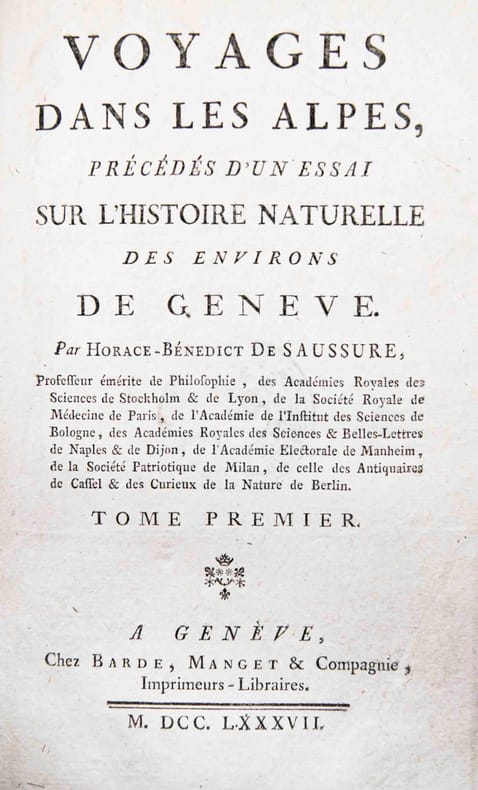
Geneve, Barde, Manget, 1787. Bound in 3 contemp. full calf. Spines gilt and with tome-and title-labels with gilt lettering. A paper-label pasted on lower part of spine on volume one. A stamp on title-pages. Engraved frontispiece. (1), XVI, 308 (2), 244 " 290 pp., 1 large folded engraved map (gravée par C.G. Geisler) and 13 engraved plates (incl. frontispiece, numb. I-XIII, all). A few scattered brownspots. A fine, wide-margined copy.
18839696Staunton VA: Printed by S. M. Yost & Son for Jed Hotchkiss 1883. Hard Cover. Good binding. Quarto. xi 1 196 192; 6 196; 1 iii 196 pp. maps illus. First edition. Volume 1 & 2 bound together in library buckram; Volume 3 in marbled boards with modern bonded leather spine and corners; Volume 4 in library buckram. Volume II is lacking volume title page and index. All volumes trimmed some closer than others. Ex-library with typical markings; bindings are a trifle worn but sturdy; contents are a bit brittle with some closed tears to the folds of the maps a couple of maps have cleanly separated along those tears; occasional early tape repairs to a few leaves and a few maps. Rogers’s geological map is quite crisp and bright. Relatively well-preserved volumes from this landmark publication. <br /> <br /> An important periodical that ran from 1880 through Volume VI 1885 before being merged into the Industrial South. Jedediah Hotchkiss the editor and publisher is perhaps most remembered as the staff officer of Stonewall Jackson and employed his topographical and cartographical skills to the great benefit of Jackson during the Civil War. After the war Hotchkiss established himself in Staunton VA as a consulting engineer and geologist among other endeavors eventually editing and publishing this present periodical. Given the wealth of information related to natural resources it's easy to imagine that these efforts brought significant funding into the commonwealth at a time it was greatly needed. <br /> <br /> While there are contributions by most significant geologists of the day as well as maps and sections by Hotchkiss J. Peter Lesley James P. Kimball R. O. Currey John L. Campell and others. But certainly the most notable inclusions is William Barton Rogers’s 1841 geological map of Virginia. This first systematic geological survey of Virginia began in 1835 when Rogers a recognized expert was engaged by the Virginia General Assembly to undertake the task. The manuscript of the map was largely complete when funding for the project was cut off in 1841. This map languished for decades until a version of it Marcou 592 was published in Virginia: A Geographical and Political Summary. Hotchkiss a friend and colleague of Rogers further added to the map and issued it in Vol. I No. 6 of The Virginias 1880. Of this map E. M. Sanchez-Saavedra writes: "The geological map of Virginia is modest in appearance but it contains more information than first meets the eye. Its topography was based on the 1827 Boye nine-sheet map altered to emphasize natural drainage and erosion patterns. The large patches of color representing different formations were the result of Rogers's years in the field—digging climbing and analyzing rock strata." Finally noting that this color coding seems to have been of Roger's invention it would be employed to some degree in subsequent years by John Wesley Powell as he embarked on his ambitious undertaking to map the entirety of the country. This map remains an important piece of Virginia geologic and cartographic history. Sanchez-Saavedra A Description of the Country: Virginia's Cartographers and Their Maps 1607-1881. pp. 103-118. Marcou 612. Printed by S. M. Yost & Son for Jed Hotchkiss unknown