[River Murray]. KINLOCH, ArthurBiblio.com

8 621 résultats
185378787Adelaide: W.C. Cox Printer 1853. First Edition. Hardcover. Very Good. Adelaide W.C. Cox Printer 1853. Octavo 46 pages. Antique-style quarter calf and marbled papered boards; title page slightly dusty and a trifle marked with two tiny closed tears to the top edge; a few pencilled emphases to the margins; light vertical crease down the centre of the last six leaves; an excellent copy. The author Clerk of the Executive Council of South Australia was on board the vessel; this is his account of the first successful navigation of the Murray as far as Swan Hill by Captain Francis Cadell. Fellow-passenger James Allen also published his version of events. Captain William Randell and his paddle-steamer 'Mary Ann' left Goolwa at the Murray mouth ahead of Cadell and travelled much farther up the Murray but Cadell overtook him en route and reached Swan Hill first. However both men deservedly earned the bonus of 2000 pounds offered by the South Australian Government 'for each of the first two steamers to travel up the Murray as far as the Darling junction' 'Australian Dictionary of Biography'. W.C. Cox, Printer hardcover
1942233601942. Internment camp copy of Flowering Plants and Ferns of Arizona from the Gila River Project School Libraries preserving the school library apparatus of a War Relocation Authority camp for Japanese Americans incarcerated in Arizona during World War II. The stamp "Property of Gila River Project School Libraries / War Relocation Authority" the "High School Library" date slip and the retained circulation card checked out to "Mrs. Young" on February 21 place this volume inside the camp's formal school system. Gila River was one of the War Relocation Authority camps created to confine Japanese Americans removed from the West Coast and this is one of the materials which circulated within that controlled educational setting. Gila River confined more than 13000 Japanese Americans and maintained a formal elementary and secondary school system under War Relocation Authority administration with separate school structures in the Canal and Butte camps. The stamp in this volume identifies the bureaucratic machinery through which education was organized inside wartime incarceration. <br /> Kearney Thomas H. and Robert H. Peebles. Flowering Plants and Ferns of Arizona. Washington D.C.: United States Department of Agriculture 1942. USDA Miscellaneous Publication 423. This copy was held by the Gila River Project School Libraries the school library system operating within the Gila River War Relocation Center under War Relocation Authority administration. 9" x 5" x 2" 1069 pages. The ownership stamp rear pastedown date slip marked "High School Library" and retained book pocket and circulation card identify the book as part of that internal educational bureaucracy rather than a later outside institutional holding. Thick octavo in original green cloth stamped in gilt. The title page identifies Kearney as Principal Physiologist and Peebles as Associate Agronomist in the Division of Range Research Bureau of Plant Industry. Preliminary leaves include a detailed table of contents with sections on ecological factors geographical relationships of the flora vegetation and an annotated list of species while the introduction notes Arizona's exceptional botanical diversity and the absence of any earlier comprehensive manual for identifying its flowering plants and ferns.<br /> The camp provenance distinguishes this copy. Gila River divided into the Canal and Butte camps on the Gila River Indian Reservation maintained elementary and secondary schools for incarcerated Japanese Americans and this volume preserves the lending mechanics of that system in unusually direct form through its stamp date slip and borrower record. Because the book is a substantial Arizona reference work rather than casual reading matter its use in a camp high school library points to organized classroom or instructional use within confinement linking federal scientific publishing to wartime educational administration inside the camp. Light rubbing to cloth; text block clean and sound; library pocket date slip and circulation card intact; institutional stamp strong and legible. Overall good condition. An internment camp school library copy with circulation evidence still present preserving the internal educational life of Gila River through the use of a federal Arizona flora. unknown
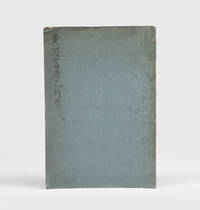
1935184174Qingdao: no stated publisher 1935. Water power First edition of this rare and extensively illustrated proposal for increasing freight traffic and other commercial transport along China's second-longest river and building new port facilities at the mouth in the Bohai Sea. The valuable maps and plans show infrastructure and key locations along the river as well as past and proposed improvements. Cui Shijie 1888-1970 was a government official in Shandong Province charged with regional economic development. Rivers were a core part of his vision for coastal and hinterland prosperity. He published his report four years after the devastating 1931 floods when China's major water systems burst their banks and claimed the lives of up to 4 million people the worst natural disaster ever recorded. The table of contents calls for two end plans that were seemingly not issued as they are present neither in this copy nor in the copy held by the National Library of China. Quarto 255 x 175 mm bound without author's portrait title page and 2-page preface. With all substantive illustrations including 32 maps and plans 12 folding 2 diagrams tables in text. Text in Chinese. Contemporary blue card covers traces of original spine front cover lettered in manuscript. Red pencil underlining in text; old Chinese bookseller's annotated ink stamp on rear cover. Rear cover reattached contents lightly and evenly toned maps plans and diagrams well preserved: very good. unknown
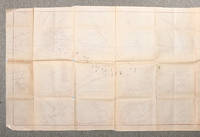
1937176095China: Hai Ho Conservancy Commission 1937. An imposing cartographic document A rare plan untraced institutionally produced on the cusp of the Japanese invasion of Tianjin showing the fruits of a multi-decade effort to turn the city into a major international port. "Connected with the sea by an artificial river Tianjin's status as a seaport was heavily dependent on the continuous conservancy efforts of the Haihe and its tributaries" "River Conservancy". Formed in 1897 the Hai Ho Conservancy Commission focused on opening the channel to shipping for example by straightening the channel and thereby cutting the route to the sea by 17 miles. This plan shows the river's winding course marked with hundreds of survey stones and the build-up of warehouses and wharves by the foreign concessions Tanggu and Xidagu. Also shown are the results of the most recent survey of the seabed at the river's mouth. Although Japan declared war on China in July 1937 it respected the integrity of Tianjin's foreign concessions and river management remained in the hands of the British French and American authorities until Pearl Harbor. At the same time Japan started development of Tanggu Xingang - the foundations of which blossomed into the present-day megaport at Tianjin. Diazoprint plan 67 x 274 cm printed in reddish brown text primarily in Chinese. Contemporary black ink and red crayon marking and annotations in Chinese and Japanese on both sides. Toned old folds a few small splits and losses neatly conserved with tissue: a very good example of a fragile document. "River conservancy and the undetermined future of the port of Tianjin" Open Rivers available online. unknown
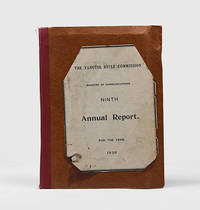
1933165267Nanjing: Yangtse River Commission 1933. Richly illustrated with 130 elevations statistical graphs and plans First edition first printing of this report published in the wake of the devastating 1931 Yangtse floods. In 1930 the Yangtse River Commission focused on hydrological engineering and regulating the channel with surveys conducted at ten of the river's eleven bars. We have traced a single institutional copy of this detailed report held by the Chinese Academy of Sciences Natural Science Library. In keeping with the commission's Chinese and expatriate membership the same information is presented in both English and Chinese. This copy is bound without pages 39-44 of the Chinese-language portion with the corresponding data and text appearing on pages 26-31 of the English section. The bilingual plates employ both English and Chinese. While the English title page dates the report to 1931 this is more accurately a reference to when the text and data were compiled. Quarto 255 x 185 mm. With 130 plates tables in text. Text in English and Chinese. Near-contemporary brown card post-binder purple linen backstrip part of original front wrapper laid down on front cover rear wrapper bound in. Chinese-language section missing pages 39-44. Post-binder worn but still sturdy chipping to first leaf and rear wrapper text generally fresh. A very good copy. unknown
1841117511langlois leclercq fortin masson renard martinet 1841 16 in-8 A Paris, Au Bureau Principal des Editeurs, et chez Langlois et Leclercq/ Fortin, Masson et Cie, Renard, Martinet et Cie, 1841-1849, 16 volumes in-8 de 245x155 mm environ, de 384 à 820 pages par volume, complet de 287 planches annoncées sur la table (dont de nombreuses rehaussées à l'aquarelle). Demi chagrin bleu nuit, dos à 4 nerfs plats portant titres et tomaisons dorés, gardes marbrées. Dos insolés, des frottements sur les coiffes, les coins et les coupes, des épidermures, des rousseurs, des pages brunies, état général satisfaisant.
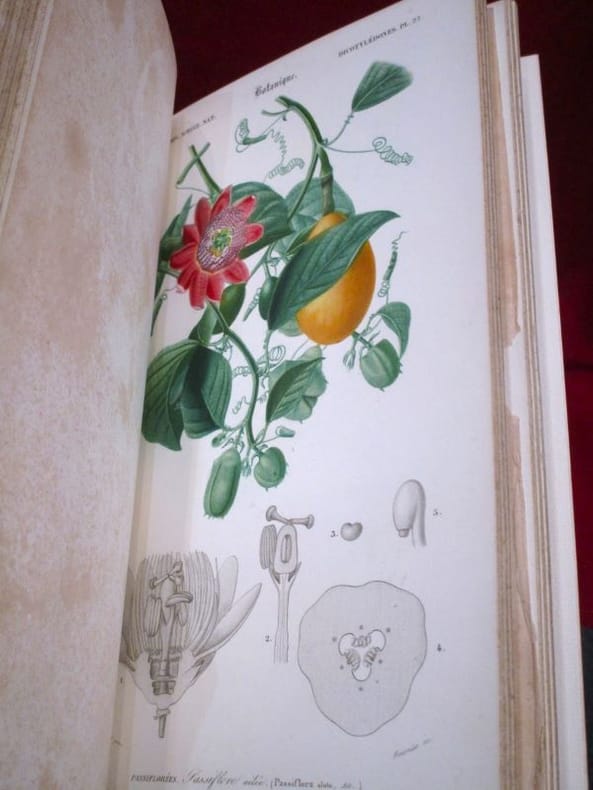
1832PHO-1689Paris, J. Tastu, 1832, In-folio, demi-chagrin noir, dos orné de filets dorés à froid Atlas de botanique seul comprenant 76/80 pl. sur chine collé, liste des planches in fine, peu de défauts.
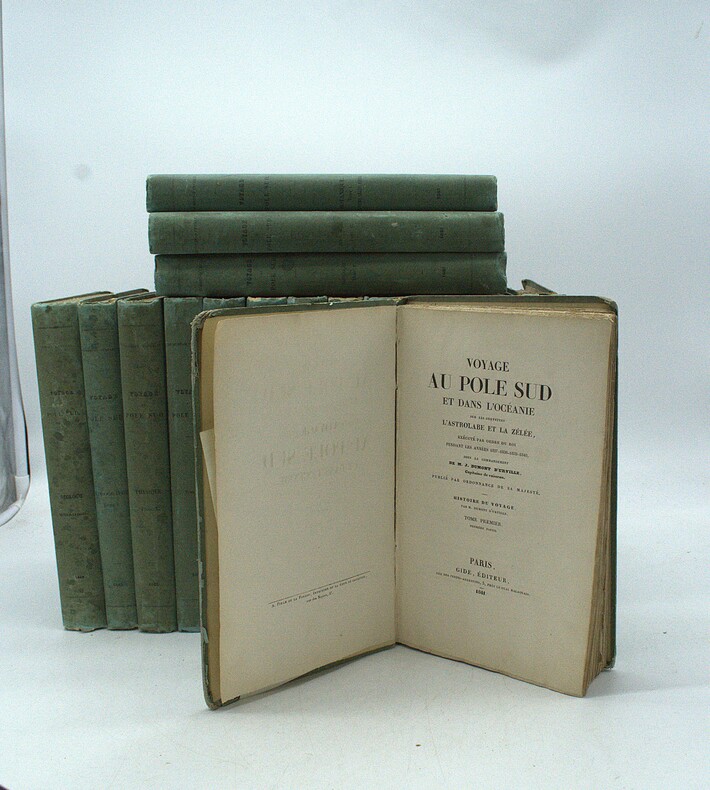
1841PHO-1967Paris, Gide, 1841-1848, in-8, cartonnage éditeur, frottements, qlqs petits manques de matière, coins usés, qlqs coiffes usées, qlqs taches aux plats, T4 avec manque au dos et en haut du 1er plat 16 volumes de texte (sur 21) comprenant : Histoire du voyage, 1841-1846. 10 volumes en premier tirage, (1er tome, 1ère partie correspondant au 1er tome, 1er tome seconde partie correspondant au 2nd tome et 2nd tome, 1ère partie correspondant au tome 3), T2 mouillure en marge sur les derniers feuillets, T4 mouillure, T2 rousseurs, papier légèrement bruni aux tomes 3,4,5,6,7,8 et début tome 9. Zoologie, 1846, 2 volumes (sur 4, tome 1 et2) Botanique, 1845, 1 volume (sur 2), tome 1, plantes cellulaires, papier légèrement bruni Physique, 1842. 1 seul volume (en raison de la mort de Vincendon-Dumoulin) bien que d’autres annoncés, papier légèrement bruni Géologie, Minéralogie et Géographie physique du Voyage. 1848- 1 volume (sur 2, le second paru en 1854), 1 planche in-fine, papier légèrement bruni Hydrographie. 1843. 1 volume (sur 2), 1 planche in-fine, papier légèrement bruni.
46401979, Londres, Nourse ; Paris, Desaint, 1767 ; 2 vol. in-12, veau fauve marbré, dos ornés, tranches bleues marbr. (Reliures de l’ép.). 1 f. blanc, faux-titre, titre, puis paginé de VII à XVI, 353 pp.- 2 ff., 547 pp.EDITION ORIGINALE in-12 parue en même temps et chez les mêmes éditeurs qu’une édition in-4. Dupont de Nemours a qualifié ce livre « d’ouvrage sublime ». C’est Le Mercier de La Rivière qui réussit à enthousiasmer Diderot pendant quelques mois pour la Physiocratie : « Il est le premier qui m’ait éclairé, qui m’ait instruit…Il est le seul qui m’ait donné des idées claires, nettes et vraies du commerce tant intérieur qu’extérieur, et de la nature du commerce en général » (Lettre à Damilaville 1767). « Subjugué par la cohérence de la doctrine exposée par l’auteur, qui avait été intendant des Antilles de 1759 à 1764, Diderot le recommanda chaleureusement à Catherine II puis l’invita en Russie. L’entente ne fut guère parfaite et Le Mercier séjourna seulement à Saint-Pétersbourg d’octobre 1767 à mars 1768. Adepte du despotisme légal qui n’est autre que celui de l’ordre naturel, Le Mercier donna un fondement philosophique à la doctrine économique de Quesnay. Le monarque physiocrate dispose à la fois des pouvoirs législatifs et exécutifs ; il est absolu, mais ce despotisme n’est nullement en contradiction avec l’indispensable liberté économique car le souverain n’est pas là pour faire des lois, mais appliquer les lois naturelles ; faire respecter la propriété et la liberté, telles sont les missions de l’Etat. L’ouvrage se termine par une théorie de l’impôt : le souverain héréditaire est le co-propriétaire foncier du royaume et l’impôt constitue une co-jouissance indispensable des revenus du Domaine » Hasquin. Diderot et son temps n°178 - Lavergne p.183.- INED 2794.- Einaudi 3307.- Kress-Goldsmith 10269.- Janet II p.637.Bel exemplaire avec un ex-libris manuscrit du XVIII e S. « Préau ». Cet ex-libris est rayé et remplacé par celui d’un certain N. Boussé ( ?) qui en avril 1846 a rédigé une note critique sur la garde du tome I. Notes au crayon par le même, dans plusieurs marges de l’ouvrage.
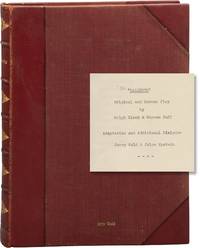
1934161384N.p.: N.p. 1934. Draft script for the 1935 film seen here under the working title "Caliente." Specially bound copy belonging to screenwriter Jerry Wald with his name in gilt on the front board and his annotations in manuscript pencil on the title page.<br /> <br /> Jerry Wald is best remembered for his long and successful association with Warner Brothers as both a screenwriter and producer of a number of notable films including "Mildred Pierce" 1945 "Humoresque" 1946 "Key Largo" 1948 and "Flamingo Road" 1949. In the 1950s he moved to Twentieth Century-Fox and was the producer there for "An Affair to Remember" 1957 "Peyton Place" 1957 and "Sons and Lovers" 1960.<br /> <br /> In order to sober up a hard-drinking magazine editor is sent to a Mexican resort where he falls in love with a dancer about whom he had once written a scathing review. Choreographed by Busby Berkeley. <br /> <br /> Shot on location in Tijuana.<br /> <br /> Bound in red cloth with red quarter leather binding with five raised bands and gilt titles on the spine. Title page present undated with credits for screenwriters Ralph Block Warren Duff Jerry Wald and Julius J. Epstein. 120 leaves with last page of text numbered 115. Mimeograph duplication rectos only with blue revision pages throughout dated variously between 12/21/34 and 1/19/35. Pages Near Fine binding lightly edgeworn and faded else about Near Fine. N.p. unknown
1921ABE-857353084Paris Floury 1921. Renoir et ses amis Riviere George. Paris: Floury 1921. First edition with one original drypoint by Renoir "Le chapeau epingle" Delteil 8 and one color lithograph Tete de jeune fille on front cover printed on fine wove paper in original binding in very good condition. 1st Edition. Soft cover. Very Good/No Jacket. Paris, Floury paperback books
2292Paris Verneau 1900. Lithograph in colors from PAYSAGE PARISIENS. 52.5 X 82CM.From the series OF 8 PLATES "published in 1900 "PAYSAGES PARISIENS" . Each was published in an edition of 1000 plus 25 signed in pencil. In fine condition with full margins. unknown books
1921ABE-857353084Paris Floury 1921. Renoir et ses amis Riviere George. Paris: Floury 1921. First edition with one original drypoint by Renoir "Le chapeau epingle" Delteil 8 and one color lithograph Tete de jeune fille on front cover printed on fine wove paper in original binding in very good condition. 1st Edition. Soft cover. Very Good/No Jacket. Paris, Floury paperback
19352110502150414142Heibonsha 1935. Soft Cover. Fine. Number of books: 11 Heibonsha paperback
1853100379Adelaide: W.C. Cox Printer 1853. First Edition. Hardcover. Very Good. Adelaide W.C. Cox Printer 1853. Octavo 46 pages. Relatively recent quarter morocco and buckram by the Law Bindery Melbourne; title leaf a little foxed with minimal light scattered foxing to a few other leaves; an excellent copy with most interesting provenance see below. The author Clerk of the Executive Council of South Australia was on board the vessel; this is his account of the first successful navigation of the Murray as far as Swan Hill by Captain Francis Cadell. Fellow-passenger James Allen also published his version of events. Captain William Randell and his paddle-steamer 'Mary Ann' left Goolwa at the Murray mouth ahead of Cadell and travelled much farther up the Murray but Cadell overtook him en route and reached Swan Hill first. However both men deservedly earned the bonus of 2000 pounds offered by the South Australian Government 'for each of the first two steamers to travel up the Murray as far as the Darling junction' 'Australian Dictionary of Biography'. We have noted previously the manuscript correction page 5 line 4 'largest' to 'longest' river and presume it is in Kinloch's hand. At the head of the title page of this copy is the pencilled ownership name possibly his signature of Robert Wadsworth over-written in red ink by the subsequent owner 'John Shillinglaw from Robert Wadsworth 1854'. Shillingworth has annotated the text in both pencil and red ink three and seven pages respectively. The pencilling identifies the 'gentleman's son' working as a shepherd as 'old "Bigodd Macdonald"' and asks elsewhere of a sentence nine lines long 'what does this wretched twaddler mean' he's got a point too!. Robert Wadsworth was eventually Clerk of the Victorian Executive Council from 1875 to 1889; of passing interest to bibliophiles his son Arthur 1864-1931 was the first Commonwealth Parliamentary Librarian having 'charge of the Commonwealth library for over twenty-six years while also being titular head of the Victorian State parliamentary library' ADB. <p>John Joseph Shillinglaw 1831-1905 public servant and historian was the eldest son of the librarian of the Royal Geographical Society. 'He was to study under Captain John Washington eminent maritime surveyor and in 1852 he migrated with his father and brothers to Victoria arriving in October. From November he was chief clerk of petty sessions at Williamstown and in 1854 was appointed inspector and sometime acting superintendent of the Water Police. He was also secretary to the Steam Navigation Board until December 1857. In 1856-69 he was shipping-master for the Port of Melbourne and registrar of seamen; he helped to found the first Sailors' Home and did much to improve the working conditions of seamen'. It is hardly surprising that he should be given a copy of this book soon after its publication. He held various public service positions over the years; from 1885-94 he 'was secretary to the royal commission on vegetable products. He was also secretary to the Board of Viticulture. Shillinglaw was an enthusiast in whatever department he worked; however he is remembered for his association with colonial literature and history'. He was the author of numerous books and on his death his estate 'included a vast collection of papers and rare books' presumably including this item ADB. Ferguson 11196. W.C. Cox, Printer hardcover
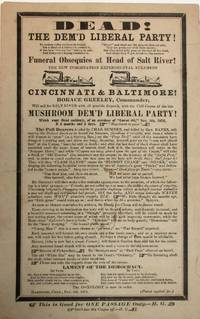
187238915Hartford 1872. Broadside 6" x 9-1/2" text surrounded by mourning border. A few spots Very Good. Illustrations of two steamers. At the bottom: "This is Good for ONE PASSAGE Only. - H.G." Dated at Hartford November 5 1872.<br /> <br /> "Salt River" is 19th century American slang: a losing candidate for office was taking a trip "up Salt River." Tickets for passage "up Salt River" were frequently printed to mock supporters of losing candidates. <br /> This humorous scarce broadside taunts Horace Greeley and other defectors from the Republican Party for their support of Greeley in 1872. "On the overwhelming defeat of the Liberal Republican Party and its candidate Horace Greeley in the presidential election of 1872. Greeley had been nominated at a Liberal Republican convention at Cincinnati in May and at the Democratic National Convention at Baltimore in July 1872" AAS description.<br /> Pall bearers include Charles Sumner and General Banks prominent Republican supporters of Greeley.<br /> OCLC 191231113 2- AAS Middlebury 47090036 1- CT Hist. Soc. as of August 2025. unknown
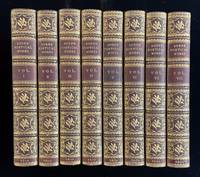
1834013113London: Cochrane & M'Crone 1834. 1st Edition Thus. Hardcover. Near Fine. A lovely 8 volume set in polished speckled full leather double- ruled covers front and back floral dentelles aeg spine with six compartments gilt raised bands. Incidental spotting to the interior here and there. Solid bindings all around. Cochrane & M'Crone hardcover
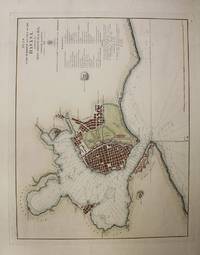
1844M6443London: Chart Committee of the Admiralty c. 1844. Very Good; four small tears in the upper right right and lower right margin professionally repaired and not affecting the image. Notes: Originally printed in 1798 in Spanish later translated by Faden in 1804 and again in 1844. Hydrographic Office seal in top right. The bay is marked with depth soundings. In the upper right of the map is a legend denoting various landmarks and edifices on the map. Size : 446x551 mm 17.56x21.69 Inches Coloring: Hand Colored Reference: Cueto 189 Category: Maps City Maps;Maps West Indies Cuba & Bahamas; Chart Committee of the Admiralty unknown
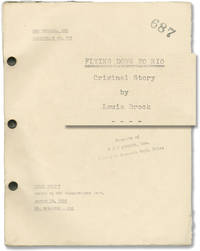
1933153095Culver City CA: RKO Studios Inc 1933. Final Draft script for the 1933 film. Carbon typescript on onionskin with production number "687" and "Property of RKO Studios Inc. Return to Scenario Dept. Files" stamps on front wrapper.<br /> <br /> Based on an unpublished play by Anne Caldwell and Louis Brock. One of the most famous dance debuts in film history featuring the iconic team of Fred Astaire and Ginger Rogers performing "The Carioca." The film's success set a dance and music craze across the country and made the pair bankable worldwide for a string of classic films. Nominated for an Academy Award.<br /> <br /> Set in and shot on location in Rio de Janeiro Brazil. <br /> <br /> Tan titled wrappers noted as FINAL SCRIPT on the front wrapper rubber-stamped production No. 687 dated August 25 1933 with credits for author Louis Brock. 161 leaves with last page of text numbered 159. Ribbon copy typescript rectos only. Pages Near Fine wrapper Near Fine bound with three gold brads. RKO Studios, Inc unknown
184829072New York: Van Norden 1848. The 1st annual report of the Hudson River Railroad not recorded on OCLC. Early reports authorizing the construction of the railroad from NY to Albany are dated 1848; the 2nd Annual Report of the Directors of the Hudson River Railroad is dated August 1849 <br /> The New York & Harlem Railroad NY&H was incorporated in 1831 to build a line in Manhattan from 23rd Street north to 129th Street between Third and Eighth Avenues the railroad chose to follow Fourth Avenue. At first the railroad was primarily a horsecar system but in 1840 the NY&H's charter was amended to allow it to build north toward Albany. In 1844 the rails reached White Plains and in January 1852 the NY&H made connection with the Western Railroad later Boston & Albany at Chatham New York creating a New York-Albany route. The Hudson was a busy river and the towns along it felt no need for a railroad - except during the winter when ice prevented navigation. Poughkeepsie interests organized the Hudson River Railroad in 1847. <br /> <br /> 8vo 24 page pamphlet. Printed paper wrappers one folding sheet of statistics tipped-in. Ex-lib with Hamilton College Library stamp and catalog numbers at front cover and slt foxing internally o/w very good. A fascinating first look at the Hudson River Rail line with the progress to date" now about 3000 men working between this city and Poughkeepsie the most of them between the city and Breakneck hill." p2. Van Norden unknown
1851406078New York: Wm. C. Locke & Co 1851. Wrappers chipped at edges professionally rebacked some unobtrusive offsetting on map. 8vo. 50 pages. Large folding map on three joined sheets 21 x 1788 cm; 8.25 x 61.75 inches. 11 woodblock illustrations in text and with 2 more not recorded in the index but always present. Original printed wrappers with woodblock vignette. SCARCE Hudson River Railroad travel guide published the first year in which the full line was completed. It covers points of interest along the route with woodblocks illustrating the text. Topics include: the history of the Hudson River the history of the construction of the Hudson River Railroad and the cities towns and villages along the Hudson from New York City all the way to Troy. Concerning the West Point Foundry at Cold Spring the guide states: "the iron foundry was established here by Gouverneur Kemble. The works are situated about a mile west of the village upon a small stream which tumbles rapidly down the mountains affording considerable water power. It is the largest establishment of its kind in the country employing nearly five hundred hands constantly." The building of the Hudson River Railroad is another topic in the guide. The project was considered highly impractical since much of the route had to be cut through extremely difficult rock and terrain. This section includes a description of the tunnels which had to be constructed. The railroad was opened in three stages. In September 1849 it allowed passengers to travel from New York to Peekskill. By that December 6 twenty-three additional miles were opened extending to New Hamburg. By the 31st of the month it was open the remaining distance of nine miles to Poughkeepsie. The Hudson River Railroad was an extension of the Troy and Greenbush Railroad which was chartered in 1845 connecting Troy South to Greenbush now Rensselaer on the east side of the Hudson. The Hudson River Railroad was chartered on May 12 1846 to extend this line south to New York City. The full line opened on October 3 1851 the same year in which this travel guide was published. WorldCat/OCLC records 25 copies but it is scarcely found complete with the map and the map is also excluded from the digitized versions available online. <br/><br/> Wm. C. Locke & Co unknown books
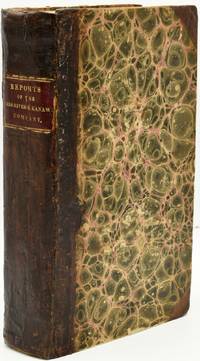
1841283161Richmond: Shepherd & Colin Printers 1841. First Edition. Half Leather. Poor binding. The first six Annual Reports of the President to the Stockholders of the James River and Kanawha Company for the years of 1835 through 1840. The canal was first developed by the James River Company in 1790 resumed in 1820 by the Commonwealth of Virginia and revived for the second and final time by the James River and Kanawha Company. By the final of these annual reports the canal reached only to Lynchburg and would later be driven out of operation by damage sustained by the Civil War and competition by the C&O railroad. With a large folding map of a proposed canal from Richmond to Tidewater. Foxing to the preliminaries; Japanese tissue reinforcement to the hinges. Half calf over marbled paper with a leather label. Uncommon. OCLC notes one holding each for the First Second and Fifth Annual Reports only. Poor binding. Shepherd & Colin Printers unknown books
194920.809Santander: Imp. de la Librería Moderna 1949 -1962. 1ª ed. Tela verde con títulos dorados en los lomos. 12.5x17.5. Firma de y ex-libris de anterior propietario. Alguna huella de óxido en algunos tomos pero buenos ejemplares Imp. de la Librería Moderna hardcover
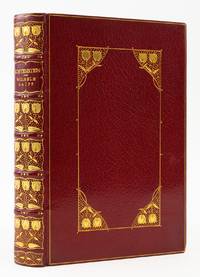
1900ST17635London and New York: Ernest Nister; E. P. Dutton & Co ca. 1900. 194 x 125 mm. 7 5/8 x 4 7/8". 304 pp.Adapted for English readers by L. L. Weedon. <br/> EXTREMELY ATTRACTIVE CONTEMPORARY RED MOROCCO BY RIVIERE & SON stamp-signed in gilt on front turn-in covers with gilt-ruled border and panel the panel corners each with two tulips stems on ground stippled in gilt raised bands one compartment with gilt titling the others densely gilt with three tulip stems on ground stippled with gilt and within a curving gilt-ruled border gilt ruled turn-ins with gilt tulips and stippling at each corner red watered silk pastedowns and endleaves all edges gilt. With frontispiece seven plates several in text-illustrations and head- and tailpieces by T. H. Robinson. AN ALMOST PERFECT COPY the binding especially lustrous and virtually pristine internally.<br/> <br/> This is a beautifully bound English translation of a popular German historical romance set in 16th century Württemberg. Inspired by the novels of Sir Walter Scott poet and novelist Wilhelm Hauff 1802-27 set his tale in Swabia during the reign of Duke Ulrich 1487–1550 a volatile nobleman dubbed "the Swabian Henry VIII" for his scandalous exploits. The novel appeared in German in 1826 just a year before the author's untimely death from typhoid and was a huge success. Duke Ulrich's descendant Duke Wilhelm of Ulrach was so taken with the story that he restored the eponymous Lichtenstein Castle. With prominent gilt blossoms against a stippled ground our especially pretty Riviere binding is done in the style of the Doves workshop which was flourishing under the direction of Thomas J. Cobden-Sanderson at the time of publication. The long-lived Riviere firm began with Robert who set up as a bookseller and binder in Bath in 1829 then established a bindery in London in 1840; in 1881 he took his grandson Percival Calkin into partnership at which time the firm became known as Riviere & Son; the bindery continued to do business until 1939 when it merged with Baytun of Bath. Rivere's work has consistently been of the highest standard throughout its long years of operation. The binding here is little changed since the day it left the workshop and the glossy brilliant white leaves of the text look like new. Ernest Nister; E. P. Dutton & Co unknown
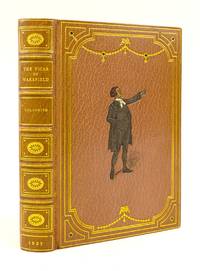
1927ST16866hLondon and New York: Macmillan Co 1927. 191 x 127 mm. 7 1/2 x 5". xxxvi 306 pp.Preface by Austin Dobson. <br/> CHARMING CONTEMPORARY FAWN-COLORED PICTORIAL CRUSHED MOROCCO BY RIVIERE & SON covers with frame formed by multiple gilt rules with onlaid green dot cornerpieces and gilt festoons at head and tail of frame central PICTORIAL INLAY IN FOUR COLORS depicting a vicar pontificating and in front of him as an indication of shadow thin penwork lines inscribed into the morocco; raised bands spine gilt in French fillet compartments with central gilt patera wide gilt-framed turn-ins with ribbon cornerpieces leather hinges marbled endpapers all edges gilt. In a linen-covered slipcase. With frontispiece and 181 illustrations in the text by Hugh Thomson. ◆Spine very slightly and uniformly sunned toward a butterscotch color but A VERY FINE COPY the text clean fresh and bright and the lustrous appealing binding with only the most insignificant wear.<br/> <br/> This copy of Goldsmith's classic is delightful enhanced by the appealing illustrations of Thomson and the book's charming pictorial cover. Riviere is one of the foremost names in English binding partly because the firm did consistently fine work and partly because it was so long in business. Robert Riviere began as a bookseller and binder in Bath in 1829 then set up shop as a binder in London in 1840; in 1881 he took his grandson Percival Calkin into partnership at which time the firm became known as Riviere & Son and the bindery continued to do business until 1939. <br /> <br /> Written in 1761-62 but not published until four years later "The Vicar of Wakefield" was said to have been rescued from some of Goldsmith's unpublished manuscripts by Dr. Johnson who thus saved the penniless author from debtors' prison by selling it to a publisher for £60. Considered to be the masterpiece of the middle-class domestic novel the "Vicar" has never gone out of style because its whimsically delineated characters have a delightful simplicity that somehow insulates them against ultimate misfortune and the innocent and virtuous are rewarded as they should be in the end. Macmillan Co unknown