Garcia del Rio, Juan, editorBiblio.com
433 résultats
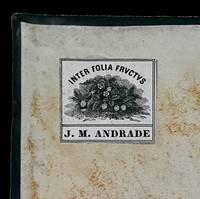
1842LL 513<p><strong>El Museo de ambas Américas.</strong></p><p>Polished black morocco paneled in blind spine titled and decorated in gilt. Subscribers' lists in volumes 1 & 3. Provenance: Bookplate of Jose Maria Andrade 1807-1883 the famous Mexican bibliophile and publisher. FIRST EDITION AND A COMPLETE RUN of all 36 issues of this very early and important Chilean periodical. The year 1842 marked a "before" and an "after" in the intellectual development of Chile. Along with the creation of the University of Chile one of the most significant milestones of that year was the crystallization of a literary movement that would end up acquiring a foundational character not only in regard to Creole intellectual output but also to link it with political discourse. At the head of this project were José Victorino Lastarria and Francisco Bilbao among other thinkers who sought to infuse society with the revolutionary ideals of freedom equality and fraternity using above all the periodical press. The cultural activity in the crucial year 1842 was matched in by appearance of three publications that would mark the course of the intellectual movement: Revista de Valparaíso El Semanario de Santiago and El Museo de ambas Américas The Museum of both Americas. This triad reflects the fundamental role that the port of Valparaíso played as the transfer point for European ideas which then radiated to the capital. El Museo de ambas Américas shows the state of the social political and economic views of the Chilean intellectual culture of the period. Its cosmopolitan spirit is evident in the declaration of principles of the magazine and is also reflected in the themes developed there. Edited by the Colombian Juan García del Río the publication played a central role in the controversy between Chileans and Argentines and in the creation of the intellectual movement that would reach its consolidation with the Revista de Santiago. The magazine contains numerous articles on the continental spirit and on the idea of America forged since Discovery and Conquest. It also highlights the concerns about education which for those years was a central issue in the discussions of the intellectual movement as well as public hygiene policies and their link with the development of the Republic. The reflection on history and culture became more and more intense as the century progressed and El Museo de ambas Américas reflects this concern. The erudite character of the magazine is shown in its "Efemérides" and its "News and curious facts". Scarce. We could locate only one at auction in the last 50 years. Sabin 51564. Palau 186430. WorldCat US Libraries: 11 copies. Yale Stanford Harvard BL Universities of Stony Brook Michigan Iowa S. Illinois N. Carolina Houston and Texas at Austin.</p> Imprenta de M. Rivadeneyra
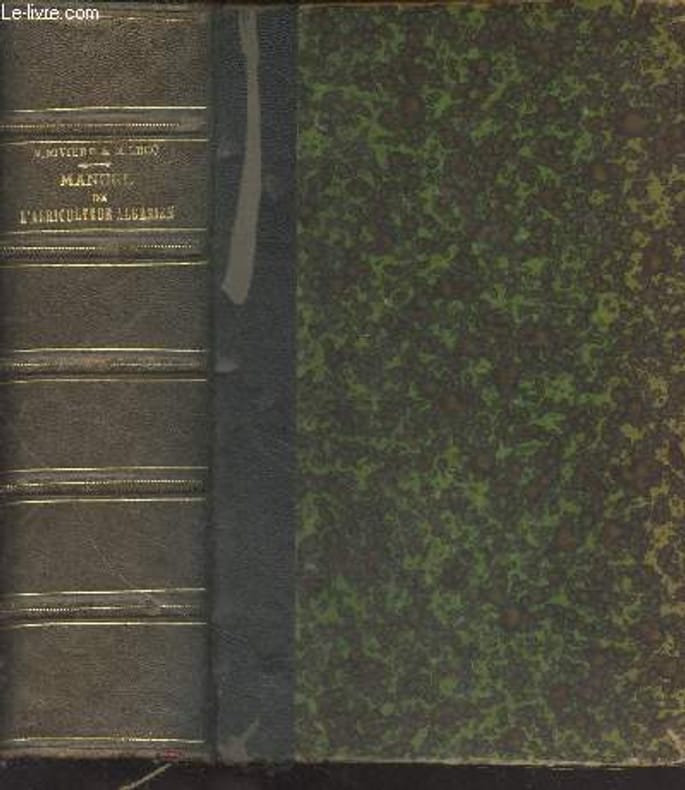
1900R300328911Augustin Challamel. 1900. In-8. Relié demi-cuir. Etat d'usage, Coins frottés, Dos frotté, Papier jauni. XV + 1143 pages - quelques illustrations en noir et blanc dans le texte. Plats et contreplats jaspés. Dos cuir à 5 nerfs, titre, auteur, filets et roulettes dorées. Mors légèrement fendus en coiffe de pied.. . . . Classification Dewey : 965-Algérie
18860103# AUTEUR: A Melandri # ILLUSTRATEUR: Henri Rivière # ÉDITEUR: A Quantin imprimeur éditeur - Paris # ANNÉE ÉDITION: 1886 # COUVERTURE: demi toilé rouge - monté sur onglet - composition en couleur sur le 1er plat - bords biseautés # DÉTAILS: In 4° relié 2ff + 33pp + 2ff. Edition originale . 1er tirage des lithos de H Rivière en plusieurs tons qui avait 22 ans lorsqu'il illustra cet album où l'influence japoniste est sensible (Huret) # PHOTOS visibles sur www.latourinfernal.com
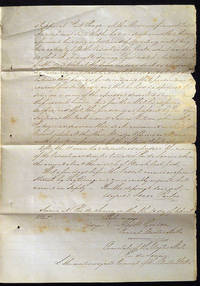
18450002564Good. 1845. On offer is a sensational remarkable group of 1845 manuscript depositions detailing the mutinous activity and desertions during a voyage of the whaling Bark Alto between 1844 - 1845. The eyewitness testimonies are comprised of 37 pages or so of handwritten fair copies; five 5 complete and one 1 incomplete deposition all by various crew members the five complete copies each personally attested and signed at the conclusion by George William Gordon American Consul at Rio de Janeiro May 20 1845. Blunt facts display the ferocity of emotions and simmering violence provide snippets like 'Palmer said to deponent that . . . he would put one of those dirk knives into him' abound throughout the testimonies. The depositions paint a picture of unbridled upset on the ship: lawlessless violence suspicions of poisoning desertion and a final critical comment from nature itself: a calamitous lightning strike makes for a final exclamation point to the awful whaling voyage. The vessel at the center of the events described herein the Alto was built in Tiverton Rhode Island we note that research indicates the Alto was in fact the only such vessel ever built at Tiverton in 1826 and was lost near the Falkland Islands in 1870. The National Maritime Digital Library date the events related in the documents occurred during the Alto's fourth voyage under the direction of Captain Nehemiah West whose deposition is included and which lasted from September 1844 to April 1847. A successful voyage commercially as the records further note that the Alto collected 339 barrels of sperm oil 304 barrels of baleen oil and 2700 lbs. of whale bone. As a group the depositions--from the Captain First Second and Third Mates and two boat helmsmen paint a vivid often harrowing picture of a voyage fraught with tension and danger. Researchers and historians will note that at least two of the depositions document an ominous shipboard discussion of the earlier well-documented mutiny aboard the vessel Globe out of Nantucket which took place in 1827. While the general outline of the events remains consistent throughout each of the deponents provides a unique personal perspective on what transpired often with the addition of unexpected or surprising details omitted by the others. Virtually all of the crew involved are identified by name multiple times throughout the documents two however are repeatedly described only as "Portuguese". In broad overview complaints from crew members that the vessel is leaky and unseaworthy leads to refusal to perform duties; the captain administers punishment including placing crew members in irons and striking them with a piece of "rattling" ratline; a small group of crew desert with one of the boats but are caught and jailed at St. Jago Cape Verde and shipped back to the U.S. on the U.S. Sloop of War Decatur; after a few months of relative calm unrest breaks out again this time with threats of violence to fellow crew members with clubs and "dirk knives"; in the most dramatic event eleven crew members desert with the remaining two boats taking with them a large store of the whaling equipment. The Alto its crew and equipment drastically reduced suffers the final indignity of a lightning strike "breaking and splitting" the mainmast but is able to hobble into Rio de Janeiro where these eyewitness accounts were given to the American Consul and preserved in the present documents. Here is a snippet from the deposition of helmsman William Williams approx. 8 pages on two pairs of conjugate leaves: "William Williams . . . deposed as follows. . . . That he was born in the County of Essex in England is 29 years of age and a naturalized citizen of the United States was naturalized at Boston Mass. in July 1842. That he shipped on board the Barque 'Alto'--Nehemiah West Master at New Bedford in August 1844 as Boat steerer to proceed on a Whaling Voyage. That the Vessel sailed on the 3rd September following. That 14 or 15 days after the Vessel went out to sea all the foremost hands refused duty--alleging that the Vessel was leaky. On their refusing duty Captain West interrogated each of them separately and three of them returned to duty and eleven still refused and were sent below where they were kept about 48 hours. While the eleven men were below as aforesaid they experienced two very heavy squalls but none of said men offered to return to duty--but on the other hand made sport of them that were at work. After they had been below deck 24 hours the Master went forward and requested four of the men to come on deck. They refused to come unless all were allowed to some on deck at a time--and after a good many threats on the part of the men the Master told them that if the men he had called did not come on deck that he would have the forecastle smoked to force them out. Soon after four came on deck as the Master had directed and still refusing to go to duty on being called upon the deck and refusing duty were put in Irons and the others one being called upon deck and refusing duty were seized in the rigging there being no Irons to put upon them. That at New Bedford before sailing one of the men named Spencer who had shipped deserted and another man named Charles Shane came on board in his place--but Shane's name was not put on the Papers. That when the men were called up as aforesaid said Shane took the ground that his name was not upon the Shipping Paper and therefore he would not go to duty and obey the Master--upon which the Master gave him four blows with a piece of Rattling i.e. part of the ratline. George Ritter also who was supposed to be the instigator in the men's refusing duty and who was insolent to the Master also receive three strokes with the Rattling. Another man the steward named James Wilson also got three blows with the Rattling for insolence to the Captain. He said that he never was flogged on board of a Blubber Hunter although he had been on board of a Man of War. No others were flogged or punished in any way and they all returned to duty." Scattered light soiling a bit of staining and handling wear creases; some tears tiny holes and small chips mostly confined to edges; no substantial losses; otherwise very good to fine overall the writing dark and distinct. Overall G.; Manuscript; 4to - over 9¾" - 12" tall; KEYWORDS: HISTORY OF WHALING SHIP MUTINY BARK ALTO NEW BEDFORD MASSACHUSETTS WHALERS MUTINEERS DESERTERS BARQUE MARINE NAUTICAL NAVAL GEORGE WILLIAM GORDON AMERICAN CONSUL AT RIO DE JANEIRO CAPTAIN NEHEMIAH WEST TIVERTON RHODE ISLAND MUTINY ABOARD THE VESSEL GLOBE NANTUCKET AMERICANAHANDWRITTEN MANUSCRIPT DOCUMENT LETTER AUTOGRAPH WRITER HAND WRITTEN DOCUMENTS SIGNED LETTERS MANUSCRIPTS HISTORICAL HOLOGRAPH WRITERS AUTOGRAPHS PERSONAL MEMOIR MEMORIAL AMERICANA ANTIQUITÉ CONTRAT VÉLIN DOCUMENT MANUSCRIT PAPIER ANTIKE BRIEF PERGAMENT DOKUMENT MANUSKRIPT PAPIER OGGETTO D'ANTIQUARIATO ATTO VELINA DOCUMENTO MANOSCRITTO CARTA ANTIGÜEDAD HECHO VITELA DOCUMENTO MANUSCRITO PAPEL . unknown
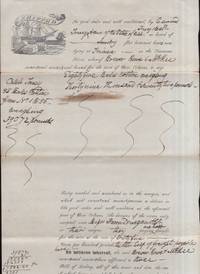
184836021Triana Alabama: n.p. 1848. Paper. Very good. Paper. Approximately 12.5" x 8." Folded. Front side is printed and hand written. Back side is a written receipt and written bill of lading for the cotton belonging to the Caleb Toney estate. Illustrated shipping letterhead from the Brewer Rowe & McKee that 85 bales of Cotton formerly owned by Caleb Toney were being shipped on "flat bottomed boats now lying on the Tennessee River whereof "Brewer Rowe & McKee owners and masters and bound for the port of New Orleans." At this time the best cotton land in the country was located along the Tennessee River from Whitesburg then known as Ditto’s Landing extending to a point three miles west of Triana. Madison County as we all know has led all counties in the State in cotton production practically without interruption since its creation in 1808. In 1816 it<br /> produced ten thousand bales for the market which according to The National Intelligencer was twice the production of any county of its size in the U.S. The big problem now facing the cotton merchants was transportation. With no railroads the only means of transportation was by navigation. As early as 1815 the leading businessmen of the county were making plans to meet the situation. Cotton had to reach the Tennessee River to be loaded on steamboats and transported to New Orleans via Paducah Kentucky down the Ohio River to Cairo and thence into the Mississippi for its ultimate destination.<br /> <br /> There is one family in particular that Judge Taylor refers to in his history the Toney Family. There were three brothers Harris Caleb and Edmund. They came into Madison County in 1818 and were among the first to buy land in the Triana vicinity. These three brothers were men of considerable means as judged by the standards of<br /> that time and quickly identified themselves with the development of Triana. Harris Toney was the eldest and the leader. He first engaged in the merchandising and cotton business later investing his ample means in farm lands and Negroes. He was far in advance of his time in his methods of farm development and was laying plans so extensive they would have overshadowed all other agricultural enterprises of his time but unfortunately he did not live long enough to see the fruition of his undertaking. He died according to Judge Taylor’s history in the prime of his manhood. Don’t know just when that was. He evidently was never married as his lands and properties were inherited by a Mrs. Coons and Mrs. Barclay. The next oldest brother Caleb died at an early age. <br /> <br /> The youngest of the three Col. Edmund Toney was one of the best businessmen of his day possessing excellent judgment and sound business sense. It was said of him that in his whole life he never was known to make a financial blunder. While the war stripped him of slaves and his land ran to waste yet at the close of the war he<br /> was out of debt and able to embark in the General Merchandising business in Triana. He died in 1877 at age 77 and is buried in Maple Hill Cemetery.<br /> <br /> Excerpts taken from Highlights in the History of Triana by Charles Dillard Lyle printed in The Huntsville Historic Quarterly June 21 1997. n.p. unknown
18997339Raton NM 1899. 36 silver prints 9.5 cm x 12 cm / 3.75" x 4.75" on curved gray Kodak decorative mounts 14 cm x 17 cm / 5.5" x 6.75". All 36 have manuscript identifications and descriptions on the back in black ink. A few mounts show minor rubbing and discoloring at extremities one mount chipped at the head. Some images have gentle spotting and fading.<br /> <br /> - Our Home Raton New Mexico<br /> - New Store built for us in Raton 1898<br /> - Out for a Drive By reservoir on Chico Rico New Mex. 1898<br /> - Out for a Drive. Sugarite Canon 1898.<br /> - A pretty camp on mouth of South Fork Conejos River Colo. 1898 <br /> - Scene on Conejos River on mouth of South Fork Colorado. 1898<br /> - Camp above Falls on Conejos River Colorado 1898<br /> - Conejos River above Falls Colorado 1898<br /> - Conejos River above Antonito from Bridge 1897 <br /> - Our camp on shore of Lake on Lake Fork of Conejos River. Colorado 1898.<br /> - Lake on Lake Fork Conejos River Colo 1897.<br /> - Boat riding on Conejos Lakes. 1898 <br /> - A bit of tough road on Conejos River men holding wagon on road by Poles. 1898 <br /> - Camp scene on Elk Creek Colo. 1898<br /> - Mr. Davies and our Camp on Elk Creek. 1898<br /> - Dinner on Elk Creek 1898 <br /> - Head of San Juan River Continental Divide Colorado 1897<br /> - Scene on West Fork San Juan River Colorado 1898<br /> - Hours Lake. West Fork San Juan River Colorado 1897 <br /> - Engine Rock on East Fork San Juan River 1898<br /> - Our camping outfit on East Fork of San Juan River. Colorado 1897<br /> - A grand wild spot above Hot Springs on San Juan River Colorado 1897<br /> - San Juan River as it flows through Park in Pagosa Springs Colo 1898<br /> - Our Partner Whistler's camp in Park Pagosa Springs Colo. 1898.<br /> - Harvey mounted on a Rocky Mountain Canary. Pagosa Camp in Park Colorado 1898<br /> - Our friend Jon Blake's House Pagosa Springs Colo.<br /> - Up in Brazos Gorge Showing Side Walls 1898<br /> - Whistler fishing in Mouth of Gorge on Brazos. 1898<br /> - Harry Sallin Shep packed Brazos River Camp 1897<br /> - Sallin her friend at Lake Camp Colorado 1897<br /> - Our beauty in morning. Camp on Brazos. 1897<br /> - Your humble servant with a nice trout in tow. Mouth of Brazos Canon 1898<br /> - A few Rabbits Ducks on Crow Creek 1898<br /> - Palisades in Cimarron Canon on Cimarron River New Mex. 1898<br /> - Our camp on Sulphur Spring Cimarron Canon 1898.<br /> - Flume on a draw on top of Sanga De Christo Range. Colfax Co. Part of a ditch 54 miles long. Used for Hydraulic mining. Nice collection of late 19th century images showing intentional camping and recreating in southern Colorado and northern New Mexico created by a family in Raton New Mexico. Images of camping riding hunting fishing boating etc. All views are nicely identified. unknown
1893RO30337205Chevalier-Marescq et cie/ E. Plon, Nourrit et cie. 1893. In-16. Relié demi-cuir. Etat d'usage, Couv. partiel. décollorée, Dos frotté, Papier jauni. 402+254+86+176+159+932+72 pages (1 volume). Fortes épidermures et accrocs en plats. Quelques rousseurs. Coins rognés, émoussés. Titre et auteur en doré au dos.. . . . Classification Dewey : 340-Droit
189864137Bay View & La Conner WA: A. Eugene Lovell 1898. Oblong 12mo. 7 x 5.5 in. 12 pp unpaginated. thick gray card stock slotted die-cut windows for inserting photos with 11 original photographs sized 3.25 x 4.25 in. 6 albumen on thin photo paper 5 silver gelatin on matte finish photo paper 1 manuscript Christmas note presenting the album Christmas 1898 a few ever-so-faint pencil manuscript captions below. Pebbled textured black cloth silver lettering stamped on front cover minor edgewear soiling to rear pastedown minor soiling to final image still a VG- exemplar. This souvenir album opens with beautiful sunset shot across the Columbia River followed by a photo of a young woman standing in front of well-appointed home with Hops growing along the porch. These are followed by photos capturing shipping along the Columbia River with the British sailing yacht Samantha out of Liverpool tied up to the Bailey Gatzert sternwheeler; the sternwheeler Kehani which operated from Portland originally launched in 1890 and was rebuilt and renamed Ottawa in 1905; a nice front view of the passenger sternwheeler Regulator built originally in 1891 by Louis Paget for The Dalles Portland & Astoria Naviagation Co. known as the Regulator Line operating steamer service from The Dalles to the Lower Columbia River past Kalama. Other photos depict a stately Victorian hotel on pilings near the shipping channel; a shipwreck of a 3-masted schooner on its’ side buried in the sand; and Cape Horn along the River prior to construction of the rail line. The final photo captures the waterfront of Astoria in 1898 with warehouses and canneries on pilings and houses above on the bluffs. Lovell 1883-1976 moved from Illinois to Washington following the death of his father William Lovell with his mother Susan Lovell and brothers Charles & Harry Lovell who homesteaded near La Conner WA after first settling in Bay View WA in late 1898. The trip must have been prior to July 12 1898 as the Regulator sternwheeler depicted in one of the photos wrecked at the Cascade Locks July 12 1898 was salvaged and rebuilt with a larger and heavier hull launching Feb. 1899. A. Eugene Lovell, hardcover
187651606070049The Enquirer Printing and Publishing Co 1876. Leather. Acceptable. Fair leather hardcover. ORIGINAL 1876 PRINTING. 598 pages. 3" X 5". Text unmarked. Some pages light foxing spots. Covers show heavy edge wear with rubbing/scuffing and bumped corners. Spine covered with paper. Hinges cracked but binding still intact. Previous owners name on inside front cover.; 100% Satisfaction Guaranteed! Ships same or next business day! The Enquirer Printing and Publishing Co hardcover
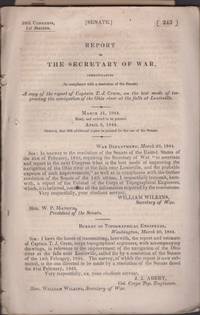
184434812Washington DC: n.p. 1844. Wraps. Incomplete. Disbound loose wraps. 34 pages. Illustrated with 16 numbered folding plans and sections with an additional 5 folding maps and plans not numbered. Stitching has been removed and contents and plans are loose and separated. One plan has a closed tear at the fold intersection. No loss of content. Maps and plans are in good condition. Text ends on page 34 with no back cover. Contents lightly toned and clean. <br /> <br /> Issued in 1844 this copy has 21 folding plans and maps of which 16 are numbered. It does not have all the 27 folding plates and maps compared to the 1845 copy currently held by the Cincinnati Public Library their copy states "Part 2". Does not appear maps or plans were removed at the back. Possible that this copy is incomplete but difficult to verify if the 34 page text came with 21 drawings or 27 drawings initially. n.p. unknown
188760494Salem OR: n.p. 1887. 8vo. 6 2 pp. Self-printed softcovers & title minor shelfwear dustsoiling still a VG bright copy from the library of Caroline Augusta Gray Kamm 1840-1932 noted socialite and philanthropist in Portland built home for poor women & girls with the YWCA and was daughter of PNW pioneer William H. Gray 1810-1889 who traveled to the Lapwai Mission in Lewiston ID in 1836 where he was the Nez Perce secular agent and she subsequently later married Jacob Kamm 1823-1912 pioneering Oregon steamship builder industrialist entrepreneur and co-owner/operator of the Ilwaco Railway & Navigation Co. First edition of this scarce speech delivered by J.H.D. Gray 1839-1902 who was the first Euro-American “White†male child born west of the Rocky Mountains after his pioneer father William Henry Gray 1810-1889 came West with Dr. Marcus Whitman in 1836. This speech was one of the earliest proposals to construct a “large iron gastron†dam immediately above the Dalles filled with heavy timbers to back up enough water so that the treacherous Celilo Falls could be deepened and enable continuous navigation on the Columbia River. Largely due to financing political will and the Herculean engineering obstacles this dream would not reach fruition until March 10 1957 when the floodgates of The Dalles Dam were opened 70 years later. J.H.D. Gray first began working for his brother-in-law Jacob Kamm’s Oregon Steam & Navigation Co. in 1858 and ran sternwheelers from Celilo Falls to Lewiston ID to the Owyhee Crossing and onto the Snake River. After losing his hand he began operating the sternwheeler U.S. Grant between Astoria and Ilwaco and in 1886 was elected to the Oregon State Senate. No copies in Worldcat. n.p.], paperback
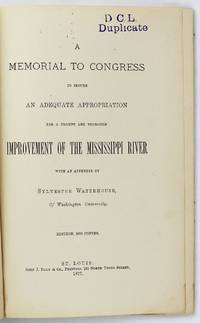
18775827St. Louis 1877. Good. 239pp. Original limp cloth covers gilt. Light fading and wear. Library ink stamp on title page. Minor wear to contents. Memorial submitted to Congress by the members of the River Improvement Convention held in St. Paul advocating for an allocation of government funds to improve the flow and path of the Mississippi River to better accommodate trade along the water route. unknown
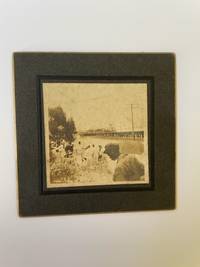
1900177661900. Early African American PHOTOGRAPHY -- RELIGION. silver gelatin photograph of a river baptism featuring a large group of African American subjects. Mississippi ca early 1900s. Photograph size is 2 1/4 x 2 1/4 in. Original silver gelatin photograph on cardstock mount .A young African American man wearing a hat and suit stands with his back to the camera we see in the foreground on the riverbank a group of African American subjects in light clothing close to the water's edge. A large ship is just visible beyond the dock in the background. Pencil inscription on verso reads "Miss- Colored Baptizing." 9Not: Historical records are evidence of the time in which they were created and often contain language are racist or derogatory and insensitive. This content does not reflect our values. These type of baptism on the banks of the Mississippi River were a public ceremony that attracted many converts in the South to the Delta region. Predominately African American Baptists performed their sacred ritual of outdoor baptisms on the Mississippi River until well into the 20th century in this Baptist-heavy state. Immersion baptisms typically took place in rivers or other natural bodies of water and summer and fall were the natural seasons for these congregational events. This rare photo captures a religious practice that has been integral to African-American Baptists for centuries. Photo has some toning surface soiling spotting and very small tear to right edge. But is still clear and in good to very good condition. unknown
1900662751900 Paris, Editions de la Plume, 1900, in huit, 32 pp, broché, état convenable, légers manques à la couverture ,intérieur frais,
1883PHO-1179Paris, imp. Noblet , Administration: 12, rue Visconti, sd (circa 1883) . In-folio (26x35 cm ) , oblong , relié toile éditeur ,[4], 8 pp et 25 planches H.T. ,reliure usée , début de fente ,coins usés ,petite mouillure, gardes changées .Les planches tirées sur acier sont les ports , villes et vues au cours du voyage de Laplace à bord de l’Artémise . Avec une vue de l’Artémise échouée à Papeete ainsi que une belle vue de Hawaï et des bagnards de Van Diemen .
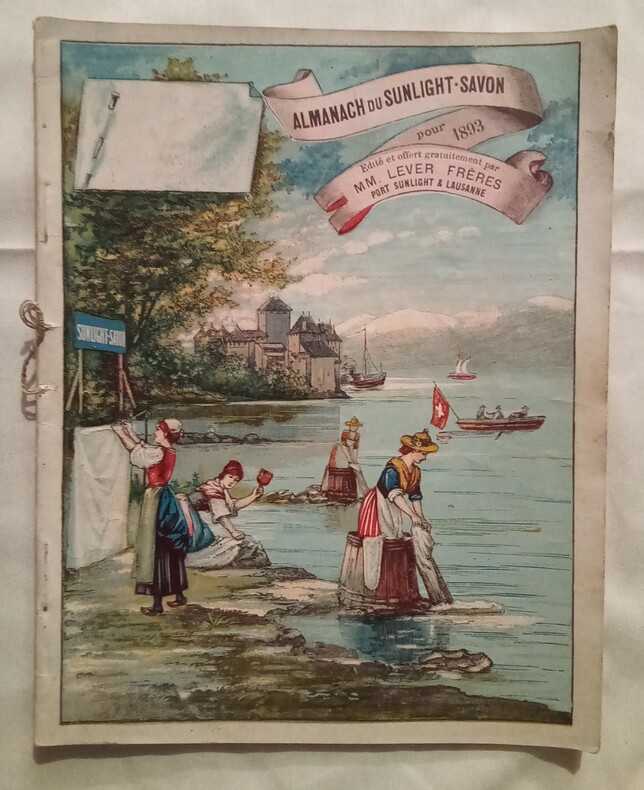
1893WOC-1227Édité et offert gratuitement à la clientèle par MM. LEVER frères – Port-Sunlight et Lausanne. Nombreuses illustrations, dessins, croquis. Lausanne, Imprimerie Ch. Viret-Genton, 1892. In-8 (21x16,5cm) broché, de plat supérieur en couleurs orné d'une scène de Lavandière sur le Lac Léman, le Château de Chillon et Bateaux, et le plat inférieur de vues ( General View of Works et Houses for Employees). 64pp.
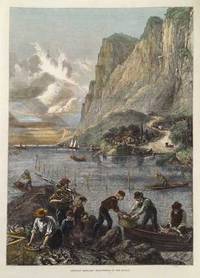
187520995London: Illustrated London News 1875. Very good overall. Striking full page wood engraving with later hand color of the abundant Hudson River shad harvest from the Illustrated London News. In 1870 New York began a program of seed the Hudson with over 2 million shad fry. The program was very successful with the river yielding astonishing quantities of shad in subsequent years. In the foreground fishermen unload baskets of shad while in the middle ground shad boats work the river. In the distance are a cottage at the water's edge a winding mountain road and the towering cliffs of the Hudson River with a dramatic sky. With handsome later hand coloring. Approximately 10 3/4 x 16" Illustrated London News unknown
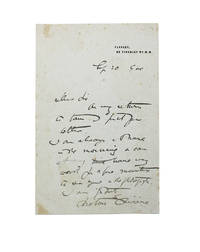
1894031526UK 1894. First Edition . Paper. Good. 48mo - over 3 - 4" tall. An Original Handwritten and Signed Letter by British Artist Briton Riviere. Dated 1894. A letter on headed paper addressed Flaxley Finchley Road N W London the artist's home address to 'Dear Sir' arranging meeting and give a photograph. Briton Rivière RA 1840 -1920 was a British artist of Huguenot descent. He exhibited a variety of paintings at the Royal Academy but devoted much of his life to animal paintings. Size is 180mm x 117mm. Condition is good. Light folding crease. Gum residue to rear corners on reverse. Ref19257 <br/> <br/> unknown
184183671Paris, 1841, in-8, 192pp, broché, Très bel exemplaire! 192pp
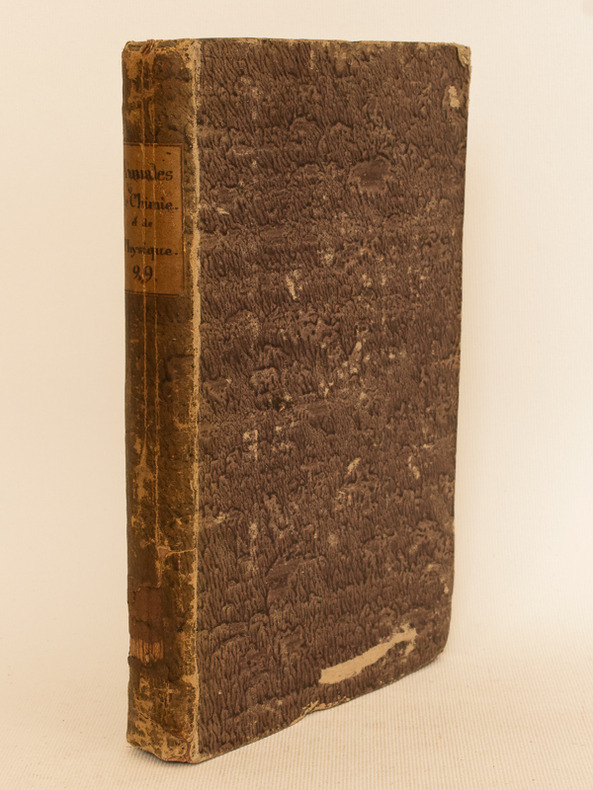
1825346411 vol. in-8 cartonnage marbré de l'époque, Chez Crochard, Paris, 1825, 448 pp. avec 3 planches dépliantes. Contient notamment : Mémoire sur une nouvelle Expérience électro-dynamique, sur son application à la formule qui représente l'action mutuelle de deux élémens de conducteurs voltaïques, et sur de nouvelles conséquences déduites de cette formule (Ampère) ; Lettre de M. Ampère à M. Gerhardi sur divers phénomènes électro-dynamiques ; Extrait d'un Rapport fait à l'Académie par M. Ampère sur les Piles sèches de M. Zamboni ; Examen de quelques minéraux du genre grenat (Vachmester) ; Note sur la Répulsion que des corps échauffés exercent les uns sur les autres à des distances sensibles (Fresnel) ; Note sur l'existence de l'iode dans le règne minéral (Vauquelin) ; Analyse des Séléniures du Harz oriental (Rose) ; Sur la séparation de l'acide titanique de l'oxide de fer (Henri Rose) ; Analyse d'un Alliage d'or avec du rhodium, de la maison du Départ de Mexico (André del Rio) ; De l'action des poisons sur le règne végétal (Marcet) ; Examen du Platine trouvé en Russie (Laugier) ; Nouvelles Recherches sur les Vibrations de l'air (Félix Savart), etc...
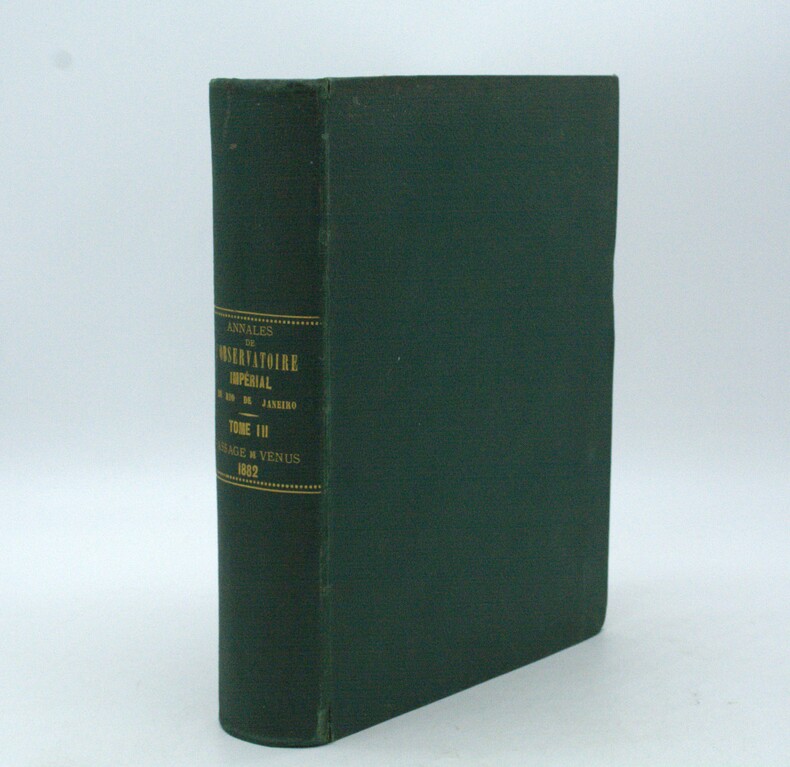
1887PHO-1969Rio de Janeiro, Lombaerts & Cie, 1887, grand in-4° (32x23cm), pleine percale époque, titre au dos, petits frottements aux mors, quelques rousseurs. Texte en portugais avec sa traduction française en regard, complet de ses illustrations sous serpentes.
1893ZB447937Washington: GPO 1893. 335 pp. folding profiles maps charts etc paper wrappers chipped and lacking back cover text browning with last leaf torn reading or working copy only. - If you are reading this this item is actually physically in our stock and ready for shipment once ordered. We are not bookjackers. Buyer is responsible for any additional duties taxes or fees required by recipient's country. Photos available upon request. Washington: GPO, unknown
18624410Paris 1862. Tinted lithograph 18 x 27 cms blank verso. From Vues de Londres by Charles Francois Riffardeau Duc de Riviere. An interesting technical feature of these views is the presence of tiny pinholes used to achieve correct register in overlaying the separate tints. These printers marks are usually to be found at the corners of the print but are here cleverly concealed in appropriate parts of the picture - on the bowsprit of a ship at the hub of a wheel the bullseye of a lantern or pierced through a childs balloon. The views themselves are lively and pleasing with bustling crowds in the foreground of each. Print unknown
1894CC10-839Washington, Government Printing Office, 1894. original Broschur, 80 p. with numerous illustrations, partial unopened
183718463nantes Forest 1837 1 -in-4 demi-basane 1 volume, reliure demi-basane marron foncé in-quarto (half binding leather in-quarto ), reliure d'époque (26,5 x 21 cm), dos long (spine without raised bands) décoré or (gilt decoration), titre et auteur frappés or (gilt title and volume numbering), filet épais or et filet fin or de part et d'autre en place des nerfs, filet fin or en tête et en pied, entre nerfs à fleurons dorés, papier peigné aux plats (cover with painting paper), toutes tranches lisses (edges smooth), abondamment illustré (plentifully illustrated) de 31 lithographies hors-texte (full page engraving) en noir par E. de La Michellerie, Messager, Louis Petit, Hersart du Buron, Jules Noël et Rivière Fils + 2 importantes vignettes in-texte en noir (7 au Tome 1, 6 au Tome 2, 9 au Tome 3 + 2 vignette in-texte , 5 au Tome 4, 1 au Tome 5), texte 2 colonnes (text - 2 coloumns), rousseurs et importante mouillure claire marginale tout au long du livre, pagination normale jusqu'à la page 32 du 1er volume, ensuite pagination à la colonne, Tome 1 : 417 pages + 6 de tables, Tome 2 : 398 pages + 6 de tables, Tome 3 : 429 pages (tables comprises), Tome 4 : 398 pages (tables comprises), Tome 5 : 494 pages (tables comprises), 1837-1841 Nantes Forest Imprimeur Editeur,