DARWIN, CharlesBiblio.com

7 255 résultats
187169501London: John Murray 1871. Full Description:<br> <br> DARWIN Charles. The Descent of Man and Selection in Relation to Sex. With illustrations. London: John Murray 1871.<br> <br> First edition first issue with "transmitted" appearing as the first word on p. 297 of Volume I with printer's imprint on the verso of the half-title of Volume II and with twenty-five errata seventeen for Volume I and eight for Volume II on the verso of the title leaf to Volume II and with the leaf pp. ix-x containing Darwin's note on "a serious and unfortunate error" tipped in leaf after p. viii in Volume II. Two small octavo volumes 7 1/2 x 4 15/16 inches; 191 x 126 mm Volume II is 5 mm shorter than volume I. viii 423 1 printer's imprint 16 publisher's ads; viiiix-x "Postscript" 475 1 printer's imprint 16 publisher's ads pp. The 16 pages of publisher's advertisements at the end of each volume are both dated January 1871 . Wood-engraved text illustrations.<br> <br> Original green cloth with covers stamped in blind and spines stamped and lettered in gilt. Black-coated endpapers. Head and tail of spines with some minor shelf-wear. Corners slightly bumped. Some very light rubbing to board edges. Some minor bubbling to cloth of front board of volume II. Front inner hinge of volume I with a mostly closed crack holding firm. Previous owner's armorial bookplate on front pastedown of volume II. Some minor pencil markings to volume I otherwise very clean inside. Overall an exceptional set.<br> <br> The first issue of 2500 copies was published on February 24 1871 and the second of 2000 copies in March. "The book in its first edition contains two parts the descent of man itself and selection in relation to sex. The word 'evolution' occurs for the first time in any of Darwin's works on page 2 of the first volume of the first edition that is to say before its appearance in the sixth edition of The Origin of Species in the following year. The last chapter is about sexual selection in relation to man and it ends with the famous peroration about man's lowly origin the wording of which differs slightly in the first edition from that which is usually quoted" Freeman p. 129.<br> <br> "In the Origin Darwin had avoided discussing the place occupied by Homo sapiens in the scheme of natural selection stating only that 'light will be thrown on the origin of man and his history.' Twelve years later he made good his promise with The descent of man in which he compared man's physical and psychological characteristics to similar traits in apes and other animals showing how even man's mind and moral sense could have developed through evolutionary processes. In discussing man's ancestry Darwin did not claim that man was directly descended from apes as we know them today but stated simply that the extinct ancestors of Homo sapiens would have to be classified among the primates; however this statement as misinterpreted by the popular press caused a furor second only to that raised by the Origin" Norman Library. This title created almost as much sensation as his Origin of Species. In it he elaborated further on his views adding sexual selection and using the word 'evolution' for the first time.<br> <br> Milestones of Science 48. Freeman Darwin 937. Garrison-Morton 170. Norman Library 599.<br> <br> HBS 69501.<br> <br> $5500. John Murray unknown
186016363London: John Murray 1860. Third edition 1st printing 10th Thousand. With 14 text woodcuts. Original publisher’s cloth front cover a bit worn; interior very good. Second edition later issue tenth thousand with new preliminaries and a postscript at the end of the preface the final definitive text with extensive revisions from its first appearance of Darwin’s first published work which chronicles his historic five-year voyage on the Beagle to Brazil Argentina Tierra del Fuego Chile Peru the Galapagos Islands New Zealand Australia and other countries and islands along the way. This journey was the most important event in Darwin’s intellectual life. The appearance of this record was a turning point in the history of biological science and marked the beginnings of a whole new conception of the origin of the various species of life on earth.<br /> <br /> Freeman 20. John Murray unknown
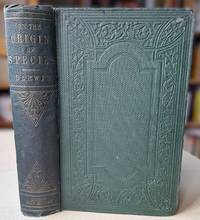
41593London : printed by W. Clowes and Sons for John Murray 1861. Third edition. Octavo original green cloth boards blocked in blind spine gilt corners rubbed a few light marks small splits to head and foot of spine hinges unobtrusively strengthened binding variant A with full point period after “MURRAY†in spine imprint tan endpapers small chip to fore edge of front free endpaper bookseller's pencilled notes verso contemporary owner's name to to half-title small owner's initial to title page pp. xix; blank 548; 2 - publisher's catalogue small ink underline folding lithographic plate by William West after Darwin a couple of clear tape reinforcements verso light pale scattered foxing one quire slightly sprung a very good copy of the third edition. The first edition of 1859 a great rarity is described in Freeman as "". the most important biological work ever written.""; Dibner "". the most important single work in science.""; Printing & the Mind of Man "". revolutionized our methods of thinking and our outlook on the natural order of things. The recognition that constant change is the order of the universe had been finally established and a vast step forward in the uniformity of nature had been taken"". The third edition of which 2000 copies were printed contains substantial revisions by Darwin unlike the second edition which was essentially a reprint of the first. The third edition 'was extensively altered and is of interest for the addition of a table of differences between it and the second edition a table which occurs in each subsequent edition and also for the addition of the historical sketch. which was written to satisfy complaints that Darwin had not sufficiently considered his predecessors in the general theory of evolution. there is also a postscript on page xii. concerning a review of the earlier editions by Asa Gray' Freeman p. 78. A very good example. Freeman 381 binding variant A with full point period after “MURRAY†in spine imprint.  hardcover
1896177013New York: D. Appleton and Company 1896-97. The first collected edition The Authorized edition uncommon complete with the publisher's half morocco bindings in bright and attractive condition. The American publisher Appleton made the first serious attempt towards a uniform collection an idea that was most comprehensively achieved nine decades later under the imprint "The Pickering Masters" 1986-9. There was no collected edition published during Darwin's lifetime. Together 12 works in 15 vols octavo. Illustrated with photographic half-tone plates folding maps line drawings and diagrams. Original red half morocco spines lettered in gilt marbled sides top edges gilt other edges uncut some leaves unopened. Bookseller's ticket on rear pastedowns. Bindings bright the spines near-uniformly red faint splash mark to a few top edges affecting outer leaves clean overall trivial stub tear to a couple of folding maps. A near-fine set. unknown
1860023046London: John Murray 1860. Second edition fifth thousand. Octavo pp x 502 32 page publisher's catalogue dated January 1860 slight age-toning and very slight occasional foxing several lightly creased corners a small marginal tear to page 13/14 the folding plate at page 117 is a little foxed but one part of the three sections is now detached and frayed at the bottom edge the hinge following page 120 is widely cracked but no looseness the front free endpaper very slightly marked the front hinge beginning to crack but no weakness the front paste-down endpaper has two early signatures - James Sharp and E. Byres of Claremont House Balham original green cloth the corners very slightly bruised very slight rubbing the spine slightly dull the spine head slightly pulled and similarly so at the base but with one small tear. Freeman 376 variant a . Second edition. Cloth. Good. John Murray Hardcover
1891feb02673<p>1891. First German Edition of Letters on Geology.<br /><br /> Extract from Deutsche Rundschau</p><p>Used book For more details and availability please contact me</p> E. Schweizerbartsche Verlagshandlung
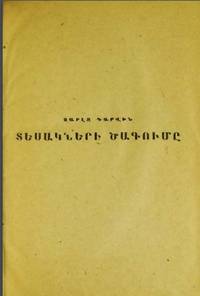
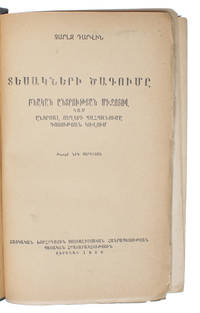
1936feb02632<p>1936. First Armenian Edition - On the Origin of Species by Means of Natural Selection or the Preservation of Favoured Races in the Struggle for Life by Charles Darwin<br />ÕÕ¥Õ½Õ¡Õ¯Õ¶Õ¥Ö€Õ« Õ®Õ¡Õ£Õ¸Ö‚Õ´Õ¨ Õ¢Õ¶Õ¡Õ¯Õ¡Õ¶ Õ¨Õ¶Õ¿Ö€Õ¸Ö‚Õ©ÕµÕ¡Õ¶ Õ´Õ«Õ»Õ¸ÖÕ¸Õ¾ Õ¯Õ¡Õ´ Õ¨Õ¶Õ¿Ö€ÕµÕ¡Õ¬ ÖÕ¥Õ²Õ¥Ö€Õ« ÕºÕ¡Õ°ÕºÕ¡Õ¶Õ¸Ö‚Õ´Õ¨ Õ£Õ¸ÕµÕ¸Ö‚Õ©ÕµÕ¡Õ¶ Õ¯Õ¼Õ¾Õ¸Ö‚Õ´</p><p>Used book For more details and availability please contact me</p> SSR Armenia
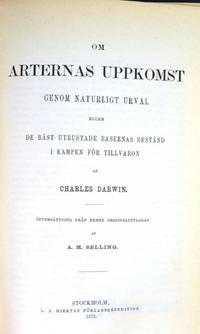
1871feb02733<p>1871. First Swedish Edition - On the Origin of Species by Means of Natural Selection or the Preservation of Favoured Races in the Struggle for Life by Charles Darwin.<br />Om Arternas Uppkomst genom naturligt Urval eller de bäst utrustade rasernas Bestånd i Kampen för Tillvaron.</p><p>Used book For more details and availability please contact me</p> L.J. Hiertas hardcover
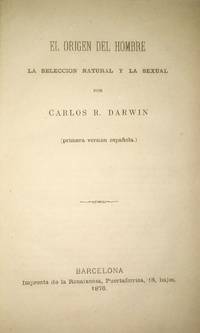
18761701Barcelona: Imprenta de la Renaixensa 1876. First Spanish edition. In contemporary half leather. Marbled endpapers. Spine with small damage to the head wormholes at joints. Corners slightly bumped. Pages yellowed due to aging. Last pages with wormholes. Overall in very good condition. First Spanish edition. In contemporary half leather. Marbled endpapers. XI 2 14–322 2 p. First Spanish edition of Charles Darwin’s 1871 groundbreaking book on human evolution and the sexual selection “The Descent of Manâ€. Imprenta de la Renaixensa unknown
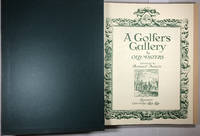
lom-MS000910In English. Short description: A GOLFER'S GALLERY BY OLD MASTERS. Bernard DARWIN London Country Life circa 1920 First edition. Album with 18 rare illustrations related to golf from the 16th century up to 19. The foreword was written by Charles Darwin's grandson the famous golfer Bernard Darwin. Please feel free to contact us for a detailed description of the copies available. SKUMS000910 unknown
lom-MS000910In English. Short description: A GOLFER'S GALLERY BY OLD MASTERS. Bernard DARWIN, London, Country Life, circa 1920 First edition. Album with 18 rare illustrations related to golf, from the 16th century up to 19. The foreword was written by Charles Darwin's grandson, the famous golfer Bernard Darwin. Please feel free to contact us for a detailed description of the copies available. SKUMS000910
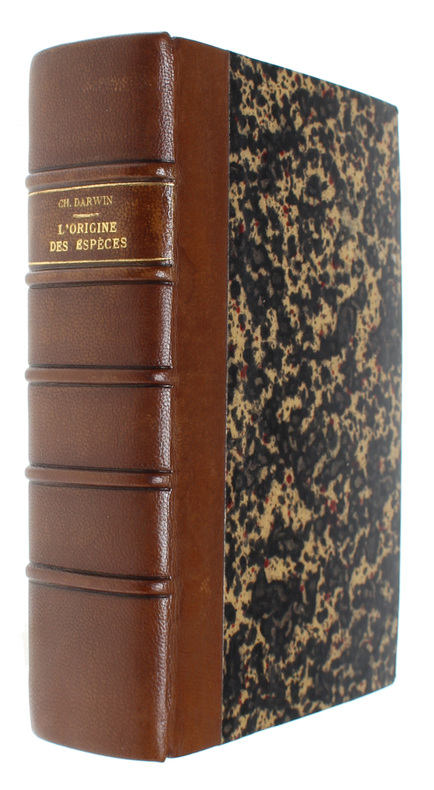
186250871Paris, Guillaumin et Cie, Victor Masson et Fils, 1862. 8vo. Bound uncut and with the original printed front wrapper (expertly restored) in a very fine later half morocco binding with four raised bands and gilt title to spine. Very light minor brownspotting to a few pages. An exceptionally nice, clean, and attractive copy. LXIV (incl. half-title), I-XXIII + (24-) 712. pp. and 1 folded plate (between pp.160 a. 161). Fully complete.
193553497Moscow, Academy of Science, 1935-1959. Royal8vo. In 9 uniform full cloth bindings (albeit with slightly different colours, as published). All volumes with Darwin's signature ""Ch. Darwin"" embossed in gold to lower right corner of front board. All nine volumes with wear to spines. All nine volumes internally fine and clean (no stamps or brownspotting). XLVII, (1), 604, (4) pp. + 3 folded maps.: 682, (2) pp. + 3 folded maps: X, (2), 831, (1) pp. + 1 folded map.: 883, (1) pp.: 1040 pp. + 1 folded plate.: 696 pp.: 650 pp.: 543, (1) pp.: LVI, 734, (1) pp. The following being the collation of the papers which represent the first Russian translation of the given paper:[Geologija, Eskavajra, Tjlena Korolevskogo obschestva (i.e. 'Manual of Scientific Enquiry']: Vol. 2: Pp. 613-637[Usonogie raki (i.e. 'Living Cirripedia')]: Vol. 2: Pp. 37-87[Lectsii evolutsionnoi teorii (i.e. 'Studies in the theory of descent')]: Vol. 3: p. 755.[Proishozhdenie vidov putem estestvennogo otbora... (i.e. 'On the tendency of species to form varieties')]: Pp. 239-255.[Razlichnye formy tsvetov u rastenii odnogo i togo zhe vida (i.e. 'The Different Forms of Flowers on Plants of the Same Species')]: Vol. 7: Pp. 31-251.[Oplodotvorenie tsvetov (i.e. 'Fertilisation of flowers (Hermann Müller)']. Vol. 6: Pp. 652-654.[Zhizn Erazma Darvina (i.e. 'The Life of Erasmus Darwin')]. Vol. 9: Pp. 251-309.
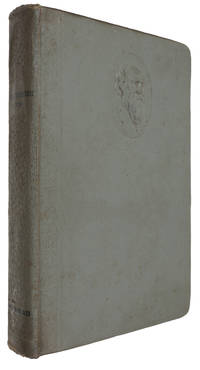
193662681(Kharkiv), Derzhavne medychne vyd-vo (State Medical Publishing House), 1936. 8vo. In publisher's original grey cloth binding with black lettering to spine with Darwin's portrait embossed on front board. Wear to extremities, corner bumped and light spoling to back board. Inner hinges split and first 3 leaves partly detached. Last 20 ff. slighly creased due to dampstain, otherwise internally a nice and clean copy. 674 pp. + frontispiece, portrait of Darwin and 1 plate with genealogical tree.
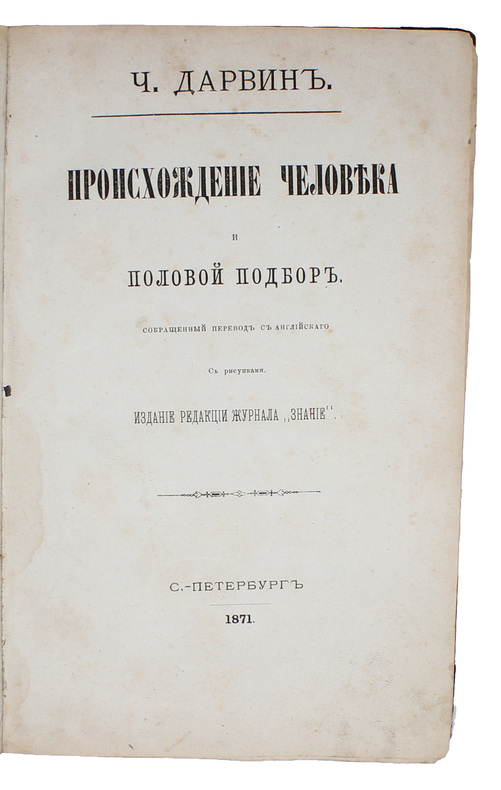
187153279S.-Peterburg, Izdanie redaktsii zhurnala ""Znanie, 1871. 8vo. In contemporary black half calf with four rasied bands and gilt lettering to spine. Corners of binding with repairs and a three cm long tear to lower front hindge. Light miscolouring throughout, especially to first 10 leaves. (2), VII, (6), 439 pp.
193654837Erevan, Armenia, Gosizdat, 1936. 8vo. In publisher's original full cloth with title in silver lettering to spine and front board. A picture of Darwin embossed to front board. Extremities with wear and hindges weak. Spine miscoloured and remains of paperlabel to upper part of spine. First quire loose. Internally fine and clean. (2), 765 pp. + frontiespiece and plate with genealogical tree.
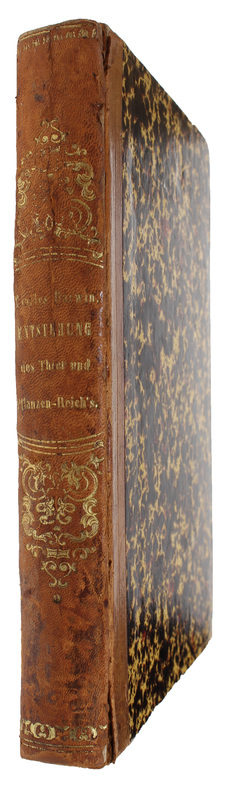
186050927Stuttgart, E. Schweizerbart'sche Verlagshandlung und Druckerei, 1860. 8vo. Bound in contemporary half calf with gilt lettering and ornamentation to spine. Small stamp and previous owner signature to title page. Leather on lower part of spine with a tear and part detached. Hinges weak but book-block firmly attached. VIII (including half, 520, (6) pp + 1 plate.
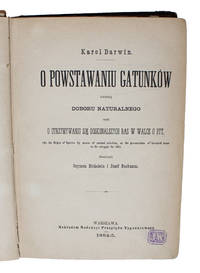
188456005Warszawa, Przegladu Tygodniowego, 1884. Large8vo. In contemporary half calf. Spine with wear, lacking the upper 1 cm. Small stamp to title-page. Hindges weak and back board detached from bookblock. Verso of title-page and first leaf on content. 437, (1), XVI [Including the plate] pp.
186250871Paris Guillaumin et Cie Victor Masson et Fils 1862. 8vo. Bound uncut and with the original printed front wrapper expertly restored in a very fine later half morocco binding with four raised bands and gilt title to spine. Very light minor brownspotting to a few pages. An exceptionally nice clean and attractive copy. LXIV incl. half-title I-XXIII 24- 712. pp. and 1 folded plate between pp.160 a. 161. Fully complete. <br/><br/><em>The scarce first French edition of Darwin's masterpiece one of the most important books ever printed. The "Origin" started the greatest of all intellectual revolutions in the history of Mankind.There were some difficulties with the first French edition. Mlle Royer who Darwin described as 'one of the cleverest and oddest women in Europe' and wished 'had known more of natural history' added her own footnotes. He was not really happy until the third translation by Éduard Barbier appeared in 1876. Freeman. Freeman No 655 Freeman does not mention the plate which is present here. </em> hardcover
193662681Kharkiv Derzhavne medychne vyd-vo State Medical Publishing House 1936. 8vo. In publisher's original grey cloth binding with black lettering to spine with Darwin's portrait embossed on front board. Wear to extremities corner bumped and light spoling to back board. Inner hinges split and first 3 leaves partly detached. Last 20 ff. slighly creased due to dampstain otherwise internally a nice and clean copy. 674 pp. frontispiece portrait of Darwin and 1 plate with genealogical tree. <br/><br/><em>The exceedingly rare first Ukranian translation of Darwin's landmark 'Origin of Species'. OCLC only list two copies Library of Congress and The Huntington Library USA Freeman F797. </em> hardcover
187153279S.-Peterburg Izdanie redaktsii zhurnala "Znanie 1871. 8vo. In contemporary black half calf with four rasied bands and gilt lettering to spine. Corners of binding with repairs and a three cm long tear to lower front hindge. Light miscolouring throughout especially to first 10 leaves. 2 VII 6 439 pp. <br/><br/><em>The exceedingly rare first Russian translation of Darwin's 'Descent of Man' published only four month after the original English. The Russian publisher was eager to have a translation published hence this early abridged edition - two other Russian translations followed later the same year - The present translation being the very first into any language. "The Descent of Man showed that the process of organic evolution propelled by the struggle for existence and natural selection applied to man no less than to the rest of the animal kingdom. It gave explicit recognition to the idea of the anthropoid origin of man. This claim surprised no one for it was clearly hinted at in the great work of 1859 and was elaborated in Thomas Huxley's Man's Place in Nature and Vogt's Lectures on Man. Nor was it much of a surprise when three Russian translations of The Descent appeared within one year after the publication of the English original. Two general ideas represented the essence of The Descent: natural selection is not only behind the physical survival of man but also behind the evolution of cultural values; and the differences between animal and human behavior are differences of degree rather than of kind." Darwin in Russian Thought "The Expression helped lay the foundations for a scientific study of the psychological aspect of the evolution of species. The book appeared in a Russian translation only a few months after the publication of the English original. The paleontologist Vladimir Kovalevskii was the translator and the embryologist Aleksandr Kovalevskii was in charge of editorial tasks. In 1874 Vladimir wrote to Darwin that nearly two thousand copies of the Russian translation were sold." " The Expression deals much more extensively with selected aspects of human and animal behavior than with general problems of evolutionary biology. The Russian reviewers were generally impressed with Darwin's descriptions and categorizations of animal behavior. The Journal of the Ministry of Public Education was unusually profuse in praising the book's content and writing style. The reviewer commended Darwin's impartiality and avoidance of "materialistic trappings." Even the adherents of spiritualism could read the book he wrote without the least discomfort. The reviewer thought that psychologists would benefit from the information the book presented on the "physiological" basis of behavior. Indeed he recommended the book to all readers interested in the scientific foundations of human behavior. The liberal journal Knowledgewas equally laudatory. It noted that the book was eminently successful on two counts: it offered a "rational explanation" of many expressions of human emotions and it integrated the study of animal and human behavior into the universal process of organic evolution. In fact no educated person could afford to ignore it.N. P. Vagner professor of zoology and comparative anatomy at St. Petersburg University called The Expression a book with "great strengths and minor flaws." The volume reminded him of Darwin's previous works which marked "turning points in the history of science." The strength of the book lay much more in its suggestion of new topics for comparative-psychological research than in a presentation of a theoretically and logically integrated system of scientific thought. Insufficient exploration of the physiological underpinnings of mental activities represented the book's major shortcoming" Darwin in Russian Thought In Russia Darwinism had a profound influence not only upon the different sciences but also on philosophy economic and political thought and the great literature of the period. For instance both Tolstoy and Dostoevsky referenced Darwin in their most important works as did numerous other thinkers of the period.Like Strakhov however Dostoevsky acknowledging the significance of the "Origin of Species" saw the dangers of the theory. In the same year as the publication of Rachinsky's translation he lets the narrator in "Notes from Underground" 1864 launch his attack on Darwinism beginning: "As soon as they prove you for instance that you are descended from a monkey then it's no use scowling you just have to accept it."In "Crime and Punishment" two years later 1866 the Darwinian overtones inherent in Raskolnikov's theory of the extraordinary man are unmistakable. He describes the mechanism of "natural selection" where according to the laws of nature by the crossing of races and types a "genius" would eventually emerge. In general Darwinian themes and Darwin's name occur in many contexts in a large number of Dostoevsky's works.'Descent of Man' was transted into Danish Dutch French German Italian Polish Russian and Swedish in Darwin's lifetime. Freeman 1107. </em> unknown
193654837Erevan Armenia Gosizdat 1936. 8vo. In publisher's original full cloth with title in silver lettering to spine and front board. A picture of Darwin embossed to front board. Extremities with wear and hindges weak. Spine miscoloured and remains of paperlabel to upper part of spine. First quire loose. Internally fine and clean. 2 765 pp. frontiespiece and plate with genealogical tree. <br/><br/><em>The exceedingly rare first Armenian translation of Darwin's landmark work.Only two Armenian translations of 'Origin of Species' has been made. The present first a second from 1963 both translations are of the upmost scarcity. Due to the relatively low number of people speaking Armenian approximately 3 million in Armenia and 7 million outside books in Armenian were printed in comparatively low numbers. OCLC locates no copies. Freeman 630.R.B. Darwin Online F630. </em> hardcover
193553497Moscow Academy of Science 1935-1959. Royal8vo. In 9 uniform full cloth bindings albeit with slightly different colours as published. All volumes with Darwin's signature "Ch. Darwin" embossed in gold to lower right corner of front board. All nine volumes with wear to spines. All nine volumes internally fine and clean no stamps or brownspotting. XLVII 1 604 4 pp. 3 folded maps.: 682 2 pp. 3 folded maps: X 2 831 1 pp. 1 folded map.: 883 1 pp.: 1040 pp. 1 folded plate.: 696 pp.: 650 pp.: 543 1 pp.: LVI 734 1 pp. The following being the collation of the papers which represent the first Russian translation of the given paper:Geologija Eskavajra Tjlena Korolevskogo obschestva i.e. 'Manual of Scientific Enquiry': Vol. 2: Pp. 613-637Usonogie raki i.e. 'Living Cirripedia': Vol. 2: Pp. 37-87Lectsii evolutsionnoi teorii i.e. 'Studies in the theory of descent': Vol. 3: p. 755.Proishozhdenie vidov putem estestvennogo otbora. i.e. 'On the tendency of species to form varieties': Pp. 239-255.Razlichnye formy tsvetov u rastenii odnogo i togo zhe vida i.e. 'The Different Forms of Flowers on Plants of the Same Species': Vol. 7: Pp. 31-251.Oplodotvorenie tsvetov i.e. 'Fertilisation of flowers Hermann Müller'. Vol. 6: Pp. 652-654.Zhizn Erazma Darvina i.e. 'The Life of Erasmus Darwin'. Vol. 9: Pp. 251-309. <br/><br/><em>A rare complete run of Moscow's Academy of Science Journal's publication of Darwin's 'Collected Works' containing seven first Russian translations of Darwin's shorter works. -Manual of Scientific Enquiry Freeman 338 Translated by D. L. Weiss. Annotated by N. S. Shatskiï. 1935-Living Cirripedia Freeman 341 Translated by N. I. Tarasov. 1936.-Studies in the theory of descent August Weismann Freeman 1415 Translated and with notes by S. L. Sobol'. 1939.-On the tendency of species to form varieties Freeman 370 Translated by A. D. Nekrasov S. L. Solol 1939.-Different forms of flowers Freeman 1302 Translated by A. P. Il'inskiï and E. D. D'yakov 1948.-Fertilisation of flowers Hermann Müller Freeman 1433. Translated by V. A. Rybin. 1950.-Erasmus Darwin Ernst Krause Freeman 1324 Translated by V. N. Sukachev. 1959.Freeman 338 341 370 1302 1324 1415 1433 </em> hardcover
186050927Stuttgart E. Schweizerbart'sche Verlagshandlung und Druckerei 1860. 8vo. Bound in contemporary half calf with gilt lettering and ornamentation to spine. Small stamp and previous owner signature to title page. Leather on lower part of spine with a tear and part detached. Hinges weak but book-block firmly attached. VIII including half 520 6 pp 1 plate. <br/><br/><em>The very scarce first edition of the highly important first German translation which appeared just months after the original.This translation came to play a tremendous role in the spreading of Darwinism in Germany and Northern Europe in general. It was through this translation that Darwinian thought reached most of the German scientists and thinkers of the period and it was this translation that challenged German scholars to think in new ways about morphology systematics paleontology and other biological disciplines. It was from this translation that Ernst Haeckel Darwin's most famous nineteenth-century proponent and popularizer in Germany got his Darwinism and was able to further spread the new ideas in his own country. The German translation of Darwin's "The Origin of Species" appeared in 1860 just months after the original thanks to Heinrich Georg Bronn a distinguished German paleontologist whose work in some ways paralleled Darwin's. Bronn's version of the book with his own notes and commentary appended did much to determine how Darwin's theory was understood and applied by German biologists for the translation process involved more than the mere substitution of German words for English."Its Origin of Species greatest impact on German biological practice lay in the introduction of historical modes of explanation for the observable phenomena of living nature. The historical approach to nature was rejected not only by the opponents of evolution but also by the idealist evolutionist. Whether they favored a teleological or a reductionist biology the idealists could not see the point of a theory that emphasized the irregularities and exceptions in the organic world. In the timeless real of idealist thinking unchanging laws worked out an inevitable destiny. But Darwin taught his followers to look at living beings one by one. Thus prompted they recognized as if for the first time the surprising fact of anomaly and the wisdom of an open-ended theory." Glick The Comparative Reception of Darwinism. "Darwin was not happy about the first German translation. It was done from the second English edition by H.G. Bronn who had at Darwin's suggestion added an appendix of the difficulties which occurred to him; but he had also excised bits of which he did not approve. This edition also contains the historical sketch in its shorter and earlier form." Freeman.Freeman No 672 - Freeman does not mention the lithographed plate. </em> hardcover
188456005Warszawa Przegladu Tygodniowego 1884. Large8vo. In contemporary half calf. Spine with wear lacking the upper 1 cm. Small stamp to title-page. Hindges weak and back board detached from bookblock. Verso of title-page and first leaf on content. 437 1 XVI Including the plate pp. <br/><br/><em>First edition of the first full Polish translation of Darwin's "Origin of Species". An attempt to publish a Polish translation was made as early as 1873. This was however never completed and only half of the work was published Freeman 739 thus making the present copy the very first full Polish translation. As seen in several other countries especially in Japan the majority of Polish intellectuals adopted a Social Darwinism perspective at a very early stage rather than appreciating the English naturalist's caution in applying his ideas to human society."Before the first translations of Darwin's appeared . many Polish intellectuals such as positivist writer Eliza Orzeszkowa 1841-1910 complained about the increasing confusion over the essence of the English naturalist's ideas which had all too often been mixed up with all sorts of ideological debates. However when Darwin's books were actually available in Polish translations the novelty of his concepts gradually wore off making room for more serious attempts to come to terms with evolutionary theory." Glick The Reception of Charles Darwin in Europe. "It appears that the struggle for or against Darwinism in partitioned Poland prefigured a pattern that is relevant for Polish thinking up to the present day: the conflict of striving for progress with the help of powerful allies abroad and of virulently rejecting all foreign advice for fear of losing one's cultural identity." Ibid.Translation was begun by Szymon Dickstein who in the processe of the translation committed suicide. It was completed by Józef Nusbaum who also translated 'The Variation of Animals and Plants under Domestication' in 1888.Freeman 740 </em> unknown