DARWIN, CHARLESBiblio.com
7 255 résultats
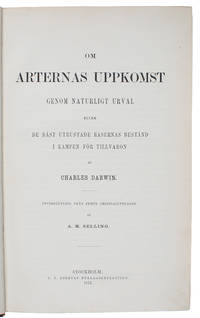
187156496Stockholm L.J. Hiertas Förlagsexpedition 1871. 8vo. Contemporary half calf with gilt lettering to spine and gilt ornamentation forming five compartments. Hindges with a few worm holes back hindges mostly affected but binding still tight and firmly attached to book block. Previous owner's stamp to pasted down front end-paper. Internally extraordinarily fine and clean. XI 1 420 pp. plate with genealogical tree inserted between p. 96 and p. 97. <br/><br/><em>The rare first Swedish translation also being the first in Scandinavia of Darwin's Origin of Species. Initially the work mainly received attention from religious institutions who also compared to most other countries were fiercely against Darwin's theory. Freeman wrongly lists this first Swedish edition as appearing in 1869 he also does not register the plate. </em> unknown
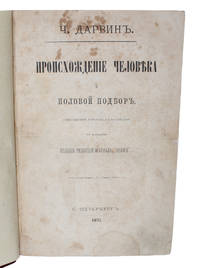
187156375S.-Peterburg Izdanie redaktsii zhurnala "Znanie 1871. 8vo. In recent half calf with four rasied bands and gilt lettering to spine. Soiling and damp stain to title-page. Light brownspotting throughout. 2 VII 5 439 7 pp. <br/><br/><em>The exceedingly rare first Russian translation of Darwin's 'Descent of Man' published only four months after the original English. The Russian publisher was eager to have a translation published hence this early abridged edition - two other Russian translations followed later the same year - The present translation being the very first into any language. "The Descent of Man showed that the process of organic evolution propelled by the struggle for existence and natural selection applied to man no less than to the rest of the animal kingdom. It gave explicit recognition to the idea of the anthropoid origin of man. This claim surprised no one for it was clearly hinted at in the great work of 1859 and was elaborated in Thomas Huxley's Man's Place in Nature and Vogt's Lectures on Man. Nor was it much of a surprise when three Russian translations of The Descent appeared within one year after the publication of the English original. Two general ideas represented the essence of The Descent: natural selection is not only behind the physical survival of man but also behind the evolution of cultural values; and the differences between animal and human behavior are differences of degree rather than of kind." Darwin in Russian Thought "The Expression helped lay the foundations for a scientific study of the psychological aspect of the evolution of species. The book appeared in a Russian translation only a few months after the publication of the English original. The paleontologist Vladimir Kovalevskii was the translator and the embryologist Aleksandr Kovalevskii was in charge of editorial tasks. In 1874 Vladimir wrote to Darwin that nearly two thousand copies of the Russian translation were sold." " The Expression deals much more extensively with selected aspects of human and animal behavior than with general problems of evolutionary biology. The Russian reviewers were generally impressed with Darwin's descriptions and categorizations of animal behavior. The Journal of the Ministry of Public Education was unusually profuse in praising the book's content and writing style. The reviewer commended Darwin's impartiality and avoidance of "materialistic trappings." Even the adherents of spiritualism could read the book he wrote without the least discomfort. The reviewer thought that psychologists would benefit from the information the book presented on the "physiological" basis of behavior. Indeed he recommended the book to all readers interested in the scientific foundations of human behavior. The liberal journal Knowledgewas equally laudatory. It noted that the book was eminently successful on two counts: it offered a "rational explanation" of many expressions of human emotions and it integrated the study of animal and human behavior into the universal process of organic evolution. In fact no educated person could afford to ignore it.N. P. Vagner professor of zoology and comparative anatomy at St. Petersburg University called The Expression a book with "great strengths and minor flaws." The volume reminded him of Darwin's previous works which marked "turning points in the history of science." The strength of the book lay much more in its suggestion of new topics for comparative-psychological research than in a presentation of a theoretically and logically integrated system of scientific thought. Insufficient exploration of the physiological underpinnings of mental activities represented the book's major shortcoming" Darwin in Russian Thought In Russia Darwinism had a profound influence not only upon the different sciences but also on philosophy economic and political thought and the great literature of the period. For instance both Tolstoy and Dostoevsky referenced Darwin in their most important works as did numerous other thinkers of the period.Like Strakhov however Dostoevsky acknowledging the significance of the "Origin of Species" saw the dangers of the theory. In the same year as the publication of Rachinsky's translation he lets the narrator in "Notes from Underground" 1864 launch his attack on Darwinism beginning: "As soon as they prove you for instance that you are descended from a monkey then it's no use scowling you just have to accept it."In "Crime and Punishment" two years later 1866 the Darwinian overtones inherent in Raskolnikov's theory of the extraordinary man are unmistakable. He describes the mechanism of "natural selection" where according to the laws of nature by the crossing of races and types a "genius" would eventually emerge. In general Darwinian themes and Darwin's name occur in many contexts in a large number of Dostoevsky's works.'Descent of Man' was transted into Danish Dutch French German Italian Polish Russian and Swedish in Darwin's lifetime. Freeman 1107. </em> unknown
1890126612c.1890. Highly unusual Darwinian polyptych Striking and handsomely presented photographic polyptych of major British figures of the late 19th century a number having a strong association with Charles Darwin or his "bulldog" T. H. Huxley including Frederick Temple archbishop of Canterbury Sir John Lubbock and Huxley himself. Top row: 1 Queen Victoria 1819-1901: this fine portrait was taken by the studio of William Ernest Downey described by a contemporary as "the doyen of British professional photographers". He first photographed Victoria in the early 1860s; "royal patronage undoubtedly assisted the firm which grew to be one of the premier society photographers of the late nineteenth century" Encyclopaedia of Nineteenth-Century Photography vol. I p. 436; 2 Frederick Temple 1821-1902 archbishop of Canterbury: Temple welcomed the insights that Darwin's theory of evolution offered to religion and in an essay entitled "Religion and the Doctrine of Evolution" published in The Popular Science Monthly December 1884 declared that "the doctrine of Evolution restores to the science of Nature the unity which we should expect in the creation of God"; 3 Sir Wilfrid Lawson second baronet 1829-1906 politician and temperance campaigner; 4 Ernst Haeckel 1834-1919 zoologist Darwin's leading popularizer in Germany; 5 Sir John Lubbock 1834-1913: "was the closest of CD's younger friends and frequent visitor to Down House from childhood. Lubbock suggested Westminster Abbey funeral for CD and organized letter to the Dean; served as a Pall Bearer" Freeman; 6 Frederic Farrar 1831-1903 dean of Canterbury novelist and philologist: "in 1860 he published An Essay on the Origin of Language. This work emphasizing the onomatopoeic force of primitive language and its evolutionary development interested Tennyson and intrigued Darwin who made use of it in The Descent of Man and proposed Farrar for a fellowship of the Royal Society in 1866. Years later Farrar controversially arranged for Darwin to be buried in Westminster Abbey and preached the funeral sermon" ODNB; he too was also a pall bearer at the funeral. Bottom row: 7 John Ruskin 1819-1900 "one of the great thinkers and critics of the Victorian period" NPG: "1879 CD met and made friends with in the Lake District; visited his home Brantwood Coniston" Freeman; 8 Sir Frederick Leighton 1830-1896 painter and president of the Royal Academy. Leighton and T. H. Huxley sat together on the Provisional Council of the National Trust in July 1894; 9 William Ewart and Catherine Gladstone 1809-1898 "the grand old man of British politics; leader of the Liberal Party and prime minister in four governments from 1848 to 1894" National Portrait Gallery: "1876 visited Down House Darwin's Kent home in company with Huxley. 1877-79 CD corresponded with mostly on behaviour" Freeman; 10 Lord Salisbury 1830-1903 prime minister on three separate occasions between 1885 and 1902 married to Georgina Alderson who "was on 'Personal Friends invited' list for CD's funeral" Freeman and a cousin of Darwin's wife Emma; 11 T. H. Huxley 1825-1895 known as "Darwin's Bulldog" was "a key figure in Victorian scientific life. A vigorous supporter of Darwin's theory of evolution particularly during the famous 1860 Oxford debate with Samuel Wilberforce Bishop of Oxford" NPG; 12 William Booth 1829-1912 founder of the Salvation Army. Following the publication of In Darkest England and the Way Out 1890 - "a classic in the literature of poverty" ODNB - Booth was attacked by T. H. Huxley: "In the winter of 1890-91 the 'bulldog' spirit in Huxley was briefly sidetracked into tangling in The Times with what he felt was the dangerously authoritarian structure and financially irresponsible governance of General William Booth's Salvation Army" J. Vernon Jensen Thomas Henry Huxley: Communicating for Science 1991 p. 122. Folding red grain skiver arch-top display case 360 X 135 mm unfolding to 855 mm wide each window glazed and with a gilt border liner of dark blue silk embossed with a foliate pattern. 12 original cabinet card photographs by various studios Barraud Bassano W. & D. Downey Elliott & Fry London Stereoscopic Company John Moffat of Edinburgh James Russell & Sons; all measuring approximately 140 x 105 mm 5 1/2 x 4 inches some trimmed to fit frame. A few light abrasions to case glass missing from portrait of Booth otherwise in particularly nice condition. Freeman Charles Darwin: A Companion. unknown
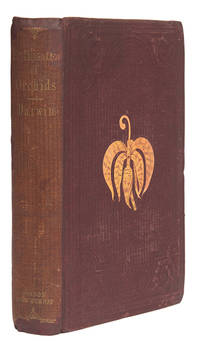
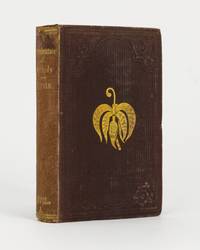
113167London John Murray 1862. . First edition first impression first issue; 8vo in twelves; folding plate woodcuts within the text 32-page publisher's ads dated December 1861 to rear Edmonds & Remnants binder's ticket to rear pastedown bookplate contents partially unopened a few stray spots and tiny marks but overall contents clean; housed in a modern slipcase original plum cloth rebacked with the original spine laid down with some loss from the ends titles to spine and orchid to upper board gilt decorative design to boards blocked in blind coated endpapers corners restored some loss of size from cloth very good condition; 365pp.<br /> First edition first issue of this important contribution to Darwin's theory of evolution by natural selection. Freeman's variant a with vertically lined cloth and ads dated December 1861.<br /><br />Orchids 'was concerned with working out in detail the relationships between sexual structures of orchids and the insects which fertilise them their evolution being attributed to natural selection. It is therefore the first of the volumes of supporting evidence. It was much praised by botanists but sold only about 6000 copies before the turn of the century' Freeman The Works of Charles Darwin p. 112. Darwin wrote to his publisher John Murray in September 1861 that 'I think this little volume will do good to the Origin' Freeman.<br /><br />In his autobiography Darwin stated that though the preparation of Orchids had taken ten months 'most of the facts had been slowly accumulated during several previous years. During the summer of 1839 and I believe during the previous summer I was led to attend to the cross-fertilisation of flowers by the aid of insects from having come to the conclusion in my speculations on the origin of species that crossing played an important part in keeping specific forms constant. I attended to the subject more or less during every subsequent summer. For some years before 1862 I had specially attended to the fertilisation of our British orchids; and it seemed to me the best plan to prepare as complete a treatise on this group of plants as well as I could rather than to utilise the great mass of matter which I had slowly collected with respect to other plants. My resolve proved a wise one; for since the appearance of my book a surprising number of papers and separate works on the fertilisation of all kinds of flowers have appeared; and these are far better done than I could possibly have effected'.<br /> Freeman The Works of Charles Darwin 800. London, John Murray, 1862. hardcover
18909032323New York: D. Appleton and Co 1890. Hardcover. Very Good. Author's Edition stamped with same and faux author signature on half-title pages. One of 1000 numbered copies copyright page states "Authorized Edition." Bound in half burgundy leather with marbled boards and five raised bands spines and covers stamped in gilt marbled endpapers. Top edges gilt. Illustrated with engravings charts drawings maps photographs and geological studies including fold-outs in black and white and color. All pages clean and bright. Minor wear to corners and extremities. Includes: Animals and Plants Under Domestication I & II Structure and Distribution of Coral Reefs The Descent of Man and Selection in Relation to Sex Expression of the Emotions in Man and Animals The Different Forms of Flowers on Plants of the Same Species Geological Observations on the Volcanic Islands and Parts of South America Insectivorous Plants The Life and Letters of Charles Darwin I & II The Power of Movement in Plants The Origin of Species I & II The Formation of Vegetable Mould Through the Action of Worms Journal of Researches Into the Natural History and Geology of the Countries Visited During the Voyage of H.M.S. Beagle Round the World. A bright and beautiful set. 5 1/2 x 8 1/4 inches. <br/><br/> D. Appleton and Co hardcover
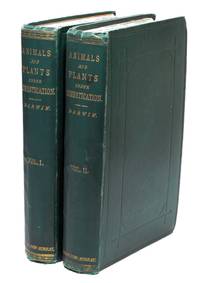
18682642London: John Murray 1868. FIRST EDITION. Original Cloth. Very Good. FIRST EDITION FIRST ISSUE IN ORIGINAL CLOTH of Darwin's sequel to the Origin of Species including his first use of the term "survival of the fittest". "The Variation was a full statement of the facts on which the theories of the Origin were based. <br /> <br /> "After the Origin's publication Darwin embarked on two broad lines of research: botanical experiments and studies of variation sexual selection and emotional expressions in humans and mammals. In 1860 he began recycling the early as yet unpublished chapters of 'Natural selection' and studying the osteology of domestic pigeons ducks and geese for a book on how breeders and horticulturists modify species. This was The Variation of Animals and Plants under Domestication 1868. Its two volumes were intended to provide overwhelming evidence for the ubiquity of variation although they would also incidentally answer Lyell and Gray who maintained that variations had not occurred purely by chance but were providentially directed. Darwin showed that breeders indeed selected from a vast array of minute random variations. He gave numerous instances of the causes of variability including the direct effect of the conditions of life reversion the effects of use and disuse saltation prepotency and correlated growth.<br /> <br /> "The Variation also addressed a key criticism of the Origin of Species: that it lacked an adequate understanding of inheritance. Darwin's 'provisional hypothesis of pangenesis' was constructed to explain how heritable traits were passed from parents to offspring. He supposed that each part of a parent organism throws off minute particles or 'gemmules' which circulate in the body and collect in the sexual organs to be transmitted in reproduction. Because gemmules are received from two parents the offspring develop to resemble them both more or less. 'The child strictly speaking does not grow into the man but includes germs which slowly and successively become developed and form the man' Darwin Variation.<br /> <br /> "The term 'survival of the fittest' borrowed at Wallace's insistence from Herbert Spencer's 1866 Principles of Biology first appeared in the Variation. It was a partial substitute for Darwin's more anthropomorphic 'natural selection' which many critics took to imply the existence of a 'selector'. Mistaking Darwin's metaphor they concluded that intelligence lay as much behind nature's selecting as behind a pigeon fancier's. Nevertheless Darwin defended his use of 'natural selection' while conceding that he had personified it too much" Dictionary of National Biography. <br /> <br /> First issue: with 1-line publisher's imprint on cloth at base of spines 5 lines of errata in vol. I and 7 in vol. II. <br /> <br /> Complete with 32 pages of ads dated April 1867 at rear of vol. I 2 pages of ads dated February 1868 at rear of vol. II as issued and 43 in-text wood engravings. <br /> <br /> London: John Murray 1868. Octavo original cloth. Two volumes. Handsome bookplate and small bookseller's Foyle's sticker on front pastedown of each volume and neat owner signature in pencil on flyleaves. A little foxing to flyleaf and title of volume 2 otherwise text generally clean. Cloth with only a little rubbing and a few mild spots of soiling. Volume 1 possibly recased spine cloth tight against text block. Spine gilt exceptionally bright. A handsome copy in original cloth of an essential Darwin text. John Murray unknown
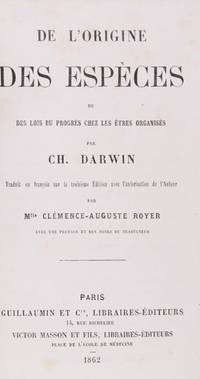
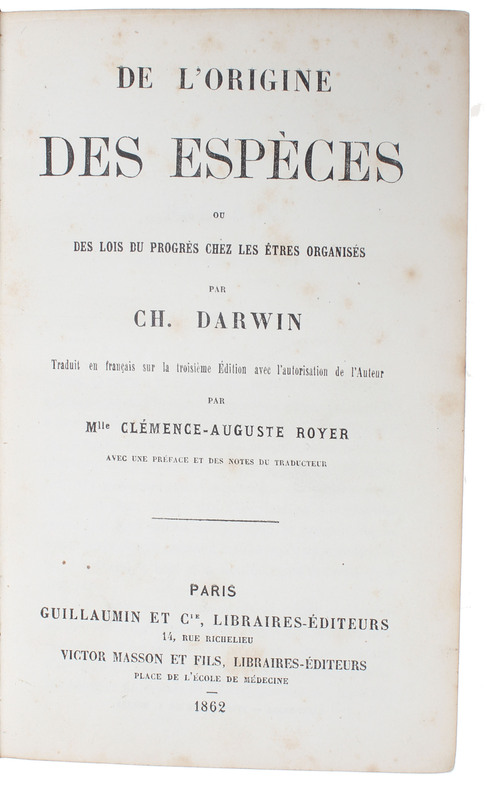
1862feb02661<p>1862. First French Edition - On the Origin of Species by Means of Natural Selection or the Preservation of Favoured Races in the Struggle for Life by Charles Darwin<br />De l'origine des espèces ou des lois du progrès chez les êtres organisés</p><p>Used book For more details and availability please contact me</p> Guillaumin und Masson hardcover
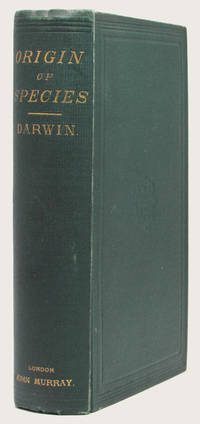
187233920London: John Murray 1872. The Highly Important Sixth Edition with additions and corrections thirteenth thousand the last edition which Darwin lived to amend and revise. This copy with pleasing provenance the copy of Anthony Traill Provost of Trinity College Dublin. Folding lithographed diagram by W. West. 8vo publisher's original green cloth gilt lettered on the spine and blocked in blind in a panel design on the covers original brown coated endpapers all edges untrimmed. xxi 458 pp. A very fine handsome bright and unmarked copy very clean and crisp throughout unusually so. A VERY FINE BRIGHT AND PLEASING COPY OF THE RARE SIXTH EDITION OF 1872 THE GREATEST BIOLOGICAL WORK EVER WRITTEN. IT IS CONSIDERED RARE AND WAS ISSUED IN A QUANTITY NOT EXCEEDING 2000 COPIES. This edition includes an expanded version of "An Historical Sketch of the Recent Progress of Opinion on the Origin of Species" as well as a table of corrections. The Sixth Edition of 1872 consisted of 3000 copies including three states of the title page reading "Eleventh" "Twelfth" and "Thirteenth" Thousand The Sixth Edition contained a new chapter VII written to address and to refute the views certain other scientists. A glossary appears for the first time and additionally it is in this sixth edition that Darwin used for the first time the word "evolution". The word was inserted three times into the text twice on pages 201 and three times on page 424.<br> 'This edition was extensively revised by Darwin and the new chapter VII was inserted to confute the views of the Roman Catholic biologist S. George Mivart. The title changes to THE ORIGIN OF SPECIES and a glossary appears. It is in this edition that the word 'evolution' occurs for the first time. It had been used in the first edition of THE DESCENT OF MAN in the previous year but not before in this work. 'Evolved' had bee the last word of the text in all previous editions but 'evolution' had been omitted perhaps to avoid confusion with the use of the word by Herbert Spencer or with its more particular embryological meaning. The word had however been used in its transformist sense by Lyell as early as 1832 Principles of Geology Vol. II p. 11. On the verso of the title leaf of the 1872 issues there are advertisements for nine of Darwin's works whereas the 1873 reprint has ten. It must have been in press before November 1872 when EXPRESSION OF THE EMOTIONS came out otherwise the new book would have been added. See Freeman<br> Darwin's Revolutionary Masterwork in which he not only "drew an entirely new picture of the workings of organic nature; he revolutionized our methods of thinking and our outlook on the natural order of things. The recognition that constant change is the order of the universe had been finally established and a vast step forward in the uniformity of nature had been taken." PMM Together with Copernicus' DE REVOLUTIONIBUS and Newton's PRINCIPIA it is deemed one of the three greatest and most important scientific works ever penned.<br> "The most influential scientific work of the nineteenth century" and "The most important biological work ever written" Horblit Freeman. Darwin's elaboration of the theory of natural selection laid the groundwork for the controversy over the evolution of man and with only slight modification by such scientists as Stephen Jay Gould Darwin's ideas remain the umbra under which most current biological research is conducted.<br> Darwin had intended the book to be an abstract of his 'big book' on transmutation of which only the first part Variation Under Domestication 1868 was published in his lifetime.<br> This copy was owned by Anthony Traill whose neat signature is found at the head of the half-title page. Traill was actively involved in politics during the 1870's and 1880's. He was an Ulster Unionist and in 1884 was appointed High Sheriff of Antrim. He was also chairman of the world's first electric tramway Portrush founded with his brother William. He was appointed Provost of Trinity College Dublin in 1904. During his time in the office he carried out many internal reforms. Traill refused to change the University's constitutional position at any time in his Provostship despite pressure. He remained the Provost until he died at the Provost's House in 1914.<br> Anthony Traill. 1838-1914 Provost of Trinity College Dublin. LLD LLB MB MCh MD. Honorary LLD degrees from Glasgow Aberdeen and St. Andrews Dictionary of Irish Biography John Murray hardcover
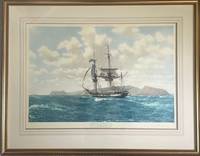
66330. The ship 'Beagle' is shown moored off James Island on October 17th. 1835. The topographical view is taken from the coastal sketch ordered by 2nd.Lieut. Sullivan at the time. The details of the 'Beagle' were taken from Admiralty charts and records. The artist JOHN CHANCELLOR 1925-1984 originally a merchant seaman latterly chartered his owm hydrographic survey vessel and on retirement became one of the foremost marine artists of the 20th. century. This painting of the 'Beagle' was one of his last productions - it took 500 hours of research and 750 hours at the easel is meticulous in its detail and full of atmosphere and interest. The run of 850 copies was sold out within 12 months and has been keenly sought since then. It is used on the 'Beagle Project' and the CUP 'Darwin On-Line' web-sites and is also the foundation work for the building of a replica 'Beagle'. Chancellor took considerable trouble to find the best colour printer for the work and the copy offered here is in excellent bright condition. We will of course send images on request. unknown
66329. The ship 'Beagle' is shown in rough seas off Cape Horn. The details of the 'Beagle' were taken from Admiralty charts and records. The artist JOHN CHANCELLOR 1925-1984 originally a merchant seaman latterly chartered his own hydrographic survey vessel and on retirement became one of the foremost marine artists of the 20th. century. This painting of the 'Beagle' was one of his last works published posthumously. It is meticulous in its detail and full of atmosphere and interest. For a detailed discussion of the technicalities of the two Beagle paintings by ChANCELLOR himself see http:darwin-online.org.uk. unknown
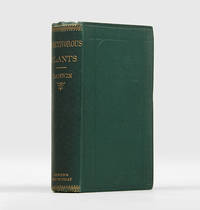
1875119518London: John Murray 1875. First edition first issue. "These meticulous studies form a minor contribution to the evolutionary series by the study of the adaptations of such plants to impoverished conditions. The book was published on 2 July 1875 in a standard binding without inserted advertisements. It is stated that 3000 were printed of which 2700 were sold to the trade at once. This cannot be strictly true because both the second and third thousands of the same year stated their thousands on the title pages" Freeman. Octavo. 30 wood-engraved illustrations in the text. Original green bead-grain cloth neatly rebacked with the original gilt lettered and decorated spine laid down corners refurbished blind-panelled covers brown coated endpapers. Attractive contemporary armorial bookplate of Alfred Crease Coxhead; only slight rubbing to extremities inner hinges cracked but sound a few leaves at the beginning with brown staining probably from a pressed flower. A particularly bright copy. Freeman 1217. hardcover
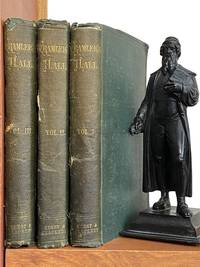
41877London. Hurst and Blackett Publishers. 1858. 8vo. in 8's 19.4cm first edition in 3 volumes 3151 & 3104 & 308pp. in the original green cloth gilt spine titles wear on the edges corners bumped inner hinges shaken damp stain mainly on the bottom edge of all three volumes condition is good rare thus ho1.1. ~ Volume Three bears the signature "C. Darwin" Charles Dawin. 1Volumes One and Two bear the signature “E. Darwin†probably Edward Charles Darwin’s half cousin 1821-1901. ~ Julia Wedgewood 1821-1901 was Charles Darwin’s cousin and correspondent. This is the second of two novels. Wedgewood's father objected to her writing novels so she continued writing literary criticism and articles. One of the latter was published in 1861 on the theological significance of "On the Origin of the Species" to which Darwin responded "You understand my book perfectly". I have examined twenty or so specimen signatures and conclude it is Darwin. Wedgewood’s association and family provenance would be sufficient evidence of authenticity. ~ Darwin was know to be rough on books. He read in bed often laying in with books piled high on the bedroom floor. Folio and quarto being heavy he would often breake the spine in two and could find the second half in the bedside piles within minutes when needed. London. Hurst and Blackett, Publishers. 1858 unknown
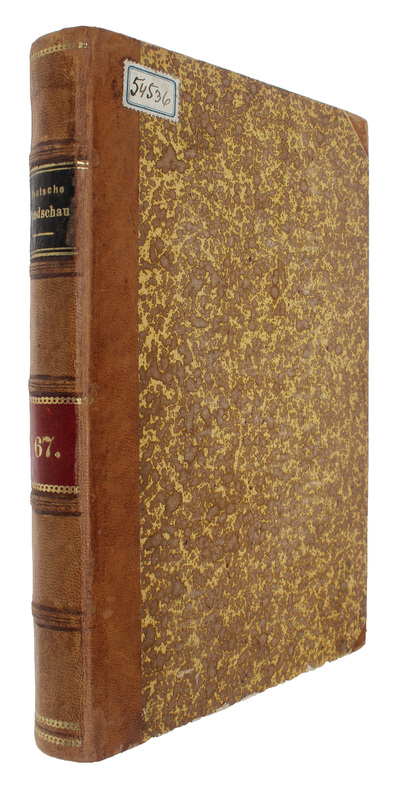
189153191Berlin, Gebrüder Paetel, 1891. Large8vo. In a nice contemporary half calf binding with 5 raised bands and gilt lettering to spine. In ""Deutsche Rundschau"", Band 67, 1891. Green leather title-label and red leather tome-label to spine, Small paper label pasted on to top left corner of front board. Two stamps to first leaf and one stamp to P. 476. Light wear to extremities, internally very fine and clean. Pp. 357-390. [Entire volume: IV, 480 pp.]
186252388Paris, Guillaumin et Cie, Victor Masson et Fils, 1862. 8vo. In contemporary half calf with gilt title to spine. Very light minor brownspotting to a few pages. Previous owner's name to half title. A fine copy. LXIV (incl. half-title), I-XXIII + (24-) 712. pp. and 1 folded plate (between pp.160 a. 161). Fully complete.
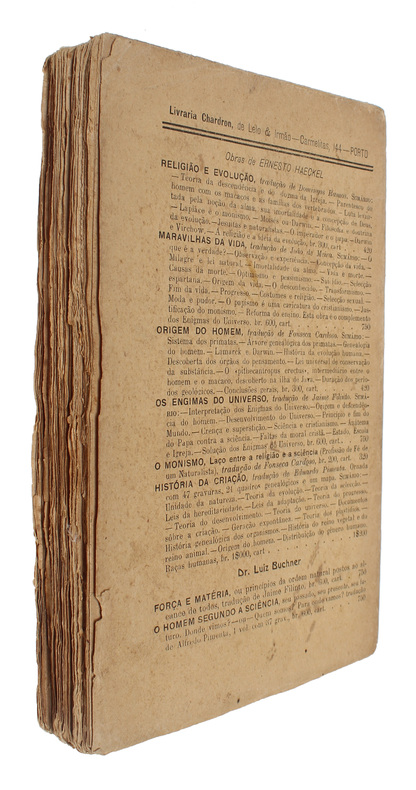
191355761Oporto, Livraria Chardron, de Lello y Irmao, (1913). 8vo. Partly uncut in the original printed wrappers. Spine cracked and front hindge with repair. Wrappers with a few nicks. Half-title with previous owners names. Internally fine and clean. XVI, 477 pp.
189153191Berlin Gebrüder Paetel 1891. Large8vo. In a nice contemporary half calf binding with 5 raised bands and gilt lettering to spine. In "Deutsche Rundschau" Band 67 1891. Green leather title-label and red leather tome-label to spine Small paper label pasted on to top left corner of front board. Two stamps to first leaf and one stamp to P. 476. Light wear to extremities internally very fine and clean. Pp. 357-390. Entire volume: IV 480 pp. <br/><br/><em>The Exceedingly rare first and only 19th century translation of Darwin's first published work "Letters on Geology" from 1835. The pamphlet was initially published without Darwin's consent and he was "a good deal horrified" when he learned about the publication which explains the posthumous translation. The work contains extracts from ten letters written by Darwin to John Stevens Henslow 1796-1861 during his five-year voyage on the Beagle. Henslow the charismatic and well-connected Regis Professor of Botany at Cambridge was Darwin's close friend and first mentor in natural history and responsible for obtaining for Darwin his position as ship's naturalist aboard the Beagle. Henslow had this pamphlet printed without Darwin's knowledge for distribution amongst the members of the Cambridge Philosophical Society "in consequence of the interest which has been excited by some of the Geological notices which they contain and which were read at a Meeting of the Society on the 16th of November 1835" an act which secured Darwin's reputation with the scientific community even before his return to England in October 1836. "It has always been assumed that it was issued to members of the Cambridge Philosophical Society in December 1835 and this is probably so but I have not seen a copy with a dated ownership inscription or accession stamp for that year" Freeman.The original pamphlet was reprinted in facsimile in 1960 again for private circulation in the Cambridge Philosophical Society and for friends of that Society. Only two translations has been made: The present first and a Russian from 1959 Freeman 7.Freeman No. 6. </em> hardcover
186252388Paris Guillaumin et Cie Victor Masson et Fils 1862. 8vo. In contemporary half calf with gilt title to spine. Very light minor brownspotting to a few pages. Previous owner's name to half title. A fine copy. LXIV incl. half-title I-XXIII 24- 712. pp. and 1 folded plate between pp.160 a. 161. Fully complete. <br/><br/><em>The scarce first French edition of Darwin's masterpiece one of the most important books ever printed. The "Origin" started the greatest of all intellectual revolutions in the history of Mankind.There were some difficulties with the first French edition. Mlle Royer who Darwin described as 'one of the cleverest and oddest women in Europe' and wished 'had known more of natural history' added her own footnotes. He was not really happy until the third translation by Éduard Barbier appeared in 1876. Freeman. Freeman No 655 Freeman does not mention the plate which is present here. </em> unknown
191355761Oporto Livraria Chardron de Lello y Irmao 1913. 8vo. Partly uncut in the original printed wrappers. Spine cracked and front hindge with repair. Wrappers with a few nicks. Half-title with previous owners names. Internally fine and clean. XVI 477 pp. <br/><br/><em>The first edition in the rarely seen wrappers of the first Portuguese translation of Darwin's "Origin of Species". The comparatively late translation is partly due to the Portuguese 'Frenchism' at the time. The first French translation appeared in 1862 and was also widely circulated in Portugal. It also appears that the translator a doctor and professor who was also a Mason a self-proclaimed poet and the founder of the Spiritist Society of Portugal named Joaquim Marques Dá Mesquita Montenegro Paúl 1875-1946 used the French translation rather than the English original. This apparently led to a number of errors and mis-translations that rendered the work unfaithful to say the least. Unfortunately this translation continued to be reprinted for the rest of the century in the Portuguese speaking world oftentimes by simply changing the name of the translator for a spurious name. The first Brazilian edition in 1973 turned out to be nothing but an exact reproduction of the text of the Portuguese translation. It appears that even in the 21st century many of the purported new translations were still reprints of the first Portuguese edition. A proper translation from the English was made in 1982 but it was apparently condensed from the 6th ed. 1872. In 1985 a complete translation was published but it was based on the first ed. 1859. In 2011 and 2014 finally two different translations were published in Brazil that appear to be more legitimate which as a commentator avers see links below doesn't necessarily guarantee that they are faithful. Thus the Portuguese OSS bibliography remains murky and convoluted to this day and it appears to be a continuing saga. Therefore this late defective first translation seems to have been crucial to the understanding-or misunderstanding- of Darwin's OSS for Portuguese readers for the remainder of the century and then some.The uncertainty regarding the publication year is quite puzzling for a modern book. Freeman online gives three different numbers F743 F743a and F743b the latter being 1961 and 1990 both of which are by the same translator as the first and he gives the date "192-" and 1920 to the first. The entry in the Biblioteca Nacional de España states "1924" and two Brazilian libraries give "1900's" and the rather wide ranging "1910-1992" a Portuguese university library states "1900-80" and the Biblioteca Nacional de Portugal says "1900." The year 1925 is given to the only two copies in US libraries the American Philosophical Society and The Huntington. In the links below the commentators assign it to the year 1913 and even though they don't justify that date they seem to be quite familiar with Portuguese OSS editions in general. The date 1913 is also given by Ana Leonor Pereira in "The Reception of Darwin in Portugal 1865-1914" Revista Portuguesa de Filosofia T. 66 Fasc. 3 Evolução Ética e Cultura / Evolution Ethics and Culture 2010 pp. 643-660 which perhaps makes it more plausible As a final note the 1961 translation at the Huntington purportedly by Eduardo Fonseca is one of those spurious reprints with a made up name mentioned earlier. http://catalog.huntington.org/record=b1703473 For a few commentaries on the different editions and on various Portuguese OOS translations and purported translators see:http://observatoriodaimprensa.com.br/armazem-literario/_ed802_lendo_darwin_em_portugues/ andhttp://naogostodeplagio.blogspot.com/2009/10/miseria-pouca-e-bobagem.html Freeman 743 </em> unknown
18665323DB1866. 4 Auflage 8. Tsd. mit Ergänzungen und Korrekturen. London John Murray 1866. XXI S. 593 S. mit gefalterter Tafel Diagramm 32 S Werkverzeichnis vom Murray Verlag London. Orignal Leinenband. Besitzerstempel auf dem vorderen Vorsatz: "Wm Krahnstover - Baden-Baden" unknown
18605280New York: D. Appleton and Company 1860. First American edition. Hardcover. Very Good. First American edition fourth issue in original year of US publication. Original cloth spine a bit faded to golden tan shelfwear to edges and corners recased with endpapers expertly renewed. Contents clean contemporary owner's signature on front endleaf. With supplement of the author's additions and alterations on pages 426-432. Garrison-Morton 220 1859 London original edition; Freeman 380 this edition. D. Appleton and Company hardcover
1846NF3922The natural history of these islands is eminently curious and well deserves attention. Most of the organic productions are aboriginal creations found nowhere else; there is even a difference between the inhabitants of the different islands; yet all show a marked relationship of America though separated from that continent by a open space of ocean between 500 and 600 miles in width. The archipelago is a little world within itself or rather a satellite attached to America whence it has derived a few stray colonists and has received the general character of its indigenous productions. Considering the small size of these islands we feel The more astonished at the number of their aboriginal beings and at their confined range. Seeing every height crowned with its crater and the boundaries of most of the lava-streams still distinct we are led to believe that within a period geologically recent the unbroken ocean was here spread out. Hence both in space and time we seem to be brought somewhat near to that great fact Ð that mystery of mysteries Ð the first appearance of new beings on this earth"------Charles Darwin Journal of Researches into the Natural History and Geology of the Countries visited during the Voyage of H.M.S. Beagle round the World under the Command of Capt. FitzRoy R.N. Harper & Brothers 1846 first American edition 2 volumes some wear to the fore edge corner tips and spine extremities of both volumes exhibiting some cloth loss some ROHRSCHACH type stains to the original yellow end-papers and paste-downs the first five textual leaves in volume one exhibit an old moisture tidal mark at the base and lower area of the gutters foxing throughout the text block of both volumes volume two shows wear and missing cloth along the outer front hinge else good copies of this most important and pioneering volume. Indeed Darwin's first book. Harper & Brothers hardcover
1862143986London: John Murray 1862. First Edition. Hardcover. Very Good. London John Murray 1862 first edition first issue. Octavo vi 366 32 publisher's advertisements pages with 34 wood-engraved illustrations some full-page one a folding plate additional to the pagination. Ribbon-embossed plum cloth blocked in gilt and blind; covers slightly worn at the corner-tips and unevenly sunned on the spine; old repair to a split at the head of the front joint; contemporary library stamps to a dozen pages but see our footnote; front hinge cracked but firm; a few other minor signs of age and handling; a very good copy. The scarce first issue of Darwin's first major work after 'On the Origin of Species' 1859. Its exploration of the mechanisms of pollination offered a persuasive observable demonstration of his theory of natural selection in operation in particular through the coevolution of insects and the sexual structures of the orchids that they fertilise. <p>Although praised by botanists the book did not sell well and in later issues the sheets from the first printing were offered in a variant binding and with advertisements dated as late as 1871. This example is in the first-issue binding and has advertisements dated December 1861. The total edition likely comprised fewer than 2000 copies. <p>This copy has the contemporary blindstamp of the Adelaide bookseller W.C. Rigby to the front free endpaper and flyleaf and the contemporary library stamps of the Gawler Institute attesting to the early importation of Darwin's works into colonial South Australia. The title page has an early manuscript shelf mark in ink the Gawler Institute red inkstamp with the inserted reference number 1947 and a much later blue inkstamp for the Salisbury North High School Library. That this book has survived at all is cause for celebration. <p>Freeman 800 'variant a.'. John Murray hardcover
18972786New York: D. Appleton and Company 1897. First Thus. Near Fine. The first authorized collected edition of Darwin's works in 15 volumes.Original red half morocco over marbled boards with gilt to spine. Top edges gilt. Light occasional spotting and some sunning to spines. Small tear to the foot of spine on Descent of Man. Uncommon in the original morocco this set of Darwin's most influential work is overall a pleasing and neat addition to any collection.<br/><br/>"Perhaps no one has influenced our knowledge of life on Earth as much as English naturalist Charles Darwin. His theory of evolution by natural selection now the unifying theory of life sciences explained where all of the astonishly diverse kinds of living things came from and how they became exquisitely adapted to their particular environments" Wyhe. The present set was the first one to be authorized by Darwin himself bringing together his most important scientific contributions into one beautiful and functional reference library. Near Fine. D. Appleton and Company unknown books
2-78444Modena Zanichelli 1864 ma 1865 sulla copertina originale conservata all'interno 8vo cm. 24 x 14 legatura moderna in mezza pelle beige titolo e fregi in oro al dorso conservate all'interno le copertine della brossura originale con difetti pp. XVI-403 con una tavola litografica fuori testo. Mitica prima traduzione italiana. Freeman n° 706; Coccia pp. 157-160. unknown
1871649L2London: John Murray 1871. First edition. Leather. Good. 7" by 5". None. A first edition first issue set of this famous work regarding evolutionary theory in the context of humans by eminent Victorian naturalist Charles Darwin. The 'Descent of Man' was the first of Charles Darwin's works to use the word 'evolution' and this can be found to page 2 of the first volume. It next appeared in Darwin's sixth edition of 'Origin' published in the following year. This work continues on the principles laid out in Darwin's 'On the Origin of Species' which served as an abstract of his theory. Here Darwin applies his evolutionary theory to humans and proceeds to detail his theory of sexual selection. He also looks at evolutionary psychology evolutionary ethics race sexes and how evolutionary theory is relevant to society. A harlequin set with volume I in a half morocco binding with cloth covered boards and volume II in library cloth. Both volumes are the first edition first issue with the correct errata to the verso of title page to volume II seventeen errata for volume I and eight for volume II. With the note to a leaf between i and x referring to 'a serious and unfortunate error'. To volume I page 297 starts with 'transmitted' and contains misprints such as 'kaola' to page 27. This first volume is very scarce as only 2500 copies of this issue were printed. Collated both volumes have been rebound without the half-titles and publisher's adverts. Ex-library copies with institutional stamps to the recto and verso of title pages only for the 'National Central Library London'. To the recto of front endpaper to volume II there is also a stamp for 'British Library Boston Spa Yorkshire'. Illustrated with several in-text illustrations. A scarce opportunity to own a copy of the first edition first impression of this important scientific work. A harlequin set. With volume I in a half morocco binding with cloth covered boards and volume II in library cloth. Blind stamp to the board of volume I for London Library St James's Square. Externally volume I is worn with heavy rubbing to the extremities and joints. Volume II is generally smart with two library stickers to the front board. Front joint to volume I is tender with the hinge detached resulting in the lifting of the backstrip. A few small chips to the preliminaries of volume I. With library stamps to the endpapers and title pages of both volumes. Loss to the front pastedown and endpaper of volume I. Internally both volumes are firmly bound. Pages are generally bright. The odd spots to pages mostly to volume I which has the occasional ink blot to margins. A good candidate for a rebind. Good John Murray hardcover