DARWIN, CHARLESBiblio.com
6 067 résultats
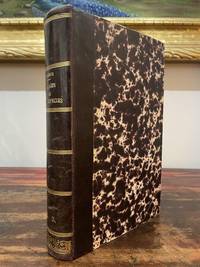
187660588Moscow izdanie V. P. Plemânnikova 1876. 8vo. 3 parts bound in 2 uniform contemporary full cloth bindings with blind stamped titles to spines. Some soiling to extremities and part of cloth around hinges worn of. Internally with occassional brownspotting. 4 168 2 393 1 VII 2 pp. 4 folded plates. <br/><br/><em>Rare first Russian translation of Darwin’s Insectivorous Plants published only one year after the English original. Freeman F1244OCLC only locates one copy in Poland Huntinton in Pasadena also holds a copy. </em> hardcover
195757927Bucharest National Academy 1957. Folio. With the original printed wrappers in publisher's full cloth with gilt lettering to spine and gilt ornamentation to spine forming 6 compartments. A fine copy. 2 LXXXIV 398 2 pp. plate with genealogical tree included in the pagination. <br/><br/><em>Rare first complete Romanian translation of Darwin's "Origin of Species". A preliminary and incomplete translation was made and published in 1950 48 pp. which also included a biography of Darwin Freeman 746.Freeman 747. </em> hardcover
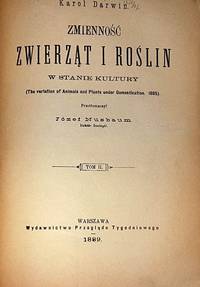
1888feb02677<p>1888. First Polish Edition of Variation of Animals and Plants under Domestication in 2 Volumes by Charles Darwin.<br /><br />Zmienność zwierząt i roślin w stanie kultury</p><p>Used book For more details and availability please contact me</p> Wydawnictwo Przeglądu Tygodniowego hardcover
187154640E-172: John Murray. Very Good. 1871. Hardcover. Leather. 8vo. John Murray. 1871. Two Volumes. Viii 423 pgs and viii 475 pgs. First Edition/Later Issue lacking transmitted on pg. 297 of the 1st volume and the errata slip at the beginning of volume 2; lacking the catalog at the end of volume 2. Bound in full blue leather with gilt rule gilt titles raised bands and red and black leather spine label present to the spine. Boards have some light wear present. Marbled endpapers. No ownership marks present. Text is clean and free of marks. Binding tight and solid. The word "evolution" appears here for the first time in any of Darwin s works on page 2 of the first volume that is to say before its appearance in the sixth edition of the Origin of species in the following year Freeman p 129. In Origin Darwin had avoided discussing the place occupied by Homo sapiens in the scheme of natural selection stating only that light will be thrown on the origin of man and his history. Twelve years later he made good his promise with The descent of man in which he compared man's physical and psychological characteristics to similar traits in apes and other animals showing how even man's mind and moral sense could have developed through evolutionary processes. In discussing man's ancestry Darwin did not claim that man was directly descended from apes as we know them today but stated simply that the extinct ancestors of Homo sapiens would have to be classified among the primates; however this statement as misinterpreted by the popular press caused a furore second only to that raised by the Origin Norman. E-172; 8vo 8" - 9" tall . John Murray hardcover
189097629NY:: D. Appleton and Company. Very Good. 1890s. Hardcover. An incomplete set: 14 of 15 volumes Volume I of The Origin of Species is missing. Animals and Plants Under Domestication two volumes Structure and Distribution of Coral Reefs The Descent of Man and Selection in Relation to Sex Expression of the Emotions in Man and Animals The Different Forms of Flowers on Plants of the Same Species Geological Observations on the Volcanic Islands and Parts of South America Insectivorous Plants The Life and Letters of Charles Darwin two volumes edited by his son Francis Darwin The Power of Movement in Plants The Origin of Species Volume II only The Formation of Vegetable Mould Through the Action of Worms Journal of Researches Into the Natural History and Geology of the Countries Visited During the Voyage of H. M. S. Beagle Round the World. Author's Edition Limited: this set is number 223 of 1000. Octavos half bound in burgundy leather marbled boards raised bands along the spines gilt lettering and design on the spines top edges gilt marbled endpapers illustrations photographs and fold-out maps. Light shelf wear and aging aptly the Insectivorous Plants volume has two small holes at the fore edge of the text block - insect damage one of the volumes has the previous owner's name and address on a front endpage else all volumes are very good. Texts are clean and bindings are sound. . D. Appleton and Company, hardcover
1881140940727London: John Murray 1881. First Edition. Near Fine. First edition first printing. Bound in publisher's original green cloth with titles stamped in gilt on the spine. Darkening to spine cloth and slight tear at head. Foxing to textblock edge preliminary and terminal sheets. Previous owner name in pencil to front paste down. Darwin's final work published shortly before his death in April 1882. John Murray unknown
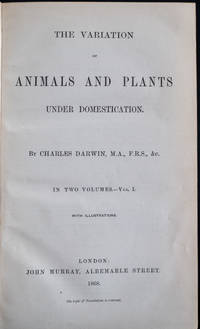
18686645London: John Murray 1868. First edition. Fine. 2 volumes octavo 23 cm. First issue points: 5 errata on 6 lines in Vol. I and 9 errata on 7 lines in Vol. II. LACKS ADS apparently discarded when bound by Henry Southeran. Bound in full tan polished calf double-ruled in gilt; six-compartment spine tooled in blind and gilt with black title labels. Marbled edges and endleaves. Ticket of Henry Southeran. A very handsome set! <br /><br />Darwin's sequel to the Origin of Species including his first use of the term "survival of the fittest" and his much-admired essay on pigeons. John Murray unknown
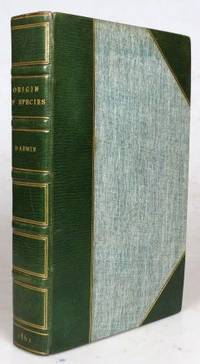
186149837London: John Murray 1861. Third edition seventh thousand. 8vo. xx 538 pp. Later green half straight grain morocco for Hatchards green cloth sides spine with raised bands gilt lettered direct to two panels and dated at the foot marbled endpapers with the bookplate of a Laurence Currie to the front pastedown top edge gilt. Folding table. Light rubbing to the extremities an attractive copy. Freeman 381. First published 1859 this edition includes a leaf detailing alterations from the second edition and also the historical sketch for the first time in a Murray edition. The latter had originally appeared in a shortened form in the first German edition and subsequently in the fourth American printing both 1860. London: John Murray unknown
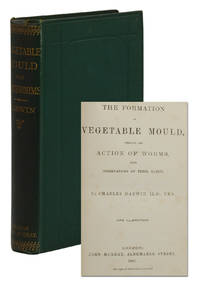
1881163369London: John Murray 1881. A fresh copy of his last book in the original cloth First edition first issue of the author's final book. Published the year before his death it was a remarkable success and sold 6000 copies within a year initially selling faster than the Origin of Species had done. The culmination of ten years of intensive research and close observation on the interaction of earthworms with their physical environment and their influence on great earth movements the work was Darwin's "leitmotif explaining vast changes by minute incremental events: mountain uplift evolving life and now worms transforming the soil" ODNB. The first impression of 2000 copies was apparently split between two equal issues the first without a "thousand" statement as here and the second with "second thousand" on the title; all issues thereafter had such a statement. Octavo. Woodcut and engraved figures in the text. Publisher's advertisement leaf at rear. Original green cloth spine lettered and decorated in gilt covers panelled in blind brown coated endpapers. Ownership inscription on first blank. Cloth with couple of bumps and tiny wear to corners but fresh overall superficial splits to sound inner hinges outer leaves foxed contents clean inconsequential paper flaw to lower corner of pp. 1/2. A very good copy indeed. Freeman 1357. hardcover
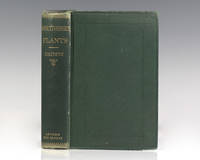
1880156556London: John Murray 1880. It has always pleased me to exalt plants in the scale of organised beings First edition first issue of Darwin's penultimate book continuing his experiments with climbing plants and prepared with the assistance of his son Francis. The first issue is distinguished by the presence of two lines of errata on p. x which are corrected in the second issue of the same year. The collaborative authorship proclaimed on the title page reflects Darwin's interest in introducing his children into the world of science. Francis Darwin had trained as a doctor but turned from medicine to botany initially working as secretary and assistant to his father. In 1876 he had been for some months at the University of Würzburg learning laboratory methods from Julius Sachs. "The book was an extension of Charles Darwin's work on climbing plants and it showed that the same mechanisms can be observed in plants in general. By extending the idea of irregular circumnutation the Darwins analysed the growth movement of plants in response to factors of the environment such as light gravity and wounds. In addition they demonstrated that the mechanism of curvature in both roots and shoots was the result of differential growth rates. They could also confirm that the effect of the stimuli on the growth movement was indirect and that light and gravity act on some substance in the tip of the root and the shoot which is transmitted to other parts of the plant. Francis Darwin later refined some of the experimental techniques and modified their theoretical conclusions" ODNB. Provenance: with the ownership signature of Ralph W. Lewis dated 1949 on the half-title. Lewis was a professor of botany plant pathology biology and natural science at Michigan State University from 1937 to 1980. He is best known for his arguments in favour of formalizing evolutionary theory and recognizing evolution as a system of theories. Octavo. With 196 woodcuts in text; 32-page publisher's catalogue dated May 1878 at rear. Original green cloth spine lettered and decorated in gilt covers panelled in blind brown coated endpapers. Spine ends and corners gently bumped and rubbed small indentation at centre of spine some marks to rear cover professionally recased pp. 272-3 browned from slip of paper once laid in. A very good copy. Freeman 1325. hardcover
1868191093London: John Murray 1868. Darwin's earliest use of "survival of the fittest" First edition first issue of the first of Darwin's works to use the famous evolutionary phrase preceding its appearance in the fifth edition of the Origin of Species by a year. "Survival of the fittest" p. 6 was coined by the philosopher and sociologist Herbert Spencer. Variation provides a full statement of the facts on which the theories of Origin were based. This work was intended as the first section of Darwin's projected "big book" on evolution of which the Origin was an abstract. Its purpose was "to provide overwhelming evidence for the ubiquity of variation. Darwin gave numerous instances of the causes of variability including the direct effect of the conditions of life reversion the effects of use and disuse saltation prepotency and correlated growth. Variation also addressed a key criticism of Origin: that it lacked an adequate understanding of inheritance" ODNB. This is the only Darwin title published by Murray to appear in the larger format of demy octavo. This copy is from the first issue published in a run of 1500 and is distinguished by the presence of five errata in Volume I nine errata on seven lines in Volume II and the spine imprint on a single line. 2 vols demy octavo. With 43 woodcuts. Vol. I with 32 pp. of publisher's advertisements dated April 1867 Vol. II with 2 pp. of advertisements dated February 1868. Original green cloth spines lettered and ruled in gilt covers panelled in blind dark green coated endpapers binder's ticket of Edmonds & Remnants to rear pastedown of vol. I. Armorial bookplates of one John F. Sinclair. Cockling and faint marks to cloth spine ends and corners bumped and a little worn water soiling to lower inner corner of second volume rear cover and endpapers front inner hinge split but holding firm occasional short closed tears to outer margins: a very good copy. Freeman 877; Garrison-Morton 224.1; Norman 597. hardcover
183972639Volume I xxviii 4 597 pp errata. Volume II xiv 2 694 pp. Appendix Volumeviii 352 pp. 54 black and white plates which include 7 loose folding maps. The loose maps are all facsimiles and not originals. Published by Henry Colburn hardcover
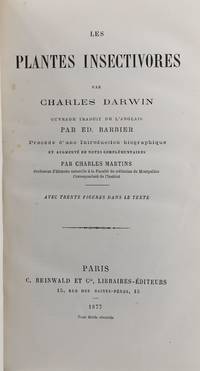
1877feb115656<p>1877: First French Edition of Insectivorous plants</p><p>Les plantes insectivores<br /><br />Used. For more details please contact me</p> C. Reinwald hardcover
1871feb0128<p>1871: First Dutch Edition of The descent of man and selection in relation to sex by Charles Darwin in 2 Volumes <br />De afstamming van den mensch en de seksueele teeltkeus</p> Delft IJkema hardcover
19153159Fexis: Athen 1915. First greek edition. In original paper. Small tear on the top of the cover. Uncut. First greek edition. In original paper. 585 p. First greek edition. Athen unknown
18591293943London: John Murray 1859. Third Edition. Hardcover. Octavo 429 pages with two fold outs and pages of advertisements. In Good plus condition. Rebacked in green cloth with gilt lettering to spine with original boards and preserved and parts of original spine laid on. Boards show wear along the edges; corners bumped and beginning to fray. Pages are age toned as is typical with some minor spotting mostly at the beginning and on the fold outs. Interior otherwise clean and free of marking. An ex-library copy with usual markings including a bookplate from the Royal Navy on front paste down and faded ink stamp on title page. <br /> <br> <br /> <br> <br /> Darwin's contribution present and corrected on page 268. The first edition of 1849 had a transposition error in Darwin's essay some later states included a corrected text in a rear pocket. The second edition was issued in 1851 with no offprint of Darwin's article. This is the third edition complete. Fold out maps are present with some slight tears to the rear map. Shelved in Case 10. 1293943. Shelved Dupont Bookstore. John Murray hardcover
188453520Budapest Kiadja A. K. M. 1884. 8vo. In the publisher's original two embossed full red cloth bindings with gilt lettering to spine. Small vague stamp to both half-titles. Hindges loose on volume i. A fine fine and clean copy. LXXI 1 542 pp.; VII 5 436 pp. <br/><br/><em>The exceedingly rare first Hungarian translation of Darwin's The Descent of Man. "Compared with the original and with a biography by Margó Tivador" Freeman. The Hungarian public was introduced to Darwinism early on when Ferenc Jánosi reviewed The Origin of Species in the Budapesti Szemle Budapest Review a half year after it first appeared in English. Darwin's principal works were first published in Hungarian translation by the Royal Hungarian Natural Science Society Királyi Magyar Természettudományi Társulat. The Origin of Species translated by László Dapsy was published in 1873; The present work in 1884 and a few years later in 1897 the latter work was translated anew and published by László Seress. "It is characteristic of the enlightened spirit of the country in this period that Darwin received academic recognition earlier in Hungary than in England. Although Cambridge did not honor Darwin until 1879 he was elected an honorary member of The Hungarian Academy of Sciences in 1872 the same year on this occasion the renowned Hungarian zoologist Tivadar Margó visited him at Down.Historical circumstances played a major role in this quick appearance of Darwinism and its popularity in Hungary. The failure of the 1848-49 revolution and war of independence seemingly put an end to progressive political discourse signaling an ideological crisis among the intelligentsia. In this context the natural sciences with their 'eternal truths' promised a way out inasmuch as science's promised objectivity might well serve as a politically neutral expression of progressive values" Mund The Reception of Charles Darwin in Nineteenth-Century Hungarian Society."Darwin wrote in the preface to the second edition of 'the fiery ordeal through which this book has passed'. He had avoided the logical outcome of the general theory of evolution bringing man into the scheme for twelve years and in fact it had by that time been so much accepted that the clamour of the opposition was not strident. He had also been preceded in 1863 by Huxley's Man's place in nature. The book in its first edition contains two parts the descent of man itself and selection in relation to sex. The word 'evolution' occurs for the first time in any of Darwin's works on page 2 of the first volume of the first edition that is to say before its appearance in the sixth edition of The origin of species in the following year." Freeman.Freeman no. 1084. </em> hardcover
188253459Kief F. A. Johanson 1882. 8vo. In contemporary half cloth with gilt lettering to spine. Extremities with wear and spine lacking 1 cm of upper part of spine. Title-page with 8 numbers written in contemporary hand. Pasted down back end-paper with two small stamps otherwise internally fine. VII 433 pp. <br/><br/><em>Rare first Russian translation of Darwin's "The Power of Movement in Plants" published two years after the Original English. "This the present work was an extension of the work on climbing plants to show that the same mechanisms hold good for flowering plants in general. It was another specialist book.". Freeman.It appeared in French German and Russian by 1882 and in Italian and Romanian later. Freeman 1349 </em> hardcover
187555758Lwów Ksiegarnia Polska 1875-1876. 8vo. In contemporary half cloth with gilt lettering to spine. Previous owner's stamp and another owner's sginature to title-page. Light wear to extremities otherwise a fine and clean set. 262 2; 313 3 pp. <br/><br/><em>Rare first Polish edition of the second and third parts of the Descent of Man but published separate from the first part as one work hence the title 'Sexual Selection' a translation authorised by Darwin in response to Malowski's request to make the translation Letter 8910 14 May 1873. Whereas "Origin of Species" established Darwinism as a turning point in nineteenth-century biology "The Descent of Man" helped built a bridge between biology the social sciences and the humanities and made Darwinism a broad system of research designs theoretical principles and philosophical outlook.The numeration of parts is from Chapter I to Chapter VI vol. I and from Chapter VII to Chapter XIV vol. II. It is generally based on the first English edition 1871 but at the end of vol. II the Polish publisher has added the short note on the brains of man and apes of T. H. Huxley which was originally published in the second English edition 1874. "It was translated into Danish Dutch French German Italian Polish Russian and Swedish in Darwin's lifetime and into ten further languages since." Freeman.Maslowski 1847-1928 studied medicine and natural sciences in Paris before returning to Poland where he took part in the January Uprising: he remained active in politics primarily as a journalist. At first an ardent Darwinian he later became a fierce opponent.Not in FreemanDarwin Online: F1101b.1 F1101b.2.OCLC locates four copies worldwide Cornell Univ. Huntington Libr. Yale Univ. Libr. National Library of Poland </em> hardcover
18774623Madrid: José de Rojas 1877. 2nd Spanish Edition. Fine. Full title: "Origen de Las Especies por Medio de la Seleccion Natural ó Conservacion de las Razs en su Lucha por la Existencia por Charles Darwin; Traduccion Directa de la Sexta Edicion Inglesa por Enrique Godinez. Segunda edicion castellana notablemente corregida y aumentada." Origin of Species by Means of Natural Selection or Conservation of Roots in their Struggle for Existence by Charles Darwin; Direct Translation of the Sixth English Edition by Enrique Godinez. Second Spanish edition notably corrected and enlarged. The second Spanish edition of Charles Darwin's Origin of Species with original frontispiece and fold out diagram for page 128. This is also the first printing of two letters from Darwin who was known to constantly update editions of Origin of Species during his life. Bound in contemporary quarter calf over marbled boards with five panels divided by triple gilded lines and with gilded lettering. Old library label to first pastedown from the library of 19th century Spanish Naval officer and author Fernandez Duro. Thin and light crease to front cover lower right corner; otherwise in excellent condition with only minor rubbing or creasing elsewhere. Interior is very clean and clear with minor to no toning.<br /> <br /> Pages: 2 12 559<br /> Dimensions: 8¾ x 5â…ž x 1â…. José de Rojas unknown
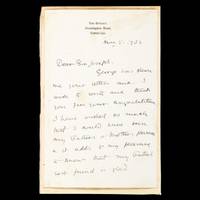
419752 pp. manuscript in ink written on the first two sides of an octavo-size bifolium of notepaper 180 x 115 mm with Horace Darwin's letterhead 'The Orchard Huntingdon Road Cambridge'; dated 5 May 1903 the letter is addressed 'Dear Sir Joseph' i.e. Sir Joseph Dalton Hooker and is signed in full at the foot of the second side 'Horace Darwin'; the writer thanks Hooker for his congratulations by inference on his becoming a Fellow of the Royal Society although this event is not referred to explicitly; mounted on a section cut from an album page; some toning from the old glue on the verso else clean and legible. An unpublished and hitherto unrecorded piece of private correspondence between Cambridge scientist Horace Darwin 1851-1928 - the son of Charles Darwin - and the eminent botanist Sir Joseph Dalton Hooker 1817-1911 - Charles Darwin's closest friend. Horace thanks Hooker for congratulating him on becoming a Fellow of the Royal Society an achievement which elicits fond memories of his father: for although he had passed away more than twenty years earlier we sense that Horace's emotional and deeply sincere words sum up accurately and concisely how much Charles Darwin meant to both men - as a proud and loving father as a loyal friend and as a brilliant intellect. 'Dear Sir Joseph George Horace's older brother has shown me your letter and I wish to write and thank you for your congratulations. I have wished so much that I could have seen my Father & Mother's pleasure & it adds to my pleasure to know that my Father's best friend is glad. My wife and I are sorry that you are so far from well but we hope you may be able to get to George's later & that we may see you then. Ever sincerely Horace Darwin'. Horace's obvious attachment to and respect for his father is to a large extent explained in this extract from The Darwin Correspondence Project: Darwin and Fatherhood University of Cambridge: 'The close relationships that developed with many of his adult children were highly prized by Darwin. So how exceptional was Darwin as a father In most respects the concerns and beliefs that Darwin expressed about fatherhood were ones that were very typical of men from similar backgrounds in the mid-Victorian period. He frequently discussed his own and other people’s children in letters to friends and relatives. He sought to ensure that his children would be successful when measured according to conventional norms of professional middle-class behaviour. The importance that Darwin attached to his paternal responsibilities and the enjoyment that he gained from his relationships with each of his sons and daughters were typical. However the characteristic that made Darwin unusual when compared to his neighbours and friends was the nature of his work. As a gentleman scientist who worked from home and was frequently not well enough to go to public events his life was centred on his home and family to an exceptional extent. His wife children and servants thus contributed to his research and writing and the practical and intellectual consequences of his scientific work were central to the relationships that he formed with his children.' Provenance: Autograph album compiled by Jane Emma Murphy Balcombe 1854–1924 ""The Briars"" Mornington Victoria Australia; à  Beckett family Melbourne by descent.  unknown
1875000860John Murray 1875. 1st Edition . Hardcover. Good. First edition first issue published by John Murray in 1875. x 462 pages. Original green cloth covers with a forward lean bright gilt lettering to the spine spine ends and corners a little rubbed rough cut page edges brown endpapers with a bookseller label to the front pastedown for S&T Gilbert London gift inscription in ink to the back of the free endpaper which as well as the half title is spotted pages otherwise clear with some light creasing or indentations where pages have been turned the rear board is just starting to come a little loose between the last page and the rear free end paper but all remains secure. Good condition. <br/> <br/> John Murray hardcover
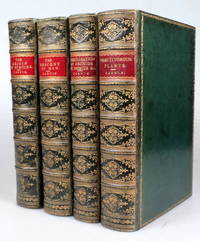
187545749London: John Murray 1878 1877 1877 1875. Four volumes mixed editions. 8vo. Uniformly bound in contemporary green full calf spines with raised bands gilt lettered red spine labels the other compartments richly gilt endpapers and all edges marbled the early book label of a Walter Palmer of "The Acacias Reading" to the front free endpapers. "Origin." with a folding plate illustrations in the text throughout the other works. Foxing to the front and rear of each volume some rubbing to the extremities a handsome set of these early issues. "Origin of Species" - sixth edition 20th thousand dated 1878 the second issue of the definitive text published two years earlier; "Various Contrivances." - second edition revised preceded only by the first edition of 1862; "Descent of Man" - second edition 12th thousand revised and augmented 1877; "Insectivorous Plants" - second thousand preceded only by the first issue published in July the same year. Freeman 403 801 948 and 1217 respectively. London: John Murray unknown
1875132980London: John Murray 1875. First edition of this classic work by Darwin. Octavo original green cloth with gilt titles to the spine woodcut illustrations by Darwin and his sons George and Francis Darwin. In very good condition. Bookplate and Henry Southeran's bookseller ticket to the pastedown. Darwin states in the opening pages to this comprehensive account: "During the summer of 1860 I was surprised by finding how large a number of insects were caught by the leaves of the common sun-dew Drosera rotundifolia on a heath in Sussex. I had heard that insects were thus caught but knew nothing further on the subject." The book chronicles Darwin's experiments with various carnivorous plants in which he carefully studied their feeding mechanisms Darwin tried several methods to stimulate the plants into activating their trap mechanisms including feeding them meat and glass blowing on them and prodding them with hair. He found that only the movement of an animal would cause the plants to react and concluded that this was an evolutionary adaptation to conserve energy for prey and to ignore stimuli that were not likely to be nutritious. He also discovered that while some plants have distinct trap-like structures others produce sticky fluids to ensnare their prey and concluded that this was an example of natural selection pressure resulting in various methods for food capture. John Murray hardcover
1864COLLECTI013679I<p>NEW YORK NY: D. APPLETON AND COMPANY. VERY GOOD. PUB 1864. DARWIN ON-LINE INDICATES THE FOLLOWING PRINTINGS 1860 4 ISSUES18611864186518671868186918701870 5TH ED . PUBLISHER'S ORIGINAL BROWN MUSLIN CLOTH COVERED BOARDS WITH GILT SPINE TITLES LIGHT YELLOW BUFF COATED ENDPAPERS. VERY SLIGHT RUB WEAR TO THE CORNERS AND SPINE ENDS WITH A FAINT DAMP MARK AT THE BOTTOM FORE-EDGE CORNERS OF THE PRELIMINARY LEAVES AND SOME LIGHT SCATTERED FOXING TO THE TEXT. A VERY NICE CLEAN TIGHT WELL PRESERVED AND COMPLETE COPY OF THIS RARE CIVIL WAR ERA PRINTING. This copy has the 3 quotes on the page facing title the " A NEW EDITION REVISED AND AUGMENTED BY THE AUTHOR" on title page the 6 starred repeated numbered pages 116-121 between 116 and 117 the 6 page Supplement pp 426-432 following p 425 and Darwin's 7 page preface v-x1 dated Feb 1860. .</p> D. APPLETON AND COMPANY hardcover