7 255 résultats
1956feb02705<p>1956. First Mexican Edition of The descent of man and selection in relation to sex by Charles Darwin</p><p>El origen del hombre y la selección en relación al sexo</p><p> Used book For more details and availability please contact me</p> Nacional
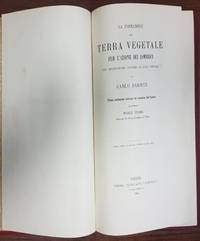
1882feb111961<p>1882. First French Edition of Vegetable Mould and Worms by Charles Darwin<br /><br />La formazione della terra vegetale per l'azione dei lombrici con osservazioni intorno ai loro costumi<br /><br />Used. For more details please contact me</p> Torino hardcover
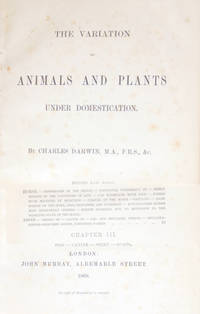
2404SB020<p>By CHARLES DARWIN M. A. F. R. S. &c. IN TWO VOLUMES. Vol. I. Vol. II With Illustrations. LONDON: JOHN MURRAY ALBAMARLE STREET. 1868.</p>_x000d_<p>2 Volumes in 8.º de 23x15 cm. Com viii 411 i 32; viii 486 ii págs. Encadernações do editor em tela encerada verde com ferros a ouro na lombada. Folhas de guarda originais em papel preto.</p>_x000d_<p>Ilustrado no texto com 43 xilogravuras e algumas tabelas apenas no primeiro volume.</p>_x000d_<p>Exemplar com etiquetas de cota na lombada e falta de partes das folhas de rosto recortadas por motivo da obliteração de assinatura de posse afetando o texto. O primeiro volume tem ainda falta das folhas com as págs.: 129/130 e 371/372; o segundo com as págs.: 113/114 171/172 e 417/418. Inclui reproduções fotocopiadas das mesmas. Apresenta assinaturas de posse à cabeça de algumas páginas em ambos os volumes.</p>_x000d_<p>No segundo volume a página 299 está numerada 259.</p>_x000d_<p>Primeiras páginas em numeração romana com lista de obras do autor no verso das folhas de rosto e índice de conteúdos em ambos os volumes. O segundo volume inclui a partir da página 433 um índice remissivo a duas colunas. Cada volume tem no final uma lista de obras disponíveis para venda do editor nas últimas 32 páginas numeradas do primeiro e nas últimas duas não numeradas do segundo. Apresentam as seguintes datas: Vol. I - «February 1871»; Vol. II - «February 1868».</p>_x000d_<p>Exemplar da 2.ª tiragem da primeira edição com o nome do editor gravado numa única linha no pé das lombadas.</p>_x000d_<p>A primeira edição desta obra teve duas tiragens: a primeira com 1500 exemplares foi publicada a 30 de Janeiro; a segunda com 1250 exemplares foi publicada em Fevereiro e teve ligeiras alterações na composição tipográfica. A primeira distingue-se por ter 5 erratas em 6 linhas na p. vi do vol. I; 7 erratas na p. viii do vol. II; e o nome do editor gravado numa única linha no pé das lombadas. A segunda tiragem distingue-se por ter apenas uma única errata no primeiro volume também na p. vi e nenhuma errata no segundo volume. Existem variantes desta tiragem que diferem ao nível da encadernação com o nome do editor gravado numa ou em duas linhas no pé da lombada; mas também pelas datas que constam dos anúncios inseridos no final dos volumes.</p>_x000d_<p>SOBRE A OBRA</p>_x000d_<p>Obra rara. Publicada em 1868 esta é uma das mais extensas obras de Darwin. Fundamental para a compreensão da teoria da seleção natural de Darwin.</p>_x000d_<p>Representa um prolongamento significativo da seminal «<em>On the Origin of Species</em>» A Origem das Espécies de 1859 oferecendo uma visão aprofundada das teorias de Darwin acerca dos mecanismos subjacentes à variação entre indivíduos de uma espécie sob domesticação. Trata-se da expansão dos primeiros dois capítulos da <em>Origem </em>constituindo aliás a única secção publicada do projetado «grande livro» de Darwin sobre a origem das espécies do qual a <em>Origem</em> seria apenas um resumo.</p>_x000d_<p>É especialmente notável pela teoria sobre hereditariedade hoje posta de lado que Darwin designou por <em>pangenesis</em> pangénese. A obra é também citada como a primeira em que Darwin inclui a frase «<em>survival of the fittest</em>» sobrevivência do mais apto cunhada pelo filósofo e sociólogo Herbert Spencer ao ler a <em>Origem</em> que teria terríveis usos durante o século XX servindo de suporte a ideologias racistas ao Holocausto e a muitas guerras e abusos contra os direitos humanos.</p>_x000d_<p>Ao examinar as práticas de seleção artificial na origem de novas raças de animais e variedades de plantas Darwin elucida como estes mesmos princípios se aplicam na natureza moldando a evolução das espécies ao longo do tempo; ou seja clarifica a noção de seleção natural através da descrição da prática da reprodução selectiva. Nestes dois volumes são abordados os avanços numa série de espécies de culturas arvenses hortícolas pecuárias e de animais domesticados especialmente pombos; os efeitos benéficos do cruzamento e os efeitos adversos da consanguinidade estreita. Além disso Darwin desenvolveu a sua hipótese da pangénese para preencher a lacuna que justificava a forma como a variabilidade era herdada.</p>_x000d_<p>A pangénese foi o mecanismo hipotético de Charles Darwin para a hereditariedade no qual ele propôs que cada parte do corpo emitia continuamente o seu próprio tipo de pequenas partículas orgânicas chamadas <em>gémulas</em> que são depois transmitidas aos órgãos reprodutores e passadas aos descendentes. Através deste mecanismo as variações adquiridas pelos indivíduos durante a sua vida poderiam ser herdadas pelas gerações seguintes contribuindo para a diversidade de características numa população.</p>_x000d_<p>Da pangénese só ficou por dela provir o étimo do termo <em>gene</em> pois foi completamente posta de lado pela Genética Mendeliana assim designada a partir do apelido do seu genial descobridor Gregor Mendel frade da Ordem de Santo Agostinho que forma a base principal da genética clássica.</p>_x000d_<p>No final do livro Darwin contesta diretamente os argumentos apresentados contra as suas teorias de variabilidade por diversos sectores em especial a Igreja Anglicana sugerindo que a seleção natural ou a ação humana e não uma intervenção divina moldam as formas de vida.</p>_x000d_<p>Atualmente vários avanços da genética como a mutação artificial a poliploidia a adaptação e os marcadores genéticos ampliaram a disciplina com conceitos e questões cujas sementes se encontram nas palavras originais de Darwin. Assiste-se a um florescimento da investigação genómica sobre o próprio processo de domesticação sendo muito curioso notar como a nossa visão da diversidade doméstica contrasta com a dos escritos de Darwin. Este sublinhava a abundância da diversidade e o poder diversificador da seleção artificial ao passo que hoje em dia estamos preocupados com a diminuição da diversidade genética que acompanha a agricultura moderna.</p>_x000d_<p>Charles Robert Darwin Shrewsbury 1809 Downe 1882 foi um naturalista inglês famoso pela sua teoria da evolução através da seleção natural. Desde cedo demonstrou interesse pela história natural. Depois de se formar em Teologia na Universidade de Cambridge embarcou numa jornada épica a bordo do HMS Beagle onde recolheu uma vasta gama de espécimes e observações que influenciaram profundamente o seu pensamento.</p>_x000d_<p>Publicou a sua obra muito célebre «A Origem das Espécies» em 1859 onde propôs que todas as espécies de seres vivos descendem de ancestrais comuns e que a seleção natural é o mecanismo primário responsável pela evolução das espécies ao longo do tempo. A teoria de Darwin teve um impacto revolucionário não só no campo da biologia mas também nas ciências humanas desafiando conceções prevalecentes sobre a origem e a diversidade da vida na Terra.</p>_x000d_<p>Além das suas contribuições científicas Darwin era também um escritor e correspondente prolífico. O seu trabalho continua a ser estudado e debatido até aos dias de hoje estabelecendo o seu lugar como um dos pensadores mais influentes da história da ciência.</p>_x000d_<p>EN 2 Volumes in octavo. 23x15 cm. viii 411 i 32; viii 486 ii pp. Publisher's binding in green waxed canvas with gilt lettering on the spine. Original black endpapers.</p>_x000d_<p>Illustrated in the text with 43 woodcuts and some tables only in the first volume.</p>_x000d_<p>Copy with library shelf labels on the spine and parts of the title pages missing cut out due to the obliteration of the ownership title affecting the text. The first volume also lacks pages 129/130 and 371/372; the second volume lacks pages 113/114 171/172 and 417/418. Includes photocopied reproductions. There are handwritten ownership titles at the head of some pages in both volumes.</p>_x000d_<p>In the second volume page 299 is numbered 259.</p>_x000d_<p>First pages in Roman numerals with a list of the author's works on the back of the title pages and an index of contents in both volumes. The second volume includes a two-column index from page 433 onwards. At the end of each volume there is a list of the publisher's works available for sale on the last 32 numbered pages of the first and the last two unnumbered pages of the second. They bear the following dates: Vol. I - "February 1871"; Vol. II - "February 1868".</p>_x000d_<p>Copy from the 2nd print run of the first edition with the publisher's name engraved in a single line at the foot of the spines.</p>_x000d_<p>The first edition of this work had two print runs: the first with 1500 copies was published on 30 January; the second with 1250 copies was published in February and had slight changes to the typesetting. The first was distinguished by having 5 errata in 6 lines on p. vi of vol. I; 7 errata on p. viii of vol. II; and the publisher's name engraved in a single line at the foot of the spines. The second print run is distinguished by having only a single errata in the first volume also on p. vi and no errata in the second volume. There are variants of this print run which differ in terms of the binding with the publisher's name engraved in one or two lines at the foot of the spine; but also in terms of the dates given in the adverts at the end of the volumes.</p>_x000d_<p>ABOUT THE WORK</p>_x000d_<p>Rare work. Published in 1868 this is one of Darwin's most extensive works. Fundamental to understanding Darwin's theory of natural selection.</p>_x000d_<p>Represents a significant prolongation of the seminal «<em>On the Origin of Species</em>»from 1859 offering an in-depth look at Darwin's theories about the mechanisms underlying variation between individuals of a species under domestication. It is an expansion of the first two chapters of <em>On the Origin</em> was in fact the only published section of Darwin's projected "great book" on the origin of species of which the <em>On the Origin</em> was only a summary.</p>_x000d_<p>It is especially notable for the theory of heredity today set aside that Darwin called <em>pangenesis</em>. The work is also cited as the first in which Darwin includes the phrase "<em> of the fittest</em>" made famous by the philosopher and sociologist Herbert Spencer when he read the <em>On the Origin</em> which would have terrible uses during the 20th century serving as support for racist ideologies the Holocaust and many wars and abuses against human rights.</p>_x000d_<p>By examining the practices of artificial selection in the origin of new breeds of animals and varieties of plants Darwin elucidates how these same principles apply in nature moulding the evolution of species over time; in other words he clarifies the notion of natural selection by describing the practice of selective breeding. In these two volumes advances in a range of arable horticultural livestock and domesticated animal species especially pigeons are discussed; the beneficial effects of cross-breeding and the adverse effects of close inbreeding. In addition Darwin developed his hypothesis of pangenesis to fill the gap in justifying how variability was inherited.</p>_x000d_<p>Pangenesis was Charles Darwin's hypothesised mechanism for heredity in which he proposed that each part of the body continuously emitted its own type of small organic particles called <em>Gemmule</em> which are then transmitted to the reproductive organs and passed on to the offspring. Through this mechanism variations acquired by individuals during their lifetime could be inherited by subsequent generations contributing to the diversity of characteristics in a population.</p>_x000d_<p>Only the term <em>gene</em> was left over from pangenesis since it was completely set aside by Mendelian Genetics named after the surname of its brilliant discoverer Gregor Mendel a friar of the Order of St Augustine which forms the main basis of classical genetics.</p>_x000d_<p>At the end of the book Darwin directly contests the arguments put forward against his theories of variability by various sectors in particular the Anglican Church suggesting that natural selection or human action rather than divine intervention moulds life forms.</p>_x000d_<p>Today various advances in genetics such as artificial mutation polyploidy adaptation and genetic markers have expanded the discipline with concepts and questions the seeds of which can be found in Darwin's original words. Genomic research into the domestication process itself is flourishing and it is very curious to note how our view of domestic diversity contrasts with Darwin's writings. He emphasised the abundance of diversity and the diversifying power of artificial selection whereas today we are concerned about the decrease in genetic diversity that accompanies modern agriculture.</p>_x000d_<p>Charles Robert Darwin Shrewsbury 1809 - Downe 1882 was an English naturalist famous for his theory of evolution through natural selection. From an early age he showed an interest in natural history. After graduating in Theology from Cambridge University he embarked on an epic voyage aboard the HMS Beagle where he collected a vast array of specimens and observations that profoundly influenced his thinking.</p>_x000d_<p>He published his very famous work "The Origin of Species" in 1859 where he proposed that all species of living beings descend from common ancestors and that natural selection is the primary mechanism responsible for the evolution of species over time. Darwin's theory had a revolutionary impact not only in the field of biology but also in the human sciences challenging prevailing conceptions about the origin and diversity of life on Earth.</p>_x000d_<p>In addition to his scientific contributions Darwin was also a prolific writer and correspondent. His work continues to be studied and debated to this day establishing his place as one of the most influential thinkers in the history of science.</p>_x000d_<p>Referências/References:<br />Freeman 877 878 878b.<br />Norman 597.<br />Garrison-Morton 224.1</p> M-19-C-6 hardcover
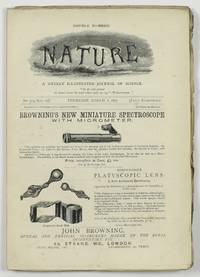
72378London Nature 1877. Folio 28.2 x 19.6 cm. pp. 410-412 in: Nature issue 15384 pp. cliii-clxiv 389-424. Original printed wrappers. = On the occasion of Charles Darwin's 69th birthday the Dutch zoologist ornithologist and chairman of the Netherlands Zoological Society Adriaan Anthoni van Bemmelen 1830-1897 and the societys secretary the entomologist Huibert Johannes Veth 1846-1917 sent Darwin an album with photographs of 217 Dutch admirers including 81 doctors and 21 university professors. Darwin replied: "I suppose that every worker at science occasionally feels depressed and doubts whether what he has published has been worth the labour which it has cost him; but for the remaining years of my life whenever I want cheering I will look at the portraits of my distinguished co-workers in the field of science and remember their generous sympathy. When I die the album will be a most precious bequest to my children.". Currently the album is in Down House. Uncut as issued. A few spots on the outer wrappers; weak vertical fold due to method of dispatching; otherwise a very good clean copy. Darwin Correspondence Project Letter no. 10831; Freeman 1776. unknown
albe8a525c465a18d02Darwin C. Essays in 9 Volumes. Volume 9. Notebooks. Diaries. Memoirs. The Life of Erasmus Darwin. In Russian (ask us if in doubt)/Darvin Ch. Sochineniya v 9 tomakh. Tom 9. Zapisnye knizhki. Dnevniki. Vospominaniya. Zhizn Erazma Darvina.Translation from English article and commentary by Prof. S.L.Sobolya. Academy of Sciences of the USSR. 1959. 735s. We have thousands of titles and often several copies of each title may be available. Please feel free to contact us for a detailed description of the copies available. SKUalbe8a525c465a18d02
albb5f8d37531ce339aDarwin Charles. On the expression of feelings in humans and animals. In Russian /Darvin Charlz. O vyrazhenii oshchushcheniy u cheloveka i zhivotnykh. St. Petersburg In the printing house of F.S. Suschinsky, 1872. 336s. We have thousands of titles and often several copies of each title may be available. Please feel free to contact us for a detailed description of the copies available. SKUalbb5f8d37531ce339a.
alb27e8c389274fc6dd"Darwin Charles. Human origins and gender selection. In two volumes. With drawings. In Russian /Darvin Charlz. Proiskhozhdenie cheloveka i podbor po otnosheniyu k polu. V dvukh tomakh. S risunkami. Soc. Charles Darwin; Translated from English, edited by I.M. Sechenov. St. Petersburg Cherkesov Bookshop, 1874. 322 and 374s. We have thousands of titles and often several copies of each title may be available. Please feel free to contact us for a detailed description of the copies available. SKUalb27e8c389274fc6dd."
18782930793John Murray 1878. This is an ex-library book and may have the usual library/used-book markings inside.This book has hardback covers. In good all round condition. No dust jacket. Second edition. Medium 8vo with green cloth. Gilt lettering on backstrip. Minimal foxing on some pages including title page. Interior is secure clean and clear. Trimmed. Please note the Image in this listing is a stock photo and may not match the covers of the actual item850grams ISBN: John Murray hardcover
41597Stockholm : Albert Bonnier 1872. Two volumes octavo contemporary gilt-lettered half-morocco over pebbled cloth edges scuffed particularly at head and foot of spine marbled edges pink endpapers pp. iv; 314; 2; iv; xv; blank; 294; 6 portrait frontispiece of Darwin to volume two text illustrations internally fine a fine set. The first Swedish edition of Darwin's 'The Descent of Man and Selection in Relation to Sex' translated by Rudolf Sunderström originally published in London in 1871. Freeman 1136 hardcover
49790by means of natural selection or the preservation of favoured races in the struggle for life. With a new preface by Charles G. Darwin. Illustrated with wood engravings by Paul Landcare. New York : Limited Editions Club 1963. Printed for The Limited Editions Club at The Griffin Press Adelaide South Australia. Quarto quarter wallaby over papered boards imitating wooden boards spine lettered and decorated in gilt top edge speckled green pp. xxxii; 470 2 folding table illustrated with wood-engravings printed on paper made in Australia especially for this edition housed in publisher's green cloth slipcase with printed title label slightly bumped at head and foot of spine a very good to fine copy. Limited to 1500 numbered copies this copy is no. 690. Loosely enclosed : The Monthly Letter of The Limited Editions Club April 1963 which discusses this publication. A fine and handsome printing of the original text from 1859 notable for being the first edition printed in Australia and finely bound in Australian wallaby. The first edition of 1859 a great rarity is described in Freeman as "". the most important biological work ever written.""; Dibner "". the most important single work in science.""; Printing & the Mind of Man "". revolutionized our methods of thinking and our outlook on the natural order of things. The recognition that constant change is the order of the universe had been finally established and a vast step forward in the uniformity of nature had been taken."" The Limited Editions Club was founded in New York in 1929 by George Macy. For over fifty years they published fine quality editions of classics in literature and science produced to a high standard and featuring illustrations by notable artists. This edition was printed and bound in Adelaide under the supervision of Douglas A. Dunstan of The Griffin Press who produced a number of editions for the Club. On the origin of species is considered by many to be the most significant scientific book ever published. Freeman 598 hardcover
41941London : John Murray 1882. Second edition revised and augmented. Fifteenth thousand. Octavo gilt-lettered green cloth edges slightly rubbed upper hinge tender pale foxing to endpapers slight marginal stain to lower portion of text block pp. xvi; 693; blank 78 text illustrations ownership inscription of C. J. Martin 1883 to preliminary blank annotated below 'fr. H. J. R.' a good copy. The second edition of Darwin's important work on natural selection. As Freeman notes: the word 'evolution' occurs for the first time in any of Darwin's works on Page 2 of the first volume of the first edition before its appearance in the sixth edition of the 'Origin' in the following year. This edition includes the Supplemental Note on Sexual Selection in Relation to Monkeys Reprinted from Nature November 2 1876 p. 18. This first appeared in the 12th Thousand of 1877. Freeman 955. Provenance : Sir Charles James Martin CMG FRS FRCS 9 January 1866 – 15 February 1955 eminent British/Australian scientist who lectured at Australian universities for twelve years. 'During World War I he served with the Australian Army Medical Corps in Gallipoli Egypt and France as a pathologist with the rank of Lieutenant-colonel. He found some cases of enteric fever at Gallipoli were not typhoid but paratyphoids A and B and made a vaccine for all three. A memo to his colleagues on the different treatments for amoebic and bacillary dysentery was widely circulated by the army under Martin’s name . His contributions to the foundation of biological science in Australia were commemorated by the National Health and Medical Research Council which created the Sir Charles James Martin Overseas Biomedical Fellowships in 1951' - Wikipedia Loosely enclosed on the back of a letter to Martin from Australia House London is a manuscript note signed by Martin and dated Cambridge 1946 indicating this copy of Darwin's Descent of Man is 'probably the first scientific book I purchased. H. J. R. was my brother'. hardcover
47639/ by Charles Darwin ; with photographic and other illustrations. London : John Murray 1872. First edition second impression. Octavo half crushed morocco over marbled papered boards edges rubbed spine in compartments with raised bands lettered in gilt marbled endpapers and edges pp. vi 374 bound without the advertisements with photographic heliotype plates and wood-engraved illustrations in the text; the contents are clean a very good copy of the first edition. Freeman 1142. hardcover
1881144232London: John Murray 1881. Hardcover. Very Good. London John Murray 1881 fourth thousand/ 1881. Octavo viii 326 2 list of Darwin's works colophon pages with 15 illustrations. Green cloth lettered and decorated in gilt on the spine and decorated in blind on the sides; all edges uncut; slight wear to the extremities; leaves adjacent to the endpapers foxed with scattered light foxing elsewhere; front hinge lightly stabilised; one preliminary leaf creased with a few short marginal tears expertly sealed; a few minor signs of age and use; a very good copy. 'This last book is outside the main stream of Darwin's work and reverts to his earlier geological interests. He had indeed published a paper on mould in 1838 in the "Proceedings of the Geological Society of London" Vol. ii pp. 5-74-76 which he had read to the Society in the previous year. The book was remarkably successful selling 6000 copies within a year and 13000 before the end of the century . Darwin comments that he corrected the sixth thousand of 1882' Freeman R.B.: 'The Works of Charles Darwin: An Annotated Bibliographical Handlist' page 33. Freeman 322. Darwin died on 19 April 1882 soon after the publication of this edition. <p>Provenance: Dr Kenneth Ernest Lee 1927-2007 distinguished NZ-born Australian soil scientist with his signature and 1982 book purchase details at the head of the title page. Loosely inserted in the book is his obituary: not least it records that Lee's influential 1985 publication 'Earthworms: their Ecology and Relationships with Soils and Land Use' was the direct descendant of Darwin's pioneering work. Mounted on the front pastedown is the earlier armorial bookplate of James Rankin 'Prudentia et Virtute'. John Murray hardcover
40453by means of natural selection or the preservation of favoured races in the struggle for life. London : John Murray 1889. Sixth edition with additions and corrections to 1872 thirty-seventh thousand. Octavo original publisher's gilt-lettered green cloth edges and corners rubbed slightly bruised with short tear at head and foot of spine original endpapers lightly foxed with a label dated January 15th 189 on front pastedown presenting the book to Henry J. Taperell Chief Reporter of the New Zealand Times on the occasion of his leaving for Sydney from members of the New Zealand Parliamentary Press Gallery and the Wellington Press pp. ii xxi blank 468 folding lithographed plate slightly miscreased light foxing to preliminaries. A very good copy. A fine copy of the sixth edition of one of the most important texts in the history of science. The first edition of 1859 a great rarity is described in Freeman as "". the most important biological work ever written.""; Dibner "". the most important single work in science.""; Printing & the Mind of Man "". revolutionized our methods of thinking and our outlook on the natural order of things. The recognition that constant change is the order of the universe had been finally established and a vast step forward in the uniformity of nature had been taken."" The sixth edition extensively rewritten by Darwin and published in 1872 removed the word 'On' from the title 'On the origin of species' and includes rebuttal of Roman Catholic biologist St. George Mivart's theological arguments in his 1871 text On the Genesis of Species. The sixth edition is significant for including the use of the word 'evolution' for the first time in furtherance of Darwin's argument for natural selection. It is the last edition published in Darwin's lifetime and includes extensive revisions and rewriting by the author. The sixth edition went through numerous printings and includes all Darwin's revisions since On the origin of species was first released in 1859. It is considered the definitive text for what many consider to be the most significant scientific book ever published. Freeman 426. hardcover
40525by means of natural selection or the preservation of favoured races in the struggle for life. London : John Murray 1890. Sixth edition with additions and corrections to 1872 thirty-ninth thousand. Octavo gilt-lettered green cloth lightly flecked pp xxi blank 458 folding lithographed plate light foxing to preliminaries. A very good clean copy. A fine copy of the sixth edition of one of the most important texts in the history of science. The first edition of 1859 a great rarity is described in Freeman as "". the most important biological work ever written.""; Dibner "". the most important single work in science.""; Printing & the Mind of Man "". revolutionized our methods of thinking and our outlook on the natural order of things. The recognition that constant change is the order of the universe had been finally established and a vast step forward in the uniformity of nature had been taken."" The sixth edition extensively rewritten by Darwin and published in 1872 removed the word 'On' from the title 'On the origin of species' and includes rebuttal of Roman Catholic biologist St. George Mivart's theological arguments in his 1871 text On the Genesis of Species. The sixth edition is significant for including the use of the word 'evolution' for the first time in furtherance of Darwin's argument for natural selection. It is the last edition published in Darwin's lifetime and includes extensive revisions and rewriting by the author. The sixth edition went through numerous printings and includes all Darwin's revisions since On the origin of species was first released in 1859. It is considered the definitive text for what many consider to be the most significant scientific book ever published. Freeman 436 hardcover
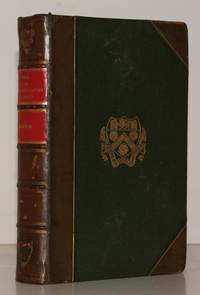
187650311John Murray 1876. 8vo. First Edition with numerous tables and a diagram in the text; strongly bound BY WILSON FOR TRINITY COLLEGE CAMBRIDGE in contemporary half calf green cloth sides ruled in gilt upper board with Trinity College arms blocked in gilt back with raised bands second and third compartments with red leather labels ruled and lettered in gilt first and last compartments blocked with with Trinity College Arms in gilt marbled edges marbled endpapers a very good bright clean crisp copy. The binding is signed on front free endpaper verso. SCARCE IN THIS CONDITION. Freeman BNHB 914; Freeman Darwin 297. John Murray, hardcover
18770101765New York: D. Appleton and Company 1877. Second edition. Hardcover. pp. xvi 300 8. 8vo. Dark orange cloth binding with gilt lettering to spine and black decoration to boards. Illustrated with in-text woodcuts present as called-for. Spine darkened edges worn front joint starting endpapers split at hinges mull intact binding sound ink name to endpaper half-title torn and repaired. D. Appleton and Company hardcover
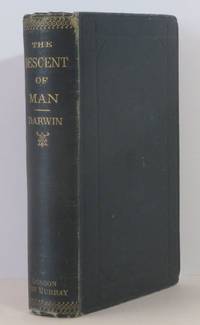
1896B6799London: John Murray William Clowes and Sons. 1896. Interior with slight toning otherwise clean and crisp. Edition: Second edition Binding: Full original green cloth boards. Double blind framing on boards. Spine with gilt lettering decorative gilt fillet and stamp. Patterned paste-in and free endpapers. Front edges uncut. Notes: A fine example of Darwin’s key work which applies evolutionary theory to human evolution and details his theory of sexual selection a form of biological adaptation distinct from yet interconnected with natural selection. <br><br>Charles Robert Darwin 1809 – 1882 was an English naturalist geologist and biologist renown for his contributions to the understanding of evolutionary biology and he has been described as one of the most influential figures in human history. His proposition that all species of life have descended from a common ancestor is now generally accepted and considered a fundamental concept in science. In a joint publication with Alfred Russel Wallace he introduced his scientific theory that this branching pattern of evolution resulted from a process that he called natural selection in which the struggle for existence has a similar effect to the artificial selection involved in selective breeding. <br>The Descent of Man discusses many related issues as perceived by Darwin including evolutionary psychology evolutionary ethics evolutionary musicology differences between human races differences between sexes the dominant role of women in mate choice and the relevance of the evolutionary theory to society. The first edition was published by John Murray in 1871.<br> Size: 8vo.190x125 mm Illustration: With a profusion of in-text illustrations and plates. Many signatures still uncut.<br>Second edition revised and augmented. Thirty-third thousand. Pages: Blank 2. Half title. Blank. Title. Advertisement. Preface v-vi. Table vii-ix. Blank. Contents xi-xvi. P. 1 – 693. Blank. Category: Book Science & Technology; John Murray, William Clowes and Sons. hardcover
1882B6801London: John Murray William Clowes. 1882. Slight browning to early and last leaves. Interior otherwise clean and crisp. Pp. 65/66 bound between 48/49. Edition: First edition Binding: Full original green cloth boards. Blind framing on boards. Spine with gilt lettering decorative gilt fillet and stamp. Brown paste-in and free endpapers. Notes: A near fine example of this last scientific book by Darwin on earthworm behaviour and ecology. <br><br>Charles Robert Darwin 1809 – 1882 was an English naturalist geologist and biologist renown for his contributions to the understanding of evolutionary biology and he has been described as one of the most influential figures in human history. His proposition that all species of life have descended from a common ancestor is now generally accepted and considered a fundamental concept in science. In a joint publication with Alfred Russel Wallace he introduced his scientific theory that this branching pattern of evolution resulted from a process that he called natural selection in which the struggle for existence has a similar effect to the artificial selection involved in selective breeding. <br><br>The Formation of Vegetable Mould though the Action of Worms sometimes known simply as Worms continued the theme common throughout Darwin’s work which is that gradual changes over long periods of time can lead to large and sometimes surprising consequences. It was the first significant work on soil bioturbation although that term was not used by Darwin it first appeared in the soil and geomorphic literature one hundred years later. The inspiration for Worms likely stemmed from a visit to his uncle’s home where Darwin’s uncle pointed out an area of ground where lime and cinders spread years previously had vanished into the soil forming layers under a top layer of loam. His uncle suggested that this might have been the work of earthworms but apparently thought that this would be of little interest to his nephew who was working on continental scale geological problems. The subject was in fact of interest to Darwin; when he returned to London later that year he prepared a paper on worms forming mould. The paper on the role of earthworms in soil formation was read out by Darwin at the Geological Society of London on 1 November 1837. This was an uncommonly mundane subject for the society and his peers may have hoped to hear of something more grandiose even seeing this paper as highlighting Darwin's growing idiosyncrasies. The leading geologist William Buckland subsequently recommended Darwin's paper for publication. This later led to Darwin’s renewed work on earthworms that led to the publication of the present volume. <br>When asked why he had turned to such an ‘insignificant’ subject such as worms Darwin answered "I have been studying their habits for forty years." In Darwin's view the "insignificant" was the foundation of much greater phenomena.<br> Size: 8vo.188x125 mm Illustration: With many in-text illustrations. <br>First edition seventh thousand corrected. Pages: Blank 2. Title. Printer’s signature. Contents iii-vii. Blank. P. 1 – 328. Advertisement. Printer’s signature. Category: Book Science & Technology; John Murray, William Clowes. hardcover
1896B4118New York: D. Appleton & Company 1896. A fine copy in contemporary half red morocco. . Edition: Third Edition Binding: Original half crimson morocco with matching marbled boards blind tooled rules tooled gilt lettering on spine. Size: 8vo: 125mm x 195mm Illustration: Illustrated with 3 foldout maps and a few scientific diagrams Pages: P. Half title Full title edition Preface v-xv Description of plates xvii-xx 1-344. Category: Book Natural History;Book Geological Minerals & Mining; D. Appleton & Company hardcover
188915210London: John Murray 1889. Second Edition Revised and Augmented Seventeenth Thousand. Hardcover. Very Good bound in full green cloth with gilt titles on spine. Edge wear and minor wear to exterior toning to decorated end papers. No markings to text binding intact. Illustrated throughout. 693 printed pages. 8vo. John Murray hardcover
51522Masson.1870.In-8 reliure d'époque.614 p.Etat satisfaisant avec qques piqûres en page de garde et de titre.
48931Reinwald et Cie.1872.2 vols.in-8 en percaline verte.Traduit par Moulinié.E.O.76 figures In-T.24 pages de catalogue. Intérieur très frais.Couvertures décolorées.
1871chd05aaLondon: John Murray. G : in Good condition without dust jacket. Rebound with marbled endpapers. Lacking rear advertisements. Cover rubbed with wear to spine and scuffing to leather. Area of wear with loss to marbled paper to front pastedown. Endpapers lightly foxed. March 1871. First Edition second issue. Green gilt embellished hardback half-leather cover. 190mm x 130mm 7" x 5". viii 423pp. B/w vignettes. First edition second issue. Issue points: 'When variations occur. and are transmitted' - first sentence on p.297 rather than 'Transmitted as in first issue'; Use of the term 'evolution' on p.2 - 'Descent' was the first of Darwin's works to utilise this term; both half title and title page are present. This rebound copy lacks the 16pp. advertisements originally present in each volume. . John Murray hardcover
188757522BB3 Bände. London, John Murray, 1887. Gross-8°. IX, 3 n.n. S., 539 (recte 395) S.; 2 Bl.,393 S.; IV, 418 S. Mit 3 Frontispiz, 1 Faksimile und Illustrationen im Text. Originalleinwandbände.