1 008 résultats
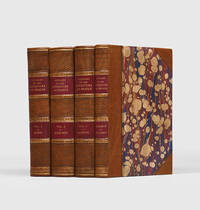
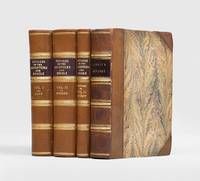
1839001512London: Henry Colburn 1839. First edition early issue 3 vols in 4 8vo ownership signature to half-title vol. I title vol. II half-title vol. III; 9 folding engraved maps by J. Gardner and J. & C. Walker; 47 etched plates after P. King A. Earle C. Martens R. Fitzroy and others original blue blind stamped cloth gilt glazed yellow endpapers vols I-III neatly recased preserving majority of original spines inner hinges of vols I-III neatly strengthened. This set with the following early issue points: the half-title to vol. III does not contain the initials F.R.S. after Darwin's name thus denoting an early printing of the preliminaries prior to Darwin becoming a Fellow of the Royal Society on 24th January 1839 all spines imprinted Colburn / London rather than London / Colburn each volume bears the author's name lacking from later issues this set without advertisements as sometimes and as noted by Freeman light foxing and stains to frontispiece and plates vol. II overall a good clean set with important Australian provenance. Darwin's first published and his most widely read book: the account of the most important 19th-century voyage. On this voyage Darwin prepare for his life's work ultimately leading to The Origin of the Species.From the library of Charles Joseph LaTrobe Superintendent of the Port Phillip District of New South Wales from 1839 to 1851 and from 1st July 1851 until his departure three years later the first Lieutenant-Governor of the Colony of Victoria; with his distinctive signature to all three volumes. An evangelical Christian his father was a leader of the Moravian Church LaTrobe spent fifteen years in the Australian colonies leaving in 1854 a disillusioned and dispirited man. His time in office coincided with a period of tremendous expansion with major infrastructure projects roads and sanitation being a priority however much of central Melbourne's green landscape can be put down to LaTrobe's foresight in preserving this land as open space. On his arrival in Port Phillip LaTrobe's first speech put him at odds with the settlers of the District. These pioneers were looking to better their lot expecting grants of land which would lead to the dispossession of the aboriginal peoples yet LaTrobe spoke of different priorities: 'It is not by individual aggrandisement by the possession of numerous flocks or herds or by costly acres that the people shall secure for the country enduring prosperity and happiness but by the acquisition and maintenance of sound religious and moral institutions without which no country can become truly great'. This clash of ideas was highlighted by Darwin in his Journal of The Voyages of HMS Beagle published a few months before LaTrobe made his speech. In it Darwin observed that in 'the wide extent of the Americas Polynesia the Cape of Good Hope and Australia' the native populations were being suppressed. 'The varieties of man' he noted 'seem to act on each other in the same way as different species of animals the stronger always extirpating the weaker.' This theory of the survival of the fittest became the justification for many colonists in the removal of indigenous peoples from their native land. Darwin was given the third volume The Voyages of HMS Beagle writing 'I am to have the third volume in which I intend giving a kind of journal of a naturalist not following however always the order of time but rather the order of position' The first volume contains King's account of the expedition in the Adventure made between 1826 and 1830 which surveyed the coasts of Patagonia and Tierra del Fuego; and the second and its appendix volume describes the narrative of the Beagle's second voyage under Capt. Fitzroy made between 1831 and 1836 to South America the Galapagos Islands Tahiti New Zealand Australia and other islands and countries. 'The five years of the voyage were the most important event in Darwin's intellectual life and in the history of biological science. Darwin sailed with no formal scientific training. He returned a hard-headed man of science knowing the importance of evidence almost convinced that species had not always been as they were since the creation but had undergone change . The experiences of his five years . and what they led to built up into a process of epoch-making importance in the history of thought' DSB. First Edition. Hardback. Good. 4to. Henry Colburn Hardcover
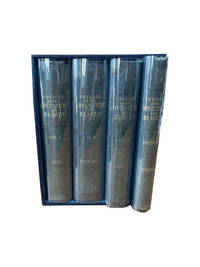
1839169069London: Henry Colburn 1839. From the Wedgwood family library First edition association copy with the inscription "Wedgwood Maer" faintly pencilled on the half-title of Darwin's volume itself the first issue of his first published book. The prominent Wedgwood family were relatives; he frequently visited their Staffordshire home Maer Hall and consulted them about the publication of his account of the Beagle's voyage. The Darwin and Wedgwood families became intertwined in the 18th century linked by friendships business dealings and a number of first- and second-cousin marriages. Charles's grandfathers were the renowned pottery entrepreneur Josiah Wedgwood and the physician Erasmus Darwin and Charles himself married his cousin Emma Wedgwood in 1839. He corresponded with several members of the Wedgwood family about the publication of his volume the Journal and Remarks now popularly known as The Voyage of the Beagle and invited them to read the manuscript notebook of his travels upon which the work was based. Fanny and Hensleigh Wedgwood were specifically asked to provide feedback which the latter gave in a letter dated 20 December 1836 describing it as a "very interesting journal" Darwin Correspondence Project. Darwin also discussed the possibility of his account being accompanied by that of Fitzroy with his sister Caroline Wedgwood. At the time of publication Maer Hall was owned by Josiah Wedgwood II and the rector of Maer parish church was John Allen Wedgwood. We have been unable to attribute the inscription to any one individual member of the family. Maer Hall was sold in 1843 suggesting that this copy was incorporated into the Wedgwood library before this date. These four volumes on the voyages of HMS Adventure and Beagle including Darwin's Journal and Remarks are "famous as the genesis of his theory of evolutionary biology" Hill. Darwin's volume is an outstanding account of natural history exploration describing the fieldwork that ultimately led to the publication of On the Origin of Species 1859. As Freeman notes of Darwin's books this "is undoubtedly the most often read and stands second only to On the Origin of Species as the most often printed" p. 31. Darwin himself would state that "the voyage of the 'Beagle' has been by far the most important event in my life and has determined my whole career. I have always felt that I owe to the voyage the first real training or education of my mind; I was led to attend closely to several branches of natural history and thus my powers of observation were improved" Life and Letters I p. 61. The Journal and Remarks was printed before the end of January 1839 the month Darwin was elected to the Royal Society and so his name appears without the letters "F.R.S." on the second title. Volume I contains Phillip Parker King's account of the expedition on the Adventure made between 1826 and 1830 surveying the coasts of Patagonia and Tierra del Fuego. In Volume II and its appendix bound separately as issued Captain FitzRoy describes the Beagle's second voyage between 1831 and 1836 to South America the Galapagos Islands Tahiti New Zealand and Australia and other countries. Volume III is Darwin's account of his time aboard the Beagle. The popularity of the latter exceeded its companion volumes leading to Colburn bringing out a separate edition in the same year. 3 vols in 4 vols I-III and appendix to vol. II octavo 225 x 142 mm. With 47 engraved plates after P. King A. Earle C. Martens R. Fitzroy and others by T. Landseer S. Bull T. Prior and others 9 folding engraved maps by J. Gardner and J. and C. Walker 8 bound in and 1 loose in pocket at rear pastedown of vol. II numerous diagrams and tables within text. Rebound to style in brown half calf twin red morocco spine labels compartments and raised bands elaborately tooled in blind and gilt respectively marbled sides and edges brown endpapers. Vol. I bound without half-title. Binding presenting smartly; contents generally fresh and clean occasional neat pencil marginal annotations and small ink "90" to half-titles upper margin of vol. I sig. 2D8 creased and nicked at edge; plates and maps foxed closed tears to latter repaired with no loss and in most cases discreetly faint damp stain along top edge of first map in vol. I second map of same sometime reattached with cloth tape. Overall a handsome set in very good condition. Freeman 10; Hill I pp. 104-5; Norman 584; Sabin 37826. Francis Darwin ed. The Life and Letters of Charles Darwin 1887; Darwin Correspondence Project letter 7 December 1836 to Caroline Darwin ref. DCP-LETT-325; 20 December 1836 from Hensleigh Wedgwood ref. DCP-LETT-332. hardcover
1839189657London: Henry Colburn 1839. An outstanding account of natural history exploration First edition of the Voyage of the Beagle with the third volume Darwin's Journal of Researches being the first separate edition of his account. The popularity of Darwin's contribution to the series meant that his volume was reissued three months later as a standalone publication the version present in this set. The first issue of Darwin's Journal appeared in May 1839 as Volume III of the Narrative under the title Journal and Remarks Freeman 10. The second issue was published in August printed from the same sheets but with variant preliminaries Freeman 11. It "is undoubtedly the most often read and stands second only to On the Origin of Species as the most often printed" of Darwin's works Freeman p. 31. Volume I of the Narrative contains King's account of the expedition on the Adventure made between 1826 and 1830 surveying the coasts of Patagonia and Tierra del Fuego. In Volume II its appendix bound separately as issued FitzRoy describes the narrative of the Beagle's second voyage between 1831 and 1836 to South America the Galapagos Islands Tahiti New Zealand and Australia. 3 vols in 4 vols I-III and appendix to vol. II octavo 224 x 145 mm; 219 x 137 mm. With 47 engraved plates 9 folding engraved maps 3 bound in and 6 linen-backed and loose in front pockets diagrams and tables within text. Recent and late 19th-century vol. III half calf spines lettered and ruled in gilt spine labels marbled sides and edges buff endpapers. Contemporary ownership signature of one I. S. G. Smith on title page of vol. III partially obscured during binding process; 1950s unattributed inscription on first blank of vol. I; ownership signatures of one Thomas Leighton dated 1979 on vol. I II and appendix blanks; 20th-century bookplates of one Richard Campbell perhaps of the Campbells of Kildalloig and later Carmarthenshire. Wear to vol. III extremities spine of same a little darkened foxing to maps plates and occasionally to contents tear to half-title of vol. I closed tears to map folds repairs to folding map facing p. 463 vol. I and both maps in vol. III first of which creased and standing a little proud: overall in very good condition. Freeman 10 Narrative vols I & II & 11 Journal. Francis Darwin ed. The Life and Letters of Charles Darwin 1887. unknown
187660588Moscow izdanie V. P. Plemânnikova 1876. 8vo. 3 parts bound in 2 uniform contemporary full cloth bindings with blind stamped titles to spines. Some soiling to extremities and part of cloth around hinges worn of. Internally with occassional brownspotting. 4 168 2 393 1 VII 2 pp. 4 folded plates. <br/><br/><em>Rare first Russian translation of Darwin’s Insectivorous Plants published only one year after the English original. Freeman F1244OCLC only locates one copy in Poland Huntinton in Pasadena also holds a copy. </em> hardcover
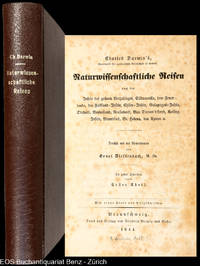
18447627CB1844. Zwei Teile in einem Band. Braunschweig Friedrich Vieweg und Sohn 1844. 8°. XVI 319 S.; VIII 301 S. Mit 1 gef. Karte. Moderner Leinenband. Freeman 188. Erste deutsche Ausgabe. Das Papier durchgehend stärker stockfleckig und gebräunt. unknown
184440321BRAUNSCHWEIG: Friedrich Vieweg u. Sohn 1844. Primera edición alemana.- 4º.- Lomera y puntas pergamino de época lomera con tejuelo.- 2 tomos en 1 volumen.- I: XVI.- 319 páginas.- II: 301 páginas.- Ilustraciones entre texto más un mapa plegado fuera de texto de Sur América. Primera edición alemana del viaje de Charles R. Darwin en la expedición como naturalista a bordo del H.M.S. Beagle entre 1831 y 1836 dando la vuelta al mundo. Traducida por el Dr. Ernst Dieffenbach. Investigando nociones de geología entomología disección de invertebrados marinos etc. Saliendo de Plymouth van a Tenerife Cabo Verde Bahia Rio de Janeiro Monterideo Falkland Islands Valparaiso Callao Galapagos Sydney Hobart King George's Soward Mauritius Cape Town Bahia Azores y otra vez Plymouth. Sabin 18650 Friedrich Vieweg u. Sohn unknown
184454590Brunswick F. Vieweg und Sohn 1844. 8vo. 2 volumes bound in one contemporary half calf binding with gilt lettering to spine. Previous owner's stamp to front free end-paper. Light brownspotting throughout especially to first and last leaves. XVI 319 VIII 301 3 pp. 1 folded map. <br/><br/><em>Rare first German translation of Darwin's Journal of researches now known as Voyage of the Beagle constituting the very first translation of any of Darwin's works into any language. As Darwin later recalled in his autobiography 'The voyage of the Beagle has been by far the most important event in my life and has determined my whole career'. "On its first appearance in its own right also in 1839 it was called Journal of researches into the geology and natural history etc. The second edition of 1845 transposes 'geology' and 'natural history' to read Journal of researches into the natural history and geology etc. and the spine title is Naturalist's voyage. The final definitive text of 1860 has the same wording on the title page but the spine readsNaturalist's voyage round the world and the fourteenth thousand of 1879 places A naturalist's voyage on the title page. The voyage of the Beagle first appears as a title in the Harmsworth Library edition of 1905. It is a bad title: she was only a floating home for Darwin on which in spite of good companionship he was cramped and miserably sea-sick; whilst the book is almost entirely about his expeditions on land." FreemanFreeman 176 </em> unknown
184260134London University of London 1842. 8vo. In contemporary half calf. In "The London Edinburgh and Dublin Philosophical Magazine and Journal of Science" Vol. XXI. July - December entire volume offered. Spine with wear and lacking bits of the leather especially affecting front hinge. Leather brittle. Front hindge loose. Exlibris pasted on to pasted down front end-paper. Internally nice and clean. Darwin's paper: Pp. 180-88. Entire volume: viii 568 pp. <br/><br/><em>First appearance of Darwin’s paper on the effects produced by the glaciers of Caernarvonshire. In 1831 Charles Darwin came to Cwm Idwal and failed to perceive the evidence of glaciation there. In 1842 Darwin then went on to describe the glaciation of Cwm Idwal in some detail. He recorded both his first visit with the Cambridge geologist Adam Sedgwick and his second more aware visit in his autobiography: “Next morning we started for Llangollen Conway Bangor and Capel Curig. This tour was of decided use in teaching me a little how to make out the geology of a country. Sedgwick often sent me on a line parallel to his telling me to bring back specimens of the rocks and to mark the stratification on a map. On this tour I had a striking instance of how easy it is to overlook phenomena however conspicuous before they have been observed by any one. We spent many hours in Cwm Idwal examining all the rocks with extreme care as Sedgwick was anxious to find fossils in them; but neither of us saw a trace of the wonderful glacial phenomena all around us; we did not notice the plainly scored rocks the perched boulders the lateral and terminal moraines. Yet these phenomena are so conspicuous that as I declared in a paper published many years afterwards in the ‘Philosophical Magazine’ Darwin 1842 a house burnt down by fire did not tell its story more plainly than did this valley. If it had still been filled by a glacier the phenomena would have been less distinct than they now are. Darwin 1887†“By 1842 not only had Darwin travelled widely Herbert 1991 but Agassiz 1840 had published his theory of glaciation. Darwin was also then apprised of the arguments of the geologist William Buckland. Buckland was known for his penchant for eating every variety of animal a trait which his son inherited Burgess 1967: Chapter 1; Chorley et al. 1964: 100–118; see also Lewry 2008 but he also developed highly significant ideas on glaciation and the limitations of the diluvial theory Chorley et al. 1964: 207–210. A key realization is that water-lain flood deposits are normally laid down in stratified layers with the coarser material below the fine while the glacial deposits are unstratified and mixed in size. Thus in contrast to his earlier 1831 lack of glacial observation†Trudgill Do theories tell us what to see The 19th-century observations of Darwin Ramsay and Bonney on glacial features Darwin wrote: “Guided and taught by the abstract of Dr. Buckland’s memoir ‘On Diluvio-Glacial Phænomena in Snowdonia and the adjacent parts of North Wales’ I visited several of the localities there noticed and . I have been enabled to make a few additional observations. Dr. Buckland has stated that a mile east of Lake Ogwyn there occurs a series of mounds covered with hundreds of large blocks of stone which approach nearer to the condition of an undisturbed moraine than any other mounds of detritus noticed by him in North Wales. By ascending these mounds it is indeed easy to imagine that they formed the north-western lateral moraine of a Trudgill 559 Downloaded from ppg.sagepub.com at PENNSYLVANIA STATE UNIV on September 16 2016 glacier descending in a north-east line from the Great Glyder mountain. But at the southern end of Lake Idwell the phænomena of moraines are presented though on a much smaller scale with perfect distinctness. From the present paper p. 180†Darwin then gives a detailed description of the glacial features: “On entering the wild amphitheatre in which Lake Idwell lies some small conical irregular little mounds which might easily escape attention may be seen at the further end. The best preserved mounds lie on the west side of the great black perpendicular face of rock forming the southern boundary of the lake. They have been intersected in many places by streams and they are seen to consist of earth and detritus with great blocks of rock on their summits. They at first appear quite irregularly grouped but to a person ascending any one of those furthest from the precipice they are at once seen to fall into three with traces of a fourth narrow straight linear ridges. The ridge nearest the precipice runs someway up the mountain but the outer one is longer and more perfect and forms a trough with the mountain-side from 10 to 15 feet deep. On the eastern and opposite side of the head of the lake corresponding but less developed mounds of detritus may be seen running a little way up the mountain. It is I think impossible for any one who has read the descriptions of the moraines bordering the existing glaciers in the Alps to stand on these mounds and for an instant to doubt that they are ancient moraines; nor is it possible to conceive any other cause which could have abruptly thrown up these long narrow steep mounds of unstratified detritus against the mountain-sides. From the present paper p. 180†</em> hardcover
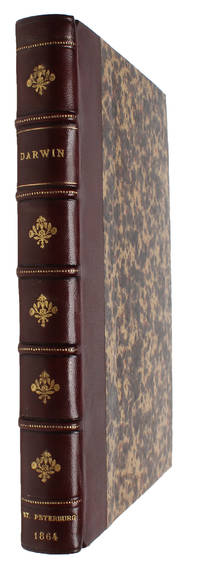
186460791S.-Peterburg 1864. 8vo. Bound in a beautiful half calf recent pastiche-binding with marbled papers over boards and elegant gilding to spine. End-papers renewed. Stamp to half-title title-page and first leaf of text. First leaves evenly browned and dampstain to outer margin affecting last 50 ff. A few occassional brownspots throughout. XIV 399 1 pp. 1 plate with genealogical tree between pp. 92/93. <br/><br/><em>First edition of the first Russian translation of Darwin's "Origin of Species" a main reason for the widespread effect of Darwinism in Russia where the theory met less resistance in the 1860'ies than it did in Western Europe. In Russia Darwinism had a profound influence not only upon the different sciences but also on philosophy economic and political thought and the great literature of the period. For instance both Tolstoy and Dostoevsky referenced Darwin in their most important works as did numerous other thinkers of the period."In 1864 S.A. Rachinsky professor of plant physiology at St. Petersburg University produced the first Russian translation of the "Origin". Although not a masterpiece of translation art the book sold out so quickly that in 1865 it went through a second printing. By this time Darwin's ideas were discussed not only by scientists but also by such popular writers as Dmitri Pisarev and M. A. Antinovich." Glick p. 232. Rachinsky began translating the "Origin" in 1862 and wrote an important article on the theories presented in it while working on the translation. This article and the translation of the "Origin" into Russian were responsible for the great success and rapid widespread knowledge of Darwinian theory of evolution in Russia. "Darwin was concerned that the "Origin of Species" reach naturalists across the world but translations of that complicated work raised problems for Darwin. If he found it difficult to make the reader "understand what is meant" in England and America at least in those two countries he and the reader were discussing the "Origin of Species" in the same language. Foreign language editions raised not only the thorny question of translating Darwinian terms but also the problem of translators who often thought it proper to annotate their editions to explain the "significance" of Darwinism. The first Russian translation of the "Origin of Species" 1864 appeared however without any comment whatever by the translator Sergei A. Rachinsky professor of botany at the University of Moscow. Rachinsky had begun the translation in 1862 and published an article on Darwinism while continuing work on the translation in 1863." Rogers p. 485. In the year of publication of the translation 1864 Pisarev wrote a long article in "The Russian Word" which purports to be a review of this translation; the critic complains about the absence of notes and commentaries by the translator. Pisarev furthermore points to several errors in the translation and to numerous infelicities of expression. Acknowledging the importance of the work however and of the spreading of Darwinism in Russia he goes on in his own essay to provide a much more popular account of Darwin's theory and to impress upon his readers its revolutionary significance.Nikolai Strakhov also reviewed the translation immediately upon publication acknowledging the effect it would have. Strakhov however recognized potential dangers inherent in the theory and expressed them in his review of Rachinsky's translation. He praised the work for its thoroughness and rejoiced in the evidence that man constituted the highest stage of organic development; but then he went on to argue that by moving into questions of philosophy and theology the Darwinists were exceeding the limits of scientific evidence. Like Pisarev Tolstoy enthusiastically embraced Darwinism. "The first mention of Darwin in Tolstoy's literary "Nachlass" is found in one of the drafts to "War and Peace". There Darwin is listed apparently quite favorably among leading thinkers "working toward new truth" . Thus by the late 1860's the name of Darwin as a leading scientist was already familiar to Tolstoy and duly respected." McLean p. 160. A fact which is often overlooked is that Tolstoy actually knew Rachinsky quite well. Interestingly it was in a letter to Rachinsky in reply to a question about the structure of "Anna Karenina" that Tolstoy made the famous statement that all Tolstoy scholars and lovers know by heart: "I am proud of the architecture - the arches are joined in such a way that you cannot discover where the keystone is". Like Strakhov however Dostoevsky acknowledging the significance of the "Origin" saw the dangers of the theory. In the same year as the publication of Rachinsky's translation he lets the narrator in "Notes from Underground" 1864 launch his attack on Darwinism beginning: "As soon as they prove you for instance that you are descended from a monkey then it's no use scowling you just have to accept it."In "Crime and Punishment" two years later 1866 the Darwinian overtones inherent in Raskolnikov's theory of the extraordinary man are unmistakable. He describes the mechanism of "natural selection" where according to the laws of nature by the crossing of races and types a "genius" would eventually emerge. In general Darwinian themes and Darwin's name occur in many contexts in a large number of Dostoevsky's works.Freeman 748. See: James Allen Rogers: The Reception of Darwin's Origin of Species by Russian Scientists. In: Isis Vol. 64 No. 4 Dec. 1973 pp. 484-503.Thomas F. Glick: The Comparative Reception of Darwinism. 1974.Hugh McLean: In Quest of Tolstoy. 2008. </em> hardcover
186456000S.-Peterburg 1864. 8vo. Bound in a beautiful recent pastiche-binding of brown half calf with marbled papers over boards and elegant gilding to spine. End-papers renewed. A few dampstains and a bit of brownspotting throughout. A nice copy. XIV 399 1 pp. 1 plate. <br/><br/><em>First edition of the first Russian translation of Darwin's "Origin of Species" a main reason for the widespread effect of Darwinism in Russia where the theory met less resistance in the 1860'ies than it did in Western Europe. In Russia Darwinism had a profound influence not only upon the different sciences but also on philosophy economic and political thought and the great literature of the period. For instance both Tolstoy and Dostoevsky referenced Darwin in their most important works as did numerous other thinkers of the period."In 1864 S.A. Rachinsky professor of plant physiology at St. Petersburg University produced the first Russian translation of the "Origin". Although not a masterpiece of translation art the book sold out so quickly that in 1865 it went through a second printing. By this time Darwin's ideas were discussed not only by scientists but also by such popular writers as Dmitri Pisarev and M. A. Antinovich." Glick p. 232. Rachinsky began translating the "Origin" in 1862 and wrote an important article on the theories presented in it while working on the translation. This article and the translation of the "Origin" into Russian were responsible for the great success and rapid widespread knowledge of Darwinian theory of evolution in Russia. "Darwin was concerned that the "Origin of Species" reach naturalists across the world but translations of that complicated work raised problems for Darwin. If he found it difficult to make the reader "understand what is meant" in England and America at least in those two countries he and the reader were discussing the "Origin of Species" in the same language. Foreign language editions raised not only the thorny question of translating Darwinian terms but also the problem of translators who often thought it proper to annotate their editions to explain the "significance" of Darwinism. The first Russian translation of the "Origin of Species" 1864 appeared however without any comment whatever by the translator Sergei A. Rachinsky professor of botany at the University of Moscow. Rachinsky had begun the translation in 1862 and published an article on Darwinism while continuing work on the translation in 1863." Rogers p. 485. In the year of publication of the translation 1864 Pisarev wrote a long article in "The Russian Word" which purports to be a review of this translation; the critic complains about the absence of notes and commentaries by the translator. Pisarev furthermore points to several errors in the translation and to numerous infelicities of expression. Acknowledging the importance of the work however and of the spreading of Darwinism in Russia he goes on in his own essay to provide a much more popular account of Darwin's theory and to impress upon his readers its revolutionary significance.Nikolai Strakhov also reviewed the translation immediately upon publication acknowledging the effect it would have. Strakhov however recognized potential dangers inherent in the theory and expressed them in his review of Rachinsky's translation. He praised the work for its thoroughness and rejoiced in the evidence that man constituted the highest stage of organic development; but then he went on to argue that by moving into questions of philosophy and theology the Darwinists were exceeding the limits of scientific evidence. Like Pisarev Tolstoy enthusiastically embraced Darwinism. "The first mention of Darwin in Tolstoy's literary "Nachlass" is found in one of the drafts to "War and Peace". There Darwin is listed apparently quite favorably among leading thinkers "working toward new truth" . Thus by the late 1860's the name of Darwin as a leading scientist was already familiar to Tolstoy and duly respected." McLean p. 160. A fact which is often overlooked is that Tolstoy actually knew Rachinsky quite well. Interestingly it was in a letter to Rachinsky in reply to a question about the structure of "Anna Karenina" that Tolstoy made the famous statement that all Tolstoy scholars and lovers know by heart: "I am proud of the architecture - the arches are joined in such a way that you cannot discover where the keystone is". Like Strakhov however Dostoevsky acknowledging the significance of the "Origin" saw the dangers of the theory. In the same year as the publication of Rachinsky's translation he lets the narrator in "Notes from Underground" 1864 launch his attack on Darwinism beginning: "As soon as they prove you for instance that you are descended from a monkey then it's no use scowling you just have to accept it."In "Crime and Punishment" two years later 1866 the Darwinian overtones inherent in Raskolnikov's theory of the extraordinary man are unmistakable. He describes the mechanism of "natural selection" where according to the laws of nature by the crossing of races and types a "genius" would eventually emerge. In general Darwinian themes and Darwin's name occur in many contexts in a large number of Dostoevsky's works.Freeman: 748. See: James Allen Rogers: The Reception of Darwin's Origin of Species by Russian Scientists. In: Isis Vol. 64 No. 4 Dec. 1973 pp. 484-503.Thomas F. Glick: The Comparative Reception of Darwinism. 1974.Hugh McLean: In Quest of Tolstoy. 2008. </em> hardcover
188253617Moscow S. P. Arkhipov. 1882. 8vo. In contemporary half calf. Wear to extremities and small stamp to upper right corner of title-page internally fine and clean. IV 186 pp. <br/><br/><em>Second Russian translation published the same year as the first Russian and the year after the original English of Dawin's "Vegetable Mould and Worms". "This last book is outside the main stream of Darwin's work and reverts to his earlier geological interests. He had indeed published papers on mould in 1838 and in 1840. The book was remarkably successful selling 6000 copies within a year and 13000 before the end of the century". Freeman. Freeman 1409 </em> unknown
183944052London: Printed by Richard and John E. Taylor 1839. 4to. 28cm. pp39-81 plus 2 engraved plates "Parallel Road." red outline colour & "View of the Paralled Roads of Glen Roy" pp. fine binding by Pierre Thibaudeau in quarter slightly speckled brown calf blind ruled raised bands crushed crimson morocco label gilt title match marbled boards and endpapers a fine clean attractively bound copy. fine. Freeman 1653. "Darwin's only paper in Philosophical Transactions the snappily titled Observations on the Parallel Roads of Glen Roy and of Other Parts of Lochaber in Scotland with an Attempt to Prove That They Are of Marine Origin 1839 describes parallel lines cut horizontally across the hillsides of Glen Roy and proposes that they had marine origins as had similar features he had seen at Coquimbo in Chile while on the Beagle expedition. In 1840 the lines were explained by French geologist Louis Agassiz as due to a lake formed in an ice age. After many years of argument Darwin conceded in 1862 that his paper was "one long gigantic blunder". In his autobiography Darwin claims "This paper was a great failure and I am ashamed of it." Wiki. Printed by Richard and John E. Taylor unknown
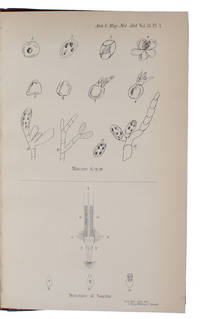
184456990London Taylor and Francis 1844. 8vo. In a nice later half morocco binding with five raised bands and gilt lettering to spine. Blind stamped to upper outer corner of first leaf of table of contents. In "The Annals and Magazine of Natural History" volume 13. A very fine and clean copy. Darwin's paper pp. 1-6 1 plate. Entire volume: viii 1 - 528 14 plates 4 hand-coloured. <br/><br/><em>First edition of Darwin's paper on marine arrow worms collected by him on his voyage on the Beagle. It is one of Darwin's early papers on invertebrates which was originally intended for publication in The Zoology of the Voyage of HMS Beagle. Described by Darwin as "one of the most anomalous animals in the world" the origin of these strange carnivorous animals which Darwin found highly interesting is still unresolved. These early works are rarely seen on the market. The plate drawn by Darwin is based on his drawings made during the Beagle Voyage.Darwin arrived back in England from his voyage around the world on the Beagle in October 1836. He immediately set about writing up the results of the expedition-first his general account the Journal of the Beagle and then publishing the scientific observations and collections he had made while on the Beagle. The majority of these were published in the Zoology-including parts on mammals fish birds and reptiles but Darwin ran out of funds beforehe could bring out the volume on invertebrates:"Darwin undertook to provide a comprehensive programme for the publication of the zoological results of the Beagle voyage - he obtained a Treasury grant to pay for the necessary engravings and having enlisted the leading taxonomical specialists in the several fields he superintended the publication of the Zoology of the voyage of H.M.S. Beagle from February 1838 to October 1843 - The work comprises five parts: Fossil Mammalia by Richard Owen; Mammalia by G. R. Waterhouse; Birds by John Gould; Fish by Leonard Jenyns; and Reptiles by Thomas Bell-a total of nineteen quarto issues. Darwin contributed a substantial portion of the text drawing uponhis field notes for geological and geographical data and for the descriptions of the habits and habitats of the species - Darwin had originally planned to include descriptions of invertebrates in the Zoology but the exhaustion ofthe government grant forced him to abandon the idea. Instead he decided to publish his own observations and descriptions of the specimens that he considered to be important new discoveries and did so in articles on Sagitta finished during the autumn of 1843 and Planariae described in 1844" Burkhardt 1986 p. xv.PROVENANCE: From the collection William Pickett Harris Jr. 1897 - 1972 pencil note on p. iii. American investment banker and biologist. Following a career in banking Harris was appointed Associate Curator of the Museum of Zoology at the University of Michigan in 1928. "Harris played a highly important role in developing mammalogy and systematic collections of mammals at the University of Michigan" Hooper p. 923.Freeman 1664. </em> hardcover
183954344London Richard and John E. Taylor 1839. 4to. Without wrappers. Extracted from "Philosophical Transactions of the Royal Society of London." 1839 Part I. Pp. 39-81 and 2 plates. 1 engraved map and 1 lithographed plate. Both plates with a few brownspots. <br/><br/><em>First appearance of Darwin's investigations of the geological phenomenon of the so-called "Parallel Roads" in Scotland."The first published description of the Parallel Roads was by Thomas Pennant in 1771 in his book A Tour of Scotland. This work was far from scientific but during the 19th century Glen Roy played an important role in the development of geological and geomophological theories of landscape evolution.1 Initially the 'Roads' were believed to be lake or marine shorelines. How they were formed in an area that was now high above the sea and without signs of a closed lake bed was a mystery. Initially it was thought that the shorelines were of marine origin and formed during a period when the sea reached levels of the Parallel Roads. Among the proponent of this theory were both Charles Darwin and Charles Lyell.2 It was in particular Darwin who was impressed by the geology of Glen Roy. In 1838 he wrote to Lyell "I wandered the mountains in All directions and examined that most extraordinary district. I think without any exceptions not even the first volcanic island the first elevated beach or the passage of the Cordillera as so interesting to me as this week. It is far the most remarkable area I ever examined. . I can assure you Glen Roy has astonished me".3 Darwin and Lyell proved to be wrong in this matter." Jan Oosthoek. Freeman 1653. </em> unknown
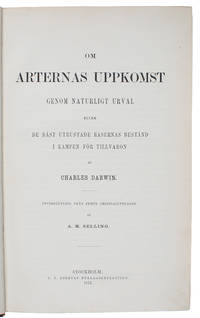
187156496Stockholm L.J. Hiertas Förlagsexpedition 1871. 8vo. Contemporary half calf with gilt lettering to spine and gilt ornamentation forming five compartments. Hindges with a few worm holes back hindges mostly affected but binding still tight and firmly attached to book block. Previous owner's stamp to pasted down front end-paper. Internally extraordinarily fine and clean. XI 1 420 pp. plate with genealogical tree inserted between p. 96 and p. 97. <br/><br/><em>The rare first Swedish translation also being the first in Scandinavia of Darwin's Origin of Species. Initially the work mainly received attention from religious institutions who also compared to most other countries were fiercely against Darwin's theory. Freeman wrongly lists this first Swedish edition as appearing in 1869 he also does not register the plate. </em> unknown
187252105Kjøbenhavn Gyldendalske Boghandel F. Hegel 1872. 8vo. Bound in contemporary half calf with 4 raised bands and gilt lettering to spine. Spine rubbed. A few light brownspots throughout. Otherwise a fine and clean copy. 10 XIII 605 1 1 plate. <br/><br/><em>The Scarce first Danish edition translated from the 5. edition of Darwin's monumental "On the Origin of Species". "In 1872 the book was translated into Danish by the young botanist J. P. Jacobsen. He was soon to become a celebrated novelist famous for Marie Grubbe - A Lady of the Seventeenth Century 1876 and Niels Lyhne 1880. In the early 1870's however he was still dedicated to science. In 1873 he received the University of Copenhagen's Gold Medal for his work on desmids single-celled green freshwater algae. The Descent of Man was also translated by Jacobsen and appeared in 1874-75. "In the early 1870s With the Danish translation the literary critic Georg Brandes started promoting Darwin's ideas as part of his liberal ideology and soon Darwinism became the mark of a new generation of intellectuals. Both the Steenstrup circle and the Brandes circle held Darwin in high esteem but made completely different attributions to his theory. Consequently they both decided to raise money separately for the same Darwin. Darwin had borrowed the collection of barnacles from the Zoology Museum in Copenhagen with the help of Steenstrup. As a compliment Darwin sent him a signed copy of the Origin. Steenstrup acknowledged Darwin as an important fellow naturalist but like many of his colleagues at the University of Copenhagen he never accepted evolutionary theory. The initial scientific reaction to Darwin's work on evolution by means of natural selection was respectful but made few converts. memorial in 1882. Independently Darwinism transformed as it became part of popular culture. "Kjærsgaard Darwinism comes to DenmarkFreeman: 643. PMM 344 - first edition </em> hardcover
187247264Kjøbenhavn Gyldendalske Boghandel F. Hegel 1872. Contemp. hcalf. Spine gilt and with gilt lettering. Spine slightly rubbed. Corners a bit bumped. 10XIII6051 pp. and 1 folded plate. A few faint brownspots to the first leaves. <br/><br/><em>Scarce first Danish edition of "On the Origin of Species" 1859.Freeman: 643. </em> unknown
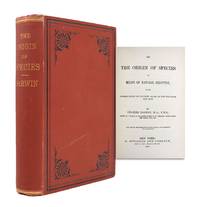
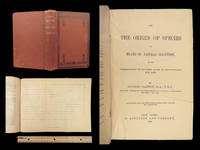
187172218New York: D. Appleton and Company 1871. Fifth Edition. Hardcover. Very Good. 20 x 13 cm. Octavo. 447pp 8pp ads. Half-title. Fold-out lithographic diagram opposite page 114 in nice condition. Bound into brown pebbled cloth. Stated fifth American edition. Spine is sun toned and the head and tail are chipped. There is some discoloration to the title page from what looks like a newspaper clipping lay for many years. Binding is tight. Freeman F390b. D. Appleton and Company hardcover
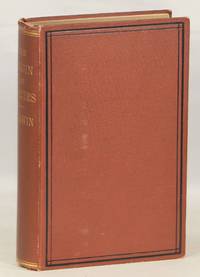
1875000013141New York: D. Appleton and Company 1875. Later edition. Hardcover. Near Fine. 8vo. 5 vi-xxi 2 2-458 2 pp. Red publisher's cloth with two black borders on each board gilt lettering and rules on the spine. Yellow coated endpapers and pastedowns. New edition from the sixth English edition with additions and corrections. A sharp example of a later edition of Darwin's monumental treatise on biology forever changing the field. A touch of wear to the cloth an 1877 name on the first blank leaf. D. Appleton and Company hardcover
1878365957New York: D. Appleton and Company 1878. New Edition from the Sixth English Edition with Additions and Corrections. xxi 1 1-458pp. 1 vols. Small 8vo. Publisher's russet cloth blocked in black. Near fine. New Edition from the Sixth English Edition with Additions and Corrections. xxi 1 1-458pp. 1 vols. Small 8vo. "Certainly the most important biological book every written . The sixth edition which is usually regarded as the last appeared in London in February 1872 . It is again extensively revised and contains a new chapter VII. . It is in the edition that the word 'evolution' occurs for the first time. It had been used in THE DESCENT OF MAN in the previous year but not before in this work" Freeman p. 79. The present 1878 edition is the fifth issue of the American edition based on the sixth edition. A lovely copy of an early American edition. Freeman 403 D. Appleton and Company unknown
18991045316th Edition 2vols. bound in one.: D. Appleton & Company. Very Good. 1899. Hardcover. Hardcover bound in publisher's red brick buckram gilt titles to spine; black stamped decor to cover. Corrected sixth edition; two volumes in one. Very good in and out. 8vo. 702pp. ; 8vo 8" - 9" tall . D. Appleton & Company hardcover
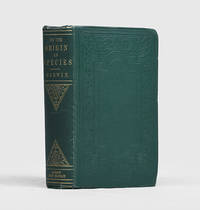
1860171418London: John Murray 1860. The most influential scientific work of the 19th century Second edition of "the most important biological book ever written" Freeman the issue dated 1860 on the title page. Darwin's Origin was published in 1859. The second edition largely reprinted the text of the first with a few authorial changes ranging from correcting the misprint "speceies" to diluting Darwin's "whale-bear" story where he speculated that a bear scooping insects from the water may evolve into a whale-like creature. The hypothesis was seen as absurd at the time and was seized upon by Darwin's critics to ridicule and criticize both the scientist and his evolutionary theory; Charles Lyell advised him to remove it entirely. "This story is not found again in any printing except in the American editions of 1860 until the end of copyright" Freeman p. 78. All copies of the second edition save for a handful dated 1859 are marked "fifth thousand" on the title page; the edition is not otherwise indicated as the second. The issue dated 1860 - the form in which the second edition is almost always seen - was published on 7 January 1860 in a print run of 3000 copies. Octavo in 12s. Folding diagram facing p. 117. With 32 pp. of publisher's advertisements dated January 1860 at rear. Original green diagonal-wave-grain cloth spine lettered and decorated in gilt covers blocked in blind Freeman's variant a light brown coated endpapers. Housed in a dark green quarter morocco solander box by the Chelsea Bindery. Cloth and gilt bright and unmarked spine ends and corners bumped; inner hinges expertly restored endmatter lightly spotted else contents clean upper outer corner of L1 creased resulting in small split. A near-fine copy. Freeman 376. hardcover
1859172148London: John Murray 1859. Presented to his botanical counterpart in France who prefigured Darwin's theory of adaptation First edition presentation copy inscribed on the front free endpaper in a secretarial hand "Dr Weddell Bagnères de Bigorre from the author". This is a premier copy: Weddell is one of the earliest named recipients on Darwin's list of presentation copies. Darwin and Weddell who had comparable experience as scientists aboard major expeditions to South America exchanged findings plant specimens and presentation copies throughout their careers. Though born in England Hugh Algernon Weddell 1819-1877 was raised in France and qualified as a physician there in 1841. He joined the Castelnau scientific expedition to South America the following year aged 23 before leaving in 1845 to concentrate on his own plant collecting in the Andes. He returned to France in 1848 having discovered coca and cinchona among other plants and collected over 5000 specimens. These travels and a later trip to Bolivia established him as a specialist in South American flora. He served as an assistant naturalist at the Muséum d'histoire naturelle in Paris from 1850 to 1857 before settling in Bagnères-de-Bigorre and later in Poitiers. Histoire naturelle des quinquinas ou monographie du genre 1849 the two-volume Chloris Andina 1855-57 and Monographie de la famille des Urticés 1856 are among his most noted publications. "Weddell was the first to demonstrate scientifically the medical importance of coca. as well as the dangers attached to its misuse. His work contributed to the cultivation of cinchona in the Dutch East Indies and other tropical regions and earned him the Order of the Netherlands Lion in 1855 a rare distinction for a foreigner. His observations on the fossils of Tarija in Bolivia and on the different varieties of cinchona led him to elaborate between 1850 and 1860 a theory of adaptation that anticipated Darwin at least in France" Natural History Museum. In 1858 Darwin and Hooker consulted the new data in Weddell's 1856 monograph to calculate the number of species and varieties in large and small genera. Weddell sent Darwin a copy of his paper on the Cynomorium plant in 1860 and two years later Darwin responded in kind by gifting Weddell a copy of Orchids on page 19 of which he cites Weddell's work on the "naturally produced" hybrids of Aceras. Weddell is also included on Darwin's presentation list for "Two forms in species of Linum" 1863 which prompted a written correspondence on pollination mechanisms. In his letter of 13 May 1863 DCP-LETT-4161 Weddell apologizes to Darwin for being unable to find the requested samples of Ophrys apifera bee orchids in his local area: "If at any future period I am more lucky I shall not fail to observe a sufficient number of them as respects their manner of fertilisation and make you acquainted with the results". The final exchange between Darwin and Weddell concerned membership of the Académie des Sciences. Darwin applied twice to become a corresponding member of its botanical section but it was not until after Weddell's death that the Académie offered the newly vacant place to him DCP-LETT-11640A. Darwin drafted his list of recipients of presentation copies of the Origin between August and October 1859. Weddell appears on the first page of the list as "Dr. Weddell Bagneres de Bigorres Haute Pyrenees" Correspondence Vol. 8 p. 555. "There are no known author's presentation copies of the first edition inscribed in Darwin's hand" Norman. Subsequent provenance: Louis Devergne likely the archpriest 1891-1941 at Loudon some 40 miles from Poitiers where Weddell died his neat ink ownership inscription on front free endpaper; private French collector. Octavo. Folding diagram lithographed by W. West. 32-page publisher's catalogue at rear dated June 1859. Original green cloth spine lettered and decorated in gilt Freeman variant b no priority brown endpapers. Housed in a green quarter morocco solander box by the Chelsea Bindery. Extremities rubbed and bumped cloth and gilt bright small patch of dampstain at upper edge of rear cover with resulting area visible at gutter of rear endpapers contents notably clean bar very occasional faint spotting and soiling neatly repaired closed tear at fore edge of G5 tiny nick at fore edge of P5: a fine copy. Freeman 373; Garrison-Morton 220; Horblit 23b; Norman 593; Printing and the Mind of Man 344b. "Appendix III - Presentation copies of Origin" in Frederick Burkhardt & James Second eds The Correspondence of Charles Darwin Volume 8: 1860 1993. hardcover
188025818<p><strong>1880 DARWIN Origin of Species Evolution Survival of Fittest Biology Science</strong></p><p><em>"One general law leading to the advancement of all organic beings namely multiply vary </em><strong><u>let the strongest live and the weakest die."</u></strong></p><p>― Charles Darwin<em> The Origin of Species</em></p><p><em>"Origin of Species"</em> originally written in 1859 helped lay the foundation for many of the theories of evolution that would shape thinking for the next century. According to Glick</p><p>"'Origin of Species' greatest impact on German biological practice lay in the introduction of historical modes of explanation for the observable phenomena of living nature. The historical approach to nature was rejected not only by the opponents of evolution but also by the idealist evolutionist. Whether they favored a teleological or a reductionist biology the idealists could not see the point of a theory that emphasized the irregularities and exceptions in the organic world. In the timeless real of idealist thinking unchanging laws worked out an inevitable destiny. But Darwin taught his followers to look at living beings one by one. Thus prompted they recognized as if for the first time the surprising fact of anomaly and the wisdom of an open-ended theory." Glick <em>Comparative Reception of Darwinism</em></p><p>Garrison calls this work "the most wonderful piece of synthesis in the history of science."</p><p>Item number: #25818</p><p>Price: $499</p><p>DARWIN Charles</p><p><strong><em>On the origin of species by means of natural selection.</em></strong></p><p>New York: D. Appleton and Company 1880.</p><p><u>Details</u>:</p><p><!-- if !supportLists-->· <!--endif-->Collation: Complete with all pages</p><p><!-- if !supportLists-->o <!--endif-->xxi 1 458</p><p><!-- if !supportLists-->· <!--endif-->References: Freeman 438; Glick; Garrison & Morton 220; <em>Printing and the Mind of Man</em> 344b.</p><p><!-- if !supportLists-->· <!--endif-->Language: English</p><p><!-- if !supportLists-->· <!--endif-->Binding: Hardcover; tight and secure</p><p><!-- if !supportLists-->o <!--endif-->Cloth</p><p><!-- if !supportLists-->· <!--endif-->Size: ~8in X 5.5in 20.5cm x 13.5cm</p><p>Our Guarantee:</p><p>Very Fast. Very Safe. Free Shipping Worldwide.</p><p>Customer satisfaction is our priority! Notify us with 7 days of receiving and we will offer a full refund without reservation!</p><p>25818</p><p>Photos available upon request.</p> D. Appleton and Company hardcover
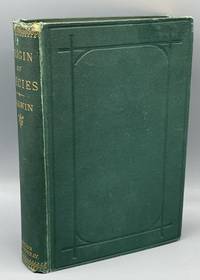
188412288London: John Murray 1884. Octavo 7.75 x 5.25" green cloth with gilt spine lettering xxi 1 458 pp. Sixth Edition with editions and corrections to 1872 Twenty-Sixth Thousand. An early edition of this classic. An attractive copy with wear to corners mild fraying to spine tips slight discoloration to covers bit of rubbing and soiling to endpapers rear endpaper lacking owner inscription to front endpaper. John Murray hardcover