Milito D. (cur.); Lisanti E. (cur.)MareMagnum

64 résultats
ril. Dal confronto tra studiosi e su temi di rilevante interesse è emersa l'intramontabilità del Braille, che, nell'era delle tecnologie, si conferma come strumento ineludibile per l'approccio con ogni sapere. Tra l'altro il Braille, in dimensione pedagogica, non solo si configura come chiave di ingresso nel futuro, bensì è interpretato come opportunità di riscatto rispetto a qualsiasi tentazione di inferiorizzazione e di marginalizzazione della persona non vedente o ipovedente. I vantaggi del Braille sono correlati, in particolare, con la sinergia che esso è in grado di estrinsecare nel rapporto con linguaggi non verbali come quelli della musica e dell'arte, attraverso cui è possibile manifestare e percepire ogni sentimento umano. L'impulso culturale del Braille si invera, infine, attraverso la sua configurazione di codice utilizzato in quasi tutti i paesi del mondo e, pertanto, funzionale al superamento della logica delle nazioni, contribuendo all'incontro fra i popoli e all'affermazione di una visione esistenziale planetaria.
51432491like new. unknown
0266948650.Ghardcover. Good. Access codes and supplements are not guaranteed with used items. May be an ex-library book. hardcover
152830702X.Gpaperback. Good. Access codes and supplements are not guaranteed with used items. May be an ex-library book. paperback
0331439565.Ghardcover. Good. Access codes and supplements are not guaranteed with used items. May be an ex-library book. hardcover
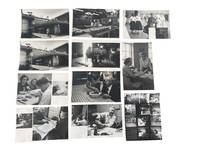
1960234021960. Disability RightsDisability Activism Braille Institute of America photo archive documenting blind and low-vision adults at the Institute's Los Angeles facility recording the everyday work of disability education before the Americans with Disabilities Act made access and public accommodation a national civil-rights mandate. J. Robert Atkinson founded the Universal Braille Press in Los Angeles in 1919 after losing his sight in 1912; the organization later became the Braille Institute of America moved to Vermont Avenue in 1939 and expanded into a new William Pereira designed facility that opened in 1974. The Institute's early work also helped shape national access to reading: Atkinson's lobbying preceded the 1931 Pratt-Smoot Act which placed federal funds under the Library of Congress to provide books for blind adult readers. The activities shown here matter because literacy handwork movement performance and social gathering were not secondary amenities; they were the practical means by which blind and low-vision people gained public presence skill confidence and community in a city built overwhelmingly for sighted people.<br /> Photo archive of 26 total images printed across 11 silver gelatin prints Los Angeles California circa 1960s to 1970s. Images show the outside of the building with the sign "Braille Institute of America Inc." while a man stands with a guide dog and later walks toward the entrance under the covered walkway. Interior scenes include adults reading braille at tables visitors talking together around tables and a smiling man sculpting clay at a worktable. Weaving instruction appears at a tabletop loom; other scenes show clay or tactile craft work and participants gathered around tables with guide dogs resting beside their handlers. Several images show black and white participants on a dance floor One sheet is a print of 12 enlarged film strip cells and four sheets contain two images printed on a single sheet.<br /> The archive belongs to a longer twentieth-century history in which blind Americans fought for access not only to books but to streets schools workrooms libraries and ordinary public life. White cane laws including early municipal ordinances in the 1930s and later state protections made the cane and guide dog public signals of mobility and right of way while federal braille and talking-book programs made reading a public responsibility rather than a private burden. The Braille Institute provided adults in the Los Angeles area a resource to read by touch shape clay work at looms dance with partners move with guide dogs and participate in many other activities where disability was not an obstacle for culture learning or socializing. All sheets complete with light handling wear only; overall in very good condition. unknown
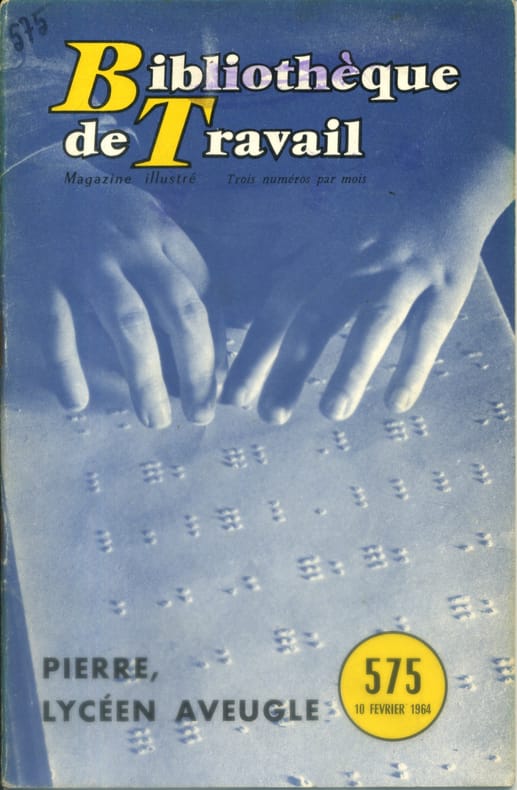
1964141554Couverture souple. Brochure de 40 pages.
1931ABE-177474220003424,5 CM X 31 CM-(DG24)
47461, Zellik, Roularta Books. 1997, Hardcover, 128pp., 21x14cm., ills. in z/w., zeer goede staat. ISBN 9054663006.
1397334215.Gpaperback. Good. Access codes and supplements are not guaranteed with used items. May be an ex-library book. paperback
1397334339.Ghardcover. Good. Access codes and supplements are not guaranteed with used items. May be an ex-library book. hardcover
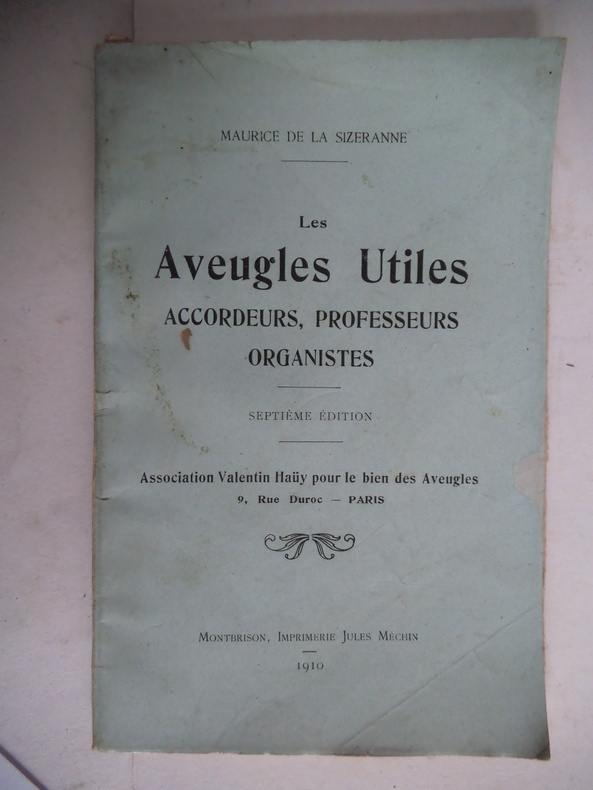
10494Association Valentin Haüy pour le bien des aveugles Paris. In 12 broché, titre 63 pages, Montbrisson imprimerie Jules Méchin 1910 petite tache en marge extérieure de la page 53 à la fin.
brossura Il kit cartonato è composto di undici fogli, uno per ogni colore, che al tatto rilasciano l'odore codificato per ciascun colore (c'è un "odore nero", un "odore giallo" ecc.); ogni foglio porta impresso il "segno" del colore costruito convenzionalmente con una puntinatura di tipo Braille, percettibile al tatto. Completano il kit legato a ganci metallici undici fogli pretagliati che forniscono le tessere indispensabili per gli esercizi di manipolazione, costruzione di sequenze colorate, costruzione dei rapporti colore/odore/suono. Al kit è collegato il sito www.odorisuonicolori.it che costituisce parte integrante della pubblicazione. Il prodotto, secondo indicazioni spontanee di specialisti della riabilitazione, può risultare assai efficace anche in molte altre aree dell'handicap sia sensoriale sia neurologico, sia psichico (recupero tossicodipendenti, anziani, anche in via preventiva, pazienti psichiatrici) e in numerose situazioni di deprivazione sensoriale.