66 618 résultats
10 pp. (including postscript) on 2 bifolia and one single leaf, 8vo (167 x 110 mm) and 4to (206 x 160 mm). In French, with amendments and hurried deletions throughout. A long, wide-ranging letter to the Scottish lawyer Thomas Burnett (1656-1729) in which Leibniz explains that he intends to write about books received from Burnett and mentions the controversy between John Locke and the Bishop of Worcester, but has no time to do so at present. He encloses some verses from Paris by M. Cresset ("God save the King of Spain, otherwise everything will go completely haywire, and England will not feel at all happy about having being disarmed"), confirms he has received a book on the Council of Trent from the Bishop of Salisbury (Thomas's kinsman Gilbert Burnet), and discusses the literary tastes of the Electress of Brunswick, whose books must "show spirit, and have at the same time something cheerful about them" owing to the recent loss of her husband Ernst August, Elector of Brunswick, from which she is struggling to recover ("the spirit is willing but the flesh is weak"). Leibniz adds a lengthy postscript advising that he is enclosing an extract from a letter he recently sent to the Bishop of Salisbury "in confidence" in which he talks "about matters of religion and the state, both of which are in the competence of the illustrious Bishop", fearing "'black practices' against the King, and that it is right to take every imaginable precaution for the preservation of his person" and hoping that "France will finally resolve herself for good and all to peace. Perhaps she flatters herself that peace will break up the Grand Alliance [...] we in Germany are taking steps to help in assuring the public order [...] to prevent our being taken by surprise". He concludes by describing how he resolved a dispute about coinage of England and muses as to how the King should be designated: "C'est ce que j'ay exprimé par ce distique: Tertius, an primus Guilielmus sit ve secundus, / Desinite o critici quaerere; Magnus erit" ("William First, Or Second, Or Third? / Ask Not, Critics, Great's The Word"). - Includes, on a separate quarto leaf, a fair copy of Leibniz's letter to Gilbert Burnet, headed "P.S.": "I have frequently the honour of attending the Electress of Brunswick, which great Princess sometimes will suffer my conversation. We fall often into religion, and I have long been interested in studying controversies [...]". Leibniz is curious about the "separation of communions which one sees among the Protestants", and thinks the differences with Rome "infinitely more important". He is troubled by news that the House of Lords wavered in excluding "Romanists" from the Crown and wonders why Burnet did not support this exclusion, voicing his concern that a future monarch who had the appearance of Protestantism could be working to destroy it. He asks for Burnet's opinion and urges the matter be brought again before parliament. - This letter forms part of the significant, 18-year-long correspondence between Leibniz and Thomas Burnett of Kemnay in Aberdeenshire, occasioned by their meeting at the court of Hanover in 1695. The most recent Akademie edition of Leibniz's correspondence includes some 29 letters from Leibniz to Burnett and 51 from Burnett to Leibniz written during the period 1695-1707, with more still to be published. When Leibniz met Burnett, he was already corresponding on matters religious and political with his cousin Gilbert Burnet, Bishop of Salisbury. Leibniz also found in Burnett a useful conduit to fellow philosopher John Locke, with whom he was keen to correspond, and a source of intellectual and political news and gossip from England and elsewhere. Our letter shows he was also the means for Leibniz to obtain the latest writings published in English ("I saw some issues of an English journal or newspaper which was half-way between a scholarly journal and a society newspaper, but I do not know whether it is carried on"). - Also shown here is Leibniz's close relationship with the Electress Sophia, a friendship that lasted for 40 years. Leibniz is clearly preoccupied with English politics and the issue of the Protestant (Hanoverian) succession, demonstrating a great admiration for the English monarchy. At the time of writing, the Electress Sophia was the next Protestant in line to the throne, but it was not until the 1701 Act of Settlement that she was formally named heiress presumptive and, while she did not survive long enough to take up the crown, that position was to be secured by her son George. In the present letter Leibniz fears "black practices" against King William in a precarious political situation and speaks of the readiness of Germany and the Empire to have troops mobilised against France despite negotiations towards peace. - Slight splitting and small holes at folds professionally repaired. Provenance: Thomas Burnett, 2nd Laird of Kemnay (1656-1729), and thence by descent; held in the archive at Kemnay House, Aberdeenshire, until now. The correspondence collected by the Berlin Akademie includes a letter from Leibniz to Gilbert Burnet written three days before ours (no. 311, p. 478), the contents of which, however, bears little resemblance to our "postscript", and it may be, therefore, that our copy is the only surviving record of another letter. Published in Leibniz, Allgemeiner politischer und historischer Briefwechsel (Berlin, 1998) no. 316, L2, pp. 492f., without the postscript to Thomas Burnett or the copy postscript to Gilbert Burnet. Another longer letter to Burnett, written on the same day, is also included in the correspondence (no. 316, L1, pp. 486-491). It is also published Susan Burnett, Without Fanfare: The Story of my Family (Kemnay, 1994), pp .11f., and elsewhere, but not in Gerhardt, Die philosophischen Schriften von G. W. Leibniz.
8vo. 2 pp. on bifolium, in pencil. In Russian, to his third wife, Natalya Andreevna (née Manchenka, 1902-90), about some of his paintings that were sold, his return to Moscow, where everyone is happy to see him, and a presentation he attended there: "[...] Yesterday I went to the Academy to hear a presentation by Shutko on Dziga Vertov. It was quite remarkable, and I also saw three performances by Vertov. Eisenstein sulked like a little girl. There was another presentation held by a German from Dessau, but I left before that. The people from ASNOVA [the Association of New Architects] want me to go to Moscow. Klyun will leave on Wednesday [...]". - Kirill Ivanovich Shutko (1884-1941) was editor-in-chief of the magazine "Soviet Cinema". - Somewhat wrinkled. Malewitsch über sich. Zeitgenossen über Malewitsch. Briefe. Dokumente. Erinnerungen. Kritik. Bd. 1, Moskau 2004, Nr. 9.
8vo. 3 pp. on 3 ff. In Russian, to his third wife, Natalya Andreevna (née Manchenka, 1902-90): a lyrical letter about celebrating Christmas in Moscow (while she is in Leningrad) and how much he desires to live with her "in a new place", as "Leningrad has spoiled me" (transl.). Malewitsch über sich. Zeitgenossen über Malewitsch. Briefe. Dokumente. Erinnerungen. Kritik. Vol. 1, Moscow 2004, no. 1.
8vo. 3¼ pp. on bifolium. Apparently to the French aesthete, Symbolist poet, art collector and dandy Robert de Montesquiou (1855-1921), who had been the inspiration both for des Esseintes in Joris-Karl Huysmans' "À rebours" (1884) and for Baron de Charlus in Proust's "À la recherche du temps perdu" (1913-27), discussing his attending a conference and a novel by Gabriele D'Annunzio: "Vous 'ne doutez pas' comme disent les gens du monde, que je ne souhaite - sans guère l'espérer - d'être en état d'assister à la Conférence. Je serais heureux de me rendre compte par moi-même ce qu'en penserait la Petite (non, la Grande!) Mademoiselle. Elle a toujours eu un faible pour nous (ce qui est son fort!) Et le merveilleux roman de d'Annunzio me semble par son sujet convenir merveilleusement à l'instruction des enfants confiés à Miss Winter. Je vois là le thème tout indiqué pour les représentations de théâtre jouées au naturel entre frère et sœur. Vous voyez que je ne fais pas comme les gens qui font semblant de ne pas connaitre l'existence des enfants dont on ne leur a pas notifié la venue au monde. Je n'ai pas moins ressenti de cette omission, au tort de mes sentiments, d'une façon cruelle et durable 'car enfin mon respect et mon obéissance semblent dignes à mes yeux d'une autre récompense'. Mais cela ne m'empêche pas de les admirer tout de même beaucoup ! Votre très dévoué | Marcel Proust"'. - Slightly browned and spotty; small collection stamp on p. 1.
On two sheets, each signed "LB" or "Laur de Brunhoff". 305:210 mm. The first of the charming watercolours shows Babar preparing for his trip by changing his crown to a black hat and packing his suitcases. The others show Babar boarding his plane and the famous elephant visiting a jazz club and an antique store in New York after his arrival in the United States. Prefectly preserved, from the Ralph Esmerian Collection, New York.
8vo. 2 pp. - (Bound before): Krause, Ernst. Erasmus Darwin. Translated from the German by W. S. Dallas. With a preliminary notice by Charles Darwin. London, John Murray, 1879. 8vo. IV, 216 pp. With a portrait frontispiece and a fullpage illustration. Full calf with marbled endpapers, all edges gilt, gilt inner dentelle, leading edges gilt. With Darwin's gift inscription pasted to endpaper and Leslie Stephen's autograph ownership and notes above and below. To the writer and critic Sir Leslie Stephen (1832-1904), whose copy this book is, responding to Sir Leslie's reassurances after having been attacked by the novelist Samuel Butler (1835-1902): "My dear Leslie Stephen. Your note is one of the kindest which I have ever received, & your advice shall be strictly followed. It was very good of you, busy as you are, to take so much trouble for me; but your trouble will not be thrown away, in so far as when in the dead of the night the thought comes across me how I have been treated, I will resolutely try to banish the thoughts, & say to myself that so good a judge as Leslie Stephen thinks nothing of the false accusation. The Litchfields & some of my other children are intensely curious to read your judgment. Believe me / yours ever gratefully / Charles Darwin. / I have written on opposite page my name if you think fit to paste it into the Life of E.D.; but I much wish that you would name one or more of the books, written wholly by myself, which I could treat in the same manner for you." Indeed, the dedication "From Charles Darwin / with kindest regards / Jan. 13th 1881" has been cut out and mounted on the flyleaf, and underneath Sir Leslie has added by way of explanation: "The letter upon the next page refers to a silly attack made upon Darwin by Butler of 'Erewhon' etc. I had given Darwin the obvious advice to take no more notice of the creature, D. having already made a sufficient acknowledgement of a trifling error. For details see 'Academy' of the period. LS. - Darwin afterwards sent me the 'Origin of the Species' & the Voyage of the Beagle." - The physician Erasmus Darwin (1731-1802), Charles's grandfather, espoused an early theory of evolution all his own, which he sketched, obliquely, in a question at the end of a long footnote to his popular poem "The Loves of the Plants" (1789). Samuel Butler rejected Charles Darwin's theory of natural selection. In his 1879 book "Evolution, Old and New" he accused Darwin of having borrowed heavily from and distorted Buffon, Erasmus Darwin and Lamarck, trying to reinstate these earlier thinkers and with them, the design argument. - Provenance: by descent to Leslie Stephen's daughter, the writer Virginia Woolf (1882-1941), who left it to her husband, the writer Leonard Woolf (1880-1969). Woolf had the book auctioned at Sotheby's a year before his death (sale of Feb. 29/20, 1968, lot 279); acquired by a northern Swedish collector, whose descendants returned it to the trade. Darwin Correspondence Project, no. 13012 (regestum only).
4to. 119 pp. and 99 pp. Includes a "Melic draft", dated 7 April 1944 (2 pp.). 220 pp. altogether. On staved paper; one ms. somewhat browned by age. The present, complete XVth "Zwölftonspiel" comprises: 1) Melischer Entwurf, captioned "J. M. Hauer XV. Zwölftonspiel. Hanns Blaschke 7. April 1944". 2 pp., notes in four colours (coloured pencil in blue, red, green, and orange). 2) Ms. score, captioned "Josef Matthias Hauer. XV. Zwölftonspiel für Orchester mit einer Zwölftonreihe, die vom Bürgermeister Dipl. Ing. Hanns Blaschke gewählt wurde, und die in sechs verschiedenen Tropen steht. Partitur/ Erster Teil im 2/4 Takt mit achttaktigen Perioden d=50, Dauer 10 Minuten". 119 pp., ink and pencil. 3) Ms. score, captioned "Josef Matthias Hauer XV. Zwölftonspiel für Orchester mit einer Zwölftonreihe, die von Bürgermeister Dipl. Ing. Hanns Blaschke gewählt wurde und die in sechs verschiedenen Tropen steht. Erster Teil im 2/4 Takt mit achttaktigen Perioden. Zweiter Teil im 3/4 Takt mit sechstaktigen Perioden. Partitur", 99 pp., ink and pencil. - Well-preserved fair copies. Cf. New Grove VIII, 303-305.
4to and oblong 8vo. Altogether 21 pp. With 3 autograph envelopes. Includes two typed letters by Jung's assistant Aniela Jaffé, the draft for a letter from Leonore L. Fabisch, and a hectographed letter of recommendation by Jung (together 4 pp. 4to and oblong 8vo). Important, hitherto unpublished German correspondence with the graphologist and psychologist Leonore L. Fabisch, who briefly studied under Jung and had fled from Berlin to New York in the 1930s. Encompassing the years from 1940 to 1960, shortly before Jung's death, the letters cover a broad range of professional subjects and biographical events, giving evidence of a long but complicated friendship. Some of the early letters from the war and its immediate aftermath strike a melancholy tone, especially the second one, dated 2 April 1941, in which Jung complains that he seems unable to write anything meaningful and dreads answering the many letters he receives. He briefly refers to antisemitism, cautiously confirming Fabisch's suspicions that this might prove a hindrance to her establishing herself professionally in New York: "You are right, the Jew and antisemitism are a big problem. I suppose something of this sort must exist, it wouldn't be so otherwise". Jung goes on to condemn the entire world as "largely a rotten mess" ("grösstenteils eine Schweinerei") only barely good enough to survive, perpetually on the brink of "croaking on all its wickedness". All things considered, he writes, human existence is about "eating or being eaten", and those who have "a roof over their heads, enough to eat and a one or two decent acquaintances" have already reached a "so-called state of happiness" - anything beyond that is "a luxury and treacherous luck". Fabisch ought to be grateful every day for "not being in Germany or anywhere else in Europe any longer". The ambiguity of Jungs's short remark about antisemitism and its subtle relativization fit the pattern of his widely criticized statements during the rise of Nazism and his psychological characterizations of "Germans" and "Jews" from the late 1930s. While Jung has never been considered an antisemite, his remarks were often felt to be naive, and he later felt it necessary to apologize to several Jewish friends. - His bitter, insensitive letter to Fabisch may have contributed to the four-year hiatus in the correspondence to which Jung refers in a subsequent letter of 4 August 1945, stating that he has reduced his psychological practice to a minimum for the benefit of his scientific projects. Jung also announces the 1946 publication of "Psychology of the Transference" and hints at "Mysterium Coniuctionis", which would not appear until 1955. In both publications Jung tries to establish a connection between psychology and alchemy, a subject which recurs in a letter from 1 April 1955. While Jung shows more empathy with Fabisch's struggles as an immigrant in New York after the war, he paints a grim picture of postwar Europe: "I understand that you never feel quite at home in America, even though Europe has been turned into a hellscape thanks to the Germans' madness" (3 August 1946). In his view, Switzerland has been "miraculously spared" but has become a "cultural island" and a "small piece of old European culture", for "the situation is worse than after the Thirty Years' War". - Referring to his fragile health and old age on several occasions, Jung regrets that he does not have the energy to visit Fabisch in New York but hopes to welcome her in Europe. Fabisch's first visit to Switzerland after the war seems to have occurred in July or August 1949, with a second one in 1953. A potential third visit was overshadowed by the death of Jung's wife Emma in November 1955. - On 14 December 1955, Jung's assistant Aniela Jaffé thanks Fabisch in Jung's name for a letter of condolence, emphasizing that it was one of the few he had read personally. In early 1956 Jaffé confirms the possibility of a visit in June but writes that Jung now lives in semi-seclusion and cannot spare "as much time as you wish and possibly need". The enigmatic phrasing and Jung's avoidance of writing personally points to a complication in the relationship with Fabisch that a typed letter from 4 June 1954 had anticipated: "The difficulty that you experience in your relationship to me is illuminated by your dream. It speaks of an entitlement that is not in agreement with my reality. Even within the dream there is a remarkable disconnection to the external situation, as you lightheartedly indulge in sleep without the least consideration for me, your surroundings, or their situation. It would seem to me quite understandable that no relationship can be formed under these circumstances". Overall, the correspondence remains professional and friendly. In the same letter, Jung interprets the dream of one of Fabisch's patients: "I have never seen this symbolism before. It appears to imply that the sexual act is elevated from the sphere of mere drive, where it resides, to the psychological sphere". He also encourages Fabisch to publish her cases and thanks her on several occasions for books and birthday wishes she had sent him. When Jung and Fabisch discuss her plan to relocate Brazil, he seems on the verge of repeating his earlier insensitive remarks, noting that while from Zurich the move seems gigantic, Fabisch has, after all, "already uprooted herself once and may as well continue the routine", at the same time warning her that Brazil "lags far behind Chicago, on the very border of the jungle," and has "strange spirits in the atmosphere, but no spirit". He advises her to go to New England instead (5 December 1958). Two years later, in a letter from 4 August 1960, after Fabisch has in fact decided to move to Sao Paulo, he strikes a new tone: "After all, that place is also on earth and consists of human beings". In contrast to his letter written in 1941, Jung here appears once more capable of a cautiously positive assessment of humanity. - One of the manuscripts is a diagram of a tarot reading by Jung for Leonore L. Fabisch in black ink, pencil and red pencil, dated 11 August 1949. The second manuscript might be the attachment with transcriptions of an inscription sent with a letter from 1 April 1955, wherein Jung discusses an alchemical image. It comprises 7 lines with two Greek quotes referring to the gods Aion and Telesphorus and a German translation by Jung. The first quote is attributed to Heraclitus. - With two exceptions on stationery with printed address. Overall in very good condition with occasional creases and minor tears and a few deeper tears (24 April 1940, 19 April 1949) but no loss to text. - A letter from Fabisch to Jung, dated 28 October 1940, is held at the archive of the ETH Zurich (Hs 1056:8868).
Large 8vo (145 x 229 mm). In German. 1½ pp. (30 lines in pencil on blue squared paper). To his friend Robert Klopstock, a medical student and fellow sufferer of tuberculosis: "Dear Robert, just a few words, the lady waits. From the report given by Miss Irene I was under the impression that the worst was over and that a hospital could therefore be ruled out. But if you feel that a hospital might be able to give you any ease, even the slightest, we could try it after all (service at your place is undoubtedly very poor), it would not be a supplication at all, I would approach my colleague and have him intercede quite proudly or, which might be even better, go to Prof. Münzer. So let me know. I have received a message today from Dr. Hermann, but a very brief and unclear one, mentioning a slight flu; I shall visit him tomorrow. How high is the fever? Indeed, I had already answered your letter when Miss Irene called here yesterday. The fever made the whole matter even less important than it had been already; the answer lies with me" (transl.). - Irene Bugsch, the daughter of Aladár (Alexander) Bugsch, one of the owners of the Matliary Sanitarium, belonged to Franz Kafka's circle of friends (which also included her sister Margarete and Robert Klopstock) during his half-year stay (18 December 1920 to ca. 26 August 1921) in the Tatra mountains. Then 26 years old, she applied at the Dresden Academy of Arts, an endeavor in which she received support from Kafka. The connection to Egmont Münzer (1865-1924), professor at the University of Prague since 1907, has been mediated through Kafka's cousin Robert (1881-1922), who was related to Münzer through his wife. Otto Hermann was one of the physicians whom Kafka consulted in Prague. H. Wetscherek (ed.), Kafkas Letzter Freund. Der Nachlaß Robert Klopstock (Wien, Inlibris, 2003), no. 25. Published in part (omitting five lines) and with departures in M. Brod (ed.), Kafkas Briefe 1902-1924 (Frankfurt/M., S. Fischer, 1958), pp. 419f.
8vo. 13 pp. on blue squared paper, written on rectos only. A long, unpublished manuscript recounting the horrors of the "Semaine sanglante" of May 21st through 28th, 1871, which saw the defeat and collapse of the revolutionary government of Paris. Originally drafted as a preface to a never-published sequel volume to Lachâtre's 1870 "Nouvelle encyclopédie nationale", what the author conceived as an apology for the book's long delay constitutes a powerful first-hand account of the "Bloody Week" and of his own persecution. The manuscript is written in a scribal hand but is extensively revised in Lachâtre's own, characteristically graceful handwriting, showing his deletions, insertions and various textual changes on almost every page. Lachâtre describes the Communards' heroic resistance, in which women fought on the barricades alongside their husbands, brothers and sons against the vastly more numerous and better equipped army. He deplores the atrocities which the Communards, too, committed in their desperation (such as the execution of no fewer than 123 clergymen and gendarmes who had been taken hostage), but his emphasis is clearly on the indiscriminate, ruthless cruelty with which the invading soldiers slaughtered men, women and children, the decrepit and infants alike, if they suspected them of any connection at all with the Commune: "Les Versaillais massacrent, fusillent, percent de leurs sabres - baïonnettes et par milliers tous ceux qui leur tombent sous leur main, innocents ou coupables, hommes et femmes, enfants et vieillards; la vapeur du sang les énivre, la soif de la vengeance les pousse à chercher de nouvelles victimes; ils parcourent les rues, envahissent les maisons, fouillent les demeures des citoyens, arrachent de leur lit les malades, tuent tous ceux qu'ils soupçonnent avoir été partisans de la Commune [...] Ceux là sont conduits par files innombrables, prisonniers de tous les âges, hommes et femmes, des mères tenant de petits enfants par la main, quelques unes allaitant un nouveau-né; ces longues files de victimes enchaînées vont s'engouffrer dans les cours des casernes dont les portes se referment avec un bruit lugubre, et où toutes sont massacrées, toutes, jusqu'à la dernière!!!" - Lachâtre himself barely escaped into hiding before a platoon of soldiers arrived looking for him and his associate Félix Pyat (1810-89), with whom he had published the radical papers "Le Combat" and "Le Vengeur": "Se décida à abondonner la place, laissant chez lui deux femmes, deux jeunes filles dont une de dix ans à peine, son enfant. Dans la maison se trouvait également le caissier de la librairie, M. Profilet, vieillard inoffensif, qui jamais ne s’était occupé de politique [...] On était au mercredi, 22 mai! Vers les deux heures de l’après-midi, moins d’une demi-heure après le départ du citoyen Maurice La Châtre, la maison est envahie par une troupe de soldats [...] Après une heure de mortelles angoisses pour le pauvre caissier, il est lui-même emmené prisonnier! Mr. Profilet était porteur d’une montre en or avec sa chaîne, et d’une somme de 400 fr en pièces d’or, quand il fut enlevé de sa maison… Où fut-il conduit par les soldats de 55e de ligne? Quel a été le sort réservé à ce vieillard inoffensif, absolument innocent de tout acte insurrectionnel? C’est ce que ni sa famille, ni ses amis n’ont jamais su! [...] Nous vous devions le récit de ces évènements, chers lecteurs [...] A vous, aimables lectrices, à vous, chers lecteurs, amis connus et inconnus, l’auteur adresse de la terre d’exil de salut fraternel". - Slight paper flaws to bottom edge of the final leaf, otherwise very well preserved. At the head of the first page, Lachâtre has inscribed the manuscript to his longtime collaborator Félix Pyat: "Maurice LaChâtre à Félix Pyat". A diplomatic transcription of the full text is available upon request.
Large 8vo. 1½ pp. Written in blue and red ink. With autogr. envelope. To his third wife, Natalya Andreevna (née Manchenka, 1902-90), about his arrival in Moscow and negotiations concerning his payment, then already concluded: "[...] I arrived in Moscow. I was upset all day, even more so at the Glavnauka [Main Administration of Scientific, Artistic, and Museum institutions], the whole Glavnauka, all Main Administrations convinced me not to stay abroad, this is where my bread grows, they said ... It was decided to pay me the full 160 Rubles [...] The line of my life will proceed with you and will finally climb the height of art. Now I am completely by myself and united with you in one single force, and you will endure with me everything until the very end [...]". Malewitsch über sich. Zeitgenossen über Malewitsch. Briefe. Dokumente. Erinnerungen. Kritik. Bd. 1, Moskau 2004, Nr. 2.
2 pp. Large 4to. In Russian, a long letter to his third wife, Natalya Andreevna (née Manchenka, 1902-90), in which Malevich describes the terrible situation in which he finds himself: he has no money to receive medical treatment while his health is deteriorating, nor for the rent of his dacha; the landlord is urging him to sign the contract. Moreover, his relationship to his brother Myachislav has become very difficult, Myachislav having "transgressed all fraternal boundaries": "[...] We had no family relationship from our earliest years onwards, but now it has reached a level of indecency which is no longer tenable [...] He is thoroughly an official, and although he knows the situation in which I find myself, he has not left me a single piece of bread or sugar [...] and accuses me of having caused material damage to him by preventing him from marriage [...]". - Small pinhole, touching one letter, but without loss. Malewitsch über sich. Zeitgenossen über Malewitsch. Briefe. Dokumente. Erinnerungen. Kritik. Bd. 1, Moskau 2004, Nr. 42.
8vo. 9 ff., each measuring c. 120 x 90 mm, carefully mounted under mattes bound in calf the late 19th century (with a description of the contents added at the end). In slipcase. A collection of devotional miniatures of outstanding quality, with dedications to countess Maria Anna von Callenberg, née countess Thurn-Valsassina (1721-86), first lady-in-waiting to Empress Elizabeth Christina, mother of Maria Theresa and since 1757 married to general Karl Kurt Reinicke, count Callenberg. Five of the nine miniatures are by daughters of Maria Theresa and Emperor Francis I (thus uniting five out of eight princesses that survived infancy), one by a sister of Maria Theresa, another by the youngest sister of Francis I, yet another by the Imperial couble's daughter-in-law, and one by an unidentified writer. A scholarly study of the album, published in 1999 (cf. the sources below), praises the "outstanding graphic quality" of the miniatures, arguing that they must have been created by "professionally trained artists" (cf. Feldhaus, p. 19). - All inscriptions are in French or German; they include: 1) St. Cajetan (S. Cajetanus Thieneus), 3-line inscription signed by Archduchess Maria Amalia, Duchess of Parma (1746-1804), dated 1769. - 2) Charles Borromeo (S. Carolus Borromaeus), 6-line inscription signed by Archduchess Maria Anna (1718-1744), sister of Maria Theresa, dated 1743. - 3) St. Jerome (S. Hieronimus), 6-line inscription signed by Archduchess Maria Josepha (1751-67), dated 1767. - 4) Mother of Sorrows (Mater Dolorosa), 4-line inscription signed by Princess Anne Charlotte of Lorraine (1714-73), youngest sister of Emperor Francis I; undated. - 5) The Virgin and Child ("Du Königin des guten Raths bitt für uns"), 5-line inscription signed by Maria Theresa's eldest daughter, Archduchess Maria Anna (1738-89), dated 1757. - 6) King Stephen I of Hungary (S. Stephanus Rex Hung.), 5-line inscription signed by Maria Luisa of Spain (1745-1792), Grand Duchess of Tuscany and later Empress as the spouse of Leopold II; dated 1770. - 7) St. Expeditus (S. Expeditus), signed by Archduchess Maria Elisabeth (1743-1808), undated. - 8) St. Aloysius Gonzaga (S. Aloysius Gonzaga S. I.), 3-line inscription signed by Archduchess Marie Antoinette ("Auspice Deo. En regardant cette image souvenez vous toujours chère Callenberg de Votre très affectioner Antoine Archiduchesse"), dated 29 March 1770, but a month before her fateful departure for France. - 9) Man of Sorrows (Wahre Abbildung des schmerzhaften Heilands auf dem S. Stephansfriedhof), 2-line inscription, undated and unsigned, ascribed to Charlotte von Reischach, lady-in-waiting, by the included index (4to, 4 pp.). - Provenance: count Carl Callenberg (d. 1820), son of the recipient of these dedications; by descent to her daughter Henriette, the last countess of Callenberg (1764-1835), married in 1787 to count Johann Mittrowsky (1757-99), army surgeon to count Lássy's Infantry Regiment; by descent to the counts Mittrowsky; later in the library of the Austrian collector and Keeper of the Purse, count Franz Folliot de Crenneville-Poutet (1815-88), with his collection stamp on fol. 1; sold through the Vienna art trade to a Rhenish private collection in 1969. Irmgard Feldhaus, Gemalte Andachtsbilder aus dem Österreichischen Kaiserhaus aus den Jahren 1743-1770, in: Arbeitskreis Bild, Druck, Papier: Tagungsband Kassel 1998. Ed. by Christa Pieske et al. (Münster, Waxmann, 1999), pp. 13-28.
Folio (194 x 320 mm). In Latin. 2 pp. Matted and framed. To the Protestant theologian Sebastian Boetius in Halle, writing to recommend the young priest Christian Hertwig junior. Boetius (1515-73), who had studied under Luther and Melanchthon at Wittenberg, succeeded Justus Jonas as superintendent of Halle and founded the famous Library of St Mary, still in existence. - In his letter, Melanchthon reminds his former student that their minds often run in the same channel, as their letters show, and describes the role of the ideal pastor. He recommends Hertwig for such a position, both on the strength of his doctrines as on that of his moral fibre: "S[alutem] d[ico] reverendo vir & cariss[imo] frater. Memini antea in quada[m] ad te epistola hac uti similitudine, de qua sepe cogito. Ut in navi remiges, amisso gubernatore, cuius cernere signa & cora[m] audire ma[n]data potera[n]t, necesse est sua sponte maiore cura concordia[m] tutti et co[n]silia co[n]ferre. Sic nos oportet co[n]iu[n]ctiores esse, cu[m] principes cura ecclesiar[um] paru[m] adficiantur, ac insu[m]eamur summu[m] gubernatore[m] filii dei qui non deerit nobis invocantib[us] ipsu[m]. Spes facta est huic Christiano Hertwik nato ex pastore ecclesia vicina oppido Hertzberg, prafectu[m] vestru[m] ei commendatu[rum] esse ecclesia[m] qua[n]da[m]. Quare te oro ut p[er]fecto eu[m] co[m]me[n]des, sed ita ut tu quoq[ue] consideres doctrina[m] & mores huius iuvenis. Vides quale sit seculu[m] in hac circumstantia [?]. Ideo qua[n]tu[m] potes vicinis ecclesiis consulito. De sale tibi gratia[m] habeo, et si nollem te sumptus fecisse mea causa. Sed benevolentia tua delector. Mitto pagellas, quia alia nu[n]c no[n] erant ad manu[m] [...]". - Christian Hertwig (b. in Buckau c. 1530, d. before Oct. 1574) was probably the elder of two sons of the like-named former Augustinian monk C. Hertwig (c. 1495-1562), who left his order in 1526 and was recommended to the Elector by Justus Jonas and Luther in 1531. Christian the younger studied at Wittenberg for a year before teaching the gospel in Brandenburg. Twice Melanchthon interceded on his behalf: on 25 March 1555, shortly before the present letter to Boetius, he provided Hertwig with a personal letter of recommendation, quoting Georg Buchholzer's praise for the young man and appealing to anyone in a position to help to provide him with an office (CR VIII, 449f.). - Slightly browned; traces of folds. Altogether in fine condition. Unpublished. Melanchthons Briefwechsel (ed. H. Scheible), vol. VII, p. 295, no. 7449. Koehler, Epistolae quaedam Phil. Melanthonis (1802), 37 note x. De Wette/Seidemann, Dr. Martin Luthers Briefe VI (1856), 646.
Folio (295 x 220 mm). 1 ½ pp. on bifolium. With integral address leaf. Hitherto unknown letter in Italian to the Venetian consul resident in Alexandria, Biagio Dolfin, reporting on the situation of the spice and wine trade. Part of the correspondence between two influential Venetian merchants and trade officials in Egypt, this letter is an illuminating document of the vast Venetian trading network and of the intricacies of trade between the Islamic and Christian worlds. It also highlights the importance of Mecca in the pepper trade via the red sea: "2[mil]a sarano alla Mecha oltra le altre cosse ai tempi scuto fera manda dalla Mecha alla zornada satende ritorno di messo [...]". While spice imports via Mecca and Baghdad (curiously here called Babylon) went ahead more or less according to schedule, the Venetian wine exports to Egypt met greater challenges. Michiel relays a conversation with the nâz'ir al-khâs's (the Sultan's private treasurer) concerning a wine consignment that had been confiscated by Mamluk authorities in the port of Damietta: "I have been in touch with Nadrachas, complaining of what was done at Damietta. He answered me that he was sorry, but nothing can be discussed about wines anywhere. And note this: I replied, there are no wines, but there are things to eat. He said if they belonged to Venetians, he would look after them" (transl.). - The official prohibition on any discussion of the incident and Michiel's attempt to declare the shipment as foodstuff speaks of the criticality of the matter. Wine was tolerated in trade cities like Alexandria but was strictly outlawed in Cairo and other places of worship. The Venetians were permitted to import food and wine free of duty for private use, but as they "imported so much wine that they could hardly declare it to be for their own consumption" and the business was lucrative, problems frequently arose (Christ, p. 169). Since the taxation and regulation of wine imports could not be handled officially due to religious interdictions, the fate of the cargo remains open. The wine might have been poured away so as to suppress illegal trade, embezzled, or even discreetly returned to the Venetians. - The Patrician Angelo Michiel was one of the most senior and important merchants in Alexandria, presiding over the "Council of Twelve" governing the Venetian community in the city. In the summer of 1419 he was officially tasked with a mission to Cairo to gather information regarding the spice trade on behalf of the newly appointed consul Biagio Dolfin (ca. 1370-1420). This intelligence was crucial for the delicate timing of the Venetian imports via the port of Alexandria every autumn. A vast correspondence of at least 31 letters exchanged between 9 August and 26 September 1419 could be reconstructed from the few surviving letters and receipts. The letter at hand, mentioned in a letter from 15 September, adds to only six other preserved letters from the correspondence and has never been published (Christ, pp. 300). - Traces of folds, some browning, stained on the lower right. Three minor and one deeper tear (touching the text) on the lower border. Transcribed in full with English translation. - Provenance: Argyll Etkin Ltd., 48 Conduit St., London (1992), purchased from Christie's Zurich, 17/18 April 1985. G. Christ, Trading Conflicts: Venetian Merchants and Mamluk Officials in Late Medieval Alexandria (Leiden & Boston: Brill, 2012). S. Conermann, Everything is on the Move: The Mamluk Empire as a Node in (Trans-)Regional Networks (V&R unipress, 2014).
(Oblong) 8vo. Altogether 73¾ pp. on 22 bifolia and 1 single sheet. 11 letters in pencil; 2 on mourning paper. 6 with engraved or printed letterhead. With one autograph envelope. Amicable correspondence with her good friend Jessie Lennox (1830-1933), one of the original "Nightingale Nurses" who trained at the Florence Nightingale School at St. Thomas's Hospital in London in the 1860s. Written in the fondest terms and taking great interest in her work, Florence Nightingale rejoices at the progress already made in the nursing profession, asks for advice and discusses at length, over several letters, the ideal role of the matron she wishes to appoint to take over the care of some 500 poor boys in an "industrial boys home". The matron, she writes, should embody the practicalities of a trained nurse with a mother's care for her charges, with an emphasis on good diet, warm clothing and good shoes. She cites the story of Ella Pirrie, the Lady Superintendent of the Union Infirmary at Belfast, who persuaded a child struck dumb to speak by adopting this gentle approach when harsher means had failed. She asks Lennox's advice in drawing up a set of requirements to put forward as clearly as possible to the "man committee": "This [...] is a difficulty because the man-Committee does not seem to think a woman has any business in the Barrack huts at all [...] In fact I do not expect to get her at all [...]" (11 April 1887). Her frustration with such committees is evident, even for an influential person such as herself, but she recognizes the enormous progress that has already been made in changing the status of nursing into a highly trained respectable profession. She goes on to discuss the tasks of the district nurse and her ability to become a role model: "The work of the District Nurses is truly not only to nurse, but to teach the families how to nurse […] to know to what charity or authority to apply, to get flannels, sick comforts, food & stimulants, where ordered - sick appliances, bedding, warm clothing, where imperatively needed [...] do not you think that these things had better not be given by the District Nurse herself. For where alms-giving, clothes-giving [...] is practiced by the nurse, real nursing flies out of the window [...] if the nurse has really that influence which she ought to have in the Patient's family, do they not become ashamed of letting her see the man or the woman drunk again? And does not that exercise a reforming influence? [...]" (23 May 1889). - The collection includes a facsimile letter dated May 1900 addressed to all her nurses ("My dear children") in which she recognizes her role as the Mother of Nursing and speaks of advances in medicine and the professionalisation of nursing, ending however with a swipe at the suffragists: "You have called me your mother-chief, it is an honour to me & a great honour, to call you my children [...] Woman was the home drudge. Now she is the teacher. Let her not forfeit it by being the arrogant - the 'Equal with men' [...]". - Enclosed is an ALS by Jessie Lennox to Dr Lilias Maclay (b.1893), discussing a letter Lennox gave to Maclay seven years after the death of Florence Nightingale: "This one was written when Miss Florence Nightingale was quite an old lady, when her hand was not very steady. The writing in the early ones is much stronger [...] her body is at rest but her work is still very much with us [...]" (Edinburgh, 21 Dec. 1917). With autograph envelope. Maclay had enrolled at Glasgow University to study for a medical degree in 1912, passing the course with first class certificates in clinical surgery. During WWI she served with the Royal Army Medical Corps in Egypt and is one of the few females featured in the University's Roll of Honour. After her marriage to John Edmund Hamilton in 1926 she practised as a doctor in Glasgow and Edinburgh. - Further includes a typescript solicitor's letter, confirming that a total of 16 letters by Florence Nightingale were bequeathed to Dr Maclay after Lennox's death in 1933. - An extraordinarily well-preserved set.
4to (175 x 263 mm). Black-brown ink on paper. 1 p. with integral address panel to verso. Stored in custom-made half morocco case. An early 15th century letter from a Venetian merchant based at Homs, a strategic trade centre of the ancient China Silk Road, to his brother Donato Soranzo (Donatus Supantius) in Tripoli, followed by a post-scriptum message from Marco Polo, probably a descendant of the famous traveller. - Both the letter and post-scriptum concern goods to be shipped to Tripoli (and thence to Venice): "cotoni de Hama" (cotton from the namesake Syrian city), silk (also with arabesque patterns), and a specific pigment for cloth-dying, "lume di rocca," produced in the Syrian town of Edessa. An important terminus of the Ancient China Silk Road, Homs is the only natural gateway from the Mediterranean coast to the interior. Homs was the third Syrian station on the Silk Road, after Dura Europos and Palmyra. Homs was particularly well known for silk and wool weaving, especially the alaja, which was mottled muslin run through with gold threads and used in feminine apparel. This silk was exported as far as the Ottoman capital Istanbul. - The addressee, Donato Soranzo, was one of the Serenissima's most important merchants of his time. Established in 1400, the "fraterna Soranzo", an association between four brothers of whim he was the eldest, was heavily involved in the cotton trade between Venice and Syria. Their ledgers, preserved in Venice, are famous for being the earliest recorded instances of the double-entry bookkeeping system. The author of the letter calls Donato his "dear brother" and signs himself "Lorenzo, your kinsman". He was Lorenzo Soranzo, the youngest. - A Marco Polo, probably a great-nephew of the namesake traveller, is recorded among the Venetian merchants based in Hama, doing business with the Soranzos. He was probably Marco, son of Maffeo, son of Marcolino, of the San Giovanni Grisostomo branch of the Polo family - the last male heir, who died circa 1417. - A handful of scattered small holes affecting a few letters, traces of horizontal and vertical folds. Slight soiling to verso, minimal toning, otherwise in very good condition. A remarkable ephemeral witness to the commercial pre-eminence of Venice circa 1400, and its connection to the ongoing silk and textiles trade of the Ancient China Silk Road. Cf. Jong-Kuk Nam, Le commerce du coton en Méditerranée à la fin du Moyen Age (Leiden, 2007). M. Ryabova, "The Account Books of the Soranzo Fraterna (Venice 1406-1434)", in: Accounting Historians Journal 45 (2018), 1-27. A. C. Moule & P. Pellicot, The Description of the World (London, 1938).
Red dyed leather with giltstamped ornaments. Resting on four silver plated brass feet. 17.7 x 18 x 18 cm. Contains 127 written cards, 150 x 150 mm. Unique, splendidly presented collection of 127 birthday cards, personally inscribed by notable Austrian and German writers and artists including Thomas Mann, Hermann Hesse, Marie von Ebner-Eschenbach, and Arthur Schnitzler. - The elaborate red morocco casket, a masterpiece from the Wiener Werkstätte in the shape of a little house with a curved roof in the Asian style, was commissioned by the Viennese publisher Robert Mohr for the 60th birthday of his possibly most important author, the Viennese humorist Eduard Pötzl (1851-1914), celebrated on 17 March 1911. The design agrees in many details with that of a postcard box created in 1906 by Koloman Moser and Josef Hoffmann for the "Imperial and Royal Military Mail in Bosnia-Herzegovina" (WW Archive, MAK Vienna, see below). While its present counterpart is only stamped "Wiener Werkstätte", it departs from Moser's highly characteristic design merely in the four dented olive-shaped feet which replace the legs and in the ornamental gilt dots along the gable, used in place of a row of tiny balls, for which reason the design can be attributed to Moser with a high degree of certainty. The postcard box was realised only in late 1910 or early 1911, more or less simultaneously with the present coffer, at a time when Moser had already left the Wiener Werkstätte - which explains why Hoffmann was named as the executive artist. - The interior of the lid bears the publisher's gilt dedication with the date of the jubilee. To facilitate the removal of the loosely stored cards, the front of the box folds down upon opening - a characteristic feature of the Viennese tradition of box-making. All birthday greetings are inscribed on pre-printed square cards bordered by triple rules incorporating the date of Pötzl's 60th birthday. Among the many other noted contributors who form a Who's Who not only of the Viennese literary and art scene in the first decade of the 20th century are Peter Altenberg, Raoul Auernheimer, Hermann Bahr, Vincenz Chiavacci, Felix Dahn, Josef Engelhart, Franz Karl Ginzkey, Max Kalbeck, Alexander Roda Roda, Peter Rossegger, Felix Salten, Hugo Salus, Richard Schaukal, and Jakob Wassermann. - Trained for the law, the sometime civil servant Eduard Pötzl soon entered the world of journalism, editing the widely circulated "Neues Wiener Tagblatt", writing courtroom reports, satires of Viennese society, short stories, and humoristic sketches (cf. Giebisch/Gugitz, p. 305f.). He is commemorated by an honorary gravesite in Vienna's Central Cemetery and a street named after him in the city's 18th district. - Hinge very slightly misadjusted; insignificant stain to front of the lid, otherwise impeccable. Cf. Wiener Werkstätte archive, MAK Vienna: model no. BL 428; inv. no. KI 12564-8 (design), WWF 100-65-1 (contemporary photograph).
- Scripta et Picta, Paris 1937, 24,7x32,6cm, relié sous chemise et étui. - Scripta et Picta, Paris 1937, 24,7x32,6cm, full morocco under chemise and slipcase. Edition illustrated by Raoul Dufy, one of 130 numbered copies on papier blanc de Rives. Precious full morocco binding "aux têtes de lion" [lion heads] signed Paul Bonet and dated 1949. Full purple morocco binding by Paul Bonet dated 1949, very skillfully restored and retinted, discreet restoration on the upper part of a joint, inlaid covers featuring lions with fine pieces of green, ochre, and red calf within numerous gilt fillets, light green velvet endpapers, original wrappers and spine preserved, gilt over untrimmed edges, chemise and slipcase entirely restored. Illustrated with 107 original color lithographs and 34 ornamental initials by Raoul Dufy. "Beautiful modern publication, the most important of the artist" (Carteret). Exceptional copy with two original watercolors (one signed in pencil) and an original pencil drawing signed by Raoul Dufy. Handsome copy set in a rare Bonet binding "aux têtes de lion". [FRENCH VERSION FOLLOWS] Édition illustrée par Raoul Dufy imprimée à 130 exemplaires numérotés sur papier blanc de Rives. Précieuse reliure "aux têtes de lion" en plein maroquin violet signée Paul Bonet et datée 1949. Plein maroquin très habilement restauré, reprise de teinte, dos lisse, discrète restauration en tête d'un mors, plats figurant des lions mosaïqués de fines pièces de veau (dans les tons vert, ocre et rouge) et d'un important jeu de filets dorés, contreplats et gardes de peau velours vert amande, couvertures et dos conservés, toutes tranches dorées sur témoins, chemise et étui entièrement restaurés, reliure signée Paul Bonet et datée de 1949. Ouvrage illustré de 107 lithographies originales en couleurs et 34 lettres ornées de Raoul Dufy. « Belle publication moderne, la plus importante de l'artiste » (Carteret). Notre exemplaire est exceptionnellement enrichi de deux aquarelles originales (dont une signée au crayon) et d'un dessin original au crayon signé de Raoul Dufy. Magnifique exemplaire enrichi de deux aquarelles et d'un dessin de Raoul Dufy établi dans une rare "reliure aux têtes de lion" par Paul Bonet.
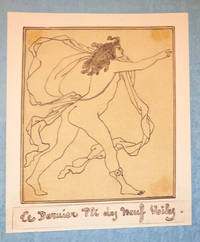
- s.d. (ca 1920), 620 ff. sous trois chemises de 25x33cm, en feuilles sous chemises. - Unpublished autograph manuscript of Le Dernier Pli des neuf voiles a true poetic testament [1892-1920] | 620 loose leaves under three custom slipcases A priceless poetic testament from Marcel Proust's mentor, hidden away and out of sight since the death of the author. The set of largely unpublished autograph poems by Robert de Montesquiou-Fezensac is brought together by the Count in a collection entitled Le Dernier Pli des neuf voiles, whose composition extends from his very first collection (Les Chauves-Souris, 1892) to his last trilogy (Offrandes, 1915). Set of 620 autograph leaves. 532 unpublished, first draught, handwritten on the recto and numbered in pencil, preserved in 3 chemises in half red contemporary morocco, red morocco labels with gilt author and title; the poems are then placed in the chemises with a handwritten title and a number for publication. According to a note from the author, "the differences in ink have no meaning, mere change of copy". Rare pages from the hand of his secretary Henri Pinard: p. 20 of "Huitième voile" and p. 29 of "Neuvième voile". 23 pages present the printed or typewritten texts of the poems and are enriched with Montesquiou's handwritten corrections. A set of printed proofs are found at the top of the first chemise, as well as a pencil tracing after Aubrey Beardsley drawn by the author and accompanied by his handwritten indications. Sublime ode to dandyism, to homosexuality and beauty, this worldly and poetic promenade by Montesquiou embarks the reader into the decadent, fin-de-siècle Paris described in In Search of Lost Time by his friend Marcel Proust. Imbued with his legendary enthusiasm for pictorial, decorative, theatrical and floral art, the collection also delivers hundreds of mournful verses after the disappearance of Montesquiou's lover Gabriel Yturri. Thanks to this collection of poems by Robert de Montesquiou-Fezensac, all of which had been lost since 1986, it is now possible to complete the rehabilitation of the aristocratic poet who has long embodied and shaped the Parisian spirit. In May 1920, Montesquiou left handwritten instructions for the posthumous publication of the collection, initially announced in two volumes, and never produced. On his death a year later, the poems were bequeathed to his secretary Henri Pinard, who in turn sold them on an unknown date. Auctioned on 24 November 1986, they were mentioned in the LoWire-Littérature colloquium in 1989. This considerable manuscript by Montesquiou forms a veritable "home of poetry" like his famous aesthetic apartments described by Huysmans. The series of Voiles contain dozens of unpublished poems written in parallel with his previous collections. The author himself indicated the kinship of each "voile" with a published set of poems, announcing here the total completion of his work by the addition of poems which still lay dormant in his papers. The three thick chemises contain rare and curious treasures, sometimes drawn on colored sheets, often pasted on larger sheets, rigorously ordered while awaiting their publication. The poems are written without crossings-out, they are fluid, with rounded and precious handwriting, and stand alongside other first-draught manuscripts: redactions and corrections also bear witness to the work in progress on the new poems; they were applied in the printed proofs of the work, present at the top of the manuscript's first chemise. Some poems are taken as they are from collections already published but are slightly modified, according to the explanations given by the author. Montesquiou also adds some handwritten notes detailing his intentions. The manuscript contains a poetic anthology of sacred art, of extremely rare flowers and of antique furniture adorning his famous Parisian apartments "around which so many legends were built" (Jacques Saint-Cère) which fuelled the personalities o
1920759331920. Fine. A priceless poetic testament from Marcel Proust's mentor hidden away and out of sight since the death of the author. s. d. ca 1920 25 x 33 cm en feuilles sous chemises The set of largely unpublished autograph poems by Robert de Montesquiou-Fezensac is brought together by the Count in a collection entitled Le Dernier Pli des neuf voiles whose composition extends from his very first collection Les Chauves-Souris 1892 to his last trilogy Offrandes 1915. Set of 620 autograph leaves. 532 unpublished first draught handwritten on the recto and numbered in pencil preserved in 3 chemises in half red contemporary morocco red morocco labels with gilt author and title; the poems are then placed in the chemises with a handwritten title and a number for publication. According to a note from the author the differences in ink have no meaning mere change of copy. Rare pages from the hand of his secretary Henri Pinard: p. 20 of Huitième voile and p. 29 of Neuvième voile. 23 pages present the printed or typewritten texts of the poems and are enriched with Montesquiou's handwritten corrections. A set of printed proofs are found at the top of the first chemise as well as a pencil tracing after Aubrey Beardsley drawn by the author and accompanied by his handwritten indications. Sublime ode to dandyism to homosexuality and beauty this worldly and poetic promenade by Montesquiou embarks the reader into the decadent fin-de-siècle Paris described in In Search of Lost Time by his friend Marcel Proust. Imbued with his legendary enthusiasm for pictorial decorative theatrical and floral art the collection also delivers hundreds of mournful verses after the disappearance of Montesquiou's lover Gabriel Yturri. Thanks to this collection of poems by Robert de Montesquiou-Fezensac all of which had been lost since 1986 it is now possible to complete the rehabilitation of the aristocratic poet who has long embodied and shaped the Parisian spirit. In May 1920 Montesquiou left handwritten instructions for the posthumous publication of the collection initially announced in two volumes and never produced. On his death a year later the poems were bequeathed to his secretary Henri Pinard who in turn sold them on an unknown date. Auctioned on 24 November 1986 they were mentioned in the LoWire-Littérature colloquium in 1989. This considerable manuscript by Montesquiou forms a veritable home of poetry like his famous aesthetic apartments described by Huysmans. The series of Voiles contain dozens of unpublished poems written in parallel with his previous collections. The author himself indicated the kinship of each voile with a published set of poems announcing here the total completion of his work by the addition of poems which still lay dormant in his papers. The three thick chemises contain rare and curious treasures sometimes drawn on colored sheets often pasted on larger sheets rigorously ordered while awaiting their publication. The poems are written without crossings-out they are fluid with rounded and precious handwriting and stand alongside other first-draught manuscripts: redactions and corrections also bear witness to the work in progress on the new poems; they were applied in the printed proofs of the work present at the top of the manuscript's first chemise. Some poems are taken as they are from collections already published but are slightly modified according to the explanations given by the author. Montesquiou also adds some handwritten notes detailing his intentions. The manuscript contains a poetic anthology of sacred art of extremely rare flowers and of antique furniture adorning his famous Parisian apartments around which so many legends were built Jacques Saint-Cère which fuelled the personalities of Des Esseintes Baron Charlus Dorian Gray and the vain peacock in Edmond Rostand's Chantecler. Moreover Montesquiou was overwhelmed by the features of these famous fictional ghosts of w unknown
- S.n. , s.l. [1810-1812], in-8 (18,5x23,5cm), (1f.) 2 f. découpés (78f.), broché. - La Fête de l'amitié. Unique complete autograph manuscript [The Friendship's Party] [Charenton asylum] n. d. [ca. 1810-1812], in-8: 18,5 x 23,5 cm , (1 f.) 2 f shaved (78 f.), original wrappers The complete original manuscript of the last play by the Marquis de Sade, ruled in red throughout, comprising 78 leaves of 12 lines written recto and verso. This manuscript, like the other extant items from the Marquis, was dictated to a scribe and corrected by Sade himself. Two pages at the beginning of the notebook were excised before the text was written. Contemporary pink paper wrappers, a few lacks to head and foot of spine. Ink title to upper cover "5/ La Fête de l'amitié" including a prologue and a vaudeville sketch entitled Hommage à la reconnaissance, these forming two acts of mixed prose, verse, and vaudeville. This title is incorrect, as shown by the first page, on which the following title appears: "La Fête de l'amitié. Prologue. Encadrant l'Hommage à la reconnaissance. Vaudeville en un acte." Manuscript note by the Marquis to verso of upper cover, indicating the position he intended this work to occupy within his oeuvre. Several manuscript corrections, annotations and deletions in Sade's hand, including a quote from his own work as prelude to the vaudeville: "On est des dieux l'image la belle quand on travaille au bonheur des humains. Hommage à la reconnaissance. [We are in the finest image of the gods when we work for the good of humanity. Homage to recognition.]" "This piece, written by the Marquis in honor of the director of the Charenton Asylum, M. de Coulmiers, was played in the Charenton theatre between 1810 and 1812, approximately a year before the total ban on the plays there was introduced on the 6 May 1813. This late work is the only play of Sade's entire theatrical output at Charenton that has come down to us." The play is historic testimony of Sade's genuine respect - despite the inevitable tensions - for the director of his final home, whom the play lauds under the transparently anagrammatic name of Meilcour. But La Fête de l'amitié is also, by its very subject, a precious source of information on the progress of psychiatric medicine, just freeing itself from its repressive accoutrements in favor of new therapeutic methods, like the drama productions to which Sade contributed heavily and to which he here pays singular homage. The piece is particularly Sadean in its approach of casting madness not in the negative form of an illness, but quite the opposite, through the character of the benevolent God Momus, the focal point in this atypical vaudeville. Essentially, though the feast the play describes is a celebration in honor of the director of an asylum similar to Charenton located in ancient Athens, the central figure is the god of insanity himself, whose presence completely upends the relationship between the sane and the sick - much like with the players in the production itself, in which you couldn't distinguish the professional actors from the inmates of the asylum. The whole production, including both song and dance, is made up of two plays - a prologue/epilogue, La Fête de l'amitié, followed by a vaudeville: Hommage à la reconnaissance, played by the same characters as the prologue. The complete production was played at the "festival for the Director." Each dramatic layer is an allegorical variant on the real situation and there's no doubt that the actors, as they got deeper and deeper into the piece, were still playing their own parts. The work of a polished writer in full control of his subject and all the various dramatic and narrative tools, this seemingly frothy piece - by virtue of belonging to the literary genre of homage, which is very conventional and strictly codified - nonetheless contains the subversive elements so dear to the Marquis. And it's also a man who has suffered the regular confiscation and destructio
Zusammen 19 SS. auf 12 Bll. bzw. 1½ SS. auf 1 Bl. 4to. Mit 7 nicht hinzugehörigen eh. adr. Kuverts. 2 Briefe mit Holzschnittvignette. Selten inhaltsreiche Korrespondenz mit dem Arzt und Sammler Wilhelm Mayer und Gattin über seine Arbeiten, die er in Auswahl übersendet (22. XI. 1917), seine Einzelausstellung in der Galerie Neue Kunst Hans Goltz (23. II. und 27. IV. 1918), sein Klavierspiel und die Leidenschaft für Dostojewksi ("Das ist keine 'Literatur': Mit ihm 'liebt' man die Menschheit; man versteht die armen, verwirrten Geschöpfe, und erfasst sie in ihrem Elend, oder in ihrem wundervollen Heldentum", 18. V. 1918), seine im Krieg verdächtige amerikanische Staatsbürgerschaft (23. II. 1918), die künstlerischen Versuche seines Sohnes, "die ich auf (pardon!) Closettpapier drucke" (10. V. 1918) und schließlich die Niederlage Deutschlands: "Es ist schwer, jawohl! Es ist tragisch, was jetzt mit Deutschland geschieht. Nicht, dass es, nach vier Jahren unerhörten Ringens sich endlich, gegenüber der Welt die sich gegen es zusammengetan hatte, als besiegt beugen musste. Nein! Aber, dass es, nach dieser grossen, heldenhaften Geste, dieser heroenhaften Demütigung, sich keinem edlen Feinde gegenüber befindet. Sie haben Deutschland in diesen Krieg hineingelockt mit mörderischem, vernichtendem Vorsatze, und sie bleiben Mörder und und [sic] rachsüchtige Wilde, ohne Barmherzigkeit, Ritterlichkeit oder überhaupt blosser Menschlichkeit: es sind Tobsüchtige, die die empfangenen Schläge, die sie so lange erhielten, nicht als verdient, als bewundernswerte Abwehr eines mächtigen und edlen Gegners, hinzunehmen wussten. Es ist erschütternd, dieses mächtige deutsche Volk vergeblich um Schluss des Mordens flehen zu sehen. Wer ist denn da, der es versteht? Als Antwort erhält es, von Schulmeistern und Rechtsanwälten, die völlig verständnisslos jedem kriegerischen Tun gegenüberstehen (und sie mögen noch so ehrlichen Willen zum Frieden und zur Versöhnung besitzen) und nur die Kriegshärte des Gegners erblicken können, die für sie dann 'Unmenschlichkeit' heisst, eine Antwort, die überhaupt nichts zur grossen Sache tut, die eine übelste 'Moralpredigt' und eine unerhörte Verunglimpfung eines Heldenvolkes darstellt! War jemals eine unerhörtere Lage, als diese, in der Deutschland jetzt steht? Die heutige Antwort auf die Unterwerfung Deutschlands ist eine Schmach. Und, zudem, scheinen sie dort doch machtlos, dem Greuel ein Ende zu bereiten! Wohin soll sich dieses Land wenden? Es pendelt zwischen Dilettanten und Irren [...]" (16. X. 1918).
Various formats. Altogether 14 pp. Some minor wearing to the letters after being folded. Together with the calling card of Mengelberg, inscribed on reverse by him "Edvard Munch Kragerö in Norwegen". 7 items. To the German businessman and art collector Richard Mengelberg. 2 letters dated Kristiania (Oslo, undated and 10 June 1897), 2 dated Paris 10 January and 17 March 1897. The postcards dated Kristiania (Oslo) 29 July 1894 and undated but poststamped Oslo 24 May 1926. - Letter 1 (undated) deals with family matters and that everyone misses him. Munch adds that he regrets having been unable to paint Mengelberg's feverish dreams while in Stockholm. - Letter 2 (10 June 1897): Munch writes he wanted to send birthday greetings, but when he left Hamburg he was without money, unable even to afford a postcard. He has sent a lithograph, mentions that Hamsun and Ibsen just passed by his window, and adds he wishes to travel to Paris in the spring. - Letter 3 (10 Jan. 1897): mentions the artist Paul Durand-Ruel, stating that all he exhibits is not symbolic. He also plans to publish an album of lithographs, provided he managed to find more subscribers. - Letter 4 (17 March 1897): some chat on the spring; mentions an exhibition in Dresden. - Postcards: complaints that Mengelberg is a poor correspondent. - Richard Mengelberg (1853-1932) wrote, in 1894, an article on Munch's works for the Frankfurter Zeitung. He was father of Nora Mengelberg, whose portrait Munch painted in 1894. He also made an etching of Richard Mengelberg the same year, his first work as an graphic artist.
4to. 3 pp. on bifolium. With autograph address. In French. Beautiful juvenile letter to his half-brother Alphonse, thanking him for a "beautiful edition of Juvenal" and promising to study so as to achieve good grades. Baudelaire, then a 12-year-old schoolboy at the Collège Royal de Lyon, had received gifts and awards for his good performance, although he must "shamefully admit" that he "obtained these advantages without much effort". Therefore, he promises to improve: "this year I want to cram heavily so that if I do not succeed, I shall have nothing for which to blame myself". He describes the excitement of receiving the awards and gifts that motivated him: "It is really nice to hear your name proclaimed for an award, to which you add this sentence 7 times nominated! Nominated in all subjects! And then it's your mother or father who crowns you! [...] With these prizes, one accumulates book after book, and then the gifts of the parents and then those of the brother too. Because they are beautiful". Finally, he explains with the help of three sketches the gift of a phenakistiscope that he had received from his stepfather Jacques Aupick: "This word is as strange as the invention. [...] It is a cardboard box in which there is a small mirror that is placed on a table between two candles. There is also a handle to which a cardboard circle with small holes all around is adapted. On top of it we add another cardboard drawing, the drawing turned towards the mirror. Then one makes turn, and one looks by the small holes in the mirror where one sees very pretty drawings". The phenakistiscope was the first widespread animation device that created a fluent illusion of motion. It was invented in 1832, only one year before the young Charles Baudelaire received this novelty from his stepfather. - A fascinating letter that provides a valuable insight into Baudelaire's childhood. Good grades without much effort is a fitting summary of his school career. While his high intelligence and intellectual precociousness were obvious, he was also erratic in his studies and was often scolded for idleness. - Traces of folds. With a tear from breaking the seal and minor tears to the folds but no text loss. Some browning and somewhat creased overall. Published in: Correspondance (Pléiade), vol. I, p. 21; Exposition Baudelaire, Petit Palais 1968 (no. 37).