66 618 résultats
Albumen print, ca. 115 x 85 mm, under brown cardboard matte (17 x 13 cm). A very rare example of a signed Lenin portrait. Dated in his own hand "26/V 1920" and signed in French as "Vladimir Oulianoff". Additional signature of the photographer, Moses Solomonovitch Nappelbaum (1869-1958), in pencil in the lower right corner of the cardboard matte. Nappelbaum shot the famous portrait at the Smolny Institute in St Petersburg in 1918. The present print shows typical graphic retouching by the artist to the background and lapel areas. A near-identical print, inscribed by Lenin on 15 April 1920, is in the Corrêa do Lago collection (Magia del Manoscritto catalogue, p. 206). - By tradition, this photograph was presented by Lenin to the English socialist politician George Lansbury (1859-1940), who had visited the Soviet Union in early 1920 and hat met the leader of the Revolution in Moscow on 22 February. Later that same year, Lansbury published a widely received account of his journey, "What I Saw in Russia", in which he gave a highly flattering portrayal of Lenin. - Occasional insignificant scuffs; dark areas show some silver mirroring due to the oxidative-reductive process. Nappelbaum's signature is rather faded, while that of Lenin remains stark and well-defined. - Provenance: Swiss private collection; accompanied by a description from Diana J. Rendell, Inc., Massachusetts.
8vo. 1 p. bifolium with integral address leaf. Unpublished, early letter in French, Marx's only known missive to the Belgian journalist and politician Lucien-Léopold Jottrand (1804-77), who during the Belgian Revolution of 1830 had designed what would become the national flag of Belgium: "J’ai l’honneur de vous faire parvenir l’original de mon petit discours inséré au Northern Star. Je me fais un Plaisir d’y ajouter un exemplaire de mon livre contre M. Proudhon [...]". Five days previously, at a Brussels "Workers' Banquet" led by Engels and Jottrand, it had been decided to found a "Democratic Association", and Engels was elected to its organising committee. Engels had warned Jottrand that he might have to leave Belgium and thus would be unable to serve; his suggested replacement was Marx. Indeed, on the 30th of September, Engels officially wrote to Jottrand that circumstances would require his absence: "I therefore request you to call on a German democrat resident in Brussels to participate in the work of the committee charged with organising a universal democratic society. I would take the liberty of proposing to you one of the German democrats in Brussels whom the meeting, had he been able to attend it, would have nominated for the office which, in his absence, it honoured me by conferring upon myself. I mean Mr Marx, who, I am firmly convinced, has the best claim to represent German democracy on the committee. Hence it would not be Mr Marx who would be replacing me there, but rather I who, at the meeting, replaced Mr Marx [...]" (cf. MEGA III.2, p. 110). On the same day, he advised Marx of the content of his letter to Jottrand, adding: "I had in fact already agreed with Jottrand that I would advise him in writing of my departure and propose you for the committee. Jottrand is also away and will be back in a fortnight. If, as I believe, nothing comes of the whole affair, it will be Heilberg’s proposal that falls through; if something does come of it, then it will be we who have brought the thing about. Either way we have succeeded in getting you and, after you, myself, recognised as representatives of the German democrats in Brussels, besides the whole plot having been brought to a dreadfully ignominious end" (cf. p. 105). Under the influence of Marx, the Brussels Democratic Association would soon become one of the principal hubs of the international democratic movement, and the present letter constitutes Marx's formal introduction to its president, Jottrand. Notably, Marx included with his letter the manuscript of a piece he had written for Engels's "Northern Star" as well as his recently published "Poverty of Philosophy", an attack on Proudon’s "Philosophy of Poverty" and a pivotal work in Marx’s thinking. Here, Marx memorably described his opponent as "petit bourgeois" - an epithet which resounded in all later Communist literature. Marx’s book paved the way for the Communist Manifesto, written between December 1847 and January 1848. - Marx dated the letter "2 octobre" from his Brussels address in the rue d’Orléans; the letter is erroneously docketed "1848" in another hand. Vertical and horizontal folds, but well-preserved. Not in MEGA III.2 (Letters May 1846-Dec. 1848); for Jottrand cf. p. 1176.
8vo. 1 page. To an unnamed addressee, probably Juste Vernouillet, director of the publishing house Lachâtre & Co.: "M. Roy ayant priè M. Lachâtre de lui faire donner 300 f. à la fin de ce mois. M. Lachâtre a demandé que je donne mon autorization. J'écris donc aujourdhui à vous et à M. L. pour vous autorizer à payer immédiatement cette somme à M. Roy. Je vois de la lettre de M. Roy qu'il n'a pas encore reçu un seul fascicle imprimé. C'est presque incroyable! Certainement, ce n'était pas là une manière d'activer son travail ou de le mettre à même de changer son mode de traduction [...]" ("M. Roy has asked M. Lachâtre to give him 300 f. by the end of this month. M. Lachâtre has asked me to give my authorisation. Therefore, I write to you and to M. L. today to authorise you to pay M. Roy this sum immediately. From M. Roy's letter I see that he has not received a single printed fascicle. That is almost unbelievable! Surely, this was not a means to prompt his work or to even make him change his mode of translation [...]"). - With old inventory note. Not in: Marx/Engels, Werke vol. 33 (Briefe Juli 1870 - Dezember 1874).
Oblong folio (353 x 270 mm). Full score for orchestra. Manuscript in black ink on 20-stave paper by "D. T. Éditeur, Paris", mainly on one system per page. 12 pp. on 3 bifolia (only ff. 2-3 still conjoined), lacking one bifolium after f. 5 (portions of f. 1 and f. 5 roughly torn off). Extremely rare musical manuscript: the orchestral score for a dance from "The Maid of Orleans". Composed in 1878-79, with a libretto by the composer, Tchaikovsky's opera in 4 acts premiered on 25 February 1881 at the Mariinsky Theatre in St Petersburg; in the following year it became the first of Tchaikovsky's operas to be performed outside Russia, with a production in Prague opening on 28 July. - The part in this manuscript belongs to Act II, nearing the central moment of the opera when Joan of Arc's victory is announced: at the Château de Chinon, King Charles VII, absorbed in his worries, seeks to distract himself by listening to the minstrels, and three dances follow one another: "Dance of the Gypsies" (Allegro vivace), "Dance of the Pages and Dwarves" (Allegro moderato), and finally the present "Dance of the Buffoons" (Allegro molto). - Though lacking a bifolium (bars 173-233), the manuscript is otherwise complete in orchestration and includes a number of revisions by the composer. An elegant copy, the manuscript nevertheless shows some haste in writing, with corrections to the text, a whole bar crossed through, and other corrections (with a slightly thicker pen nib) probably made on checking through. The text offers a number of minor variants from the received printed score, chiefly relating to dynamics and slurrings. - The manuscript's dating poses a puzzle: Tchaikovsky was working on the libretto from about 21 November to 3 December, though in a letter to Mme. von Meck he indicated he did not intend to begin composition until after he had finished work on the orchestral Suite no. 1, whose last two movements he completed on 27 November (the same day as the present manuscript). In the event he did not begin work on the composition until 4 December, according to a letter to his brother Anatoli of the following day; at the end of the opera's autograph he writes that it was begun in Florence on 23 December. The present manuscript therefore precedes the accepted dates for the beginning of composition: its finished condition, and the fact that the "Dance of the Buffoons" would not represent the most obvious starting point for the opera, may mean that it originally formed part of a separate composition, and the coincidence of dates hints at some association with the Suite no. 1 itself. Tchaikovsky had left home late in 1878 for a trip to Florence and Paris, arriving in Florence on 20 November. - Provenance: The editors of the Thematic and Bibliographical Catalogue of P. I. Tchaikovsky's Works refer to the composer's "rather careless attitude towards his own manuscripts [...] Many of them were handed to various people and were later partly lost". The present manuscript, of a movement which was subsequently incorporated into a larger work, would have been a suitable candidate for presentation. It was most likely acquired from the composer, or shortly afterwards, by a cousin of Anton and Nikolai Rubinstein, Aaron Rubinstein (b. 1850); at some subsequent stage ownership stamps appear to have been roughly removed from the first and fifth leaves. Sold at Christie's London for Aaron Rubinstein's descendants on 3 June 2009 (lot 41: £97,250). - Musical manuscripts by Tchaikovsky are extremely rare on the market: prior to the appearance of this manuscript at Christie's more than a decade ago, only a single leaf had been offered for sale in the preceding 30 years, and no substantial manuscript had appeared since before the war. Since then, a 16-leaf working manuscript comprising score drafts of several movements of the orchestral Suite no. 2 was sold at Sotheby's in 2015, commanding £270,000.
Oblong 4to (287 x 228 mm). 1 page, meticulously notated in 38 bars on five systems of two staves. Annotated in a 19th-century hand "copié par Chopin", loosely matted. Stored in a custom-made red morocco portfolio with cut signatures of Arthur Rubinstein (1931) and Vladimir Horowitz (1978), famed as interpreters of Chopin's music. Two short piano works inspired by Polish folk music. Kobylanska considers that whilst both works are signed by Chopin, they are too unsophisticated to be his own compositions, and are perhaps transcriptions of Polish folk tunes: "Beide Stücke sind zwar mit Ch signiert, in ihrer ganzen Art jedoch zu primitiv, als daß man sie für eigene Kompositionen Chopins halten könnte. Wir ordnen sie in dieses Kapitel ein, da es sich vielleicht um Übertragungen von polnischen Volksweisen handeln mag." If so, it is fascinating not only to see Chopin in the posture of an ethnomusicologist some sixty or more years before the pioneering research of Bartók and Kodály, but also that the resulting works, notated with his characteristic exquisite neatness, should be granted the imprimatur of his discreet, repeated signature. - Provenance: 1) collection of the actor, director and playwright Sacha Guitry (1885-1957); his sale, Drouot, Paris, 21 November 1974 (lot 15); 2) collection of the Canadian chemist and physician Frederick Lewis Maitland Pattison (1923-2010), with his bookplate on the portfolio's inside front cover. Krystyna Kobylanska, Frédéric Chopin: Thematisch-bibliographisches Werkverzeichnis (1979), VII b (Transkriptionen von Volksweisen), nos. 7 and 8. First published in Jean-Jacques Eigeldinger, "Un autographe musical inédit de Chopin", Schweizerische Musikzeitung / Revue musicale suisse, CXV/1 (Jan.-Feb. 1975), pp. 18-23. F. L. M. Pattison, "A Folk Tune Associated with Chopin and Liszt", Journal of the American Liszt Society 20 (1986), pp. 38-41. J. M. Chominski & T. D. Turlo, Katalog dziel Fryderyka Chopina (1990), p. 240 (Sketches, fragments, exercises): "Folk melodies meticulously recorded on a single sheet".
Folio. 12 pp. on 3 bifolia, numbered 140-142. Numerous corrections, deletions, and insertions. The manuscript discusses cosmogony and the movement of the planets, mentioning the contributions made by Immanuel Kant and especially Laplace, as well as Kepler's Laws, then expanding these considerations to the level of metaphysics. This is the working manuscript for vol. 2, chapter 6 ("Zur Philosophie und Wissenschaft der Natur") of Schopenhauer's collection of philosophical reflections, "Parerga und Paralipomena" ("Appendices and Omissions") - the philosopher's final work, published in 1851. The "Paralipomena" volume, from which this is taken, contains short ruminations arranged by topic under 31 subheadings. In view of the less-than-enthusiastic reception of the philosopher's earlier publications, publishers were reluctant to commit to this work; it was only after significant difficulty (and through the persuasion of the philosopher's disciple Julius Frauenstädt) that Hayn of Berlin consented to publish the two volumes in a print run of 750 copies - with a honorarium of only ten copies for the author. The subject matter and stylistic arrangement of the "Paralipomena" were significant influences on the work of the philosopher and psychologist Paul Ree, and through him most notably on the philosopher Friedrich Nietzsche, whose later work explores - following Schopenhauer - the relation of man to himself, the universe, the state, and women through the art of aphorism. - In the present manuscript, Schopenhauer writes: "The truth of cosmogony, however, is based not only on the space-relationship upon which Laplace insisted, namely, that 45 celestial bodies circle in a uniform direction and at the same time rotate likewise; more firmly still is it rooted in the time-relationship, expressed by the first and third Law of Kepler [...] These thoughts on cosmogony give rise to two metaphysical reflections [...] Even such a far-reaching physical explanation of the world's creation can never satisfy the desire for a metaphysical one, or indeed take its place. On the contrary! The closer one comes to tracking down a phenomenon, the more clearly it appears that it is precisely that: a mere phenomenon, an apparition, and not at all the essence of the thing in itself [...]" (transl.). - The present text begins with the final paragraph of § 85. It corresponds with the printed text in the Sämtliche Werke, ed. by A. Hübscher, vol. 6, p. 142, line 4 up to p. 150, line 19, with the exception of two sections not yet present in this draft (p. 146, lines 11-16, and p. 146, lines 32-page 147, line 7). Most of the parts which Schopenhauer deleted are published in vol. 7, pp. 130-138 and p. 138. - Slight edge damage. Provenance: On loan to the Dresden State Library until 1945; later in a foreign private collection. Sold at Stargardt's auction on Oct. 4, 1989. Schopenhauer manuscripts are of the utmost rarity: auction records since 1975 list only five other autograph manuscripts, only one of which was of comparable length.
8vo (115 x 175 mm). Ink on paper. ½ p. Stored in custom-made red half morocco case. To "Mess. Longmans & Co", in English: "Sirs, The firm of Faesy and Frick (Vienna) have asked me to forward them through you 2 copies of my book 'Misere de la Philosophie'. Please to inform them that the edition is completely exhausted. I have myself in vain tried to get some copies second hand for a correspondent at St. Petersburgh. Yours obediently [...]". - Traces of a vertical and horizontal fold. Well preserved. Not in: Marx/Engels, Werke vol. 34 (Briefe Januar 1875 - Dezember 1880).
Small 8vo. 1 page. In French. Apparently to Juste Vernouillet in Paris, director of the publishing house Lachatre & Co. in the absence of Maurice Lachatre, who was still exiled in San Sebastian, Spain, for his role in the Paris Commune. Marx addresses Vernouillet as "cher citoyen" and sends him the next 31 pages of Joseph Roy's translated manuscript of "Le Capital" (up to p. 472), with his own extensive revisions, for typesetting. He also requests "100 copies of fascicle II, as well as 30 copies of fascicle I, which you will add to my account". - The first livraison of the French edition had appeared in August 1872, the second was delayed until early February 1873. In January 1872, Marx and Lachatre had not even signed their publication contract. Although Marx was not usually prone to misdating letters at the beginning of the year (a lapse more common in Engels's letters), he was at that moment seriously overworked with revising Roy's translation for Lachatre's ongoing publication, and simultaneously completing the revised second German edition for his publisher Otto Meissner in Hamburg. Quite recently he had complained to his correspondent Friedrich Adolph Sorge, "Because of the French translation, which makes me more work than if I had to do it without the translator, I am so overworked that I have not been able to write to you" (21 Dec. 1872), and still a month after the present letter, he wrote to Friedrich Bolte in very similar vein that "the revision of the French translation is causing me more work than if I had done the whole translation myself" (12 February 1873). - Slightly wrinkled and slight edge damage. Recipient's note to upper margin. Not in: Marx/Engels, Werke vol. 33 (Briefe Juli 1870 - Dezember 1874).
Oblong 8vo (17 x 11 cm). An exceedingly rare vintage blue ink signature, in Chinese characters, inscribed to the verso of a printed invitation to a Buffet Party hosted by the China-Latin America Friendship Association at the Xinqiao Fandian (Hotel) on Thursday, 27 October 1960 at 6.30 pm, "in order to kindly see off the cultural friendship delegations of Latin American countries". Chinese text printed in red on off-white paper. Encapsulated. A fine signature obtained during a 1960 Buffet Party in honour of Latin American communists, held at Beijing's Xinqiao Hotel and attended by Mao Zedong. The China-Latin America Friendship Association, who hosted the venue, was established in Beijing earlier that same year, in March 1960, and soon became the general fortress of cultural infiltration into Latin America. The U.S. diplomat Roy R. Rubottom Jr., who served as Assistant Secretary of State for Inter-American Affairs (1957-60), noted that, also in 1960, Mao Zedong appeared to have "gone out of his way" to receive Latin American Communist leaders and to exhort them to give their full backing to the kind of revolution he favoured. The following year, the Xinqiao Hotel would be the site of a major conference hosted by Zhou Enlai, who there encouraged intellectuals and cultural activists to start work again. - Following the end of World War II, the Communist movement was flourishing in Latin America, and as early as 1947 Mao Zedong was prompted to remark that "the Latin American peoples are not the obedient slaves of United States Imperialism". Chairman Mao and the Chinese communists' goal was the defeat of United States Imperialism, and Latin America was regarded as vital to attaining this goal, as it supported Mao Zedong’s theory of the establishment of rural revolutionary base areas. Chinese interest and activities in Latin America increased sharply in the early 1950s (there were believed to be 250,000 card-carrying communists active in the area), and the countries were of considerable interest to the Chinese and viewed as a fertile ground for advancing Communism, not least Red China's own brand of the ideology. - Some very light overall soiling to both sides, barely affecting the signature. An attractive example of one of the rarest and most sought-after autographs of all major political leaders and cultural icons of the 20th century. PSA/DNA certified, authentic autograph 84503553, and encapsulated. LOA certification number AF07300.
8vo. ½ page on laid paper, torn from a notebook, watermark "Joyn[son] Super[fine]". Measures 181:114 mm. Unpublished letter to the Chartist and radical freethinker Collet Dobson Collet (1812-98), in English: "My dear Sir, On my return from the seaside I found your letter d.d. 23 September. You will much oblige me by being so kind as to forward me some of the copies of the 'Revelations', as I have none left. Yours very truly [...]". - In very good condition, with intersecting folds, moderate wrinkling and a few creases; the sheet is bright, the writing dark, precise, and easily legible in spite of Marx's distinctively minute hand. - Marx was a close friend of the Collet family, which included the pioneering feminist activist Sophia Dobson Collet, social reformer Clara Collet, and the recipient of this letter, the editor of "The Free Press: A Diplomatic Review", to which Marx contributed a number of articles. The men became good friends and soon held weekly meetings at each other's houses to recite Shakespeare. The assembled group, which was formally coined as the Dogberry Club, included Marx's daughter Eleanor and Collet's daughter Clara, as well as Edward Rose, Dollie Radford, Sir Henry Juta, and Friedrich Engels. The publication to which Marx alludes, "Revelations of the Diplomatic History of the 18th Century", was originally serialized in the "Free Press" from August 1856 to April 1857. Not in: Marx/Engels, Werke vol. 34 (Briefe Januar 1875 - Dezember 1880).
8vo. 2 ff. on 2 pp. In red crayon. In Russian, to his nine-year-old daughter Svetlana: "Hello, little lady of the house! I am sending you pomegranates, tangerines, and candied fruit. Eat - and enjoy, my little lady of the house. There's nothing for Vasja because he is still doing poorly at school and keeps making empty promises. Explain to him that I do not trust long-winded promises and shall believe him only when he really applies himself and delivers a performance that can be called at least middle-rate. I report, dear lady of the house, that I spent a day in Tbilisi. I was visiting [my] mother and said many greetings from you and from Vasja. She is tolerably well and sends you many kisses. That's all for now. Kisses. I shall be seeing you soon. / Secretary to Svetlana - poor paterfamilias, J. Stalin". Svetlana Iosifovna (Stalina) Alliluyeva, born in Moscow in 1926, died in Richland Center, Wisconsin, USA, in 2011. - Traces of horizontal folds; very well preserved. Includes: portrait photograph of Stalin (vintage). Probably Moscow, ca. 1935. Albumen print, 209 x 269 mm, mounted on backing cardboard (298 x 400 mm). A large head-and-shoulders portrait, likely taken shortly before the beginning of the Great Purges. With a few unobtrusive scuff marks; backing cardboard smudged and stained. Russian lab label on reverse: "Foto-Laboratorija, U.P.P. Leningradskogo Otdelenija, Muzfonda SSSR, Leningrad. Lenoblgorlit No. 1094". Rare.
Oblong 12mo (ca. 98 x 52 mm). 1 p., with a similar receipt for another legacy with 4 additional signatures on verso. Evenly browned, a little stained, edges a little chipped. Decoratively framed and glazed with a brass plaque and an engraved portrait (light chipping to gilt frame). Signature by Johann Sebastian Bach, confirming in his own hand the receipt of 2 guilders ("acc[epi] - 2 fl.") from the Lobwasser Bequest. The sum was paid out around every 2nd of July to the cantor, deputy headmaster, and third teacher (tertius) at St. Thomas. Above and below Bach's signature, his colleagues Conrad Benedict Hülse and Abraham Kriegel sign for their 2 guilders. - One of Bach's several supplementary sources of income which together made up a substantial part of his Leipzig salary, this payment would in the mid-18th century have corresponded roughly to an organist's weekly wages. The "Legatum Lobwasserianum", a legacy of 1000 guilders, was bequeathed in 1610 by a Leipzig lawyer's pious widow, Maria Lobwasser; the 50 guilders of annual interest, paid on the Feast of the Visitation, went toward supporting St Thomas's church and school personnel. - This is one of only two known receipts from Bach receiving his Lobwasser funds. The other, from 1750, was originally written on the same sheet of paper underneath the entry for 1748, but the two records were later cut apart and separated. Curiously, the relevant entry for 1749 must have been made in another, now lost document, as a date "1749" and Hülse's stricken-out signature, apparently made here in error, appear at the bottom of the present slip of paper (formerly between the 1748 and 1750 records). The small 8vo leaf, removed from a receipt book, was complete in 1908 when it was offered at C. G. Boerner's sale of "precious autographs from a Viennese private collection" (lot 3). The buyer was probably the noted Swiss collector Karl Geigy-Hagenbach, in whose "album of manuscripts by illustrious personages", published in 1925, it was again illustrated intact. The receipt's location was subsequently unknown until, in May 1986, the present upper half of the sheet appeared at Christie's manuscripts sale (lot 271). It was likely acquired there by the Canadian chemist and physician Frederick Lewis Maitland Pattison (1923-2010) and subsequently sold by the New York dealer Kenneth W. Rendell (his description pasted on the reverse of the frame) to the Musée des Lettres et Manuscrits, Paris; acquired from their sale. - In December 2014, the lower half (bearing the receipt for 1750, signed by Bach's son Johann Christian in the place of the blind and dying composer) appeared at Swann's in New York, described as having previously been in the collection of the Polish harpsichordist Wanda Landowska (1879-1959), and was bought by the Bach-Archiv in Leipzig. C. G. Boerner, auction catalogue XCII (Leipzig, 8 & 9 May 1908), lot 3. K. Geigy-Hagenbach, Album von Handschriften berühmter Persönlichkeiten vom Mittelalter bis zur Neuzeit (Basel 1925), p. 243. H.-J. Schulze, Marginalien zu einigen Bach-Dokumenten, Bach Jahrbuch (1961), pp. 79-99, here at p. 93. Bach-Dokumente, Krit. Gesamtausgabe (ed. W. Neumann & H.-J. Schulze), vol. 1 (1963), p. 207, no. 137.
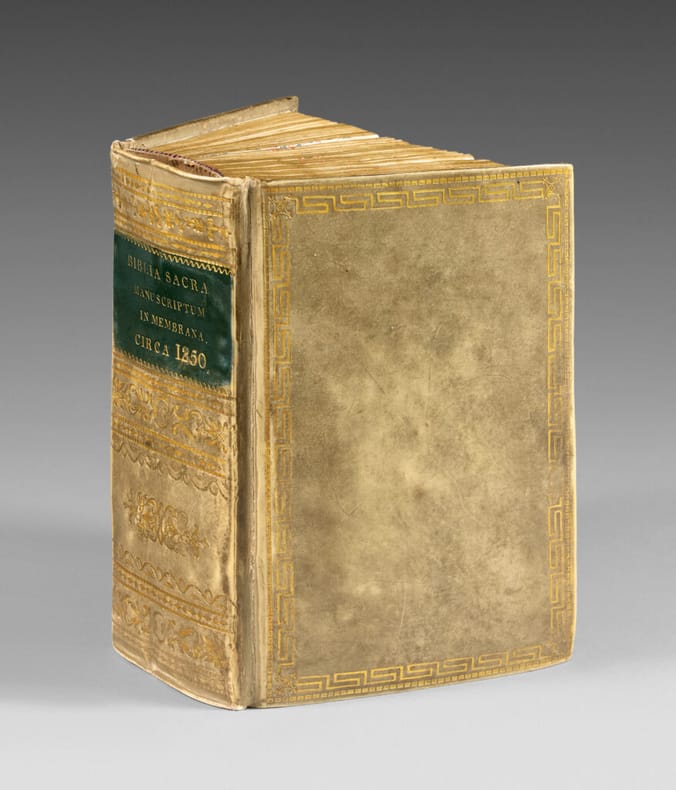
LCS-18358Un chef-d’œuvre de l’enluminure capétienne orné de 78 miniatures d’une finesse exquise réalisé sous le règne de Saint Louis. Bible en latin, avec le Prologue attribué à St Jérôme et l’interprétation des noms hébreux. Nord de la France, probablement Paris, 1230-1250. In-12 de 1 + 658 ff.: 1-1524, 1620, 17-2224, 2310, 24-2524, 2617 (sans le f. blanc xviii), 2726, 2828, 295 (sans le f. blanc vi). Ainsi complet. Double colonne de 47 lignes écrites à l’encre brune dans une très fine écriture gothique. Justification: 92 x 60 mm. 78 initiales historiées. Cahiers numérotés en chiffres romains au pied des versos des derniers ff. et signatures au pied du coin inférieur du texte sur chaque recto de la première moitié d’un cahier, rubriques en rouge, initiales en rouge, lettres des titres courants et numéros des chapitres alternativement en rouge ou bleu, initiales des chapitres sur 2 lignes alternativement en rouge ou bleu avec un décor de la couleur opposée, initiales de 5 à 7 lignes au début des prologues du même type mais avec des décors des deux couleurs ouvrant les prologues, 78 initiales historiées, la plupart ornées de feuillage et de dragons, le prolongement de 29 d’entre elles formant des bordures décorant la marge, peintes en bleu, rose, orange-rouge et jaune (qq. trous de vers ds. le premier f., atteinte à qq. titres courants, dernier f. restauré ds. la marge extérieure). Vélin rigide du XIXe siècle, encadrement d’une roulette grecque dorée autour des plats, dos lisse orné, pièce de titre de maroquin vert, tranches dorées. 140 x 93 mm.
1) Manuskripte und Typoskripte. Zusammen ca. 3715 Bll. - 2) Korrespondenzen. Ca. 27.244 Bll. - 3) Lebenszeugnisse. N. a. - 4) Fotografien und Fotonegative. Ca. 5000 Stück. Der hier vorliegende Nachlass umfasst nicht nur die gesamte eigene Lebensspanne von "Fräulein Gusti Adler" - eine Anrede, auf die sie stets höchsten Wert legte -, sondern reicht in noch tiefere Vergangenheit, nämlich in die Jugend ihrer Eltern und Großeltern. Schon durch seinen beeindruckenden Umfang - allein schon die über Jahrzehnte hinweg mit Helene Thimig geführte Korrespondenz umfasst etwa 1040 Schreiben - dokumentiert er die mannigfaltigen und weitreichenden Interessen, die sich von eigener literarischer Arbeit und Übersetzungstätigkeit über Malerei, Theater und Film bis hin zu Reisen erstrecken. Adlers akribischer Sammelleidenschaft sei es gedankt, dass wir nicht nur mit Reisetagebüchern, -notizen und -erinnerungen, sondern auch durch eigene Anschauung mit Hilfe von unzähligen Fotos ins Italien der 1890er bis 1970er Jahre, durch die Bergwelt Mitteleuropas der 1910er Jahre, durch das Europa vor dem Zweiten Weltkrieg, durch Guatemala, Mexiko, Hollywood, San Francisco und New York in den 1950er Jahren, nach Italien und in die Türkei der 1960er Jahre und schließlich ins Venedig der 1970er Jahre reisen können. - In Briefen, Tagebüchern und Aufzeichnungen, Notiz- und Adressbüchern werden nicht nur die frühen ersten Jahre in Salzburg, d. h. der Salzburger Festspiele, wieder lebendig ("sehr interessante Briefe v. mir über 1. Salzburger Zeit (Bahr, Zweig, Faistauer etc.)", so ihre Beschriftung auf einem Umschlag), sondern auch die Jahre vor und nach der Emigration, zumal nicht nur sie selbst, sondern auch ihre im weiteren Sinne engste Familie emigrierte: neben Mutter und Schwester auch Max Reinhardt, Helene Thimig und zahlreiche andere aus Reinhardts Umfeld; ein Brieftyposkript, das "für Marianne … geschrieben" wurde, und Reisetagebücher erzählen von dieser "Reise nach Amerika". - "Workshop-Notizen" beleuchten weiters die Jahre von 1939 bis 1941, in denen Adler weiter für Reinhardt und für dessen Workshop of Stage, Screen and Radio tätig war. Korrespondenzen, Briefentwürfe, Notizen, aber auch Photos, Zeitungsausschnitte, Filmmagazine und nicht zuletzt ihr Firmenausweis geben Auskunft über die beinahe vier Jahrzehnte lange Tätigkeit für Warner Bros. und runden ein bewegtes Leben ab, das in den Hauptstädten zweier Monarchien begann, mit Max Reinhardt über viele europäische Bühnen führte und schließlich in den Hollywood Hills sein Ende fand. - Gusti Adler, 1890 in Brixen geboren, war die Tochter der Malerin Maria Adler und des Gutsbesitzers und späteren Journalisten Heinrich Adler, dem Bruder von Victor Adler, des Begründers der Sozialdemokratischen Arbeiterpartei; ihre Schwester war die Künstlerin und Restauratorin Marianne Adler. Nach einer Ausbildung zur Bildhauerin bei Richard Kaufungen in Wien wechselte sie zu Malerei und Kunsthandwerk über und schrieb seit 1913 Artikel für das Feuilleton des "Wiener Fremdenblatts". Nach ihrer Übersiedlung nach Berlin schrieb sie unter dem Pseudonym Christoph Brandt für Wiener und Berliner Zeitungen und gab Schriften von Jean Paul und Georg Forster heraus. - Durch Vermittlung ihrer Jugendfreundin Helene Thimig lernte sie 1919 Max Reinhardt kennen und wurde wenig später für zwei Jahrzehnte dessen Privatsekretärin und, mehr noch, dessen rechte Hand, die nebst vielen privaten Dingen für Reinhardt auch einen Großteil von dessen Inszenierungen organisierte, vor allem bei den Salzburger Festspielen. - 1939 folgte sie Reinhardt in die USA und arbeitete an dessen "Workshop for Stage, Screen and Radio" mit. Nach Reinhardts Tod im Oktober 1943 arbeitete sie bis zu ihrem 80. Lebensjahr in der Dokumentationsabteilung von Warner Bros. in Hollywood. - 1946 erschien ihr Buch "Max Reinhardt - Sein Leben", 1980 folgte "… aber vergessen Sie nicht die chinesischen Nachtigallen". Gusti Adler verstarb 1985 in Hollywood.
340 pencil drawings, drawn by Alfred Hitchcock, one drawing highlighted in blue, each sheet with three boxes (or cells) with 3 pencil sketches, 46 cells are left blank and 22 drawings were crossed out. Numbering in the left-hand margin in pencil and red crayon (1-152, 240-293, plus 8 leaves numbered in Roman numerals at the end for the final scenes: pursuit in the theatre; decapitation by the theatre's security curtain and final scene), autograph annotations, directions and revisions throughout, one or two "camera angle" diagrams sketched out on left-hand pages. In all 130 loose sheets (208 x 262 mm), in pencil, mostly only recto, but three leaves are drawn also on verso. Sketch of a profile behind scenes 103 and 104; sketch of a stage setting behind scenes 98 A, 98 B and 99. Original black cloth folder-binder, blindstamped with paper label on the front cover and inscription "J. Martin" in faded red ink and "Stage Fright / R. Todd / M. Dietrich / M. Wilding" in blue ink. Preserved in a fitted case. Extraordinary autograph pre-production storyboard for Hitchcock's 1950 film "Stage Fright", comprising preparatory sketches for some three quarters of the film, including the infamous "false flashback" initial sequence, the rest of the first half of the film, the garden party scene and the finale. A rare collection of sketches and comments detailing how the legendary director crafted his scenes. - "Stage Fright" is a 1950 British noir thriller directed and produced by Alfred Hitchcock and starring Jane Wyman, Marlene Dietrich, Michael Wilding, and Richard Todd. The film was shot in London and Elstree in 1949, on a brief sojourn from California where Hitchcock had been working since 1940, and in some ways it was a return to the style (and humour) of his earlier British films. The crime thriller, centered on a killer who dupes a woman friend into helping him try to escape police after he murdered his actress lover's husband, was much criticised on release for the extraordinary "unreliable flashback" or "false flashback" scene, which Hitchcock famously considered his second greatest career mistake (after the death of the little boy in "The Secret Agent"). Posterity has been rather kinder: the device has influenced later generations of filmmakers more interested in artifice than truth, and the film as a whole has seen a partial critical reassessment in recent years. - Hitchcock had trained as a draughtsman and worked in advertising before turning to film, and his use of extensive storyboards, down to the finest detail of production, is well known. One of the myths to have built up around his career maintains that, after planning and storyboarding his films so thoroughly, once on set Hitchcock never so much as peeked through the camera viewfinder, bearing each scene from start to finish precisely in his head. - The sketches for "Stage Fright" include very precise directions for the actors and for camera angles which would have left the crew with little room for imagination ("pan up from stain", "CU" (close-up), "Dolly in to a dolly", "Back to Eve. Pan then out until the couple are in waist-shot going through the door"). Some of the most memorable shots of the film were clearly planned in advance and can be seen here: the car driving up to the camera at the beginning, the first shot of Alistair Sim framed in a lead window, the blood-stained dress shots, the blurring as Doris Tinsdale tries on her glasses, the umbrellas at the garden party and the finale with the stage curtain. But at the same time there are significant differences from the finished film, and this storyboard demonstrates that sequences and shots were dropped, added or amended during production. - The production files for all the other post-1940 films are in the Hitchcock Archives at the Margaret Herrick Library, Academy of Motion Picture Arts and Sciences, Beverley Hills. - In excellent condition throughout notwithstanding one or two dampstains; the last few leaves a little creased and frayed at edges. Provenance: 1) Jack Martin (1899-1969), first assistant director on "Stage Fright" (his credits also include assistant director on "Moby Dick" and production manager on "This Happy Breed"); 2) Hugh Harlow (b. 1939), assistant director and production manager on many films. - Includes a signed portrait photograph of Hitchcock at work on the storyboard drawings of his first American film, "Rebecca", in mid-1939, with Daphne du Maurier's novel opened before him and strewn with the cards on which the director would set out in sketched illustrations every detail of the film as he envisaged it.
8vo. 2½ pp. on bifolium. Letter to a comrade who had contacted her with publishing questions, in part (translated): "This poem is hardly suitable for publication. I would advise - if your time allows for it - to read our classic writings: Lassalle, Engels and Marx; you would certainly find many ideas and viewpoints. Right now, your essay to me seems to be based on solely warm feelings instead of clear concepts. That may also derive from the poetic form (of the essay). Having said that, I would be very pleased if you continued to dedicate yourself with the same enthusiasm to our good cause of socialism […]". - In fine condition, with a fragile central mailing fold, mild soiling, and a few pencil notations. Accompanied by three unsigned postcard photos.
8vo (124 x 200 mm). 3 pp. on bifolium. With five original watercolour and ink wash drawings as well as an ink portrait sketch of Jules Guillemet. Mounted at the beginning of an 8vo volume (248 x 160 cm) bound in early 20th century half-vellum with morocco title label (scattered foxing, spine a little rubbed), containing three studies of Manet which appeared in the year after his death. To the wife of his friend Jules Guillemet: an exceptional, unpublished letter illustrated with five watercolours showing little bags (which Manet called "pochettes") of various shapes and sizes, asking her to choose a model which he will then bring her from Paris: "Très bien choisie, la brioche. Je ne l’ai [pas] réussi [!] hier je la recommencerai aujourd’hui. J’irai à Paris probablement ces jours-ci et je vous apporterai en échange un rose, un jaune, ou un bleu à votre goût. Ecrivez-moi ce que vous voulez et la forme ; écrivez-moi ce que vous vouliez. J’irai vous demander à déjeuner ce jour-là. Ce n’est pas gentil de nous avoir fait faux bond mardi [...]". On the verso is a pen-and-ink portrait of the correspondent's husband, the tracing of a self-portrait by Guillemet himself: "Voilà Jules dessiné par lui-même je le décalque avec tout le soin possible". - For Manet, fashion and its accessoires represented nothing less than modern life itself. The motif of fashion accessoires is frequent in his letters, which frequently "contain pictorial references to elements of feminine adornment: hats, little boots, handbags, parasols, etc. The hats and the bag appear as elements of a still life [...] These small watercolours constitute dashed-off manifestations of the same deep interest that we find in his more elaborately conceived large canvases" (cf. G. Mauner, "Un arrosoir et quelques articles de mode", in: Manet, les natures mortes, Musée d’Orsay, 2001, p. 140). - The three Monet studies in the volume are: - 1) Edmond Bazire. Manet. Paris, A. Quantin, 1884. With 2 original etchings by Manet's "L'Odalisque couchée" and "La Convalescente" (M. Guerin, nos. 64 and 65, this one in third state), 3 etchings after Manet by H. Guérard, 6 photogravures after Manet, a facsimile of a letter to Mme Guérard, and many other illustrations. First edition of Manet's first biography, published a few months after the artist's death by his great friend. - 2) Jacques de Biez. Edouard Manet. Conférence faite à la salle des Capucines le mardi 22 janvier 1884. Paris, Ludovic Baschet, 1884. - 3) Joséphin Peladan. "Le procédé de Manet d'après l'exposition de l'École des Beaux-Arts", L'Artiste, February 1884, pp. 101-117. - The texts by Bazire and Péladan are each preceded by a portrait of their author (vintage silver prints, 146 x 103 cm, mounted on a page before the text). Also included in the volume are a portrait of Manet (wood engraving on China paper) and a reproduction of the drawing of his "Polichinelle" (pp. [13] and 14, from an unidentified magazine, mounted and unfolded). - Provenance (according to a handwritten note inserted in the volume): 1) Madame Jules Guillemet (1850-1913), recipient; 2) "Stchukine" (probably Ivan Stchoukine [1869-1908], brother of the great collector Sergei Stchoukine, who settled in France in 1893); 3) unidentified collector who received the volume and the letters from Stchukine: possibly Plácido Zuloaga (1834-1910), whose relationship with Ivan Stchoukine is well attested; 4) Drouot sale after July 1910, Paris; 5) Valentina Zuloaga (bookplate engraved by her husband), daughter-in-law of Plácido Zuloaga and wife of the painter Ignacio Zuloaga (1870-1945); 6) Maria Rosa Suárez Zuloaga, niece of Ignacio Zuloaga; 7) French trade. Cf. Aglaé Achechova, "Aux origines du fonds russe de la BULAC : le don ultime du mystérieux M. Stchoukine. Partie 1", 5 mars 2018. Françoise Cachin, Manet, lettres à Isabelle, Méry et autres dames (Paris, Centre Georges Pompidou, 1985). Arnauld Le Busq, Manet, lettres illustrées (Paris, 2002). Leah Lehmbeck, "'L'Esprit de l'atelier': Manet's Late Portraits of Women, 1878-1883", in: Manet, Portraying Life (London, 2012). Manet 1832-1883 (Paris, Grand Palais, 1983). Manet and Modern Beauty, the artist's last years (Los Angeles, J. Paul Getty Museum & Chicago, The Art Institute of Chicago, 2019). Manet, Les Natures mortes (Paris, Musée d'Orsay, 2001).
4to (235 x 185 mm). 177 pp. Contemporary wrappers (wanting spine). Handwritten title and name on front cover. An early 19th century Egyptologist's fascinating travel notes documenting his journey through the Nile valley, profusely illustrated with more than 230 sketches showing hieroglyphs and Greek and Coptic inscriptions. - At the age of 27, Louis de Vaucelles undertook an expedition to Egypt to explore the banks of the Nile from Cairo to Aswan. He set out from Marseille on 27 January 1826 and reached the second cataract on 27 May. In his journal he accurately reproduces all cartouches and inscriptions of the temples, tombs and palaces visited up to the first cataract south of Aswan. He gives the condition of monuments (sometimes mere ruins), identifies traces of Christian chapels and churches, translates hieroglyphs dedicated both to pharaohs and Roman emperors, indicates (in cursive script) several Arabic words and names, and mentions the orientalists who preceded him: his mentor Champollion as well as Denon, Maillé, Belzoni, and Niebuhr. Among the temples and sites he describes are Ipsamboul, Edfu, Dakka ("un des mieux conservés"), Thèbes ("Louqsor"), Karnak, Denderah Assouan, Elephantine and Philae as well as the pyramids of Giza, Cleopatra's Needle, the Sphinx (the head of which is said to be "extrêmement mutilée"), Alexandria, and the Nile Delta. - The final fifty-odd pages are devoted to contemporary Egyptian cities, their people, and their Arab, Jewish and Coptic traditions. As Vaucelle notes, Coptic Christians are free to practice their religion due to the unrivalled tolerance of the Muslim faith ("tant il est vrai qu’il n’y a pas de religion plus tolérante que la religion mahométane"). He also provides details of medical operations such as castration, circumcision, and excision, as well as of the "Kalisch" festivities held in Cairo at the time of the opening of the dikes. - Louis de Vaucelles de Ravigny was trained by Jean-François Champollion, who in 1824 published his "Précis du système hiéroglyphique des anciens Égyptiens". Apart from the present travel journal he also produced a "Chronologie des monuments antiques de la Nubie" (1829), based on the interpretation of the royal legends contained in the hieroglyphic reliefs, a book in which he pays tribute to the German egyptologist François-Christian Gau. - Slight fraying to edges; wants wrappers' spine. A fine survival.
- s.l. (Londres, Paris, Toulon...) 1791-1832, 12 000 feuillets de divers formats, en feuilles. - The Complete Archives of Louis, Chevalier de Sade 1791-1832 | ca 12,000 leaves | various format Unpublished political, scientific and historical archives The complete manuscript unpublished papers of Louis, Chevalier de Sade (1753-1832), author of the Lexicon politique and cousin of the famous Marquis. The important geopolitical, historical, and scientific archives of a learned aristocrat, a privileged witness of the end of the Ancien Régime, the French Revolution, the Consulate, Empire, and Restoration. A unique fund of research on the implementation of a constitutional monarchy. Exceptional collection of the Chevalier Louis de Sade's personal archives, the cousin of the Marquis de Sade, representing 12,000 handwritten pages, including several thousand unpublished and written by his hand. The Chevalier shows a thought system that he describes as «holistic,» including historical, political and scientific reflections. Louis, Chevalier de SADE If we take the French Revolution as the birth of an experiment, both secular and political, the Chevalier de Sade was without doubt one of its early critics. Not only of the Revolution, which had many other detractors, but of its political ideology, which would go on profoundly to impact the two hundred years that followed. What he calls «positive politics» is «based on reasoning and experience». «The theory did have some attractions for me; I studied it with care, I savored its principles. Now, I see their value only in terms of the impact of their implementation, what we've seen them produce in the peoples of which history has given me knowledge. This is my method; I know that it is, all in all, the opposite of the methods utilized by the men who have governed us and written our constitutions to this very day without deviation. This continuous divergence between what has been done and what should never have been done increased my confidence in the path to be followed and at the same time fortified my determination to keep to the views I had adopted, of judging laws by the historic consequences they entail rather than by the lyrical, supposedly conclusive, metaphysical arguments with which these innovators continually, and still to this day, assault us.» The Chevalier de Sade, who saw the world in terms of his own time and place, could be nothing other than a Royalist. There were practically no examples of democracy in the history known to the Chevalier, apart from the Classical democracies of Greece and Rome which had been experiments only in very elitist forms of democracy. These were very well known to this political scientist, whose papers contain 7,000 pages dedicated to the history of the Classical world. The republic ushered in by the Revolution, was more than just a political system - it was the realization of a philosophical political ideal. And while most of those opposed to the new regime saw in it above all a threat to their personal situations, their religious beliefs or even more simply their habits, the writings of the Chevalier de Sade show no such dogmatic influence; or at least, he never uses dogma to justify his arguments. Louis de Sade, a gentleman without a fortune and without significant ties, was conservative through philosophical and historical conviction and not out of interest. It is with this perfect intellectual honesty that he studies the essays, memoirs and political or theoretical works of his contemporaries. Running counter to Enlightenment thought, the Chevalier's view of society owed very little to philosophy. Though he puts together a serious theoretical history of the development of Man from the condition of «savages» to the forging of various societies, he does not posit Man's ideal nature, as some of his contemporaries did. Rather, the Chevalier examines the gap between nature and the civilized being without passing moral or philosophical judgment
Monastery of Narek (Modern day southern part of Lake Van, Turkey), 1405. 4to. Binding measuring 180 mm x 145 mm. Strictly contemporary full calf binding over wooden boards. Extraordinarily, this manuscript has been preserved in its first binding, which was made by Dom Sarkis (Sergius), priest from Sebaste [as stated on colophon]. The more than 600 year old binding is very worn, especially back board and spine. It is missing some of the leather spine and the lower part (ab. 1/5) of the back board (both wood and leather on recto). Some small holes to front board, from ties and presumably some kind of ornamentation. Quite magnificently, the binding has never been exposed to restorations of any kind, and we have left it as it is, providing us full view of the cloth underneth the leather spine, the original stiching and the original capital cords, and the red silk between the wooden board and the leather. Remains of one tie to inside of back board. The last portion of leaves is quite worn at the bottom, where the binding has not been able to protect it due to the missing lower part of the back board. The leaves here at the end are curled, affecting script on the last ab. eight leaves. The damage to the leaves is marginal on the remaining portion of leaves at the end and does not affect the script. Apart from that, the leaves are quite worn in places and the book has evidently been well used and read. The first three leaves have extensive worming, causing loss of text, and a number of leaves towards the middle and end of the block have old re-enforcements to inner margins (an old kind of paper pulp). The block is worn at extremities, sometimes causing loss to marginal illustrations/notes. Some of the leaves are loose. The splendid full-page illuminations are somewhat worn.363 ff. Leaves measuring 180 x140 mm. Written space 130 x 90 mm. 17 lines in double colums, in Bologir script. Text:1. Gospel according to St. Mathew. 106 ff. Lacking first leaves of genealogy of Jesus. 2. Gospel according to St. Mark. 67 ff.3. Gospel according to St. Luke. 109 ff.4. Gospel according to St. John. 81 ff.Three illuminated title-pages (lacking the first for the gospel of St. Mathew) and three half-page headpieces and zoomorphic initials and opening lines of text.The manuscript was written for Taddeus the Monk, Priest and Philosopher, by Stephanos the Monk (Birth name Izit.), son of Amirbek and Turmeled, bother to Thoma Priest, Lazarus and Stephanos. Stephanos (Izit) is definitely the scribe and with all probability also the illuminator. The manuscript was donated by Taddeus, son of Khnkik and Avta, grandson to Khaceres and Shamam, brother to Stephanos, Astvazatur, Martiros, Tata, Elkhatun, Markhatun, Mama Tikin Zmrukht (Emerald), to the Religious order of the Church of Saint Teothokos, Dom Hussik, Monastery of Narek, near Lake Van (Prior: Lazar the Monk). [FULL TRANSCRIPTION IN ARMENIAN AND TRANSLATION INTO ENGLISH OF ALL FOUR COLOPHONS ARE AVAILABLE UPON REQUEST].
Mostly 4to. 23 ff. 4 letters on halved sheets; mostly folded. Addendum. Highly interesting collection of personal letters from the last years of the King's life. In French, to Eléonore de Maupertuis, lady-in-waiting to Princess Anna Amalia of Prussia, Frederick's youngest sister. Eléonore was the daughter of the well-esteemed Prussian diplomat, scholar, and translator Kaspar Wilhelm von Borcke. In 1744 she had married the French mathematician and astronomer Pierre-Louis Moreau de Maupertuis, also a close confidant of Frederick's and head of the Prussian Academy of Science. After her husband's death in 1759 she concentrated on her office in the household of the Princess. - Since 1756 Anna Amalia of Prussia was Abbess of the Quedlinburg Convent but spent most of her time in Berlin. She is mainly remembered for her alleged affair with the Prussian officer and adventurer Frederick von der Trenck. While the historical truth of this anecdote cannot be proven, she was undoubtedly - and more importantly - one of the 18th century's few female composers of note. Her music collection ("Amalienbibliothek") contains many important prints and manuscripts, including the autograph of Johann Sebastian Bach's Brandenburg Concerts. She spent her last years in seclusion at Berlin, always remaining in close contact with her brother, who visited her regularly. She survived Frederick's death on 17 August 1786 by just a few months, passing away on 30 March 1787 (cf. MGG I, 486f. and T. Debuch, Anna Amalia von Preußen, Berlin 2001). - There are but few sources for the life of Anna Amalia, many of which are dubious (such as Trenck's autobiography) or focus on Frederick the Great (such as the diaries of Count Lehndorff). Thus, the King's present letters to Eléonore de Maupertuis constitute a unique source for the last years of the Princess. They reflect Frederick's concern for Amalia's health after she suffered a stroke in 1773 and underscore the close relationship between the siblings: "Ma cher Madame, J'ai non recours a Vous pour ne point fatiguér ma bonne Soeur, Com(m)e je suis obligé de ma rendre demain au Parc pour des affaires je me propose des profités en ces Voisinages pour rendre visite a ma bonne Soeur [...]" (Charlottenburg, 2 May 1783). - "Je Vous prie Ma chere Madame, de Conjurer ma Soeur en mon nom de Voulloir prendre quelque Medecine, pour Luy facillitér L'expectoration [...]" (n. d.). - "Voici ma bonne Madame deux Sortes de Tabac pour ma bonne Soeur [...]" (n. d.). - "Je vous prie Ma chere Madame, de m'envoyer Le Nom de Soupes que Ma Soeur mange avant dinér, et une Liste des plats qu'elle aime et qui convienent le mieux en Sa Santé [...]" (n. d.). - "Je vous suis bien obligé, des bonnes nouvelles que vous me donnez de la Santé de la Principe ma Soeur, par votre lettre endate d'hier [...]" (6 March 1785). - Almost all letters close with the words "Votre (tres humble) Serviteur Federic". Most of the present letters are a quarter or half page in length and undated; a few are dated only by day but not year ("ce 6 May", "ce 22", "ce 25 Juin", etc.). One bears a note by another hand on the reverse ("[...] Potzdam, 1777, Von I. M. d. König"). Only two are dated in full: "Charlottenburg ce 2 May 1783" and "a Potsdam le 16 de Mars 1785". This last letter is written by a scribe's hand, bearing only an autograph postscript and signature by the King. This is also the only letter formally addressed "à la Gouvernante de Maupertuis, neé de Borck, à Berlin". Content and form, however, prove that all letters are from the same time and to the same recipient. - All letters written in brown ink on fine, clean laid paper, most with posthorn watermark. Includes a browned folio sheet (watermark St. Wolfgang, pointing to Georg Friedrich Meyer's Röthenbach paper mill) with late 18th-c. caption: "Collection de Lettres de Fredéric le Grand Roi de Prusse, de Sa main propre; à feüe Madame de Maupartuis Gouvernante de feüe la Princesse Amélie Soeur de ce Roi". - An exceptionally well-preserved collection.
Oblong small 4to. 1 page. With autograph address on reverse ("An Herrn v. Mayer"). In German. To Friedrich Sebastian Mayer, with instructions for the singer who performed the role of Don Pizarro at the premiere of "Fidelio" (in the original première of 20 November 1805 as well as in that of the reworked version of 29 March 1806): "Hier der Ite Akt - diesen Abend den Zweiten - wo eigentlich nur wenige Veränderungen gemacht worden - sobald beyde Akte geschrieben, bitte ich sogleich, mir sie wieder zu zustellen" ("Here is the 1st Act - the second will follow this evening - which in fact contains only few changes - when both have been copied, please return them to me directly"). - The reception of Beethoven's first "Fidelio" version had been lukewarm; the second had enjoyed greater success. However, it was not until 1814, when Beethoven produced a third version of his only opera, that the work met with resounding cheers. Wilhelmine Schröder-Devrient, one of the greatest tragic sopranos of the 19th century, who had accepted the role of Leonore in 1822, was instrumental for the opera's ever-increasing popularity. When Vienna's State opera, destroyed by Allied bombs during WWII, re-opened in 1955, it was Beethoven's "liberation opera" that was chosen to mark the occasion. - Slightly browned and wrinkled, overall in good condition. Beethoven, Briefwechsel (ed. S. Brandenburg), no. 244.
4to. 2½ pp. on bifolium with address on verso. In custom-made cloth box. To the 1st Earl of Shelburne, about the health of his son Thomas, then Smith's student and lodger: "My Lord / I think it my Duty to inform your Lordship that Mr. Fitzmaurice has been for some days past ill of a slight fever, from which, however, he never appeared to be in the least danger and from which I hope he is now in a fair way of recovery. He was seized with it on Wednesday last. I missed him that forenoon from the Class, which I had never done before and upon my return to my own house, I found him lying upon his bed and complaining of a headache. I immediately sent for a Physician who ordered him to be blooded. He was a good deal relieved by the bleeding, but became very feverish that evening. He continued so all next day but the day following found himself greatly relieved in consequence of a sweat and a sound Sleep. I should have written to your Lordship that evening, that is by fridays post, for I could have written no sooner, but he appeared to be so much better and Dr. Black assured me positively that all danger was now over, and that he would probably be quite well next day, that I resolved to wait one other post before I wrote anything that could possibly alarm your Lordship [...] Your Lordship, perhaps, may think that as I ventured to delay writing to you by last post, I ought not to have written by this: and I shall readily acknowledge that my behaviour in this respect is not very consistent. But when Mr. Fitzmaurice had a slight relapse on Saturday evening I felt so much uneasiness for not having written to your Lordship the day before that I resolved never to expose myself to the like; your Lordship may depend upon his being treated with the utmost care and attention [...]". Written in ink in a neat cursive hand, approximately 23 lines to the page, with a few corrections and one or two smudges not affecting legibility in the text, annotated: "Mr. Smith giving acct. of my son Thomas his illness & recovery". Sometime folded for posting, short tear at the foot along fold, verso with docket lightly dust soiled. Adam Smith was appointed professor of logic, and then of moral philosophy at Glasgow in 1751 and 1752 respectively. As a professor, Smith took students into his house, offering both supervision in studies and board and lodging. Of these students, the names of only two have come down to us: Henry Herbert, later Lord Porchester, and Thomas Petty-Fitzmaurice. In 1758 Gilbert Elliot, later Lord Minto, recommended Glasgow University rather than Oxford for the education of the younger son of the 1st Earl of Shelburne (the maternal grandson of the economist William Petty). Petty-Fitzmaurice (1742-93) had earlier been educated at Eton. For two years from 1759, Thomas Petty-Fitzmaurice lived with Adam Smith. After Glasgow he went to St Mary's Hall, Oxford, in 1761, was called to the English Bar in 1768 and became a Member of Parliament in 1762. In 1779 he set up as a linen merchant and established a bleaching factory at Llewenny in Wales, as his Irish estates were unproductive. He was reported to have lived on “the most intimate terms with Johnson, Hawkesworth and Garrick”. - The total number of recorded letters written by Adam Smith is surprisingly small - about 200, of which at least 24 are only known from published sources, which leaves about 176 letters surviving, virtually all in public collections. There are only 11 surviving letters of Adam Smith's predating his correspondence with Lord Shelburne. - Provenance: Bowood, home of the Earls of Shelburne. Mossner, Correspondence of Adam Smith, no. 45 (with one misreading; full transcription included).
8vo. 1 p. in red and blue crayon, with the sketch of a Soviet seal. To his thirteen-year-old daughter Svetlana, a letter facetiously couched as a party circular: "Do not copy. [Copies go to:] 1) Stalin, 2) Voroshilov, 3) Zhdanov, 4) Molotov, 5) Kaganovich, 6) Khrushchev. - Brief no. 8: En route to Zubanovo. Leaving you to your own devices. You are instructed not to lose your sense of direction. Chin up! - Signed by all secretaries as indicated above: with submission, poor Stalin / Kaganovich / Khrushchev / Zhdanov / V. Molotov for the Ukraine / Voroshilov". Svetlana Iosifovna (Stalina) Alliluyeva, born in Moscow in 1926, died in Richland Center, Wisconsin, USA, in 2011. - Weak trace of a horizontal crease; torn from a notepad leaving an irregular upper edge (loss of an additional line referring to the purported "recipients"). Very well preserved document of Stalin's private family life (pervaded by the formulae of party bureaucracy) near the end of the Great Purge.
Altogether c. 700 pp., mainly written in Weininger's meticulous handwriting, but also including some more perfunctory pages in Latin script, some shorthand. Numerous corrections and deletions. Some browning and wrinkling, occasional paper flaws to edges. Various formats, but mostly 4to (34:21 cm), as well as a few pieces in-8vo and small formats. Well preserved altogether. Extensive and previously unknown partial estate of the ill-fated Austrian philosopher. Of outstanding importance for a scholarly study of the textual development of Weininger's principal work as well as for the biography of the controversial philosopher. The present collection mainly comprises preliminary studies and working drafts for his dissertation "Eros und Psyche", as well as for "Geschlecht und Charakter" ("Sex and Character"), the notorious magnum opus which he expanded from his dissertation. Also included are numerous citations and excerpts from Weininger's literary studies, several library order slips, some exercise books and letters, a portrait, and a short autobiographical statement, as well as his father's written permission that Otto learns how to handle a gun. - Weininger's major work, a precocious study of the relationship of sex and character which earned the author his Ph.D. degree, was dismissed at first but gained immediate popularity after he shot himself at the age of 23. The work remains a key document of Vienna fin-de-siècle thinking. In spite of his rabid misogyny and antisemitism, Weininger was considered a genius by the philosopher Ludwig Wittgenstein as well as the writer August Strindberg. - Some browning and wrinkling, occasional paper flaws to edges. Well preserved altogether.