Robert de MONTESQUIOUBiblio.com
1 815 résultats
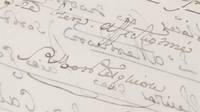
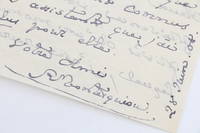
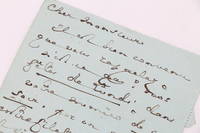
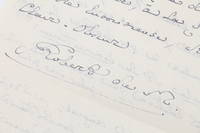
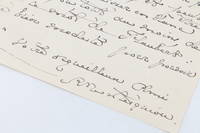
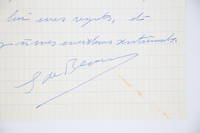
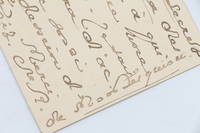
192083258s. l.: S. n. 1920. Fine. S. n. s. l. s. d. 1920 27.50 x 18 cm une page Autograph letter signed by the dandy count on a bristol card 20 lines written in black ink addressed to his friend and bibliographer the critic Henri Lapauze about an article to appear in ""Le Gaulois"" and for which he sets his conditions: ""Cher Mr Lapauze en réponse à votre aimable mot veuillez dire à M. Meyer que je lui demande pour l'article en question la place de tête pour le 28. Et que je lui demande aussi le secret à l'égard de la destinataire à qui je veux faire une surprise. Je sais qu'il sera d'accord avec moi dans ce dessein d'art et d'amitié. Merci et à bientôt. Cte R. de Montesquiou."" ""Dear Mr Lapauze in response to your kind note please tell M. Meyer that I ask him for the lead position for the article in question on the 28th. And I also ask him for secrecy regarding the recipient whom I want to surprise. I know he will agree with me in this design of art and friendship. Thank you and see you soon. Count R. de Montesquiou."" S. n. unknown
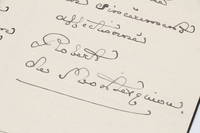
190683262s. l.: S. n. 1906. Fine. S. n. s. l. s. d. 1906 21.50 x 27.50 cm une page Autograph letter signed by the dandy count 20 lines written in black ink on tracing paper addressed probably to his friend and bibliographer the critic Henri Lapauze regarding verses commissioned from him by the newspaper ""Le Gaulois"": ""Neuilly Cher ami puisque nous supprimons le dessin remplaçons-le par par cette petite pièce qui servira de repos entre les deux autres et frappons un grand coup de vers. Les trois pièces ce nombre est necéssaire pour fixer l'attention sont les meilleurs que j'ai faites. Rendez notre cher Galdemar favorable à ce projet et dites lui que ce n'est pas moi qui sollicite du Gaulois cette publication ; mais bien le Gaulois qui la désire. J'insiste sur cette différence parce qu'elle donne je veux le croire à l'envoi ee ces nouveaux vers la grâce et l'essor d'une aile de plus. Votre bien affectionné. Cte R. de Montesquiou."" ""Neuilly Dear friend since we are removing the drawing let us replace it with this little piece which will serve as a respite between the two others and let us strike a great blow with verse. The three pieces this number is necessary to capture attention are the best I have written. Make our dear Galdemar favorable to this project and tell him that it is not I who am soliciting this publication from Le Gaulois; but rather Le Gaulois which desires it. I insist on this difference because it gives I want to believe to the sending of these new verses the grace and soaring of one more wing. Your most affectionate. Count R. de Montesquiou."" Creases inherent to folding for mailing small creases to right and left lower margins of the letter. S. n. unknown
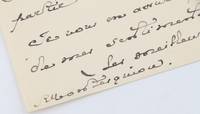
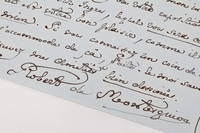
190883329s. l.: S. n. 1908. Fine. S. n. s. l. 13 juin 1908 24.50 x 17 cm une page Autograph letter signed by the dandy count 37 lines written in black ink addressed probably to his friend and bibliographer the critic Henri Lapauze. ""Neuilly Mon cher ami laissez-moi vous donner ce beau nom. C'est avec une vive et charmante émotion que je lis les belles et ""braves"" louanges dont vous voulez bien honorer ma personne et mon oeuvre. Il me plaît de penser que votre précieux éloge résulte d'une collaboration doublement sympathique et dans laquelle auprès de votre timbre métallique résonne l'accent le plus doux de l'aimable femme dont le talent m'était connu mais dont la première minute de causerie m'a révélé la compréhension et le sentiment. En attendant de vous le redire de vive voix merci donc à vous deux et de votre bien affectionné Robert de Montesquiou."" ""My dear friend allow me to give you this beautiful name. It is with a lively and charming emotion that I read the beautiful and ""brave"" praises with which you are pleased to honor my person and my work. I am pleased to think that your precious praise results from a doubly sympathetic collaboration and in which alongside your metallic tone resonates the sweetest accent of the amiable woman whose talent was known to me but whose first minute of conversation revealed to me her understanding and feeling. While waiting to tell you this again in person thank you therefore to both of you and from your very affectionate Robert de Montesquiou."" Fold marks inherent to posting. S. n. unknown
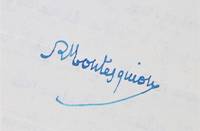
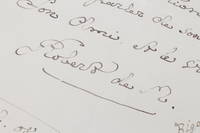
190683313s. l.: S. n. 1906. Fine. S. n. s. l. s. d. 1906 12.50 x 20 cm une page Autograph letter signed by the dandy count 11 lines written in black ink addressed probably to his friend and bibliographer the critic Henri Lapauze. ""Neuilly 14 juin Cher monsieur & ami mon dessin est à votre disposition de préférence à partir du samedi 21. Je vous assure et de mes sentiments les meilleurs. RMontesquiou."" ""Neuilly June 14 Dear sir & friend my drawing is at your disposal preferably from Saturday the 21st onwards. I assure you of my best regards. RMontesquiou."" Folding traces inherent to the envelope Henri Lapauze has inscribed across the letter in blue pencil the word ""faire"" ""to do"". S. n. unknown
192183348s. l.: S. n. 1921. Fine. S. n. s. l. 11 octobre 1921 17.50 x 21 cm une feuille Autograph letter signed by the dandy count 14 lines written in blue ink addressed to his friend and bibliographer the critic Henri Lapauze notably mentioning a work by Ingres in his possession also thanking his correspondent for his always lucid and benevolent critiques regarding him. ""Cher ami envoyez-moi je vous en prie comme nous en sommes convenus le schéma de ma donation au Petit-Palais de ma grande statuette par TroubetzKoÿ et du portrait par Arthur Chaplin de Mademoiselle Ehrmann artiste lorraine élève d'Hébert morte en 1918 ayant légué le portrait par elle de sa mère au Musée de Nancy et dont le portrait pareillement dû à son pinceau de Mademoiselle Favart figure au Foyer de la Comédie Française. Vous me ferez aussi grand plaisir en m'adressant votre bel article sur d'Annunzio et si vous la retrouvez la note des journaux sur mon don à la Bibliothèque de Versailles. Cher ami j'ai été heureux de vous revoir. RMontesquiou. 11 oct 1921."" ""Dear friend please send me as we agreed the outline of my donation to the Petit-Palais of my large statuette by TroubetzKoÿ and of the portrait by Arthur Chaplin of Mademoiselle Ehrmann Lorraine artist and student of Hébert who died in 1918 having bequeathed the portrait she painted of her mother to the Museum of Nancy and whose portrait similarly by her brush of Mademoiselle Favart is displayed in the Foyer of the Comédie Française. You would also give me great pleasure by sending me your beautiful article on d'Annunzio and if you find it the newspaper note about my gift to the Library of Versailles. Dear friend I was happy to see you again. RMontesquiou. 11 Oct 1921."" Fold marks inherent to postal delivery. S. n. unknown
190883323s. l.: S. n. 1908. Fine. S. n. s. l. 28 juin 1908 31 x 19.50 cm une page Autograph letter signed by the dandy count 40 lines written in black ink on tracing paper addressed probably to his friend and bibliographer the critic Henri Lapauze. ""Neuilly Dear friend the impossibilities that deprived me of your twice precious presence have also deprived you of a moment which I dare believe was one of those that would have moved you. And no doubt all the more I do not say! in revealing to you you sense it well. but in making you better know a character of sentiment curiously associated with the character of verve that you received the other day. If you judge it appropriate and can do so without difficulty would you publish in full the enclosed note having it preceded by a few lines that your good grace and good taste will inspire you I did not think that mention would be made of this intimate ceremony. But since it was not so it pleases me that the names be known to the attendees that I wanted for it. Your friend RMontesquiou."" Creases inherent to folding for mailing. S. n. unknown
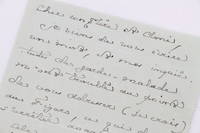
190583368s. l.: S. n. 1905. Fine. S. n. s. l. Juin 1905 11 x 14 cm une feuille Signed autograph letter from the dandy count on a sealed pneumatic card of 12 lines written in black ink addressed to his friend and bibliographer the critic Henri Lapauze: ""Cher confrère et ami je viens de vous écrire un mot et mes inquiètudes de garde-malade. Un mot troublé au point de vous adresser je crois au Figaro ce qui devait s'arrêter avant. Cela me donne le plaisir d'inscrire deux fois votre nom apprécié. RM."" ""Dear colleague and friend I have just written you a word and my anxieties as a nurse. A troubled word to the point of addressing you I believe at Le Figaro which should have stopped before. This gives me the pleasure of inscribing your appreciated name twice. RM."" S. n. unknown
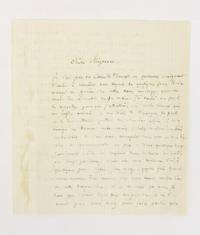
190883382Artagnan: S. n. 1908. Fine. S. n. Artagnan 1908 20.50 x 26.50 cm 7 feuillets recto Autograph letter signed by the dandy count 68 lines written in black ink on seven folios recto probably addressed to his friend and bibliographer the critic Henri Lapauze: ""Artagnan My dear friend the interesting review which I would very much like to know. has escaped me. Can you send it to me; or at least a date indication that would allow me to find it As for what you write to me about my ""social successes"" you don't think the first word of it fortunately for us! - otherwise you would start by ""not speaking to me"" as Favre used to say; and you would be quite right. Well! in all things one must consider not only the end but the true and the false the good and the bad the authentic and the counterfeit as I believed I could write even about snobbery! When it comes to letters - even more so to ladies of letters on no point does this difference stand out with such clarity. - who knows this better than you No once again we must not and this is very important let the mockeries of what we know how to do prevent us from manifesting ourselves. That would play too well into the hands of the monkeys who already have enough coconut trees as it is. For this reason I believed I should offer the noble Engadin larches the favor of hearing me. And their murmur did not reproach me for it. I am going to write to a certain Lady of letters in the good sense of the term to speak to her about her beautiful book. Your friend and hers Robert de M. Sept 08. Via Vic-Bigorre Hts Pyr. P.S.: urgent Only you can affirm to me with sufficient guarantee that Liem is still alive as I believe and wish to affirm in an article which being in press requires the information without delay. When you are reconciled with an etcher whom you do not like I will offer you for an engraving exhibition a portrait of me by him which at least you will love. If I have not read your critique of my book on the other hand I have taken note of the one you devoted to the amiable young man whom it was necessary to punish for having said three times during a dinner: Marie Murat. perhaps it would have been enough to make him copy seventy times seven times. In any case you will have been harsh. The crime deserved it. Perhaps also one day you will speak ill of me although that seems unlikely to me. But what I can affirm is that. it will not be for that! ."" Fold marks inherent to envelope mailing. S. n. unknown
191183367s. l.: S. n. 1911. Fine. S. n. s. l. 1911 27 x 21 cm 6 feuillets recto Signed autograph letter from the dandy count 68 lines written in black ink on six recto leaves probably addressed to his friend and bibliographer the critic Henri Lapauze to whom he almost orders him to review his latest work in one of his upcoming chronicles. The proud Robert de Montesquiou also evokes with complete immodesty his intellectual height and depth qualities cruelly lacking in some of his contemporaries: ""Cher ami avec plaisir je consens à faire partie de votre comité avec d'autant plus de plaisir que sans le vouloir ou peut-être intentionnellement je préfère le croire vous donnez raison à mon dernier livre. Voir page 143 : ""nulle ne serait mieux qualifiée pour ce titre de Présidente. On n'en saurait trouver de plus affable"". Oui cher ami j'en profite pour vous le redire sans plaisanterie - aussi bien que sans amertume vous vous êtes trop de fois montré efficacement sympathique pour que j'en perde si vite ni même jamais le souvenir. - vraiment je ne suis pas du tout de votre avis sur l'impossibilité de parler de mon dernier livre dans votre chronique. Je suis même de l'avis entièrement contraire. D'abord je ne voudrais pas si j'étais critique littéraire qu'il fût dit un jour qu'un tel livre a paru vous savez que je ne suis pas modeste sans que j'en ai fait mention d'une manière ou de l'autre. En outre c'est trop lui donner raison que d'en agir ainsi. Vous voyez que si je suis modeste je ne suis pas moins juste. Oui à votre place j'aurais fait la part de l'auteur et celle du lecteur même récalcitrant comme l'ont fait Robin dans le Herald et Glaser dans le Figaro comme l'ont fait et le feront d'autres. - Quant au bel article de Lucien Daudet dans le Gil Blas je pense que vous l'avez lu. Des personnes d'esprit et d'art comme vous deux ne peuvent se méprendre sur le côté réactionnaire et aristocratique d'un tel écrit dans la bonne acception de ces deux qualificatifs. L'aristocratie ce n'est tout de même pas madame Moore madame Porgès et Mam ""zell"" Gutman ; pas plus que la littérature n'est Mam ""zell"" Vacaresco et Monsieur de Pomairols. A un borgne bien intentionné qui me disait : ""vous attaquez le monde ! "". j'ai répondu : ""Pardon ! je range le salon de ma grand-mère"" Aussi quand je lis dans quelque de vos jolis commentaires trop incertains à certains à propos de je ne sais quel plus ou moins vague bouquin que ""l'auteur"" manie supérieurement l'ironie je m'écris furieusement : ""Eh bien ! et moi ! ."" Alors pour me dédommager et un peu me venger je relis votre carte du 10 octobre : ""Envoyez moi tout de suite cher ami votre insupportable héroïne"". Henry et moi nous voulons la connaître l'aimer la faire aimer. A quoi pensez vous de nous mettre ""l'eau à la bouche pour retirer ensuite ce fruit. que nous espérons défendu."" De ce moment-là je me sens mieux. Et pour vous le prouvre cher ami et que je suis sincère je vous annonce mon intention de publier à l'occasion de votre exposition un nouvel essai sur Ingres lequel vous sera dédié si tel est votre bon plaisir comme il est le mien. Si vous connaissez un coin de revue qui s'accommode de ça faites-le moi savoir et recevez mes amitiés bien dessinées. Robert de Montesquiou Janv. 911."" ""Dear friend with pleasure I consent to be part of your committee with all the more pleasure since without wanting to or perhaps intentionally I prefer to believe so you vindicate my latest book. See page 143: 'none would be better qualified for this title of President. One could not find a more affable one.' Yes dear friend I take this opportunity to tell you again without jest - as well as without bitterness you have shown yourself efficiently sympathetic too many times for me to lose the memory of it so quickly or even ever. - truly I am not at all of your opinion on the impossibility of speaking about my latest book in your chronicle. I am even S. n. unknown
190083373s. l.: S. n. 1900. Fine. S. n. s. l. s. d. circa 1900 11 x 14 cm une feuille Autograph letter signed by the dandy count on a closed pneumatic card of 14 lines written in black ink addressed to his friend and bibliographer the critic Henri Lapauze: ""Cher monsieur il est bien convenu que vous rappelez n'est-ce pas nos fêtes de lundi dans votre numéro de ce soir par un petit entrefilet invitant et signfiant avec l'heure du départ et les attractions etc. Merci et bon sentiment. Cye R.de M."" ""Dear sir it is well understood that you will remind is it not our Monday festivities in your issue this evening with a small inviting and meaningful paragraph with the departure time and attractions etc. Thank you and good feelings. Cye R.de M."" S. n. unknown
190883360s. l.: S. n. 1908. Fine. S. n. s. l. 4 février 1908 21.50 x 28 cm une feuille Autograph letter signed by the dandy count 22 lines written in black ink addressed to his friend and bibliographer the critic Henri Lapauze: ""Neuilly Indeed dear friend you would give me great pleasure by continuing to point out to your readers the faithfulness of word & the good conduct of this edition which encounters more and more the serious reception to which I hope it is entitled by showing more clearly what those titles that have become famous contained a little confidence and which want to deserve to be so after a more mature examination. And if you insist on the poor passiflora of which your wife speaks to me so eloquently and elegantly in a letter that would be a very beautiful 'art criticism' this will delight at the same time a luminous shadow and my chiaroscuro. Robert de M. 4 February 08."" Fold marks inherent to envelope placement. S. n. unknown
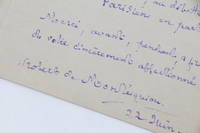
190083374Paris: S. n. 1900. Fine. S. n. Paris s. d. circa 1910 23 x 18 cm un feuillet Autograph letter signed by the dandy count 27 lines written in violet ink addressed to his friend and bibliographer the critic Henri Lapauze: ""14 avenue Bosquet Cher monsieur et ami j'ai le plaisir de vous envoyer mon livre que je l'espère vous aimerez assez pour lui concéder la gracieuse faveur que je vous demande. Quelques lignes un alinéa en première page rappelant à vos lecteurs son apparition avec un bout de commentaire que vous tracerez je le sais obligeamment et savamment seront pour dédommager et peut-être récompenser le poète qui s'entête à chanter en ces époques troublée. Un compte-rendu de M. Perret m'a été promis mais il viendra en son temps que la politique peut retarder ; et votre bienveillant et incisif rappel agirait à cette heure fort élégamment et éloquemment sur les voyageurs au débotté et sur les parisiens en partance. Merci avant pendant après de votre sincère affectionné Robert de Montesquiou. 22 juin."" ""14 avenue Bosquet Dear sir and friend I have the pleasure of sending you my book which I hope you will like enough to grant it the gracious favor I ask of you. A few lines a paragraph on the first page reminding your readers of its appearance with a bit of commentary that you will write I know obligingly and learnedly will compensate and perhaps reward the poet who persists in singing in these troubled times. A review by M. Perret has been promised to me but it will come in its time which politics may delay; and your benevolent and incisive reminder would act at this hour most elegantly and eloquently on travelers upon arrival and on Parisians departing. Thank you before during after from your sincere affectionate Robert de Montesquiou. June 22."" Small pinhole marks that held the two sheets together. S. n. unknown
192083358s. l.: S. n. 1920. Fine. S. n. s. l. s. d. circa 1920 25.50 x 20 cm une feuille Autograph letter signed by the dandy count 27 lines written in blue ink addressed to his friend and bibliographer the critic Henri Lapauze: ""Neuilly Dear friend thank you for your note. I am going to see Coppée again. When you speak again you of my book you will please me of course if this accords with your views first by recalling that it is dedicated to Barrès then by observing if not admiring what is rare in the spectacle shall we say the example given by an artist who has proven himself and publishes his eleventh volume books in which there are things without ever having cared about anything other than the esteem of those who please him; by a man who below this list of works which is requested of him by a recent questionnaire then encountering the word rewards followed by a question mark has the happiness and perhaps the honor of having to leave this useless line blank or at least to populate it with this word from Flaubert: ""One must be quite modest to be able to be honored"" Your proud friend RMontesquiou. 10 June."" Traces of folds inherent to the envelope. S. n. unknown
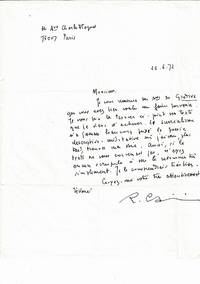
197275103Paris 1972. Fine. Paris 25 juin 1972 21 x 27 cm une page sur un feuillet enveloppe jointe Autograph letter signed by Roger Caillois addressed to Arnost Budik; one page written in black ink on a sheet of tissue paper. Envelope included. Some punch holes in the margin of the letter and envelope not affecting the text as well as some folds inherent to the folding of the missive. Roger Caillois thanks the Czech writer for the ""issues of Gravida that he was kind enough to send him"". Arnost Budik was indeed part of the editorial committee of this Belgian surrealist magazine and seems to have solicited a contribution from Caillois: ""Please find enclosed a text that I have just completed."" Caillois was alongside the surrealists only very briefly from 1932 to 1935 and here seems to apologize for this distancing: ""Surrealism never much appreciated descriptive-meditative poetry where I believed later to find my path. So if the text does not suit you have no qualms about returning it to me quite simply. I would understand very well."" unknown
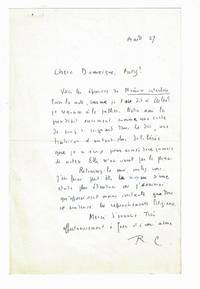
196875105Paris 1968. Fine. Paris Mardi 27 février 1968 13.50 x 20.90 cm une page sur un feuillet Autograph letter signed by Roger Caillois addressed to Dominique Aury; one page on a leaf written in blue ballpoint pen. Interesting letter concerning the article ""Mémoire interlope"" which would appear in issue 185 of the sixteenth year May 1968 of the Nouvelle Revue Française. At this time Marcel Arland and Jean Paulhan were both directors of the review which they had revived from its ashes in 1953. Roger Caillois's correspondent Dominique Aury also known under the pseudonym Pauline Réage sat on the Reading Committee of the famous Revue. This letter concerns a ""note"" that Roger Caillois asks Dominique Aury not to publish: ""Pour la note comme je l'avais dit à Arland je renonce à la publier. Notre ami la prendrait surement comme une sorte de coup de poignard dans le dos une trahison d'autant plus délibérée que je n'écris pour ainsi dire jamais de note. Elle n'en vaut pas la peine."" ""Regarding the note as I had told Arland I'm giving up publishing it. Our friend would surely take it as a sort of stab in the back a betrayal all the more deliberate since I practically never write notes. It's not worth it."" We could find no trace of this enigmatic note which Roger Caillois is impatient to recover: ""Retournez-la moi voulez-vous. J'en ferai peut-être le noyau d'une étude plus étendue où j'essaierai qu'apparaissent moins irritants que dans ce condensé les rapprochements litigieux."" ""Return it to me would you. I might perhaps make it the core of a more extended study where I will try to make the contentious connections appear less irritating than in this condensed version."" unknown
196867060Paris 1968. Fine. Paris 16 décembre 1968 21 x 27 cm 2 pages sur un feuillet Long autograph letter signed by Roland Barthes addressed to Georges Raillard. Two pages written in blue ink on a letterhead of the Ecole Pratique des Hautes Etudes. Envelope with identical header attached. Two central folds inherent in enveloping the envelope. ""Dear friend Thank you for your good letter thank you for the list of notabilities and thank you for the check.Fun has it that I will go back to Barcelona for a few hours at the end of the week.I could not have room on Saturday 21 in the plane Geneva Casablanca which takes place once a week and held by complicated dates I was obliged to go to Morocco to plan to go from Geneva to Barcelona unknown
195762715s. l. 1957. Fine. s. l. 21 mai 1957 13.30 x 20.90 cm une page sur une feuille Autograph letter signed by Roland Barthes in Wintgen written in black ink. Date at the top of the letter and signature at the bottom of the letter. Central fold caused by mailing. Roland Barthes sends this letter to warn his addressee that he will not be able to come to a meeting of authors in Germany. He writes that he must absolutely be in Switzerland on the same date. unknown
195662716s. l. 1956. Fine. s. l. 11 mai 1956 21 x 27 cm 2 pages sur un feuillet Autograph letter signed Roland Barthes written in black ink. Date at the top of the letter and signature at the bottom of the letter. Folds caused by mailing. One erasure and two additions from the author's hand.Roland Barthes sends this letter to warn his addressee that he will not send him the article he had announced on realism because what he wrote does not satisfy him: ""I can not decide to give you this text on realism and I just ask you to give it up: it does not satisfy me enough "" . He then proposes a theme of reflection for the journal of his correspondent which would be the study of the stakes of the debates between intellectuals: ""its limits its hopes its failures its action what one expects etc."" 1956 is the year of the writing of the Mythologies of Barthes which appear at Seuil in 1957. unknown
195662720s. l. 1956. Fine. s. l. 2 juin 1956 21 x 27.10 cm 2 pages sur un feuillet Autograph letter signed by Roland Barthes written in blue ink. Date at the top of the letter and signature at the bottom of the letter. Folds caused by mailing.Roland Barthes sends this letter to his correspondent to warn him that he has decided to give ""three pages of his intervention"" to Hollerer founder of the German magazine Akzente and that following his refusal of an article addressed to the addressee he afraid that it will upset him. He explains in the letter saying that these pages are not really developed but also that it ""dreads the German audience less"". 1956 is the year of the writing of the Mythologies of Barthes which appear at Seuil in 1957. unknown
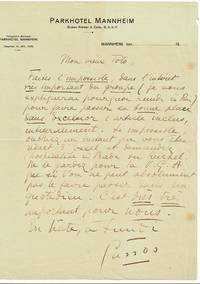
191475402Mannheim: s. n. 1914. Fine. Roland Garros comes to the aid of aviators' widows and orphans s. n. Mannheim s. d. juin 1914 22.20 x 28.80 cm une page sur un feuillet Autograph letter signed by Roland Garros addressed to his ""vieux Toto"" Jacques Mortane written in black ink on Parkhotel Mannheim letterhead. Horizontal folds from mailing a few marginal tears without loss. A rare and attractive letter in which the aviator refers to ""Le Groupe"" and the ""Jour des Aviateurs"" at Juvisy: ""Faites l'impossible dans l'intérêt très important du groupe je vous expliquerai pourquoi jeudi à Paris pour faire passer en bonne place dans Excelsior l'article inclus intégralement."" Mortane successfully managed to transmit the article which was published in the 14 June 1914 issue under the title ""Le Gala des Aviateurs - La fête aérienne d'aujourd'hui à Juvisy."" It was Roland Garros who initiated the association with Jacques Mortane serving as secretary general which he named ""Le Groupe."" Bringing together around fifteen aviation celebrities its purpose included supporting the widows and orphans of fellow aviators who had perished in pursuit of their passion. The ""Journée des aviateurs"" was the first charitable event organized by ""Le Groupe"" and as this letter testifies held great significance for Garros: ""C'est très très important pour nous."" The letters and signatures of the most famous of aviators who died at only twenty-nine are rare and much sought after. s. n. unknown
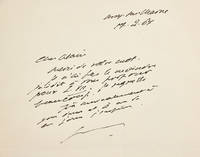
196775618n. l.: s. n. 1967. Fine. s. n. n. l. 17 février 1967 21.50 x 27 cm une page sur un feuillet Handwritten letter signed by Samuel Beckett addressed to Alain Bosquet. Some lines written in black ink on watermarked paper. I do not have the slightest novelty to offer you . I very much regret. s. n. unknown
1980770661980. Fine. 2 Juillet 1980 14.50 x 20.50 cm 1 page 1 enveloppe Autograph letter signed by Simone de Beauvoir consisting of 9 lines addressed to Antoinette Boulesteix with envelope enclosed. A central fold inherent to the mailing and an envelope mark at the foot of the letter the envelope and letter having been glued together then separated. ""Chère mademoiselle je suis très touchée de cette lettre mais je n'ai pas le temps de rencontrer votre mère. Je quitte Paris pour aller me reposer à la campagne. Dites lui mes regrets et croyez à mes meilleurs sentiments. Simone de Beauvoir."" ""Dear Mademoiselle I am very touched by this letter but I do not have time to meet your mother. I am leaving Paris to go rest in the countryside. Give her my regrets and believe in my best sentiments. Simone de Beauvoir."" unknown
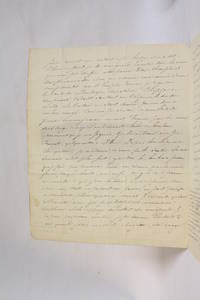
1808689671808. Fine. 26 mars 1808 20 x 24.80 cm 3 pages 1/2 sur un double feuillet Long autograph letter by Stendhal addressed to his sister Pauline written in fine handwriting with black ink. Address of Stendhal's father where his sister resides in Grenoble with the stamp ""n°51 Grande Armée."" Red wax seal bearing Stendhal's coat of arms. Several original folds inherent to postal delivery. A paper loss due to the unsealing of the letter has been skillfully restored. Published in his Correspondance ed. Henri Martineau Paris Le Divan 1933 vol. 3 no. 262 A pp. 26-29. A very beautiful letter filled with romantic passion blending childhood nostalgia with sentimental tales and foreshadowing The Red and the Black. This letter is part of the correspondence between twenty-five years old Henri Beyle and his sister Pauline three years his junior. This epistolary relationship which quickly took the form of a ""journal"" as Pauline's responses were rare. It is deemed a crucial milestone in the intellectual development of the future Stendhal: ""Here are my dreams my dear friend; I am almost ashamed of them; but after all you are the only person in the world to whom I dare confess them."" In this letter which attests to the strong bond between brother and sister Stendhal then in Germany expresses his deep nostalgia: ""I revisited in my memory all the time we spent together: how I did not love you in our childhood; how I once hit you at Claix in the kitchen. I hid in the little book cabinet; my father came back a moment later furious and said to me: 'Wicked child! I would eat you!' Then all the woes inflicted upon us by poor Aunt Séraphie; our walks along those paths surrounded by stagnant water towards Saint-Joseph."" These regrets about the past are accompanied by a typically Stendhalian melancholy: ""Alas! That delightful happiness I once imagined I glimpsed it once at Frascati and a few other times in Milan. Since then it has not returned; I marvel at my inability to feel it. The mere memory of it is more powerful than all the present joys I can procure."" This evocation of the Italy he longs for is intertwined with memories of the women he loved: ""I told you that while in Frascati at a charming fireworks display at the moment of the explosion Adèle leaned on my shoulder for an instant; I cannot express how happy I was. For two years whenever I was overwhelmed with sorrow this image gave me courage and made me forget all my troubles. I had long forgotten it; I tried to recall it today. Against my will I see Adèle as she is; but as I am now there is no longer the slightest joy in this memory."" This lengthy account of Adèle Rebuffet his cousin with whom he had a profound romantic relationship before forming a closer bond with her mother reflects Stendhal's sentimentality. He also mentions another of his great passions Angelina Pietragrua the ideal Italian woman and embodiment of his Milanese memories: ""Madame Pietragrua is different: her memory is linked to that of the Italian language; whenever something pleases me in a role for a woman in a work I involuntarily put it into her mouth."" This ""role for a woman"" that Stendhal refers to echoes the central theme of this letter the work Il Matrimonio segreto by composer Cimarosa: ""Do you sometimes play the Matrimonio Its the passage Cara sposa at the beginning between Carolina and Paolino. . But play the Matrimonio for my sake especially Signor deh permettette and the finale Io rival de mia sorella."" This opera by Cimarosa remained a constant throughout the writer's life and work. In his Memoirs of an Egotist 1832 he explains: ""In Milan in 1820 I wanted to have this written on my tomb . I wanted a marble tablet in the shape of a playing card: ""Errico Beyle - Milanese - Visse scrisse amò - Quest'anima adorava Cimarosa Mozart e Shakspeare - Morì di anni. il . 18."" ""Henri Beyle - Milanese - He lived wrote loved - This soul adored Cimarosa Mozar unknown
187164361Versailles 1871. Fine. Versailles s. d. 20-30 avril 1871 10.50 x 11.50 cm un feuillet Autograph letter signed by Théophile Gautier 34 lines in black ink address at foot on verso of the letter: ""Versailles avenue de St-Cloud n°3"". Folds inherent to mailing. The letter appears to be unpublished not mentioned in the Correspondance Générale de Théophile Gautier edited by Claudine Lacoste-Veysseyre under the direction of Pierre Laubriet Droz Geneva-Paris 12 vol. 1985-2000. Rare glimpse into Gautier's private life the letter captures the anguish that struck the author and his family during the Paris Commune. Separated from his family by the Prussian invasion of 1870 and the Parisian insurrections of 1871 Théophile Gautier confides the extent of his torments both financial and due to the Paris Commune to his ""dear sweetheart"" his younger daughter Estelle Gautier: ""I may yet manage to recover from this collapse . I am happy that these atrocious ordeals have been spared you. For my part I nearly lost my life and I am still not in brilliant condition"". Gautier's usual supporters are evident here through the names of academician Camille Doucet and dancer Carlotta Grisi. The virulence of the fighting between communards and repressive forces can be sensed in the evocation of Gautier's sister Emilie called ""Lili"": ""Lili is still in her cellar. Coming out is too perilous but she will be delivered within a few days. Alas! Very long ones"". Characteristic of the personal register rare in Gautier's correspondence the letter is imbued with the paternal love the author bears for his family: ""What a celebration when we are all reunited for my heart suffers greatly from this dispersion"". unknown
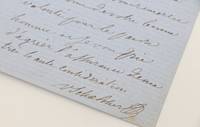
1879841641879. Fine. 12 mars 1879 10.20 x 13.30 cm une page sur un bifeuillet et une enveloppe Autograph letter signed by Victor Schoelcher one page written in black ink on a bifolium of blue paper bearing the monogram and address of the politician addressed to minister Alfred Boucher-Cadart director of the general security service at the Ministry of the Interior. The envelope containing this letter has been pasted onto the second leaf. Central fold inherent to the mailing. ""There is nothing more to be done for the worker Cauchare. He was forced to serve his 10 days in prison while the Ministry of Justice was changing his sentence. I nonetheless thank you for your goodwill toward the poor man and I ask you to accept the assurance of my highest consideration."" unknown