Maurice LEBLANCBiblio.com
1 815 résultats
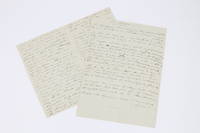
190586168s. l. 1905. Fine. s. l. s. d. ca 1905 11.50 x 18 cm 5 pages sur un double feuillet Autograph letter signed by Maurice Leblanc to a friend from Rouen named Louis asking him to perform several services as he lacks the time to handle them himself. Maurice Leblanc entrusts his friend with two commissions: first to collect some furniture reserved by one of his friends at an antique dealer's: ""Go to a man named Chassaigne antique dealer 20 rue St Romain.He sold 6 chairs to the Prats two months ago. . apparently he refused to accept a deposit. No response. Let him say frankly that he has sold everything. The bench was for me 40 francs and I would very much like to have it."" the second concerning an administrative matter: ""Go to the registry of the civil court. and request an extract of my birth certificate and an extract of my parents' death certificates. It's for a marriage."" unknown
186964422Paris 1869. Fine. Paris 16 janvier 1869 13.50 x 20.50 cm un feuillet remplié Letter autograph signed Maxime Du Camp dated January 16 1869 23 lines in black ink on blue paper handwritten address of the sender at the head of the sheet. Letter of request for recommendation that Maxim Du Camp addresses very courteously to his interlocutor who seems to have rescued him in the past. unknown
1974657191974. Fine. février 1974 18.60 x 27 cm une feuille enveloppe jointe Letter autograph signed by Michel Butor to Georges Raillard dated February 1974. 55 lines written in black pen on a sheet. Envelope attached. Michel Butor speaks from Albuquerque New Mexico to Georges Raillard literary critic and specialist of Spanish painters Antoni Tapies and Joan Miro. unknown
1797761731797. Fine. An exceedingly rare letter from Restif: « Les événemens du 18 fructidor' m'ont rendu la vie . en affligeant mon cur » 30 fructidor 1797 An V 16 septembre 1897 18.50 x 21.30 cm 3 pages sur un double feuillet Extremely rare autograph letter signed « Restif Labretone » addressed to Citoyenne Fontaine. Three pages written in black ink on a double sheet of laid paper. Remains of a wax seal folds inherent to mailing. This letter was published with some inaccuracies in Lettres inédites de Restif de Labretone by V. Forest and É. Grimaud 1883. The Fontaine couple are merchants from Grenoble and Restif de la Bretonne began corresponding with them on March 15 1797. Important letter testifying to the completion of the publication of Restif's great autobiographical work: Monsieur Nicolas ou les Ressorts du Cur Humain dévoilé. « I will have completed the Cur humain Dévoilé within 15 days I will prepare your package immediately to have it ready. » The first eight volumes of this great autobiographical work printed by Restif himself a typesetter by trade in his residence at 11 rue de la Bûcherie were entrusted to the « dishonest » bookseller Nicolas Bonneville who did not honor his debts to the writer. Besides health issues « I exchange my illnesses and do not cure them » Restif also shares with his correspondent his literary setbacks: « The Author of Nature will preserve a sincere friend for me to compensate for the scoundrels of the Institute and the perfidious Mercier ». Indeed the previous year the author learned with bitterness that he was not admitted to the National Institute and Louis-Sébastien Mercier who had praised him in his Tableau de Paris and supported his candidacy then turned away from him. To this sum of misfortunes financial difficulties are added. Penniless and living on meager state pensions he maintains all his support for the Republic: « By what fatality do I never see the views of the rulers who welcome me; or how do they not see at once that I am attached to the Revolution to the point that I still love it even when it beats me. » Restif profoundly anti-royalist wrote several pamphlets to this effect and had just added to the end of Monsieur Nicolas an apology for the coup d'état of 18 Fructidor Year V. However this date marks the end of the allowance granted to him by Lazare Carnot after his failure at the Institute: « You know the events of 18 Fructidor; I will not speak to you about them. They have given me back my life; but by afflicting both my heart and my gratitude. » But Restif's great sorrow is the loss of his daughter Filette born from his adventure with Louise Allan whose paternity was revealed to him only late: « I am writing to you from bed weeping over my Filette who died 11 months and ten days ago . Filette was my daughter and Louise's whose soul and beauty she had. » Autograph letters signed by Restif de La Bretonne that have survived to this day are extremely rare. unknown
191064371Paris 1910. Fine. Paris 1910 13.50 x 21.50 cm un feuillet remplié Autograph letter signed by Paul Mounet probably addressed to an actress 30 lines in black ink on laid paper with the address of the coffee Regency in mind. Folds inherent to the enveloping. The missive deals with the details of a forthcoming theatrical production that Mounet then comedian at the Comédie-Française insists with insistence to his interlocutor: "" I must have permission - to play outside the French"" unknown
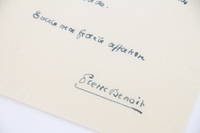
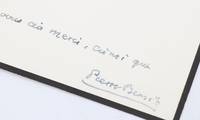
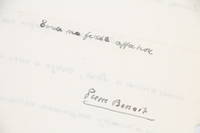
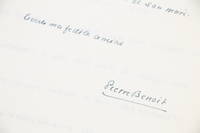
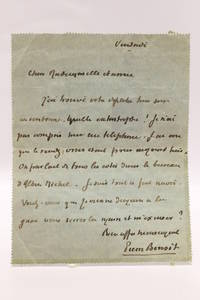
196184910Saïgon Hu Ngha 1961. Fine. Saïgon Hu Ngha 28 Février 1961 13.50 x 21 cm deux pages sur un double feuillet Autograph letter signed by Pierre Benoit on Messageries Maritimes letterhead 21 lines in black ink on tracing paper regarding his cruise in the Orient. Central fold marks perforations due to filing in a binder having caused the absence of the first letter of Paris on the fourth line of the letter. Pierre Benoit rejoices in his Oriental journey and the welcome he received; stopping in Saigon he prepares to sail toward Japan: ""ce qui nous assure là-bas un programme tout à fait au point."" ""which ensures us a perfectly organized program there"" unknown
196184909Ciboure 1961. Fine. Ciboure 28 Février 1961 13.50 x 20 cm une page Autograph letter signed by Pierre Benoit on letterhead from his property in Ciboure 14 lines in black ink. Central fold marks perforations due to filing in a binder having caused the absence of the first letter of Paris on the fourth line of the letter. Pierre Benoit recalls the recent passing of his wife Marcelle died on May 28 1960: ""Il y a neuf mois aujourd'hui que la pauvre Marcelle s'en est allée"" ""It has been nine months today since poor Marcelle passed away"" and hopes to meet his friend during his next visit to Paris in March. unknown
195285013Ciboure 1952. Fine. Ciboure 27 Octobre 1952 21 x 27 cm une page Autograph letter signed by Pierre Benoit from his property in Ciboure 19 lines in black ink. Central fold marks perforations due to filing in a binder having caused no loss. Pierre Benoit then at his Basque property in Ciboure: ""petit stage nécessaire avant le retour à Paris triage et mise en ordre de la correspondance."" brief stay necessary before returning to Paris sorting and organizing correspondence. discusses the reasons and interest of their upcoming meeting in Paris: "". le retour d'un tel voyage doit s'accompagner d'un certain nombre de ces conseils dans lesquels vous êtes passé maître."" . the return from such a journey must be accompanied by a certain number of those pieces of advice at which you have become a master. in order to share their latest travel memories: ""des impressions que je suppose toutes choses qui nécessitent quelques bons instants de tête en tête entre vous et moi."" impressions I suppose all things that require some good moments of private conversation between you and me. unknown
195085079Ciboure 1950. Fine. Ciboure 26 Septembre 1950 21 x 27 cm une page Autograph letter signed by Pierre Benoit from his property in Ciboure 21 lines in black ink. Traces of central folds perforations due to filing in a binder causing no loss one scissors cut in left margin of the letter. ""26 septembre. Mon cher ami à peine le facteur venait-il de tourner les talons emportant la lettre que je venais d'achever pour vous qu'un coup de téléphone de notre ami commun me mettait en demeure de vous en écrire une seconde ! Alors c'est donc vrai c'est vous qui assurez la charge de collaborer avec mon éditeur et le directeur du cabinet de Giaccobi pour régler la petite fête du 4 Novembre Je vous en remercie d'autant plus que ne devant revenir à Paris que le 28 Octobre je ne puis pas vous être d'un grand appui. Par le même courrier je préviens mon éditeur Robert Esmenard owner of Albin Michel publishing house . . Esmenard est habitué de ce genre de manifestation car il donne des réceptions de ce genre pour fêter d'illustres auteurs étrangers. Il a donc des listes et une formule d'invitation.Le tout sera de panacher ces listes avec la liste corse de Giaccobi. Et de mon côté je vous demande de veiller à ce que Messagenès Fabre Transat sans oublier bien entendu le C.T.O. soit à l'honneur. Enfin je suis assuré ainsi d'avoir une occasion pas trop éloignée de revoir Madame Louis Brun et son mari. Toute ma fidèle amitié Pierre Benoit."" September 26. My dear friend hardly had the postman turned on his heels carrying off the letter I had just finished for you when a telephone call from our mutual friend put me under obligation to write you a second one! So is it really true Is it you who is taking charge of collaborating with my publisher and the director of Giaccobi's office to arrange the little celebration of November 4th I thank you all the more since not having to return to Paris until October 28th I cannot be of great assistance to you. By the same post I am notifying my publisher Robert Esmenard. . Esmenard is accustomed to this kind of event as he gives receptions of this sort to celebrate illustrious foreign authors. He therefore has lists and an invitation formula. The whole thing will be to blend these lists with Giaccobi's Corsican list. And for my part I ask you to see that Messagenès Fabre Transat without forgetting of course the C.T.O. are honored. Finally I am thus assured of having an opportunity not too distant to see Madame Louis Brun and her husband again. All my faithful friendship Pierre Benoit. unknown
192562583Saint-Céré Lot Saint-Céré 1925. Fine. Saint-Céré Lot Saint-Céré s. d. Après 1925 21 x 26.50 cm 1 page sur un feuillet Letter autograph signed by Pierre Benoit a page to an unidentified friend 8 lines in black ink without date and written since Saint-Céré in the Lot. Two small tears on the margins of the sheet and without any damage to the text three spots in the foot and at the top of the sheet always without any damage to the text. Traces of creases. In this letter written from his famous room No. 2 which he occupies at the hotel of Saint-Céré since 1925 and in which he retrenched to write and ""work hard"" Pierre Benoit informs his correspondent of his geographical error concerning Saint-Céré the latter having confused Lot-et-Garonne and Lot during his previous missive. He also tells him his next return to Paris and asks if she will be there too. Finally Pierre Benoit suggests to him to send a word to The Moignée ""to tell him that I blame him to death he will understand"" and also that it gives him quickly of his news. unknown
194062642Paris 1940. Fine. Paris décembre 1940 11 x 14.40 cm une page sur une feuille Signed autograph letter from Pierre Benoit to Nadia Charlane written in black ink. This mail is a ""little blue"" paper provided by the post office that allowed mailings by pneumatic tubes in Paris these couriers were then delivered by couriers. Parisian address of Nadia Charlane on the back signature at the bottom of the letter day at the top of the letter. Pierre Benoît writes this letter to the actress following a misunderstanding about an appointment. He apologizes and proposes to his correspondent to pick her up at the station the next day. unknown
191677521Paris 1916. Fine. Paris 15 mai 1916 11 x 16 cm 6 pages sur un double feuillet et un feuillet simple Autograph letter from Pierre Louÿs signed with his initial addressed to Georges Louis. Six pages written in violet ink on a double leaf and a single leaf. Central creases inherent to posting. Very fine letter addressed to his brother Georges Louis with whom Pierre Louÿs maintained a very intimate relationship and whom he considered as his own father. The question of the real identity of Pierre Louÿs's father still fascinates biographers today: ""His father Pierre Philippe Louis . had married in 1842 Jeanne Constance Blanchin who died ten years later after giving him two children Lucie and Georges. In 1855 he remarried Claire Céline Maldan and from this union was born in 1857 a son Paul; then in 1870 our writer who received the first names Pierre Félix. This late birth the differences in character between father and son the former's disaffection toward the latter the profound intimacy that always reigned between Louÿs and his brother Georges all this has led certain biographers and critics to suspect that the latter was in reality the writer's father. The exceptionally intimate and constant relationship that Pierre and Georges maintained between themselves all their lives could be an argument in this sense. Of course no irrefutable proof has been discovered and none will probably ever be discovered. Nevertheless certain letters . are quite disturbing. In 1895 for example Louÿs writes seriously to his brother that he knows the answer to ""the most poignant question"" he could ask him a question he has had ""on his lips for ten years."" The following year in the full triumph of Aphrodite he thanks Georges effusively and ends his letter with this sentence: ""Not one of my friends has a FATHER who is to him what you are to me."" Arguing from the close intimacy of Georges and Claire Céline during the year 1870 and the jealousy that the father never ceased to show toward his younger son Claude Farrère did not hesitate to conclude in favor of Georges Louis. And what to think of this dedication by Louÿs to his brother on a deluxe paper copy of the first edition of Pausole: For Georges his eldest son / Pierre."" Jean-Paul Goujon Pierre Louÿs A true reflection on literature and the choice of words this letter was written while Pierre Louÿs was working on a work that would appear the following year: Poëtique. ""Louÿs decides . to write a Poëtique which will be like the testament of his work as well as a message to young writers. He had always reflected on poetic art and accumulated dozens of notes both on poets and on poetry itself."" Ibid. To reflect on poetic art is precisely what he does in this fine letter: ""Regarding negation I wondered why the principle I tried to establish nuance ruse or error was not classical. I believe the answer is: Chimène. - We take the word as a text to teach high school students that negation is an additional force. - Ex. ""Je ne te hais point"" ""I do not hate you"" more expressive than ""Je t'aime"" ""I love you"". But no. Rodrigue has just said: ""Votre haine"" ""Your hatred"". It is Rodrigue who imprints the image. The response ""Je ne te hais point"" ""I do not hate you"" is the passage from shadow to light: it is to speak the nuance. . It is terribly delicate to write ""ne pas"" ""not""."" Then in a period of great trouble and isolation the poet is touched by Paul Valéry's support: ""The other day I had written a long letter to Valéry about my ""Poëtique."" - He answered me immediately a letter where he began by thanking me for all that he had felt of affection for him in the very fact that I had spent part of my evening with him without his being there. I answer him in turn - as much as I remember - ""It is so rare friends who suspect affection beneath something. There are hardly more than two kinds of people: those who do not lift the stone because they are certain there is not unknown
188878162Dizy Dizy-le-Gros 1888. Fine. Dizy Dizy-le-Gros samedi 15 septembre 1888 13.70 x 21.20 cm 20 pages sur 5 doubles feuillets & une enveloppe Very long autograph letter signed by Pierre Louÿs addressed to Georges Louis. Twenty pages written in blue ink on five double sheets of graph paper. Enclosed is an envelope on which is written in pencil in Pierre Louÿs's hand: ""Letter of 20 pages about my stay in Limé"" Amusing letter addressed to his brother Georges Louis with whom Pierre Louÿs maintained a very intimate relationship and whom he considered as his own father. The question of Pierre Louÿs's real father's identity still fascinates biographers today: ""His father Pierre Philippe Louis . had married in 1842 Jeanne Constance Blanchin who died ten years later after having given him two children Lucie and Georges. In 1855 he remarried Claire Céline Maldan and from this union was born in 1857 a son Paul; then in 1870 our writer who received the first names Pierre Félix. This late birth the differences in character between father and son the former's disaffection toward the latter the profound intimacy that always reigned between Louÿs and his brother Georges all this has led certain biographers and critics to suspect that the latter was in reality the writer's father. The exceptionally intimate and constant relationship that Pierre and Georges maintained between them throughout their lives could be an argument in this sense. Of course no irrefutable proof has been discovered and probably never will be. Nevertheless certain letters . are quite troubling. In 1895 for example Louÿs writes gravely to his brother that he knows the answer to 'the most poignant question' he could ask him a question he has had 'on his lips for ten years.' The following year at the height of Aphrodite's triumph he thanks Georges effusively and ends his letter with this sentence: 'Not one of my friends has a FATHER who is to him what you are to me.' Arguing from the close intimacy between Georges and Claire Céline during the year 1870 and from the jealousy that the father never ceased to show toward his younger son Claude Farrère did not hesitate to conclude in favor of Georges Louis. And what to think of this dedication by Louÿs to his brother on a deluxe copy of the first edition of Pausole: To Georges his eldest son / Pierre."" Jean-Paul Goujon Pierre Louÿs In this titillating letter bearing at the top the mention ""Papa doesn't know I'm writing you this letter"" underlined three times young Pierre Louÿs eighteen years old tells his elder about his vacation in Limé Aisne with the Glatron family. Visibly very excited he announces to his brother after some brief family news: ""And I have great news to announce to you which will decide the happiness of my life: I'm getting married. Don't look for a match for me anymore: I've found one."" In order to keep his reader in suspense he first tells him at length about his stay in Limé and paints a portrait of the Glatron family: ""Here first is the introduction to the little work I'm sending you by way of a letter and which may be very boring. It's the tableau of the Glatron family; it amused me to study them a bit while I was there. I wanted to find for each of them three or four words to paint them completely but I soon realized that I couldn't do so for any of them."" Far from being ""boring"" this very long passage allows Pierre Louÿs to deploy his talents as storyteller and caricaturist. Each member receives a colorful description ""the queen mother"" ""a nonentity"" ""a very special character"" ""petrified phlegm"" ""a repetitive Paulus"" ""the little invalid"". and Louÿs also gives pride of place to dialogues which he deliberately exaggerates: ""'I tell you that you took her by the waist! I saw you! Don't say no I saw you!'"" These humorous observations continue with the quasi-anthropological description of a village festival in Limé: ""I arrived in Limé the day before the patron saint's festival. unknown
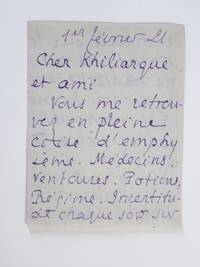
1921705101921. Fine. 1er février 1921 11.10 x 14.60 cm 4 pages sur un double feuillet Autograph letter signed by Pierre Louÿs addressed to a friend whom he calls ""khiliarque"". Ample and calligraphic handwriting in violet ink. A tear without loss of text to the first page. Eloquent letter testifying to Pierre Louÿs' fragile health in the last years of his life: ""Vous me retrouvez en pleine crise d'emphysème. Médecins. Ventouses. Potions. Régime. Intertitude chaque jour sur la journée du lendemain."" You find me in the midst of an emphysema crisis. Doctors. Cupping. Potions. Regimen. Uncertainty each day about the next day. The letter also reveals the writer's passion for dramaturgy notably through the mention of Gustave Quinson then director of the Palais-Royal theatre. ""Voulez-vous être tout à fait gentil Envoyez-moi d'abord votre livret que je suis si curieux de connaître."" Would you be so kind First send me your libretto which I am so curious to know. unknown
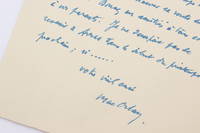
194784007Saint-Cyr-sur-Morin: S. n. 1947. Fine. S. n. Saint-Cyr-sur-Morin 20 Décembre 1947 13.50 x 21.50 cm une feuille Autograph letter dated and signed by Pierre Mac Orlan 15 lines in turquoise ink to the budding poet Roger Valuet. Fold marks inherent to postal envelope. He urges his young colleague to send him his latest writings: ""Bien sûr ! Envoyez-moi vos poèmes dès que vous les aurez réunis. Je les lirai et vous répondrai à ce sujet."" ""Of course! Send me your poems as soon as you have gathered them together. I will read them and respond to you on the subject."" and hopes to return to the North to see him again: ""Je ne désespère pas de revenir à Arras dans le début de printemps prochain si. Votre vieil ami."" ""I do not despair of returning to Arras at the beginning of next spring if. Your old friend."" Originally from Arras Roger Valuet is a popular writer who signed under the pseudonym Roger Vilard numerous detective and spy novels. At the beginning of his career he was helped by Pierre Mac Orlan who wrote the preface to his first collection of poems. S. n. unknown
189864430Paris 1898. Fine. Paris 9 mai 1898 12 x 15 cm un feuillet Autograph letter signed by Pierre Puvis de Chavannes dated May 9 1898 19 lines in black ink on letterhead with the address of the mansion of his wife Marie Cantacuzène ""89 avenue de Villiers"" . A moving letter of thanks from the painter Pierre Puvis de Chavannes: "" The thought of associating my work . with your own paternal feeling leaves me an inexpressible impression intimate full of emotion. "" unknown
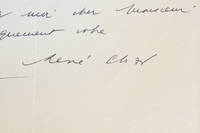
194762727L'Isle-sur-la-Sorgue 1947. Fine. L'Isle-sur-la-Sorgue 2 novembre 1947 21 x 26.90 cm 1 page sur une feuille Autograph letter signed by René Char of 11 lines written in black ink. Folds inherent to the mailing. René Char wrote this letter to René Wintzen editor-in-chief of the magazine Documents from 1929 to 1931. René Wintzen then began to publish a literary magazine Vent debout from which he sent Char a copy. The poet encourages him and tells him to persevere while ""discriminating the wheat from the chaff . "" René Char apologizes for not having a finished text to provide: ""I regret it. I write little and am only an accessory poet! "". This highlighting of a rare writing corresponds to René Char's idea of poetry and opposes the work advocated by Valéry. René Char writes little and submits to the demands of poetry: ""I never cheat. I have spent six months waiting for a word or a formula . This is the requirement of poetry. An absolute requirement. No words are free. Interview between René Char and Édith Mora Nouvelles littéraires 1965. The author also shows a distancing from poetry at the end of the decade. In fact Char experimented with new genres: he tried ballet with La Conjuration in April 1947 but also at the theater with Le Soleil des eaux music with Boulez and finally with the cinema. However he never leaves poetry and publishes the same year Poem sprayed . Char's modesty as to his status as a poet expresses the artist's subjection to the demand for poetry. unknown
190078743s. l. Londres London 1900. Fine. s. l. Londres London 24 mars 1900 10 x 15.70 cm 6 pages sur 2 doubles feuillets Handwritten signed letter addressed to Natalie Clifford Barney and enriched with a poem entitled « Le Miroir » London 24 March 1900 10 x 157 cm 6 pages on 2 double leaves Handwritten manuscript letter by Renée Vivien signed Pauline and written in black ink on a double leaf headed 24 Hyde Park Street. This letter contains a handwritten alexandrine poem entitled Le Miroir; never published on the initiative of the poet but it has been transcribed in Renée Vivien et ses masques in à l'encart April 1980: Je t'admire et ne suis que ton miroir fidèle Car je m'abîme en toi pour t'aimer un peu mieux; Je rêve ta beauté je me confonds en elle Et j'ai fait de mes yeux le miroir de tes yeux Je t'adore et mon cur est le profond miroir Où ton humeur d'avril se reflète sans cesse Tout entier il s'éclaire à tes moments d'espoir Et se meurt lentement à ta moindre tristesse Ô toujours la plus douce ô blonde entre les blondes Je t'adore et mon corps est l'amoureux miroir Où tu verras tes seins et tes hanches profondes Ces seins pâles qui sont si lumineux le soir! Penche-toi tu verras ton miroir tour à tour Pâlir ou te sourire avec tes mêmes lèvres Où trembleront encore les mêmes mots d'amour Tu le verras frémir des mêmes longues fièvres Contemple ton miroir de chair tendre et nacrée Car il s'est fait très pur afin de recevoir Le reflet immortel de la beauté sacrée Penche-toi longuement sur l'amoureux miroir! The rest of this long missive has however remained unpublished. A very beautiful letter sent from London by the Muse aux Violettes who misses her little one: Despite its slowness time passes you see and brings the hour that I await feverishly the time to meet again Natalie! Two more sad evenings and the third you will be there to rock me in your arms! . Today I was still disproportionately bored. I so need to see you again that I count the hours as they pass. I only think of you obsessed haunted taken possessed by you and by our memories. I am a poor unhappy thing far from you. Weary of society life We had the queen's dressing room how chic my darling! Lady Augustus Fitz Clarence invited us. She descends from a bastard of the King and is therefore an illegitimate relative of the sovereign! Renée lingers on the contemplation of a present from her darling: Your ring I love it so much it is a bond of our love that never leaves me. I so regretted your dagger that at the last moment I forgot to carry. Your ring you see is your memory on my finger I look at it and part of our tenderness is embodied in it. It is at the end of 1899 and through Violette Shillito that Renée Vivien then Pauline Tarn met Natalie Clifford Barney ""this American woman softer than a scarf whose sparkling face shines with golden hair sea blue eyes never-ending teeth"" Colette Claudine à Paris. Natalie who had just experienced a summer romance with the scandalous Liane de Pougy who introduced her to sapphism paid little attention to this new acquaintance. Renée on the other hand was totally captivated by the young American woman and describes this love at first sight in her autobiographical novel Une femme m'apparut: ""I lived again the hour already well past when I saw her for the first time felt the shiver that ran through me when my eyes met the mortal steel of her look those eyes blue and piercing as a blade. I had a dim premonition that this woman would determine the pattern of my fate and that her face was the predestined face of my Future. Near her I felt the luminous dizziness which comes at the edge of an abyss or the attraction of a very deep water. She radiated the charm of danger which drew me to her inexorably."" ""Winter 1899-1900. Beginnings of the idyll. One evening Vivien is invited by her new friend to Mme Barney's studio Natalie's mother 153 avenue Victor-Hugo on unknown
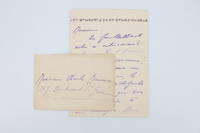
190679816s. l. Paris 1906. Fine. s. l. Paris s. d. ca. 1906 11.50 x 16 cm 1 page 1/2 sur un double feuillet Autograph letter signed by Renée Vivien addressed to Charles Maurras written in violet ink on a double leaf of headed paper adorned with a border of violets. Transverse folds inherent to mailing envelope included. Beautiful letter of thanks: ""Monsieur En feuillettant votre si intéressant volume : De l'Avenir de l'Intelligence j'ai relu avec un plaisir ému les pages - trop indulgentes vraiment ! - que vous avez consacré à mes ouvrages. Merci infiniment. Et veuillez agréer mes très reconnaissants sentiments de confraternité littéraire. Renée Vivien"" ""Sir While leafing through your most interesting volume: De l'Avenir de l'Intelligence I reread with moved pleasure the pages - too indulgent really! - that you dedicated to my works. Thank you infinitely. And please accept my most grateful sentiments of literary confraternity. Renée Vivien"" Charles Maurras had indeed devoted a dithyrambic chapter of his work to the Muse of violets whose verses he compared to those of Verlaine: ""Le vieux faune sentimental des Fêtes galantes et de Parallèlement reconnaîtrait chez Renée Vivien beaucoup plus qu'une élève certainement une des Surs une de ces Amies terribles qu'il a chantées. Quant à Baudelaire il lui dirait : ""Ma fille"" aux premiers regards échangés. Baudelairisme profond central générateur."" ""The old sentimental faun of Fêtes galantes and Parallèlement would recognize in Renée Vivien much more than a student certainly one of the Sisters one of those terrible Friends he sang of. As for Baudelaire he would say to her: 'My daughter' at first glance. Deep central generative Baudelairism."" unknown
197362631Paris 1973. Fine. Paris 19 mai 1973 21 x 29.70 cm une page sur une feuille Autograph letter signed by Robert Amadou to Mrs. Charmer-Leroy written in blue ink. Address of Robert Amadou at the top left stamp dâte at the beginning of the letter address of the recipient on the back of the letter. Traces of creases caused by mailing. The author writes this letter following a letter from his correspondent. He offers to meet her to exchange with her ""things we love - the only ones worth living ."". unknown
189074255s. l. Paris: S. n. 1890. Fine. S. n. s. l. Paris s. d. circa 1890 26.50 x 20.50 cm une page et demie sur une feuille Autograph letter signed by the dandy count one and a half pages 15 lines written in black ink to Henri Lapauze offering him several appointment options at his home: "". I shall be delighted to receive you on Friday at 10 o'clock or at 2 o'clock as you prefer. We are charmed to have you in Douai."" A black ink stain in the margin on the verso of the letter. Henry Lapauze 1867-1925 was a journalist and art critic who became in 1905 curator of the Petit Palais converted four years earlier into a museum whose collections he considerably enriched by acquiring notably the Courbet Henner and Falguière collections with in the twilight of his life a marked predilection for the Decorative Arts of which he was one of the ardent promoters. S. n. unknown
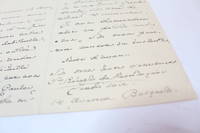
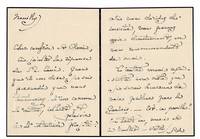
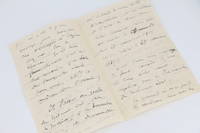
189074257s. l. Paris: S. n. 1890. Fine. S. n. s. l. Paris s. d. circa 1890 23 x 18 cm deux pages sur une feuille Autograph letter signed by the dandy count two pages 27 lines written in black ink to Henri Lapauze then journalist at Le Gaulois asking him after receiving his latest published work which he sent him to write a favorable article about him: "". I am sending you my new volume asking you to announce it with your usual good grace. I furthermore desire that the subsequent and detailed review of it be written by you for the readers of Le Gaulois."" Robert de Montesquiou also requests from Henri Lapauze a meeting when he returns to Paris: ""I will ask you for a brief meeting and we can chat for a moment."" Henry Lapauze 1867-1925 was a journalist art critic then in 1905 curator of the Petit Palais converted four years earlier into a museum and whose collections he considerably enriched by acquiring notably the Courbet Henner Falguière collections with at the twilight of his life a marked predilection for the Decorative Arts of which he was one of the ardent promoters. S. n. unknown
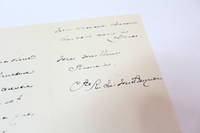
189574321s. l.: S. n. 1895. Fine. S. n. s. l. s. d. circa 1895 12.50 x 17 cm deux pages et demie sur une feuille rempliée Autograph letter signed by the dandy count of two and a half pages 27 lines written in black ink insisting to his friend Henry Lapauze then journalist at Le Gaulois to see published a note he had sent him as well as the project of an interview with a certain Monsieur Lavé and the related arrangements: "". je suis persuadé que vous trouverez l'un comme l'autre intérêt et plaisir à l'entretien projeté. Vous pouvez agir directement en vous recommandant de moi."" "". I am persuaded that you will both find interest and pleasure in the projected interview. You can act directly recommending yourself through me."" Finally Robert de Montesquiou wishes to discuss with Madame Lapauze: "". un bien précieux recueil dont je veux lui parler comme il le mérite à savoir posément et passionnément."" "". a very precious collection of which I want to speak to her as it deserves that is to say calmly and passionately."" that she had sent him. Henry Lapauze 1867-1925 was a journalist art critic then in 1905 curator of the Petit Palais converted four years earlier into a museum and whose collections he considerably enriched by acquiring notably the Courbet Henner Falguière collections with at the twilight of his life a clear predilection for the Decorative Arts of which he was an ardent promoter. S. n. unknown
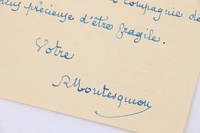
192183149s. l.: S. n. 1921. Fine. S. n. s. l. 26 octobre 1921 18 x 21 cm une page Grateful autograph letter dated and signed by the dandy count 14 lines written in blue ink probably addressed to his friend the critic Henri Lapauze. ""Mon cher ami ne doutez pas que je ne sache dans cet aimable spirituel et bienveillant article faire la part du critique intelligent qui l'a rédigé et celle du fidèle ami qui l'a inspiré. L'acte de donation en faveur de votre musée vous portera mon remerciement. La statuette est de cire. je l'espère cependant durable et l'avalanche de roses que vient décrire si poétiquement Alexandre lui promet une compagnie délicate elle aussi plus précieuse d'être fragile. Votre RMontesquiou. 26 Octobre 1921."" ""My dear friend do not doubt that I know how in this amiable witty and benevolent article to distinguish between the part of the intelligent critic who wrote it and that of the faithful friend who inspired it. The deed of donation in favor of your museum will bear my thanks. The statuette is made of wax. I hope however that it will be durable and the avalanche of roses which Alexandre describes so poetically promises it delicate company also more precious for being fragile. Yours RMontesquiou. 26 October 1921."" Fold marks inherent to envelope insertion three letters having slightly smudged. S. n. unknown
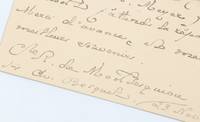
192183152s. l.: S. n. 1921. Fine. S. n. s. l. 26 octobre 1921 18 x 21 cm une page Autograph letter signed on bristol board by the dandy count 17 lines written in black ink probably addressed to his friend and bibliographer the critic Henri Lapauze. ""Cher monsieur et ami je vous recommande ma bibliographie que j'ai hâte de lire de votre main qui voudra joindre à la bonne grâce de l'écrire celle de me l'adresser. Je compte aussi sur vous pour recommander le livre à M. Paul Perret à qui j'ai demandé un entretien d'accord avec M. Meyer - et dont j'attend la réponse. Merci d'avance et mes meilleurs souvenirs. Cte R. de Montesquiou. 23 novembre."" ""Dear sir and friend I recommend to you my bibliography which I am eager to read from your hand which will wish to add to the good grace of writing it that of addressing it to me. I also count on you to recommend the book to M. Paul Perret to whom I have requested an interview in agreement with M. Meyer - and from whom I await the response. Thanks in advance and my best regards. Count R. de Montesquiou. 23 November."" S. n. unknown