89 résultats
1891249682London: William Blackwood and Sons 1891. New edition with index. Photographic frontispiece of "Himalayan and North Indian Game" illustrated by photographs and text drawings. xviii 362 pp. 1 vols. 8vo. Original pictorial green cloth stamped in gilt with mountain goat on upper cover. Extremities a bit rubbed front inner hinge cracked. Very good. New edition with index. Photographic frontispiece of "Himalayan and North Indian Game" illustrated by photographs and text drawings. xviii 362 pp. 1 vols. 8vo. A scarce and classic work of big game hunting in the mountains of Central Asia. Yakushi M23 William Blackwood and Sons unknown books
187027855France 1870. Board game. Fine. A French childrens' board game complete with the folding board 10 number disks 6 wooden pieces the instruction sheet and box. The box is papered in apricot & gold spotted paper with an image on the cover of clowns ascending a pyramide and one tumbling down. The box measures 11 x 8". All in very good condition. unknown
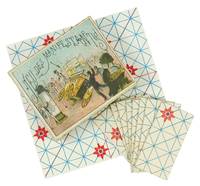
18951270431895. Paris: n.d. ca 1895. <br /> <br /> Original box 85 x 73 x 20 mm covered in gilt-patterned paper with mounted color illustrated title on outside lid and printed instructions slip on inside lid. With 8 printed rectangular card game pieces plus the rare color printed solution sheet 120 x 120 mm folded twice. Minor split to one edge of the lid a few small tears to the sheet otherwise a very good and complete example of this rare and fragile game.<br /> <br /> § A very early apparently the first issue of this French "game of protesters" in which the player takes on the part of a police officer attempting to prevent people from assembling at a demonstration. <br /> <br /> Not located in OCLC although other searches reveal copies in the Indiana Lilly Library in the Jerry Slocum Mechanical Puzzle Collection one within a "coffret de jeu" a boxed group of puzzles and games at the Musée du Jouet de Poissy and another a variant in which the game pieces are triangular at the Marseille Musée des Civilisations de l'Europe et de la Méditerranée MUCEM. Later issues with varying artwork can also sometimes appear.<br /> <br /> The Marseille museum's copy featured in a forum held on February 5 2024: "Faut-il parler des violences policières" "Should we talk about police brutality". The curator Mireille Jacotin explained: "Jeu des manifestants is a game in which you are the hero that is to say the police officer and as the accompanying instructions explicitly state you are firmly positioned on the side of the public authority responsible for maintaining order. In reality the game consists of arranging a set of cardboard pieces-printed on a right-angled triangle-shaped board-in such a way as to ensure that no two red dots end up on the same line. The underlying concept is to simplify the police's task by ensuring that they do not face a mere undifferentiated crowd-and certainly not any organized lines requiring a tactical breach such as a battlefront during wartime. The game board features no specific characters; instead it presents a simple grid-comprising lines and sectors-that serves as a framework for devising and visualizing a strategic plan atop a generic cartographic representation of public space. The red dots in this scenario represent the demonstrators. On the lid of the box however is an urban scene: an overturned double-decker bus a urinal figures stirring in the distance and a policeman in the foreground." For the original French see https://www.davduf.net/le-jeu-des-manifestants-1895. <br /> <br /> It seems likely this game was inspired by the many protests that took place in Paris throughout the 1890s including the birth of the international May Day demonstrations. unknown
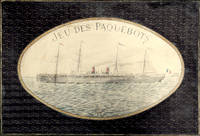
18972210164<p><i>Comprising two coloured map board 66 x 99 cm folding down to 32.5 x 49.5 cm one cloth hinge broken; 14 route cards; a barometer dial 19 x 19 cm with gilt metal spinning arrow some abrading from use; eight painted white metal playing pieces in the form of ships contained in the original small box one piece not original; 16pp booklet of instructions bound in original light green printed wrappers; all contained in the original box 35 x 52 x 5 cm; the hinged lid with a large coloured lithograph title label showing the 'Normandie' leaving port at full steam some minor abrasions but overall in good condition.</i><br /></p><p><i>Jue des Paquebots</i> was something new to games when it was published in 1897 as each player moves their boats on large maps exactly replicating the routes taken by two major French shipping lines. </p><p>The game includes two large folding boards designated 'Carte A' which illustrates the Atlantic shipping lines the other 'Carte B' with the shipping lines leaving Marseilles in the direction of the Black Sea the Indian Ocean and the Pacific. Rather pointedly the instructions state that the two maps include only the French shipping lines of the Messageries Maritimes and the Cie Générale Transatlantique the United Kingdom then the leading maritime nation is neither shown on the maps nor mentioned. </p><p>The players first decide which map they are going use and then select or bid one of the Itinerary cards 8 for map A and 6 for map B. The aim of each player is to complete the journey indicated by their itinerary and then make the return voyage; the first player to complete this double crossing wins. However the number of stopovers is not equal for each different itinerary in play. In order to equalise the chances of winning the players with the fewer ports of call have to repeat their journey a second or even a third time if necessary until the number of ports visited or passed by them in these different routes equates to the number of ports of the busiest route.</p><p>The routes all follow those which the two major French shipping companies plied. These include final destinations at Yokohama Australia New Zealand Zanzibar Odessa Buenos Ayres New York and the Antilles. </p><p>Each player places a ship playing piece at port at the beginning of their route. The first player now spins the Barometer Dial which has outer and inner instructions that allows them to advance out of port when their turn come around again the arrow is again spun and the player can read the inner line of instructions and so advance 1 2 or 3 ports along their route. However there are also stops on the Barometer Dial that include Damage - where you go back to the previous port and pay a token to the bank; Heavy Fog - where you are left stranded until the next round; Collision - this allows another turn of the dial but it the result is 50/50 chance of being sunk and thrown out of the game - you can pay for another ships so all is not lost; Call for Distress - also misses a turn; Shipwreck - something like collision although you can start out again with a new ship and no fine; Rescue - also causes the player to miss a turn; lastly and somewhat topical there is Quarantine - here the player misses a turn and also has a second spin of the arrow to determine if you can go into port or not.</p><p>The lid of the box illustrates the Cie Général Transatlantique liner La Normandie that plied the North Atlantic to New York in the summer and the south Atlantic in the winter - the ship sports a US flag on the foremast and the makers initials on the aft mast. Built in 1886 it was the largest and fastest liner of the company and was originally named 'Ville de New York.' It was also lit by electricity and could carry 1000 passengers and became the model for several sister ships built to the same plan.</p><p>The maker Charles Watilliaux succeeded the games manufacturer Coqueret in 1874 and for the next 35 years became a major publisher and manufacturer of board games and toys until their acquisition by Revenaz & Tabernat. His registered initials were 'W.X.' which is slightly modified for the flag on the box lid as C.W.X.</p> Watilliaux, éditeur.
190025498Madrid: La Caza Ilustrada 1900.- Año IV: desde el nº 76 10 de enero de 1900 hasta el nº 110 20 de diciembre de 1900; 4º mayor 27 cm.- En total son 30 fascículos que abarcan el año completo a falta de 5. Se venden todos como colección conjunta al precio indicado. Como se indica faltan 5 números para completar el año. Su estado de conservación es muy bueno sobre todo dado el tiempo transcurrido y que los fascículos se hallan sueltos. CAZA Y PESCA Libro en español La Caza Ilustrada paperback
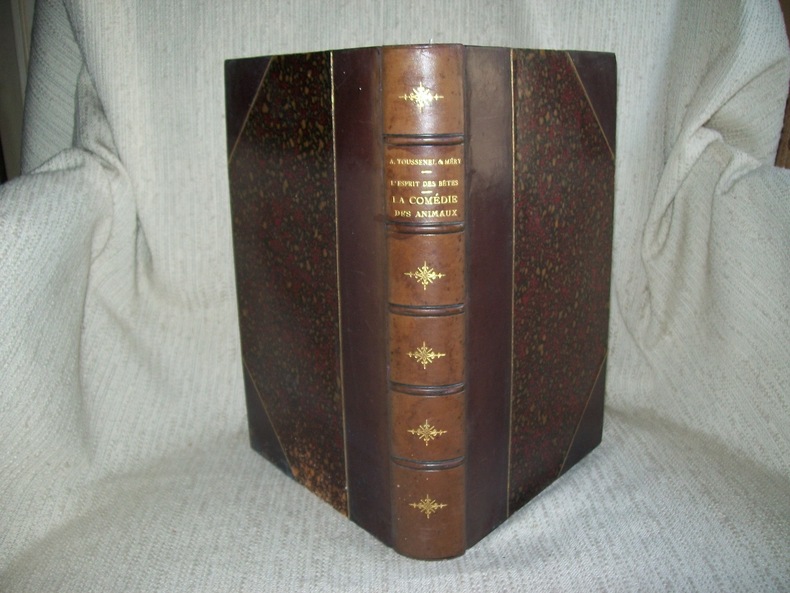
1886GITj991Paris Librairie Ch Delagrave 1886. Paris Hetzel sans date vers 1880. 2 ouvrages en 1 volume grand in-8 384pp et VIII 308pp. Demi basane acajou à coins signés, dos à nerfs orné de fleurons dorés, tête dorée, non rogné, reliure de l'époque. MERY: portrait de l'auteur en frontispice, abondante illustration dont 16 hors texte comprises dans la pagination par Morin, Speecht et Bombled, rousseurs. TOUSSENEL: Titre-frontispice et nombreuses illustrations dans le texte par Emile Bayard, quelques rousseurs par endroits. Les deux ouvrages sont complets. Dos uniformément passé au brun, reliure de l'époque solide et décorative malgré le défaut signalé.
18151191291815 A Paris, chez Pigoreau, libraire - 1815 - In-12 (environ 17 x 10cm), demi veau à petits coins, pièce de titre rouge et dorée au dos - 321 pp.
18891127781889 Editions de Bordeaux, Imprimerie nouvelle A. Bellier et Cie - 1889 - Petit in-8, broché, couverture rempliée et illustrée en N&B - 89 p. - Illustré de 15 gravures et vignettes par F. Masson et L. Bigot, 3 planches hors-textes et nombreuses croquis en N&B
184421201844 Edition Charles Lebossé, Angers,1844. In-8 demi-basane époque, dos orné. 15 pages, 4 feuillets, 4 feuillets, 125 feuillets, 4 feuillets. Notes biographiques, et notice bibliographique en tête de volume. Reproduction de l'édition de 1585. Nombreuses illustrations sur bois à mi-page
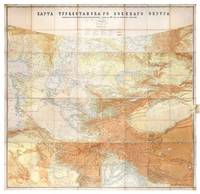
1881149774St Petersburg: Cartographic Institute of the Military-Topographic Department of the General Staff 1881. The cartographic climax of the "great game" Second edition significantly improved from the first edition 1877 to incorporate the latest military intelligence from field surveys. This magisterial work of "great game" cartography was presented at Russia's Tashkent military headquarters to the daring French explorer Stanislas Benoist-Méchin during his epic 1881-3 overland journey from Beijing to Europe. We have traced no other copies. A presentation inscription on the verso of the map reads in French "To Mr Baron Benoist-Méchin from Generals Kouropatkine and Levaschew October 1882 Tashkent." Benoist-Méchin 1854-1923 began travelling the world as a young man and then served as the French cultural attaché in Tokyo 1880-1. In 1881 he decided to return to Europe via the daring route through Central Asia. Leaving Beijing on 15 September with his regular travelling companion Comte Humbert Adrien de Mailly-Chalon 1853-1921 he journeyed through Manchuria and across Russian Siberia. In 1882 having reached Kashgar they received permission to cross Russian Turkestan spending six weeks in Tashkent as the honoured guests of General Mikhail Tchernayev the architect of Russian's expansion across Central Asia General Aleksey Nikolayevich Kuropatkin 1848-1925 and the aforementioned General Levaschov likely the artillery officer Vladimir Levaschov 1834-1898. After reaching Samarkand they travelled in extreme cold through Bukhara and via Khiva to Tehran reaching Moscow in October 1883 where they were accorded a hero's welcome. Their descriptions of this feat of exploration were published in 1885 in the Bulletin de la Société de géographie. This map was made for the use of the Russian military high command in St Petersburg and in the Turkestan Military District which had been established in the 1860s amid the occupation of Tashkent and Bokhara and dates from a period following the Second Anglo-Afghan War and the Battle of Geok Tepe when tensions were at their height. It encompasses almost the entire playing surface of the "great game" extending east-west from Xinjiang and Tibet to the Caspian Sea and Afghanistan and north-south from Siberia to northern India. Unparalleled in terms of accuracy and detail it names every city town and village and the legend has entries for such features as fortifications railways mail and caravan roads and mines. Spot heights are given in feet and deserts are marked with a light red pattern. It is much improved on the first edition which had only 48 panels and did not extend as far south. Chromolithograph map 195 x 200 cm dissected onto 64 sections and mounted on linen as issued laid-down printed slip stating "corrected up to 1881" small folding tab at right edge. Folding away to 28.5 x 28 cm. Housed in green quarter morocco solander box with chemise by the Chelsea Bindery. Map surface generally clean and brighta few stains toning and soiling at edges small repair at top-left edge verso foxed and with couple of areas of linen reinforcement: very good. unknown
1895132391895 bradel demi-percale marron clair in-octavo (half hard-back brown percale in-octavo), dos long (spine without raised bands) - pièce de titre sur fond bleu-marine avec double filet or (label of title with gilt lines) - 1 fleuron au fer plein évidé (1 hollowed out blocking stamp) - double filet or au bas du dos (double gilt line in the bottom of the spine), papier peigné aux plats (cover with painting paper), tranches rognées (edges smooth), pages de garde blanches (white endpaper), illustrations : 1 portrait de l'auteur en frontispice (author's frontispiece portrait) et 32 figures explicatives in-texte (explanatory pictures in text), 414 pages, sans date (no date) (les années environ) - 1895 - à Paris H. Delarue et Compagnie Libraires-Editeurs,
1851CHA2018MRelié, 445 pages, paru en 1851, livre en très bon état, protégé sous plastique.
188521849paris J. Rothschild 1885 in-8 pleine percale un volume, reliure pleine percaline bleu-gris cartonnage polychrome in-octavo Editeur à plaques spéciales polychromes pour le dos et les plats (editor hard-back percale with special covers editor for the spine and the cover in-octavo) (19,2 x 14 cm), plaque spéciale or et noir pour le dos avec un motif "Tête de Cerf et Tête de Lièvre", plats biseautés, 1er plat illustré en vert, marron, fauve, noir et or sur fond bleu-gris : "Thème Chasse à Courre", toutes tranches lisses rouges (all red edges), reliure signée : "CH. MAGNIER REL.", orné de 74 vignettes dans le texte en noir + 30 eaux-fortes hors-texte par Karl Bodmer, tirées en bistre sur papier gris, encadrées d 'un filet doré, sous serpentes roses, 226 pages, sans date (1885) Paris, J. Rothschild, Editeur Editeur,
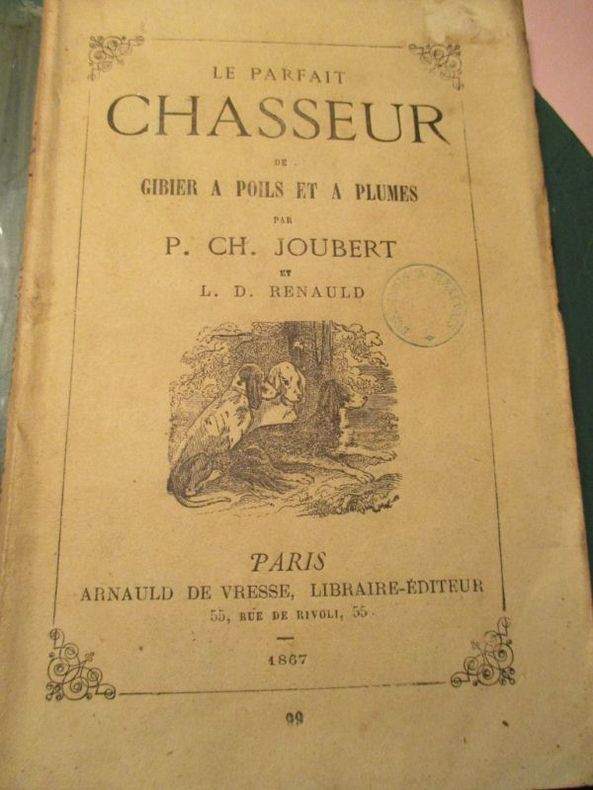
186755851867 Paris Arnauld de Vresse librairie-éditeur 1867 In12 broché 95 pages cachet de colportage sur la couverture
18676288Paris Arnauld de Vresse 1867 in-12 de 95 pp. demi-toile verte
18846396Cambrai: Renaut, 1884. 1884 1 vol in-8° (210 x 140 mm) de : 139 pp. (dont faux titre, titre) ; nombreux schémas et tableaux dans le texte ; cachet de libraire et signature manuscrite de l'auteur et concepteur du jeu au dos de la page de titre. Demi-basane verte d'époque, dos lisse orné et titré, plats recouverts de papier marbré, tranches marbrées. (Reliure frottée).
1891335233eme. Ed. revue et corrigée.- Paris: Octave Doin Ed. 1891.- XXXII-398 p. en numeración continua: Ilustraciones; 8º 189 x 125 cm.; Texto en francés; Fina encuadernación a la alemana en Tela Nueva tejuelo. La portadilla con una falta de papel pequeña en su base. El papel algo grisáceo. Por lo demás en buen estado. ESOTERIA TEOSOFÃA PARAPSICOLOGÃA ALQUIMIA CARTOMANCIA SECTAS Y CIENCIAS OCULTAS EN GENERAL Livre en français Octave Doin hardcover
189146035Paris: Octave Doin 1891. Fine. Octave Doin Paris 1891 11.50 x 18.50 cm broché Third edition with some parts in first edition as revised and corrected. Work illustrated with figures in the text. Light tear with minimal lack at head of first board two slight marginal lacks on second board some foxing. Rare. Octave Doin unknown
189146035Octave Doin | Paris 1891 | 11.50 x 18.50 cm | broché
1886R320077328DOIN OCTAVE. 1886. In-12. Broché. Etat passable, Plats abîmés, Dos abîmé, Mouillures. XXXII + 398 + 16 pages - Quelques illustrations en noir et blanc dans et hors texte - Des traces de mouillure en tranches (gouttiere) sans conséquence réelle sur la Lecture - 1er plat et page de titre manquants - VENDU EN L'ETAT.. . . . Classification Dewey : 140-Les divers systèmes philosophiques
18751130571875 A Paris, E. Dentu, éditeur, libraire de la société des gens de lettres - 1875 - Petit in-8, broché, couverture illustrée - 299 p.
18760041461876 Paris, J. Rothschild, 1876. Petit in-folio (288 X 362) demi-chagrin vert lierre, dos cinq nerfs, fleuron doré dans les compartiments, auteur et titre dorés, nom de l'éditeur en queue, tranches dorées (reliure de l'époque); (1) f. blanc, (2) ff. de faux-titre et titre imprimé en rouge et noir, frontispice, 140 pages, 45 planches couleurs hors-texte sous serpente, (1) f. blanc. Quelques rares rousseurs, principalement aux serpentes, trois taches sur le cuir du plat supérieur, sans gravité.
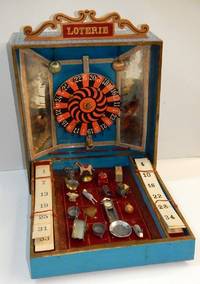
19002210013<p><i>Wooden box 32 x 26 x 8 cm with light blue patterned paper covering; the lid with a label lettered 'Loterie' and a hinged pierced wooden sign with the words 'Loterie' lettered in gilt paper on red; the lined paper interior with a central mounted wheel between mirrored sides and two hanging silk balls; the fall front where the prizes are held with two spaces left and right containing six lottery cards one from another set together with 16 toy prizes as listed below.</i></p><p>Lottery or carnival wheels games became popular at the end of the nineteenth century. Their construction was more complicated than heretofore with the addition of a rotating wheel with pins with a 'clack' mechanism sounding as the wheel is spun. The numbers on the wheel are randomly arranged from 0 through to 25 in white on alternating in black and red ground - clearly based on the 'single zero' form of roulette wheel that became the norm in Europe from the middle of the nineteenth century. The design has a second purpose as the box is hinged so that open it is given the form of a fairground entertainment with an assortment of prizes laid out in a display on squares below the wheel that each have a number too. </p><p>The idea of the game is twofold firstly as the wheel is spun and numbers called out the player who first completes a card of numbers is the winner. In the second game when the numbers 1 to 16 are called out and a player has the number on one of the cards they can then claim one of the small toy prizes. The sixteen twenty assorted of toy prizes include: a handcart wall clock bracelet scales pram wooden top bracelet fairground horse two rabbits a chicken a dish a parcel a metal top metal puzzle pair antimony jardinieres and a heart broach.</p><p>There is no makers name and the design although of a solid construction is nevertheless probably a bespoke production possibly made in order to be sold through fairgrounds and market stalls rather than the more salubrious emporia for children. The interior is lined in turquoise paper with bevelled mirrored silvered card sides and although simple the idea was glittery enough to catch any passing child's attention.</p>
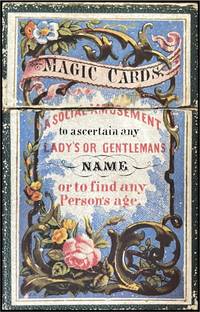
185019999England 1850. 18 cards 89 x 54 mm 9 printed on pink cardstock and 9 on yellow. Housed in original slipcover made of pebbled green paper over boards with chromolithographed label affixed to the front open at top and bottom. Light wear to edges of slipcover otherwise in excellent condition. A charming and unusual magic card game based on mathematical principles that purports to reveal anyone’s name and age. Using the pink cards for women and yellow for men the questioner holds onto the instruction and key cards and gives the player the rest of them which have lists of names and numbers and the letters A E I O U W and Y at the top. The player tells the questioner the letters corresponding to which cards have their name on them and using the key the questioner adds their corresponding numbers to get the player’s name provided it is one of the 127 names listed. The game is played the same way to determine players’ ages. The game actually works! unknown
1890GITj980Paris HAchette 1890. In-8 2 feuillets non chiffrés (faux-titre, titre) II-IV 6-415pp. Demi maroquin acajou à coins signés, dos à nerfs, tête dorée, non rogné, 1er plat de la belle couverture illustrée en couleurs conservé, reliure de l'époque. Orné de 2 plans de chenil à pleine page, 54 vignettes en tête de chapitre, cul de lampe et dans le texte d'après Bodmer et Krafty, 33 planches d'après Bodmer et de Penne (18 de races de chiens, 15 de gibiers). Rousseurs par endroits. Bel exemplaire complet du texte et des illustrations, reliure solide de bonne qualité. Thiébaud colonne 572. Edition plus complète que l'originale parue en 1858.