11 347 résultats
196011152Boston: Boston University. Fine with no dust jacket. 1960. First Edition; First Printing. Hardcover. This is the manuscript submitted by Lincoln for his Phd. Signed by the Dean of Theology & Associate Professor of Social Ehtics but NOT by Lincoln unfortunately. Bound carbon copy printed on one side of each page. Obvious precursor to "Black Muslims in America. " ; 4to 11" - 13" tall; 390 pages . Boston University hardcover
187724759<p>"<i>she bore her accumulated miseries with a serene resignation an intrepid fortitude a true heroism of soul of which the history of the world does not afford a brighter example.</i>"</p> <b>MARY LINCOLN.</b>Signed Book. "<i>Mary Lincoln. / 1878</i>" in her copy of Charles Duke Yonge <i>The Life of Marie Antoinette Queen of France</i> 2d rev. ed. London: Hurst and Blackett 1877 xvi 432 pp. 8vo. bound in tooled purple cloth boards with titled spine. A carte-de-visite portrait of Mary Lincoln has been affixed to the front free endpaper.<br /><p><b>Historical Background</b></p><p>Mary Lincoln likely identified with the guillotined French queen's plight. Their words whether truly said or not and their intentions were frequent targets of abuse in the press. The press of their respective days viewed both as spendthrifts and harshly questioned their motives attacking Marie Antoinette's commitment to the welfare of the French people "let them eat cake" and Mary Lincoln's loyalty to the Union in light of her southern familial ties.</p><p>Perhaps Mary Lincoln drew comfort and inspiration from Yonge's closing tribute to his royal subject quoted above. An incredible association copy acquired and inscribed by Mary Lincoln while she was living in France.</p><p><b>Mary Lincoln</b> 1818-1882 was born into the prominent Todd family in Lexington Kentucky. Educated at female academies and boarding schools she learned to speak French fluently and also studied literature dance drama and music. She was very well-educated for her time place and gender. In November 1842 she married Abraham Lincoln in Springfield Illinois and they had four sons. She supported her husband's political ambitions becoming First Lady in 1861. Because she was from a border state with several of her relatives supporting the Confederacy Mary Lincoln was the object of suspicion in the press. Although she was responsible for hosting many social functions her extensive spending to renovate the White House also drew complaints from a nation at war and from her husband. However she also visited wounded soldiers in Washington hospitals taking them fruit and flowers and writing letters home for them. Prone to severe headaches and depression she suffered the loss of three of her four sons and was present when Abraham Lincoln was assassinated at Ford's Theatre.</p><p>After leaving the White House she lived in Chicago where her son briefly had her committed to a sanitarium in 1875. After being declared competent to manage her own affairs in 1876 she spent the next four years traveling in Europe and living in Pau France. She later returned to Springfield where she died in her sister's home.</p><p><b>Marie Antoinette</b> 1755-1793 was born in Vienna Austria the daughter of Francis I Holy Roman Emperor. She married the future French king Louis XVI 1754-1793 in 1770 when she was just fifteen years old. They had four children between 1778 and 1786. When her husband ascended to the throne in 1774 she became the Queen of France. The young royals came to symbolize all of the excesses of the reviled French monarchy and she became the target of a great deal of vicious gossip. After the outbreak of the French Revolution in 1789 the government placed the royal family under house arrest in the Tuileries Palace. After the abolition of the monarchy in September 1792 the Convention found the former king guilty of undermining the French Republic and executed him in January 1793. The Revolutionary Tribunal tried Marie Antoinette in October and found her guilty of depleting the treasury conspiracy against the Republic and treason. She was sent to the guillotine on October 16 1793.</p><p><b>Charles Duke Yonge</b> 1812-1891 was born in Eton and attended Eton College Cambridge University Oxford University and Keble College. From 1866 to his death he held a chair of English Literature at Queen's College Belfast. He authored a dozen books of history and biography. He translated six works by Cicero and prepared an English-Latin dictionary and an English-Greek lexicon.</p><p><b>Condition</b></p><p>Spine cracked with some minor losses and some rubbing at top and bottom some wear to boards pages overall clean with a few bearing some marginal loss that has been repaired else very good.</p> Hurst and Blackett hardcover books
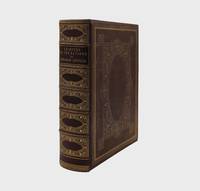
1867376997Washington D.C.: Government Printing Office 1867. Frontispiece portrait. 2XXX930pp. 4to. Original full brown turkey morocco elaborately stamped in gilt repair to front joint. Frontispiece portrait. 2XXX930pp. 4to. One of only 100 specially-bound copies of this official government printing reproducing in its totality the foreign correspondence and declarations of sympathy received from foreign governments and diplomats across the world in response to Lincoln's assassination. <br /> <br /> Congress' resolution for the publication of this work is printed within: "Resolved by the Senate and House of Representatives of the United States of America in Congress assembled That in addition to the number of copies of papers relating to foreign affairs now authorized by law there shall be printed for distribution by the Department of State on fine paper with wide margin a sufficient number of copies of the Appendix to the Diplomatic Correspondence of 1865 to supply one copy to each senator and each representative of the Thirty-ninth Congress and to each foreign government and one copy to each corporation association or public body whose expressions of condolence or sympathy are published in said volume; one hundred of these copies to be bound in full Turkey morocco full gilt and the remaining copies to be bound in half Turkey morocco marble edged." <br /> <br /> The text organizes the messages of sympathy alphabetically by source country and contains an extensive and detailed index to the correspondents within. The frontispiece reproduces the famous Darby & Miller engraved portrait of Lincoln. Monaghan mentions that a small number of copies were bound with Carpenter's portrait as the frontispiece. Monaghan 881; Sabin 41174 Government Printing Office unknown
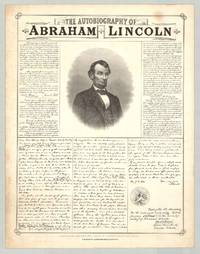
3389Boston: James R. Osgood & Co. 1872. Broadside 24.5†x 19†plus margins; portrait and text in five columns. CONDITION: Torn through upper right the tear affecting the portrait restored backed with Japanese tissue. <p>The first separate printing and first separate facsimile of Lincoln’s famed autobiographical sketch originally composed in response to a request from his friend Jesse Fell printed with a brief account by Fell of the circumstances under which it was written and extracts from a few of Lincoln’s speeches.</p> <p>Lincoln and Fell became acquainted during a session of the Illinois State Legislature in the winter of 1834–35. Lincoln was serving as a representative and Fell as a lobbyist for MacLean County Illinois. The two became political friends and saw much of each other in subsequent years. In 1858 when Lincoln came to prominence as a result of his debates with Stephen Douglas Fell who had recently returned from a trip east where the public was hungry for information about Lincoln approached his friend as he came out of the Bloomington Illinois courthouse one afternoon and asked him for a biographical sketch. Lincoln initially resisted but the following year gave in composing a brief autobiography as well as a letter of explanation both of which he mailed to Fell on December 20th 1859.</p> <p>Delighted that Lincoln had finally complied and eager to promote his cause Fell forwarded Lincoln’s autobiography to his friend Joseph J. Lewis in Pennsylvania who used it for an article that was published in the Chester County Times PA on February 11th 1860. Lewis’s article was reprinted in many newspapers and “became the first widely read biographical sketch of Lincoln and served as a basis for the first three Lincoln campaign biographies in book form†Sage. In 1872 while preparing his biography of Lincoln for publication Ward H. Lamon wrote to Fell asking him to forward Lincoln’s sketch and its accompanying letter to his publisher James R. Osgood & Co. for consultation and facsimile publication. Placing no particular value on the original manuscripts when he first received them Fell had not requested their return but now retrieved them in response to Lamon’s request. He then forwarded the biographical sketch but not Lincoln’s letter of explanation substituting instead his own cover letter. Since Lincoln’s sketch was neither addressed to Fell nor signed Fell included with his letter clippings in Lincoln’s hand reading “Hon. J. W. Fell†and “Yours very truly/A. Lincoln†which were then pasted onto Lincoln’s sketch. Also added was an emblem and statement testifying to the authenticity of the manuscript signed by David Davis Lyman Trumbull and Charles Sumner dated at Washington D.C. March 20th 1872. The facsimile was included in Lamon’s biography and published separately in the form of the broadside offered here.</p> <p>Rare. OCLC records only four copies.</p> <p>REFERENCES: Not in Monaghan; Stern Collection 4792; Sage Harold K. Jesse W. Fell and the Lincoln Autobiography in The Journal of the Abraham Lincoln Association Vol. 3 Issue 1 1981 pp. 48–58. </p> Boston: James R. Osgood & Co., 1872 unknown
1886100151Boston:: Roberts Brothers. Very Good. 1886. Hardcover. An early printing. INSCRIBED by the author to no one in particular on the front free endpaper. Octavo half-bound in brown cloth with gilt lettering and black borders on the spine marbled boards. Moderate shelf wear and aging foxing to edges and endpapers soiling on a few interior pages else very good. Binding is sound. ; 536 pages; Signed by Author . Roberts Brothers, hardcover
1864D16155Baltimore: Cushings & Bailey 1864. First Edition. First and only edition extra-illustrated with approximately 65 inserted portraits. Full red pebbled morocco gilt dated 1882 on the spine rebacked with the original spine laid down the covers panelled in gilt the spine tooled and lettered in gilt with the initials "W.H.W." at the foot. 10 x 8 inches 25.5 x 21 cm; with lithographed title and approximately 65 mostly engraved or lithographed portraits inserted three are original drawings including one of Julia Ward Howe xi lithographed contents 200 pp. lithographed fascsimiles of the handwriting of the authors. Intermittent foxing the inserted portraits have offset to the text leaves opposite rebacked as noted and lightly rubbed. <br/><br/>This volume produced at the time of the 1864 Baltimore Sanitary Fair contains what is considered the first reproduction of the Gettysburg Address in Lincoln's hand. The facsimile was made from what is now known as the "Bliss Copy" of the address the fifth and final manuscript copy of the address that Lincoln executed at the request of the editors of this volume. Other authors represented here include Emerson Poe Melville Hawthorne and many other notables of the period. Cushings & Bailey unknown
1681H0011a2-a6b-b7c-c7d-2315 pages. Small square octavo 7 ¾" x 6 ¼" bound in full leather. Second edition. Thomas Barlow 1607-1691 was an English academic and clergyman who became Provost of The Queen's College Oxford and Bishop of Lincoln. He was considered in his own times and by Edmund Venables writing in the Dictionary of National Biography to have been a trimmer a reputation mixed in with his academic and other writings on casuistry. His views were in fact Calvinist and strongly anti-Catholic and he was one of the last English bishops to identify the Pope as the Antichrist He worked in the 1660s for the 'comprehension' of nonconformists but supported the crackdown of the mid-1680s; and declared loyalty to James II of England on his accession having strongly supported the Exclusion Bill which would have denied the Catholic James the succession. Pope Pius V's response to Queen Elizabeth I of England assuming governance of the Church of England included support of the imprisoned Mary Queen of Scots and her supporters in their attempts to take over England "ex turpissima muliebris libidinis servitute". A brief English Catholic uprising the Rising of the North had just failed. Pius then issued a bull Regnans in Excelsis dated April 27 1570 that declared Elizabeth I a heretic and released her subjects from their allegiance to her. In response Elizabeth who had thus far tolerated Catholic worship in private now actively started persecuting them. Condition: Original bards with new period spine and red label with gilt lettering to spine corners rubbed and bumped else a good to very good copy. Printed by S Roycroft for Robert Clavel at the Peacock hardcover books
1681H0011a2-a6b-b7c-c7d-2315 pages. Small square octavo 7 ¾" x 6 ¼" bound in full leather. Second edition. Thomas Barlow 1607-1691 was an English academic and clergyman who became Provost of The Queen's College Oxford and Bishop of Lincoln. He was considered in his own times and by Edmund Venables writing in the Dictionary of National Biography to have been a trimmer a reputation mixed in with his academic and other writings on casuistry. His views were in fact Calvinist and strongly anti-Catholic and he was one of the last English bishops to identify the Pope as the Antichrist He worked in the 1660s for the 'comprehension' of nonconformists but supported the crackdown of the mid-1680s; and declared loyalty to James II of England on his accession having strongly supported the Exclusion Bill which would have denied the Catholic James the succession. Pope Pius V's response to Queen Elizabeth I of England assuming governance of the Church of England included support of the imprisoned Mary Queen of Scots and her supporters in their attempts to take over England "ex turpissima muliebris libidinis servitute". A brief English Catholic uprising the Rising of the North had just failed. Pius then issued a bull Regnans in Excelsis dated April 27 1570 that declared Elizabeth I a heretic and released her subjects from their allegiance to her. In response Elizabeth who had thus far tolerated Catholic worship in private now actively started persecuting them. Condition: Original bards with new period spine and red label with gilt lettering to spine corners rubbed and bumped else a good to very good copy. Printed by S Roycroft for Robert Clavel at the Peacock hardcover
1862WRCAM54585Washington D.C.: War Department Adjutant General's Office 1862. Three volumes with over 300 individual imprints. 12mo. Uniformly bound in contemporary three- quarter roan and marbled boards gilt leather labels. Wear to leather and edges boards somewhat rubbed front hinges tender. Contemporary ownership inscriptions and binder's tickets on front endpapers of second and third volumes; later bookplate on front pastedown of first volume. Light toning in places otherwise internally clean. Very good. A uniformly-bound set of General Orders issued by the Adjutant General's Office of the War Department in Washington D.C. previously owned by Brig. Gen. John Pope Cook. The orders cover 1861 and 1862 and comprise a nearly complete run of orders for the Union Army during the first two years of the Civil War. Undoubtedly the most significant General Order in this collection is a preliminary printing of the Emancipation Proclamation. <br> <br> A handful of the orders are signed in ink by the various adjutant generals. The Emancipation Proclamation bound in the third volume is as follows: <br> <br> GENERAL ORDERS No. 139. THE FOLLOWING PROCLAMATION BY THE PRESIDENT IS PUBLISHED FOR THE INFORMATION AND GOVERNMENT OF THE ARMY AND ALL CONCERNED: BY THE PRESIDENT OF THE UNITED STATES OF AMERICA A PROCLAMATION caption title. Washington D.C.: War Department Adjutant General's Office ca. September 24 1862. 3pp. This work is one of the earliest printings of the Preliminary Emancipation Proclamation issued to regimental commanders in the field during the Civil War in the week after President Lincoln's official manuscript version was finished. Here the third paragraph rings out with Lincoln's timeless words: "That on the first day of January in the year of our Lord one thousand eight hundred and sixty- three all persons held as slaves within any State or designated area of a State the people whereof shall then be in rebellion against the United States shall be then thenceforward and forever free." <br> <br> Following the Seven Days Battle and Gen. McClellan's retreat from the Peninsula at the end of June 1862 President Lincoln realized that there would be no early end to the war and found himself "as inconsolable as it was possible for a human to be and yet live." Anxious for news from the army and needing to escape the constant interruptions at the White House he frequently visited the telegraph office in the War Department building to await dispatches. It was during one such visit early in July that he asked the chief of the telegraph staff Maj. Thomas Thompson Eckert for some paper to "write something special" and began the first draft of the Emancipation Proclamation completing it in a few weeks. <br> <br> Lincoln had long hoped to resolve the slavery issue through a congressional act of emancipation compensating slave owners for their loss of "property" but that approach was roundly rejected by representatives from the border states leaving the President who had decided upon the necessity of emancipation with a presidential proclamation as the only option. The extraordinary document he conceived would announce the liberation on January 1 1863 of all slaves in those states still in rebellion against the Union and promised compensation to slave owners in those states that returned to the fold before that time if they adopted "immediate or gradual abolishment of slavery." This proclamation would be followed by a final proclamation issued on the 1st of January identifying those states still in rebellion and confirming the liberation of all slaves therein. <br> <br> On Tuesday July 22 Lincoln presented his draft to the Cabinet telling them that he had resolved firmly upon the course of action it specified and asking them not for advice but suggestions. The only observation he had not anticipated came from Secretary of State Seward who proposed that it might be best to wait for a military victory before issuing the Proclamation as it could otherwise seem like "the last measure of an exhausted government." Immediately recognizing the wisdom of the suggestion Lincoln held back. On September 17 after an anxious wait of nearly two months he received the victory he needed at the bloody Battle of Antietam. Completing his final draft Lincoln presented it to his cabinet for refinement on September 22. Following the meeting Seward took the amended draft with him to the State Department where a formal manuscript copy was made then signed by Lincoln and Seward. <br> <br> The first edition of the Preliminary Emancipation Proclamation Eberstadt #1 a small three-page circular intended for distribution within the government and to the local press was likely printed on September 22. At the time that Charles Eberstadt published his study of the Proclamation 1950 he was able to locate only one copy which he himself owned and as nearly as we have been able to determine no other copies have come to light since then. <br> <br> Eberstadt #2 is a supposed second edition no copy of which Charles Eberstadt was able to locate whose existence he inferred from the standard State Department practice of printing a folio edition consisting solely of the text of the proclamation followed by another printing consisting of the text of a letter of transmittal from the Secretary of State as well as the text of the proclamation. While there may be a copy of Eberstadt #2 in the National Archives as he speculated it is not recorded in their online catalogue nor have we been able to find a copy in any other online catalogue including OCLC the Library of Congress and the Abraham Lincoln Library. <br> <br> Eberstadt's third printing of the Preliminary Emancipation Proclamation is without a doubt the earliest obtainable printing. It consists of Secretary of State Seward's one-page letter of transmittal addressed "To the Diplomatic and Consular Officers of the United States in foreign countries" and the text of the proclamation. Eberstadt located a total of only five copies in institutions at the Library of Congress the National Archives Yale the Clements Library and Brown. OCLC does not record any additional copies nor is it recorded in Monaghan. This firm sold a copy several years ago. <br> <br> The present copy of GENERAL ORDERS No. 139 is Eberstadt's fourth printing of the Preliminary Emancipation Proclamation dated in print on September 24. Charles Eberstadt surmises that this field order printing could have been accomplished as late as September 29 or 30 and produced in as many as 15000 copies. It is however rather uncommon in the market and this is the first copy of this printing of the Preliminary Emancipation Proclamation offered by this firm. <br> <br> "From the first days of the Civil War slaves had acted to secure their own liberty. The Emancipation Proclamation confirmed their insistence that the war for the Union must become a war for freedom. It added moral force to the Union cause and strengthened the Union both militarily and politically. As a milestone along the road to slavery's final destruction the Emancipation Proclamation has assumed a place among the great documents of human freedom" - National Archives. "The proclamation has been called by responsible persons one of the three great documents of world history ranking with Magna Carta and the Declaration of Independence" - Eberstadt. <br> <br> Besides including about 300 orders on all manner of Union military activity at the outset of the Civil War the present collection also contains the 1861 printing of REGULATIONS FOR THE UNIFORM AND DRESS FOR THE ARMY OF THE UNITED STATES. Set out in GENERAL ORDERS No. 6 this twenty-four-page printing of the Army dress regulations was the first to set out uniform requirements for the Union during the conflict. The first sentence of the first section requires officers to "wear a frock coat of dark blue cloth." Thus the Blue and the Gray begins. <br> <br> This set was collected and bound by John Pope Cook who began the Civil War as a colonel in command of the 7th Illinois Volunteer Regiment. He was promoted to brigadier general after his troops played a key role in the Union victory at Fort Donelson early in 1862. After his promotion he was transferred to a command in the Department of Iowa and Dakota Territory where he remained until early 1863 conducting campaigns against the Sioux from his base in Sioux City Iowa. These orders must have been bound near the end of this period since contemporary labels note the binder one William F. Kiter as being from relatively close by Council Bluffs. <br> <br> A very early printing of one of the most important political acts in the Civil War and indeed in American history contained in a set of General Orders contemporaneously assembled by a significant Union Army commander. EBERSTADT LINCOLN'S EMANCIPATION PROCLAMATION 4. War Department, Adjutant General's Office hardcover books
1864D16155Baltimore: Cushings & Bailey 1864. First Edition. First and only edition extra-illustrated with approximately 65 inserted portraits. Full red pebbled morocco gilt dated 1882 on the spine rebacked with the original spine laid down the covers panelled in gilt the spine tooled and lettered in gilt with the initials "W.H.W." at the foot. 10 x 8 inches 25.5 x 21 cm; with lithographed title and approximately 65 mostly engraved or lithographed portraits inserted three are original drawings including one of Julia Ward Howe xi lithographed contents 200 pp. lithographed fascsimiles of the handwriting of the authors. Intermittent foxing the inserted portraits have offset to the text leaves opposite rebacked as noted and lightly rubbed. <br/><br/>This volume produced at the time of the 1864 Baltimore Sanitary Fair contains what is considered the first reproduction of the Gettysburg Address in Lincoln's hand. The facsimile was made from what is now known as the "Bliss Copy" of the address the fifth and final manuscript copy of the address that Lincoln executed at the request of the editors of this volume. Other authors represented here include Emerson Poe Melville Hawthorne and many other notables of the period. Cushings & Bailey unknown books
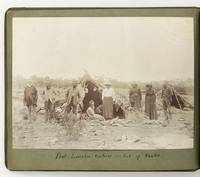
1900143581Adelaide: Government Printer 1900. First Edition. Hardcover. Fine. Adelaide Government Printer circa 1900. An oblong quarto photograph album approximately 250 × 320 mm containing 22 original vintage gelatin silver photographs each approximately 200 × 280 mm tipped in on the recto and verso of 11 card leaves captioned in ink on the mount. Cord-bound textured papered boards; minimal signs of age and handling; essentially in fine condition. 'South Australia' is written in ink on the front pastedown and the individual captions tend to be informative and site-specific: 'Aquaduct at the Gorge on the Torrens River'; 'View from Mount Barker'; 'Orchard & Vineyard Roseworthy College Farm'; 'Head of Gillen on the River Murray'; and 'Vineyard at Magill' are a few examples along with numerous identified bridges viaducts reservoirs and rivers. <p>This level of detail has enable us to locate thanks to Trove an article in an Adelaide newspaper 'The Express and Telegraph' Wednesday 3 October 1906 headed 'Advertising the State. South Australian Photographs in London'. The description of many of the photographs on display at the Bank of Adelaide branch in London 'The whole of these photographs were supplied by Mr. Vaughan the photo-lithographer' matches many of those in this album leading us to our attribution. <p>The article records that 'The Government recognise the value of photographs . and they have been putting the cameras in the Lands Department to good use lately for the purpose of advertising the State. A large number of pictures and slides for lantern use have been sent to the office of the Agent-General and every mail now takes a small addition to the stock. The photographs are used for advertising the State in various ways'. <p>It is perhaps unsurprising that the extraordinary portrait of the 'Port Lincoln natives - last of tribe' is not mentioned in the report. The State Library of South Australia has two examples of this print in its collection B 512 and B77443 - the latter in poor condition dated 'Approximately 1897' and '1897' respectively. Government Printer hardcover
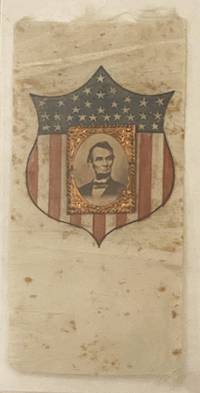
1864BB_Lincoln_badge<p><strong>LINCOLN</strong> Abraham 1809–1865</p><p><em><strong>PHOTO BADGE</strong></em> in copper frame with silk <strong>Campaign Ribbon</strong> circa 1864</p><p>Framed Albumen Portrait measures 1 x ¾ inches; Ribbon imprinted Chicago: North Western Flag & Banner Co. L. 4 inches.</p><p>The portrait by Anthony <strong>BERGER</strong> of Matthew Brady's Gallery the image taken in Washington DC 9 February 1864</p><p>Reference: C Hamilton and L Ostendorf: <em>Lincoln in Photographs</em> 109</p> North Western Flag & Banner Co.
18642547081864. very good-. This historic and rare black printed broadside presents the platforms of both parties the Republicans having convened in Baltimore in June and nominated Abraham Lincoln for President and Andrew Johnson for Vice President and the Democrats having convened in Chicago in August and nominated George B. McClellan for President and George H. Pendleton for Vice President. This copy measures 29 x 23 cm is double columned and with the imprint "For sale by all News Agents. Price $1 per 100." Very light foxing at the bottom margin more visible on the verso. Fraying at the margins as usual. Sabin 63348 Exceedingly scarce.<br/> <br/> unknown
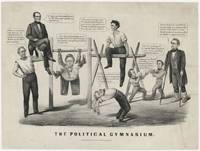
186060001<p><strong>Scarce iconic & fantastic lithograph Abraham Lincoln cartoon <em>The Political Gymnasium</em></strong></p><p>Abraham Lincoln Louis Mauer <strong><em>The Political Gymnasium</em></strong>. New York: Currier & Ives 1860. Lithograph broadside 18 x 13-1/2 inches.</p><p>This scarce and iconic lithograph is a detailed humorous "parody on the field of presidential candidates and their supporters in the 1860 campaign." Bell and Everett for the Constitutional Union Party are there: Bell a muscle man holds Everett aloft on a barbell. Horace Greeley struggles to do a pull-up in his effort to gain the New York governorship while Lincoln is easily astride his own bar wooden rails offering helpful advice: "You must do as I did Greely get somebody to give you a boost. I'm sure I never could have got up here by my own efforts." The New York Courier's James Watson Webb does a backward somersault in the foreground.</p><p>The broadside evidently issued after the parties' nominating Conventions because Seward is depicted as a cripple "on crutches and with bandaged feet." Breckinridge and Douglas "the two sectional Democratic candidates compete in a boxing match."</p><p>Auction records for the last couple of years show a colored example with trimmed right margin selling for $8125 and a nice but sooty uncolored example for $5250. Both sold by Heritage. Measures 18 x 13-1/2 in. and is an ideal candidate for framing. Overall Near Fine. Professionally cleaned & mended. Closed tear crosses most of Seward's midsection.</p> Currier & Ives
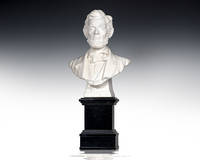
1909148487c. 1909. Painted plaster bust of Abraham Lincoln mounted on a wood pedestal base. After Raffaello Gironi for The Boston Sculpture Company. Signed faintly on reverse of integrated plaster pedestal "R. Gironi." An unpainted plaster of this sculpture is in the collection of the Canadian Museum of History Ottawa. In fine condition. The piece measures 21 inches by 9.5 inches. Abraham Lincoln served as the 16th President of the United States from March 1861 until his assassination in April 1865. He led the United States through its Civil War and in doing so preserved the Union of the United States of America abolished slavery and strengthened the federal government. In his Address at the Sanitary Fair in Baltimore Maryland in April of 1861 Lincoln stated: “The world has never had a good definition of the word liberty and the American people just now are much in want of one. We all declare for liberty; but in using the same word we do not all mean the same thing. With some the word liberty may mean for each man to do as he pleases with himself and the product of his labor; while with others the same word may mean for some men to do as they please with other men and the product of other men’s labor. Here are two not only different but incompatible things called by the same name liberty. And it follows that each of the things is by the respective parties called by two different and incompatible names…liberty and tyranny.†unknown
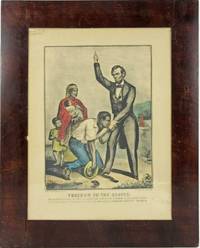
186538499New York: Currier & Ives 1865. Color print 11-3/4" x 15-1/2" by sight. A black man newly freed from slavery kneels at Lincoln's feet his shackles broken. He kisses Lincoln's hand. His wife and babies stand behind him. Lincoln's right arm is raised and pointing heavenward. Light uniform toning but brightly colored. Two blank margin tears at lower right corner one blank margin tear at upper left corner. Framed in wood a few small dings to overall size 16" x 20." Very Good.<br /> <br /> "This commemorative print was issued soon after the assassination of President Lincoln to comfort his supporters. The semi-allegorized representation portrayed the former president as the emancipator of enslaved African Americans guided by divine principles" Description online at The Met. <br /> Entering Richmond in 1865 Lincoln was met by many former slaves who kneeled before him. Lincoln told them to stand and thank God not Lincoln for their freedom. A decade later the Colored People's Educational Monument Association headed by the African-American abolitionist Henry Highland Garnet. created a memorial to Lincoln. The result was a sculpture erected in 1876 in Lincoln Park near Capitol Hill depicting a supplicant slave and a towering Lincoln. Known as the Emancipation Memorial or the Freedmen's Memorial it generated some contemporary criticism for its depiction of the inferior position of the black man. <br /> Gale 2311. Not in LCP Reilly or Weitenkampf. OCLC 1292616124 1- OH Hist. Connection 870219805 1- IN Hist. Soc. as of May 2024. AAS also owns a copy. Currier & Ives unknown
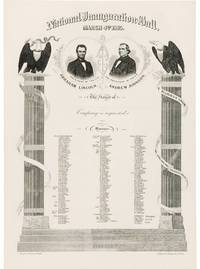
186540934Washington: Designed & Drawn by Bruff. Engraved by Dempsey & O'Toole 1865. Engraved broadside invitation 10-1/2" x 7-1/2" printed on heavy card stock engraved by Dempsey & O'Toole Designed & Drawn by Bruff to the Ball celebrating the second inauguration of President Abraham Lincoln and the inauguration of Vice President Andrew Johnson. The name of the invitee is not filled in. Fine.<br /> <br /> The attractively engraved invitation has detailed engraved portraits of Lincoln and Johnson flanked by two iconic American Eagles perched atop Corinthian columns. The Eagle on the left holds a rattlesnake in its beak reminiscent of the "Dont Tread on Me" flag. The pillars rest on three steps labeled "1777-83" "1812-15" and "1860-65." Beneath the portraits a three-column list of Managers is printed including prominent political and military figures of the time such as outgoing Vice President Hamlin Generals Grant Sherman Thomas Sheridan Doubleday Winfield Scott Hancock and Admirals Farragut and Porter. "E Pluribus Unum" and "We Are One and Indissoluble" are inscribed on banners wrapped around the columns<br /> The 1865 Inaugural Ball was held on March 6 1865 not March 4 at the Patent Office in Washington D.C. now home to the Smithsonian American Art Museum and National Portrait Gallery.<br /> OCLC records about ten locations under several accession numbers as of May 2025. Designed & Drawn by Bruff. Engraved by Dempsey & O'Toole unknown
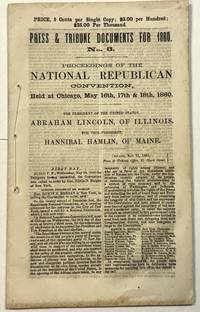
186041812Chicago: Press & Tribune Office 1860. Caption title as issued. 44pp. Stitched. Widely scattered light foxing. Near Fine. At head of title: "PRICE 5 Cents per Single Copy; $3.00 per Hundred; $25.00 Per Thousand."<br /> <br /> The "stenographic report" Monaghan of the country's most significant political convention with a record of all activities including speeches platform and the balloting for President and Vice President. Unlike modern conventions the winner of this one was far from clear. Several formidable candidates-- including Seward Chase Bates and Fremont--- stood in Lincoln's way. Although he had planned his strategy with great intelligence Lincoln was a true 'Dark Horse.' <br /> "Instead of attending in person Lincoln was represented by his friend and campaign manager Illinois judge David Davis whose initiative and deal-making skills despite his candidate's disapproval of such behind-the-scenes maneuvering is widely credited with his eventual nomination. Davis did however follow Lincoln's instruction in forming their general strategy as he maneuvered throughout the building nicknamed The Wigwam. <br /> "To make up for his meagre resume compared to Seward and Chase his team thought it prudent to not go on the attack against the frontrunners and instead become 'everybody's second choice.' through the convention's ranked voting system. His campaign also used the convention to start forging Lincoln's image as the Rail-Splitter a reference to his working-class background and a potential golden opportunity to appeal to the common laborers in the industrial Northern states who stood to benefit the most from the Republicans' Free Soil ideology. They also made direct appeals to delegates from the critical swing states of Pennsylvania and Indiana. When voting began on the 18th Davis and his allies felt confident in their chances to pull ahead. The first ballot placed Seward predictably with the highest vote total of 173.5 but not enough to win a majority while Lincoln followed with a total of 102. The second round bumped Lincoln's total number of votes to 181. The momentum on Lincoln's side continued to surge into the third round where Lincoln received a total of 231.5 votes still not enough to be nominated until David Cartter leader of the Ohio delegation announced his decision to switch support from Chase to Lincoln making him the 1860 Republican nominee for President" American Battlefield Trust 'Inside the Wigwam'.<br /> Ante-Fire Imprints 504. Monaghan 76. Sabin 65894. Press & Tribune Office unknown
186095830c. 1860. Rare original painting of the 16th President of the United States Abraham Lincoln. After a photograph by Civil War photographer Alexander Gardner. Scottish photographer Alexander Gardner immigrated to the United States in 1856 where he became best known for his photographs of the American Civil War President Abraham Lincoln and the execution of the conspirators to Lincoln's assassination. In near fine condition. In a period frame. The entire piece measures 20.75 by 16.75 inches. Rare and desirable. Abraham Lincoln served as the 16th President of the United States from March 1861 until his assassination in April 1865. He led the United States through its Civil War and in doing so preserved the Union of the United States of America abolished slavery and strengthened the federal government. Lincoln began constructing his cabinet on election night and sought to create a cabinet that would unite the Republican party. His eventual cabinet would include his primary rivals for the Republican nomination and although his appointees held differing views on economic issues all were opposed to the expansion of slavery into the territories of the United States. The most senior cabinet post of Secretary of State was appointed to William Seward who had recently failed to win the 1860 Republican presidential nomination and Lincoln's choice for Secretary of the Treasury was Ohio Senator Salmon P. Chase Seward's primary political rival and the leader of a radical faction of the Republican party that sought the immediate abolition of slavery. unknown books
186095830c. 1860. Rare original painting of the 16th President of the United States Abraham Lincoln. After a photograph by Civil War photographer Alexander Gardner. Scottish photographer Alexander Gardner immigrated to the United States in 1856 where he became best known for his photographs of the American Civil War President Abraham Lincoln and the execution of the conspirators to Lincoln's assassination. In near fine condition. In a period frame. The entire piece measures 20.75 by 16.75 inches. Rare and desirable. Abraham Lincoln served as the 16th President of the United States from March 1861 until his assassination in April 1865. He led the United States through its Civil War and in doing so preserved the Union of the United States of America abolished slavery and strengthened the federal government. Lincoln began constructing his cabinet on election night and sought to create a cabinet that would unite the Republican party. His eventual cabinet would include his primary rivals for the Republican nomination and although his appointees held differing views on economic issues all were opposed to the expansion of slavery into the territories of the United States. The most senior cabinet post of Secretary of State was appointed to William Seward who had recently failed to win the 1860 Republican presidential nomination and Lincoln's choice for Secretary of the Treasury was Ohio Senator Salmon P. Chase Seward's primary political rival and the leader of a radical faction of the Republican party that sought the immediate abolition of slavery. unknown
18642547081864. very good-. This historic and rare black printed broadside presents the platforms of both parties the Republicans having convened in Baltimore in June and nominated Abraham Lincoln for President and Andrew Johnson for Vice President and the Democrats having convened in Chicago in August and nominated George B. McClellan for President and George H. Pendleton for Vice President. This copy measures 29 x 23 cm is double columned and with the imprint "For sale by all News Agents. Price $1 per 100." Very light foxing at the bottom margin more visible on the verso. Fraying at the margins as usual. Sabin 63348 Exceedingly scarce.<br/><br/> unknown books
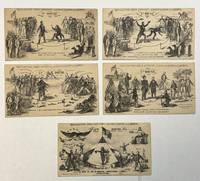
186141884New York: J.H. Tingley 1861. Five postal covers each oblong 3-1/4" x 5-7/8." The recto of each is an engraving of a Round of the boxing match. Near Fine.<br /> <br /> From the U VA description: "Five envelopes in the Champion Prize Envelope set depict a boxing match between Lincoln and Davis in which the latter is easily defeated and Winfield Scott commands the Union armies. Smaller vignettes in the corners depict dogs guarding southern cotton and then fleeing; liberated slaves Union artillery advancing firing and marching home; Union and Confederate politicians commenting on the fight including John Minor Botts who is seen as keeping Virginia in the Union; European countries commenting on the fight; and the Union eagle and Liberty victorious with Lincoln the champion of all sections."<br /> 1st Round: Standing around a boxing ring Lincoln and Davis in the middle are a group of civilians Soldiers cannon. two dogs guarding a bale of cotton and a Confederate flag a group of slaves three men on a globe Capitol and American flag in the background. In the ring Davis cowers before Lincoln who says "I use no more force than necessary." Davis: "Let me alone!"<br /> 2nd Round: The same group encircles the ring. Lincoln: "Go back you dog to the junction I'll call on you there soon." Davis: "Beauregard Lets fall back on Richmond." From the crowd of civilians: "Secession is looking smaller" and "We shall soon strip it." Other comments are also uttered.<br /> 3d Round: Lincoln: "I will soon smother those pirates." From the same encirclement anti-Confederate comments such as "General That's secession's last kick" rebel soldiers saying "Let's go home boys." The cotton bale and Confederate flag are missing.<br /> 4th Round: Seward and Scott are in the ring. Seward: "General where is secession now" Scott : "Don't you see that greasespot" Comment: "Virginia and Kentucky may now be heard in behalf of the whole Union."<br /> 5th Round: Lincoln with "The Champion Belt": "You shall all have my impartial constitutional and humble protection." He is surrounded by the iconic Screaming Eagle; a triumphant West North East and South; and Lady Liberty who says "I still live." <br /> Not in Reilly or Weitenkampf. AAS and the University of Indiana own all five envelopes. OCLC 277634667 1- U VA 14953428 2- CT Mus. Hist. Culture U IL as of June 2026. J.H. Tingley unknown
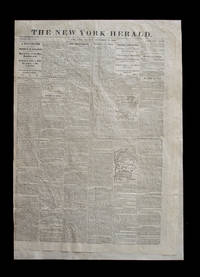
186268870New York: The New York Herald 1862. Full Description:<br> <br> LINCOLN Abraham. Emancipation Proclamation."A Proclamation by the President of the United States. Operations of the Confiscation Act. All Slaves in States in Rebellion January 1 1863 to Be Free." New York. Published in: The New York Herald Tuesday September 23 1862. Whole No. 9506.<br> <br> The publication of Lincoln's Emancipation Proclamation in James Gordon Bennett's pro-Democratic New York Herald and one of if not the first official public announcements of the preliminary Emancipation Proclamation.<br> <br> Broadsheet folio one large leaf folded along top to make four pages two leaves printed on recto and verso. Six-column format. 22 x 15 1/2 inches; 560 x 395 mm. Light creases down the middle in both directions. Some nearly invisible repaird along top margin and edges. Some of the repairs just touching a few letters in the headline. Still a very good copy of this important declaration. We could only find 3 copies of this at auction and it is not mentioned in Eberstadt. Eberstadt mentions that his Third edition of the Emancipation has a publication date somewhere between September 24th and 26th therefore putting the current copy before this. Eberstadt's first and second edition are the official state department editions printed the day of the declaration September 22nd just the day before this New York Herald was printed.<br> <br> Abraham Lincoln issued the preliminary Emancipation Proclamation on September 22 1862 stating that if the rebelling states did not cease fighting and rejoin the Union by January 1 1863 the slaves in those states would be set free. The New York Herald issued this front-page top left corner early printing of Lincoln's Proclamation the very next day appearing under the headline: "All Slaves in States of Rebellion January 1 1863 to Be Free."<br> <br> "Lincoln read the first draft of what came to be known as the Preliminary Emancipation Proclamation to his cabinet on 22 July 1862. Given the criticism directed at Lincoln for moving too slowly on the issue of emancipation it is worth noting that this first reading took place just sixteen months after he had pledged not to 'interfere with the institution of slavery in the States where it exists.' He continued to revise the document throughout the summer and following the Union victory at Antietam he issued the preliminary proclamation-which managed to balance daring with prudence-on 22 September. This first proclamation essentially gave the Rebel States one hundred days to return to the Union after which period any slaves within their borders would be "then thenceforward and forever free." Any rebellious states that returned to the Union in the interim would be able to adopt immediate or gradual-and compensated-abolition of slavery within their borders." Sotheby's.<br> <br> The front page of this newspaper also contains two maps and reports of the campaigns in Kentucky.<br> <br> HBS 68870.<br> <br> $3500. The New York Herald unknown
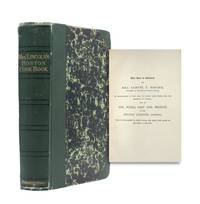
1884353213Boston: Roberts Brothers 1884. First edition second printing published the same year as the first with sixteen advertisements on seven pages rather than six on four pages except for the advertisements the contents and pagination of the 1884 1885 1886 and 1887 printings are identical. Illustrated. xiv ii 536 7 adspp. 1 vols. 8vo. Original publisher's green half cloth over marbled boards generally good unrestored condition with some wear to spine and edges of boards corners bumped. First edition second printing published the same year as the first with sixteen advertisements on seven pages rather than six on four pages except for the advertisements the contents and pagination of the 1884 1885 1886 and 1887 printings are identical. Illustrated. xiv ii 536 7 adspp. 1 vols. 8vo. Grolier American 86; Crahan 74; Wheaton p.152 #3707; Vicaire p.524 1887 edition; Bitting p. 288 citing 1896 edition Roberts Brothers unknown
1884140942960Boston: Roberts Brothers 1884. Second Printing. Very Good. First edition second printing published the same year as the first with sixteen advertisements on seven pages rather than six on four pages. Except for the advertisements the contents and pagination of the 1884 1885 1886 and 1887 printings are identical. The milestone cookbook from the first principal of the Boston Cooking School and a student of Maria Parloa. Bound in contemporary black pebbled cloth with new black leather spine lettered in gilt. Pages soiled or foxed throughout chip to top corner of title page fore edges occasionally worn an amateur repair to one leaf pages 304/305. A scarce early printing of an important American cookbook. Roberts Brothers unknown