11 347 résultats
18593483New York: Charles Scribner 1859. First edition. Near Fine. Original publisher's cloth binding stamped in gilt and blind. Faint spotting to boards and gentle fraying to extremities mostly concentrated to the crown of the spine and upper front corner. Binding tight and square. Buff endpapers. Collating xxix 1 blank 31-363 1 blank: complete. Some staining to pages 312-313 and small marginal stains to pages 349-363 else a surprisingly fresh and clean copy without the typical foxing of the era. Inscribed on the front endpaper by the author in the year of publication: "To one of my earliest pupils Mrs. Martha White Gilbert with ever affectionate remembrance of Almira H. L. Phelps. Baltimore MD Oct. 10 1859." A scarce book institutionally and in trade it does not appear in the modern auction record and is the only copy currently on the market. A testament to Phelps' lifelong dedication to women's education the present copy was given to one of the first girls she ever taught. A meaningful association.<br/><br/>A pioneer in American women's education Almira Phelps began her career tutoring students of the all-male Middlebury College in science mathematics and philosophy. "This experience illustrated the disparity between education available for men and for women and Almira spent the rest of her life fighting for more educational opportunities for females" History of American Women. Joining forces with her sister Emma Willard the founder of the Troy Female Seminary in New York Phelps began to teach rigorous humanities and science courses in addition to lecturing publicly on behalf of women's rights for equal education. Phelps established herself as a frontrunner in the field publishing ten books on the education of women. The present Hours with my Pupils came after decades of experience as she reached the pinnacle of her career. "In 1841 Phelps received an invitation.to take charge of the Patapsco Female Institute in Ellicott's Mills Maryland. Phelps became principal and her husband was the business manager of the Institute which soon attained a great reputation due to its high academic standards. Ever a proponent for the betterment of the education of young girls Phelps focused on creating a curriculum.designed in particular to train highly qualified teachers" Dictionary of Early American Philosophers. Retiring in 1855 and settling in Baltimore Phelps continued her work by publishing activist pieces in national periodicals and books like this. A collection of educational addresses from throughout her career Phelps expresses optimism about what her work can still accomplish: "Go then ye written thoughts speed your way to the hearts of the women of my country.teach them the worth of their own souls!" <br/><br/>Ogilvie's Women in Science 147. History of American Women. Near Fine. Charles Scribner unknown books
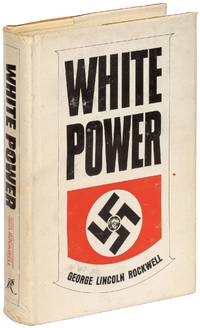
1967614666Dallas: Ragnarok Press 1967. Hardcover. Very Good/Very Good. Stated second edition but published in the month after the first September 1967 with a slightly different dedication after Rockwell's assassination on August 25th. Octavo. 482pp. Illustrated. With two manuscript corrections each to the publisher's address on both the jacket and copyright page. Pictorial boards reproducing the jacket art. Spine base gently bumped about 15 pages with a tiny bump at the top corner a near fine copy save for about 80 pages marked in red and blue ink ranging from a single underlined passage to major portions underlined bracketed struck through and a couple of brief marginal notes but still easily legible. In a faintly tanned very good or a bit better glossy dust jacket with small chips and tears and the author's name on the spine sunned. Rockwell's screed was first published in August 1967. This edition was printed posthumously in September after Rockwell's assassination by former ANP member John Patler on August 25th. Ragnarok Press) hardcover
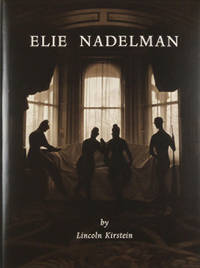
197384031Eakins Press. As New. 1973. Hardcover. 0871300346 . FREE UPGRADE to Courier/Priority Shipping Upon Request - IN STOCK AND IMMEDIATELY AVAILABLE FOR SHIPMENT - AS NEW THE TEXT BLOCK IS PRISTINE CLEAN UNMARKED AND IN EXCELLENT CONDITION - - 358 2 pages 215 illus; 4to. Description: "When writer and New York City Ballet founder Lincoln Kirstein died in 1995 he was hailed as a Renaissance man. This splendid publication compiled and composed by Kirstein on the works of the acclaimed American sculptor Elie Nadelman stands as a monument to both extraordinarily talented men. This 1973 first edition featuring extensive reproductions from all phases of the artist's career is the most complete catalogue of Nadelman's work and writing." Catalogue Raisonné Catalogue Raisonne Catalog Raisonnee Complete Works Eakins Press hardcover
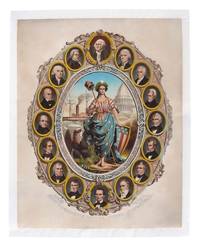
186136386Philadelphia: Published by F. Bouclet 1861. Rare beautifully colored 20" x 25-3/4" lithograph printed on wove paper titled "Presidents of the United States". Displays all the Presidents through a beardless Lincoln surrounding a vignette of Lady Liberty the American eagle a steamboat and the Capitol the dome complete as anticipated though still under construction. Published by F. Bouclet and lithographed by A. Feusier. In superb condition with just a hint of toning from previous framing. Fine.<br/><br/> "A large patriotic print probably issued around the time of Abraham Lincoln's inauguration. Columbia stands before the U.S. Capitol holding a shield and a staff with a liberty cap. On her brow she wears a laurel wreath with a single star. Beside her is an eagle holding a streamer with the motto "E Pluribus Unum." A steamship is visible in the background left. The central scene is framed by oval portraits of the first sixteen presidents of the United States with George Washington at the top and a beardless Abraham Lincoln at the bottom" Reilly.<br/> The print "commemorates Lincoln's election and recognizes the challenges and opportunities facing the 16th president. In this image a portrait of Lincoln completes an unbroken ring of portraits depicting the 15 presidents who preceded him. The illustration calls to mind a quote from Lincoln's first inaugural 'Perpetuity is implied if not expressed in the fundamental law of all national governments'. By commemorating Lincoln's election and illustrating the troubled and complex scene he faced this chromolithograph encapsulates the spirit of Lincoln's presidency" Mast 'A Closer Look at Presidents of the United States 4 President Lincoln's Cottage page 2 2009. <br/>Reilly 1861-13. OCLC 41119329 2- Lib. Cong. MN Public School District as of November 2019. The print is also included in the Jay Last Collection at the Huntington. Published by F. Bouclet unknown books
1929106036New York: National Americana Society 1929. Hardcover. very good. 2nd printing. x126pp. Folio in original gilt lettered blue cloth and blue endpapers with gilt top edge photogravure plates and plates from facsimiles and maps. Inscribed from Lincoln Ellsworth on front free endpaper. very good Collection of articles on Ellsworth's two Arctic expeditions with Amundsen the first flying from Spitsbergen to the North Pole in two planes largely financed by Ellsworth the party of six reached 87`44N before being forced down with engine trouble. In 1926 Amundsen and Ellsworth returned to the Arctic this time in the semi rigid airship the 'Norge' making the first crossing of the polar sea from Spitsbergen to Teller Alaska over the North Pole. Although the title page states second printing both printings are the identical and both are very scarce. 1929 National Americana Society hardcover
2010mon0000069040Lincoln Electric 2010-01-01. Unknown Binding. Good. in x in x in. Lincoln Electric unknown
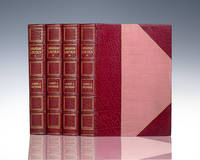
1928146970Boston and New York: Houghton Mifflin Company 1928. Limited manuscript edition of this complex and revealing biography of one of the most popular Presidents of the United States. Octavo four volumes bound in the publisher's cherry-red three-quarter crushed morocco at the Riverside Press with gilt titles and ruling to the spine in six compartments top edge gilt red silk ribbons tipped in tissue-guarded frontispiece portrait of Abraham Lincoln and additional tissue-guarded color plate views of the Lincoln Memorial to each volume illustrated with thirty-two tissue-guarded plates and maps throughout window-mounted leaf of the author's manuscript research notes adhered to the front flyleaf of Vol. I some pages uncut stamp-signed by the Riverside Press. One of one thousand numbered sets printed at the Riverside Press Cambridge U. S. A. this is number 130. In fine condition bookplate from the library of American banker and philanthropist Frank K. Houston to the front flyleaf of Vol. II. An exceptional set. Praised for his biographies of Chief Justice John Marshall and President Abraham Lincoln American historian and United States Senator Albert J. Beveridge has introduced the public to the realities of the lives of revered historical figures. Using analysis and thorough investigation Beveridge was able to contextualize the actions of America's sixteenth president with his traditions and influences in his four-volume biography 'Abraham Lincoln 1809-1858' published post-humously in 1928. His contributions to historical study cannot be understated and the American Historical Association's Beveridge Award exists to demonstrate as much. Houghton Mifflin Company unknown
19383113549New York: The Museum of Modern Art. Near Fine in Very Good dust jacket. 1938. First Edition; First Printing. Hardcover. First Edition. Published in September 1938. Errata slip present. Lacks belly band. Near fine in very good dust jacket. Faint offsetting at upper portion of front panel extending to spine. A few short edge nicks and hint of chipping to jacket. Top edge lightly foxed. 87 images. 5000 copies printed. A photographic high spot that has become increasingly difficult to locate in jacket. ; 8" x 9"; 198 pages . The Museum of Modern Art. hardcover
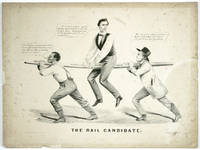
1860WRCAM37633New York: Currier & Ives 1860. Lithograph 13 1/2 x 18 inches. Moderate age-toning foxing and soiling. Moderate browning in margins. Small closed tears and chips in margins one moderate-size closed tear in left margin. A fair copy. A lithographic political cartoon published by Currier & Ives commenting upon the anti- slavery plank of the 1860 Republican platform. "The 'essential' anti-Lincoln cartoon of 1860" - Holzer et al. Abraham Lincoln is shown being carried uncomfortably in the middle of a split wooden rail an allusion to both the platform and to Lincoln's backwoods origins. Supporting the left end of the rail is a black man in simple working clothes who states "Dis N asterisks ours strong and willin' but its awful hard work to carry Old Massa Abe on nothing but dis ere rail!!" Holding the right end of the rail is well-dressed newspaper editor and strong Lincoln supporter Horace Greeley identified by a copy of his NEW YORK TRIBUNE in his coat pocket. Greeley tells Lincoln "We can prove that you have split rails & that will ensure your election to the Presidency." Lincoln replies "It is true I have split rails but I begin to feel as if this rail would split me it's the hardest stick I ever straddled." Lincoln is depicted - visually and thematically - as a straddler at best while the images of Greeley and the African American supporting the rail are derisive. <br> <br> A finely drawn and insightful political cartoon from the 1860 election. REILLY AMERICAN POLITICAL PRINTS 1860-31. WEITENKAMPF p.123. CURRIER & IVES: CATALOGUE RAISONNÉ 5478. Harold Holzer Gabor Borritt & Mark Neely THE LINCOLN IMAGE p.38 figure 18. Currier & Ives hardcover books
41587Oblong double-folio 13 x 17 inches seal affixed; docketed on verso. Several small breaks at corner folds corner torn away just touching the docketing. A very good copy. In this document Jonathan Tucker was appointed second lieutenant of a company in the 5th Regiment of Militia in Worcester County. In the following month Lincoln was named Major General of all the Massachusetts state militia; he was given command of the southern department in 1778 and after his capture and exchange was with Washington at Yorktown where he was chosen to receive Cornwallis's sword. Other members of the council who signed this document include Perez Morton James Otis Benjamin Greenleaf Caleb Cushing John Winthrop Joseph Gerrish John Whetcomb Elias Taylor Michael Farley Joseph Palmer Moses Gill Samuel Holton B. White Charles Chauncey and John Taylor. <br/><br/> unknown books
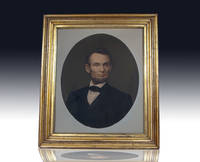
1864109542Cincinnati: E.C. Middleton 1864. Rare oleographic portrait of Abraham Lincoln by E.C. Middleton. With Middleton's Warranted Oil Colors imprint to the verso of the frame dated 1864. Between 1861 and 1873 E.C. Middleton of Cincinnati published a series oval oleographic portraits intended to have the appearance of oil paintings including thirteen “Portraits of American Statesmen and Heroes.†Middleton invented the method of oleography which used the process of chromolithographic printing with oil based inks mounted on canvas. The portraits were exclusively sold in frames directly through agents by subscription. In near fine condition. Matted and framed. The portrait measures 13.25 inches by 16.25 inches. The entire piece measures 20 inches by 23.25 inches. A rare striking portrait of Lincoln. Abraham Lincoln served as the 16th President of the United States from March 1861 until his assassination in April 1865. He led the United States through its Civil War and in doing so preserved the Union of the United States of America abolished slavery and strengthened the federal government. Lincoln began constructing his cabinet on election night and sought to create a cabinet that would unite the Republican party. His eventual cabinet would include his primary rivals for the Republican nomination and although his appointees held differing views on economic issues all were opposed to the expansion of slavery into the territories of the United States. The most senior cabinet post of Secretary of State was appointed to William Seward who had recently failed to win the 1860 Republican presidential nomination and Lincoln's choice for Secretary of the Treasury was Ohio Senator Salmon P. Chase Seward's primary political rival and the leader of a radical faction of the Republican party that sought the immediate abolition of slavery. E.C. Middleton unknown
184822094.01 -.02<p>Lincoln's spot resolution and speech condemns the pretexts for starting the war with Mexico. He requests proof from President Polk that American blood was shed on American soil and that the enemy provoked the Americans and he asks if those Americans present were ordered there by the United States Army.</p> <b>ABRAHAM LINCOLN.</b>Newspaper. <i>National Intelligencer</i> Thursday December 23 1847. Washington: Gales & Seaton . 4 pp. Offered with another issue of the <i>National Intelligencer</i> January 20 1848. 4 pp.<p><b><br /></b></p><p><b>Excerpts:</b></p><p><b>December 23 1847 issue</b></p><p>Page 2 bottom of first column to second column</p><p><i>Mr. LINCOLN moved the following preamble and resolutions which were read and laid over under the rule:</i></p><p><i> Whereas the President of the United States in his message of May 11 1846 has declared that "the Mexican Government not only refused to receive him the envoy of the United States or listen to his propositions but after a long-continued series of menaces have at last invaded </i>our territory<i> and shed the blood of our fellow citizens on</i> our own soil<i>."</i></p><p><i> And again in his message of December 8 1846 that "we had ample cause of war against Mexico long before the breaking out of hostilities; but even we forbore to take redress into our own hands until Mexico herself became the aggressor by invading </i>our soil <i>in hostile array and shedding the blood of our citizens."</i></p><p><i> And yet again in his message of December 7 1847.</i></p><p> Resolved by the House of Representatives<i> that the President of the United States be respectfully requested to inform this House—</i></p><p><i> 1st. Whether the spot on which the blood of our citizens was shed as in his messages declared was or was not within the territory of Spain at least after the treaty of 1819 until the Mexican Revolution.</i></p><p><i> 2d. Whether that spot is or is not within the territory which was wrested from Spain by the revolutionary Government of Mexico. </i></p><p><i> 3d. Whether that spot is or is not within a settlement of people which settlement has existed ever since long before the Texas revolution and until its inhabitants fled before the approach of the United States army.</i></p><p> <i>4th. Whether that settlement is or is not isolated from any and all other settlements by the Gulf and the Rio Grande on the south and west and by wide uninhabited regions on the north and east.</i></p><p><i> 5th. Whether the people of that settlement or a majority of them have ever submitted themselves to the government or laws of Texas or of the United States by consent or by compulsion either by accepting office or voting at elections or paying tax or serving on juries or having process served upon them or in any other way.</i></p><p><i> 6th . Whether the people of that settlement did or did not flee from the approach of the United States army leaving unprotected their homes and their growing crops </i>before<i> the blood was shed as in the messages stated; and whether the first blood so shed was or was not shed within the enclosure of one of the people who had thus fled from it. </i></p><p><i> 7th. Whether our </i>citizens<i> whose blood was shed as in his messages declared were or were not at that time armed officers and soldiers sent into that settlement by the military order of the President through the Secretary of War.</i></p><p><i> 8th. Whether the military force of the United States was or was not so sent into that settlement after Gen. Taylor had more than once intimated to the War Department that in his opinion no such movement was necessary to the defense or protection of Texas. </i></p><p><i> Several resolutions of inquiry were here offered my Messrs. GEORGE S. HOUSTON W.P. HALL PHELPS GREEN McCLELLAND and KAUFMAN which are omitted for want of room.</i></p><p><b>January 20 1848 issue: </b></p><p>Page 2 bottom of 3rd column thru 6th column. In this lengthy address Lincoln questions President Polk's judgment regarding the aims and prosecution of the war in Mexico putting it in the context of the American Revolution: <i>"Texas revolutionized against Mexico and became the owner of something…if she got it in any way she got it by revolution; one of the most sacred of rights—the right which he believed was yet to emancipate the world; the right of a people if they have a government they do not like to rise and shake it off…He talked like an insane man. He did not propose to give Mexico any credit at all for the country we had already conquered; he proposed to take more than he asked for last fall…"</i></p><p>Additional news: page 2 middle of 4th column prints a lively senatorial debate involving Jefferson Davis. Page 3 bottom of 2nd column <i>"Mr. LINCOLN from the same committee reported a bill for the relief of William Fuller and Orlando Saltmarsh. Read and committed." </i>Page 4 middle of 3rd column <i>"By Mr. LINCOLN: A bill to amend an act entitled 'An Act to raise for a limited time an additional military force and for other purposes' approved February 11 1847."</i> This act gave the president permission to raise one regiment of dragoons and nine regiments of infantry to be used in the war with Mexico. In addition the act dealt with the logistics of each regiment such as raising the pay for field surgeons or adding a quartermaster to each regiment.</p> books
1973C84031Eakins Press. As New. 1973. Hardcover. 0871300346 . FREE UPGRADE to Courier/Priority Shipping Upon Request - IN STOCK AND IMMEDIATELY AVAILABLE FOR SHIPMENT - AS NEW THE TEXT BLOCK IS PRISTINE CLEAN UNMARKED AND IN EXCELLENT CONDITION - - 358 2 pages 215 illus; 4to. Description: "When writer and New York City Ballet founder Lincoln Kirstein died in 1995 he was hailed as a Renaissance man. This splendid publication compiled and composed by Kirstein on the works of the acclaimed American sculptor Elie Nadelman stands as a monument to both extraordinarily talented men. This 1973 first edition featuring extensive reproductions from all phases of the artist's career is the most complete catalogue of Nadelman's work and writing." Catalogue Raisonné Catalogue Raisonne Catalog Raisonnee Complete Works -- with a bonus offer-- - May be EITHER: out of print OOP and extremely rare in this pristine condition; signed by author or contributor; or a first or special edition; inquire for details . Eakins Press hardcover
186125965<p><b>ABRAHAM LINCOLN.</b>Chromolithograph. <i>Presidents of the United States</i> Philadelphia: Published by F. Bouclet lithographed by A. Feusier. Sheet size: 21 in. x 27 in. Image size: 24½ in. x 18¾ in. </p><br />A large patriotic chromolithograph issued around the time of Abraham Lincoln's first inauguration. The central image is the goddess Columbia wearing a draped American flag flanked by bald eagle and Union shield. Behind her is a steam ship and the artist's rendition of what the then-uncompleted Capitol building was expected to look like. Surrounding Columbia is an ornate frame made up of portraits of the presidents of the United States from 1789-1861—including a beardless Abraham Lincoln: George Washington John Adams Thomas Jefferson James Madison James Monroe John Quincy Adams Andrew Jackson Martin Van Buren William H. Harrison John Tyler James K. Polk Zachary Taylor Millard Fillmore Franklin Pierce James Buchanan and Abraham Lincoln.<p><b>Historical Background</b></p><p>Erin Mast curator of "My Abraham Lincoln" a 2009 exhibition at President Lincoln's Cottage Museum noted that the print "both commemorates Lincoln's election and recognizes the challenges and opportunities facing the 16th president. The 16 presidential portraits encircle symbols of the republic at a time when a divided nation faced secession and civil war. In the center Columbia holds a shield and liberty cap the latter being a symbol both of revolution and of freed slaves. A bald eagle grasps arrows and an olive branch and carries a ribbon with the motto 'E Pluribus Unum.' The Capitol dome shown completed at a time when it was still unfinished symbolizes the founding of the democratic republic while a steamship symbolizes development and progress. The allegorical images relate to concepts that Lincoln expressed in his first inaugural address; that seceding and breaking the Constitution would be a step backward not forward and violates the very principles of the Union a Union which is 'older than the Constitution.' By commemorating Lincoln's election and illustrating the troubled and complex scene he faced this chromolithograph encapsulates the spirit of Lincoln's presidency."</p><p><b>Provenance</b></p><p>From the Estate of Malcolm S. Forbes.</p><p><b>Condition</b></p><p>Damp stains at top two corners light mat burn but generally a very fine example.</p> books
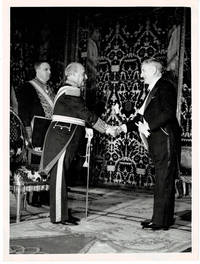
195298714Madrid: Oficina de Informacion Diplomatica March 27-28 1952. 1952. Fine. - Folio hardcover. Original 12-3/4 inch high by 9 inch wide printed wrappers bound with silk cord into sumptuous 15-1/4 inches high by 10 inches wide burgundy leather with a gilt device centered within gilt decorated roulette and gilt double-ruled frames on the front cover. The binding is further enhanced by gilt inner dentelles and silk pastedowns. 28 pages including 10 pages with tipped on original clippings from Spanish newspapers and 16 pages with 9-1/2 by 7 inch tipped on original photographs presumed to be by Campua of the festivities. The edges of a few of the photos are creased. A unique sumptuous volume. <p>"Presentacion de Credenciales del Excmo. Senor LINCOLN MAC VEAGH Embajador de los Estados Unidos."<p>Together with an autograph note signed consisting of over 70 words by the claimant to the Spanish throne Juan III written on both sides of a 4-1/8 inch by 6-1/2 inch card with the Royal Crown printed at top left. "Estoril. 24 - 1 - 52. Dear Ambassador I have just heard about your appointment as U.S. Ambassador in Madrid & I feel I cannot remain indifferent with this news.Yours sincerely Juan / Conde de Barcelona". There are minor staple holes along the left edge of the card.<p>TOGETHER WITH: 2 original photographs by Jose Demaria Vazque 1900-1975 popularly known as "Pepe Campua" the photographer of Franco and the Spanish royal family during the dictatorship. Both photographs are stamped "Campua" and dated March 27 1952 on the versos. One photo pictures the procession to the Pardo Palace of MacVeagh in a gilded coach drawn by six horses followed by 50 soldiers of Franco's personal Moorish guard. It was the same coach in which Washington Irving went to present his credentials to the regent during the Carlist wars in 1842. The second photo pictures a handshake between MacVeagh and Franco MacVeagh having presented his credentials to the Generalissimo. Foreign Minister Alberto Martin-Artajo stands in the background. The photographer's credits are stamped in purple on the verso. Likely once mounted into an album there are black paper remnants adhering to the verso of each photo. In addition there are 15 small snapshots many cropped from larger photos of MacVeagh's time in Spain.<p>Lincoln MacVeagh 1890-1972 a Renaissance man graduated from Harvard magna cum laude in 1913. He went on to study languages at the Sorbonne and became fluent in German French Spanish Latin Greek and Classical Greek. After World War I he became a director of the Henry Holt and Company publishing firm where he became friendly with the poet Robert Frost. In 1923 he left the firm and founded the Dial Press. His name appears on the imprint of many of their publications. In 1933 President Roosevelt appointed him Minister to Greece. He followed presentation of his credentials with a speech in Classical Greek. While in Greece he conducted excavations beneath the Acropolis and made archeological contributions to the National Museum in Athens. He left Greece in 1941 when the German army over ran the country. From there he was appointed the first US Minister to Iceland where he negotiated agreements for the construction of the Keflavik airfield. In late 1942 he became Minister to the Union of South Africa and coordinated American wartime agencies there. In 1943 he was sent to Cairo as Ambassador so that he could assist the governments in exile of Greece and Yugoslavia. He returned to Athens as Ambassador in 1944. MacVeagh gave secret testimony before Congress concerning the Balkans in 1947 testimony that was an important factor in the formation of the Truman Doctrine. In 1948 as Ambassador to Portugal MacVeagh was influential in admitting her into NATO. In 1952 President Truman named him Ambassador to Spain. President Truman wrote to him on March 9 1948: "On the occasion of your appointment as Ambassador to Portugal I would like to make some personal expression of appreciation for the high services you have already rendered your country. During the past fifteen critical years you have served with distinction as Chief of the United states Missions to Iceland the Union of South Africa Yugoslavia and Greece. In this last post especially - as Minister from 1933 to 1941 and as Ambassador since 1943 - your scholarly statesmanship and diplomatic judgment have been of the utmost value." Madrid: Oficina de Informacion Diplomatica, March 27-28, 1952. hardcover
193398736circa 1933. 1933. Very good. - What is being offered here are the final hand-written manuscript together with a typed copy of a translation into English of the first 6 Satires of Juvenal. The manuscript is on 10-1/8 inch high by 8 inch wide lined sheets; the typed sheets are on 11 inch high by 8-1/2 inch wide sheets. The translation is realized in 4-line stanzas quatrains of poetry in the ABCB rhyme scheme. The contents of both the hand-written manuscript and the typed copy are as follows: Book 1: Satire One 31 pages with 12 lines per page; Satire Two 30 pages with 12 lines per page except for the last page; Satire Three 56 pages with 12 lines per page except for the last page; Satire Four 28 pages with 12 lines per page except for the last page; Satire Five 31 pages with 12 lines per page. Book 2: Satire Six 123 pages with 12 lines per page except for the last page.<p>The famous Satire Six begins: "I'll not deny that Chastity/for many years remained/And was long seen upon the earth/in days when Saturn reigned. But that was when some chilly cave/provided hearth and home/For men and herds and household gods/beneath one gloomy dome. The mountain-wife who made her bed/of forest leaves and grasses/and skins of local animals/could not compare with lasses/Like Cynthia or Lesbia/whose grief-bereddened eyes/Lost all their native sparkle through/a sparrow's sad demise/But suckling mighty babes on milk/that she could well afford/Was often more unsightly than/her acorn-belching lord. For earth and sky were new and life/was different to folk/Who fatherless were formed from clay/or sprang from riven oak."<p>The sheets are housed in two cardboard cases with the title "JUVENAL" and MacVeagh's initials "L.Mac.V." written on the spines. The boxes in which the manuscript and typescript are housed are broken.The title page of the typed copy of "Satire 6" has a tear. Unique. <p>Robert Frost wrote to his friend Lincoln MacVeagh from Amherst on December 11 1933: "I have been over your Juvenal again by myself. I have consulted no one at all about it; and the conclusion I have arrived at is entirely my own. The translation and the versification are a good job. But they only confirm me in the indifference not to say dislike I have always felt for the subject matter of the original. I believe it gains in harshness said right out in English. You know me: I can stand sorrow better than evil."<p>Lincoln MacVeagh 1890-1972 a Renaissance man graduated from Harvard magna cum laude in 1913. He went on to study languages at the Sorbonne and became fluent in German French Spanish Latin Greek and Classical Greek. He served in the Atois St. Mihiel and Meuse Argonne campaigns of World War I as an aide to the commanding general of the 80th Division and of the Ninth and Sixth Army Corps. He rose to the rank of Major. After the war he became a director of the Henry Holt and Company publishing firm where he became friendly with the poet Robert Frost. In 1923 he left the firm and founded the Dial Press. His name appears on the imprint of many of their publications. In 1933 President Roosevelt appointed him Minister to Greece. He followed presentation of his credentials with a speech in Classical Greek. While in Greece he conducted excavations beneath the Acropolis and made archeological contributions to the National Museum in Athens. He left Greece in 1941 when the German army over ran the country. From there he was appointed the first US Minister to Iceland where he negotiated agreements for the construction of the Keflavik airfield. In late 1942 he became Minister to the Union of South Africa and coordinated American wartime agencies there. In 1943 he was sent to Cairo as Ambassador so that he could assist the governments in exile of Greece and Yugoslavia. He returned to Athens as Ambassador in 1944. MacVeagh gave secret testimony before Congress concerning the Balkans in 1947 testimony that was an important factor in the formation of the Truman Doctrine. In 1948 as Ambassador to Portugal MacVeagh was influential in admitting her into NATO. In 1952 President Truman named him Ambassador to Spain. President Truman wrote to him on March 9 1948: "On the occasion of your appointment as Ambassador to Portugal I would like to make some personal expression of appreciation for the high services you have already rendered your country. During the past fifteen critical years you have served with distinction as Chief of the United states Missions to Iceland the Union of South Africa Yugoslavia and Greece. In this last post especially - as Minister from 1933 to 1941 and as Ambassador since 1943 - your scholarly statesmanship and diplomatic judgment have been of the utmost value." [circa 1933]. unknown
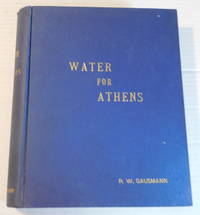
194098653Athens Greece 1940. 1940. Very good. - Quarto 11-3/8 inches high by 9 inches wide. Hardcover bound in blue cloth titled in gilt on the front cover and on the spine. 2 x & 328 mechanically reproduced pages printed on the rectos only. Illustrated with an original photograph as the frontispiece a pictorial title page 60 inserted charts and plates not included in the pagination and a folding plate reproducing a document. Most of the plates with drawings were created by the author. Near fine. <p>A RARE AND VALUABLE UNPUBLISHED WORK. Of 15 mimeographed copies this is No. 5 designated for Lincoln MacVeagh and was his copy.<p>Laid into the book is a map outlining the Parnassos Aqueduct with notes on the stages of construction and a "General Plan" of the Athens-Piraeus Waterworks in 1945.<p>The author Roy W. Gausmann was one of the designing engineers of the Marathon Dam and until 1941 the general manager of EEY the Greek Water Company. He trained as an engineer at Columbia University and worked for Ulen & Co. on the Shandaken Tunnel bringing water from the Catskill Mountains to New York City. During World War II he supervised camouflaging the dam and purification plant in Athens in order to prevent the Germans from taking control of the water company.<p>From the library of Lincoln MacVeagh and his wife Margaret with their "Arcades ambo" bookplate. Lincoln MacVeagh 1890-1972 a Renaissance man graduated from Harvard magna cum laude in 1913. He went on to study languages at the Sorbonne and became fluent in German French Spanish Latin Greek and Classical Greek. He served in the Atois St. Mihiel and Meuse Argonne campaigns of World War I as an aide to the commanding general of the 80th Division and of the Ninth and Sixth Army Corps. He rose to the rank of Major. After the war he became a director of the Henry Holt and Company publishing firm where he became friendly with the poet Robert Frost. In 1923 he left the firm and founded the Dial Press. His name appears on the imprint of many of their publications. In 1933 President Roosevelt appointed him Minister to Greece. He followed presentation of his credentials with a speech in Classical Greek. While in Greece he conducted excavations beneath the Acropolis and made archeological contributions to the National Museum in Athens. He left Greece in 1941 when the German army over ran the country. From there he was appointed the first US Minister to Iceland where he negotiated agreements for the construction of the Keflavik airfield. In late 1942 he became Minister to the Union of South Africa and coordinated American wartime agencies there. In 1943 he was sent to Cairo as Ambassador so that he could assist the governments in exile of Greece and Yugoslavia. He returned to Athens as Ambassador in 1944. MacVeagh gave secret testimony before Congress concerning the Balkans in 1947 testimony that was an important factor in the formation of the Truman Doctrine. In 1948 as Ambassador to Portugal MacVeagh was influential in admitting her into NATO. In 1952 President Truman named him Ambassador to Spain. President Truman wrote to him on March 9 1948: "On the occasion of your appointment as Ambassador to Portugal I would like to make some personal expression of appreciation for the high services you have already rendered your country. During the past fifteen critical years you have served with distinction as Chief of the United states Missions to Iceland the Union of South Africa Yugoslavia and Greece. In this last post especially - as Minister from 1933 to 1941 and as Ambassador since 1943 - your scholarly statesmanship and diplomatic judgment have been of the utmost value." Athens, Greece, 1940. hardcover
186131279Philadelphia: F. Bouclet 1861. Very Good. Philadelphia: F. Bouclet 1861. Original color lithograph 68x54cm. Mounted to matte backing; marginal tears and soiling; rubbing and a few scrapes around title; colors remain bright; a Very Good copy. <br /> <br /> This large vibrant lithograph was issued to commemorate Lincoln's first inauguration depicting the first sixteen Presidents with George Washington at top a beardless Abraham Lincoln at the bottom. The female personification of Columbia stands in the center before the Capitol holding a shield and staff with a liberty cap. The Capitol Dome sits in the background and is depicted as the artist anticipated it would look--the structure was not completed until late 1863. A handsome and uncommon print scarce in retail and auction records with only two holdings found in OCLC at the Library of Congress and the Mankato Area Public School District in Minnesota. . F. Bouclet unknown
186358199Camp near Brooks Station Saturday April 11 1863. Fine original condition. 15-1/2 x 9-3/4 inches. ".Yesterday I witnessed one of the grandest sights that I ever beheld. Our whole corps was reviewed by the President Generals Hooker McLain Howard Steinway Secretary Seward and an innumerable host of Brigadier Generals and it was a sight that has paid me for coming to war." The spectacle is described in great detail. Private Penfield was soon to be captured at Chancellorsville spending 12 days as a prisoner of war before being exchanged. He survived the war to carry on his father's carriage making business in Monroe Connecticut and later founded a small private academy. unknown
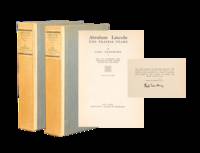
19266332New York: Harcourt Brace and Company 1926. First edition. Near Fine. Number 22 of 260 copies printed on Dutch Charcoal Rag Paper numbered and signed "Carl Sandburg" by the author. Two octavo volumes 9 1/2 x 6 3/8 inches; 241 x 161 mm. xvi 480; vi 482 pp. Bound in publishers cream buckram over blue boards spines with printed paper labels blue endpapers top edge gilt others uncut. Spines very slightly darkened otherwise a near fine partially unopened set complete with the publishers duplicate labels at the end on each volume.<br /> <br /> Abraham Lincoln 1809-1865 was the 16th President of the United States and remains one of the most seminal figures in American History. During his tenure which was cut short by his assassination in 1865 he saw the country through the Civil War and stewarded Emancipation. Carl August Sandburg's 1878-1967 biography The Prairie Years traces the early part of Lincoln's life and the formation of a man who would go on to be president up until his move to Washington. Sandburg would also publish additional volumes covering Lincoln's war years. Hailed as a voice of American Sanburg would win one of his three Pulitzer Prizes for this compelling biography.<br /> <br /> Monaghan 2877. Near Fine. Harcourt, Brace and Company unknown
186085724Chicago: Charles Leib 1860. Very Good. Four-page newspaper. A couple of small holes various brown spots and other bits of minor wear A campaign newspaper for Abraham Lincoln in the Presidential Campaign of 1860. We note a half-column story on the front page of this issue that accuses Senator Douglas of being a Roman Catholic -- a charge based partly on the fact that Mrs. Douglas was a Catholic as were their children -- probably an effective charge in largely Protestant mid-19th century America. Our brief research suggests that Douglas was neither a Catholic nor a formal member of any other organized religious group. The purpose of another half-column story on the front page was to make it clear that Lincoln had publicly condemned the actions of John Brown and did not object to Brown's execution. Charles Leib the editor was a political operative with an unclear background who had previously edited a Democratic campaign newspaper on behalf of the Buchanan campaign in 1856. Leib served briefly as an Assistant Quartermaster in the Union Army before heading to New Mexico probably in 1863 and died there in 1865 at the age of 38. Charles Leib unknown
183723104.01<p>Lincoln and John Todd Stuart cousin of Lincoln's future wife Mary Todd had served together in the Illinois House of Representatives from 1834-1836. They formed Stuart & Lincoln on April 12 1837.</p> <b>ABRAHAM LINCOLN.</b>Newspaper. <i>Sangamo Journal</i> Springfield Ill. December 23 1837. 4 pp. 18 x 24¾ in. Double matted and framed with glass on both sides to display pages one and four. Slightly chipped 26 x 33 in. frame.<p>In the upper portion of the first column of the first page appears this five line advertisement: <i>"STUART & LINCOLN / ATTORNEYS and Counsellors at Law will practice / conjointly in the Courts of this Judicial Circuit. – / Office No. 4 Hoffman's Row up stairs. / Springfield april 12 1837."</i> Two ads directly above: <i>"NINIAN W. EDWARDS / ATTORNEY & COUNSELLOR AT LAW / Springfield – Illinois."</i></p><p>Lincoln had moved from New Salem Illinois to Springfield in 1836. He had first met fellow attorney Ninian W. Edwards when both were members of the Illinois State House of Representatives. Edwards married Elizabeth Todd in 1832 and Lincoln met Elizabeth's sister Mary Todd at the Edwards home where Mary had moved in 1839. On November 4 1842 Lincoln and Mary Todd were married in the Edwards mansion.</p><p>The <i>Sangamo Journal </i>started publishing in 1831 shortly after a young Lincoln settled in New Salem. The newspaper faithfully supported Abraham Lincoln and the Whig Party throughout many name changes: the <i>Illinois Journal</i> 1847 shortly after Lincoln left for Congress then the <i>Illinois State Journal</i>1855. As the Whig party broke up the newspaper supported the newly-formed Republican Party and Abraham Lincoln's rising political star.</p><p><b> Condition</b></p><p>Very fine with no visible tears.</p> books
4951BENJAMIN LINCOLN 1733-1810. Lincoln was a Revolutionary War general and the Secretary of War from 1781 to 1783. SURRENDER OF CHARLESTON SOUTH CAROLINA. On April 2 1780 10000 British soldiers under the command of General Henry Clinton sieged 3000 Continental Army soldiers at Charleston. On May 12 the over-matched forces surrendered marking the largest Continental Army capitulation of the American Revolution. General Cornwallis was left in charge of British forces and Lincoln was eventually traded for a British general. After the Charleston surrender a guerilla war broke out in South Carolina. When the British surrendered at Yorktown Benjamin Lincoln was there to accept Cornwallis’s sword. D. 2pg. 8†x 10â€. 1780. Charleston South Carolina. A contemporary draft of General Lincoln’s articles of capitulation for Charleston: “Article of Capitulation proposed by Major General Lincoln – Art. 1 that all acts of hostilities and Work…Between the Besiegers and Besieged Until…of Capitulation shall be Agreed on signed…Executed or be collectively Rejected. Art. 2. The town and fortifications shall…be surrendered to the Commander in Chief of the…Forces such as they now stand. Art. 3. The Continental Troops and Sailors – with their baggage shall be Conducted to a Place to be Agreed on – where they will Remain Prisoners of War – until Exchanged – White Prisoners they shall be supplied with Good and Wholesome Provisions in such quantity as is Served out to the Troops of his Britanic sic Majesty. Art. 4. The militia now in garrison shall be permitted to return to their respectives homes and…be secured in their persons and property. Art. 5. The sick and Wounded shall…be continued under the care…Art. 6. The Garrison shall at an hour appointed march out with shouldered arms Drums beating and Colours Flying to a place to be agreed on where they will pile their arms. Art 7. That the French Consul his house papers and other movable property shall be protected and untouched and a proper time granted to him for retiring to…that may afterwards be agreed upon between…Commander in Chief of the British forces. Art. 8. That the citizens shall be protected in their persons and Property. Art. 10. That a twelve months time be allowed all such as do not choose to continue under the British Government to dispose of their Effects real and personal in the State with out any molestation or to remove such part thereof as they choose as well as themselves and families and that during that time they or any of them may have it as their option to reside occasionally in town or country. Art 11. That the same protection to their persons and properties and the same time for the removal of their Effects be given to the subjects of France and Spain as required for the citizens in the previous articles. Art 12. That a vessel be permitted to go to Philadelphia with the General’s dispatches which are not to be opened. Signed May 8th 1780 B Lincolnâ€. This likely is an early draft since Article 6 is not included; that stated “The officers of the army and navy shall keep their horses swords pistols and baggage which shall not be searched and retain their servants.†It is in an unknown hand and is not in the writing of Lincoln’s aide-de-camp Hodijah Baylies. The document just underwent a professional restoration to remove silking and improve the overall condition although I would still rate the document’s state as fair. There are paper losses that affect some words but the legibility has improved considerably. unknown books
1907876081907. Photograph signed and dated "Gutzon Borglum 1907." The photograph taken by Borglum shows his marble bust of Abraham Lincoln. On February 6 1908 the President's son Robert Todd Lincoln wrote to Borglum regarding the bust as "the most extraordinarily good portrait of my father I have ever seen." The sculpture is on display in the Crypt of the U.S. Capitol Building. A<i> </i>typed Lincoln quotation pasted to mount at lower left. In very good condition. Double matted and framed. The entire piece measures 15 inches by 17.5 inches. Sculptor Gutzon Borglum designed and oversaw the execution of the Mount Rushmore National Memorial from 1927 to 1941 with the assistance of his son Lincoln Borglum. Conceived by South Dakota historian Doane Robinson the 60-foot sculpture was initially intended to promote tourism in the Black Hills Region of South Dakota. unknown books
1907876081907. Photograph signed and dated "Gutzon Borglum 1907." The photograph taken by Borglum shows his marble bust of Abraham Lincoln. On February 6 1908 the President's son Robert Todd Lincoln wrote to Borglum regarding the bust as "the most extraordinarily good portrait of my father I have ever seen." The sculpture is on display in the Crypt of the U.S. Capitol Building. A typed Lincoln quotation pasted to mount at lower left. In very good condition. Double matted and framed. The entire piece measures 15 inches by 17.5 inches. Sculptor Gutzon Borglum designed and oversaw the execution of the Mount Rushmore National Memorial from 1927 to 1941 with the assistance of his son Lincoln Borglum. Conceived by South Dakota historian Diane Robinson the 60-foot sculpture was initially intended to promote tourism in the Black Hills Region of South Dakota. unknown