(Lincoln, Abraham)Biblio.com
11 347 résultats
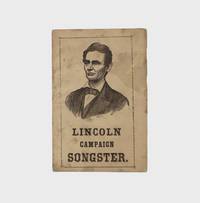
1864377694Philadelphia: Published by Mason & Co 1864. 16pp. 16mo. Publisher's wrappers with a portrait of Lincoln on the front and advertisements for political emblems badges pins etc. on the verso. Minor staining. Housed in a morocco backed slipcase. 16pp. 16mo. A pocket songster printed to support Lincoln's reelection campaign in 1864 featuring a rather youthful portrait of the president on the front wrapper and twelve spirited pro-Union songs. The titles largely military in theme include such works as "Give us Noble Leaders" "The Veteran Volunteer" "Cast Your Votes for Abraham" "For Lincoln or McClellan you'll be called on to decide/ The one to save the union the other to divide" and "We are Coming Father Abraham 600000 More." <br /> <br /> The advertisements on the rear wrapper encourage readers to purchase a wide variety of Lincoln campaign badges emblems pins and photographs from the publishers. Despite Lincoln's overwhelming electoral victory in 1864 the race was rather close in Pennsylvania where this was printed - Lincoln took Philadelphia County by a scant few percent and actually failed to secure a majority in neighboring Montgomery and Bucks counties. Monaghan 323; Abraham Lincoln: His Life in Print p. 199 Published by Mason & Co unknown
1864101729Np New York: For sale by all News Agents. Price $1 per 100. 1864. 4to. Broadside text in two columns; creased from prior folding and split at creases some toning and paper clip rust staining. Republic campaign broadside reprinting an interview with Lincoln by former Wisconsin State Assemblyman Joseph T. Mills and former state Governor Alexander Williams Randall. Lincoln vigorously defends the use of Black soldiers in the Union Army against Democratic candidate McClellan's strategy of leniency towards Southern States rejoining the Union: "The slightest knowledge of Arithmetic will prove to any man that the rebel armies cannot be destroyed with Democratic strategy. It would sacrifice all the white men of the North to do it. There are now in the service of the United States near 200000 able-bodied colored men most of them under arms defending and acquiring Union territory. The Democratic strategy demands that these forces be disbanded and that the masters be conciliated by restoring them to slavery. Will you give our enemies such military advantages. to get them back into the Union Abandon all the posts now garrisoned by black men take 200000 men from our side and put them in the battle-field or corn-field against us and we would be compelled to abandon the war in three weeks. . There have been men base enough to propose to me to return to slavery the black warriors of Port Hudson and Olustee and thus win the respect of the masters they fought. Should I do so I should deserve to be damned in time and eternity. My enemies pretend I am now carrying on this war for the sole purpose of abolition. So long as I am president it shall be carried on for the sole purpose of restoring the Union. But no human power can subdue this Rebellion without the use of the emancipation policy and every other policy calculated to weaken the moral and physical forces of the Rebellion." This is the first separate printing of the interview which was first published as "The Loyal Road to Peace and the Disloyal Road to Ruin President Lincoln on Democratic Strategy" in the Wisconsin Grant County Herald August 1864. The broadside also prints Grant's letter to E.B. Washbourne "The Rebels have now in their ranks their last man. The little boys and old men are guarding prisoners guarding railroad bridges and forming a good part of their garrisons for entrenched positions " and a poem by Bayard Taylor on the Democrats' presidential nominating convention. REFERENCE: Sabin 41157; Weinstein Against the Tide 141 For sale by all News Agents. Price, $1 per 100. unknown
5190ABRAHAM LINCOLN ASSASSINATION. Newspaper. 4pg. 10 ¼†x 13 ¾â€. Sunday April 16 1865. San Francisco. A The Flag’s Evening Dispatch from San Francisco detailing the death of President Lincoln. It is printed in four columns with mourning borders with front-page coverage of the assassination and its aftermath. The left column has headlines including Booth being the killer and that Johnson is the new President. There is an announcement by the San Francisco mayor that there will be a funeral for the President and news from the country’s interior. An editorial argues that the assassination argues “Let the fires of retribution sweep across the land accursed by treason. Let the sacrificial fires be lighted and the bodies of the hellish monsters who originated and took part in the conspiracy be offered up as a partial though tardy atonement for the destruction of the nation's peace.†There are the usual folds and a few minor edge tears and repaired fold separations. Extremely rare with only a few institutional holdings. unknown books
1870List1032Jefferson City: S. Winans Photographer 1870. Carte-de-visite photographs measuring 3 ¾ x 2 ¼ on slightly larger mounts versos with the decorative stamp of S. Winans photographer 126 High St. Jefferson City. Some fading to images else about fine quite well preserved near fine overall. Near Fine. The Lincoln Institute of Jefferson City Missouri had its roots in the educational programs set up for soldiers of the 62nd Colored Regiment during the Civil War most of whom were from Missouri. After the war with $6000 raised from donations a group led by the white abolitionist officer Richard Foster set up the Lincoln Institute in Jefferson City. The student body was entirely African-american with the faculty a mix of African-American and white. The state of Missouri provided additional funding. <br /> <br /> Collected here are four portraits of students of the institute likely taken in the founding decade before the carte-de-visite format was replaced by the cabinet card. The photographer S. Winans took the photographs likely in his Jefferson City gallery as they are all staged in a formal portrait gallery. Winans also took a well known portrait of David W. Wallace the father of Bess Wallace Truman. Quite uncommon - we find no other record of these images elsewhere. S. Winans, Photographer unknown books
OTF-S-9780440219835Laurel Leaf. New. BRAND NEW GIFT QUALITY! NOT OVERSTOCKS OR MARKED UP REMAINDERS! DIRECT FROM THE PUBLISHER! Laurel Leaf unknown
186536639New York 1865. Elephant Folio. 8pp. Each page printed in six columns. Uncut at top edge. Very Good. A contemporary hand has written in pencil at the top blank margin "His last Proclamation. Keep this Paper."<br/><br/> This was Lincoln's "Last Public Address" Abraham Lincoln Online. This issue of the Times appearing the following day is surely a candidate for its earliest printing. His Speech discloses Lincoln's most recent thoughts on Reconstruction the War having virtually ended by the surrender of Lee's Army at Appomattox Court House on April 9. Reconstruction he says is "fraught with great difficulty. We simply must begin with and mould from disorganized and discordant elements. Nor is it a small additional embarrassment that we the loyal people differ among ourselves as to the mode manner and means of reconstruction."<br/> Lincoln emphasizes his flexibility. He disclaims any intention to insist upon a single comprehensive plan. He makes clear that "the Executive claimed no right to say when or whether members should be admitted to seats in Congress" from the rebellious States. He remarks that he has never pronounced on the interesting legal question "whether the seceding States so called are in the Union or out of it." Such an issue has no practical significance. "We all agree that the seceded States so called are out of their proper relation with the Union; and that the sole object of the government civil and military in regard to those States is to again get them into that proper practical relation." Lincoln will act as circumstances require the only criterion being whether the proposed policy will expedite that "proper practical relation." It is obvious that Lincoln had he lived would have been much more successful than his dogmatic and inflexible successor at guiding Reconstruction.<br/> This issue treats many other issues arising from the War's end including the topic "What shall be done with Jeff. Davis unknown books
199911658N. Y.: Thornwillow Press 1999. First edition. With a never-before-seen collection of all the known letters & telegraph communications exchanged among members of the Lincoln family up to the time of his assassination. One of 185 copies printed on handmade paper & signed by David Herbert Donald a leading Lincoln scholar winner of two Pulitzer Prizes for biography & the Charles Warren Professor Emeritus of American History & American Civilization at Harvard University. A lovely book. As new. Small 4to illustrated with three tipped-in photogravure portraits & two fold-out facsimile letters 3/4 black moroccan goatskin & dark blue paste-paper boards t.e.g. velvet lined folding black cloth traycase. A lovely book. As new. Thornwillow Press unknown books
199347088Norwalk CT: Easton Press 1993. Ten volumes. 8vo. Approx. 4500 pp. Titles in red & black. Frontispices to each vol. numerous plates. Uniformly bound in full brown morocco elaborately gilt decorated covers spines red & gilt morocco spine labels a.e.g. silk moire endpapers Fine set. First Easton Press edition of this invaluable reference to one of our most important Presidents. The Easton includes the two supplements combined into one volume. Easton Press, unknown
19341276113Milwaukee WI/Mundelein IL/Washington DC: The Bruce Publishing Company/Canon Law Digest St. mary of the Lake Seminary Chicago Province/Canon Law Society of America 1934. Hardcover. Good. Set of Volumes 1-11. A set of eleven hardcover books bound in brick-red cloth. Ex-library hardcover books. Library stamps/labels on endpapers and title pages; residue on spines where shelf labels removed. Text clean and tight unmarked pages. Good to very good condition overall. Volumes 1 through 11 of this series of documents on the Catholic Code of Canon Law. Text is in English. Publication dates span 1934-1991. These volumes cover documents issued from 1917-1985. The Bruce Publishing Company/Canon Law Digest, St. mary of the Lake Seminary, Chicago Province/Canon Law Society of America hardcover
186323743<p>In this creative pamphlet Lincoln stands trial before a jury of his "peers" former presidents and statesmen from American history including Stephen A. Douglas Daniel Webster Henry Clay John Hancock Patrick Henry Gouverneur Morris Alexander Hamilton John C. Calhoun James Madison George Mason Elbridge Gerry Andrew Jackson Thomas Jefferson George Washington and William Gaston. The author compiles passages from their speeches in mock dialogue with the defendant Lincoln as they contradict his defenses against their charges.</p> <b>ABRAHAM LINCOLN.</b>Pamphlet. <i>Trial of Abraham Lincoln by the Great Statesmen of the Republic. A Council of the Past on the Tyranny of the Present. The Spirit of the Constitution on the Bench—Abraham Lincoln Prisoner at the Bar his own Counsel.</i> New York: Office of the Metropolitan Record 1863. Original printed wrappers stitched. 29 3 pp. First Edition.<p><b><br /></b></p><p><b>Excerpts:</b></p><p>"<i>George Washington the father of the American Union who was surrounded by the great statesmen of the Revolution and by others of a still later date…had assembled for the trial of the present incumbent … on charges of the gravest and most serious character. the Spirit of the Constitution…occupied the bench of Justice.</i>" 4-5</p><p>"<i>Abraham Lincoln is herein charged with treasonable intent purposes and designs in having committed the following unconstitutional acts in the course of his administration:</i></p><p>"<i>1. In having declared war against independent and sovereign States under the pretence of repossessing himself of certain forts and other property seized and held by said States.</i></p><p>"<i>2. In having arrested citizens of the United States and incarcerated them in Government bastiles without process of law.</i></p><p>"<i>3. In having suppressed the liberty of speech thereby denying to the citizen the Constitutional right of criticizing the acts of his Administration.</i></p><p>"<i>4. In having prohibited and stopped the publication of certain newspapers for the exercise of the same right referred to in the preceding charge.</i></p><p>"<i>5. In having placed the military above the civil power as shown in the establishment of martial law over portions of the country which were not embraced within the theatre of war.</i></p><p>"<i>6. In overthrowing State sovereignty as in the case of Virginia the integrity of which was violated by the erection of the so-called State of Kanawha within its limits.</i></p><p>"<i>7. In having approved indorsed and partially carried into execution the unconstitutional act of Congress known as the Confiscation Bill.</i></p><p>"<i>8. In having approved of the infamous law known as the Conscription Act which was not only subversive of the Constitution but violative of State sovereignty.</i></p><p>"<i>9. <b>In having attempted to carry into execution the Emancipation Act thereby violating the most sacred guarantees of the Constitution.</b></i> 5-6</p><p>"<i>The criminal looked around the court and on the faces of the assembled patriots of the past but as they returned his gaze they shuddering averted their heads. Then the Spirit of the Constitution addressing him spoke as follows:</i></p><p>"<i>'You have been tried and found wanting. You have been given the opportunity of saving a nation but you have stabbed it to the heart. You were born in the freest country under the sun but you have converted it into a despotism. You have violated your oath; you have betrayed the trust reposed in you by the popular will and to the outraged justice of your countrymen I now leave you with the brand of "Tyrant" upon your brow. They will hereafter inflict upon you that penalty which justice demands while history will pronounce its judgment upon the infamous acts of your Administration.'</i>" 28-29</p><p><b>Historical Background</b></p><p>Contemporaries historians and others have criticized Lincoln for violating state sovereignty freedom of speech and freedom of the press for suspending habeas corpus and imposing martial law. All of these charges figure prominently in this ghostly trial of the President.</p><p>The publisher and possibly author of this pamphlet was John Mulally the Irish-born editor and proprietor of the <i>Metropolitan Record</i> a weekly Catholic family newspaper published from 1859 to 1868 in New York City. From 1859 to March 1863 it was the official organ of the Archbishop John Hughes of New York. Catholic critics accused it of taking an "open and avowedly treasonable course…since the war broke out; but more especially since the President issued his Emancipation Proclamation" and of forcing Archbishop Hughes to withdraw his support.</p><p><i>The Indiana State Sentinel</i> a Democratic newspaper published in Indianapolis printed much of the pamphlet on its front page declaring it "perhaps the most thorough and effective exposition of the terrible character and extent of the departure of the present Administration from the word and spirit of the fathers of the Constitution that has yet been put in print."</p><p>In 1863 authorities arrested Baltimore booksellers Michael J. Kelly and John B. Piet publishers of the <i>Catholic Mirror</i> for printing works of a "treasonable character." On May 23 1864 Provost Marshal detectives again arrested Kelly and Piet and searched their store. Among the "inflammable matter" found were 97 copies of <u>this</u>pamphlet envelopes with rebel flags 57 packs of playing cards with Confederate officers and some 212 Confederate photographs. The authorities imprisoned Kelly and Piet in Fort McHenry. On May 28 Kelly's son received permission to reopen the store and authorities allowed the press to resume publication of the <i>Catholic Mirror</i> on May 30 while Kelly and Piet awaited trial. On June 1 and 2 Major General Lew Wallace ordered Kelly and Piet released if they each posted a $5000 security bond not to violate any departmental regulations.</p><p>In March 1864 Major General William S. Rosecrans a Catholic commander of the Department of the Missouri ordered the Provost Marshal General in St. Louis to seize all issues of the <i>Metropolitan Record</i> to prohibit further distribution of the newspaper in that department and to punish all vendors who sold or distributed issues of the newspaper knowing their "traitorous contents." Rosecrans had read enough in the <i>Metropolitan Record</i> to satisfy himself that "no reasonable freedom nor even license of the press suffice for the traitorous utterances in those articles" and that they were "a libel on the Catholics who as a body are loyal and national." In November 1864 Major General Hugh Ewing commanding the District of Kentucky likewise banned the circulation of the <i>Metropolitan Record</i> and seven other newspapers in his district.</p><p>In the midst of the 1864 presidential election campaign the <i>Metropolitan Record</i>advertised for canvassers to sell this as "the great campaign pamphlet of the day." Mulally later reportedly repudiated McClellan as the Democratic nominee favoring a peace candidate instead.</p><p>111 Eberstadt 332. Monaghan 252. Sabin 41234. LCP 10399.</p><p><b>Condition</b></p><p>Margin dusting to the front wrapper Very Good.</p> Office of the Metropolitan Record paperback books
043393Harrogate Tennessee: Lincoln Memorial University. Twelve clean tight blue cloth hardcovers in very good condition; lightly bumped corners and light shelf wear. No DJs as issued. NOTE: twelve volumes; no priority or overseas Amazon orders. . Very Good. Hardcover. Lincoln Memorial University hardcover
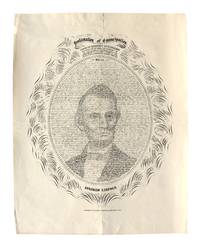
190027986Denver CO: Issued by Halsey M. Rhoads 1900. Very Good. Denver CO: Issued by Halsey M. Rhoads ca. 1900. Later printing. Broadside with calligraphic portrait of Abraham Lincoln in which the script of the Emancipation Proclamation forms the image within a decorative frame surrounded by the names of the members of Congress who voted for the amendment of the U.S. Constitution. 48 x 37 3/4 cm. A few tears to edges with tape mend to verso top edge; folds; minor edge wear; paper residue to verso from previous mount; overall Very Good. <br /> <br /> The original design was by W.H. Pratt in 1865 with just portrait and border and the names to the outside added to later printings. Halsey Rhoads was publisher of the Rocky Mountain Herald and a well known and prominent Denver citizen--even his bout with appendicitis in 1901 treated with leeches and ice garnered several writeups in contemporary newspaper accounts. <br /> This broadside scarce in any printing. <br /> <br /> See Eberstadt 42. Issued by Halsey M. Rhoads unknown
186139392Springfield: Charles H. Lanphier 1861. 4 pp. Folio. 16-1/4" x 23-1/2.". Lightly chipped blank inner edge. Each page printed in six columns each separated by a rule. Very Good.<br /> <br /> The Register no friend of Abraham Lincoln was a Democratic Paper supporting the Crittenden Compromise. Reporting on State and National issues the Register notes "The Crittenden Resolutions have strong friends but the ultra republicans will not take them." Lincoln had insisted that his allies hold firm against Crittenden's Compromise. The Register rebukes Lincoln for his famous declaration that "the Union could not endure permanently part slave and part free." Developments in the fracturing Union are reported. <br /> Lincoln had been elected President nearly three months before the appearance of this issue. His inauguration would occur five weeks later. Paid advertisers include John McClernand and John Stuart who advertise their legal services in the first column of page 1. The large number and variety of advertisements for an array of medical complaints about four columns are surprising- - and a little disturbing. <br /> This issue also reports an incident involving the John Brownites at Boston who were snubbed by British Lord Brougham after inviting him to attend a convention discussing the abolition of slavery. Charles H. Lanphier unknown
1862100336Newspaper folio unbound 8pp. Dampstained browned at edges with some foxing early owner's ink stamp on top margin some small tears and chips along edges and a little creasing. Still in decent shape overall. This is one of the earliest printings of the Emancipation Proclamation which was issued on September 22 1862. The Emancipation Proclamation declared freedom for all slaves in any Confederate state that didn't return to the Union by January 1 1863. Although this executive order did not actually free a large number of slaves it set the stage for the freedom of all slaves. Coverage of the Emancipation in this newspaper begins in the middle of the first page. This newspaper article represents important coverage of a very significant event in American History. archives government exhibits emancipation website
186330001.20<p>Contains Lincoln's entire 1863 Message to Congress where he reaffirmed his commitment to emancipation as well as His Proclamation of Amnesty and Reconstruction which laid out a plan to return the rebellious states to the Union fold. Commonly called the "Ten Percent Plan" it allowed for a state to hold new elections when 10% of its 1860 voters took a loyalty oath to the Union.</p> <b>ABRAHAM LINCOLN.</b>Newspaper. <i>New York Times</i> New York N.Y. Dec. 10 1863 with <i>"Supplement to The New York Times"</i> complete with its own masthead. 12 pp. 14¾ x 21 in.<p><b><br /></b></p><p><b>Excerpt</b></p><p>"<i>To now abandon them would be not only to relinquish a lever of power but would also be a cruel and an astounding breach of faith. I may add at this point that while I remain in my present position I shall not attempt to retract or modify the emancipation proclamation nor shall I return to slavery any person who is free by the terms of that proclamation or by any of the acts of Congress.</i>"</p><p><b>Historical Background</b></p><p>Throughout the fall of 1863 eventual Union victory became increasingly clear and on December 8 1863 Lincoln issued his Proclamation of Amnesty and Reconstruction. This lenient plan that offered citizens of the rebellious states full pardons voting and property rights except possession of slaves encouraged the states to begin addressing the issue of the freedmen and women without compromising their rights and allowed a former Confederate state to hold elections and form a pro-Union government once 10% of the number of voters in the 1860 election swore loyalty oaths. Commonly called the "Ten Percent Plan" it reflected both Lincoln's charitable view of Reconstruction as well as the reality that heavy penalties denial of voting and property rights to rebels and impoverishing the South was no way to rebuild a nation after a war fought at least initially to preserve the Union.</p> books
1877239161877. No binding. Fine. Autograph Quote Signed from Lincoln's Cooper Institute speech given on February 27 1860. Sept 10 1877. Schuyler Colfax U.S. representative from Indiana and vice president under Ulysses S. Grant pens a famous quote from Lincoln's Cooper Institute speech. Transcript""Let us have faith that Right makes Might; and in that faith let us to the end dare to do our Duty."" Lincoln's Cooper Institute speech Feb. '60. Yrs truly Schuyler Colfax / Sept 10 1877Schuyler Colfax 1823-1885 born in New York City moved with his family to Indiana when he was an adolescent. Colfax pursued a career in journalism serving as legislative correspondent for the Indiana State Journal and becoming part-owner of the Whig organ of northern Indiana the South Bend Free Press renamed the St. Joseph Valley Register in 1845. Colfax was a member of the 1850 state constitutional convention and four years later was elected as a Republican to Congress where he served until 1869. An energetic opponent of slavery Colfax's speech attacking the Lecompton Legislature in Kansas became the most widely requested Republican campaign document in the 1858 mid-term election. In 1862 following the electoral defeat of Galusha Grow Colfax was elected Speaker of the House. In that capacity Colfax announced the passage of the Thirteenth Amendment on January 31 1865: ""The constitutional majority of two thirds having voted in the affirmative the Joint Resolution is passed."" Colfax considered February 1 1865 the day he signed the House resolution the happiest day of his life. ""Fourteen years before among a mere handful of kindred spirits in the Constitutional Convention of his State he had said: 'Wherever within my sphere be it narrow or wide oppression treads its iron heel on human rights I will raise my voice in earnest protest.' He had kept his word and well earned his share in the triumph."" Hollister 245. Colfax next served as Vice President under Ulysses S. Grant 1869-1873. He lost a re-nomination bid in 1872 as a result of his involvement in the Crédit Mobilier of America scandal. Hollister Ovando James. Life of Schuyler Colfax 1886. books
186124870<p>"<i>The Sanitary Commission is … of direct practical value to the nation in this time of its trial. It is entitled to the gratitude and confidence of the people… There is no agency through which voluntary offerings of patriotism can be more effectively made. A. Lincoln.</i>"</p> <b>ABRAHAM LINCOLN. HENRY W. BELLOWS.</b>Printed Circular Letter to "<i>the Loyal Women of America</i>." Washington D.C. October 1 1861. 3 pp. 8 x 10 in.<p><b><br /></b></p><p><b>Historical Background</b></p><p>The United States Sanitary Commission USSC was a private relief agency to support sick and wounded Union soldiers and sailors. The idea began at a meeting of the Women's Central Relief Association of New York in April 1861 and was modeled on the British Sanitary Commission which operated during the Crimean War. The USSC set up and staffed hospitals and operated thirty soldiers' homes lodges and rest houses for traveling and disabled Union soldiers.</p><p>This circular urges American women to send contributions to the USSC for distribution to suffering servicemen. "<i>Every woman in the country can at the least knit a pair of woolen stockings</i>" the letter declared "<i>or if not can purchase them.</i>" The USSC sought blankets quilts pillows slippers delicacies such as cocoa and dried fruit checker and backgammon boards and books and magazines for convalescing soldiers and sailors. Before it was printed Frederick Law Olmsted wrote to Lincoln requesting "a line from the President recommending the purpose of the Commission to the confidence of the public." Lincoln's response sent the same day is included at the end.</p><p>7000 affiliated local societies held bazaars concerts raffles and plays to raise money. Beginning in the fall of 1863 major cities—including Chicago Cincinnati Brooklyn New York Pittsburgh Philadelphia St. Louis and Boston—held large sanitary fairs that lasted for weeks. With donations from many famous figures and artifacts for sale such as signed copies of the Emancipation Proclamation over the course of the war the USSC raised an estimated $5 million in cash and $15 million in in-kind contributions.</p><p>At first the Army Medical Bureau resented civilian involvement and questioned the use of women as nurses. Similar groups such as the Christian Commission argued that their counterparts were more interested in providing something for the upper classes to do in the war aside from fighting than they were in sympathizing with the plight of soldiers. But its success silenced most critics over time.</p><p>The USSC did provide significant opportunities for women to participate in the war effort. Dorothea Dix Mary Livermore and Mary Ann Bickerdyke held leadership roles. Novelist Louisa May Alcott was a nurse in a USSC hospital. One of its nurses Clara Barton became a founder of the American Red Cross. Many of the Northern women who were its grass roots workers developed an involvement in philanthropic and public affairs including the Civil Rights and Women's Suffrage movements.</p><p><b>Henry W. Bellows</b> 1814-1882 born in Boston graduated from Harvard College in 1832 and Harvard Divinity School in 1837. In 1839 he became the pastor of the First Congregational church in New York City. Gaining a reputation as a pulpit and lyceum speaker he became a leader of the Unitarian Church in America. From 1847 to 1866 Bellows edited the <i>Christian Inquirer</i> a weekly Unitarian newspaper. Bellows planned the United States Sanitary Commission and served as its only president from 1861 to 1878. In 1877 he became the first president of the first Civil Service Reform Association.</p> books
186424202<p>Two tickets to the Great Central Fair in Philadelphia. One admitted a pupil of the public schools of Philadelphia and was used on Saturday June 11 according to the stamp on the verso. The other is an apparently unused "Season Ticket" that admitted the bearer "<i>To All Parts of the Fair</i>" except the Children's Exhibitions but was "<i>Forfeited if Transferred and Not Good unless Endorsed</i>." The verso includes the oath "<i>I hereby promise that this Ticket shall be used to obtain admission to the Fair by myself only</i>" and a blank line for a signature.</p> <b>CIVIL WAR. ABRAHAM LINCOLN.</b>Great Central Fair Tickets June 1864. Pair of passes for the Great Central Fair held in Philadelphia June 7-28 1864. One ticket is for one day's admission for a public school student. The other is a season ticket. 1 p. each 3½ x 2¼ and 3½ x 2 in.<p><b><br /></b></p><p><b>Historical Background</b></p><p>During the Civil War several northern cities hosted sanitary fairs between 1863 and 1865 to raise money for the care of wounded soldiers. The Great Central Fair held at Logan Square in Philadelphia in June 1864 was a fundraiser for the United States Sanitary Commission and was one of the largest fairs. The main exhibit building constructed in forty working days by local volunteer skilled labor enclosed 200000 square feet. It featured nearly one hundred departments offering a broad range of displays from Arms and Trophies to Fine Arts to Umbrellas and Canes. Curiosities included a $1000 doll house a recreated parlor of William Penn with Penn artifacts the boat used by Arctic explorer Elisha Kent Kane and George Washington's carriage.</p><p>Over three weeks the fair welcomed more than 400000 visitors. The season ticket offered here cost $5 a week's pay for a day laborer or a domestic and several days' wages for skilled workers. The fair served more than 9000 meals per day in its restaurant and had a daily newspaper with descriptions of the various departments. During its existence the fair raised approximately $1 million for the Sanitary Commission second only to New York City in money raised.</p><p>President Abraham Lincoln attended the fair with his family on June 16. He also donated forty-eight signed copies of the Emancipation Proclamation printed under the auspices of George Boker of the Union League which were sold for $10 each.</p><p><b>Condition</b></p><p>Both have glue discolored on the reverse sides. The smaller card has a 1" edge tear on the right side neatly repaired with archival tape.</p><br /> books
1938D12803The Museum of Modern Art 1938. First Edition. Hardcover. Near Fine/Good. Black cloth paper spine label; dust jacket; square 8vo; pp. 200 with 87 b/w photo-illustrated plates bound-in errata slip. Spine tips and corners just a little frayed; a little faint soiling on paper spine label; otherwise a nice tight internally clean copy of the book. Dust jacket chipped and torn at head of spine and along edges of front panel affecting a portion of the lettering. <br/><br/> The Museum of Modern Art hardcover books
1862100336Newspaper folio unbound 8pp. Dampstained browned at edges with some foxing early owner's ink stamp on top margin some small tears and chips along edges and a little creasing. Still in decent shape overall. This is one of the earliest printings of the Emancipation Proclamation which was issued on September 22 1862. The Emancipation Proclamation declared freedom for all slaves in any Confederate state that didn't return to the Union by January 1 1863. Although this executive order did not actually free a large number of slaves it set the stage for the freedom of all slaves. Coverage of the Emancipation in this newspaper begins in the middle of the first page. This newspaper article represents important coverage of a very significant event in American History. archives government exhibits emancipation website books
1864M13597New York: Derby & Miller 1864. 1864. Volume II. 8vo. xxxi 1 711 1 pp. Subtle waterstain at top margin viewable from pages 500-712. Original full dark blue-green pebbled cloth gilt spine titles; light wear to extremities. Bookplate of the Essex Institute; small rubber stamp on title C.W. Post College Documents Library. The Emancipation Proclamation declared freedom for all slaves by January 1 1863. This proclamation is dated January 2 1863. Lincoln in writing this one of the most important documents in all US history declared "And by virtue of the power and fpr the purpose aforesaid I do order and declare that all persons held as slaves within said designated States and parts of the States are and henceforward shall be free; and that the Executive government of the United States including the military and naval authorities thereof will recognize and maintain the freedom of said persons." / The War Orders of 1863 are among the most historical during the Civil War. The volume includes: General Orders No.1: Emancipation Proclamation Liberty for Slaves. / General Orders No.100: The Lieber Code How soldiers should conduct ethically themselves in wartime. / General Orders No. 143: Order for the creation of the United States Colored Troops. / General Orders No.1. President Abraham Lincoln issued the Emancipation Proclamation on January 1 1863. With this Executive Order. He took a decisive stand on the most contentious issue in American history redefined the Union's goals and strategy and sounded the death knell for slavery. / Lincoln had always believed slavery to be immoral and fought its expansion. The President took the action "sincerely believed to be an act of justice" knowing that it might cost him the election. / With the Emancipation Proclamation Lincoln dramatically tied the Union's war aims to ending slavery. Whether they approved or not after January 1 1863 Americans could no longer deny that emancipation was central to the Union war effort. / Though ready to lay the groundwork for emancipation Lincoln feared that delivering the Proclamation at the wrong time would doom its chances for public acceptance and harm the Union cause. / On September 22 1862 Lincoln issued his preliminary Emancipation Proclamation giving the South 100 days to end the rebellion or face losing their slaves. / His final Proclamation on January 1 1863 further demonstrated his own evolving views by eliminating earlier references to colonizing freed blacks and compensating slave-owners for voluntary emancipation. Lincoln also added provisions for black military enlistment. Pausing before he signed the final Proclamation Lincoln reportedly said: "I NEVER IN MY LIFE FELT MORE CERTAIN THAT I WAS DOING RIGHT THAN I DO IN SIGNING THIS PAPER." Despite the political risks by 1864 he insisted on both reunion and emancipation as preconditions to any peace negotiation. Though the battle for civil rights would have to follow Lincoln rightly regarded the Proclamation as: "THE CENTRAL ACT OF MY ADMINISTRATION AND THE GREAT EVENT OF THE 19TH CENTURY" Derby & Miller, 1864. hardcover books
1997__1852787651Edward Elgar Pub 1997. Hardcover. New. 1152 pages. 10.00x7.25x3.75 inches. Edward Elgar Pub hardcover
2014mon0003249943The Easton Press 2014. Hardcover. Very Good. . 8 vols. Extremely scarce number 127 of only 800 sets. Full brown leather with gilt lettering and embellishments. Minor edge wear may be present due to storage. Otherwise NF set appears unread. The Easton Press hardcover
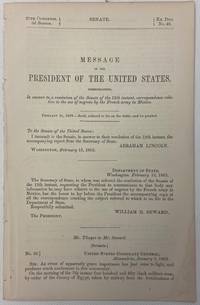
1863175681863. Lincoln Abraham. African Troops Scarce U.S. Senate executive document transmitting a message from Abraham Lincoln and accompanying State Department correspondence concerning the French deployment of Black troops to Mexico during the American Civil War. Issued by the 37th Congress 3rd Session in February 1863 the report reflects the convergence of emancipation-era policy racialized military labor and international imperial strategy.<br /> <br /> U.S. Senate Executive Document No. 40 37th Congress 3rd Session; February 1863. Original printed pamphlet in standard folio format.Prepared under the direction of William H. Seward the document compiles diplomatic intelligence indicating that France transported African troops from Egypt-specifically from regions identified as "Dalfour" and Nubia-to reinforce forces stationed at Veracruz during the French Intervention in Mexico. The stated rationale as recorded in the report was that "the black race is not subject to the yellow fever" revealing the period's racialized medical assumptions and their direct application in imperial military logistics.<br /> <br /> Produced in the immediate aftermath of the Emancipation Proclamation this document is especially significant for situating Black military labor within a global context. While the Union was actively recruiting African American soldiers U.S. officials were simultaneously monitoring European powers deploying African troops across colonial networks. The report thus provides rare contemporary evidence of how race disease theory and military necessity intersected in both American and European wartime policy. This document holds strong research value across multiple fields: African American military history Civil War diplomacy transnational slavery and emancipation colonial medicine and 19th-century imperial warfare. It is particularly notable for documenting the perceived biological resilience of Black soldiers as a strategic asset-an idea central to both colonial and military history. AS per OCLC Scarce in institutional holdings with only a small number of recorded copies including Wyoming North Texas Michigan and Faulkner University. OCLC data should be understood as approximate and subject to revision. Condition: Light dampstaining to the lower right blank corner; otherwise in very good condition and clean legible text. unknown
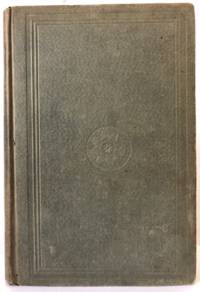
1860158491860. Lincoln Abraham. The Lincoln and Douglas Debates 1860 printed record of the seven public debates between Abraham Lincoln and Stephen A. Douglas during the 1858 Illinois Senate campaign a pivotal series of political confrontations over slavery and the future of the United States. The debates addressed the expansion of slavery into western territories and the constitutional implications of the Supreme Court's Dred Scott decision. Lincoln used the campaign to articulate a moral and political critique of slavery's expansion including the position he expressed in his earlier convention speech that "a house divided against itself cannot stand." Although Lincoln lost the Senate race to Douglas the debates established him as a leading national figure within the Republican Party and played a major role in shaping the political arguments that led to his presidential election in 1860.<br /> <br /> Lincoln Abraham. The Lincoln And Douglas Debates. A Political Debates between Hon. Abraham Lincoln and Hon. Stephen A. Douglas. In the Celebrated Campaign of 1858 in Illinois. Columbus: Follett Foster and Company 1860. First edition third issue identified by the numeral "2" on page 13 and the presence of the publisher's advertisement. Octavo volume containing 268 pages. Bound in publisher's original olive green textured cloth with blind stamped borders and spine lettered in gilt.<br /> <br /> The Lincoln Douglas debates represented one of the most influential series of political exchanges in nineteenth century American history addressing the central constitutional and moral questions surrounding slavery in the years immediately preceding the Civil War. Douglas defended the doctrine of popular sovereignty arguing that territories should decide the legality of slavery for themselves while Lincoln challenged the compatibility of that doctrine with the Dred Scott decision and emphasized the moral consequences of the institution. Although Douglas retained his Senate seat Lincoln's articulate presentation of the issues drew national attention and positioned him as a major political figure within the emerging Republican Party. Slight chipping to the head of the spine fading to boards and gilt minor damp staining with light foxing and toning consistent with age. Overall good condition. unknown