2 979 résultats
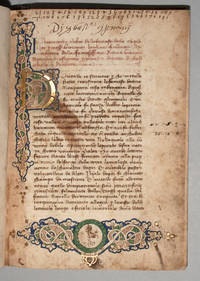
14565673<p>BOCCACCIO'S FAMOUS WOMEN SIGNED AND DATED SEPTEMBER 1456 BY THE SCRIBE</p><p>COPIOUSLY ANNOTATED WITH EARLY POEMS ON WOMEN SOME UNPUBLISHED</p><p>Florence F. di Pagolo Piccardi 1456.</p><p>4to manuscript on paper 27.3 x 19.5 cm 133 ff. consisting of 13 quinions and 3 singletons written in a single column of thirty lines f. 1r. with white-vine initial 'D' and white-vine lower border in gold blue green pink and white with laurel wreath with blank space for arms; later unidentified arms added in brown ink rubricated chapter headings initials in blue early foliation in Arabic numerals in upper margin catchwords on final page of quires Arabic numeration of quires preserved on first page of several gatherings. Bound in old 17th-century vellum pattern of pricked holes for straps on lower cover vellum sewing stays at middle of quires red sprinkled edges. Minor rubbing and edge wear to spine and covers. Copiously annotated see below some rubbing staining edge wear to f. 1r minor to moderate occasional spotting and staining mostly marginal one to two letters of a few marginal annotations trimmed at fore-edge not affecting poems old repairs to inner margin of ff. 8-11 leaves of fourth quire out of order due to scribal error and misbinding text perfectly legible neatly and consistently written.</p><p>Fine 15th-century Florentine vernacular manuscript – illuminated on its opening page with the 'white-vine' motif made famous by Tuscan illuminators of the Quattrocento – of Giovanni Boccaccio's 1313-75 renowned treatise <em>De mulieribus claris</em> <em>Famous Women</em> "the first collection of biographies in Western literature devoted exclusively to women" and a work considered to be "the fountainhead of the European tradition of female biography" V. Brown pp. xii and xxii. The present manuscript preserves the first <em>volgare</em> translation of Boccaccio's original Latin text an Italian rendering <em>Delle famose donne</em> made by Donato degli Albanzani di Casentino d. 1411 a Venetian schoolmaster and friend of the author. Donato degli Albanzani began his translation in the 1360s "almost contemporaneously" Scarpati p. 211 with Boccaccio writing the original work which he first composed in 1361/1362 but revised several times in the following years. The present volume was expertly written out in a <em>mercantesca libraria</em> script signed and dated 1 September 1456 by the noted scribe Francesco di Pagolo Piccardi active 1440s-70s who was working at the behest of the prominent Florentine <em>cartolaio </em>Angolo Tucci 1395-1476 see below. The volume also contains copious later marginal annotations in several hands including poems on prominent women by Bernardo Accolti 1458-1535 and Raffaello Gualtieri fl. 1550s-70s as well as several pieces which are yet to be identified see below.</p><p>While the manuscript tradition of Boccaccio's Latin <em>De mulieribus claris</em> has received sustained scholarly attention over the last century see especially Branca much work and indeed even a proper census remains to be done on this earliest of vernacular translations especially considering that during the Trecento and Quattrocento the greater part of female readership of the <em>Famous Women</em> would have experienced the text not in the Latin but in the <em>volgare</em>.</p><p>Inspired by Petrarch's 1304-74 <em>De viris illustribus</em> <em>Lives of Famous Men</em>; a title Donato degli Albanzani also translated into the <em>volgare</em> Boccaccio in the <em>De mulieribus claris</em> penned 103 chapters on classical goddesses and female mythological figures e.g. Juno Minerva Isis Medea Arachne Medusa 'historical' women of the ancient world Helen Dido Sappho Lucretia Cleopatra Agrippina and prominent women who lived in post-classical times Empress Irene of Constantinople Queen Joanna of Jerusalem and Sicily the Sienese widow Camiloa the infamous 'Pope Joan'. Boccaccio notably excludes the vast pantheon of female Christian saints who had already been adequately covered in the hagiographical tradition. He sought to record for posterity the stories of women renowned for any sort of deed – including both 'good' and 'bad' women – and although he rarely cites his sources his stories typically derive from classical authors newly elevated in the wake of Petrarchan humanism including Livy Ovid Pliny the Elder Statius Suetonius Valerius Maximus and Virgil.</p><p>Boccaccio composed the <em>De mulieribus claris</em> at Certaldo between the summer of 1361 and the summer of 1362. He dedicated his treatise to Andrea Acciaiuoli Countess of Altavilla a Tuscan noblewoman living in southern Italy who was the sister of Niccolò Acciaiuoli an old friend of Boccaccio and a major power behind the throne of Joann Queen of Naples. Donato degli Albanzani our translator first met Boccaccio in Ravenna in 1346 while at the court of Ostasio da Polenta but a friendship between the two scholars took root only later during Boccaccio's visit to Venice in 1363 where he was a guest of Petrarch at the Palazzo Molin sulla Riva degli Schiavoni. Donato began his translation of the <em>De mulieribus claris</em> in the mid-1360s and is believed to have presented a preliminary version of his work to Boccaccio in 1368 when he visited the writer at Padua. Donato's translation would not be fully finished however until sometime after he moved to Ferrara in 1381 to work as chancellor to Alberto d'Este and as tutor in the d'Este household. He dedicated the completed translation to his pupil Niccolò III d'Este son of Alberto see Zaccaria pp. 132-6.</p><p>"Among the most popular works in the last age of the manuscript book" Brown p. xii both in its Latin and vernacular versions the <em>Famous Women</em> immediately exerted a considerable influence on authors across Europe including Geoffrey Chaucer who inserted a translation of the entire chapter on Zenobia as one of the stories that makes up <em>The Monk's Tale</em> and Christine de Pizan who used Boccaccio's work as a point of departure for her <em>Livre de la cité des dames</em> 1405. "The <em>Famous Women</em> also inspired many imitators in the fifteenth and sixteenth centuries among whom are Iacopo Filippo Foresti <em>De plurimis claris selectisque mulieribus</em> Giovanni Sabbadino degli Arienti <em>Gynevera de la clare donne</em> Alvaro de Luna <em>De las virtuosas y claras mujeres</em> Alonso of Cartagena <em>De las mujeres ilustres</em> and Thomas Elyot's <em>Defense of Good Women</em>" Brown p. xxii.</p><p>Fascinatingly the present manuscript includes numerous later marginal additions attesting to the fact that Boccaccio's treatise was carefully read well into the 17th-century. <em>Ottava rima</em> poems treating Semiramis f. 2r. Medea 19r Helen 39r Lucretia 53v and Cleopatra 101r all written out in the same 16th-century hand are the work of the renowned poet Bernardo Accolti 1458-1535; called 'L'Unico Aretino'. At ff. 45v-46r is a sonnet on Dido itself glossed with relevant lines from Book IV of the <em>Aeneid</em> by the poet Raffaello Gualtieri of Arezzo fl. 1550s-70s. These poems were published together in the <em>Libro terzo delle rime di diversi nobilissimi et eccellentissimi autori nuovamente raccolte</em> Venice 1550 but they appear there in readings that differ from those found in this Boccaccio manuscript suggesting that the annotator was perhaps working from a manuscript collection of poems or indeed working from memory. In any case a thoughtful addition of contemporary poems about famous women to a volume of Boccaccio's <em>Delle famose</em> <em>donne</em> that was written out a century earlier certainly warrants further examination given the context of wider Cinquecento debates about women then raging on the Italian peninsula e.g. in Baldassare Castiglione's <em>Il Cortegiano</em>.</p><p>Further annotations in the manuscript include a passage from Aesop's "De Gallo et Jaspide" a popular school text here added to Boccaccio's chapter on Jocasta; f. 26r and unidentified poems at entries on Semiramis 2v Juno 5r Hypermnestra 15r Almathea 27r Pocris 29v-30r and Flora 75r as well as various lines of devotional verse e.g. 52r 133v monetary notes mathematical calculations and the like. One annotator records at fol. 80r the planting of parsley on Monday 4 August 1567 while another signs fol. 62v "5 November 1663 from Florence." The names 'sammoello dangnolo' and 'antonio dangnolo dale corti' are written in the margins of ff. 120r and 121r and the opening page on the manuscript is inscribed by Bartolomeo Cipriani: An 'Antonio d'Agnolo di Battista dalle Corti' and a 'Bartolome Cipriani' are attested as living in the Tuscan town of Greve in Chianti during respectively the 1570s and 1660s-1670s C. Baldini pp. 172 and 183; I Baldini pp. 51 and 209 and perhaps should be associated with the manuscript.</p><p>The manuscript's colophon reads: "<em>Questo libro e schritto per me Francesco di Pagolo Piccardi a pitizione Dangiolo Tucci cartolaio ad primo di settembre 1456. Iddio lodato</em>." The scribe Francesco di Pagolo Piccardi seems to have specialized in the writing of vernacular manuscripts recording his name in Italian translations of Ovid's <em>Metamorphoses</em> and of Livy in a copy of Boccaccio's <em>Il Ninfale Fiesolano</em> and in an <em>ottava rima</em> pilgrim's guide to Santiago de Compostella. His earliest surviving effort dated 27 August 1444 is in fact another copy of Bocaccio's <em>Delle famose donne</em> which he wrote out while a prisoner at Florence's infamous Carcere delle Stinche see Cursi p. 184 no. 20; Pavia Biblioteca Universitaria MS Aldini 249.</p><p>Agnolo Tucci 1395-1476 was <em>cartolaio</em> to the Badia in Florence from 1451 to 1467 managing shops located opposite Sant'Apollinare and the Camera del Comune. His business was taken over at his death by his son Bartolome d'Agnolo Tucci 1427-1525 who employed several well-known Florentine illuminators of the later Quattrocento see <em>Commissioni</em> p. 21.</p><p>Further manuscripts identified as having been by written by the scribe Pagolo Piccardi are: Vatican City Biblioteca Apostolica Vaticana Barb. lat. 3933 dated 1473; Vatican City Biblioteca Apostolica Vaticana Capp. 243 dated 1454; Florence Biblioteca Riccardiana 1517 Q. III. 9 dated 1463; Florence Biblioteca Medicea Laurenziana Acq. e doni 145 dated 1455; Florence Biblioteca Nazionale Centrale II. IV. 17 Conv. Soppr. B. V. 2582 dated 1470; Florence. Biblioteca Nazionale Centrale Palat. 583 dated 1475; Rome Biblioteca Nazionale Vitt. Em. 488; Torino Biblioteca Nazionale N. I. 14.; Paris Bibliothèque nationale de France Département des Manuscrits Italiens ms. n. 900-8773 on manuscripts signed by Pagolo Piccardi see S. Mattiazzo p. 207 no. 184.</p><p>Watermarks are of the letter 'P' and although buried in the gutter as expected in a quarto book and thus impossible to examine with precision they are consistent throughout the volume and are very like Briquet 8971 which is localized to Siena 1454-57 and Florence 1461-62.</p><p>We have located only 1 example of Donato degli Albanzani's <em>Delle famose donne</em> at a U.S. institution New Haven Yale Beinecke Library MS 398 and just 6 further global copies Pavia Biblioteca Universitaria MS Aldini 249; London British Library MS Add. 16. 435; Oxford Bodleian MS Canon. It. 86; Florence Biblioteca Nazionale Centrale MS Palat. E. 5. 6. 60; Torino Bib. Univ. Cod. E. IV 29 Lat. 1047; and Montecassino MS 528 s. xv see Inguanez vol. 3 pp. 185-6; Tosti pp. 7-14.</p><p>Indeed while manuscripts of Boccaccio's Latin <em>De mulieribus claris</em> survive in much greater numbers than do manuscripts of Albanzani's translation V. Branca traces some 110 Latin copies although 30 of these are damaged incomplete or excerpts these too are quite rare in the United States with just 3 examples having been recorded New Haven Yale Beinecke Library Marston MS 62; Wellesley Mass. Wellesley College MS 843; Cambridge Harvard MS Richardson 41 fragment; see V. Branca.</p><p> G. Manzoni <em>Delle Donne Famose de Giovanni Boccacci traduzione di M. Donato degli Albanzani di Casentino detto L'Apenninigena</em> 1881; V. Brown ed. and trans. <em>Giovanni Boccaccio. Famous Women</em>; V. Zaccaria "I volgarizzamenti del Boccacco latino à Venezia" in V. Branca and G. Padoan eds. <em>Boccaccio Venezia e il Veneto</em> pp. 131-52; L. Tosti e.d <em>Volgarizzamento di Maestro Donato da Casentino dell'opera di Messer Boccaccio</em> De claris mulieribus; C. Scarpati "Note sulla fortuna editorial del Boccaccio: I volgarizzamenti cinquecenteschi delle opere latine" in G. Tournoy ed. <em>Boccaccio in Europe</em> pp. 209-20; A. Altamura "Donato da Casentino: Un volgarizzamento trecentesco del <em>De Claris mulieribus</em> del Boccaccio" <em>Atti e memorie della R. Accademia Petrarca di Lettere Arte e Scienze</em> vol. 24 1938 pp. 265-71; L. Toretta "Il <em>Liber de claris mulieribus</em> Parte III: I traduttori del <em>Liber de claris mulieribus</em>" <em>Giornale storico della letteratura italiana</em> vol. 40 1902 pp. 35-50; F. Novati "Donato degli Albanzani alla corte estense" <em>Archivio storico italiano</em> ser. 5 vol. 6 1890 pp. 365-85; V. Branca <em>Tradizione delle opere di Giovanni Boccaccio</em> vol. 1 "Un primo elenco dei codici e tre studi" pp. 92-98 and vol. 2 "Un secondo elenco di manoscritti e studi sul testo del 'Decameron' con due appendici" pp. 57-62; M. Franklin <em>Boccaccio's Heroines: Power and Virtue in Renaissance Society</em>; I. Baldini <em>Pievi parrocchie e castelli de Greve in Chianti</em>; C. Baldini <em>Statuti della lega di Val di Greve</em>; M. Cursi "'Con molte sue fatiche': copisti in carcere alle Stinche alla fine del Medioevo secoli XIV e XV" in <em>In uno volumine: Studi in onore di Cesare Scalon</em> ed. L. Pani pp. 151-92; C. Guerzi "Un manoscritto ferrarese del tempo di Niccolò III d'Este: il <em>De mulieribus claris</em> della Bodleian Library di Oxford Canon. it. 86 e il suo miniatore" in <em>Intorno a Boccaccio</em> ed. S. Zamponi pp. 157-77; M. P. Mussini Sacchi "Le ottave epigrammatiche di Bernardo Accolti nel ms. Rossiano 680" <em>Interpres</em> vol. XV 1995-96 pp. 219-301; S. Mattiazzo <em>Di mia propria mano. Le sottoscrizioni dei copisti "italiani" del Quattrocento nei codici della Bibloteca Riccardiana di Firenze</em>; R. Daniels <em>Boccaccio and the Book: Production and Reading in Italy 1340-1520</em>; F. Zambrini <em>Serie delle edizioni delle opere di Giovanni Boccacci: Latine volgare tradotte</em> pp. 21-7; A. Hortis <em>Studi sulle Opere Latine del Boccaccio</em> pp. 930-31.</p> F. di Pagolo Piccardi
19123011BBMünchen und Leipzig, Georg Müller und Hans von Weber, (1912-13). 8°. 264, 252, 188, 238, 227 Seiten. Orig. rotes Maroquin mit grünen Rückenschildchen, reicher Rückenvergoldung, Goldbordüre auf Deckeln, Kopfgoldschnitt.
BB67014Berlin: Propyläen-Verlag. hardcover. gebraucht gut Halbleinenband der Zeit Kopffarbschnitt private Registratur auf Innendeckel Buchrücken etwas berieben sonst GUTE EXEMPLARE. 21 x 135 cm. Für Ihre Zufriedenheit versenden wir mit DHL und ausschließlich mit Trackingcode für eine sichere Sendungsverfolgung! Weitere Angebote unter antiquariat-kastanienhof Propyläen-Verlag hardcover
1333158947.Gpaperback. Good. Access codes and supplements are not guaranteed with used items. May be an ex-library book. paperback
1334314411.Gpaperback. Good. Access codes and supplements are not guaranteed with used items. May be an ex-library book. paperback
55932Zürich Manesse Verlag Conzett & Huber um 1980. Leinen gebunden; blaue Einbände Rückengoldprägung Farbkopfschnitt mit weissen/ blauvioletten illustrierten Schutzumschlägen / 2 Bände / Anz. Seiten: 669 608 / 10 x 155 cm / mit 120 Holzschnitten / Zustand: gut leichte Gebrauchsspuren; Schutzumschlag etwas berieben lichtrandig angerändert und an einer Stelle leicht eingerissen Besitzereinträge auf den Vorsätzen Erschienen in der Reihe "Manesse Bibliothek der Weltliteratur"; die Holzschnitte sind der venezianischen Ausgabe des Decamerone von 1492 entnommen; die deutsche Übersetzung stammt von G. Diezel und wurde revidiert von Paola Calvino; der 2. Band enthält den 6 bis 10 Tag des Decamerone und das Schlusswort von Giovanni Boccaccio sowie ein Nachwort von Horst Rüdiger Zürich, Manesse Verlag Conzett & Huber, um 1980 unknown
1172917612.Gpaperback. Good. Access codes and supplements are not guaranteed with used items. May be an ex-library book. paperback
1172906173.Gpaperback. Good. Access codes and supplements are not guaranteed with used items. May be an ex-library book. paperback
26855Georg Müller und Hans von Weber 1913. Half - cloth. l The 5 Volumes Set in a facsimilé of 1913. Leather of spinea a little chipped spine weary. photo on request hardcover
19123011BB1912. München und Leipzig Georg Müller und Hans von Weber 1912-13. 8°. 264 252 188 238 227 Seiten. Orig. rotes Maroquin mit grünen Rückenschildchen reicher Rückenvergoldung Goldbordüre auf Deckeln Kopfgoldschnitt. Nicht bei Rodenberg. - Faksimile der berühmten Boccaccio-Ausgabe. "Von dieser Ausgabe wurden 100 Exemplare für die Mitglieder der Vereinigung 'Die Hundert' auf Velin von Van Gelder mit dem Hundertzeichen weitere 100 Exemplare auf gleichem Velin mit dem Wasserzeichen "Boccaccio" für die Luxusausgabe abegezogen." Vorliegendes Exemplar ist Nr. 42 der Luxusausgabe. - Rücken von Bd. 1 und Teil des hinteren Deckel etwas verblasst Kratzer auf Vorderedeckel von Bd. 4. unknown
14030Berlin: Propyläen Verlag n/d. Hardcover. vg. 5 volumes. 264pp. 252pp. 188pp. 238pp. 227pp. Half leather over marbled boards. Gold decorated spine with labels in red and green. Some fading to green on spine on Vol.II III and IV. Corners bumped and worn. The story takes place in medieval Europe during the "Black Death" the plague that killed one third of the European population. Illustrated with b/w reproductions of etchings by Gravelot Boucher and Eisen taken from the 1757 edition. Translated from the Italian by Heinrich Conrad. Text in German. Binding in very good interior in near fine condition. Scarce in this special binding. Propyläen Verlag hardcover
14026Berlin: Propyläen Verlag n/d. Hardcover. vg. 5 volumes. 264pp. 252pp. 188pp. 238pp. 227pp. Quarter vellum over sienna paper-covered boards. Gilt decorated spine. Slight discoloration to spines. Minor scuffing and occasional tiny stains to boards. Translated from the Italian by Heinrich Conrad with etchings by Gravelot Boucher and Eisen taken from the 1757 edition. The story takes place in medieval Europe during the "Black Death" the plague that killed one third of the European population. Text in German. In very good condition. Propyläen Verlag hardcover
21364Berlin: Propyläen Verlag n/d. Neuausgabe. Hardcover. vg. 5 volumes. 264pp. 252pp. 188pp. 238pp. 227pp. Three-quarter vellum over orange paper-covered boards. Labels in green and red with gold lettering on spine. Binding by A. Köllner after a design by Hugo Steiner-Prag. Staining on spines. Scuffing minor age wear and staining on boards. Slight rippling to pages. Ribbon markers. Creasing to fore-page edge on some pages in Vol. II. The story takes place in medieval Europe during the "Black Death" the plague that killed one third of the European population. Illustrated with b/w reproductions of etchings by Gravelot Boucher and Eisen taken from the 1757 edition. Translated from the Italian by Heinrich Conrad. Text in German. Tight copies in very good condition. Propyläen Verlag hardcover
003254Berlin Germany: Propyläen 1923. 5 volumes small quartos. Black boards backed in red cloth with red cloth spine. Very good condition Back cover of first vol slightly misshaped. Illustrated with engravings after designs by Gravelot Elsen Boucher first appearing in the edition of 1757. German text translated by Heinrich Conrad. Nice clean tight set. Hard Cover. Very Good/No Jacket. 8vo - over 7¾" - 9¾" tall. Propyläen (1923) hardcover
0364092564.Ghardcover. Good. Access codes and supplements are not guaranteed with used items. May be an ex-library book. hardcover
066673769X.Ghardcover. Good. Access codes and supplements are not guaranteed with used items. May be an ex-library book. hardcover
0666633355.Ghardcover. Good. Access codes and supplements are not guaranteed with used items. May be an ex-library book. hardcover
0666741352.Ghardcover. Good. Access codes and supplements are not guaranteed with used items. May be an ex-library book. hardcover
1334314705.Gpaperback. Good. Access codes and supplements are not guaranteed with used items. May be an ex-library book. paperback
0484520954.Ghardcover. Good. Access codes and supplements are not guaranteed with used items. May be an ex-library book. hardcover
192517670Munchen und Leipzig: Georg Muller und Hans Von Weber c 1925. Second edition. Hardcover. Very Good. 4 Volumes each 5 1/4 x 8 inches. Second edition with the plates of the 1767 edition 1st was 1913 these not dated but circa 1925. Text in German. Condition is Very Good; Rubbing and soiling to the spines text and illustrations are perfect with no toning foxing stains markings etc. bindings are tight. STK Georg Muller und Hans Von Weber hardcover
FMM2516Munchen: Georg Muller und Hans von Weber 5 volumes; Essentially a fine facsimile of the 1757 edition; Von der Hundertausgave ist dieses Exemplar Nr. XLIV; Fine bindings by Carl Sonntag Leipsig; Polished maroon Morocco gilt spine title on green label heavy gilt spine decoration gilt borders to covers top edges gilt illustrations reproduced from the 1757 edition & red satin bookmarks; A near fine set. 247 188 252 238 & 227 pages. Size: 5"x8". Hardcover. Illus. by Gravelot Boucher & Eisen der Ausgabe. Georg Muller und Hans von Weber Hardcover
178345052ABWittenberg und Zerbst, Zimmermann 1783-86. XVI, 320, XIV [recte VIII], 231, XVI, 318 S. Späterer Pappband mit marmorierten Deckeln und schwarzem Rückenschild. Gelenke geringf., Kapitale etwas stärker berieben. Teils geringf. gebräunt.
19715952The Hague/Paris, Mouton, 1971. 8°, 138 Seiten. mit 2 Falttafeln. Orig.Leinen mit Goldprägung und OSU.
1912233232München/Leipzig: Georg Müller/Hans von Weber 1912/13. 264, 252, 188, 238, 227 S., zahlr. s/w Kupfer und Vignetten auf Taf. HLdr. *25 Jahre Georg Müller Verlag S. 75 *bibliophile Halbfranzbände mit goldgeprägten Rückenschildern und reicher Rückenvergoldung, Kopffarbschnitt und farbig-gesprenkeltem Bezugspapier *Einbandentwurf von Hugo Steiner-Prag* schöne Reihe.