571 résultats
1969132781Los Angeles: Twentieth Century-Fox 1969. Original title card maquette hand lettered by Harold Adler for the 1969 film. Based on the "Alexandria Quartet" by Lawrence Durrell. <br/><br/>Harold Adler was a calligrapher who created hand lettered titles on over 100 films worked frequently with Alfred Hitchcock and was a favorite of legendary title sequence designers Saul Bass and Pablo Ferro. In addition to "Justine" his credits include "Comanche!" 1956 "The Man with the Golden Arm" 1955 "The Seven Year Itch" 1955 "Carmen Jones" 1954 "Psycho" 1960 "The Birds" 1963 "In the Heat of the Night" 1967 and "Finian's Rainbow" 1969. In 2012 an exhibition of Adler's work was organized by noted typographer and design historian Jill Bell at the American Advertising Federation Kansas City. <br/><br/>A young British schoolmaster and poet travels to Alexandria where he meets Justine the mysterious wife of a banker whom he discovers is involved in a plot to arm the Jewish underground in Palestine. Shot in part on location in Tunisia. <br/><br/>17.25 x 11.5 inches. Black ink on white card stock with tissue paper overlay. Near Fine with light toning to the card edges. Holograph annotations one noting "original" to the tissue overlay and card. Twentieth Century-Fox unknown books
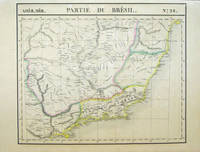
182740380Bruxelles: Ph. Vandermaelen 1827. First edition. A very good sharp set housed in a clamshell box. 17 sheets. Hand-colored lithographic maps. 47 x 57 cm. The Empire of Brazil on a grand scale printed shortly after Pedro declared the independence of Brazil but before the conclusion of the Cisplatine War against the United Provinces of the RÃo de la Plata Argentina which cost her Uruguay. Sheets from Phillipe Vandermaelen Atlas universel de geographie physique politique statistique et mineralogique. a magnificent and ground breaking six volume atlas of the entire world which was the first Atlas to use lithography to show the entire world using such a large uniform scale approximately 26 miles to the inch and which was designed to be joined together into a three-dimensional globe with a diameter of aboout 25 feet. Includes all of Brazil with some surrounding areas: 1. Amer. Merid. no. 9. Partie de la Colombie et du Bresil. Parts of Peru Colombia and Brazil. 2. Amer. Merid. 10. Partie du Bresil. Amazonas region Brazil. 3. Amer. Merid. 11. Partie du Bresil. Parts of Amazonas Para and Amapa. 4. Amer. Merid. 12. Partie du Bresil. Covers parts of Para and Maranhao. 5. Amer. Merid. 13. Partie du Bresil. Parts of Piaui Ceara and Rio Grande do Norte. Text: Note sur le Bresil . Pour la suite voyez la carte no. 32. 6. Amer. Merid. 15. Partie du Perou et du Bresil. Parts of Peru Brazil and northern Bolivia. 7. Amer. Merid. 16. Partie du Bresil. Parts of Brazil and northern Bolivia. 8. Amer. Merid. 17. Partie du Bresil. Parts of Mato Grosso Tocantins Amazonas and Para. 9. Amer. Merid. 18. Partie du Bresil. Parts Tocantins Bahia Maranhao and Piaui. 10. Amer. Merid. 19. Partie du Bresil. Parts of northeastern Brazil. 11. Amer. Merid. 22. Partie du Bresil. Part of Santa Cruz Bolivia and Mato Grosso and Mato Grosso do Sul Brazil. 12. Amer. Merid. 23. Partie du Bresil. Parts of Goias Federal District Minas Gerais and Tocantins. 13. Amer. Merid. 24. Partie du Bresil. Parts of Bahia and Minas Gerais with coast soundings. 14. Amer. Merid. 27. Partie du Bresil. Part of southern Brazil. 15. Amer. Merid. 28. Partie du Bresil. Parts of Sao Paulo Minas Gerais Espirito Santo and Rio de Janeiro states. 16. Amer. Merid. 32. Partie du Bresil. Part of southern Brazil. Text box: Note sur le Bresil. Pour le commencement voyez la carte no. 13. 17. Amer. Merid. 35. Partie du Bresil. Parts of Uruguay Rio Grande do Sul Brazil and Buenos Aires province Argentina an eighteenth sheet No.36 was labeled 'Partie du Bresil but in fact only included parts of Argentina and Chile. If joined together the map would measure approximately 9 x 7 feet. Phillips 749. Amer. Geol. Soc. Catalogue of Maps of Hispanic America: III p. 172. Sabin 43762. [Ph. Vandermaelen] unknown books
1685262811Lyons: Girin 1685. hardcover. very good. 3 full page copperplate engravings and 4 engraved chapter headings. Thick 12mo 22 445 5 pages rubricated title and edges full calf gilt spine chipped and worn. Lyons: Jean Girin & B. Riviere 1685. Scarce. Very good .<br/><br/> Sabin 21146; Wellcome II p. 494; Bitting 134.<br/><br/> Girin unknown books
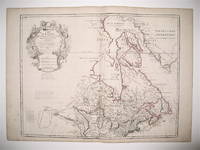
1783242998Dezauche 1783. Map. Engraving with hand coloring. Image measures 19.75 x 25.5". Sheet measures 21.5 x 30".<br/><br/> This map of Canada and the northern United States extends north from around the latitude of Baltimore all the way up to Baffin Bay along the shore of Greenland. Published by Jean-Claude Dezuache in 1783 it is the eighth revision of a map originally published by De L'Isle in 1703. The map is notable as the first to include "Etats-Unis" in the title coming as it did on the heels of the American Revolution. In fact this appearance is one of the earliest appearances of the name United States Etats-Unis on a printed map. The map is compelling in its accuracy particularly with regard to the Great Lakes depicting them as fully enclosed and properly placed in longitude and latitude. There is also excellent detail around the Hudson and Mississippi Rivers. The elaborate cartouche is decorated with a beaver natives one of whom is bearing a scalp and Jesuit explorers. Furthermore the fleurs-de-lis that previously adorned the shield at the top of the cartouche has been erased and the crown converted into a halo suspended above an orb a response to the execution of the king following the French Revolution Below a table of colors delineates the boundaries of the United States and European possessions. Indian nations are also labeled. The map is in excellent condition with wide margins as issued. Guillaume De L'Isle 1675--1726 was a French cartographer known for his popular and accurate maps of Europe and the newly explored Americas and Africa. He is important as the first "scientific" cartographer who incorporated the most current information on exploration and topography into his maps. Philippe Buache 1700--1773 was a student of De L'Isle and became one of the most active proponents of the so-called school of theoretical cartography active in mid-18th century France. This map is fascinating record from a remarkable moment in North American history.<br/><br/> Dezauche unknown books
1692LV1992Paris:: Chez Claude Barbin Jean Boudot George & Louis Josse avec privilege du Roy 1692. 1692. Sm. 4to. xx 406 xxiv pp. 6 chapter vignettes engraved by Vallet pp. aii 1 71 165 231 323 large engraved portrait of General Stanislas Jablonowski by Picart large folding map of Siberia 3 engraved plates: engr. pl. of transport sled of Moscow facing p.150 engr. pl. of a Calmouc Tartar facing p. 195 "Esquiss des Cosaques" facing p. 356. Nineteenth century quarter maroon morocco maroon paper over boards; rubbed. Rubber-stamp of Abbe E. Emile Longin Beaujeu fl.1904; receipt of sale of this copy to Armand Pushman 1932 NYC. First edition. This work was first translated into English in 1693. "At this time a major preoccupation of the Catholic Church and its China mission was to discover a safe land route from Europe to Peking through central Asia. This was due to the large numbers of out-going clergy who perished tragically every year at sea." Ames & Love p. 202. "The last decade of the century saw the publication of the accounts of several overland travelers to China and their destinations of China’s inner-Asian neighbors. The story of the Jesuit Philippe Avril’s attempt to establish a route across Russia for the safe passage of missionaries to China appeared in 1692 and includes descriptions of both the routes from Moscow to China and the peoples on China’s frontiers. Avril himself however did not travel beyond Moscow and his descriptions therefore are not the result of his own observations." Lach & Kley pp. 1685-1686. The same for Nicolaas Witsen. Avril Philippe a Jesuit born in France explored extensively throughout Asia and the Far East. He was a professor of mathematics and philosophy in Paris before he began his overland journey. He traveled for six years through Kurdistan Armenia Astrakhan Persia and other parts of the southeast. At one point he came to Moscow and was refused entry to Tatary. He was sent by the government to Poland via Istanbul and back to France. Apparently affected by exhaustion and disease he still undertook another voyage his last for the ship was lost at sea circa 1698. – Love Ronald S. "A Passage to China: A French Jesuit’s Perceptions of Siberia in the 1680s." French Colonial History 3: p. 94 2003. Ames & Love offer: "Though obliged to leave Moscow Avril did not return to France with Louis Barnabe . . . Remaining instead at Warsaw the two Jesuits had entered in early March 1688 Avril attempted twice more to achieve his objective or reaching China by land – if not through Siberia then via Persia and Central Asia. Aided in part by the Polish monarch John Sobieski r.1674-1696 and his ambassador to Russia the French priest once again traveled to Moscow in late spring. Just two days after his arrival in the Muscovite capital however Avril was ordered summarily out of the country. Once again he appealed the command in vain. ‘Russia intended to keep her trade with China a secret.’ Nor did he have better luck later the same year 1688 when he and a fellow Jesuit Pere de Beauvillier tried going south to Constantinople instead and thence through Persia to Bokhara Samarkland and the Chinese frontier. Crossing secretly into Ottoman territory the two men were arrested as spies. After several weeks they secured their release and resumed their trek. But Avril whose health had been waning as a result of relentless exertions suddenly developed a hemorrhage. Ordered to abandon the search and return home by his superiors he reached France in autumn 1689." Ames & Love p. 219. For Abbe Emile Longin provenance: see Bulletin de la Societe des sciences et arts du Beaujolais 1904 p.92. There is a Maggs Bros. London booksellers receipt of sale of this copy to Armand Pushman 10 Nov. 1932. Armand was one of two sons of Hovsep Pushman 1877-1966 an American artist of Armenian descent. He had studied art at the Imperial School of Fine Arts Istanbul. For a time Pushman lived at the famous Mission Inn Riverside California. He was also involved in the founding of the Laguna Beach Art Association. Armand Pushman d.1999 lived to 98 years and had been throughout his career a partner with his brother in their carpet business Pushman & Company. See: NYT Obituary January 11 1999. See: Henri Cordier Bibliotheca Sinica Dictionnaire Bibliographique des ouvrages relatifs a l’Empire chinois t. III 2088; De Backer Augustin & Carlos S.J. Sommervogel Bibliotheque de la Compagnie de Jesus. Bibliographie tome I p.706; Donald F. Lach Edwin J. Van Kley Asia in the Making of Europe Volume III: A Century of Advance book 4: East Asia. University of Chicago Press 1998; Glenn Joseph Ames Ronald S. Love Distant Lands and Diverse Cultures: The French Experience in Asia 1600-1700. Praeger 2003 – pp. 202 219; Howgego A142; Salmaslian Armenag Bibliographie de l’Armenie 1946 p. 238; Walravens Hartmut China illustrata. Das europaische Chinaverstandnis im Spiegel des 16. bis 18. Jahrhunderts. Mit einem Beitrag von David E. Mungello. Ausstellung im Zeughaus der Herzog August Bibliothek Wolfenbuttel vom 21. Marz bis 23. August 1987. Ausstellungskataloge der Herzog-August-Bibliothek Nr. 55 Wolfenbuttel: Herzog August Bibliothek 1987 55. 1691. Chez, Claude Barbin, Jean Boudot, George & Louis Josse, avec privilege du Roy, 1692. hardcover books
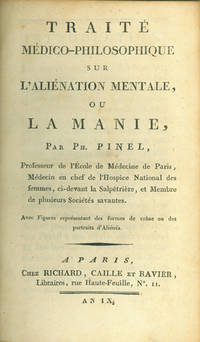
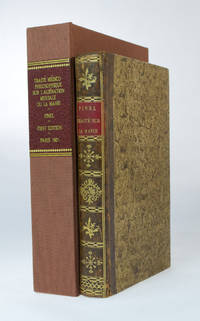
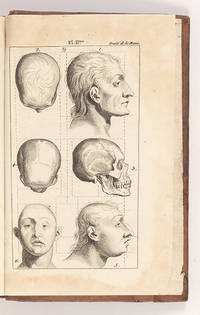
180134528Paris: Richard An IX 1801. <p>Foundation of Modern Psychiatry</p> <p> Pinel Philippe1745-1826. Traite medico-philosophique sur l'alienation mentale ou la manie. 8vo. lvi 318pp. Fold. printed table 2 engraved plates. Paris: Richard Caille & Ravier An IX 1800/1801. 193 x 118 mm. Quarter mottled sheep paste paper boards vellum corners slightly worn at spine. Light browning & foxing but a fine copy.</p> <p> First Edition. Garrison-Morton 4922. Pinel was one of the first to treat the insane humanely striking the chains from the lunatics at the Bicetre Hospital and implementing his "traitement moral" a compassionate form of psychiatric therapy that identified insanity with illness rather than moral perversity or demonic possession. In his Traite Pinel replaced the theorizing and speculation characteristic of earlier works on mental illness with his own practical observations of the Bicetre's mental patients whose behavior could now be observed undistorted by cruel treatment. He retained the old classifications of mental illness but distinguished mania from delirium and recognized the relationships between periodic mania melancholy and hypochondria. He recognized emotional disorders to be the main cause of intellectual dysfunction but also took into account heredity predisposition and hypersensitivity and attempted to find relationships between insanity and cranial deformity. Pinel founded the Salpetriere's famous school of psychiatry and trained a generation of psychiatrists the most important of whom was Esquirol. Norman 1701. Hunter & Macalpine pp. 602-10. Zilboorg pp. 319-41. </p> . Richard (An IX) unknown books
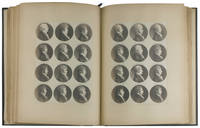
1862CAT0173New York: Elias Dexter 1862. Small folio later black cloth viii 104 pp. Complete with sixty-three plates as well as a photographic title page. One of 100 copies. Very Good. A very scarce and important reference on Saint-Memin also important as one of the earliest books illustrated with unique sets of photographic prints. This copy generally well preserved with some occasional fading to plates. Some dampstaining to text portion at margins. Light marginal creasing to corners of plates not affecting images. The photographic title page appears to be a copy of an earlier edition reading: Partie de la Collection des 818 / Portraits graves / par / Ch. Balt Julien Fevret de Saint Memin ancien Officier / aux Gardes Francaises pendant son emigration aux Etats-Unis. 1793 - 1814 and includes sixteen portraits surrounding the text. This title page detached all other pages soundly attached with a sound 20th-century cloth binding in generally excellent condition with some slight bowing to boards. A nice copy of a very scarce work. Title continues "Photographed by Gurney and Son of New York from proof impressions of the original copper-plates engraved by M. de St.-Memin from drawings taken from life by himself during his exile in the United States from 1793 to 1814. To which are prefixed a memoir of M. de St.-Memin by Ph. Guignard and biographical notices of the persons whose portraits constitute the collection compiled from authentic and original sources by the publisher E. Dexter." Miles Saint-Memin 212; Howes F107 "b"; Sabin 75444 OCLC 4827791. Elias Dexter unknown books
1920165270Paris: Au Sans Pareil 1920. 1 of 9 copies on Japon Imperial paper Copy No. IV. Softcover. VG or better glassine jacket with minor chipping few tiny tears no significant loss microscopic at best. Printed oversize wraps with glassine jacket. Half-title. Title-page with woodcut vignette and 4 woodcut illustrations by Marc Chagall. 48 pp. Among Marc Chagall's earliest book illustrations preceded only by appearances in 1914 and 1918. With Andre Breton Soupault was one of the founders of the Surrealist movement: "Soupault's earliest verse collection 'Aquarium' 1917 was published with the help of Guillaume Apollinaire who introduced Soupault to André Breton. In 1919 Soupault Breton and Louis Aragon cofounded the review 'Littérature'. Originally drawn to the antirationalism of the Dada movement Soupault soon rejected its nihilism and he and Breton experimented with other revolutionary techniques. One result of their experimentation was the "automatic writing" of the jointly authored 'Les Champs magnétiques' 1920; 'The Magnetic Fields' known as the first major Surrealist work. Soupault soon abandoned automatic writing to produce carefully crafted verses such as those in 'Westwego' 1922 and 'Georgia' 1926. As the Surrealist movement became increasingly dogmatic and political Soupault grew dissatisfied with it and eventually broke with it and Breton" Encyclopedia Britannica online. Exceptionally rare one of 9 such copies. Au Sans Pareil unknown books
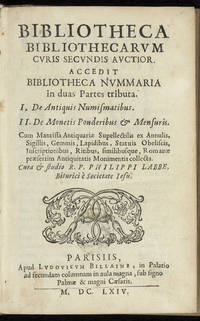
164616 p.l. 398 pp.; 27 pp. Two parts in one vol. 8vo cont. calf extremities a little rubbed contrasting leather lettering piece on spine. Rouen: A. Maurry for L. Billaine 1678. Third edition 1st ed.: 1664 "of the earliest extant bibliography of bibliographies. It is basically an alphabetical list arranged by authors' first names followed by eight intricate subject indices among them one of publishers' and booksellers' catalogues. Appended is a very useful numismatic bibliography. The work enjoyed three later editions during the seventeenth century and provided the basis for Teissier. Labbé 1607-67 one of the most learned polymaths of his time was a Jesuit professor of philosophy in Paris."-Grolier Club Bibliography 62-1st ed. The work attributed to John Selden on the title-page is actually by Alessandro Sardi 1520-88 and first appeared in 1579. There is also included a substantial bibliography on weights and measures. Haebler in his Handbuch states that this is the second book on incunabula and the first in which the word is used in connection with printing. A fine copy with some minor foxing. ❧ Taylor Book Catalogues pp. 176 208 & 219-20. hardcover books
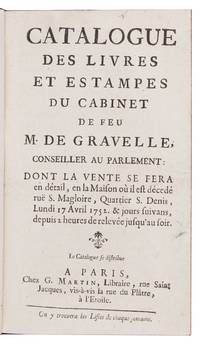
69441 p.l. 120 pp.; 21 p. & 19 leaves of author index in a contemporary hand. Two parts in one vol. 8vo attractive antique calf-backed paste-paper boards spine gilt red morocco lettering piece on spine. Paris: G. Martin 1752. One in a series of the very rare later auction catalogues issued by Gabriel Martin the Paris de Meyzieu of 1761 being his last. This library was formed by Gravelle 1699-1752 a magistrate in the court of inquiry of the Paris Parliament who is today best remembered for his Recueil de pierres gravées antiques published between 1732 and 1739 and for his parody L'Amant déguisé which was performed after his death. He was an expert engraver who prepared the etchings for his book on engraved gems. This was a fine and scholarly library of 1723 lots rich in literature and books on antiquities and art. There are many 16th-century works. The final 21 pages describe his large collection of prints and drawings 113 lots including works by Watteau van Dyck Boucher Guercino Le Brun Rembrandt Teniers An. Carracci etc. Fine copy. The first part has been priced throughout in a contemporary hand. There is also a most unusual manuscript index at the end. ❧ Lugt 785. Benezit Dictionary of Artists. Esprit des Livres website. Not in Grolier Club Printed Catalogues of French Book Auctions.1643-1830. hardcover books
180166795The Textual Foundation of Psychiatry PINEL Philippe. TraitÈ mÈdico-philosophique sur lÃaliÈnation mentale ou la Manie.Avec figures reprÈsentant des formes de cr‚ne ou des portraits d'aliÈnÈs. Paris: Chez Richard Caille et Ravier An IX 1800/1801. First edition. Octavo. lvi 318 pp. Folding letterpress table between pp. 250 and 251 and two engraved plates. Contemporary French quarter mottled sheep over paste paper boards. Smooth spine ruled in gilt with gilt red morocco lettering label. Occasional very light spotting. Housed in a custom brown cloth clamshell. Overall a superb copy. ìPhilippe PinelÃs TraitÈ mÈdico-philosophique sur lÃaliÈnation mentale ou la manie which presented the textual foundation of psychiatry stands as the first great publication of the nineteenth century in clinical medicineî Grolier Medicine. ìIn October 1793 while serving as mÈdecin des infirmeries at BicÃtre Hospital Pinel 1745-1826 had the chains struck off from forty-nine male psychiatric patients in order to substitute for this cruel oppression his ëtraitement moraleà a humane form of psychiatric therapy that identified insanity with illness rather than moral perversity or demonic possession. This dramatic act performed in the liberating spirit of the American and French Revolutions found immediate and enduring favor in the popular imagination as a symbol of a new attitude toward the insane and ignited a general desire for more humane treatment of the mentally ill that culminated in the English non-restraint movement of the mid-nineteenth century. Yet humanitarian treatment of the insane although crucial to PinelÃs psychiatric work was not that workÃs sole focus for Pinel also devoted himself to establishing psychiatry as a scientifically based branch of medicine. His TraitÈ replaced the speculation and theorizing characteristic of earlier discussions of insanity with his own practical observations of the lunatics of the BicÃtre whose illnesses could now be observed undistorted by cruel treatment. He retained the old classifications of mental illness stating that contemporary medicine was as yet too primitive for more precise categories but did introduce some subdivisions isolating mania from delirium and recognizing the relationships between periodic mania melancholy and hypochondria. He recognized emotional disorders to be the main cause of intellectual dysfunction but also took into account heredity predisposition and hypersensitivity and attempted to find relationships between insanity and cranial deformityî Norman Library. Cushing P286. Garrison and Morton 4922. Grolier Medicine 54. Heirs of Hippocrates 668. Hunter & Macalpine pp. 602-610. Norman Library 1701. Waller 7456. Wellcome IV p. 388. HBS 66795. $3250 Chez Richard, Caille et Ravier hardcover books
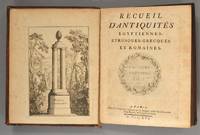
1761891021761. CAYLUS Anne Claude Philippe de Tobieres de. RECUEIL D'ANTIQUITES Egyptiennes Etrusques Grecques et Romaines. Paris Chez Duchesne 1761-1767. Seven volumes. Second edition of Volume I with two title pages dated 1756 and 1761. First edition of Volumes II-VII dated 1756 1759 1761 1762 1764 and 1767. Xix 3 348pp. 104ff. plates; viii4293pp. 129ff. plates; xxxvi448pp. 121ff. plates; xx4181pp. 125ff. plates; xxvi2348pp. 121FF. PLATES; XX 132ff. plates; 4xxviii336pp. 85ff. plates. Lacking only 4 out 107 plates to Volume I one plate out of 121 to Volume III and seven out of 97 to Volume VII leaving 818 of 830 numbered platesand 829 in total including four unnumbered plates and seven frontispieces. Several plates are out of order or misnumbered. A compendious and learned account of a formidable collection of antiquities with over 800 plates each with up to five objects depicted plus headpieces and initials. Each object is discussed in detail in the text. Le Comte de Caylus was noted for many reasons not all of them reputable but primarily as a pioneer in the study of ancient objects focussing on their subject matter and style with a critical eye. He left his collection to the King. He also studied the archaeological remains of the Gauls and Volumes III-VII are titled "Recueil d'Antiquites Egyptiennes Etrusques Grecques Romaines et Gauloises." Bound in full calf the spines in six compartments gilt with rococo floral tools and two morocco lettering-pieces. Wear to extremities; one board detached from each of Volumes III and III; rear board of VII loose; some superficial splits to hinges and abrasions to boards. Light spotting here and there faint dampstain to margins of two volumes discoloration to tops of a few boards but on the whole internally clean. An extraordinary record of early antiquarian scholarship. unknown books
5255Two engraved plates & one folding printed table. lvi 318 pp. 8vo fine cont. marbled sheep spine nicely gilt red morocco lettering piece on spine. Paris: Richard et al. An IX 1801. First edition and a lovely copy of an important book. This work which "presented the textual foundation of psychiatry stands as the first great publication of the nineteenth century in clinical medicine and at the same time as one of the paradigmatic expressions of the medical and scientific revolution that was taking place in the late eighteenth and early nineteenth centuries."-Grolier Club One Hundred Books Famous in Medicine 54. An unusually fine copy. The folding table lists pertinent data about patients he had cured. ❧ En Français dans le Texte 203. Garrison-Morton 4922-"Pinel was among the first to treat the insane humanely; he dispensed with chains and placed his patients under the care of specially selected physicians. Garrison considered the above book one of the foremost medical classics." Lefanu Notable Medical Books from the Lilly Library p. 155. unknown books
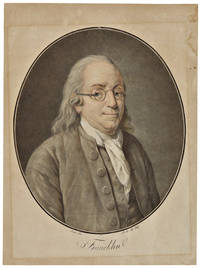
1790WRCAM45754Paris: Marie Francois Drouhin 1790. Handcolored oval mezzotint portrait 10 x 8 1/4 inches on a 12 1/2 x 9 1/4-inch sheet. Sheet lightly browned more so around the edges. Overall very good. Matted. An attractive mezzotint portrait of Benjamin Franklin with delicate contemporary coloring. The engraving was done after an original portrait by the famed French painter Charles Philippe Vanloo sometimes spelled Van Loo. The original portrait was done while Franklin resided in Paris in the years during and after the American Revolution and is now in the collection of the American Philosophical Society which was founded by Franklin. Sellers asserts that it is "beyond question a life portrait" done between 1777 and 1785. In Vanloo's original portrait Franklin wears a fur coat. In this print of the painting the fur coat has been replaced by a simpler cloth coat. Franklin wears glasses his hair is long and gray and he has a slight smile on his face. In the caption below the image his name is spelled "Francklin." "The substitution of a simple gray coat for the fur-trimmed costume of the original was undoubtedly in deference to revolutionary feeling" - Sellers. This print was engraved after Vanloo's portrait by the noted French engraver Pierre-Michel Alix who was known for his portraits of leading French citizens and prominent personalities. A handsome contemporary portrait of the American who dazzled France as a diplomat scientist philosopher and gentleman of society. SELLERS BENJAMIN FRANKLIN IN PORTRAITURE p.394. Marie Francois Drouhin hardcover books
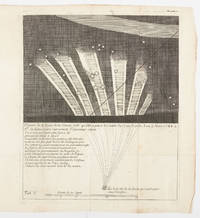
6925Six folding engraved plates. Title in red & black. 1 p.l. 308 pp. 8vo cont. mottled sheep flat spine nicely gilt contrasting leather lettering piece on spine. Lausanne & Geneva: M.M. Bousquet 1744. First edition of this important book in which Cheseaux 1718-51 grandson of Crouzas and a fellow the Royal Society of London first stated what was to become known as "the paradox of Cheseaux": "With an infinite and uniform distribution of stars throughout space the night sky should shine with a brightness corresponding to their average surface brightness." A number of notable astronomers have struggled with this problem including Halley Olbers Struve and Herschel. "The magnificent comet of 1744 was both bright and unusual in that it was reliably reported that it had multiple tails spread out like a fan. The Swiss astronomer Jean Philippe Loys de Cheseaux after whom the comet is often named began his observations on December 13 1743 and computed a parabolic orbit based on his own observations through March 1 1744.Before morning twilight on March 7 and 8 1744 Cheseaux reported seeing a multiple-tail system with 6 distinct rays extending above the horizon."-Yeoman Comets pp. 161-62. This work also contains the observations of Cassini and Jean Louis Calandrini. Nice copy. ❧ Lalande p. 425. hardcover books
19472187Princeton NJ: Halsman 1947. Photograph. Fine. ONE OF THE MOST FAMOUS IMAGES OF EINSTEIN. Philippe Halsman's now iconic 1947 photograph of Einstein has become not only one of the most celebrated images of Einstein but one of the most recognizable images of the twentieth century. It was used to a 1966 US postage stamp of Einstein and was featured on the cover of Time Magazine honoring Einstein as the "Person of the Century".

 The photographer Halsman in his book Philippe Halsman: A Retrospective explained the circumstances of the photo: I admired Albert Einstein more than anyone I ever photographed not only as the genius who single-handedly had changed the foundation of modern physics but even more as a rare and idealistic human being.
 Personally I owed him an immense debt of gratitude. After the fall of France it was through his personal intervention that my name was added to the list of artists and scientists who in danger of being captured by the Nazis were given emergency visas to the United States.
 After my miraculous rescue I went to Princeton to thank Einstein and I remember vividly my first impression. Instead of a frail scientist I saw a deep-chested man with a resonant voice and a hearty laugh.
 The question of how to capture the essence of such a man in a portrait filled me with apprehension. Finally in 1947 I had the courage to bring on one of my visits my Halsman camera and a few floodlights. After tea I asked for permission to set up my lights in Einstein's study. The professor sat down and started peacefully working on his mathematical calculations. I took a few pictures. Ordinarily Einstein did not like photographers whom he called Lichtaffen light monkeys. But he cooperated because I was his guest and after all he had helped save me.
 Suddenly looking into my camera he started talking. He spoke about his despair that his formula E=mc2 and his letter to President Roosevelt had made the atomic bomb possible that his scientific search had resulted in the death of so many human beings. "Have you read" he asked "that powerful voices in the United States are demanding that the bomb be dropped on Russia now before the Russians have time to perfect their own" With my entire being I felt how much this infinitely good and compassionate man was suffering from the knowledge that he had helped to put in the hands of politicians a monstrous weapon of devastation and death.
 He grew silent. His eyes had a look of immense sadness. There was a question and a reproach in them.
 The spell of this moment almost paralyzed me. Then with an effort I released the shutter of my camera. Einstein looked up and I asked him "So you don't believe that there will ever be peace"
 "No" he answered. "As long as there will be man there will be wars." Silver prints of this photograph have been printed in different sizes over the years. This photograph is an official Halsman silver print with his copyright hand-stamp on the verso measuring approximately 10x13 inches. Princeton NJ. Silver print. Taken 1947; printed 1970s. Image: 13x10 inches 33x25.4 cm. Archivally matted and framed under UV-protecting museum glass to an overall size of 18.5x22 inches. A stunning piece in fine condition. Halsman unknown books
16350000195Paris: S. le Moyne 1635. First edition. Full Leather. Very Good. 4to 236 x 180 mm Modern pebble leather binding with new end papers. Bookplates of Ashton Allis on new front pastedown Edward Sanford Burgess present on recto of original free end paper respectively. 16 1-238 2 158 as 358 220 as 196 pp 68 full-page copper engraved plates all botanical. Ink manuscript present on verso of front free end paper inscriptions in ink on title page and numerous notations mainly in the Enchiridion. The text block has usual browning from age some minor fore edge damp staining away from text and occasional light foxing. The plates have been attributed to Pierre Valet. <br/><br/>This is the first description of the Canadian Flora. Cornut was a French botanist and physician who never visited North America but instead received the majority of his plant specimens from the Robins family who supervised the gardens of Henry IV and the garden of the Paris Faculty of Medicine and the Morin family who owned several Parisian commercial nurseries. Over thirty species from eastern North America are here described and illustrated for the first time; the importance of which recognized by Linnaeus over a century later as he consulted this work in order to better understand the plants of that region. Cornut also included five South African bulb plants again illustrated here for the first time. Provenance: Bookplates of Ashton Allis on new front pastedown Edward Sanford Burgess present on recto of original free end paper respectively. Edward Sandford Burgess the eldest child of Chalon and Emma Burgess was born in Little Valley New York on 19 January 1855 d. 1928. Edward took an early interest in botany. By the age of sixteen he had analyzed 280 plants near his home. By the age of nineteen he had penned the Flora of Chautauqua County in which he presented the name and locality of every plant known to him 710 in that county. JB vol. 3 p. 28 This work was eventually published as the following: The Chautauqua flora: a catalogue of the plants of Chautauqua County New York native or naturalized; extending through the cryptogamous plants to the end of the Hepaticae Clinton New York 1877. In 1895 Edward went to New York City to become the head of the Department of Biological Sciences at Hunter College. Eventually he entered Columbia University where he received his Ph.D. in 1899. In addition he received the honorary degree of Doctor of Science from his alma mater Hamilton College in 1904. Edward continued in his post at Hunter College until 1925. During this period he published many works on botany. Among them were the following: "The Work of the Torrey Botanical Club" Bulletin of the Torrey Botanical Club 27 1900: 552-8; "Plant Illustrations in the Middle Ages" Torreya 2 1902: 60-1; "History of pre-Clusian botany in its relation to aster" Memoirs of the Torrey Botanical Club 10 1902: 1-447; "Aster" in Flora of the Southeastern United States J.K. Small 1903; "Species and variations of Biotian asters with a discussion of variability in Aster" Memoirs of the Torrey Botanical Club 13 1906: 1-419; and "A method of teaching economic botany" Memoirs of the Torrey Botanical Club 17 1918: 52-5. JB vol. 3 pp. 50-4 As might be deduced from his list of publications Edward was remembered most for his important work as a student of the genus Aster. In this group of extremely variable plants he hoped to find the forces of evolution at work. Indeed Edward discovered 84 species of Aster when only two to eleven had previously been known.Univ. Oregon Special Collections Cleveland 190; Hunt 227; Nissen BBI 406; Pritzel 1894; Stafleu & Cowan 1233 S. le Moyne, hardcover books
294916 p.l. 394 i.e. 392 pp. 8vo cont. vellum over boards minor browning. Paris: L. Billaine 1664. "This is the first edition of the earliest extant bibliography of bibliographies despite the 'curis secundis auctior' on the title. It is basically an alphabetical list arranged by authors' first names followed by eight intricate subject indices among them one of publishers' and booksellers' catalogues. Appended is a very useful numismatic bibliography. The work enjoyed three later editions during the seventeenth century and provided the basis for Teissier.Labbé 1607-67 one of the most learned polymaths of his time was a Jesuit professor of philosophy in Paris."-Grolier Club Bibliography 62. Haebler in his Handbuch states that this is the second book on incunabula and the first in which the word is used in connection with printing. A fine copy and rare. Old stamp on verso of title and another on following leaf. ❧ Besterman The Beginnings of Systematic Bibliography pp. 50 & 54. Taylor Book Catalogues pp. 176 208 & 219-20. hardcover books
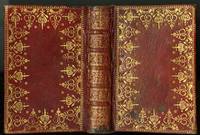
1500046291Paris: Philippe Pigouchet 1500. Hardcover Full Leather. Very Good Condition. Early ca. early 17th c. full red calf elaborately gilt modest wear at hinges a few surface marks and scuffs but a lovely binding. 4 old bookplates on endpapers Syston Park Howard Pease John William Pease old pencil note on endpaper. 1 leaf with long vertical cut in the outer margin 1 leaf with mended tear. Last leaf cut in lower part and filled out with paper. Some foxing spotting and discoloration mostly to the few few and last few leaves generally quite clean. Trimmed a little close in the top margin touching the border. Added section of final leaf says "printed in Paris by Philippe Pigouchet. Quaritch notes". In a custom clamshell box.<br/><br/><br/>116 leaves incomplete lacking title anatomical man and 6 calendar leaves signed Aa1-8Bb1-10a1-7lacks one leaf g1-4b1-8c1-8d1-8e1-8f1-8h1-8i1-8k1-4A1-8B1-8C1-3lacks C4-8D1-8. <br/><br/>A fine and largely complete example of a printed book of hours on vellum with 17 nearly full page cuts and 27 smaller cuts from the life of Christ and page borders featuring figures and mythical creatures; each page with a decorative border letters with color added throughout in blue red and gold. Pigouchet produced around 150 printed books of hours creating techniques along the way to bring them to life in the manner of the manuscript versions so revered by the aristocracy. Size: Octavo 8vo. Quantity Available: 1. Shipped Weight: Under 1 kilo. Category: Religion & Theology; Incunabula. Inventory No: 046291. Philippe Pigouchet hardcover books
177230530Paris: Edme 1772. Folio. 19 3/4 x 13 1/8 inches. Engraved frontispiece by B.L. Prevost after Sullier engraved portrait frontispiece by J. Baptiste Michel after Harguinier engraved title vignette by and after Prevost engraved arms of Charles-Eugene de Lorraine on dedication 56 hand-coloured engraved plates by B. Michel Adam femme Fessard F.A. Aveline C. Baquoy Benard Ch. Beulier L. Bosse Prevost and others after Harguinier Lafosse Saullier 19 folding and 7 engraved headpieces by Delaunay Hubert Levilain Lucas Mlle Massard Mesnil Michel after Le Carpentier type-ornament headpieces woodcut head- and tailpieces and initials. Contemporary calf covers bordered with gilt double fillet expertly rebacked to style spine gilt retaining the original red morocco lettering piece period marbled endpapers<br/> <br/>Deluxe hand-coloured first edition of the best 18th century French work on equine medicine and the anatomy of the horse.<br/> <br/>Cours d'hippiatrique is distinguished not only by Lafosse's anatomical skill and knowledge of equitation gained through both study and practice of the subject but also by the excellence of its execution: "Ce livre est un veritable monument eleve a l'Hippologie. Papier impression dessin gravure sont egalement signes" Mennessier de la Lance. The vivid colouring of the anatomical plates elevates this hand coloured issue far beyond the regular black and white edition. "Ouvrage fort bien execute et qui a ete longtemps le meilleur que l'on eut sur cette science" Brunet.<br/> <br/>Brunet III 765; Cohen-de Ricci col.587; Huth p.46; Mellon Books on Horses and Horsemanship 61; Mennessier de la Lance II pp.20-21; Nissen ZBI 2360. Edme unknown books
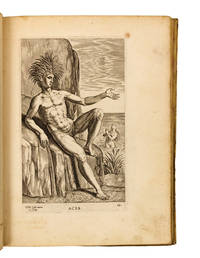
15861648421586. GALLE Philippe. Semideorum marinorum amnicorumque sigillariae imagines perelegantes in picturae statuariaeque artis tyronum usum a Philippo Gallaeo delineatae sculptae et aeditae. Engraved title-page followed by 17 numbered engraved plates. Antwerp: Galle 1586. BOUND WITH: Nimpharum oceanitidum ephydridum potamidum naiadum lynadumque icones in gratiam picturae studiosae ivventutis deliniatae scalptae et editae a Phillip. Gallaeo. Engraved title-page followed by 17 numbered engraved plates. Small 4to. 219 x 165 mm bound in contemporary Flemish vellum with title in manuscript on the spine. Preserved in a green half morocco folding box. Antwerp: Galle 1587. First Editions of both sets of prints designed and meticulously executed by Philipp Galle one of the foremost Flemish engravers of the day. These allegorical depictions of classical water deities and personifications of European waterways set male and then female figures among their appropriate geographical environment. The settings often include topographical or mythological iconography i.e. Nilus or the Nile shows a pyramid and obelisk in the background or Lerna with its Hydra in the distance however it is undoubtedly the figures themselves that are of most interest to the artist. They clearly show the influences of High Renaissance Italy with the musculature of the male figures evoking Michelangelo and the elongation of the female figures reminiscent of Parmigiano's Madonnas. Philippe Galle 1537-1612 ranks among his peers Johannes Stradanus 1523-1605 Martin de Vos 1532-1603 Adriaen Collaert 1560-1618 and Maarten van Heemskerck 1498-1574 as being known for introducing Italian art into the Northern Netherlands and influential on Dutch artists of the great period of pictorial art the Dutch Golden Age in the following century. Both sets of prints are rare. We locate a copy of both at the National Gallery a complete copy of just Semideorum marinorum at the Bibliotheque Nationale and a selection of odd plates at the Metropolitan Museum of Art and British Library. A very desirable copy bound in an un-restored contemporary vellum binding with nice impressions of the plates and wide margins. Some insignificant soiling or spotting. Brief early manuscript notes on the verso of seven plates. hardcover books