Gerard, Philippe Louis, 1737-1813Biblio.com
314 résultats
1776NS0200<p>A Paris Chez Moutard M.DCC. LXXVI 1776. First published 1774. Epistolary novel of a young rake-- said to reflect the author before entering priesthood-- saved by turning to the Church. Surely Laclos knew this popular novel and named his own rakish hero for the one here portrayed. Cioranescu 30923. Hard Cover. Three volumes: xx 4 577; 8 506; 8 590 2 pages 10 plates incl. 2 frontispieces; 17.5 cm. Bound in contemporary full calf. Good waterstains on lower portion of paper bindings worn. stock#NS0200.</p> Chez Moutard, M.DCC. LXXVI hardcover
17761204110039Paris Chez Moutard 1776. Hardcover. Very Good. 3 Volumes. xv 421 p ; 364 p ; 414 p. fronts. plates. 16 cm. 8vo. Bound in contemporary leather. Good bindings and covers to each volume. Ornate gilt design on spine. Gilt lettering on red spine label. Minimal wear to extremities. Chipping and loss to head and spine to Volume I and III; only to head of Volume II. Splitting starting on Volume I and III at head of spine. French. Clean unmarked pages with minimal toning. Please feel free to view our photographs. <br><br> Paris, Chez Moutard hardcover
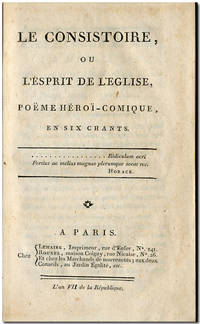
1799WRCLIT65112Paris: Chez Lemaire Rouxel et al. 1799. 101pp. Quarter gilt calf and faux treed paper boards spine gilt extra. Chip from extreme crown of spine a trace of scattered foxing but a very good copy. First edition. An anonymously published extended poem by the prolific dramatist founder of the Theatre Comique Delassements then in 1792 director of the short-lived Théâtre Molière. "Ouvrage commandé à l'auteur par le Directoire" - Barbier. OCLC/Worldcat reports three locations plus a duplicate entry none in North America. BARBIER I:726. Chez Lemaire, Rouxel, et al. hardcover books
1774173568Amsterdam 1774. Hardcover. VG front cover is unattached but back cover and spine are in great condition as is the interior. Dark red leather boards with gilt lettering on spine Riviere binding xiv 248 4 pp illustrated with bw illustrations. Written in French this is an original edition printed in 1774. The book is a poem in four songs; chant premiere chant second chant troilieme chant quatrieme along with other works. A rare book! hardcover books
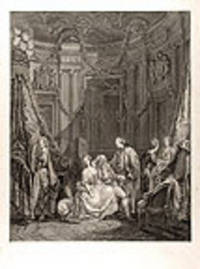
1784102511784. Engraving. Proof before letters. Printed on laid paper with watermark. In excellent condition with the exception of some very light foxing in the right margin. Image size: 15 x 11 7/8 inches. A fantastic proof before letters of this decorative Rococo print of a happy couple the morning after their wedding.<br/> <br/>Genre painting came back into favor when the Academy admitted Watteau's "The Pilgrimage to Cythera" to its ranks in 1717. From that point on a fashion for decorative subjects swept the country influencing an entire generation of French artists. This craze for intimate boudoir scenes did not subside until after the onset of the Revolution when the frivolous tastes of the aristocratic elite were dispelled and a more sober era descended upon French art. This print is a wonderful example of French Rococo tastes. The picture is set in a sumptuous bedroom the morning after a young aristocratic couple's wedding. The young bride sits on her father's lap while he speaks with his new son-in-law. Two chambermaids ready her toiletries while another closes the curtains on the marriage bed. This beautiful print is the pendant picture to Pierre Antoine Baudouin's "Le Coucher de la Mariee" which depicts the young newlyweds retiring to bed on their wedding night. Baudouin's painting was engraved by Moreau le jeune and finished by F. P. Simonet. Dugoure's frivolous scene is beautifully engraved by Triere creating a truly captivating image which epitomizes the grand era of French Rococo art.<br/> <br/>Nevill French Prints of the Eighteenth Century p. 135. unknown books
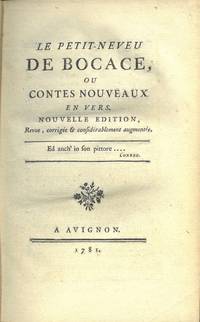
178148379Avignon. 1781. 8vo. Noe senere skinnryggbind. xi 256 s. Med kobberstukket frontispiece en kobberstukket plansje og fire vignetter. Fransk. <br/><br/><em>Cohen s. 372.Meget pent eksemplar. Plancher-Valcour 1751-1815 fransk skuespiller og dramaturg. </em> unknown
171535600685Amsterdam, David Mortier, 1715 ; 2 volumes in-12, veau fauve, colombe dor. frappée au centre des plats, dos ornés avec colombes dor. au bas, tr. rouge. (Reliure de l'époque) Seconde édition collective elzevirienne. La première, de 1663 ne contenait que 12 pièces (Willems 1724). Celle-ci contient en tout 16 pièces, soit la totalité de l'œuvre théâtrale. Ces deux tomes sont constitués de la manière suivante :1) Frontispice, titre en rouge et noir avec vignette, 4 ff. de préface ; La mort de Cyrus. Suivant la copie imprimée à Paris. 1708. 3 ff., 65 pp., - Le mariage de Cambise. Id. 1708. 3 ff., 66 pp. - Le feint Alcibiade. Id., 1682. 3 ff., 65 pp. - Les Coups de l’Amour et de la Fortune. Id., 1708. 80 pp. en tout. - Amalasonte. Amsterdam, Schelte, 1697. 3 ff., 66 pp. - Stratonice. Suivant la Copie impr. à Paris, 1708. 3 ff., 66 pp. - La Comédie sans Comédie. Id. ; 1662. 3 ff., 82 pp. - Le Fantosme amoureux. Amsterdam, Schelte, 1697. 3 ff., 77 pp.2) Frontispice, 1 f. titre en rouge et noir ; La Généreuse ingratitude. Amsterdam, Schelte, 1697. 4 ff., 74 pp. - L’Amant indiscret. Id., 1697. 3 ff., 78 pp. - Les Rivales. Id., 1697. 1 f., 70 pp. - Agrippa Roy d’Albe. Id., 1697. 3 ff., 65 pp. - Bellerophon. Suivant la Copie impr. à Paris. 1688. 3 ff., 61 pp., - La mère coquette. Id., 1666. 2 ff., 80 pp. - Astrate Roy de Tyr. Id., 1665. 3 ff., 65 pp. - Pausanias. Amsterdam, Schelte, 1697. 3 ff., 61 pp.Outre les frontispices généraux pour chaque tome, ce recueil contient des frontispices particuliers pour chaque pièce, soit 16 gravures.Bel exemplaire relié au début du XVIIIe siècle avec un emblème (colombe dressée) que nous n’avons pu identifier.
1791392111791 In-12 (210 x 150 mm), broché, couverture pélliculée illustrée, iv, 329 pages et (3) pages de tables. Paris, Editions Stil, 2001.
173649994à Cologne: Chez Pierre Gaillard 1736. Fine. Chez Pierre Gaillard à Cologne 1736 9.50 x 15.50 cm relié Reprint by the same publisher of the first edition of 1701 illustrated with a frontispiece and 100 half-page figures by Romain de Hooghe and retouched by Picart le Romain. Rare. Late 18th century binding possibly later in full red Russia leather. Foreign binding perhaps Russian. Spine with raised bands decorated with compartmented tulip tools. Gilt title and volume label. Head and foot rolls. Decorative border on covers. All edges gilt. Headcap of volume 2 partly worn. Corners slightly bumped. A tear to the lower joint of volume 2. Despite minor defects handsome and uncommon binding the set in good condition and well-printed. Les Cent Nouvelles nouvelles is the first collection of French novellas commissioned by the Duke of Burgundy Philip the Good to whom it is dedicated and who received it in 1462. It brings together one hundred very free tales by authors from the Burgundian court satirical and ribald in spirit particularly targeting women and the clergy. Pierre Champion attributes its authorship to Philippe Pot although 36 different storytellers can be identified. Their model of inspiration is clearly Boccaccio's Decameron. Along with La Fontaine's Contes this represents Romain de Hooghe's finest work who captured the spirit of each tale in a lively manner full of fantasy and humor. Chez Pierre Gaillard hardcover
173649994Chez Pierre Gaillard | à Cologne 1736 | 9.50 x 15.50 cm | relié
1771003275A Paris, chez Jombert père et fils. De l'Imprimerie de Louis Cellot. 3 vol. in-8 (20 x 13,8 cm), veau blond glacé, dos à cinq nerfs orné d'encadrements de filets or, pièces de titre maroquin marron, triple filet autour des plats, filet sur les coupes, dentelle intérieure, tranches dorées (Chatelin). Illustré d'un frontispice et 6 belles figures de Cochin, gravées par Choffard, Prévost, Rousseau et Saint-Aubin (Cohen, col. 984). Provenance : Henri d'Orléans, Duc d'Aumale (1822-1897), fils du Roi Louis-Philippe, avec cachet sur chaque page de titre et inscription manuscrite ancienne début du tome I : "Donné par le Duc d'Aumale". (Défauts d'usage, dos du premier volume légèrement plus clair).
177620599Paris Chez les Libraires Associés 1776 in-12 plein-veau un volume, reliure plein veau marbré havane in-douze (binding full calfskin in-12) (17,5 x 10,3 cm), dos long (spine without raised bands), décoré or, à roulette et filet perlé or, titre frappé or, pièce de titre sur fond rouge (red label of title) avec filet perlé or, roulette or avec filet perlé or de part et d'autre en place des nerfs et en tête et en pied, entre-nerfs à fleurons soleil, vase antique et coupe antique "or", dos légèrement frotté et épidermé, plats décorés à froid d'un filet à froid en encadrement, roulettes sur les coupes avec manque de dorure, sans illustrations, texte avec manchettes (marginal note), (XXIV + 502 + 2 p. d' approbation, & privilége du Roi) pages, 1776 Paris Chez les Libraires Associés Editeurs,
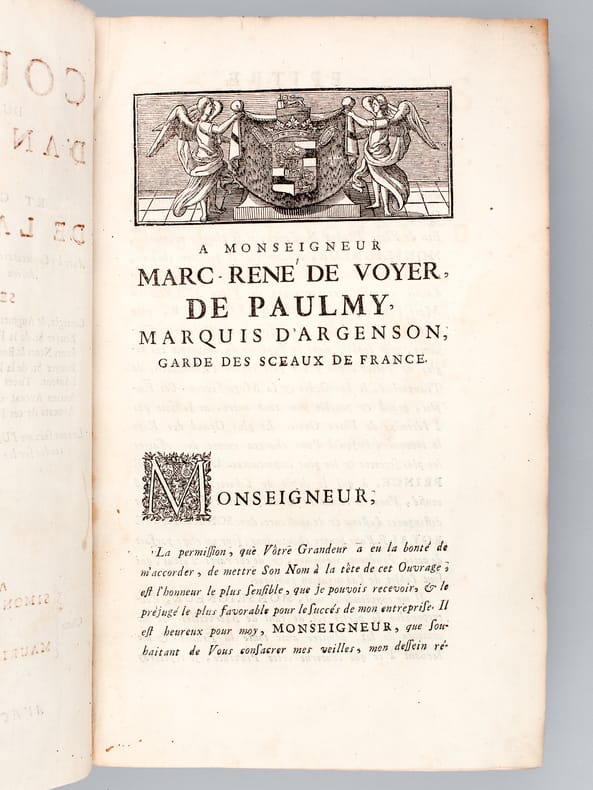
172065299Seconde Edition, corrigée & augmentée des Additions de Me Jacques Vigier, Ecuyer Sr. de la Pile, Avocat au Parlement, son fils ; et de Plusieurs Notes & Remarques, composées par Me. François Vigier, Ecuyer de la Pile, Avocat en la Cour, arrière-petit-fils de l'Auteur. Tirée des Mémoires de Me Philippe Picornet, Ancien Avocat au Parlement, & de plusieurs Magistrats, & Avocats de ces Provinces & d'ailleurs. Le tout Suivant l'Usage présent, confirmé par les Arrêts de la Cour rendus sur les principales difficultés du Païs Coûtumier, 1 vol. in-folio reliure de l'époque pleine basane marron, dos à 6 nerfs orné, Chez Simon Rezé et Maurice Puisnege, Angoulême, 1720, 5 ff., 702 pp. et 1 f.
17283457A Leide, chez Théodore Haak. 1728, 2 vol. in-12 (16 x 10 cm), VIII, 138 pp., 188 pp., reliure de l'époque, veau havane, dos lisse orné, dentelle sur les coupes, filet à froid sur sur les plats, tranches marbrées. Ouvrage rare, illustré de deux plans et 40 gravures, la plupart dépliantes (défauts d'usage aux reliures ,dos, coiffes et coins) petite restauration à une gravure, brunissures à quelques pages
17574880Paris, Chez Desaint & Saillant, 1757. (2) ff. fx.-titre, titre, , XXI-430-(2)-XXXXVIII pp., (1) f. errata, une version corrigée du dernier feuillet de table a été relié en tête de la Table, 16 planches dépl. n/b, reliure basane mouchetée, dos orné de roulettes et caissons dorés, tranches marbrées, inscription ancienne au stylo à plume sur papier de garde, 2 coins frottés, 1 coin ouvert, épidermures sur plats, petit défaut à la coiffe inférieure, mors fendu (28 mm.), intérieur frais, bon exemplaire.
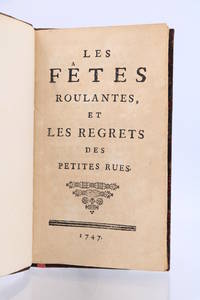
174791802n. l.: s. n. 1747. Fine. s. n. n. l. 1747 10 x 16.8 cm Relié First edition of this work published by the Société du Bout-du-Banc the celebrated literary salon presided over by Mademoiselle Jeanne-Françoise Quinault and the Comte de Caylus. This intimate circle originally comprising eight members would gather on Mondays at dinner to exchange ideas and to write; at the close of each meal every distinguished guest was required to set down a few lines whether in the coarse poissard style or in a more refined vein on paper. It was in this context that Les Fêtes roulantes ou les regrets des petites rues came into being in the wake of the celebrations held in Paris in honour of the Dauphin's second marriage to Marie-Josèphe de Saxe. Pastiche binding in plum half-shagreen spine with five raised bands framed by gilt dotted fillets and six compartments decorated with gilt fillets and fleurons marbled paper boards gilt top edge pastedowns and endpapers in shell-pattern marbled paper. Some minor rubbing to the paper of the lower board corners slightly bumped. ""In his youth the Comte de Caylus had paid considerable tribute to the literature of fairy tales which the translations from Arabic and Persian by Galland and Pétis de la Croix had brought into fashion; one does not find him again in these artificial creations to which he returned when he was nearly seventy. But in the intervening years his character as a writer emerged and declared itself in accordance with his manners and tastes and in how propitious a milieu! The Société du bout du banc that academy of Gallic ribaldry presided over by Mademoiselle Quinault; those suppers at which an inkwell served as centrepiece and which La Chaussée d'Armenonville Voisenon Moncrif the Grand Prior of Vendôme Duclos Salley and Crébillon fils enlivened with their bawdy and bantering wit. All men of letters with little taste for philosophy all content to let the world go its own way and finding it perfectly satisfactory as it was all of that sacred flock of Epicurus somewhat transformed by Circe in which each member is satisfied or very nearly with what their presiding lady declared sufficient for Duclos the least fastidious among them. The popular literature of the eighteenth century that is to say literature which took the common people as the subject of its observations and tableaux was born within this company of mirth and folly and the Comte de Caylus was its natural father and its foster father; it took its first lively flights in those ""Écosseuses"" 1739 those ""Étrennes de la Saint-Jean"" 1742 those ""Mémoires de l'Académie des colporteurs"" those ""Avantures des bals des Bois"" those ""Fêtes roulantes"" 1748 a veritable magic lantern of Parisian popular life ."" Avertissement ""Mémoires et réflexions du comte de Caylus"" 1874 s. n. hardcover
174791802s. n. | s. l. 1747 | 10 x 16.8 cm | Relié
172713331<p>Paris: Chez les Frères Barbou 1727 Second edition of a conduct book that first appeared in 1712. The preface states that this edition has been so greatly enlarged reorganized and corrected that it is virtually a new book. . Contemporary calf gilt spine with red morocco label edges stained red. Twelvemo. . One inch splits along front and back joints near head of spine binding extremities a bit worn. Old ink signature on title-page a few small stains. A good clean copy. Cioranescu describes Varennes -1745 as chaplain to the king and Abbé of Landévennec. In this book he looks at the behavior of a number of fictional characters Agenor"petit maitre étourdi sans jugement"; Elvire "fille d'une grande vertu & qui fait par cela même tant d'honneur à son sexe"; Utime "homme à qui l'ambition à tourne la `tête"; etc. in order to discuss good and bad conduct.</p> Chez les Frères Barbou,
170875081708 A Paris: Chez Jean Baptiste Coignard, 1708. In-12: 10.5 x 17 cm, 22 ff. de titre, épître et avertissement, 348 pp. de texte, 30 ff. de tables et privilège. Reliure de l'époque en veau aux armes. Dosà cinq nerfs avec pièce de titre en maroquin rouge et caissons ornés des pièces héraldiques du propriétaire: une tour et trois besants. Toutes tranches dorées. Coiffes et coins légèrement émoussés. Beau papier.
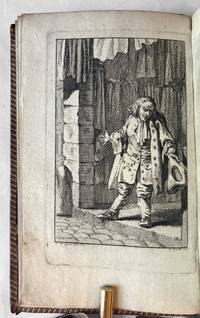
17464391The Hague i.e. Paris: s.n. 1746. 8vo 168 x 101 mm. 2 parts separately titled and paginated: 3-vi-xxiv 182 pages 1 blank leaf; 2 leaves 128 pages. Engraved frontispiece by Fessard after Cochin fils apparently included in the pagination typographic title ornaments head- and tailpieces. An attractive copy stain to fols. A2-3 in second part 2 or 3 minor marginal tears some spotting. Contemporary red morocco triple gilt fillet on sides smooth spine sparingly gold-tooled and lettered board edges gilt gilt edges scuffing to lower board edges and extremities of spine corners a bit bumped. Provenance: early purchase note on lower flyleaf; John Wodehouse 3rd Earl of Kimberley 1883-1941 bookplate; Leonard Forrer 1869-1953 his bookshop ticket of L. S. Forrer Ltd. Numismatic Booksellers London; Charles Van der Elst 1904-1982 bookplate.<br /> <br /> Only Edition of an extended literary joke by the brilliant antiquarian engraver art patron and connoisseur the Comte de Caylus. He exercised his stylistic muscles in this peculiar collection of two dozen literary pieces revolving around the word manteau: in part 1 racy anecdotes short stories fairy tales and a chivalric tale written in pseudo-archaic French; and in part 2 tongue-in-cheek erudite essays in several styles — the religious history the antiquarian disquisition the etymological or bibliographical analysis — all laced with fictional and a few real references including imaginary medieval manuscripts.<br /> <br /> A glance at the entry for manteau in the online Trésor de la Langue Française gives an idea of the semantic opportunities offered by this word whose appearances in many idiomatic expressions are exhaustively exploited by Caylus. In part 1 appear the manteau de fourrure fur coat the manteau de lit a short bed-jacket into which a jealous husband is metamorphosed by his fairy mother-in-law to teach him a lesson the long and short coat the chimney mantel same word in French and a portrait of a remarkable old man presented as the fictional originator of the term “sous le manteau†clandestine or clandestinely.<br /> <br /> In part 2 which its title notes with a wink “one doesn’t need to read†the author delves into the Roman pallium a cloak the coats of saints and clerics those both heraldic and actual of Dukes and Peers and the order of the Blancs-Manteaux. Completing the picture are a florilegium of dictionary extracts and a satirical etymological comparison of the French manteau with other languages containing sentences like: “As for the letter L which is found at the end of words like Mantel and Mantello one can very well understand it to be a diminutive of the Arabic word Allah meaning God†p. 103. <br /> <br /> The self-imposition of arbitrary constraints onto one’s writing while an ancient practice viz. poetic meter have been associated more recently with a French literary movement from the 1960s known as Oulipo short for Ouvroir de littérature potentielle â€workship of potential literature†which included the great French authors Raymond Queneau and Georges Perec whose wry humor and doggedness in pursuing the conceit to the end Caylus foreshadowed. <br /> <br /> Cochin’s frontispiece shows a rather shifty-looking merchant in the doorway of his shop filled with coats. <br /> <br /> OCLC locates 4 copies in North American libraries. Cohen-De Ricci 210; Gay-Lemonnyer 3:23; Barbier III: 34 a 1775 edition not seen elsewhere. s.n. unknown
1746CLL-317La Haye, 1746 In-12 de XXIV, 182 pp., (1) f. bl., (2) ff., 128 pp., (1) f. d'errata, maroquin rouge, triple filet gras et maigres doré en encadrement sur les plats, dos lisse orné de caissons de fleurons dorés, pièce de titre de maroquin vert, filet doré sur les coupes, roulette intérieure dorée, tranches dorées (reliure de l'époque).
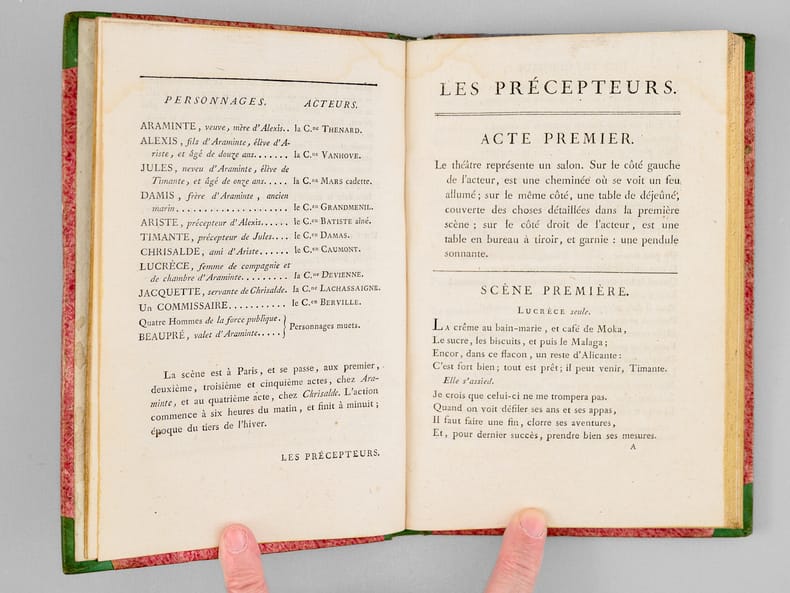
1799710871 vol. in-8 reliure demi-vélin vert à petits coins, De l'Imprimerie de la République, Paris, Frimaire an VIII, 4 ff., 133 pp.
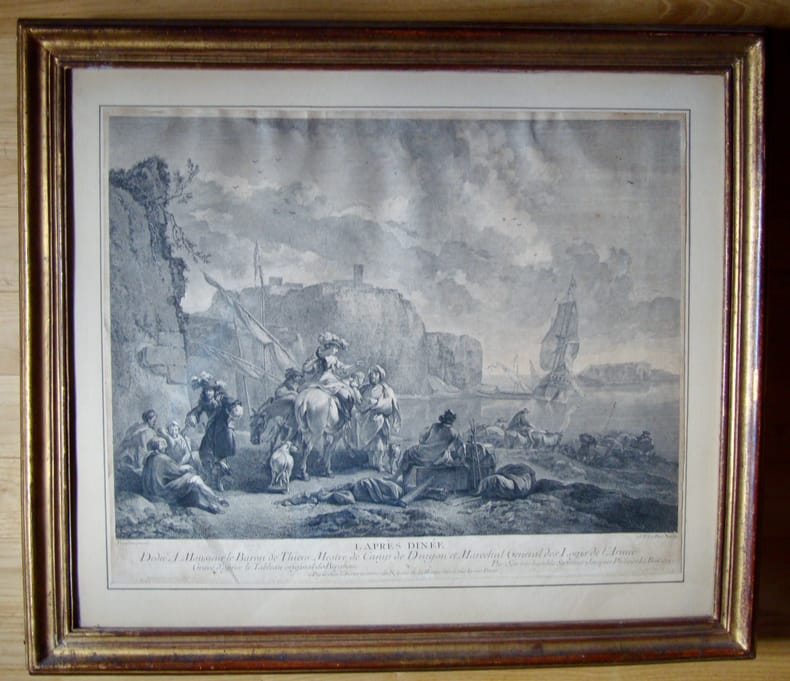
17427246Belle estampe d’après Berghem. Cadre ancien en bois doré. Très bon Paris Chez l’auteur 1742 51,5 x 59,5 cm.
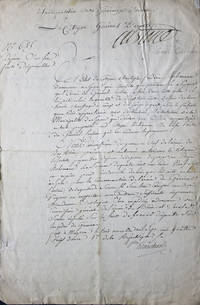
1792304899Speyer Austria 1792. 4 pp. pen and ink on paper in French in various hands with embossed seal. Old folds and light soiling paper repairs at folds. 4 pp. pen and ink on paper in French in various hands with embossed seal. Document payorder for firewood for the French Army encamped at Speyer "pour le chauffage de l'armée au Camp et Corps de Gardes" signed by General Adam Philippe Comte de Custine and Claude Blanchard. Both Custine 1740-1793 and Blanchard 1742-1802 fought in the American Revolution. Custine who lead the French forces in the Rhine campagins that seized Speyer and Mainz was guillotined in 1793 during the Reign of Terror. unknown
175227718Paris 1752. In French. 1 page. 1 vols. 6 1/2 x 8 3/4 inches. Paper. Some light marginal browning small marginal hole else very good. In French. 1 page. 1 vols. 6 1/2 x 8 3/4 inches. As Marêchal des Camps recognizing that the Sieur Jean Etienne David had remitted a sum for rents. Louis XIV's General. <br/><br/> unknown