217 résultats
18657261New York: D. Appleton and Company 443 & 445 Broadway 1865. Small octavo 18.5 x 12 cm. 200 4 pages. Advertisements. The First American Edition of Leonard Francis Simpson's English language translation of Brillat-Savarin's magnificent Physiologie du Gout. The earliest English language translation was that of Fayette Robinson published in Philadelphia in 1854. Simpson's translation here is quite unfaithful to the original admitting in the Introduction that "Many parts are however condensed others omitted as not suited to the present tone of society." Starting in 1864 editions of Simpson's translation published in the UK strayed even further with emphasis placed on a rejection of gourmandise and the title to what we have here. Quite a departure from Brillat-Savarin's original. But the translator did have high hopes for this book to affect a change upon Britain and presumably in America with this issue. The Translator's Preface has been omitted in this edition which is a shame as it takes the form of a discussion among Olympians where the goddess Gasterea speaks up to Jupiter informing him that "There is a race. of bold sea-girt islanders who worship me well in their way; indeed mighty fires of coal never cease to burn in my honour; but it a melancholy fact that London does not know 'How to Dine!'" The author proposes a reform movement starting with this book. In publisher's blind ruled and gilt-titled burgundy cloth. Very near fine. Bitting page 437; Cagle 104. D. Appleton and Company, 443 & 445 Broadway hardcover
122629Paris Charpentier 1840. . 8vo 185 X 125 mm; some minor mostly perphepheral foxing otherwise bright and clean; later 19th century Swedish binding of quarter green morocco over marbled boards by Swedish binder 'G.F Possman Stokholm' his label to verso of upper free endpaper gilt tooling and devices to spine panels red lettering-piece with marbled endpapers and edges plain-tipped board corners rubbed at extremities otherwise very good.<br /> Jean-Anthelme Brillat-Savarin 1755-1826 was a French lawyer politician and epicure who with Alexandre Balthazar Laurent Grimod de La Reynière founded the genre of gastronomic writing. This his most famous work has never been out of print. In a series of meditations that owe something to Montaigne's Essays and have the discursive rhythm of an age of leisured reading and a confident pursuit of educated pleasures Brillat-Savarin discourses on the pleasures of the table which he considers a science. It is interesting to note that he considered sugar and white flour to be the cause of obesity.<br /> Paris, Charpentier, 1840. hardcover
192610085Paris: Les Arts et le Livre 1926. Second-hand hardcover. <p>Brillat-Savarin. Physiologie du Gout: ou meditations de gastronomie. Les Arts et le Livre: Paris 1926. 8vo 240x165mm 2 vols half bnd red morocco marbled bds & eps gilt lettered t.e gilt 252300pp. #239/566 illustrated by Pierre Noury Near Fine/-</p> <p><br /> BRILLAT-SAVARIN Jean-Anthelme 1755-1826<br /> <br /> Physiologie du Goût ou Mediations de Gastronomie transcendante ouverage théorique historique et a l'ordre du jour<br /> <br /> Paris: Les Arts et Le Livre 1926. Limited Edition of 566 copies. Printed by Marius Audin Lyon; lithography by J Mourlot et fils Paris; bound by Dubois d'Enghien-Dooms. In French.<br /> <br /> Octavo 240x170mm in two volumes half bound cherry-red long-grain morocco spine gilt decorated and ruled in six compartments marbled boards and end-papers; top-edge gilt; original wrappers with colour vignettes bound in; 2xlii2528pp 283004pp. Number #239 of 520 on Lafuma vergé paper.<br /> <br /> One hundred in text and twenty-four full page inset. striking twentieth century black and white engraved illustrations by Pierre Noury 1894-1981. A French painter engraver and illustrator Noury studied and exhibited in Paris from 1920 to 1940. He designed the costumes and sets for an opera as well as murals posters and book illustrations. He was also the author of a history of painting and children's books.<br /> <br /> Published on the 100th anniversary of the first commercial edition 1826. <br /> <br /> <br /> Brillat-Savarin was a French lawyer and politician during and after the French revolution. Renowned as an epicure and gastronome he worked on his Physiologie du Gout all his life assembling it just before he died; it was privately published at his expense just two months before his death. Neither a cookery book nor a memoir it is rather a discussion of the nature of eating in its widest sense. It starts with twenty gastronomical "aphorismes" perhaps the best known being "IV tell me what you eat and I will tell you who you are"; then thirty "méditations" and finishes with twenty-seven 'variétés' in the form of anecdotes adventures recipes and inventions.<br /> <br /> "For the French and outsides alike this work early attained the status of an exemplary culinary text perhaps the exemplary text. the Physiology of Taste civilizes eating. Moreover it socializes food and it does so by recounting in story after story our social relations with food. it appears to us today as something of a sociology of taste ahead of its time" Priscilla Parkhurst Ferguson Accounting for Taste: The Triumph of French Cuisine Chicago: University of Chicago Press 2004 p. 31<br /> <br /> <br /> An instant success Physiologie du Gout has never been out of print since.<br /> <br /> A lovely near fine private press edition of the most renowned book on gastronomy.</p> Les Arts et le Livre unknown
2092902141701353Not Available N.A. Soft Cover. Fine. Number of books: 2 Not Available paperback
187910098Paris: Librairie des Bibliophiles 1879. Second-hand hardcover. <p>Brillat-Savarin Jean-Anthelme. Physiologie du Gout. Librairie des Bibliophiles: Paris 1879. 8vo 180x110mm 2 vols half red morocco marbled bds & eps 4xvi2964pp83204pp. preface by Ch Monselet; bound by Blanchetiere-Bretault In French</p> <p><br /> BRILLAT-SAVARIN Jean-Anthelme 1755 -1826<br /> <br /> Physiologie du Gout: avec un preface par Ch. Monselet. Eaux-fortes par Ad. Lalauze.<br /> <br /> Paris: Librairie des Bibliophiles 1879. Limited Edition. Printed by Imprimerie Jouaust Rue Saint-Honoré Paris. Bound by Blanchetiere-Bretault. Preface by Charles Monselet. Illustrated with 63 pictorial engravings by Adolphe Lalauze including the frontispiece portrait as well as numerous sculptured head and tailpieces.<br /> <br /> In two volumes. Octavo 180x110mm half bound red morocco marbled paper boards and end-papers spine decorated and lettered in gilt inlaid dark green morocco top-edges gilt else untrimmed ribbon marker frontispiece 4xvi2964pp83204pp. One of 170 copies on Holland Paper Van Gelder watermark; total edition 260 copies; this copy unnumbered. In French.<br /> <br /> <br /> ¶ Brillat-Savarin was a French lawyer and politician during and after the French revolution. Renowned as an epicure and gastronome he worked on his Physiologie du Gout all his life assembling it just before he died; it was privately published at his expense just two months before his death. Neither a cookery book nor a memoir it is rather a discussion of the nature of eating in its widest sense. It starts with twenty gastronomical "aphorismes" perhaps the best known being "IV tell me what you eat and I will tell you who you are"; then thirty "méditations" and finishes with twenty-seven 'variétés' in the form of anecdotes adventures recipes and inventions.<br /> <br /> "For the French and outsides alike this work early attained the status of an exemplary culinary text perhaps the exemplary text. the Physiology of Taste civilizes eating. Moreover it socializes food and it does so by recounting in story after story our social relations with food. it appears to us today as something of a sociology of taste ahead of its time" Priscilla Parkhurst Ferguson Accounting for Taste: The Triumph of French Cuisine Chicago: University of Chicago Press 2004 p. 31.<br /> <br /> <br /> An instant success Physiologie du Gout has never been out of print since.<br /> <br /> <br /> The Librairie des Bibliophiles was established in 1869 by Damase Jouast 1834-1893 publishing French classics in small limited fine print editions. Monselet 1825-1888 was a French journalist novelist poet and playwright nicknamed "the king of the gastronomes" by his contemporaries and a close friend of Baron Léon Brisse . Lalauze 1838-1906 was a French engraver illustrator and painter known for his fine steel engraving technique. Lalauze illustrated many of Jouast's publications.<br /> <br /> A fine illustrated copy of the most renowned book on gastronomy in an elegant binding.<br /> <br /> </p> Librairie des Bibliophiles unknown
18549869Philadelphia: Lindsay & Blakiston 1854. Second-hand hardcover. <p>Brillat Savarin. The Physiology of Taste; or transcendental gastronomy. Lindsay & Blakiston: Philadelphia 1854. 8vo 190x130mm rebacked original boards t.e gilt translated by Fayette Robinson</p> <p><br /> BRILLAT SAVARIN Jean-Anthelme Brillat-Savarin 1755-1826<br /> <br /> The Physiology of Taste: or transcendental gastronomy illustrated by anecdotes of distinguished artists and statesmen of both continents.<br /> <br /> Philadelphia: Lindsay & Blakiston 1854. First US Edition and first edition in English.<br /> <br /> Octavo 200x135mm blind stamped gilt decorated original publisher's brown cloth boards top-edge gilt xx pps. ix-x out of sequence126-3471 blank4 publisher advertisementspp. Translated from the last French edition by Fayette Robinson.<br /> <br /> Recently professionally re-backed in tan cloth new end-papers. Very faint foxing to preliminaries. Owner name 'John S Cunningham' neatly stamped and inked to half-title title-page and contents page; several discrete neat penciled marginal marks.<br /> <br /> Brillat-Savarin was a French lawyer and politician during and after the French revolution. Renowned as an epicure and gastronome he worked on his Physiologie du Gout all his life assembling it just before he died; it was privately published at his expense just two months before his death. Neither a cookery book nor a memoir it is rather a discussion of the nature of eating in its widest sense. It starts with twenty gastronomical "aphorismes" perhaps the best known being "IV tell me what you eat and I will tell you who you are"; then thirty "méditations" and finishes with twenty-seven 'variétés' in the form of anecdotes adventures recipes and inventions.<br /> <br /> <br /> <p>"For the French and outsides alike this work early attained the status of an exemplary culinary text perhaps the exemplary text. the Physiology of Taste civilizes eating. Moreover it socializes food and it does so by recounting in story after story our social relations with food. it appears to us today as something of a sociology of taste ahead of its time" Priscilla Parkhurst Ferguson Accounting for Taste: The Triumph of French Cuisine Chicago: University of Chicago Press 2004 p. 31<br /> <br /> Brillat-Savarin spent several years in New York as a refugee from the French revolution before returning to France and eventually becoming a judge on the French Court of Appeal; a post he held until retirement.<br /> <br /> "One of the most witty discussions on food ever written… The work is filled with entertaining anecdotes and commentary on good eating including several pages of impressions about the United States" Feret Barbara. Gastronomical and Culinary Literature. The Scarecrow Press 1979 p. 38.</p> <br /> Perhaps the most renowned book on gastronomy.<br /> <br /> <br /> Scarce. A nice copy.<br /> <br /> § OCLC records only 2 holdings this edition but no details; Huntington records 1 holding; Copac records 5 UK holdings.<br /> § Bitting p.60; Cagle & Stafford 103; Lowenstein 639; Wheaton & Kelly 876.</p> Lindsay & Blakiston unknown
29746Paris A. Sautelet 1826. 2 vol. 120 x 200 mm de 1 xiv et 390 p. ; 442 p. Demi-chagrin rouge dos à nerfs ornés pièces de titre tranches mouchetées reliure XIXe. . Édition originale et rare premier tirage avec l’erreur typographique à l’adresse « E » imprimé à l’horizontale. . Elle fut imprimée aux frais de l'auteur à 500 exemplaires et mis dans le commerce en décembre 1825. Brillat-Savarin qui décède moins de deux mois après la parution du volume n'aura guère eu le temps de profiter du succès de son grand oeuvre. Inutile de revenir sur l'importance et l'histoire de l'œuvre que nous pourrons cependant agrémenter d'un jugement catégorique et déglaçant d'un de ses illustres lecteurs quelques années plus tard : « Un homme très célèbre qui était en même temps un grand sot choses qui vont très bien ensemble . a osé dans un livre sur la Table . écrire ce qui suit à l'article VIN : ‘Le patriarche Noé passe pour être l'inventeur du vin ; c'est une liqueur qui se fait avec le fruit de la vigne.' Et après Après rien : c'est tout. Vous aurez beau feuilleter le volume le retourner dans tous les sens le lire à rebours à l'envers de droite à gauche et de gauche à droite vous ne trouverez pas autre chose sur le vin dans la Physiologie du goût du très illustre et très respecté Brillat-Savarin : ‘Le patriarche Noé.' et ‘c'est une liqueur.'. Je suppose qu'un habitant de la lune ou de quelque planète éloignée voyageant sur notre monde et fatigué de ses longues étapes pense à se rafraîchir le palais et à se réchauffer l'estomac. Il tient à se mettre au courant des plaisirs et des coutumes de notre terre. Il a vaguement ouï parler de liqueurs délicieuses avec lesquelles les citoyens de cette boule se procuraient à volonté du courage et de la gaieté. Pour être plus sûr de son choix l'habitant de la lune ouvre l'oracle du goût le célèbre et infaillible Brillat-Savarin et il y trouve à l'article VIN ce renseignement précieux : ‘Le patriarche Noé'. et ‘cette liqueur se fait'. Cela est tout à fait digestif. Cela est très explicatif. Il est impossible après avoir lu cette phrase de n'avoir pas une idée juste et nette de tous les vins de leurs différentes qualités de leurs inconvénients de leur puissance sur l'estomac et sur le cerveau. Ah ! chers amis ne lisez pas Brillat-Savarin. Dieu préserve ceux qu'il chérit des lectures inutiles ; c'est la première maxime d'un petit livre de Lavater un philosophe qui a aimé les hommes plus que tous les magistrats du monde ancien et moderne. On n'a baptisé aucun gâteau du nom de Lavater ; mais la mémoire de cet homme angélique vivra encore parmi les chrétiens quand les braves bourgeois eux-mêmes auront oublié le Brillat-Savarin espèce de brioche insipide dont le moindre défaut est de servir de prétexte à une dégoisade de maximes niaisement pédantesques tirées du fameux chef-d'oeuvre ». Costard trois étoiles et triple fourchette signés Charles Baudelaire in Les Paradis artificiels « Du Vin ». N'en déplaise à Baudelaire La Physiologie du goût est « un des chefs-d'oeuvre de la littérature gastronomique mondiale. Il est avec Grimod de la Reynière celui qui a le plus sérieusement médité sur l'art transcendantal du bien-manger » Oberlé. Bel exemplaire ; rare en reliure d'époque et de qualité comme ici. Paris, A. Sautelet, 1826. 2 vol. (120 x 200 mm) de [1], xiv et 390 p. ; 442 p. Demi-chagrin rouge, dos à nerfs ornés, pièces unknown
1854140948550Philadelphia: Lindsay & Blakiston 1854. First American Edition. Near Fine. First American edition and first English translation. xx 25-347 5 pp. with four advertising pages at rear. Bound in publisher's brown cloth ornately stamped in blind and gilt top edge gilt. Near Fine with light wear to covers and shallow chipping at spine ends and foxing to contents and textblock edges. Ownership signature in old hand to front free endpaper. Lowenstein 639.<br /> <br /> <p>Jean Anthelme Brillat-Savarin was a French lawyer and politician whose otherwise successful career was briefly interrupted by the French Revolution. The cheerful gourmand bounced back after a few years of exile and dedicated his free time to wine women and the violin -- and good meals. Written over many years and published shortly before the author's death The Physiology of Taste is a compendium of recipes culinary musings and chit-chat and anecdotes meant to enliven the dinner table. It is a seminal work of gastronomical writing and the origin of the phrase "You are what you eat. Lindsay & Blakiston unknown
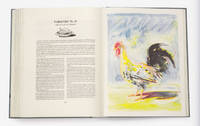
205958San Francisco CA: The Arion Press 1994. First edition. Large hardcover. 356 pages. Number 152 from an edition of only 200 from a total edition of 226 with Neo Didot text display text Bodoni Bold and printed on a French mould-made Lana Royale paper with two different weights for the text and illustration sheets. This is the forty fourth publication from the Arion Press. Features Brillat-Savarin's classic text translated by M.F.K. Fisher. Includes two hundred drawings and nine color lithographs by Wayne Thiebaud. A fine copy in cloth boards and in a fine cloth covered slipcase and with laid in very near fine example of the 16 page prospectus. Signed by Thiebaud on the limitation page. An exquisite version of this classic. Please note that this is a heavy and oversized book and will require extra shipping. The Arion Press unknown
140947668San Francisco CA: The Arion Press 1994. Limited Edition. Fine. Limited edition Number 115 of a limited 200 copies signed by Wayne Thiebaud. Bound in publisher's gray-blue cloth stamped in blue and black. With full-page lithographs and reproduced drawings throughout by Wayne Thiebaud. Trivial soiling to top edge of textblock else Fine. In a Near Fine slipcase with light edge wear tiny dent light soiling and droplet stain to cloth. A striking production by Arion Press of the foremost 19th-century gastronomic discourse being a series of meditations recipes and reflections. Thiebaud's bright eye-catching drawings brilliantly captures the epicurian's philosophy on all things food and wine. The Arion Press Bibliography 44. The Arion Press unknown
1826140946549Paris: A. Sautelet et Cie 1826. First Edition. Near Fine. First edition first issue. The first issue distinguished by the misprint in the printer's address for volume one the "e" of "Bourse" printed horizontally numbered 500 copies only. xiv 390 442 pp. Complete in two volumes. Bound in twentieth-century half goat skin with spine stamped in gilt over marbled boards. Near Fine with light rubbing to binding slight fading to spines. Textblock edges and contents lightly foxed throughout. <p>The foremost 19th-century gastronomic discourse being a series of meditations recipes and reflections. Brillat-Savarin is considered one of the most important figures in culinary history and often cited for this work. Topics range from obseity and fasting gastronomy and gourmet the function of appetite and even death. A work that exemplifies the author's joie de vivre for all things food. A. Sautelet et Cie unknown
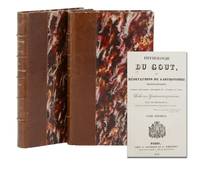
18262363Paris: Sautelet et Cie 1826. Two volumes octavo xiv 390 & 449 pages. FIRST EDITION of the most famous treatise on gastronomy. The Physiology of Taste was published in an edition of 500 copies appearing only two months after the author's death. A comprehensive philosophy of the palate the table and far beyond the book is presented in a series of thirty meditations on subjects including the senses taste appetite gastronomy restaurateurs cooking fasting obesity death sleep rest and dreams. Brillat-Savarin was an attorney and magistrate who fled France during the Terror living in Switzerland and New York until his return after the fall of Robespierre in 1796. The present work secured his eternal fame among gastronomes. M.F.K. Fisher – whose translation of Brillat-Savarin's work still stands as the best – commends this book for its straightforward and unornamented prose in an era of florid writing but the intellectual range and invention of the work is anything but simple. At the very outset: "1. The Universe is nothing without the things that live in it and everything that lives eats. 2. Animals feed themselves; men eat; but only wise men know the art of eating. 3. The destiny of nations depends on how they nourish themselves." It may be noted that Brillat-Savarin regularly refers to his gastronomic experience in America. Contemporary quarter calf and marbled boards Light wear at extremities otherwise in very good condition. Cagle 98; Crahan 491; Oberle 144; Vicaire 116; Wheaton & Kelly 860. Sautelet et Cie hardcover
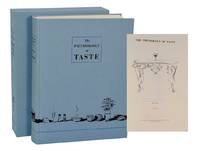
CNAP044aSan Francisco: The Arion Press 1994. Limited Edition. Hardcover. New. Thiebaud Wayne. Folio size 13 3/4" by 10 1/4" 356 pages plus 18 unnumbered pages for the prints 374 pages total. The text is Neo Didot in Monotype composition by Mackenzie & Harris. The display type is Bodoni Bold handset in foundry type. The drawings were printed by letterpress from photopolymer plates. The paper is French mould-made Lana Royale; a heavier weight of the same paper is used for the lithographs. The binding done in-house is hand-sewn in full blue-gray cloth with black titling on the front and spine and a drawing by Thiebaud across the bottom. The slipcase is covered in the same cloth with titling and a vignette on the spine. The color prints binding cloth and slipcase were printed lithographically. Edition of 200 copies plus 26 lettered copies hors de commerce signed by the artist. M.F.K. Fisher 1908-1992 contributed an introduction to the second Arion Press book "A Commonplace Book of Cookery" in 1975 but died before we were able to pay tribute to her by publishing her first major literary work a translation of Jean Anthelme Brillat-Savarin's 1755-1826 famous gastronomic essays. This book originally made for hire in 1948 for the Limited Editions Club formed her as an author on subjects relating to food wine dining and living well in the largest sense. <br /> <br /> She became a good friend of the Press extending invitations to "the crew" to come to her home in St. Helena for a hike and a swim followed by lunch where the conversation was always lively but never about food.<br /> <br /> The artist Wayne Thiebaud delivered to Hoyem a large pile of original ink drawings and told him to use what he wanted. Hoyem made photocopies of the drawings and sorted and combined them as he saw fit and Thiebaud immediately approved the selection. He also made the nine lithographs in color and drew a design for the cover of the binding that showed the skills he learned as a commercial graphic artist. A trade edition was published by Counterpoint in 1996. <br /> <br /> Note that while this copy is marked as a "Display" copy we do not believe it was actually used as such as both the book and slipcase are in fine condition. <br /> <br /> ___POSTAGE: International customers please note that additional postage may apply as the standard does not always cover costs; please inquire for details.<br /> <br /> ___Swan's Fine Books is pleased to be a member of the ABAA ILAB and IOBA and we stand behind every book we sell. Please contact us with any questions you may have we are here to help. The Arion Press hardcover
1826145035Paris: A. Sautelet et Cie 1826. The pre-eminent 19th-century gastronomic treatise First edition first issue of this famous epicurean collection of recipes reflections and anecdotes written by one of history's most influential food writers. The first issue distinguished by the misprint in the printer's address for volume one the "e" of "Bourse" printed horizontally numbered 500 copies only and is consequently rare. "For the French and outsides alike this work early attained the status of an exemplary culinary text perhaps the exemplary text. the Physiology of Taste civilises eating. Moreover it socialises food and it does so by recounting in story after story our social relations with food. it appears to us today as something of a sociology of taste ahead of its time" Ferguson p. 31. "Although there is a definite scientific approach to the material the charm of the book lies in the personality and wit of the author which are apparent throughout" Heirs of Hippocrates. 2 vols octavo 201 x 127 mm. Engraved title page devices. Contemporary quarter speckled calf twin red morocco labels to smooth spine gilt-ruled into compartments with scrollwork motifs marbled boards. A handsomely bound copy negligible rubbing to spines; contents generally clean some light marginal foxing. In very good condition. Bitting p. 60 all later editions; Cagle 98; Heirs of Hippocrates 702; Vicaire pp. 116-17. Priscilla Parkhurst Ferguson Accounting for Taste: The Triumph of French Cuisine 2004. hardcover
1826L4AE6GTITGXXParis: Auguste Sautelet et Cie. back of title-page: printed by David 1826. Contemporary half calf gold-tooled spines marbled edges and endpapers. 8vo. With a woodcut device on both title pages. 2 volumes. Very rare first issue of the first edition of the most influential work on cultured eating ever published; only 500 copies were printed. In this first issue the e of printers address is printed horizontally. This is the only edition that was published while the author was still alive. The fame of the book was cause for countless re-issues editions and translations. The author Jean Anthelme Brillat-Savarin 1755-1826 delivers his reflections on the culture of eating and gastronomy in a style that can be described as witty refined and tasteful. It struck a chord with its contemporary readers and still does today judging from the proverbs that were coined by Brillat-Savarin and remain in use: "The destiny of nations depends on the manner in which they feed themselves"; "A dessert without cheese is like a beautiful woman with only one eye" and many others. It is indeed a great French classic.Bookplate of Louis Rey on free endpaper of both volumes. A small repaired tear in the first free endpaper of volume 1. Minor foxing on the last few pages of volume 2. Small piece torn from the foot of page 181 in volume 2. Otherwise in very good clean and crisp condition.l Carteret I p. 146-147; Crahan 4gr; Heirs of Hippocrates 702; Vicaire 120; Bitting later eds.; Osler later eds. Auguste Sautelet et Cie. (back of title-page: printed by David), unknown
1826L4AE6GTITGXXParis 1826. 8vo. Auguste Sautelet et Cie. back of title-page: printed by David Contemporary half calf gold-tooled spines marbled edges and endpapers. With a woodcut device on both title pages. 2 volumes. 2 XIV 1 6-390; 442 pp. Very rare first issue of the first edition of the most influential work on cultured eating ever published; only 500 copies were printed. In this first issue the e of printers address is printed horizontally. This is the only edition that was published while the author was still alive. The fame of the book was cause for countless re-issues editions and translations. The author Jean Anthelme Brillat-Savarin 1755-1826 delivers his reflections on the culture of eating and gastronomy in a style that can be described as witty refined and tasteful. It struck a chord with its contemporary readers and still does today judging from the proverbs that were coined by Brillat-Savarin and remain in use: "The destiny of nations depends on the manner in which they feed themselves"; "A dessert without cheese is like a beautiful woman with only one eye" and many others. It is indeed a great French classic.Bookplate of Louis Rey on free endpaper of both volumes. A small repaired tear in the first free endpaper of volume 1. Minor foxing on the last few pages of volume 2. Small piece torn from the foot of page 181 in volume 2. Otherwise in very good clean and crisp condition.l Carteret I p. 146-147; Crahan 4gr; Heirs of Hippocrates 702; Vicaire 120; Bitting later eds.; Osler later eds. unknown
1826140945975Paris: Chez A. Sautelet et Cie 1826. First Edition. Near Fine. First edition first issue a presentation copy inscribed by Jean Anthelme Brillat-Savarin. The first issue distinguished by the misprint in the printer's address for volume one the "e" of "Bourse" printed horizontally numbered 500 copies only.Inscribed on the title page of volume one "Offert par l'auteur a M. Grepient" xiv 390 442 pp. Complete in two volumes. <p>Bound in contemporary full mottled calf with red morocco title labels and black numerical labels; scrollwork gilt-ruled into compartments engraved title page devices. Near Fine with trivial rubbing to extremities contents lightly toned. A handsome set. <p>Signed copies of this "undisputed classic of the table full of verve and good humor" Carter are incredibly scarce as Brillat-Savarin died at 70 of pneumonia weeks after publication.<p>The foremost 19th-century gastronomic discourse being a series of meditations recipes and reflections. Brillat-Savarin is considered one of the most important figures in culinary history and often cited for this work. Topics range from obseity and fasting gastronomy and gourmet the function of appetite and even death. A work that exemplifies the author's joie de vivre for all things food. Chez A. Sautelet et Cie unknown