1 863 résultats
20102-904816088XSpringer 2010. Paperback. New. 360 pages. 11.00x8.27x0.86 inches. Springer paperback
20142207Borgerhoff & Lamberigts 2014. 235 x 295 cm in good condition Borgerhoff & Lamberigts unknown
2018__1785482890Elsevier Science Ltd 2018. Hardcover. New. 330 pages. 9.00x6.00x0.94 inches. Elsevier Science Ltd hardcover
“Sono diventato, oltre che violentatore, traditore, genocida, uomo delle nevi... quello di cui non bisogna neanche parlare!... non esiste, quest'infame! E non è mai esistito!” È molto doloroso imbattersi in queste parole di Céline mentre lo si sta studiando. Ma lui è andato avanti a lavorare, per quella lingua che amava più di ogni altra cosa, e ha partorito, in mezzo a miseria, malattia, frustrazione, "Féerie pour une autre fois", "La Trilogia germanica" oltre a quel gioiellino che sono gli "Entretiens avec le Professeur Y". Ha scritto fino all'ultimo istante della sua vita. Ha costruito, attraverso una commistione di linguaggio antico e popolare, argot parigino, neologismi e onomatopee, secondo uno style inarrivabile che è esclusivamente il suo, un monumento, una cattedrale all'interno della letteratura francese. La lingua come identità di un paese, di un popolo, questo era il suo sentimento, lingua che lui faceva “cantare”: è la musica che sorregge la sua prosa, che la pervade e la rende così particolare, magica e misteriosa. Autori: Luisa Crismani.
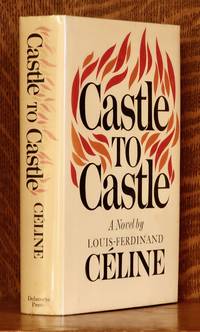
196854112New York: Delacorte 1968. first american edition. Hardcover. Good /very good. 6 x 9 in. Red cloth spine with black paper boards. Condition is GOOD ; covers and spine very clean mild shelf wear. Front board feels a little tender but has no damage spine very mildly cocked. Text clean and unmarked. DJ is VERY GOOD ; not clipped $7.50 clean spine a bit sunned with a faint water spot to tail. In a wrapper. Fic. RGR. Delacorte hardcover
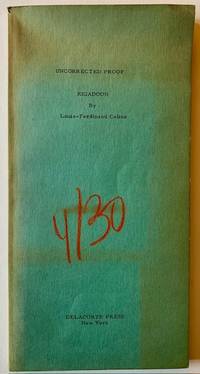
197422888New York: Delacorte Press 1974. Wrappers. Very Good. The uncorrected proof --in galleys-- of the 1974 1st American edition of Celine's "Rigadoon". Solid and VG in its tall light-blue wrappers with offsetting to the panels and a grease-pen date from the publisher at the front panel. Uncommon in this pre-publication format. Delacorte Press unknown
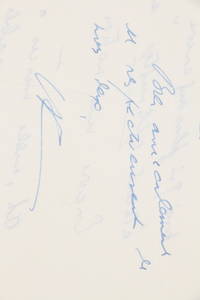
195080910s. l. Klarskovgaard 1950. Fine. s. l. Klarskovgaard 17 novembre 1950 21 x 34 cm 2 pages sur un feuillet Autograph letter signed with the initials of Louis-Ferdinand Céline addressed to his lawyer Master Thorvald Mikkelsen. Two pages written in blue ink on a large sheet of white paper; number ""568"" in Céline's hand in red pencil at the top left. Transversal folds inherent to mailing. This letter was very partially transcribed in Année Céline 2005. Early November 1950 Gaby Paul had come to visit Céline and Lucette at Klarskovgaard: ""Oh mille mercis à Mme Christensen pour son aimable repas qui réchauffé fit nos délices ! Et puis aussi gratitudes pour tout le soin qu'elle a pris de Mme Gen Paul !. Laquelle ne donne aucune nouvelle. Quelle vacherie encore . Comme c'est amusant ! Je crois qu'elle avait des projets ""journalistiques"" mais que mon attitude l'a désenchantée. """"Oh a thousand thanks to Madame Christensen for her kind meal which reheated was our delight! And also gratitude for all the care she took of Mme Gen Paul!. Who gives no news. What nastiness again. How amusing! I believe she had 'journalistic' projects but my attitude disenchanted her."" Céline also mentions the Swedish writer Ernst Bendz one of the few to defend Céline alongside Paraz: ""Une lettre amusante de Bendz ! Bendz appartient vraiment à l'aristocratie des esprits ! La preuve ! La façon qu'il ""m'estime""!!!""""An amusing letter from Bendz! Bendz truly belongs to the aristocracy of minds! The proof! The way he 'esteems me'!!!"" In 1947 Céline pursued by French justice for his collaborationist involvement was confined in Denmark. It was in May 1948 accompanied by Lucette and Bébert that he arrived at his lawyer Master Thorvald Mikkelsen's home at Klarskovgaard. The latter owned a large property by the Baltic Sea and invited the exile to stay there. On February 21 1950 as part of the épuration the writer was definitively sentenced in absentia by the civic chamber of the Paris Court of Justice for collaboration to one year of imprisonment which he had already served in Denmark. The Swedish Consul General in Paris Raoul Nordling intervened on his behalf with Gustav Rasmussen Danish Foreign Minister and managed to delay his extradition. On April 20 1951 Jean-Louis Tixier-Vignancour his lawyer since 1948 obtained Céline's amnesty under the title of ""severely disabled veteran of the Great War"" by presenting his file under the name Louis-Ferdinand Destouches without any magistrate making the connection. Céline would leave Denmark the following summer after three years spent at his lawyer's home. unknown
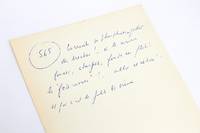
195484046Meudon 1954. Fine. Meudon 1954 20.70 x 26.80 cm une page sur un feuillet Autograph manuscript signed by Louis-Ferdinand Céline written in blue ballpoint pen on a sheet of white paper numbered 565 in the left corner. One transverse fold. Some pin holes in the upper margin evidence of the organization of Céline manuscripts in ""bundles"". « torrents de phosphore jaillir des brèches ! . et les avions foncer charger fendre ces flots ! les ""forteresses"" ! aller et retour ! et que c'est le Jules le crime » ""torrents of phosphorus gushing from the breaches! . and the planes rushing charging cleaving these waves! the ""fortresses""! back and forth! and that it's Jules who's the crime"" The passage on our sheet conforms to the published version. Published in 1954 Normance is a direct sequel to Féérie pour une autre fois which appeared two years earlier. Both parts were written during Céline's years of exile and imprisonment in Denmark. Upon his return to France in 1951 Céline undertook a work of ""polishing"" and published these two titanic texts independently originally conceived as one. ""Céline while working on it thought of this novel as a second Voyage au bout de la nuit capable twenty years later of astonishing the public as much as the 1932 novel."" Henri Godard unknown
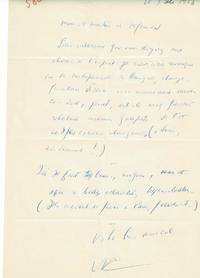
195076186s. l. Klarskovgaard 1950. Fine. s. l. Klarskovgaard 7 octobre 1950 21 x 34 cm 2 pages sur 2 feuillets Partly unpublished autograph letter signed by Louis-Ferdinand Céline addressed to his ""dear Master and defender"" Maître Thorvald Mikkelsen. Two pages written in blue ink on two large sheets of white paper; numbers ""580"" and ""581"" in Céline's hand in the upper left corner in red pencil. Transverse folds inherent to the mailing. This letter was very partially transcribed in the Année Céline 2005. Autograph letter signed by Louis-Ferdinand Céline addressed to his ""dear Master and defender"" Maître Thorvald Mikkelsen. Two pages written in blue ink on two large sheets of white paper; numbers ""580"" and ""581"" in Céline's hand in the upper left corner in red pencil. Transverse folds inherent to the mailing. Céline sends Mikkelsen an article: ""Pour intéressé que vous soyez aux choses de l'esprit je crois avoir remarqué que les turlupinades des banques changes fricoteries diverses vous amusaient aussi. Ci-donc joint article assez farceur relatant certaines galipettes de l'or et ses escrocs changeurs à Paris évidemment !"" ""However interested you may be in matters of the mind I believe I have noticed that the buffooneries of banks exchanges and various swindles also amuse you. Here therefore attached is a rather farcical article relating certain antics of gold and its swindling money-changers in Paris obviously!"" The writer attached to his letter another sheet whose numerous underlinings bear witness to the persecution he felt victim to: ""Maintenant qu'on remonte la Ligne Maginot qu'on recrée une Légion Anti Bolchéviques une armée franco-allemande il paraît qu'il est question de me poursuivre à nouveau d'après les Beaux Draps mais cette fois pour antigermanisme et sabotage de l'Europe Nouvelle et irrespect pour Hitler ! Oh je n'en mène pas large !"" ""Now that they're rebuilding the Maginot Line recreating an Anti-Bolshevik Legion a Franco-German army it seems they're planning to prosecute me again based on Les Beaux Draps but this time for anti-Germanism and sabotage of the New Europe and disrespect for Hitler! Oh I'm not feeling very confident!"" In 1947 Céline pursued by French justice for his collaborationist involvement was confined in Denmark. It was in May 1948 accompanied by Lucette and Bébert that he arrived at his lawyer Maître Thorvald Mikkelsen's home in Klarskovgaard. The latter owned a large property by the Baltic Sea and invited the exile to stay there. On February 21 1950 as part of the purge the writer was definitively condemned in absentia by the civic chamber of the Paris Court of Justice for collaboration to one year of imprisonment which he had already served in Denmark. The Swedish Consul General in Paris Raoul Nordling intervened on his behalf with Gustav Rasmussen the Danish Foreign Minister and managed to delay his extradition. On April 20 1951 Jean-Louis Tixier-Vignancour his lawyer since 1948 obtained Céline's amnesty as a ""severely disabled veteran of the Great War"" by presenting his file under the name of Louis-Ferdinand Destouches without any magistrate making the connection. Céline would leave Denmark the following summer after three years spent at his lawyer's home. In 1947 Céline pursued by French justice for his collaborationist involvement was confined in Denmark. It was in May 1948 accompanied by Lucette and Bébert that he arrived at his lawyer Maître Thorvald Mikkelsen's home in Klarskovgaard. The latter owned a large property by the Baltic Sea and invited the exile to stay there. On February 21 1950 as part of the purge the writer was definitively condemned in absentia by the civic chamber of the Paris Court of Justice for collaboration to one year of imprisonment which he had already served in Denmark. The Swedish Consul General in Paris Raoul Nordling intervened on his behalf with Gustav Rasmussen the Danish Foreign Minister and managed to delay his extradition. On unknown
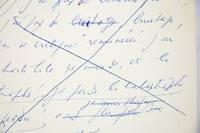
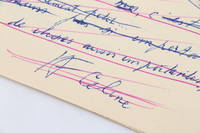
195484027Meudon 1954. Fine. Meudon 1954 20.70 x 26.80 cm une page sur un feuillet Autograph manuscript signed by Louis-Ferdinand Céline written in blue and pink ballpoint pens on a white paper sheet numbered 507 in the left corner. One transverse fold. Some pin holes in the upper margin stigmata of the organization of Céline manuscripts in ""bundles"". « j'ai pas de cinéma personnel j'ai pas de bruitage j'ai pas de critiques ""rémunérés"" j'ai que l'hostilité du monde et la catastrophe ! je perds la catastrophe je suis perdu ! . chienlit ! charlatan ! barbeau mou ! Comme ça vous m'intitulez si vous me trouvez pas dans la loge en plein enragement d'éléments ! je veux pas que vous. » The passage in our sheet presents some variations from the published version. Published in 1954 Normance is a direct sequel to Féérie pour une autre fois published two years earlier. Both parts were written during Céline's years of exile and imprisonment in Denmark. Upon his return to France in 1951 Céline undertook a work of ""polishing"" and published independently these two titanic texts originally envisioned as one. ""Céline while working on it thought of this novel as a second Voyage au bout de la nuit capable twenty years later of astonishing the public as much as the 1932 novel."" Henri Godard unknown
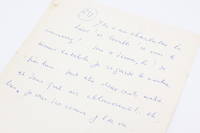
195080911s. l. Klarskovgaard 1950. Fine. s. l. Klarskovgaard 17 novembre 1950 21 x 34 cm 1 page sur un feuillet Autograph letter signed with the paraph of Louis-Ferdinand Céline addressed to his lawyer Master Thorvald Mikkelsen. One page written in blue ink on a large sheet of white paper; number ""566"" in Céline's hand in red pencil at the top left. Transversal folds inherent to mailing. This letter was very partially transcribed in Année Céline 2005. Early November 1950 Gaby Paul had come to visit Céline and Lucette at Klarskovgaard: ""Mme Gen Paul a repris la route de Montmartre toute ravie de votre accueil ! A moi de vous remercier chaleureusement car enfin j'espère que votre généreuse réception me sera comptée ""à indulgence""."" ""Mme Gen Paul has taken the road back to Montmartre delighted with your welcome! It is for me to thank you warmly because I finally hope that your generous reception will be counted in my favor as 'indulgence'."" Through her intermediary Céline evidently received news of his former Montmartre companions: ""Je ne sais pas quels crimes j'ai commis mais pour ces fourbes canailles du 18eme Arrt. ma légende de bistrot en bistrot est devenue un Super Niebelung d'horreurs ! C'est rigolo. Au point qu'aucun n'ose me venir voir ici !"" ""I don't know what crimes I committed but for these deceitful scoundrels of the 18th district my legend from bistro to bistro has become a Super Niebelung of horrors! It's amusing. To the point that none dare come to see me here!"" In 1947 Céline pursued by French justice for his collaborationist involvement was confined in Denmark. It was in May 1948 accompanied by Lucette and Bébert that he arrived at his lawyer Master Thorvald Mikkelsen's home at Klarskovgaard. The latter owned a large property by the Baltic Sea and invited the exile to stay there. On February 21 1950 as part of the épuration the writer was definitively sentenced in absentia by the civic chamber of the Paris Court of Justice for collaboration to one year of imprisonment which he had already served in Denmark. The Swedish Consul General in Paris Raoul Nordling intervened on his behalf with Gustav Rasmussen Danish Foreign Minister and managed to delay his extradition. On April 20 1951 Jean-Louis Tixier-Vignancour his lawyer since 1948 obtained Céline's amnesty under the title of ""severely disabled veteran of the Great War"" by presenting his file under the name Louis-Ferdinand Destouches without any magistrate making the connection. Céline would leave Denmark the following summer after three years spent at his lawyer's home. unknown
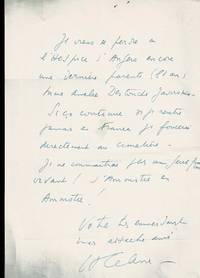
195076172s. l. Klarskovgaard 1950. Fine. s. l. Klarskovgaard 8 décembre 1950 21 x 34 cm 2 pages sur un feuillet Autograph letter signed partly unpublished by Louis-Ferdinand Céline addressed to his lawyer Maître Thorvald Mikkelsen. Two pages written in blue ink on a large sheet of white paper; numbered 575 in Célines hand in red pencil at the top left corner. Fold marks from mailing. This letter was only partially transcribed in Année Céline 2005 p. 64. A moving and bitter letter by Céline who had just lost his aunt Amélie the Aunt Hélène of Death on Credit and witnesses the slow disappearance of the world he once knew. The writer finds solace in the memoirs of Élisabeth de Gramont another witness to a bygone era. From his Danish exile Céline learns with sorrow of the death of his Aunt Amélie the last surviving member of the Destouches family: Je viens de perdre à l'hospice d'Angers encore une dernière parente. Although he had not spared his alter ego in Death on Creditthe scandalous Aunt Hélène meets a shameful end trailed by suitors lovers or clientshe recalls: À Saint-Pétersbourg elle est devenue grue. . Elle est venue nous voir au Passage deux fois de suite frusquée superbe comme une princesse et heureuse et tout. Elle a terminé très tragiquement sous les balles dun officier. The real Aunt Amélie had settled in Romania married to a diplomat Zenon Zawirski. Unfortunately reality caught up with fiction: she returned to Paris in utter destitution at the age of 80. Céline arranged for her transfer from the hospice of the Little Sisters of the Poor in Breteuil to the hospital in Angers where she died in December 1950 Que la pauvre femme meure gentiment. Assez de fins tragiques dans la famille ! he had written to Dr. Camus on 11 July 1949. His secretary Marie Canavaggia met her before her arrival in Angers: elle avait par moments des gestes et des expressions qui en éclairs me rappelaient son neveu 13 July 1949. With the last of his family gone Céline reflects on his own end: si ça continue si je rentre jamais en France je foncerai directement au cimetière. Devouring the books his lawyer sent to ease the burden of exile Céline describes his current readings: Le Temps des équipages by Élisabeth de Gramont est un des livres fameux parus vers 1920 ! Lun des « Guides des Snobs » les mieux réussis de lÉpoque. It is striking to imagine Céline delighting in this aristocrats social chronicle so alien to his world: Javais un ami Carré de Rennes étudiant en droit qui lavait appris par cur ! . il sen est établi marchand de tableaux. As a young medical student Céline had indeed crossed paths with Louis Carré later a successful Parisian art dealer who exhibited Paul Klee Juan Gris Le Corbusier and Picasso: il y a fait 10 fois fortune ! Preuve que tous les livres ne sont pas déprimants ! In 1947 pursued by French justice for his collaborationist stance Céline took refuge in Denmark. In May 1948 accompanied by Lucette and Bébert he arrived at the home of his lawyer Maître Thorvald Mikkelsen in Klarskovgaard. Mikkelsen owned a large estate on the Baltic Sea and welcomed the exiled writer to stay. On 21 February 1950 as part of the post-war purge Céline was definitively sentenced in absentia by the Civic Chamber of the Paris Court of Justice to one year in prison for collaboration a sentence already served in Denmark. Raoul Nordling the Swedish consul general in Paris intervened on his behalf with Gustav Rasmussen the Danish Foreign Minister successfully delaying his extradition. On 20 April 1951 Jean-Louis Tixier-Vignancour his lawyer since 1948 obtained Célines amnesty as a severely disabled veteran of the Great War submitting the case under the name Louis-Ferdinand Destouches without the magistrates making the connection. Céline left Denmark that summer after three years spent in his lawyers home. unknown
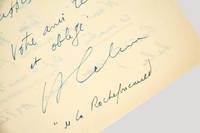
195075963s. l. Klarskovgaard 1950. Fine. s. l. Klarskovgaard 12 octobre 1950 21 x 34 cm 2 pages sur un feuillet Partly unpublished autograph letter signed by Louis-Ferdinand Céline ""ami tenace et obligé"" addressed to his lawyer Maître Thorvald Mikkelsen. Two pages written in blue ink on a large sheet of white paper; number ""579"" in Céline's hand in red pencil at top left. Transverse folds inherent to posting. This letter was very partially transcribed in the Année Céline 2005. Very enigmatic letter: ""Aladin avait déjà une très jolie lampe - avec celle là vous allez voir un peu les trésors que je vais découvrir. Vous avez raison du reste - Carpe Diem ! Mais vous savez la moitié au moins du destin : c'est le PASSEPORT. Le passeport français est moche et moch. mais il vaut mieux que rien."" ""Aladdin already had a very pretty lamp - with this one you're going to see the treasures I'm going to discover. You're right besides - Carpe Diem! But you know at least half of destiny: it's the PASSPORT. The French passport is ugly and ugly. but it's better than nothing."" Note in passing the play on words with the name of Jules Moch vice-president of the council from 1949 to 1950. He informs Mikkelsen: ""J'ai aussi merde ! un cadeau à vous offrir et que vous accepterez nom de dieu ! parce que c'est un livre en Suédois ! donc scandinave ! donc divin ! donc touchable acceptable recevable non puant."" ""I also have damn! a gift to offer you and which you will accept by God! because it's a book in Swedish! therefore Scandinavian! therefore divine! therefore touchable acceptable receivable non-stinking."" In 1947 Céline pursued by French justice for his collaborationist involvement is confined in Denmark. It is in May 1948 accompanied by Lucette and Bébert that he arrives at his lawyer Maître Thorvald Mikkelsen's home in Klarskovgaard. The latter owns a large property by the Baltic Sea and invites the exile to stay there. On February 21 1950 as part of the purification process the writer is definitively sentenced in absentia by the civic chamber of the Paris Court of Justice for collaboration to one year's imprisonment which he had already served in Denmark. The Swedish consul general in Paris Raoul Nordling intervenes on his behalf with Gustav Rasmussen Danish Minister of Foreign Affairs and manages to delay his extradition. On April 20 1951 Jean-Louis Tixier-Vignancour his lawyer since 1948 obtains Céline's amnesty as a ""severely disabled veteran of the Great War"" by presenting his file under the name Louis-Ferdinand Destouches without any magistrate making the connection. Céline would leave Denmark the following summer after three years spent at his lawyer's home. unknown
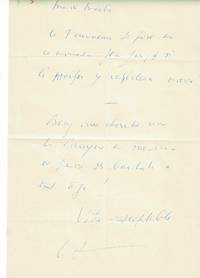
195076185s. l. Klarskovgaard 1950. Fine. s. l. Klarskovgaard 28 octobre 1950 21 x 34 cm 1 pages sur un feuillet Partly unpublished autograph letter signed by ""your touchy LF"" Louis-Ferdinand Céline addressed to his lawyer Maître Thorvald Mikkelsen. One page written in blue ink on a large sheet of white paper; number ""563"" in Céline's hand in the upper left corner in red pencil. Transverse folds inherent to the mailing. This letter was very partially transcribed in the Année Céline 2005. Céline after days of suffering from the cold is delighted to announce to his friend that he has received heating: ""Le fourneau se pose en ce moment. Je ne sais pas si la maison y résistera l'on verra !"" ""The stove is being installed right now. I don't know if the house will withstand it we shall see!"" This letter also mentions his Swedish friend Ernst Bendz like him a doctor and writer: ""Benz sic vous cherche un La Bruyère en suédois - on passe des bachots à tout âge !"" ""Bendz is looking for a La Bruyère in Swedish for you - one takes exams at any age!"" In 1947 Céline pursued by French justice for his collaborationist involvement was confined in Denmark. It was in May 1948 accompanied by Lucette and Bébert that he arrived at his lawyer Maître Thorvald Mikkelsen's home in Klarskovgaard. The latter owned a large property by the Baltic Sea and invited the exile to stay there. On February 21 1950 as part of the purge the writer was definitively condemned in absentia by the civic chamber of the Paris Court of Justice for collaboration to one year of imprisonment which he had already served in Denmark. The Swedish Consul General in Paris Raoul Nordling intervened on his behalf with Gustav Rasmussen the Danish Foreign Minister and managed to delay his extradition. On April 20 1951 Jean-Louis Tixier-Vignancour his lawyer since 1948 obtained Céline's amnesty as a ""severely disabled veteran of the Great War"" by presenting his file under the name of Louis-Ferdinand Destouches without any magistrate making the connection. Céline would leave Denmark the following summer after three years spent at his lawyer's home. unknown
195483967Meudon 1954. Fine. Meudon 1954 21.20 x 26.10 cm une page sur un feuillet Autograph manuscript signed by Louis-Ferdinand Céline written in blue ballpoint pen on a sheet of white paper numbered 237 in the left corner. Some stains as well as a central fold of no consequence. Some pinholes in the upper margin evidence of the organization of Céline's manuscripts in ""bundles"". ""Y'en a un charlatant là-haut ! et terrible ! et vous le connaissez !. donc de dessous là ! de dessous la table je regarde le moulin. pas loin. peut-être deux cents mètres. et dans quel air éblouissant !. eh bien je vous dis comme je l'ai vu."" ""There's a charlatan up there! and terrible! and you know him!. so from underneath there! from under the table I look at the windmill. not far. maybe two hundred meters. and in what dazzling air!. well I tell you as I saw it."" The passage from our sheet conforms to the published version. Published in 1954 Normance is a direct sequel to Féérie pour une autre fois published two years earlier. The two parts were written during Céline's years of exile and imprisonment in Denmark. Upon his return to France in 1951 Céline undertook a work of ""polishing"" and published these two titanic texts independently originally conceived as one. ""Céline while working on it thought of this novel as a second Voyage au bout de la nuit capable twenty years later of astonishing the public as much as the 1932 novel."" Henri Godard unknown
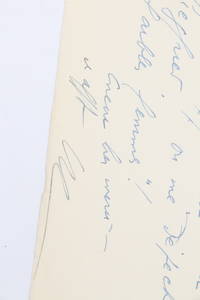
195483743s. l. Meudon 1954. Fine. Céline's Ars Poetica: ""I capture all the emotion on the surface! I cram it into my metro! s. l. Meudon s. d. 1954 10 x 21 cm 34 feuillets Manuscript pages from Conversations with Professor Y' n.p. Meudon n.d. 1954 various sizes from 10x21 cm to 27x21 cm 34 sheets. Autograph manuscript by Louis-Ferdinand Céline 34 sheets of various sizes written in blue and sometimes pink ballpoint pen. Some of the pages are numbered by Céline at top left. The last folio numbered 159 is signed by the writer at the bottom. Two leaves contain previously unpublished passages: the first a few lines long refers to the Professeur. The second leaf numbered 136 features another full-page text on the verso which we did not find in the Professeur Y' or in any of the published works of Céline. Céline refers in this unpublished passage to article 75 of the penal code condemning to the death penalty any French citizen found guilty of intelligence with the enemy. It also mentions a certain ""Me Johann Niels Borggensen"" no doubt a pseudonym for his lawyer Thorvald Mikkelsen: "".supposedly to protect me from police curiosity! holy cow! he was having a ball.when you've got the warrant up your arse crossed out: article 75 anyone can do what they like with you! what a joke! we can do what we like with you.it wouldn't have been Borggensen perhaps someone else would have been worse.give me article 75 and I'll put the whole of France in a Mouse hole for you! and Germany with it! and England such a nag and Europe with it! no bomb needed! H ! Y ! Z ! I'll make you fit the atom into a."" Important set of working manuscripts bearing witness to the writing of Conversations with Professor Y' Céline's true Ars poetica. Since the first part of Féerie pour une autre fois' Fable for Another Time was not as successful as expected Céline wanted to give the release of the second part - Normance - as much publicity as possible and restore his reputation after his years of exile in Germany and Denmark. Instead of writing the usual promotional note prière d'insérer he suggested to publisher Gaston Gallimard this eulogy written in the style of an imaginary interview between himself and Professor Y alias Colonel Réséda a prostatic old man. This zany ""interviouwe"" was published in several parts in the Nouvelle Revue française in 1954 and the finished work through Éditions Gallimard the following year. Céline speaks fervently of his style and his conception of literature and vehemently criticizes the world of letters and public taste. Unlike Céline's other works the genesis of this text crucial to the understanding of his oeuvre is poorly documented and its manuscripts are rare. The Pléiade edition of Celinian novels contains only a few pages of an earlier version very close to the published text. This set of pages covering every passage of the text contains both heavily crossed-out sheets and neatly rewritten notes. It bears witness to the different stages of the writer's work: drafting an initial sheet crossing out and rewriting on the same page then transcribing short passages on separate notes. The last page of the text is extensively crossed out and rewritten resulting in a slightly different version of the published version. The manuscript also contains the famous metaphor of the metro typical of the writer's emotive style compared here to the ""dry language"" of his peers: ""Did you see Have you noticed All caught up in my metro!. what do I leave on the surface. the worst rubbish in cinema!. foreign languages then!. translations!. retranslations of our worst rubbish that they use for their ""parlants"" talking pictures superb foreign languages!. in addition to the psychology! the psychological mumbo jumbo!. all the crap. . Me it's something else! me I'm much more brutal! me I capture all the emotion!. all the emotion on the surface! all at once! I decide! I stick it in the metro! my metro! all t unknown
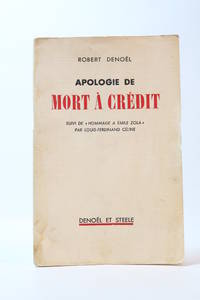
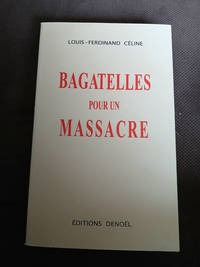
193674226Paris: Denoël & Steele 1936. Fine. Denoël & Steele Paris 1936 13.50 x 20.50 cm agrafé First edition. A light dampstain to margins of covers having also affected all leaves at their feet three minute corner lacks to covers. Rare but in this condition. Denoël & Steele unknown
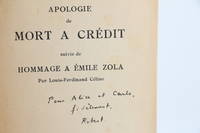
193680216Paris: Denoël & Steele 1936. Fine. Denoël & Steele Paris 1936 13.50 x 20.50 cm agrafé Rare first edition. Spine and boards marginally sunned boards slightly soiled one transverse fold on the front board. Reading marks and pencil annotations by the dedicatee in margins of some leaves. Autograph inscription signed by Robert Denoël to the Provençal writer filmmaker and caricaturist Carlo Rim who was notably the friend of Fernandel Raimu and Marcel Pagnol but also of Max Jacob. Denoël & Steele hardcover
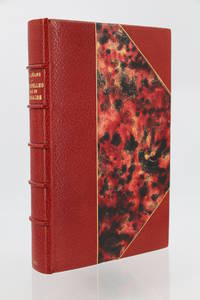
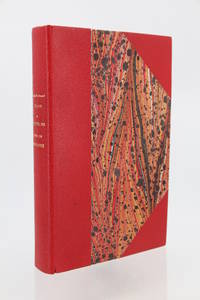
193787003Paris: Denoël 1937. Fine. Denoël Paris 1937 14.50 x 22.50 cm relié First edition one of 440 numbered copies on alfa paper. Half red morocco binding with corners spine with five raised bands set with black fillets gilt date at foot gilt fillet frame on marbled paper boards marbled endpapers and pastedowns covers and spine preserved top edge gilt elegant binding signed by Maylander. Handsome copy beautifully bound. Denoël hardcover
193787022Paris: Denoël 1937. Fine. Denoël Paris 1937 14.50 x 22.50 cm relié First edition one of 440 numbered copies on alfa paper. Half-shagreen binding with morocco corners in red smooth spine marbled paper boards combed paper endpapers and pastedowns covers and spine preserved top edge gilt binding signed by Montécot. Some foxing mainly at the beginning of the volume. A handsomely bound copy. Denoël hardcover
1937ABS2504<p>New</p> Editions Denoel paperback
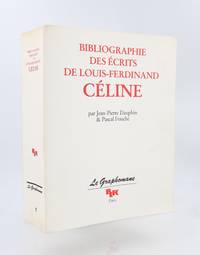
198586993Paris: Le graphomaneB.L.F.C. 1985. Fine. Le graphomane B.L.F.C. Paris 1985 18 x 23.50 cm broché First edition printed in 800 numbered copies. Iconography. Handsome copy of this essential Céline ""bible"". Le graphomaneB.L.F.C. unknown
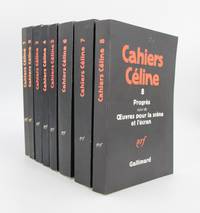
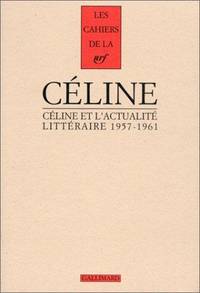
197689938Paris: Gallimard 1976. Fine. Unpublished writings letters and articles everything you always wanted to know. Gallimard Paris 1976-1988 14 x 20.50 cm 8 volumes brochés First edition with no deluxe paper copies issued except for No. 7 for each volume. Our complete set comprises: Céline Notebooks 1: Céline and the Literary Scene 19321957. Céline Notebooks 2: Céline and the Literary Scene 19571961. Céline Notebooks 3: Semmelweis and Other Medical Writings. Céline Notebooks 4: Letters and Early Writings from Africa 19161917. Céline Notebooks 5: Letters to Female Friends. Céline Notebooks 6: Letters to Albert Paraz 19471957. Céline Notebooks 7: Céline and Current Events 19331961. Céline Notebooks 8: Progress followed by Works for Stage and Screen. Illustrations. Rare complete set. Gallimard unknown
19932-2070736695Editions Gallimard 1993. Paperback. New. 252 pages. French language. 7.80x5.51x0.79 inches. Editions Gallimard paperback
197667454Paris: Gallimard 1976. Fine. Unpublished texts letters and articles - everything you've always wanted to know. Gallimard Paris 1976-1988 14 x 20.50 cm 8 volumes brochés First editions with no deluxe copies printed except for No. 7 for each volume. Our complete set comprises: Cahiers Céline 1: Céline et l'actualité littéraire 1932-1957. Cahiers Céline 2: Céline et l'actualité littéraire 1957-1961 Cahiers Céline 3: Semmelweis et autres écrits médicaux Cahiers Céline 4: Lettres et premiers écrits d'Afrique 1916-1917 Cahiers Céline 5: Lettres à des amies Cahiers Céline 6: Lettres à Albert Paraz 1947-1957 Cahiers Céline 7: Céline et l'actualité 1933-1961 Cahiers Céline 8: Progrès suivi de Oeuvres pour la scène et l'écran. Iconography. First endpaper of the first volume shadowed due to a press clipping. Rare complete set. Gallimard unknown