Jean COCTEAUBiblio.com
829 résultats
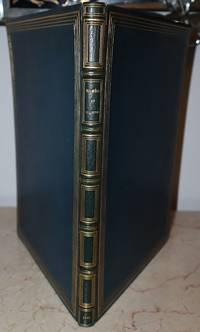
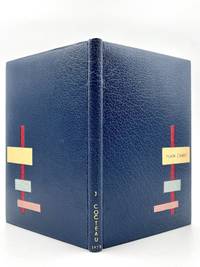
192378240Paris: Librairie Stock 1923. Fine. Librairie Stock Paris 1923 12 x 19 cm relié First edition on ordinary paper. Full bright blue morocco binding with mosaic decoration signed at the bottom of the slipcase by Jadis. Marbled paper slipcase matching the endpapers. Smooth Jansenist spine with author's name in full. Boards with mosaic decoration featuring a red fillet crossed by 3 rectangles in cream grey and pink; title in black on the cream cartouche. Original pink wrappers preserved. Inscription from Cocteau to Marc Dantzer: à Marc coeur de sommeil Jean. Marc Dantzer was a French actor who pursued his career from 1929 to 1957 he ran the restaurant at the Elysée-Matignon where cinema personalities would gather. A friend of Cocteau there was correspondence between the two men. Superb copy in perfect condition. Marc Dantzer bookplate stamp. Second bookplate with the cipher of Jean Paraf. Librairie Stock hardcover
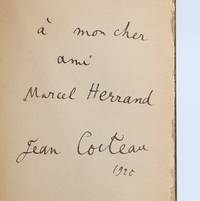
192087075Paris: Editions de la Sirène 1920. Fine. Editions de la Sirène Paris 1920 14.50 x 23 cm relié First edition on ordinary paper. Bradel binding with gilt and moiré decorative paper signed Goy & Vilaine smooth spine black morocco title-label top edge gilt fragile covers and spine lined preserved. Signed and inscribed by Jean Cocteau: ""To my dear friend Marcel Herrand. Jean Cocteau. 1920."" In the first article of Carte blanche 1919 Jean Cocteau praises the young actor Marcel Herrand then aged twenty-two: ""The new spirit is stirring all branches of art. Young actors are putting themselves at the service of modern poetry. Marcel Herrand who created 'Les Mamelles de Tirésias' and various masked roles in 'Le Dit des jeux du monde' was the first to surprise us with his rhythm his straight voice and his disdain for effect. Gestures intentions bleats shouts smiles the nuances beneath each syllable the play of timbre all disappear here to make way for a typographic reading. An inky black. Clean-cut words fall off the page one after the other. The actor does not substitute his emotion for that of the poet. He serves him instead of using himself."" During the 1920s Cocteau entrusted several roles to the talented Marcel Herrand: first as a phonograph in ""Les Mariés de la tour Eiffel"" 1921 he won the male lead in 'Roméo et Juliette' 1924 and even played the angel Heurtebise in the first cast of his famous 'Orphée' in 1926. Moving and early inscription by Jean Cocteau in homage to one of his favorite actors. Editions de la Sirène unknown
1947NE23Paul Morihien 1947. Book. Very Good. No Binding. 1st Edition. n 1947 Paul Morihien published a clandestine edition of Querelle de Brest by Jean Genet featuring 29 very explicit erotic drawings by Cocteau. 28 of 29 lithographs by Cocteau only. 4to loose as issued portfolio; with original glassine Paris 1947 Approximately 10 by 12 a partial set of a suite of plates issued separately. SURPRESSED! . Paul Morihien unknown
1926007324Paris: Au Sans Pareil 1926. Limited First Edition. Full Morocco. Near Fine. No. 131 on Velin Montolgier d'Annonay of a total limitation production of 432 copies this copy beautifully bound in full mid-blue crushed Levant morocco by Vermorel with gilt ruling raised bands etc. Folio 33 by 25 cm. 101 1 pp. With 12 color plates -- woodcuts with hand-coloring plus seven headpieces -- these are not quite half-page. Wrap covers bound in. With half-title. This beautiful "artist's" book was produced to commemorate a 1924 production at directed by Comte Etienne de Beaumont at the Theatre de la Cigale in Paris. Cocteau played Mercutio in this production. The publication was the second in the "Grande Collection" established by R. Coulouma an Argenteuil printer. Jean Victor-Hugo oversaw the hand-coloring. Condition: edge rubbing of the binding. Slight rubbing along joints. Otherwise a tight clean highly attractive copy. Au Sans Pareil unknown
19565045<p>Témoignage.Jean Cocteau. Pierre Bertrand Editeur Paris 1956. Homage to Pablo Picasso in occasion of its seventy-fifth birthday. Limited in 125 numbered copies of which this copy is n. 57. Illustrated with an original etching by Picasso depicting a nude turned on the back dated signed and inscribed in plate and an original etching by Paul Lemagny a portrait of Picasso. </p><p>In very good condition. Complete condition report on request as well extra pictures. </p> Pierre Bertrand Editeur. paperback
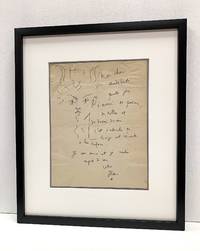
4651As a filmmaker Cocteau is most often associated with his three films based on the Greek myth of Orpheus a poet and musician often shown with his lyre. Cocteau depicts Orpheus with a lyre on his head or as part of his head in our letter to French author and playwright Jacques Audiberti 1899 -1965. Audiberti was associated with the theater of the absurd. Cocteau writes in full: " Dear Audiberti What joy to have poems letters and drawings of yours! Art attaches itself to cork and rises to the surface. I am very fond of you and will stay close to you Yours Jean." The letter measures 8.5 x 10.5 inches land floats on a dark gray mat overlaid with a white mat and framed in black satin finished wood matted and framed in museum quality materials framed in 5/8/ inch black satin wood. Frame measures 15.75 x 18.4. Condition: Visible margin folds some wrinkling as paper is attached to a lined sheet which shows at top margin very slight foxing and sunned margins. unknown
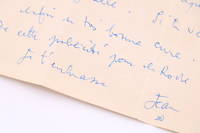
194089564Paris: Gallimard 1940. Fine. First edition on japon in full morocco with a fine autograph letter: Me voilà dans ce film de Charlot : ""Charlot fait une cure"" Gallimard Paris 1940 12 x 18.8 cm Relié sous étui First edition one of 10 numbered copies on imperial japon ours one of 3 hors commerce lettered copies a deluxe issue following 6 on chine.Bound in full sienna morocco flat spine gilt date at foot moiré-effect endpapers and pastedowns gilt fillet border on pastedowns original wrappers and spine preserved spine restored and backed gilt edges chemise edged in sienna morocco slipcase in wood-effect board with white felt lining contemporary binding signed by Roger Arnoult.Our copy is enriched with a one-page signed autograph letter by Jean Cocteau mounted on a guard written from La Roche-Posay in Vienne probably addressed to Pierre Benoit in which he humorously evokes Charlie Chaplin his fragile health and his boredom: "". Me voilà dans ce film de Charlot : ""Charlot fait une cure"" - parmi les clowns et clowneries du mercurochrome. Le docteur H. arrive à éteindre mon fer de travail avec ses pelotes d'épingles aquatiques. Mon ventre gargouille. Si tu venais ce serait une très bonne cure. Que penses-tu de cette publicité pour La Roche : La Roche source d'ennuis.""A handsome copy finely bound by Roger Arnoult a graduate of the École Estienne active until 1980 who collaborated with and worked for the foremost binders of his time such as René Aussourd Anthoine-Legrain Paul Bonet Georges Cretté Pierre-Lucien Martin. Gallimard unknown
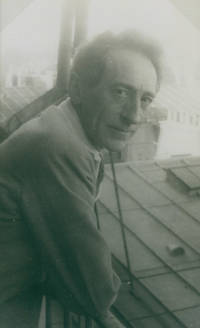
1949222172Paris 1949. Half-length leaning over the railing of his terrace face turned to camera. 1 vols. Post card format. Fine. Matted. Half-length leaning over the railing of his terrace face turned to camera. 1 vols. Post card format. Probably taken just before Cocteau's trip to America in 1949. unknown
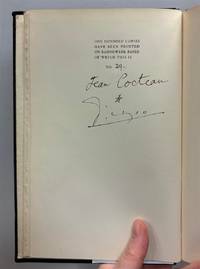
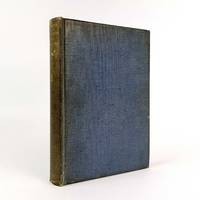
1933328735London: Oxford University Press 1933. Limited. hardcover. very good-. Picasso. Translated by Carl Wildman. Frontispiece by Picasso. 43 pages. 12mo smooth black cloth spine chipped and repaired. London: Oxford University Press 1933. Limited First Edition. A very good- copy internally fine.<br/> <br/> No. 29 of only 100 copies signed by both Cocteau and Picasso.<br/> <br/> Oxford University Press unknown
19280036105London: Wishart & Company 1928. First Edition. Hardcover Hardcover. Very Good Condition. 22cm x 16cm. viii 225 pages 3 plates. Original blue cloth gilt lettering top edge gilt. Experimental novel based on the myth of the Holy Grail. A one time student of Aleister Crowley Butts is credited as a co-author of the 1912 Magick Book 4. In 1921 she spent time at Crowley's Abbey of Thelema not enjoying her stay and departing with a drug habit. Armed with Madness explores the relationships including homoeroticism and bisexuality and ritualism among a group of young bohemians living at a country home. Considered a masterpiece of Modernist prose. One of 100 numbered copies of the Deluxe Edition on handmade paper with illustrations by Jean Cocteau. Spine discoloured and with a some small patches of light rubbing. Minor tanning to endpapers with previous owner's initials to front free endpaper. Small soil to margin of page 160 and to tail margin of the final plate and facing page. Category: Fiction; Inventory No: 0036105. BZDB407 Fiction; Unbranded Mary Butts; Jean Cocteau Armed with Madness Wishart & Company hardcover
19362091202133203503Les Cent Une 1936. Soft Cover. Fine. Volume: 1 Les Cent Une paperback
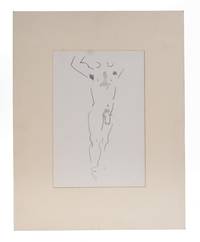
37351. Pencil on paper 10½ x 8¼ in 27 x 21 cm. unknown
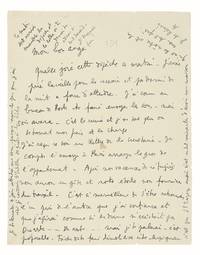
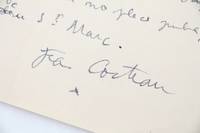
1940888411940. Fine. ""Its such a miracle to have a home that is truly ours and the sea so close by. I bless you."" s. d. juillet 1940 21 x 27 cm Une page sur un feuillet Autograph letter signed by Jean Cocteau marked with his famous star addressed to his great love the actor Jean Marais. One page penned in black ink on a single sheet.Traces of folds horizontal creases inherent to mailing two ink spots on the blank verso not affecting the text.A magnificent love letter from Cocteau to Marais who together formed one of the most iconic artistic couples of the 20th century. Set against the backdrop of turmoil and the German Occupation their unbreakable bond is embodied in this letter of the writer filled with desperate tones. Published in Letters à Jean Marais 1987 p. 159. Written by a love-stricken Cocteau while Jean Marais having been mobilised joined the front in May 1940. Cocteau had taken refuge in Perpignan where communication in those troubled times was difficult: ""Ce matin sont arrivées ensemble la dépêche et la lettre où tu donnais ton adresse à tout hasard. Je devenai sic fou! Mon bon ange Quelle joie cette dépêche ce matin. J'avais prié la veille pour la recevoir et pas dormi de la nuit à force d'attendre. J'ai couru au bureau de poste pour t'envoyer les sous - mais - sois avare - c'est la ruine et je ne sais plus où se trouvent mon frère et la charge. J'ai reçu ce soir une lettre de la secrétaire. Je compte l'envoyer à Paris arranger le gros de l'appartement. Après nos réfugiés nous aurons un gîte et notre étoile nous fournira du travail. C'est si merveilleux de s'être retrouvés l'un près de l'autre que j'ai confiance et que j'agirai comme si le drame n'existait pas. Du reste. du reste. mais je te parlerai c'est préférable. Tâche de te faire démobiliser vite. Perpignan n'est pas Saint-Tropez mais c'est un tel miracle d'avoir une maison qui est la nôtre et la mer tout près. Je te bénis. Je te demande de faire attention aux sous parce que avec le peu que j'ai ici je voudrais t'habiller des pieds à la tête ""This morning the telegram and the letter where you gave your address arrived together. I nearly lost my mind! My dear angel What joy your telegram brought this morning. I had prayed the night before to receive it and hardly slept from the wait. I ran to the post office to send you moneybut be thriftyI am broke and I no longer know where my brother and the charge are. This evening I received a letter from the secretary which I plan to send to Paris to sort out the main part of the apartment. After our refugees well have a home and our star will bring us work. Its so wonderful to have found each other again that I have confidence and will act as if the drama didnt exist. But. but. Ill tell you more in person its better that way. Try to get demobilised quickly. Perpignan is not Saint-Tropez but it is such a miracle to have a house that is ours and the sea close by I bless you.I ask you to be careful with money because with the little I have here I want to clothe you from head to toe.. The Cocteau-Marais pair would soon return to Paris and endure the harshness of the German Occupation which banned the revival of their scandalous 1939 hit play Les Parents terribles. hardcover
1946871451946. Fine. ""Ainsi les dieux grecs nous visitent encore et nous sentons autour de nous une tempête d'ailes un remous de merveilleux païen cette foule turbulente qui va de Zeus à Mercure et s'abat sur nos places publiques comme à Venise les pigeons de Saint-Marc"" Thus the Greek gods still visit us and we feel around us a storm of wings a stirring of pagan marvels this turbulent crowd that goes from Zeus to Mercury and swoops down on our public squares like the pigeons of Saint Mark's in Venice 1946 20.60 x 26.80 cm trois pages et une paperolle tapuscrite Autograph manuscript signed by Jean Cocteau entitled ""Le merveilleux païen"" 3 pages in black and blue ink on three leaves multiple rewritings and crossed-out passages. Accompanied by a typewritten bibliographical reference on paper. Pencil note by a previous bibliographer on the outer margin of the first leaf. Published in Plaisir de France no. 122 13th year December 1946 p. 18. Superb praise of ancient Greek culture and its theatrical pantheon of idols. Cocteau draws from his symbols to understand the modern world and compares Hollywood to the Olympus of old. Cocteau collaborates here in the issue of Plaisir de France devoted to ""Le Merveilleux dans l'Art et dans la Vie"" alongside Supervielle and Marcel Aymé. Fascinated from his beginnings by ancient mythology which floods his theatrical works Antigone Orphée La Machine Infernale. he writes a declaration of love to this blessed time when ""there existed a perpetual contact between human acts and their symbols"" when the marvellous was part of daily life. Numerous corrections mark the manuscript including the very title of the article which Cocteau had originally baptized ""L'Olympe"". Faithful to his mythological alter ego Orpheus who charms with his lyre and verses he will choose the shimmering tapestry ""Orphée et les Muses"" by Lucien Coutaud to illustrate this article. ""A cause du mécanisme moderne qui permet de reproduire le rare à d'innombrables exemplaires le rare se meurt et entre autres on fait du mot merveilleux un emploi abusif mot biffé. Le merveilleux cesse de l'être s'il se désingularise et l'on a une tendance à le confondre avec tout ce qui nous étonne encore : la radio la vitesse la bombe atomique. Or le merveilleux se trouve beaucoup plus en nous que dans les objets qui nous surprennent. Le véritable merveilleux c'est la faculté d'émerveillement qui s'émousse si vite chez l'homme. L'enfance le quitte. Il se blinde contre elle. Il juge il préjuge. Il repousse l'inconnu phrase biffée. S'il laisse agir en lui cette faculté atrophiée c'est pour fuir les fatigues qu'il s'impose. Il en use comme d'une drogue et se plonge pour quelques heures dans un livre ou dans un film. L'antiquité c'est l'enfance du monde. L'âge où l'enfance interroge et se meut dans un univers peuplé d'énigmes mot biffé. Les dieux grecs sont des oiseaux qui se posent sur leurs propres statues. Il y vivent à la mode des pigeons de nos squares. Il y observent les hommes qu'ils imitent ou qui agissent à leur exemple. Il existait donc un perpétuel contact entre les actes humains et leurs symboles qui se formaient tout de suite et devenaient des réalités. Deux mondes se superposent et se compénètrent. Phrase biffée Rien ne frappe en arrivant à Athènes comme cette familiarité d'une religion toujours pareille de siècle en siècle de peuple en peuple qui cette fois prenait un style de théâtre. Il fallait un décor où puissent jouer leurs drames et leurs comédies les acteurs aimés du public véritables vedettes de l'Olympe espèce d'Hollywood peuplé d'emplois divers de tragédiens de mimes de comiques et de belles filles plus ou moins mariées ensemble que la foule adore et auxquels on envoie des lettres et des cadeaux. Le moindre signe ""merveilleux"" du miracle grec relève d'un réalisme et c'est ce qui lui vaut un contact rapide. Et de même que passage biffé les yeux morts de la tête de Méduse unknown
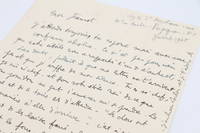
194084633Perpignan 1940. Fine. Perpignan juillet 1940 21 x 27 cm deux pages sur un feuillet Autograph letter by Jean Cocteau signed with his famous star addressed to his great love the actor Jean Marais. Dated by the author July 1940. One and a half pages in black ink on a sheet. Two small marginal tears not affecting the text. Traces of transverse folds inherent to posting. Magnificent love letter from Cocteau to Marais who formed one of the most legendary artistic couples of the 20th century. Against the backdrop of defeat and German Occupation their unbreakable bond is embodied in this letter from the writer with its desperate accents. Published in the Lettres à Jean Marais 1987 p. 157. This missive from a love-stricken Cocteau was written shortly after the Armistice of June 22 1940 marking the end of the French defeat. Marais mobilized had joined the front in May 1940 while Cocteau had taken refuge in Perpignan. Communication in these troubled times proved difficult: ""Mon Jeannot j'attends toujours ta réponse mais avec une confiance absolue. Ce n'est pas pour rien que notre étoile nous a rapprochés l'un de l'autre et sans doute fallait-il que mes lettres ne t'arrivent pas et que je souffre de mon silence"" ""My Jeannot I am still waiting for your response but with absolute confidence. It is not for nothing that our star brought us closer to one another and no doubt it was necessary that my letters not reach you and that I suffer from my silence"" ""Tu es né chef je suis né chef. Et sous notre étoile rien de ce que nous . ne peut s'annexer ni se perdre. Le principal est de se taire et d'attendre. entre guillemets : les choses ont une manière à elles d'arriver."" C'est à nous de le savoir et de les laisser faire ."" ""You were born a leader I was born a leader. And under our star nothing of what we . can be annexed or lost. The main thing is to remain silent and wait. in quotation marks: things have their own way of happening."" It is up to us to know this and let them do so ."" The Cocteau - Marais partnership would soon return to Paris and endure the torments of the German occupation which would ban the revival of their scandalous play Les Parents terribles which had enjoyed great success in 1939. unknown
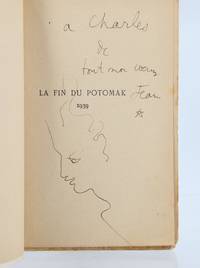
194087570Paris: Gallimard 1940. Fine. Gallimard Paris 1940 12 x 19 cm broché First edition a Service de Presse advance copy. Discrete restorations to spine some foxing in margins. Precious autograph inscription by the author enhanced with a young man's profile and a star drawn in ink: ""à Charles de tout mon coeur Jean"". Gallimard unknown
1989C102554DuMont. As New. 1989. Hardcover. 3770123808 . FREE UPGRADE to Courier/Priority Shipping Upon Request - IN STOCK AND IMMEDIATELY AVAILABLE FOR SHIPMENT - Flawless copy brand new pristine never opened -- Text in German. 418 pages; many black and white illustrations also some in color. Catalogue Raisonne Catalog Raisonné Complete Works Leben Und Werk Oeuvre-Katalog Kritischem Oeuvrekatalog Raisonnee -- with a bonus offer-- - May be EITHER: out of print OOP and extremely rare in this pristine condition; signed by author or contributor; or a first or special edition; inquire for details . DuMont hardcover
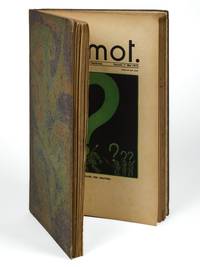
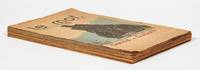
23890Paris aux bureaux de la revue imp. Crété 1914 et 1915. 1 vol. 275 x 475 mm. Cartonnage bradel papier marbré pièce de titre reliure de l'époque. Édition originale et collection complète des 20 numéros de cette revue parue entre le 28 novembre 1914 et le 1er juillet 1915. Exemplaire avec le double état de la couverture du n° 8 premier état censuré et très peu diffusé et le feuillet d’annonce pour la parution du 20 mars 1915 interdite par la censure. Envoi signé : « à Francis Poulenc son ami Jean Cocteau 1918 ». . Revue fondée par Jean Cocteau et Paul Iribe au cœur de la guerre Le Mot capte la violence du conflit jusque dans ses images : patriotisme offensif des premiers numéros puis ouverture rapide aux modernités graphiques — bois de Raoul Dufy collaborations d’Albert Gleizes Léon Bakst André Lhote ; Cocteau y signe dessins et caricatures sous le pseudonyme « Jim » pseudonyme emprunté à son chien. Réformé mais engagé à la Croix-Rouge présent aux évacuations de blessés après les bombardements de Reims Cocteau transpose dans la revue un sens aigu de l’actualité et de la propagande visuelle bientôt heurté par la censure. Le recueil est présenté en collection complète dans un cartonnage commandé par Fracis Poulenc : il réunit les 20 numéros de publication dont le double état de la couverture du n° 8. Provenance de premier plan : Francis Poulenc 1899-1963 fera partie du groupe des « Six » fondé par Cocteau après son manifeste Le Coq et l’Arlequin 1918 ; la dédicace date précisément ce moment l’amitié et le compagnonnage. Poulenc mettra en musique les Cocardes 1919 sur des textes de Cocteau participe au ballet collectif Les Mariés de la tour Eiffel 1921 argument de Cocteau et retrouvera son univers dans La Voix humaine 1959. Sommaire : N°1 - 28 novembre 1914 ; N°2 - 7 décembre 1914 ; N°3 - 19 novembre 1914 ; N°4 - 2 janvier 1915 ; N°5 - 9 janvier 1915 ; N°6 - 16 janvier 1915 ; N°7 - 23 janvier 1915 ; N°8 - 30 janvier 1915 - 2 couvertures dont la première censurée ; N°9 - 6 février 1915 ; N°10 - 13 février 1915 - avec la double page pour la gravure de Dufy ; N°11 - 20 février 1915 ; N°12 - 27 février 1915 ; N°14 - 13 mars 1915 avec le feuillet d'annonce pour le numéro du samedi 20 mars interdit par la censure ; N°15 - 27 mars 1915 ; N°16 - 3 avril 1915 mouillures sur les feuillets de ce numéro ; N°17 - 1er mai 1915 ; N°18 - 1er juin 1915 ; N°19 - 15 juin 1915 ; N°20 - 1er juillet 1915. Paris, aux bureaux de la revue, imp. Crété, 1914 et 1915. 1 vol. (275 x 475 mm). Cartonnage bradel papier marbré, pièce de t unknown
1914413911Paris: Société Générale d'Impression 1914. Unbound. Good. Magazine. A near-complete set of all 20 issues published from 28 November 1914 to 1 July 1915. The first issue consists of two leaves lacking an internal bifolium issue no. 3 is lacking the final leaf; else all other issues appear to be complete in stapled wrappers including several with publisher’s printed slips. The front and back covers of most issues are split along the spine folds else overall a good or better set with some scattered foxing to a few covers toning and modest scattered chipping to the edges.<br /> <br /> A rare near-complete set of this satirical-political wartime review founded by Jean Cocteau and Paul Iribe early in their careers in illustration fashion and graphic design. Both men were important exponents of avant-garde art: as a teenager Iribe drew illustrations for the popular caricature journal L’Assiette au Beurre The Butter Plate; and Cocteau who had published his first volume of poems "Aladdin's Lamp" at 19 had already become widely known in Bohemian circles as "The Frivolous Prince." Iribe designed most of the covers and Cocteau contributed both images and text signing his drawings with the pseudonym “Jim†the name of his dog. Other important contributors include Russian painter and theater designer Léon Bakst Fauvist painter Raoul Dufy and Cubist painters Albert Gleizes and André Lhote.<br /> <br /> Established as the wartime sequel to François Bernouard’s Schéhérazade but printed on much poorer paper the set includes fine impressions of the many famous double-page drawings and series of cartoons and sketches including Cocteau’s series titled “Atrocites†comprising frightening figure of fat stupid and sadistic Germans. Also included in issue no. 5 is one of Cocteau’s most celebrated phrases … Entre le “GOUT†et la “VULGARITɆ…: “Between Taste and Vulgarity both unpleasant there remains an élan and a measure: The Tact of Understanding Just How Far To Go Too Far. Le Mot hopes you will follow it on this path of Franceâ€.<br /> <br /> A scarce set of 20 loose issues with two additional covers and the original publisher’s advertisement slips. A detailed list is available. Société Générale d'Impression unknown
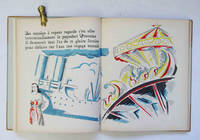
53612Paris Editions de La Sirene 1920. 4° 36 Bl. 30 ganzs. Abb. davon 13 handcoloriert HLdr. goldgeprägtem Rücken. Vordere Umschlag beigebunden. Deckel etwas berieben obere Ecke min. gestaucht Innen sauberes Exemplar. Skira 201 Exempl. 72 von 400 arab. num. Exemplaren auf Vélin pur fil Lafuma.André Lhote 1885 - 1962 französischer Maler Bildhauer Kunsttheoretiker der dem Kubismus nahesteht Juan Gris illustriert mit wenigen Strichen die Gedichte von Jean Cocteau 1889 -1963 der das schillernde Wesen der käuflichen Liebe beschreibt. Die Texte sind in für seine Zeit aussergewöhnlicher typographischer Anordnung gestaltet und bilden mit den Illustrationen ein Gesamtkunstwerk. 010 Paris, Editions de La Sirene, 1920 unknown
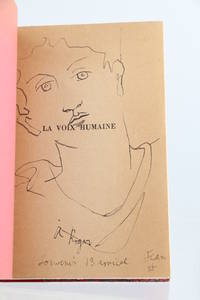
193079537Paris: Gallimard 1930. Fine. Gallimard Paris 1930 12 x 18.50 cm relié First edition one of 110 numbered copies on Rives laid paper. Half red morocco binding smooth spine gilt date at foot boards covered with abstract patterned paper red paper endpapers and pastedowns covers and spine preserved top edge gilt signed binding by P. Goy & C. Vilaine. Autograph inscription signed by Jean Cocteau to a friend named Roger enhanced with a drawing in blue ink representing the face of a young man facing forward. During the first performance in 1930 L'Echo de Paris already prophesied: ""The best actresses in the world will want to interpret La voix humaine."" Indeed on stage and screen followed Berthe Bovy Anna Magnani Simone Signoret Ingrid Bergman Sophia Loren Ornella Muti Tilda Swinton. and the opera singers Denise Duval and Felicity Lott while the greatest directors and composers took up the staging challenges of this atypical work. Among them Roberto Rossellini Francis Poulenc or Pedro Almodovar who owes his finest film to Cocteau's play: Mujeres al borde de un ataque de nervios. A monologue this variation on waiting desire and the pain of a woman suffering a telephone breakup confronts the actress with the deafening silence of the telephone receiver. The tragedy being played offers the spectator only a victim suffering the inaudible attacks of an invisible torturer. The human voice is both that broken down of this woman alternately strong fragile proud and destroyed and that other one absent but which strikes the spectator's imagination through what Cocteau calls: ""the eternity of silences"" Gallimard hardcover
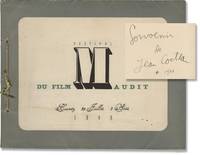
1949170399Paris: Objectif 49 / La Cinémathèque Française 1949. Vintage program for the Festival du film maudit held in Biarritz from July 29 through August 5 1949 by French avant-garde cinema club Objectif 49. SIGNED on the title page by Objectif 49 co-founder Jean Cocteau: "Souvenir de Jean Cocteau / 1949" "A token from Jean Cocteau / 1949". Text and titles in French.<br /> <br /> Objectif 49 was founded in Paris after the close of the Second World War. Although only active for two years the club's influence was significant in no small part due to its lofty goals-the promotion of new avant-garde films the reevaluation of uncommercial and "failed" films the foundation of alternative institutions for educating film audiences and most broadly the creation of entirely new systems for distributing and exhibiting cinema in France. The group staged over 40 one-night events three festivals and counted Robert Bresson Eric Rohmer René Clement Jean Grémillon and many other cinematic and literary luminaries among its ranks.<br /> <br /> Organized by Cocteau and co-founder André Bazin with a name drawn from Mallarmé's "poètes maudits" "cursed poets" the Festival du film maudit was Objectif 49's most important public event intended to be a rival to the Cannes Film Festival. Held at the posh Grand Casino on the coast the festival was notably attended by then-little-known filmmakers Jacques Rivette and François Truffaut who were accompanied in by Cocteau himself having initially failed to make their way past the doorman due to their "bohemian" behavior and attire. Films screened included Kenneth Anger's "Fireworks" Jean Grémillon's "Lumière d'été" Robert Montgomery's "Ride the Pink Horse" Jacques Tati's "Jour de fête" Jean Vigo's "Zéro de conduite" and "L'Atalante" among many others.<br /> <br /> In the wake of the festival's success "film maudit" became a term of praise used by "Cahiers du cinéma" writers in the 1950s and the term was later adopted by the publication's American counterparts. The festival would be re-staged the following year but Cocteau and Bazin were not involved and the event was less well received. <br /> <br /> A memento from a transitional time in the cinema of postwar France in which the foundations were laid for the proliferation of New Wave avant-garde and experimental films and film culture in the years to come.<br /> <br /> 11 x 9 inches. 40 pages. Very Good plus or better in wrappers with a string binding. Objectif 49 / La Cinémathèque Française unknown
1989102554DuMont. New. 1989. Hardcover. 3770123808 . FREE UPGRADE to Courier/Priority Shipping Upon Request - IN STOCK AND IMMEDIATELY AVAILABLE FOR SHIPMENT - Flawless copy brand new pristine never opened -- Text in German. 418 pages; many black and white illustrations also some in color. Catalogue Raisonne Catalog Raisonné Complete Works Leben Und Werk Oeuvre-Katalog Kritischem Oeuvrekatalog Raisonnee DuMont hardcover
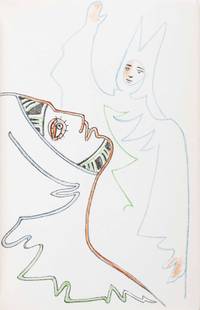
195749082Paris: Grasset 1957. Limited first edition. Hardcover. vg to near fine. Quartos. Vol.1: 535pp. 3. Vol.2: 642pp. 3. Illustrated tan leather boards with lettering and decorative motifs in blue and gilt on the covers and spines. Housed in the publisher's original cardboard slipcase. Illustrated endpapers. #7336 from a limited edition of 8800 numbered copies printed on Vergé de Voiron paper. This is a unique copy inscribed signed and dated by the author in pen accompanied by a striking original drawing in colored pencil by Cocteau all on the half-title page of the first volume. Pages throughout uncut and unopened.<br /> <br /> This fine press 2-volume monograph by the acclaimed French poet playwright writer visual artist and filmmaker Jean Cocteau 1889-1963 collects the entirety of his written plays from 1921-1957. The work is wonderfully illustrated throughout by Cocteau himself including b/w in-text images as well as an impressive series of 40 plates of color lithographs interleaved and printed by the famed Parisian art printer Mourlot Studios. Volume one contains "Les mariés de la tour Eiffel" "Antigone" "Roméo et Juliette" "Orphée" "La voix humaine" "La machine infernale" "Oedipe Roi" "Les chevaliers de la table ronde" and "Les parents terribles". Volume two contains "Les monstres sacrés" "La machine a écrire" "Renaud et Armide" "L'aigle a deux têtes" "Bacchus" "Théatre de poche" and a final section containing "Scenic and Choreographic Arguments" and a bibliography. Both volumes contain a table of contents at the rear.<br /> <br /> Text in French.<br /> <br /> Slipcase with some creasing and light smudges. Bindings with a few minor smudges to the covers and some minor cracking along the front hinge of the first volume. Bindings and interiors of both volumes in overall very good to near fine condition. Bindings and slipcase protected in modern mylar. Grasset hardcover
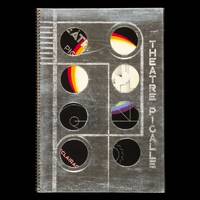
37961Montrouge : Draeger 1929. Quarto 290 x 200 mm metal spiral binding silvered boards the upper board with 8 circular ""windows"" allowing glimpses of the stunning illustrated title leaf a serigraph of a cubist-stye poster for the theatre designed by Jean Carlu which is printed on black with six colours in pochoir; 24 leaves with numerous full-page b/w heliogravure photographic illustrations by Germaine Krull and four-page preface with facsimile of a handwritten text by Jean Cocteau; a virtually pristine example accompanied by the original manila mailing envelope. Rare original edition of the brochure published to coincide with the opening of the Théâtre Pigalle in October 1929. The publication's machine-age aesthetic is in complete harmony with the design concept of this legendary theatre. 'The Théâtre Pigalle was a theatre in Paris located in the rue Pigalle in the ninth arrondissement. Opened on June 20 1929 financed by Philippe de Rothschild on the estate of his father Henri de Rothschild the Rothschilds' ambition was to construct the most modern theatre in the world. The architects Charles Siclis Henri Just and Pierre Blum were sent through Europe to research the latest technical developments in theatre design. Graphic artist Jean Carlu designed two well-known posters emphasizing its machine-age image. André Antoine was hired as art director and Gabriel Astruc as manager. Antoine was replaced after two years with Gaston Baty following a disagreement with Rothschild. The 1500-seat venue opened with Sacha Guitry's piece Histories of France. The great German impresario Max Reinhardt staged a production of Die Fleidermaus here in November 1933. Through the 1930s and the war directors and performers here included Louis Jouvet the 1931 premiere of Judith written by Jean Giraudoux the brothers Émile Isola and Vincent Isola Raymond Rouleau and many others. Although the venue had been ""furnished with four elevators an immense switchboard and a vast amount of complicated theatrical machinery"" Jouvet for one found it challenging to make it work theatrically. After the failure of Claude Vermorel's Thermidor in 1948 the theatre closed its doors. The site was sold in 1958 and an automobile garage built on the site.' Wiki. hardcover