[Euclid]. - Proclus Diadochus.MareMagnum

7 770 résultats
Folio (215 x 300 mm). (16), 272, (24) pp. With woodcut device on t. p. (Minerva and Mercury holding the wing tips of a rising phoenix), woodcut portrait on reverse, and printer's device on final leaf, as well as numerous mathematical diagrams in the text. Contemporary Italian limp vellum with ms. spine title. First Latin edition of one of the major works by Proclus Lycaeus (412-485), founder and head of the neo-Platonic school of Athens: a commentary on the first book of Euclid's "Elements of Geometry", the "oldest mathematical textbook in the world still in common use today" (PMM). Includes the text of the theorems, set within ornamental woodcut framings, and the geometrical diagrams. The editor and translator Francesco Barozzi (1537-1604) taught at the University of Padua. He was later charged with sorcery (in particular, he was said to have caused a torrential rainstorm over his native Crete) and condemned by the Inquisition in 1587. "Barocius' edition of Proclus' commentary on the first book of Euclid's 'Elements' was the first important translation of this work, for it was based on better manuscripts than previous efforts had been. The translation, published in 1560, was completed by Barocius at the age of twenty-two" (DSB). His portrait on the reverse of the title page is cut within a magnificent border. - Old ms. ownership on flyleaf obliterated (probably in the early 19th century); old ownership stamp over title woodcut erased, replaced by a different coat of arms in ink, very likely that of the Italian comital family Antico (insignificant bleeding to reverse). Occasional slight waterstaining, still an exceptionally appealing, clean copy. Edit 16, CNCE 33726. Adams P 2138. BM-STC Italian 540. Mortimer 403. Honeyman 2543. DSB I, 468. Brunet IV, 895. Riccardi I/1, 82, 1 ("Bella e rara edizione"). Cf. PMM 25.
4to. 22 ff. (a7, b8, c7: wants first and last blanks). 32 lines, Gothic type. Rubricated throughout, 3 four-line lombardic initials, red penwork decoration at beginning of text. Later cream-coloured calf in contemporary style, with blind rules and stamped cover title "Tractatus De Turcis". Third edition of this polemical treatise against the Ottomans. Mainly contains prophecies referring to the Turks (by Merlin, Cyrillus, Joachim of Fiore, St. Hildegarde, Catherine of Siena, Methodius, etc.). Also one of the earliest texts to mention Hungary, and one of the very few works printed by Zeninger: "Conrad Zeninger (from Mainz) produced a mere 10-odd books between 1480 and 1482" (cf. Halle 70). The prophecy referring to the King of Hungary (fol. a[5]r) is reprinted by Fraknói Vilmos, "Schlauch Lörincz szatmári püspöknek Török János által gyüjtött könyvtára", in: Magyar Könyvszemle 2 (1877), p. 77-90, at: 77f. (cf. Apponyi). The date is based on the mention of the death of Mehmet II on fol. A[4]v. - Some browning, with slight waterstain throughout in lower margin; first and final leaf washed. Slight paper flaw in fol. 1 (not touching text); final leaf restored. Faint traces of a later ms. page count are visible near the lower edge. Occasional 16th-century marginalia. A fine copy of this rare work, rubricated throughout. HC 15681. Goff T-503. GW M48133. BMC II, 460. BSB-Ink T-437. Oates 1077. Proctor 2229. Walsh I, 794. Pellechet 11154. Halle 70 (Newe Zeitungen), 11. Apponyi 10. Hohenemser 2169. Geldner I, 173.
4to (140 x 196 mm). (4), 52 ff. Modern half vellum over marbled boards. First edition, containing "the earliest of Bacon's authentic works to be printed" (DSB). Often referred to as one of Bacon's most important writings, it occupies leaves 37 to 52 of the volume. "A very rare book which [...] contains the editio princeps of Roger Bacon's 'De mirabili potestate artis et naturae' which is identical with his 'Epistola de secretis [...]'. This book, which has often been reprinted and translated, is, according to Hoefer, one of the most remarkable and at the same time one of the most authentic works by Roger Bacon. It contains almost prophetic gleams of the future course of science, dealing with automobiles, flying machines, diving-bells, telescopes, burning-mirrors, a sort of gun-powder, etc. As all the books edited by Oronce Finé it is beautifully printed and adorned with fine criblé initials" (Duveen). Bacon's enumeration of these "wonderful machines for flying, lifting weights, and driving carriages, ships, and submarines. and so on, which he believed had been made in antiquity and could be made again" (DSB I, 380), appears on leaf 42, while the oft-quoted allusion to the composition of power of gun-powder is on leaf 52r. Indeed, the ascription of the invention of gun-powder to Bacon is very doubtful, to say the least (cf. Sarton II, p. 958). - Edited by Oronce Finé, who prefixed Bacon's treatise with another by Claudius Coelestinus (ca. 1400), discussing miracles, secrets, the influence of planets and comets etc. Coelestinus may have been, like Bacon, a Franciscan friar: he is referred to by Finé in his preface as "Frater", and is so described in the heading to the work. - Light brownstaining throughout; several near-contemporary annotations and underlinings. Extremely rare: only three copies in postwar auction records (one offered by Lathrop Harper in 1976 for $3,500; two more sold at Sotheby's in 1989 and 2004, each commanding in excess of £5,000). Adams C 2307. BM-STC French 118. Renouard (Colines) 355. Duveen 36f. Rosenthal 190. Caillet 2416. Graesse, Bibl. mag. et pneum., p. 49. Thorndike II, ch. 61. DSB I, 384. Ferguson I, 64 (note). Hoefer I, 395. Sarton II, 963. Brüning I, 223. Wellcome 1178. Durling 979. Waller 12126. Hodgson, Hist. of Aeronautics, 68 f. Liebmann/Wahl, no. 927.
4to. 62 ff. 30-33 lines and heading line (Roman type 17:145G, 22:89G); several woodcut Greek interspersions (K6v & I3r). With full-page woodcut on reverse of title page, additional full-page woodcut on f. Jiv, and 17 half-page woodcuts in the text (with some repeats). Mid-18th-century boards using an 18th-century antiphonary. First edition of the author's first important work, an exhortation to fight the Turks, couched as a Latin tragedy. Jakob Locher (1471-1528) had been created poet laureate but months before. The volume is concluded by a "Dyalogus" against all forms of heresy (and including encomia and dedicatory addresses to the Emperor and the nobles of court and clergy). - Contains fine woodcuts, some of which were used previously in the Strasbourg editions of Terence and the Ship of Fools; at least six blocks were cut originally for this book. "The opening woodcut depicts the author and newly crowned poet laureate" (cf. von Arnim). This is the earlier impression without the armorial woodcut on fol. B6r (as in Schramm); the final line of fol. J3r still reads "tekos" (for "telos"). Typographical errors "Jacboi" on fol. L2r; "Daum" (for "Datum") in final line of fol. L3r; colophone reads "anno christo". A pinhead-sized wormhole throughout the blank margin (not touching text). Top edge trimmed rather closely in places; a few underlinings by a contemporary hand. Altogether a fine, very clean copy. Extremely rare; last seen in the trade more than a decade ago (Shipperdson-Field-Nakles copy, Christie's New York, 17 April 2000, lot 22: $15,275). HC 10153*. Goff L-264. GW M18631. BMC I, 112. BSB-Ink L-206. Schreiber 4513. Grüninger 32. Schramm XX, 23. Slg. Schäfer 212. Goedeke I, 427, 9.
Folio. 8 vols. With 8 woodcut title vignettes and 8 woodcuts in the text. Contemp. blindstamped pigskin bindings over wooden boards, some monogrammed and dated, some with preserved clasps. Second Jena edition of the collected works (in various impressions for various publishers), edited by Amsdorf, Aurifaber, Rörer, Soltz and others. Each volume begins with a brief introduction and an index (a complete index was separately published by Timotheus Kirchner in 1564). Includes: vol. 1 (Richtzenhayn/Rebart 1564), vol. 2 (ibid. 1563); vol. 3 (Richtzenhayn 1573), vol. 4 (ibid. 1560), vol. 5 (Rödinger's heirs 1557), vol. 6 (Richtzenhayn/Rebart 1568), vol. 7 (Rödinger's heirs 1558), vol. 8 (Rebart's heirs 1580). For the woodcuts monogrammed "PG" in vols. I-VII cf. Nagler (Monogrammisten) IV, 2967, 14. Vol. VIII shows the three Saxon Princes with their coats of arms and a 12-line verse encomium, "Des Luthers Bücher gros und klein". The pretty blindstamped bindings show roll-tools and platestamps, various dates and monogrammes. This set was assembled by the Saxon theologian Dr. Carl Friedrich Bonitz (1775-1835), preacher of the afternoon mass at the Leipzig University Church in 1800, then active in Langensalza from 1802 onwards (and superintendent in 1809). His autograph ownership is on the flyleaf of each volume (dated 1807 in the first). Among Bonitz's works are studies in the Pauline epistles and a "Geschichte der Lutherischen Religions- und Kirchenverbesserung" (1805). - Some browning throughout; occasional slight waterstaining; bindings rubbed. Altogether a well-preserved made-up set from the library of a Saxon protestant theologian of the early 19th century. VD 16, ZV 24 1682, L 3355, L 3381, L 3349, L 3330, L 3367 or ZV 21399, L 3336 and L 3389. Aland 572ff. Goedeke II, 151. Cf. BM-STC German 534 (another made-up set).
Folio. 10 unnumbered ff. Title printed in red and black with full-page woodcut of the instrument in question (repeated on f. 2v) and numerous woodcut diagrams. Modern half morocco over red boards. First edition of one of the rarest works by the Austrian astronomer and instrument maker. The "Quadratum geometricum", a new geodetic measuring instrument, was invented by Peurbach himself, and its use is here described for the first time. - From the library of Werner Habel, with his ownership stamp, signature and acquisition date (1977) to front pastedown. Previously in the collections of Count Wladyslaw Hrabia Bielinski and Zygmunt Czarnecki, with their stamps to title. Rare, only a single copy recorded at auction within the last 60 years. VD 16, P 2054. Adams P 2270. BNHCat P 943.
4to (165 x 211 mm). 280 ff. With title woodcut and 112 large woodcuts by Albrecht Dürer, the Master of Heintz-Narr and others. - (Bound with) II: (Lilienstayn, Jacob). Tractatus contra Waldenses fratres erroneos quos vulgos vocat Pickardos fratres sine regula: sine lege: & sine obedie[n]tia [...] Quo[rum] multi sunt in moravia plus[quam] in bohemia. [Nuremberg, Johann Weißenburger, 1505]. 36 (instead of 40) ff. 18th century calf over wooden boards with two clasps. First edition to contain Dürer's illustrations from Sebastian Brant's "Ship of Fools", with the woodcuts from the 1494 edition as well as several taken from the Latin edition. Geiler von Kaisersberg seized upon the human vices denounced in the "Ship of Fools" and treats them from the viewpoint of Christian philosophy. "Disregarding the Lübeck Bible, this is the most important woodcut cycle published before the Apocalypse [...] The first fully rounded moral genre pictures in history" (cf. Winkler, Dürer und die Illustrationen zum Narrenschiff [Berlin 1951]). The exact extent of Dürer's contribution to the 'Narrenschiff' woodcuts was long a subject of controversy; since Winkler's work, he is generally regarded as the book's principal artist (cf. Murray, p. 165; see also Strauss, Albrecht Dürer, Woodcuts and Wood Blocks [New York 1980], p. 64-81, who attributes several of the woodcuts to the young Dürer). - II: Bound in the same volume is a very rare polemical work against the Bohemian Brethren. The Viennese scholar Adauctus Voigt called this "one of the most remarkable of books [...] The author, a Dominican and professor of theology, spent nearly three years among the Brethren, probably in disguise, so as to investigate their true religious constitution and customs" (Abhandlungen einer Privatgesellschaft in Böhmen, ed. by Ignaz v. Born, vol. 6 [Prague 1784], p. 344). - Binding somewhat rubbed; spine repaired. Title-page of "Navicula" has old handwritten ownerships (some deleted); numerous old annotations and manicules in the text (mostly slightly trimmed during re-binding in the 18th centruy). The missing leaves 37-40 at the end of the second work are supplied in photocopy. Two leaves of "Registrum Capitulorum" and 1 blank, from another book, are bound between the two works. Altogether a good copy, very slightly browned and stained. I. VD 16, G 778; Adams G 316; Dacheux 50; Kristeller 623; Meder S. 274; Muller 21, 89; Panzer VI, S. 54, 232; Proctor/Isaac 9995; Ritter 959; Schmidt 48; STC 335. - II. Adams L 672 (erroneously dated "c. 1535"). Panzer IX, 108, 12. Proctor/Isaac 11043. BM-STC German 501.
4to. 32 pp. With printer's woodcut device on the title-page and different device under the colophon; several woodcut initials. Followed by a 49-page manuscript index (beginning with instructions to the "amice lector" on the verso of the colophon) on 28 blank leaves bound after the printed text. 19th century boards with red morocco spine lettered and decorated in gilt. The first edition of the 16th century: a very rare reprint of the incunable published in 1494, the first separate edition to be based on the criticism of the Renaissance scholar Ermolao Barbaro. Dedicated to Pope Alexander VI. Mela's description of the ancient world, based on good sources and written during the reign of Emperor Claudius, is the oldest Roman geography to have survived. This edition was not equipped with an index, but a contemporary humanistic owner rectified the fault by crafting his own: the humanistic "cancelaresca" manuscript provides a list of all cities, places and even subjects mentioned, a total of some 1,000 references to 227 paragraph numbers (which the owner, too, provided in brown ink throughout the inner margins of the book). - Occasional slight foxing and waterstaining to margins near end, but a fine copy of this rare book. Edit 16, CNCE 58712. Schweiger II.2, 606. Ebert 13608. Graesse V, 401: "Reimpr. rare de l'edition ... de 1494". Not in Adams, BM-STC Italian, or Riccardi. Not in Brunet or Dibdin.
Folio (204 x 325 mm). 161 (instead of 220) hand-numbered woodcut plates in early 18th-century colour, mounted on backing paper and missing parts supplemented by hand. Later half calf with 18th-c. spine label. All edges sprinkled in red. First edition of Jost Amman's encyclopedic book of costumes. A strongly fragmented copy, as usual; in the early 19th century, the plates were mounted on backing paper by the owner, the trained landscape painter Jakob Linckh (1786-1841) from Stuttgart (cf. Thieme/B. 23, 254), who also coloured the volume throughout and supplemented all missing parts of the images and even of the text by hand. Linckh, who had studied in Rome, visited Greece in 1810. There he met Byron, who commissioned him to provide the illustrations for Hobhouse's travel book. - Wants 59 plates altogether; the remainder are trimmed closely at the upper edge, and most have severe defects in the lower half. Although the present collection begins with the plate showing the Emperor, as originally issued, the remaining woodcuts follow no apparent order. 20 plates show costumes of Turkey, Arabia, Persia, Egypt, and Ethiopia; others depict Greeks, Russians, and Englishmen. 28 plates show the costumes of today's Italy; German cities are well represented, as are France and Spain, Bohemia and Hungary. Also includes the famous picture of the Brazilian Tupinamba Indians: a man with a crown and belt of feathers, a knife, and a bow and arrow, beside a long-haired woman carrying a baby in a knotted sling. The illustration is an adaptation of two cuts from the "Recueil de la diversité des habits" (Paris, 1562; Antwerp, 1572) by Francois Descerpz, "one of the first likenesses of the Brazilian Indian" (Borba de Moraes). - Title page shows Jakob Linckh's autograph ownership (dated 1825); somewhat later stamped ownership of Anton Franzin (possibly the like-named Tyrolean law clerk, c. 1840) to flyleaf. VD 16, W 1487 (BSB copy incomplete). Lipperheide 7-8 (both copies incomplete). Andresen I, 234. Becker 140. Borba de Moraes II, 373f. Maggs, Bibl. Americana 1-214 ("This book is excessively rare in a complete state").
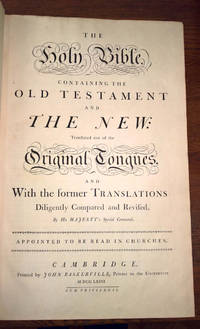
1763WRCLIT82010Cambridge: Printed by John Baskerville Printer to the University 1763. 573 leaves. Royal folio. Full contemporary blue-black morocco faded to emerald spine gilt extra narrow gilt borders on boards marbled endsheets a.e.g. Fore-corners bumped joints a bit worn but not cracked lower fore- corners of several leaves exhibit an old ink stain with old mends to two corners but otherwise an attractive copy. The Baskerville Bible one of the highpoints of the imprint and indeed of all English Bible-making was printed in an edition of 1250 copies priced at four guineas. This copy of what Dibdin declared "one of the most beautifully printed books in the world" has the subscribers list in the third state concluding with the entry for Charles York. Such an ambitious undertaking stretched Baskerville's finances to their limits and of necessity in 1768 he remaindered 556 copies to the London bookseller R. Baldwin at 36s each. As late as 1771 Baldwin was advertising copies in sheets in the BIRMINGHAM GAZETTE priced at 3 guineas. "The design is traditional but the quality of material and workmanship is so high and the conventions are so delicately modified and consistently applied that the result is extremely impressive" - CAMBRIDGE HISTORY OF THE BIBLE p.464. This is a very interesting association copy having been the family Bible in the 18th and 19th centuries of the S.L. Galton family and descendants with extensive records in manuscript on two preliminary blanks recording such events as the marriage of Frances Ann Violetta Darwin daughter of Erasmus Darwin and aunt of Charles Darwin to Samuel Tertius Galton and the birth in 1822 of Francis Galton -- the originator of the 'school' of Eugenics explorer meteorologist psychologist and a central figure in the development of the use of fingerprints as a means of identification. There are two bookplates of the Galton family on the front pastedown and another. GASKELL 26. DARLOW & MOULE 857. RUMBALL & PETRIE 145. Printed by John Baskerville, Printer to the University hardcover books
4to. (32) pp. With woodcut illustration to title-page. 18th century half calf over cardboard. Marbled endpapers. The first of the two undated editions of the "Mirror of the Art of Dying Well" by the Italian theologian, canonist, statesman, and cardinal Domenico Capranica (1400-58), published by Quentell in the 1490s. Pellechet cites one edition dated around 1496, and another dated around 1498. Although slightly differing in text, both editions bear an "Accipies" woodcut, showing a teacher inspired by the Holy Ghost (in the form of a dove on his shoulder) lecturing two disciples, which was used by Quentell between 1490 and 1500. A 17th or 18th century Latin note in ink below the woodcut mentions its recurring appearance in Quentell publications: "N. Haec figura sequenti etiam operi, ab Henrico Quentell Coloniae impresso, praefixa est". - A popular genre of devotional literature of the Middle Ages, "ars moriendi" works were widely distributed both in manuscript and printed form. Capranica created his "Speculum" in 1452; it saw a German translation in 1473. - Binding somewhat rubbed. Paper evenly browned throughout. A few contemporary marginal notes and underlinings. Bookplates of the numismatist and bibliophile Jean-Baptiste Colbert de Beaulieu (1905-95) and of Jean Stefgen to front and back flyleaf. Another ownership, dated 20 July 1874, in pencil to front flyleaf. Several bibliographical notes in pencil to flyleaves. Hain 14912. Goff A-1097. GW 2608. BMC I, 282. Proctor 1415. Pellechet 1338. Polain 971. Voullieme 304. Graesse VI, I, 460. Schreiber-Heitz, Die deutschen "Accipies" und Magister cum discipulis-Holzschnitte als Hilfsmittel zur Inkunabel-Bestimmung, 18.
8vo (105 x 159 mm). (3), 69 (but: 68), (1) ff. With two different woodcut devices to title-page and colophon; several pretty woodcut initials. Contemporary Italian carta rustica binding. Rare first Italian edition of these Fables of Bidpai. Reprinted in 1610 and again in 1872. First translated from the Pehlevi version into Arabic under the title "Kalilah wa-dimnah" by Ibn al-Muqaffa and subsequently into Greek by Simeon Seth, whose version is known under the title of "Stephanites kai Ichnelates". From this version the present Italian one is derived. - The ancient Sanskrit Panchatantra fables, a classic of the genre, are thought to have been assembled ca. 200 BC out of stories from an even older oral tradition. The stories became known in Europe through Hebrew translations of Arabic versions under the name Bidpai. Featuring animals as a mirror for human behaviour, the fables were intended to educate people, especially young rulers. - Binding a little stained. Interior shows occasional browning and very minor staining; old ink annotations to pastedown and flyleaf. An appealing copy. Chauvin II, p. 24, no. 38A. BM-STC Italian 309. Edit 16, CNCE 35122. OCLC 22606298. Not in Adams.
Folio (230:340 mm). (18) pp., 1 bl. f., 551 (but: 549), (4), 552-651, (41) pp. Attractively blindstamped contemp. pigskin binding over bevelled wooden boards. 2 brass clasps. Second issue by Herwagen (printed by him previously in 1550), first published at Ortona in 1518. The author "defends Catholicism against Judaism and also stands up for Reuchlin as regards the assaults of his contemporaries" (cf. Fürst). With many Hebrew passages and quotations. At the end: Reuchlin's "De arte cabbalistica" (not included in the first edition). This famous work on cabbalistic art is written in the form of a discussion between three men: the Jew Simon, the Muslim Marranus, and the Pythagorean Philolaus, who come together for talks at Frankfurt/Main, the residence of the Jew. - Altogether well-preserved. Very rare. VD 16, C 4616. Adams C 2420. Benzing 102. Goed. I, 416, 20. Fürst I, 314.
THE ONLY COPY PRINTED ON VELLUM OF THIS IMPORTANT AND BEAUTIFUL PUBLICATION. Two volumes, complete. FIRST AND ONLY COMPLETE EDITION, and first and only critical edition of the works of Pierre de Brach, an important 16th-century poet from Bordeaux, a close friend of Montaigne and many other key French Renaissance literary figures. ABOUT HALF THE WORKS ARE PUBLISHED HERE FOR THE FIRST TIME: Dezeimeris had discovered an important manuscript which included many texts thought lost forever, including the "Tombeau et regrets funebres sur la mort d'Aymee" and the second book of the "Amours". Extensive scholarly apparatus, notes, and index. Edition limited to 260 copies, of which this is THE UNIQUE COPY beautifully printed (by Gounouilhou of Bordeaux) on FINE VELLUM, with numerous woodcut ornaments, headpieces, and tailpieces. Title-pages printed in red and black, with large woodcut printer's device. Text in Italic type, notes in Roman type. Two engraved portraits on chine applique and two wood-engraved plates. 4to. Attractively bound in contemporary half red morocco. Top edge gilt, other edges uncut. Minimal traces of wear to bindings, else a fine set. Vicaire I, 919 (citing this copy); Brunet supp. I, 167 (citing this copy): "Belle publication." Viollet le Duc (I, 333): "C'etait un ecrivain correct, un versificateur elegant et harmonieux, bien superieur sous ce rapport a tous les poetes ses contemporains. On peut lui reprocher de manquer de la verve et de l'entrainement de Ronsard, par exemple; mais comme forme de langage, c'est un auteur des plus remarquables et assurement digne d'Ítre etudiÈ." 19th century French books printed on vellum are rare, and in such a large format they are extremely rare.
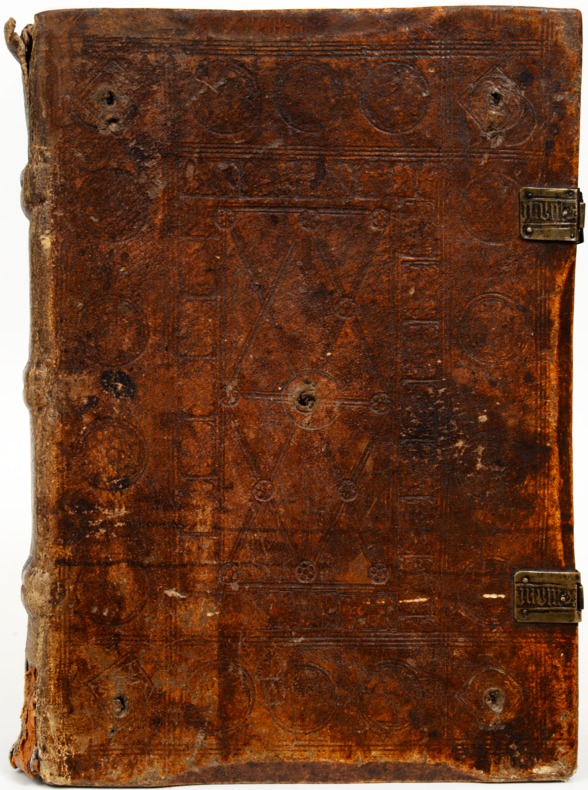
328 Bll. Blindgepr. Lederband der Zeit über Holzdeckeln auf 5 Doppelbünden. Reste von Messingschließen. Folio (300:411 mm). Dritter Druck von Gregors erstem und umfangreichstem Werk. Gregors historische, vor allem aber allegorisch-moralische Auslegung des Buches Hiob "wurde vom 7. Jh. an eifriger gelesen als andere Schriften der Kirchenväter" (KLL). Seine Homilien zum Buch Hiob bestehen in "Ansprachen, die er für Mönche [...] gehalten hatte. Er gab damit ein Beispiel monastischer Bibelauslegung; sie war gekennzeichnet durch den Verzicht auf spekulative und philologische Fragen; sie zielte direkt ab auf das geistliche und moralische Leben der Mönche [...] Dieses Buch gehörte zur Regellektüre mittelalterlicher Leser" (Kurt Flasch, Das philosophische Denken im MA [Stgt. 2013], S. 165). Gerardy (S. 22) datiert den Druck nach dem Wasserzeichen "um 1476". - Ohne das weiße Schlussblatt, sonst komplett und breitrandig mit Témoins. Vor allem zu Beginn und gegen Ende merklich wasserrandig, stellenweise in den Schriftspiegel hineinreichend, mit vereinzelten Ausbesserungen. Der massive Einband ohne das zehnteilige Beschläge, fachmännisch restauriert. Von den beiden Schließen sind nur die oberen Haften und der an einem Leinwandband angebrachte Haken des unteren Schließbands erhalten. Spiegel erneuert; am vorderen Innendeckel das alte hs. Rückenschildchen. HC 7927. Goff G-429. GW 11431. BMC I, 246. Proctor 1177. BSB-Ink G 317; Pell. 5377. Polain 1714. Voull., Bln. 868,3 & Köln 508. Nicht im IGI oder bei Oates. Zur Datierung: Theo Gerardy, "Gallizianimarke, Krone und Turm als Wasserzeichen in großformatigen Frühdrucken", in: Gutenberg-Jb. 1971 S. 11-23.
16006Ulm, Johann Zainer, [1478 ca]. Petit in-folio gothique (20 x 29 cm) de (418) ff. à 40 lignes par page, sans foliotation, réclames ni signatures dont 2 feuillets blancs (1er et 371e), peau de truie sur ais de bois biseautés, dos à trois nerfs, décor géométrique estampé à froid dans un encadrement de médaillons, titre manuscrit en noir sur le dos, fermoirs, traces de cabochons (reliure de l'époque).
4to ; 1st edition thus. 18th Century Full Leather, 4to, 4 parts in 1 volume: [148] + [112] + [119] + [128] leaves, with four sectional woodcut title pages within elaborately decorated architectural framework, their first appearance. Steinschneider, M. Cat. librorum hebraeorum, 47, 277; Cowley, 83; VD 16; ZV 17573. The Pentateuch with the Early and Later Prophets and Hagiographa. Pointed Hebrew with cantillation. Title and further information on colophon. Some opening words have woodcut decorated frames. The title page designs were so impressive that they were used again in later editions such as the Frankfurt am Oder Hebrew Bible of 1595. With extensive scholarly notations in Latin in a 17th Century hand to margins and blank rectos of well over 400 pages. Signatures in Arabic and Roman numerals: Pts. 1-2. 1-654 (334 blank, 654 verso blank) -- pt. 3. 1-304 (303 verso blank, 304 blank) -- pt. 4. 1-324 (11 verso blank, 324 verso blank). Haftarot and Pesukim are recorded in the margins. Place of printing from colophon, which is on verso of last leaf: "Nidpas be-mitsvat Yohanan u-Khonrad Ruihl ha-ahim." SUBJECT(S): Bible. Hebrew -- Versions. Haftarot. OCLC: 123017672. OCLC-Worldcat lists copies worldwide (HUC, Yale, Cambridge, Edinburgh Univ, Oxford, British Lib, NLI, Bar Ilan), with only two in the US. Eight leaves missing (91-104). In the final volume, Ketuvim, four leaves show a touch of outer margin loss, with an additional seven leaves showing substantial margin loss but touching only a letter or two of text. Thirteen leaves show enough margin loss that text is affected though never more than the outer portion of the top six lines of any leaf. Three leaves with margin notes are affected. Margin notes predate the 18th century binding and in many cases appear to have suffered some loss with trimming and rebinding in the 18th Century. 16th Century rag paper and internal binding remain very nice. Beautiful 18th Century British binding with leather spine label and armorial bookplate on front pastedown remain outstanding. Very Good Condition thus. No copies appearing at auction in the last 25 years. Rare and important, with significant period marginalia. (KH-10-7)
Folio. (36), 172, (10), 173-213, (1 blank) ff. Only preserving the front board in contemporary sheepskin parchment. First edition to be edited by Durastante, with commentary by Nicolai Mutoni, of three important late 15th-century treatises on pharmacology and medical botany. The first work, Luminare maius by Giovanni Giacomo Manlio di Bosco (fl. 1490-post 1500), is a commentary on ancient Arabic and Greek pharmacological works, especially the Arabic treatises of Yuhanna Ibn Masawayh known in the West as Mesue the elder (ca. 777-857). It gives instructions for preparing numerous medicines, indicating the quantities of the ingredients and describing each ingredient. The second work, Lumen apothecariorum by Quirico de Augustis de Tortona of Milan (fl. 1486-97), complements it with descriptions of hundreds of medicinal preparations, including many oils and syrups. The third work, Thesaurus aromatariorum by Paulus de Suardis (fl. 1479-81), gives recipes for about 500 aromatic medicines, oils, syrups, etc. The three together formed what was probably the most extensive pharmacological encyclopaedia of its day. - Title-page slightly browned, with some wormholing, a few leaves with some minor water stains, the last quire nearly detached and only preserving the front board, but most of the text still good. Durling 2943. ICCU 005328. USTC 840129.
4to. (8), 124, (2 blank); (8), 196 pp. With title-page printed in red and black in an illustrated woodcut border (showing equipment for distilling, forging and other trades plus in a cartouche at the foot Navò's rampant lion device with motto "invidia fortitudine superatur", in this case trampling a beheaded dragon, and in a cartouche at the head a scene with an allegorical female figure representing Venice), a woodcut headpiece, 4 woodcut initials with pictorial decoration (3 series), decorations built up from arabesque typographic ornaments, and a small acorn (all woodcut materials except 1 initial appear in the 1591 prelims).With: (2) PARMA, Ippolito. Introductionis ad chirurgiam libri duo. Padova, Pietro Paolo Tozzi (printed by Lorenzo Pasquato), 1612. With Tozzi's(?) woodcut Minerva device in a scrollwork cartouche on the title-page, numerous woodcut headpieces, tailpieces and other decorations, 6 woodcut decorated initials (4 series) and arabesque typographic ornaments. 2 works in 1 volume. Half calf (French, ca. 1750), sewn on 3 cords, gold-tooled spine with a tanned sheepskin (?) label (with both titles) in the 2nd of 4 compartments, plain paper sides, green headbands. First edition, second issue, first published in 1584, of a dialogue set in Aleppo on the use of barley infusions (often together with other medicines) for the treatment of various illnesses and ailments, written by the personal physician of the Venetian counsul to Syria and later professor of practical medicine at the University of Padova and published during his brief return to Italy between two long stays in Aleppo. The dialogue is set at the bedside of a Venetian merchant in Aleppo who is suffering from pleurisy. Philodicus and Phioliatrus debate the proper treatment, particularly whether to administer a barley infusion before or after purging. Minadoi proposes that they continue the discussion at his house, where they can consult his extensive library. Philodicus follows the humanist Giovanni Manardo while the more conservative Philiatrus and Minadoi follow Galen. They support their arguments by citing numerous Greek, Latin and Arabic sources, including Hippocrates and Ibn Zuhr (1094-1162), known in Europe as Avenzoar. The woodcut border around the title-page of the Minadoi was originally cut for the first edition of Biringuccio's Pirotechnia, Venice, Venturino Roffinello for Curzio Troiano Navò, 1540. It shows a dozen or so images of equipment for distilling, forging, pyrotechnics and related trades, and incorporates Navò's rampant lion device. In the years 1591-97, Navò's heirs published without using their name, but with the present imprint "ad signum Leonis" or a variant. - Minadoi (1549?-1615), born and raised in Ferrara and Rovigo, took his degree in medicine at Padova in 1576 and went to Aleppo in 1578 as personal physician to the Venetian consul to Syria. He spent much of the next eight years there, also visiting Constantinople and Jerusalem. His experience practicing medicine in the Middle East and his contacts with the Islamic world there certainly contributed to his skill as a physician. Minadoi returned to Italy in 1586 and became city physician in Udine in 1589 but resigned in 1595. From 1596 to his death he served as professor of practical medicine at the University of Padua, though from 1612 he also spent much time at the Medici court in Florence, where he died. His scholarship was conservative, based on Galen, Hippocrates and Celsus and opposing the ideas of Paracelsus and the alchemists, but his practical experience and skill brought him great success. - Francesco Osanna, published the first edition of the present work at Mantova in 1584, dedicating it to Guglielmo Gonzaga, Duke of Mantova, who appointed him Ducal printer in 1585. Domenico and Giovanni Battista Guerra published a second edition at Venice in 1587 and the present is often described as the third and last edition. In fact, however, it is a reissue of the first edition with only the preliminary quire newly set and printed (the new preliminaries repeat the text of the dedication, even though the Duke had died in 1587). Osanna's 1584 Mantova colophon on Q3v was no longer relevant in Navò's 1591 Venice reissue, no doubt the reason that Q3 was carefully cancelled (the blank Q4 was also removed but was pasted to the stub of Q3, as one can see by the two halves of the watermark in Q1 and Q4). But the list of errata on Q3r was still relevant, and the publisher appears to have cancelled Q3 in some copies but not others (both Q3 and Q4 are cancelled in at least 2 of the 6 copies listed in ICCU). - It is bound with the first and only edition of the last and most important publication by the Padova surgeon Ippolite Parma, a practical course on surgery with a general introduction followed by treatises on tumors, surgery, broken bones, dislocations and a more general treatise on the subjects. Although Parma had published Praxis chirurgica in 1608, the present book is an entirely new work. - The endpapers show a watermark that includes the year "1749", which accords with the style of the (French) binding. With two engraved bookplates on the front paste-down, that of the Paris surgeon Sauveur François Morand (1697-1773) with medical attributes in the decoration and that of Hyacinthe Théodore Baron (1707-87), professor of medicine at the Hôtel-Dieu in Paris from 1750 to 1753 and in charge of the army medical corp, with his coat of arms (sold with his library: Catalogue de la bibliothèque de feu M. Baron, with a biography, Paris, 1788, lot 3959); circular stamp on the title-page (repeated on N3) of the Archepiscopal Gymnasium in Lille, apparently an ancestor of the 1875 Catholic University, with an open book encircled by "ARCHIGYMNASII INSULENSIS CATHOL" (the open book now forms one quarter of the University arms); and a donation inscription, dated 1881, from Alfred Dujardin to François Guermonprez (1849-1932), both medical doctors in Lille. With the last printed leaf (with the errata and 1584 colophon with the device of Osanna in Mantua) cancelled as noted, and with the final blank attached to its stub. With some minor browning (especially in quires I, K and M-Q of the Minadoi, which are printed on a different paper stock than any other quires), and occasional minor foxing or spotting. In the first quire of the Minadoi, the title-page has been re-attached and there are some small stains and restorations. There is a hole in the first page of the Parma's dedication. In spite of these minor defects, most leaves of both works are in good condition. The binding is shabby, with the front hinge cracked and two of the supports broken at that hinge, the head of the spine chipped (but the chip is loosely inserted), the sides rubbed and dirty, and some of the sewing has come loose, but most of the tooling on the spine is still clear. Two first editions on practical medicine (1584/91) and surgery (1612), with extensive provenance information. (1): Durling 3171. Edit 16 31581. ICCU UM1E020598. Antoine Pietrobelli, "Polémiques sur la ptisane d'Hippocrate à Minadoi", in: Medicina nei secoli, 29 (2017), pp. 1077-1118, at pp. 1104-1106; USTC 842793. Cf. Adams M1458 (1587 ed.). BMC STC Italian, p. 439 (1587 ed.). Not in Garrison & Morton; Honeyman; Norman Lib.; Wellcome. For Minadoi: www.treccani.it (Dizionario biografico degli Italiani). - (2): BM-STC Italian (17th c.), p. 659. ICCU MILE004177. USTC 4023497. Not in Garrison/Morton; Honeyman; Krivatsy; Norman Lib.; Wellcome.
Small folio, index large 4to (29 x 20 cm). (4), 471, (1 blank), 15, (1 blank), 24, [12 (of 16)] pp. Title-page with an elaborately decorated woodcut architectural frame, about 307 (of about 317) woodcut botanical illustrations and a few woodcut decorated initials (4 series). Set in roman types with extensive italic, and textura, fraktur and Greek for the Dutch, German and Greek plant names. Contemporary or near contemporary limp sheepskin parchment, sewn on 3 double cords, with "PENA|ET|LOBEL" in manuscript capitals at the head of the spine. Enlarged Plantin issue of the first edition of an important Latin herbal with more than 300 excellent woodcut illustrations showing the plants in remarkable detail, usually including the roots. Its classification system, based on characteristics of the leaves, was better than any used previously. Thomas Purfoot first issued this edition at London in 1571 (title-page 1570), but Plantin bought a large part of the press run and reissued the book with extensive and important additions. He replaced the preliminaries, but also added a 15-page appendix (pp. 456-471) with 35 new woodcuts, the 15-page "Formulae aliquot" and 36 pages of indices. Two additional leaves ([3], [1 blank] pp.) printed with the indices (5*3-4) formed an additional appendix with 10 additional woodcuts, but have been removed from the present copy. Its last page also included Plantin's colophon, dated 26 July 1576. The main text (in both the London and the Plantin issues) is divided into two parts. The title on the title-page applies to the first part (pp. 1-410; A-2M1), while the second part devoted to trees has its own drop-title (also in the running heads): "Fruticum, subfruticum, cremiorum & arborum adversaria, concisaeque". Both the London issue and the Plantin issue include 5 slips with text and woodcuts pasted on or tipped in at the relevant places, described by Henry. Lobel also wrote a companion volume, Plantarum seu stirpium historia (Voet 1578 I), which Plantin printed to accompany the Nova stirpium adversaria, but the two were also issued separately and the Plantarum is not included here. - Plantin also acquired the original woodblocks and used them for his own botanical publications. They include the first illustration of the tobacco plant, Nicotina tabacum, including the head of a person smoking tobacco in a horn-shaped pipe. - Lacking the 2-leaf (3-page) appendix that followed the index (with its 10 woodcuts), title-page nearly detached and with a tear slightly affecting the woodcut frame, a tear running 1 cm into the text on I6, a corner torn off 2P3, not approaching the text, some tears in the gutter margin of the index (1 bifolium separated at the fold) and an occasional sheet slightly browned or foxed, but otherwise in good condition. The parchment of the binding is somewhat soiled, with a hole in the spine and a few tears, and has nearly come loose from the bookblock. Plantin's expanded issue of a seminal botanical work, which set a high standard with both its scholarly text and its more than 300 excellent woodcuts. Arents 13 (note). Arnold Arboretum, p. 437. Henry 289 (1571 London issue, but noting the Plantin issue on pp. 28-31). Hunt 127. Nissen, BBI 1218. Plesch 313. Stafleu/Cowan 7625 (note). Voet, Plantin press 1578 II (version B), III & IV.
Folio (220 x 308 mm). (228) pp., 1 blank leaf. Title-page printed in red and black. With woodcut initials, diagrams, and printer's device. Contemporary vellum using an earlier manuscript page. Second complete edition (the third altogether) of one of the fundamental works of Renaissance astronomy: the "Epitome" of Ptolemy's Almagest, edited by and with the comments of Regiomontanus and Georg Peurbach, first published in Venice in 1496. This summary of the Almagest, itself one of the most influential scientific texts of all time, was begun by Peurbach at the request of Cardinal Bessarion and completed by Regiomontanus in 1463. It would be used by Copernicus as well as by Galileo Galilei. The editor of the present edition was Erasmus Flock (1514-68), a student of Georg Joachim Rheticus who succeeded his teacher in Wittenberg as lecturer of astronomy and authored two pamphlets on comets. - "The importance of this book lies in the fact that it enshrines, within the editor's commentary, the first appearance in print, in a Latin translation from the Greek, of the monumental compendium of Claudius Ptolemaeus of Alexandria known as the 'Almagest' (an Arabic portmanteau word derived from the Greek for 'the great astronomer') [...] The 'Almagest' ist an encyclopaedia of astronomical knowledge [...] which established astronomy as a mathematical discipline" (PMM). - Title slightly brownstained. Spine restored, rebacked and lacking ties. An unusually appealing, clean and wide-margined copy with all of the diagrams intact. VD 16, S 6535. Adams R 284. BM-STC German 718. Honeyman 2608. Houzeau/L. 2261. Zinner 1997. Macclesfield 1699 (s .v. Ptolemy). Cf. PMM 40.
Folio (290 x 200 mm). (9), (1 blank), 31, (5) ff. With Du Bois's woodcut tree and 2 birds device at the end with motto, about 40 woodcut decorated initials (7 series?) plus about 100 repeats, and a vine-leaf ornament (Vervliet 44). Set in roman types with some preliminaries in an Aldine-style italic (with upright capitals) and occasional words in Greek. Recent parchment. First edition, in the original Latin, of "the first actual dispensatory" (Schelenz), written in the Emperor Claudius's Rome in AD 47, prepared for publication by the French physician and botanist Jean Ruel (ca. 1474/79-1537). It describes the preparation and use of 271 drugs and other medicines (numbered i-cclxxi) and was a standard source for nearly all later dispensaries and pharmacopoeia far into the 17th century. It includes the first accurate description of the preparation of opium, the first known account of electro-shock therapy (using a torpedo fish, a kind of ray, as a source of electrical discharge to remedy headaches) and the therapeutic drinking of one's own blood. - The colophon notes that it was published by Simon Du Bois in October 1528 and the tree device at the end may allude to his name. But although the book has its own title-page and pagination, the main series of quire signatures begins with Aa, suggesting it was also intended for issue following another work. It was indeed also issued as a sort of appendix to Celsus, De re medica, Paris, Chrétien Wechel, 1529 (several of the references below record the present edition only with the Celsus). Although the Scribonius and Celsus name two different publishers, they share most of their typographic materials and clearly come from the same printing office, and the Wechel Celsus explicitly names Du Bois as printer in its preliminaries. Du Bois and Ruel had apparently studied together but Du Bois came under fire as a heretic and had to flee Paris in 1529, moving to Alençon. Curiously, Wechel's 1532 edition of Valturio Roberto, De re militari, has a tree and 2 birds device with the same iconography, style and motto as the present one: a straight-trunked tree with leaves in the upper third, a bird on a branch among the leaves just left of the trunk and another in flight lower down to the left, with more foliage around the base of the tree and a curled bandarole with the motto "unicum arbustum non alit duos erithacos" passing behind the middle of the trunk. Though the match is clearly deliberate, neither copies the details of the other and the other typographic materials also differ. A second edition of the Scribonius alone, without revision, appeared at Basel in 1529. Although the blank leaf 2*4 appears to be conjugate to 2*1 (2*4 is cancelled in Durling 910), Durling records a separate issue with an epistle on 2*4, with the same date as the colophon: October 1528. - With a couple long contemporary manuscript notes in brown ink. With some faint stains at the foot, reaching the text only in the first preliminary quire, and a couple very minor marginal defects, but otherwise in fine condition and with large margins (2-5.5 cm). Binding also fine. First edition (first issue) of a classic of pharmacology. Adams C 1243. Durling 911. French Books 60597. Garrison/Morton 1785 & 1984.1. IA 135.095. Moreau, Invent. chron. Parisiennes, III, 1683. Schelenz, Geschichte der Pharmazie, pp. 165f. D. J. Shaw, "New dates in the career of Simon Du Bois", in: Yale University Gazette, 67 (1992), pp. 32-36. USTC 146032. Wellcome I, 5893.
1822ST17561London: Published for the Proprietor by Longman Hurst Rees Orme and Brown 1822 1823. FIRST EDITION ONE OF 227 COPIES. 288 x 220 mm. 11 3/8 x 8 5/8". 3 p.l. vi 2 100 8 103-118 pp. 2 leaves. <br/> Pleasing 20th century rich green crushed morocco gilt-framed covers and smooth spine gilt lettering to spine edges untrimmed. In a burgundy calf-backed clamshell box meant for this book but for some reason substantially larger green morocco title label on spine. WITH 60 ENGRAVED ILLUSTRATIONS as called for in Abbey 48 PRINTED IN COLORS including decorative title page dedication with Earl Spencer's coat of arms six plates with a total of 18 color ink specimens two type specimen plates four engravings of printing presses Columbian Press in two states one before letters nine defaced plates printed recto-verso and six headpieces three color printed 28 engraved plates printed in colors: five in a single block six in two to four blocks 14 in five to nine blocks and three full-color in 13 14 and 29 blocks respectively as called for in the contents and in Abbey. Front pastedown with the bookplate of the Robin Collection. Abbey Life 233; Ray "England" 99. Occasional mild thumbing otherwise nothing but the most trivial imperfections--quite a fine copy internally clean and fresh with pleasing colors in a very appealing unworn binding.<br/> <br/> This virtuoso production was in Ray's opinion Savage's magnum opus a work that was "both a highly idiosyncratic volume and a notable landmark in the history of color printing from wood." Printer and engraver William Savage 1770-1843 was in Ruari McLean's words "the first true colour printer of the nineteenth century in England." One of his great innovations which made possible color printing as seen here was a new formulation of ink. DNB reports "Printing ink in England at that time was of a very poor quality and Savage by various experiments made a printing ink without any oil in its composition. This made it more serviceable for artistic work and easier to manufacture." Savage's inks transferred so cleanly from the engraved wooden block to the paper that the blocks did not have to be wiped between impressions--speeding up the process considerably especially when as here one image could require up to 29 colored blocks. The oil-free inks were also less inclined to smear or to bleed through the paper. While Savage's elaborate methods were not economically viable for mass printing of color-illustrated works his improvements to printing ink and his use of multiple blocks paved the way for the use of chromolithography. The engravings in this work are rare because the work was strictly limited and because Savage despite some protests fulfilled his promise to subscribers that all the blocks would be destroyed. While the plate count in the work can vary from copy to copy the present item collates as indicated by the table of contents and includes Clymer's Columbian Press plate in two states as called for by Abbey. This work appears on the market from time to time but seldom in the kind of agreeable condition seen here. Published for the Proprietor by Longman, Hurst, Rees, Orme, and Brown unknown
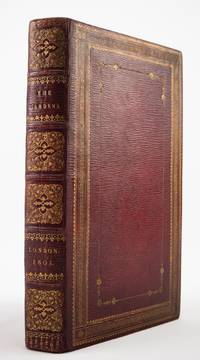
1805ST21016London: Printed by T. Bensley 1805. APPARENTLY THE ONLY COPY PRINTED ON VELLUM. 260 x 152 mm. 10 x 1/4 x 6". 2 p.l. 146 pp. 1 leaf notes. Translated by Maria Henrietta Montolieu. <br/> Very pleasing contemporary straight-grain scarlet morocco gilt by Charles Hering binder's ticket on verso of front flyleaf covers bordered with a wide frame of multiple patterned rolls with rosette cornerpieces enclosing a delicate frame of a dotted roll cornered small floral tools raised bands spine gilt in compartments wide turn-ins sumptuously gilt cream silk endleaves with gilt borders and fleuron cornerpieces all edges gilt. WITH EIGHT ENGRAVINGS BY FRANCESCO BARTOLOZZI IN TWO STATES one on gold silk and the second on paper. EXTRA-ILLUSTRATED with two engravings depicting Princess Izabela Czartoryska and her daughter Zofia. A Large Paper Copy. Henrey 624. See also Clemens Alexander Wimmer "The Princess and the Poles" Historic Gardens Review no. 10 2002: 14-17. Spine slightly darkened joints and edges with minor barely noticeable wear vellum a bit and naturally rumpled and consequently the book yawning a bit a handful of light spots but still an extremely appealing copy with fine impressions of the plates vast margins and a special story to tell.<br/> <br/> Printed on vellum richly bound and illustrated with attractive plates on silk this is an extraordinarily luxurious copy of Delille's famous poem on gardens that almost certainly belonged to a noblewoman whose gardens are mentioned in the text. First published in 1780 our poem condemns formal gardens and broad promenades in favor of a gardening art which hides its artistry by reproducing the asymmetrical groupings of nature and careless bounty of the countryside. This view accords with the translation of Virgil's "Georgics" done by Delille 1738-1813 in 1769 a version that brought him great acclaim for its supple and sonorous versification. In fact it so pleased the Count of Artois the future Charles X that he named Delille abbot of Saint-Séverin; however revolution disrupted things and the poet for a time led a wandering life in Switzerland Germany and England where this updated and expanded version of "Gardens" was published in 1801. The present special edition includes the plates which had appeared as head- and tailpieces in the first edition but now used as stand-alone plates in two states. These were executed by Bartolozzi after originals by Portuguese neoclassical painter Francisco Vieira. In addition to the called-for suite of illustrations our copy includes two inserted plates portraits of Princess Izabela Czartoryska 1745-1835 and her daughter Zofia. Czartoryska was a major figure in the Polish Enlightenment as a writer and patron of the arts as well as an advocate for improving the lives of the poor. She is best remembered for the sprawling gardens at her palace in Pu awy which included a formal garden a "wild promenade" or landscape park and multiple structures including the neoclassical Temple of the Sibyl which became one of Poland's first museums. She made the acquaintance of the author while travelling through Paris in 1791 and the two struck up a friendship. She financially backed the second edition of the work in exchange for a mention of her gardens which duly appears in heightened verse on pp. 11-13: "Favoured Pulhavi! You from Heaven obtain / Each separate charm Earth's choicest scenes contain; / Bright glow thy features fresh from Nature's hand / Excite our wonder and our praise command." The presence of this poetic tribute--and especially the inserted plates showing the princess and her daughter-- clearly suggest that the our apparently unique luxury edition must have been a presentation copy to Czartoryska herself. The present copy is as striking outside as it is inside. Charles Hering was the most distinguished and influential English binder of the first decade of the 19th century and although his career was brief from about 1795-1812 Ramsden focuses on his work as representing the transition in binding styles from those of the German émigrés of the late 18th century to the new generation of binders headed by Charles Lewis. Dibdin states that until "the star of Charles Lewis rose above the bibliopegistic horizon no one could presume to 'measure business' with Hering. There was a strength squareness and a good style of work about his volumes which rendered him deservedly a great favourite." We have been unable to trace any other copies of the present edition on vellum. Printed by T. Bensley unknown
4to. [287] ff. (B-C6, D-E8, F28 [!], G8, H6, J8, K4, L-N8, O6, P-Q8, R6, S-V8, X6, Y-Z8, a8, b4, c7 [6+1: includes "c medium" between c2 and c3], d-e8, f6, g-h8, i4, k-l8, m6, n-p8; published thus without a gathering A, agreeing with ÖNB copy). With title woodcut, 8 pp. of musical notes, and numerous (32 large, 12 almost full-page, and hundreds of small) woodcuts in the text (wanting the woodcut map and the folding plate on musical theory). Contemp. wooden boards with blindstamped pigskin spine and one central brass clasp. The first encyclopedic work in modern European history. The first Strasbourg edition, a revision of the Freiburg first edition published the previous year. In the manner of a dialogue between teacher and student, the book discusses the sciences and liberal arts, including music (with notes), medicine, geometry, surveying, etc. Grüninger modified several woodcuts from the first edition and added others; he also incorporated a brief Hebrew grammar by Conrad Pellicanus, making this the first Strasbourg-printed book to include Hebrew type (cf. Schmidt). - Among the illustrations are a map of the world on f. c6r and many charming miniature woodcuts in the margins. Occasionally, details of the initials (F11r) and woodcuts (e.g., F18v, c2v [salamander], and c3v [dragon]) have been coloured in red. Several contemporary underlinings and marginalia, including a lengthy note on earthquakes that supplements the printed text by additional sources, such as the Arabian astronomer Abu Ma'shar: "Erdbebung bedeute straff Gottes. Naturliche Ursachen nemlich die Hitz und würckung etlicher Planeten, mit der Sonnen, als Martis, Iovis, Saturni, und sönderlich sagt Albumasar vom Saturno. Bedeuten stets künfftig Unglück, wie auch Plinius danen saget, das kein Erdbidem zu Rom geschehen sey one Bedeutung künfftiger ding [...]" (c5v). Some browning and fingerstaining; quires S and e misbound; several small edge defects (larger in d5, k6); paper defects to D4 and (almost touching text) d6. Some worming near beginning and end of volume, also concerning the binding; some damage to spine-ends. VD 16, R 1034. BM-STC 731. Proctor 9891. Schmidt (Grüninger) 66. Ritter 1984. Muller 24, 26. Smith, Rara, 82. Sabin 69123. Ferguson (Reisch) 201f. Alden/L. 504/2. Zinner 849. Eitner VIII, 183. Not in Adams.