[IMPRIMERIE] Établissements PLANTINLivre Rare Book
7 773 résultats
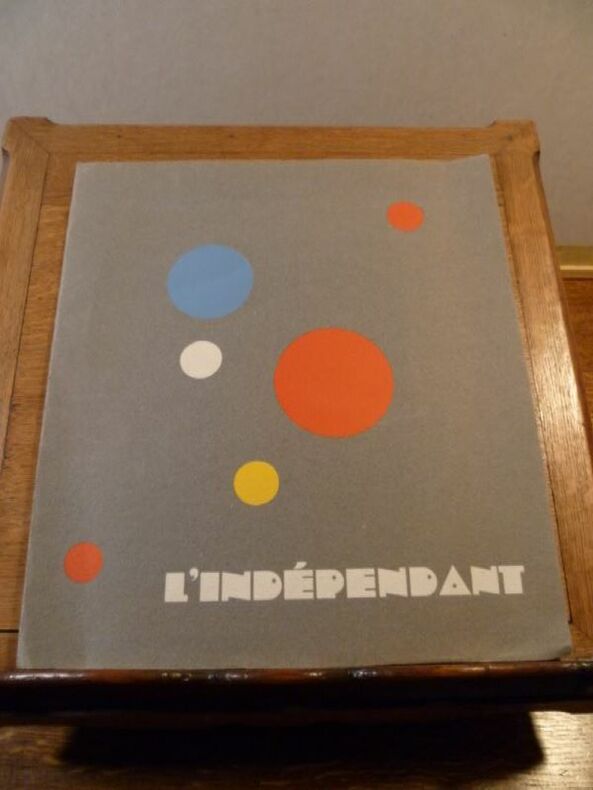
193012681930 1 Il comporte divers documents originaux dont : un feuillet en néerlandais : 'd'Onafhankelijke', un double feuillet : 'Première présentation de notre caractère de publicité L' indépendant, un feuillet 'Nous sommes à votre disposition', un feuillet reproduisant la lettre, sur papier à en-tête de l'Institut des Arts décoratifs, de Henri van de Velde concernant la 'réussite' de ce nouveau caractère, un leporello dépliant 'indépendant' caractère qu'exige la publicité en 1930, un double feuillet 'plantin's specialiteiten', un double feuillet publicitaire 'l'intertype' et son enveloppe, un carton gris 'Ét. ''plantin'' Brussel, un papier à en-tête 'Établissements PLANTIN', une enveloppe de même 32,5 x 28,7 cm, Portefeuille imprimé à caractère publicitaire comportant titre et pastilles de couleurs, rouge, bleue, jaune, blanche. Bruxelles, Imprimerie Plantin, 1930.
193012681930 1 Il comporte divers documents originaux dont : un feuillet en néerlandais : 'd'Onafhankelijke', un double feuillet : 'Première présentation de notre caractère de publicité L' indépendant, un feuillet 'Nous sommes à votre disposition', un feuillet reproduisant la lettre, sur papier à en-tête de l'Institut des Arts décoratifs, de Henri van de Velde concernant la 'réussite' de ce nouveau caractère, un leporello dépliant 'indépendant' caractère qu'exige la publicité en 1930, un double feuillet 'plantin's specialiteiten', un double feuillet publicitaire 'l'intertype' et son enveloppe, un carton gris 'Ét. ''plantin'' Brussel, un papier à en-tête 'Établissements PLANTIN', une enveloppe de même 32,5 x 28,7 cm, Portefeuille imprimé à caractère publicitaire comportant titre et pastilles de couleurs, rouge, bleue, jaune, blanche. Bruxelles, Imprimerie Plantin, 1930.
Folio (189 x 290 mm). XVI, (1) pp. With large woodcut title illustration and 6 woodcut illustrations in the text, all by Jost Amman. Modern marbled boards with cloth spine, new endpapers. All edges red. Second independent edition of this "short account of the manner how towns, castles, and other places are to be garrisoned with soldiers in such a way that they may withstand the enemy". Formerly attributed erroneously to Fronsperger's "Kriegßbuch", from which Amman's fine title woodcut was taken, the treatise was first published privately in 1560 as the 8th volume of the monumental military encyclopedia by the imperial field marshal and fortification architect Reinhard count Solms (1491-1562); Feyerabend issued it separately in 1563. The text woodcuts show siege engines and instruments. - Leaves XIII and XIIII transposed. Colophon leaf repaired at foot and spotted. - Provenance: the library of Heinrich Stiebel, Frankfurt (his bookplate on pastedown, numbered 5272). Later in the collection of Thomas Fremantle, 3rd Baron Cottesloe (1862-1956), commander of the Territorial Army and president of the Society for Army History Research (purchased from Sotheran's, December 1936). VD 16, R 940. Jähns I, 550 (and cf. 509-514). Cf. Cockle 530 (1563 ed.).
4to. LIX (but: 61) ff., final blank leaf. With 2 title woodcuts and 49 woodcuts in the text (including some repeats). 19th century unsophisticated boards. First edition of this popular genealogy of the Habsburg monarchy, published nearly simultaneously with the German translation. The Alsatian Catholic humanist and educator Gebwiler (ca. 1473-1545; cf. ADB VIII, 486f.) was a friend of Jacob Wimpfeling and counted Beatus Rhenanus among his students. The title woodcuts show the Imperial Eagle on the left, holding in its claws a many-headed hydra, and on the right the Habsburg peacock with a rooster and a lion in its claws. The other woodcuts include a half-page illustration of the Imperial Eagle and 48 small portraits of historical personages. - Spine end corner professionally repaired. Some slight duststaining; a faint dampstain to the upper margin of a few pages. A few minor edge flaws and traces of handling, but a fair copy. VD 16, G 594. BM-STC German 334. Muller II, 47, 254. Ritter 944. Ritter Cat. 1070. Schmidt 232. Cf. Lipperheide Ea 1 (1530 edition only).
Einblattdruck. 1 S. Qu.-Folio (404:307 mm). Mit papiergedecktem Siegel über rotem Wachs. Gefaltet. Aufruf an alle Untertanen, "sonderlich aber allen an der Thonaw, so wol andern nechst geseßnen Flecken", für die Verproviantierung der "anzall Italianisch Kriegßvolck" zu sorgen, welche "die Babstlich Heiligkeit [...] herauß verordnet" habe: "Also haben wir hierinn nachfolgende maaß, ordnung und Tax, Euch [...] setzen unnd benennen wöllen, Alß neblich, daß man gedachtem herab ziehenden Kriegßvolck in ihren nachtleger die notturfft, Profiant, von Brot, Wein, Bier, alt und jungem Fleisch, Käß, Ayr, Schmaltz, Habern und dergleichen, umb bezalung und volgende Tax zufüern [...], und volgender gestalt, alß drey Brott weissen gebäch, deren jedes neün Lot wigt, per ein Kreutzer, ein Maß Wein per vier Kreutzer, ein Pfunt Behaimbischen Käß, per drey Kreutzer, den besseren Käß, so man in Osterreich macht, werden unsere Commissarien nach der güet Taxiern [...]". Mit der Schlacht bei Sissek am 22. Juni 1593 war der Lange Türkenkrieg ausgebrochen, der bis 1606 währen sollte. - Dorsalvermerke des 17. Jhs. zum Inhalt sowie zeitgenöss. Vermerk "Asentirt den 30. Juni Ao. 97". Unter dem Urkundentext rechts: "Commissio domini electi imperatoris in consilio". Links mit eigenh. Zeichnung des niederösterreichischen Statthalters Wolfgang v. Hofkirchen und des Kanzlers Christoph Pirckheimer, rechts des Hans Wilhelm Frhr. von Schönkirchen ("Hanns Wilhelmb Herr von Schennkhirchen d. Ä.") und des Dr. Paul Kraus. Nicht bei Starzer.
191564006Bradford West Yorkshire UK: W.N. Sharpe Ltd. 1915. Thick oblong Folio. 13 x 10.5 x 2.5 in. 72 pp unpaginated. on thick tanned-gray card stock w/ 93 greeting cards envelopes calendar greeting cards folding cards embossed examples most of them colour printed some w/ die-cut decorations and features many w/ hand-coloured Bromide photo illustrations hand-coloured photogravure many raised gilt ornamental decorations monograms and all could be ordered w/ gilt embossed Regimental badges or ornaments. Publisher’s fish-scale scalloped ivory-silver cloth embossed gilt lettering & ornament on front cover some toning scuffing minor bumping to spine edgewear light uniform interior toning slightly shaken 1 small closed tear rear joint at head of spine still a VG- copy w/ Regimental Badges order sheet tipped-in on pricing and ordering instructions on endpapers including specific pricing for Welsh customers. First edition of this scarce World War I-era greeting card and advertising promotions salesman’s sample catalogue filled with beautifully executed printer’s samples to help raise morale during the brutal second year of the Great War. 1915 opened with the disheartening Neuve Chapelle offensive by General Haig and subsequent political fallout battles of Aubers Ridge Festubert Loos as well as Zeppelin bombings and U-Boat blockade transformed the War and Great Britain into an all out effort and grinding stalemate of trench warfare. With millions of men separated from their families and homes W.N. Sharpe and other publisher’s quickly expanded and adapted ensuring that postcards and greeting cards were supplied so that people far from loved ones could exchange morale-boosting messages. These greeting cards were available to be embossed with regimental badges flags of the allies patriotic messages and would prove to be wildly popular during the opening years of the War. When initially prepared for printing in late 1914 there were only 25 Regimental badges but this quickly grew to 62 and here Sharpe has included the updated list. The greeting cards and Christmas cards feature Bromide photos of English Bulldogs with British Empire flags; soft-focus images of idyllic rural scenes mothers & children; Naval scenes; flower arrangements and even King George V. By the early 20th-Century W.N. Sharpe was one of the largest greeting card and postcard colour printing companies in the World on par with Raphael Tuck and were well known for their famed “Patent FAB Patchwork Card†which featured a decorative square of silk that could be cut out and worked into a pin cushion or tea cozy. Following World War I they would continue to expand into producing stationery wedding cards and stationery birthday cards along with calendars postcards and many other paper ephemera. In 1937 they would built the historic 76000 square foot Hallmark House in Bradford and later in 1984 was acquired by Hallmark Cards of the United States. No copies in Worldcat; See: Graham Hall Classic Cards’ Bradford: The History of W.N. Sharpe Ltd. The Bradford Antiquary Series 3 Vol. 11 2007. W.N. Sharpe Ltd., hardcover
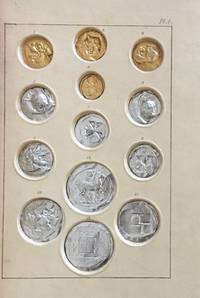
185058074London: Grant and Griffith Corner of St. Paul’s Churchyard 1850. Thick 4to. 6.75 x 9.25 x 2 in. 4 iv 208 pp. plus 2 pp. publisher’s ads decorated colophon leaf in red & black inserted errata leaf at rear. Title printed in red & black. With 10 plates featuring 114 embossed relief facsimile coins featuring gold silver copper & bronze leaf applied mimicking the originals all preserving their original printed cover leafs and some text woodcut engraved illustrations. Original embossed padded green publisher’s calf ornamental design borders & lettering in relievo marbled endpapers black linen tape reinforcement at gutter margin sunning & chipping to spine wear offsetting to text leaves minor wear & chipping to fore-edges of covers embossed raised letter spine label present still a VG bright original copy. First edition of this rare and inventive numismatic sample book on ancient Greek & Roman coins by the influential British illustrator and noted numismatist. He proclaims in his introduction how he has invented a new process to recreate actual facsimile coins in their original metals as he had found no other printing or reprographic process properly conveyed either the weight or appearance of the coins quite separate from the chromolithograph colour printing process for his very successful Coins of England. The coin specimens appear as they would have in a Victorian cabinet specimen trayHenry Noel Humphreys 1810-1879 was also fascinated with illuminated Medieval manuscripts and began producing beautiful books with painted ornaments by using the beautiful chromolithography process of Owen Jones 1809-1874. However he also had a keen interest in the natural world writing on aquariums butterflies entomology biology and more. See: Twyman A History of Chromolithography pp. 153-156; Alexander Del Mar A History of Money in Ancient Countries from the Earliest Times to the Present p. xv; Leitzmann Supplement to Lipsius Bibliotheca Numaria 60. Grant and Griffith, Corner of St. Paul’s Churchyard, unknown
Revised Edition, printer's woodcut device on title, text clean and bright throughout, [22], 494, [22] pp., contemporary vellum with yapp fore-edges, a very nice copy. Cato's treatise on agriculture (De Agricultura or De Re Rustica) is the only work by him that has been preserved. It contains a miscellaneous collection of rules of good husbandry, conveying much curious information on the domestic habits of the Romans of his age. This book of lessons on plant and animal husbandry is edited by the Swiss Physician, Theodor Zwinger (1533-1588). Adams, C1126
4to, with the circular stamp of Birmingham Law Society on title, mostly black letter, numerous early Ms. ink annotations in the wide blank margins, [1], 85 leaves, contemporary calf, rebacked and recornered, lettered in gilt on spine, a nice copy. STC 23218.
First English Edition, 4to in 8's, woodcut ornament on title, Black Letter, a few early ink annotations, small hole in M7 affecting 2 letters of one word, wide margins, [4], 232 leaves, recased in original vellum, title in ink on spine, a good copy. This is Crompton's chief work and the first English law book devoted exclusively to the Royal courts, L'authoritie is a guide to all the courts then in existence, from the court functions of Parliament to the smallest local and special courts. Additionally, it contains a number of circuit reports of criminal cases not printed elsewhere. It is also the first book printed by Charles Yetsweirt, who had received a Royal commission to be printer of law books. STC, 6050; Sweet and Maxwell, p. 259 (8); Beale, T328.
Second Edition, ink ownership inscription of Richard Grosvenor on title, occasional light dampstains in the text, minute single wormhole in last 4 leaves, closed tear in blank margin of R8 and paper flaws on lower blank margin of Bb.ii, [20], 675, [1] pp., contemporary limp vellum, some loss to spine, 1 of 4 leather ties, with the armorial bookplates of Sr. Richard Grosvenor of Eaton Coun. Cheshire. "Six conclusions touching the Holy Scripture and Church", a translation of Rainolds's "Sex theses de Sacra Scriptura, et Ecclesia", has a separate divisional title page; pagination and register are continuous. **** An influential treatise based on debates between John Rainolds and the English Catholic John Hart held at Oxford and London, first published in 1584. This copy belonged to Richard Grosvenor (1731-1802), politician and landowner, who lived at Eaton Hall in Cheshire. His son, Viscount Belgrave, was first marquis of Westminster. STC, 20627.
18932111902160200874Yoshijiro Yabusaki Tsukiji Kyobashi District Tokyo City 1893. Soft Cover. Fine. Number of books: 12 sheets per chapter Yoshijiro Yabusaki Tsukiji, Kyobashi District, Tokyo City paperback
2111902160200807Nagamatsu Do kura-ban N.A. Soft Cover. Fine. Volume: 1 Nagamatsu Do kura-ban paperback
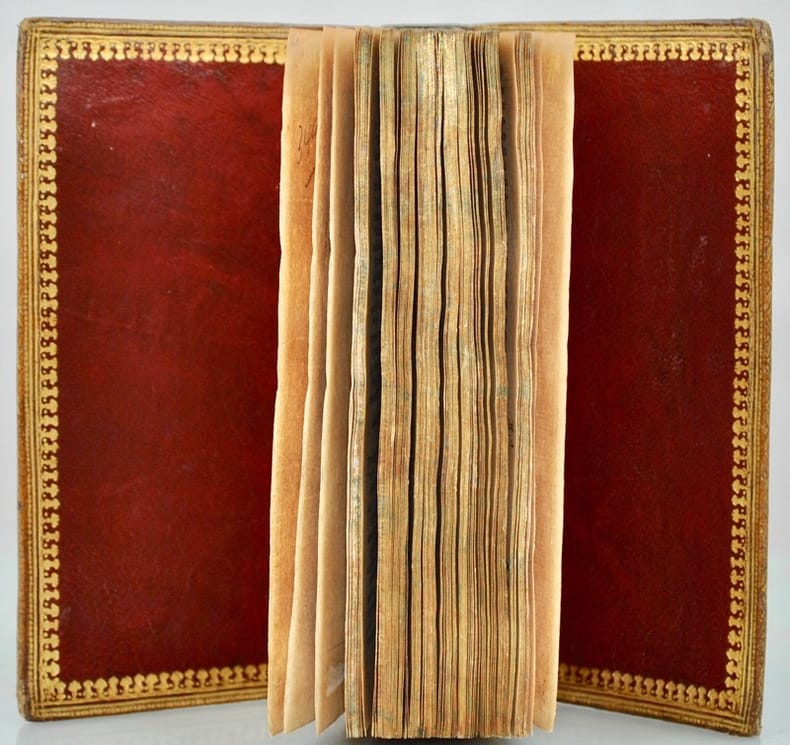
165342295Leyde, Jean et Daniel Elzevier, 1653. In-16 de 381 pp., 1 f.bl., titre-frontispice gravé, maroquin fauve doublé de maroquin rouge orné d'une frise dorée d'encadrement, dos à nerfs, pièce de titre en maroquin rouge, filet à froid d'encadrement sur les plats, tranches dorées sur marbrure (reliure de l'époque).
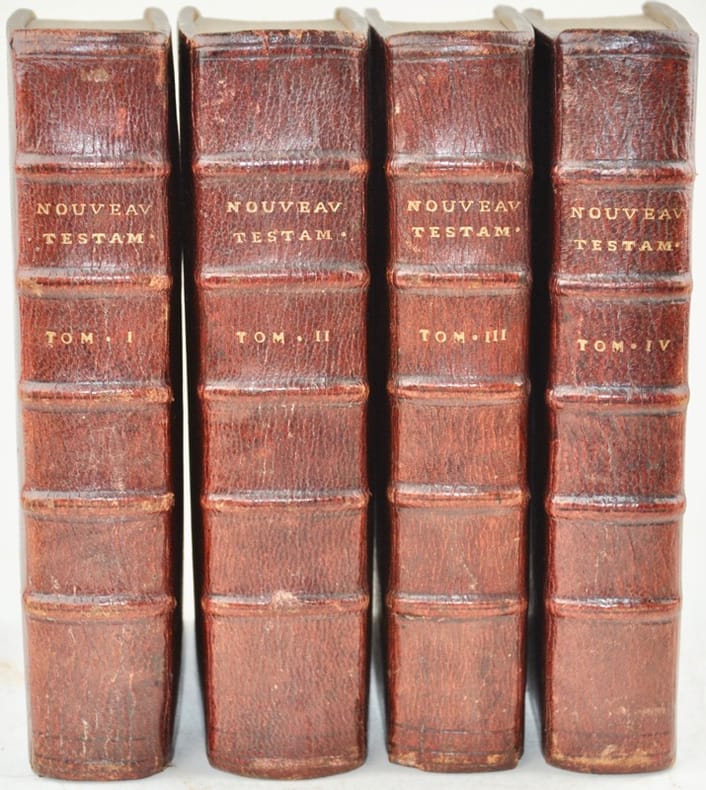
169242505Paris, André Pralard, 1692. 4 vol. in-8 de (48)-638-(58) pp. ; (8)-470-(8) pp. ; p. 471-892-(19) ; (40)-676 ; (20)-664 (i.e. 660) pp., maroquin rouge janséniste, dos à nerfs, tranches dorées (reliure de l'époque).
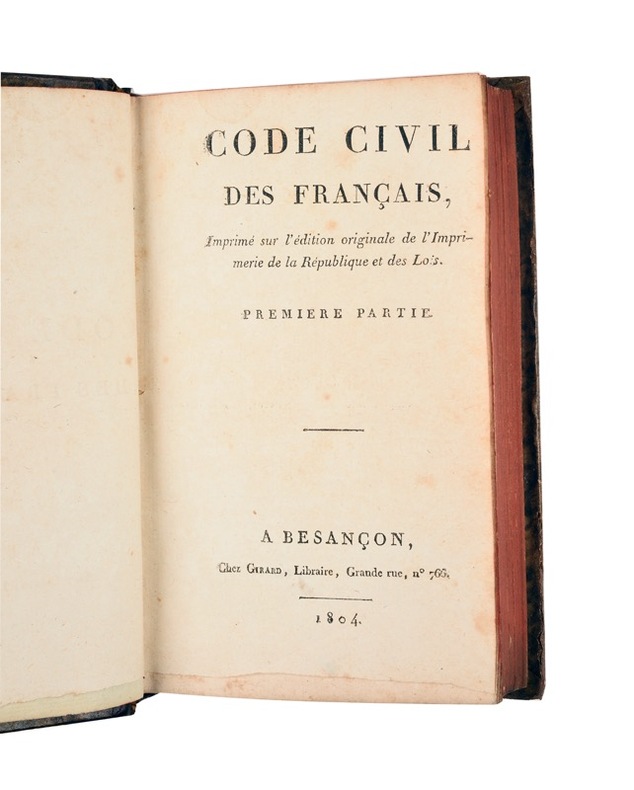
180421904Besançon, Girard, 1804; 2 parties reliées en un tome in-18 (145 mm), demi-veau brun, dos lisse, pièce de titre rouge (renouvelée), plats cartonnés avec papier à l’éponge bronze marbré, tranches rouges (reliure de l’époque) ; [4], 329, [1 bl.] pp., [1] f. blanc ; [4], 268 pp. (sign : ( )2, 1-9-18, 10-4, la dernière blanche ; ( ) 2, 1-7-18, 8-8).
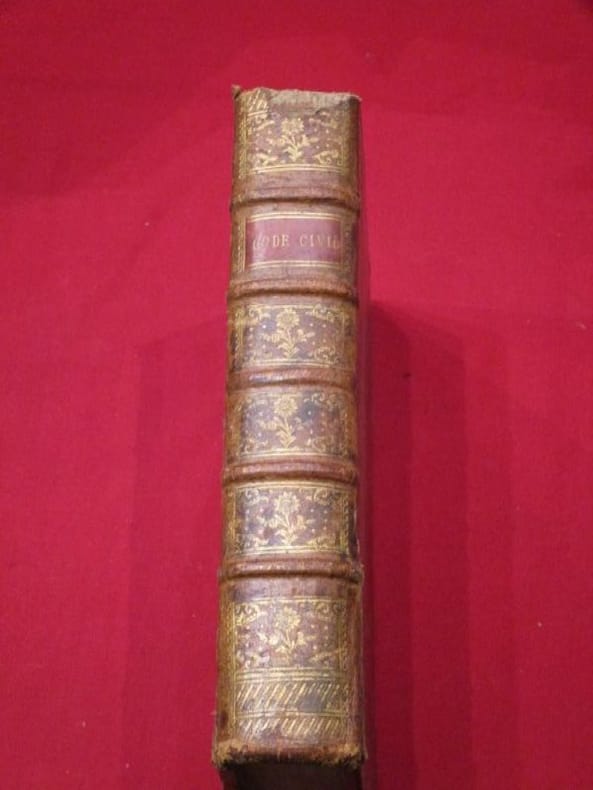
1804118651République, Rondonneau 1804 1 A Paris, De l'Imprimerie de la République, An XII, 1804, 1 volume in-4 de 195x255 mm environ, (2) ff. (faux-titre, page de titre à la vignette du Grand Juge et Ministre de la Justice), 579 pages, [suivi de la] Table alphabétique, A Paris, chez Rondonneau, an XII, 1804, 111 pages. Plein veau moucheté, dos à cinq nerfs portant titre doré sur pièce de cuir rouge, caissons ornés, double filet doré sur les coupes, tranches mouchetées, gardes blanches. Exemplaire solide mais reliure comportant des défauts (coiffe supérieure absente, fendillements sur le mors supérieur, première garde volante absente, quelques taches sur le cuir, coins frottés), des taches d'encre sur les pages 485, 486, 487, sinon bon état général, bel exemplaire de cette édition originale.
1835002107Blois s.n., Imprimerie de Félix Jahyer 1835
4to. 8 unnumbered ff. With large title woodcut and ornamental woodcut initial. Disbound, with marbled paper spine (c. 1800). Lists the entire domain of the united Spanish kingdom, as well as all its clerical and secular princes. Also identifies the exact tributes to be paid by the various lieges and their estates, including the 140,000 ducats to by paid by the "Isles whence the gold cometh". - Trimmed very closely throughout: first line of the title clipped almost entirely; full-page coat-of-arms slightly touched by binder's knife at right and lower edges. Occasional slight browning and fingerstaining. VD 16, E 3913. Not in Halle or Gilhofer (Zeitungen). Not in Sabin or Howes.
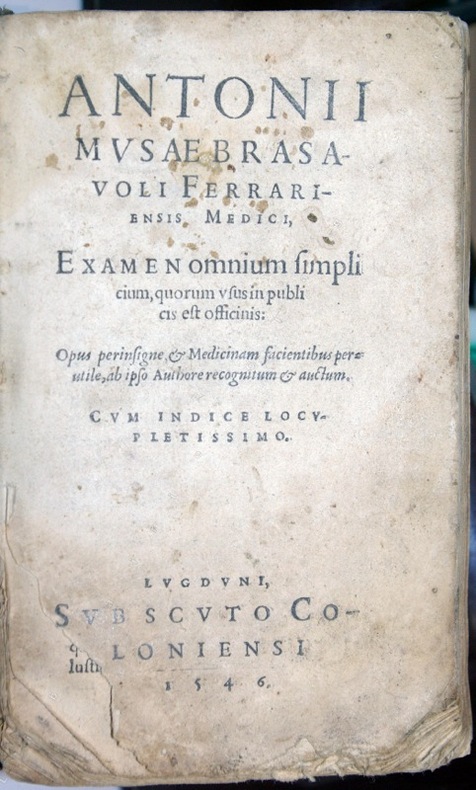
15466335Lyon, Sub scuto Coloniensi (Joannes et Franciscus Frellonii fratres), 1546 ; in-16 ; vélin souple de l'époque ; 862 pp., (29) ff. d'index, la dernière page "Lugduniexcudebant Ioannes et Franciscus Frellonii fratres 1546".
154611249Venise, Hieronymus Scotas, 1546 ; in-folio ; plein vélin ivoire en partie manuscrit (reliure de l'époque) ; (6) ff., 142 ff. recto-verso, (3) ff. le dernier, blanc, a été découpé.
16842938[], [], 1684-1689. 9 pièces reliées en 1 vol. in-12, veau brun, dos orné à nerfs, pièce de titre en maroquin rouge (reliure de l'époque).
4to. (20), 391, (1) pp. With woodcut printer's device on final leaf and several woodcut initials. Contemporary vellum with faded handwritten title to spine. Rare Latin edition of the famous work. The Greek editio princeps was not to be published until 1533 (Froben). The translation is based upon that of the Camaldolese priest Ambrosius Traversari (1386-1439) and had been already printed in 1472; the present edition (edited by Curio and Michael Bentinus) is the first of the 16th c. and the first one to be printed in the German-speaking countries. “In Valentin Curios Planung seiner noch jungen Offizin, zudem aber vor allem erstmals in textlicher Revision und Ergänzung nach einer griechischen Handschrift” (Hieronymus). - Some waterstaining to the margins throughout, unattractive damage and small wormhole to edges near end (occasionally touching the printed marginalia). Several contemporary manuscript marginalia and underlinings. VD 16, D 1837. Adams D 486. BM-STC German 244. Hieronymus, GG 92. Schweiger I, 97. Hoffmann I, 568.
16484220Lyon, Gérôme de La Garde, 1648 ; in-12 ; bradel cartonné moderne avec étiquette de titre sur le plat ; titre, 99, (11) pp. de table des matières.
18190Paris Ch. Lorilleux et Cie, sans date (1896) 1896 in 4 (32x24,5) 1 volume reliure demi basane marron de l'époque, dos lisse orné de filets dorés, XXIV et 358 pages. Avec 28 planches, dont plusieurs en couleurs, la plupart tirées en lithographie (dont Chéret: La saxoléïne). Nombreuses illustrations dans le texte. Ouvrage publié en 12 fascicules (reliés ici en un seul volume). Rare. Bel exemplaire