7 770 résultats
190063248<p>photo lithograph original green-coloured background EXTREMELY RARE. Andrew B. Graham 1845-1909 was an American lithographer. The firm Andrew B. Graham Company was one of several that thrived on lucrative government publication contracts. Condition: with folds as issued. Reference: Griffin # 748 but later edition: 1st October 1901</p> Government Printing Office, Washington.
1985892671985. STENCIL PRINTING SERIZAWA Keisuke; YOSHIDA Kogor. KIRISHITAN MONOGATARI. Tokyo Gohachi Showa 60 1985. Bound Western-style in wrappers large 26.7 x 26.3 cm album of bw stencil prints by Serizawa illustrating a brief text by Yoshida a famous scholar and historian. Pictorial vignetttes of the 16th century introduction of Christianity to feudal Japan. One of 200 copies. In about new condition in the original wraparound cover with a printed paper title label and shipping slipcase. unknown books
190180448Canton OH: The Watts Printing Co 1901. Presumed First Edition First printing. Stiff card covers tied at left side with black cord. Good. Format is approximately 5 inches by 7 inches. Binding is black cord. 51 leaves plus covers. This consists of black and white photographic illustrations with individual captions. Covers have a few rubs light soiling and short creases. There is a number written in blue ink at lower corner of the rear cover. This rare souvenir album contains captioned photographs of the funeral events honoring the slain McKinley in his hometown of Canton Ohio. One of the photographs of President Theodore Roosevelt and the Cabinet awaiting the arrival of the casket at the Canton Court House. A search of the On-line Catalogue of the Library of Congress on March 27 2021 identified four copies two in Ohio Libraries one at the University of Texas at Austin and one at a Scottish Rites Temple in Massachusetts. Occasionally copies appear briefly on-line and generally are purchased quickly. Thousands who witnessed the funeral procession as it moved from the McKinley home on Market Avenue N to the church services were "Hushed and Broken in Heart" as they watched the cortege. Mrs. McKinley spent a half hour alone with the casket but she would not attend the funeral services instead staying at home the rest of the day. The funeral procession began at the McKinley home at 1:14 p.m. and arrived at the First Methodist Church now Crossroads United Methodist Church at 1:30 p.m. McKinley's body first lay in state for public viewing in Buffalo N.Y. on Sept. 15-16;. The nation focused its attention on the casket that made its way by train first to Washington where it first lay in the East Room of the Executive Mansion and then in state in the Capitol and then was taken to Canton. A hundred thousand people passed by the open casket in the Capitol Rotunda many having waited hours in the rain; in Canton an equal number did the same at the Stark County Courthouse on September 18. The following day a funeral service was held at the First Methodist Church; the casket was then sealed and taken to the McKinley house where relatives paid their final respects. It was then transported to the receiving vault at West Lawn Cemetery in Canton to await the construction of the memorial to McKinley already being planned. The former first lady accompanied her husband on the funeral train. Historian Margaret Leech noted "the circuitous journey was a cruel ordeal for the woman who huddled in a compartment of the funeral train praying that the Lord would take her with her Dearest Love". She was thought too weak to attend the services in Washington or Canton although she listened at the door to the service for her husband in her house on North Market Street. Among organizations that participated in the procession were Canton Commandery No. 38 Knights Templars; The Grand Commandery Knights Templars of Ohio; The Knights Templars of Louisville Kentucky and Pittsburgh; Eagle Lodge No. 431 it would become the McKinley Lodge; The Grand Army Band; and Thayer's Military Band. At the church President Roosevelt occupied the front pew. Behind him were 40 United States senators 120 representatives and many state governors. Honorary pallbearers selected by the family included John C. Dueber George B. Frease R. A. Cassidy William R. Day Joseph Biechele Henry W. Harter William A. Lynch and Thomas McCarty. Widow McKinley remained in Canton for the remainder of her life setting up a shrine in her house and often visiting the receiving vault until her death at age 59 on May 26 1907. She died only months before the completion of the large marble monument to her husband in Canton which was dedicated by President Roosevelt on September 30 1907. William and Ida McKinley are interred there with their daughters atop a hillside overlooking the city of Canton. The Watts Printing Co unknown
19871145150Ron R. Van Sickle Military Books 1987. Facsimile of the 1865 edition. Owner's blindstamp on ffep of each volume. otherwise like new. A seldom-offered set in excellent condition. A heavy set that will ship at my postage cost; cannot be shipped internationally. Hardcover. Fine/No Jackets as Issued. Octavos. Book. Ron R. Van Sickle Military Books Hardcover
1807GITaz75A Besançon de l'Imprimerie de Taulin-Dessirier 1807-1808. 2vol in-8 XV 360 322 LIXpp. Demi chagrin brun, dos à 5 nerfs janséniste, tête dorée, non rogné, relié vers 1900. Bel et rare ouvrage illustré de 5 planches hors texte dépliantes.
198051138BBMünchen, Kraus International Publ., 1980. 4°. 41 cm. 648 Seiten. Original-Leinenband. (= Deutsche illustrierte Flugblätter des 16. und 17. Jahrhunderts. Herausgegeben von Wolfgang Harms. Band II.)
19241813Paris, sans nom (imprimerie F. Bouchy), 1924 ; grand in-4, broché ; (1) f. blanc, 114 pp., (2) ff. (table et marque d'imprimeur, blanc), couverture grise imprimée ; frontispice gravé, 10 grandes pointes-sèches hors-texte tirées sur vélin, 16 photographies et 44 dessins dans le texte dont 5 à pleine page.
184424820Paris Gustave Thorel 1844 6 VOLUMES In-8 XV-662 + 683 + 760 + 754 + 682 + 944 pp
190856714BBBerlin, Georg Bondi, 1908. 4°. 26,5 cm. 409, 382, 324, 358, 403, 394, 423, 433, 390 Seiten. Grüne Original-Saffian-Ganzlederbände mit goldgeprägtem Rücken- und Deckeltitel, goldgeprägte Fileten und Innenkantenfileten sowie Initialen ML (Melchior Lechter) auf Vorderdeckel.
1634952251Leiden: Bonaventura und Abraham Elzevier. 1634. Duodecimo. 125 x 68 mm. (Einband etwas fleckig, Kanten und Gelenke teils etwas berieben. Innen, von geringen Bräunungen abgesehen, sauber und frisch.) [5 Warenabbildungen] Gestochener Titel, [1 weiße], [17], Kupfer; 786, [29] (Index), [1 weiße] Seiten. - Lagenkollation: *10, A-Z12, Aa-Ll12. Geprägtes Original-Leinen mit illustriertem Umschlag,
1949ZB585155London: Co-operative Printing Society 1949-1952. large folio issues usually eight pages and some have supplements all are well illustrated; now in 5 later and not matching cloth bindings the first very worn at spine and with joints split others soiled and rubbed general age toning with a few leaves margin tattered but no loss still overall a good group; the constantly improving lives of the workers sport human interest stories expose of gross falsehoods being circulated against the Soviet Union the desire for peace etc. etc. little on the Korean War or Stalin. - If you are reading this this item is actually physically in our stock and ready for shipment once ordered. We are not bookjackers. Buyer is responsible for any additional duties taxes or fees required by recipient's country. Photos available upon request. London: Co-operative Printing Society, hardcover
AN ABSOLUTELY OUTSTANDING COPY OF THE FIRST AND ONLY EDITION OF THIS EXTREMELY EARLY AND IMPORTANT EXPLICATION OF THE KORAN. 3 leaves; 192 pp + 43 pp Arabic text starting from the back of the book, with a separate title-page. A LARGE-PAPER COPY, BEAUTIFULLY PRINTED WITH HUGE MARGINS ON EXTREMELY FINE, THICK LAID PAPER. 4to. Original paper wraps. ENTIRELY UNCUT, FINE AND BRIGHT, LIKE NEW. Chauvin (X, 70) gives a long notice of this extremely important publication.
A PRISTINE LARGE-PAPER COPY OF THE FIRST AND ONLY EDITION. XII, 168 pp. + addenda leaf (often missing, but present here). An introduction to the Chronicon Samaritanum or Liber Josuae. A LARGE-PAPER COPY, beautifully printed (in Latin, with some Hebrew types) with huge margins on extremely fine, thick laid paper (this copy about twice as thick as normal copies). Large 4to. Original unprinted wraps. Uncut and unopened. Some wear and tear to wraps, INTERNALLY FINE AND BRIGHT, COMPLETELY FRESH, LIKE NEW.
First and only edition. ONE OF ONLY 12 COMPLETE COPIES PRINTED OF THIS EXTREMELY RARE (and finely-printed) EXAMPLE OF CATALAN EROTICA. 96 pp. + a few woodcuts printed in color hors-texte. The entire edition was limited to 112 copies, but only the 12 copies on Japanese paper (like this one) include a fine reproduction of an extremely unusual erotic woodcut. 24mo. Original wraps. Uncut and unopened. Minor traces of wear to wraps, else FINE AND BRIGHT. Catalan erotica printed before the death of Franco (1975) is very rare; this example especially so.
4925176 Fleet St E.C. London no date. Four pages fol. tear on fold marks other defects but text clear and complete. The ten signatories also include W. Morrison presumably the philanthropist Walter Thomas. Brassey R.M. Castor Auberon Herbert "the originator of Voluntaryism" Wikipedia - see also DNB Hodgson Pratt Peace advocate DNB P.H. Hillard Edw. Owen Greeening Tito Pagliardini and another undeciphered. A socialist project concerning which I have found little information. They use and explainthe phrase "Industrial Partnership" the worker investing in "the work where he is employed" putting an end to industrial strife and motivating them with a share of the profits. They anticipate a benign influence on human character a blurring of class barriers. On the first page is printed in red a statement about the division of profits etc. Presumably the Company was too Utopian to last. No other copy traced. 176 Fleet St, E.C. London, no date. unknown
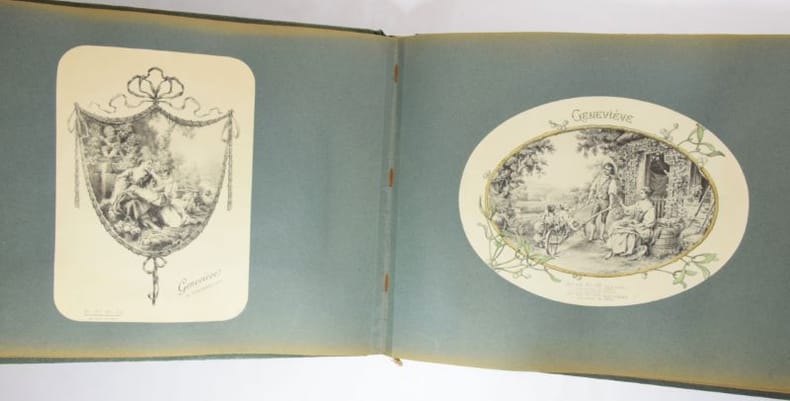
6903Paris, 240 x 321 x 240 mm, (31) feuillets avec 63 décors pour boîtes à dragées de baptême, (1) f. vierge (dernier). Reliure percaline, le premier plat comporte un décor à froid et une inscription dorée, un certain nombre de feuillets cartonnés sont insolés/ décolorés aux bords ou sur la totalité du feuillet, les vignettes collées sur les feuillets sont dans la très grande majorité très bien préservées. Bel exemplaire.
COMPLETE THREE VOLUME SET. RARE second edition of 'Voigt and Günther's Orbis pictus' - the classic illustrated textbook for children in the tradition of Comenius' 'Orbis Pictus'. Contains 90 full-page colored plates. [ALL VOLUMES]: 260x195mm. [148] + [138] + [VI+204] pages & 90 plates. Hardcover rebound with original boards (without the original spine). Gilt volume numbers on spine. Original boards and spine worn and stained. Cover corners and edges, and spine edges bumped and peeling. Few pages/plates slightly dirty. Some pages/plates age-stained. Few pages somewhat worn at corners and/or edges - no damage to text or plates. Pages yellowing and rough-cut. [VOL.I]: Ink inscription on front inner cover. Text page 45/46 edges worn, upper edge taped - NO damage to text. Plates XIII and XVIII mispaginated as nos.VI and VII. [VOL.3]: Puncture-marks on rear cover (not penetrating into inner cover). [SUMMARY]: This extremely rare and beautifully illustrated three volume classic children's textbook is otherwise in good condition. PLEASE NOTE: This item is overweight. We may ask for extra shipping costs.
2080502106505444Not Available N.A. Soft Cover. Fine. Number of books: 1 Not Available paperback
Seventh edition, 8vo (210 x 130 mm), iv, [5]-215, [1]pp., engraved frontispiece of carving for the table, cont. calf, rubbed, spine defective, upper cover just holding by cords and with 3 white labels. First published at Sheffield in 1802, a second in 1814 and a third in 1816, other editions are not recorded. All edition are rare, with JISC locating just this seventh edition (British Library and Bodleian copies only). Bitting, pp. 218-19; Oxford, p. 132.
Folio, [x],111,[3]pp., printed in Linotype Estienne with Civilite headings, Cockerell marbled paper boards, title label to spine, uncut. "This [library] was designed to be a guide and inspiration to a working printer and to illustrate the history of printing and all its adjuncts: types, pages, margins, woodcut and other decoration. The great names of Gutenberg, Fust and Schoeffer, Zel, Sweynheym and Pannartz, Wendolin of Speier, Jenson, Crantz, Gering and Friburger, and Caxton appear, and there are a number of examples of the fine borders and initials produced by the Zainers at Augsburg and Ulm and by Ratdolt at Venice."?Preface. Rogerson, 26.
Third Edition, corrected, xix,117,[3]pp., 2 fold-out lithographed plates, the first containing twelve figures of tools and implements, the second nine figures of printing presses and parts, both plates are lightly water-marked affecting the image, & with 1" marginal tear to vertical fold of each, final leaf includes publisher's advertisements for two additional titles by Hullmandel; front & back endpapers soiled, with early owner's signature (L. Stilson) & date on front pastedown, final two blank leaves bit stained, half calf with early marbled paper over boards, red leather label (3x2") with gilt border & title, "A Manual of Lithography", & the name "L. Stilson" added to front board; spine worn & rubbed with 1-1/4" piece missing at head & small label with black "C" at foot; 3" split in front joint; corners, edges & joints worn, paper boards chipped, edges of cover label chipped. Hullmandel's best know work and most influential publication is his book 'The art of drawing on stone' which was first published in 1824. But in terms of establishing lithography in Britain, his translation from the French of this treatise by Raucourt de Charleville was probably just as important. This third and final edition contains some important new additions. Colonel Antoine Raucourt was chief engineer at the Ecole des Ponts et Chauss?es in Paris and ran its in-plant lithographic press. His book was originally published in Toulon in 1819. Hullmandel thought highly of Raucourt's treatise and wrote in the preface: "The books which have hitherto been published on lithography are very imperfect, and are much more adapted to persons who already understand the art than those who wish to learn it... I have repeatedly wished for a guide to explain the new accidents which occur every instant, and which... appear each time so new and intricate, that the beginner is consequently tempted to give up all hopes of ever succeeding. I am consequently better enabled to appreciate the value of this excellent treatise on lithography, and hesitate not an instant to pronounce it the best work which has ever been published on the art." Bigmore & Wyman II, p.240; Twyman, pp.110-14.
Second edition, revised, 12mo, xxxvi,176pp., 12 illustrs., (6 of which are on 2 folding leaves), the folding leaves creased and waterstained, some light spotting and staining, bookplate of Jacob L. Chernofsky, new marbled endpapers, recent full calf. The second revised edition which was published in the same year as the first. It provides a good overall account of the art of lithography up this date and illustrates the apparatus involved along with examples of techniques. Michael Twyman, Lithography 1800-1850, p. 264.
Single sheet printed on one side only (214 x 135 mm), printed black on white fragile paper, mounted on card, soiled and creased. From the London Times, February 25, 1828, page 3, Column 1 : "It is this week our painful duty to record one of the most cold-blooded murders that ever darkened the annals of crime, a deed which has spread a wider gloom and deeper horror than any event which has occurred in this neighbourhood within the remembrances of the eldest inhabitants." John Dyon was the second son of a wealthy landowner in Yorkshire, England near Doncaster. He lived a hard working, respectable and quiet life. He married the lovely Betty Conway and together they had 3 daughters, Elizabeth (from whom we descend), Mary and Matilda. Working closely with his father, he often gained favors and gifts from the older man. In 1826 and 1827 alone, it is recorded that he received 63 acres of land and 300 pounds sterling. His older brother, William also received many gifts from their father as a young man, but the money was mostly squandered and drunk, and eventually the gifts stopped coming. So William struggled and John thrived? and William stewed, and his resentment grew. William frequently ranted of his anger to his son, John, poisoning the younger man's mind against his uncle. On Saturday, the 16th of February, 1828, John Dyon attended the market in Doncaster (12 miles away) with a couple of friends as was his custom. On his return home that evening, when he dismounted his horse to open the gate to his property, he was assaulted, shot, and left for dead. His wife, concerned when he didn't arrive home at the time he should, sent a servant to look for him. The servant found John's horse standing near the gate, but did not see John lying a few feet away. They found him in the morning lying where he had bled out. Mr. E. B. Denison, Esq. and the local constable rode out from Doncaster immediately upon receiving the news Sunday morning and began their investigation. Mr. Denison, a student of the new forensic sciences, was pleased to find the murder scene offered an abundance of clues. It had rained on Saturday and the ground was quite moist, then the temperature dropped below freezing overnight, capturing the escape route of the assailants. Mr. Denison observed that there were two attackers; one smaller and lighter than the other. He noted that these persons were relatively wealthy because they possessed a pair boots with both a right and left foot. He also noted that the larger footprints had a distinctive toe-out gait. An inquest was called by the coroner. After the presentation of evidence, the jury delivered a verdict of "Willful murder by person or persons unknown". Many in the area knew of the ill will that William Dyon and his son held for William's brother, John Dyon. By Thursday of the following week, both were arrested. They provided alibis, insisting that they had been nowhere near the scene of the crime. The magistrate felt he had to let them go. After his release by the authorities, William went to a pub in Gainesborough, and bragged there that he had "humbugged" the local magistrate, apparently disclosing further details of the crime. His brags were soon brought to the attention of Mr. Denison and additional inquiries were made. A farmer who had previously worked for William, but was now in John's employ, admitted that he knew of William and young John's plan to kill John Dyon. He also said that he had hidden the gun at his home for a week prior to the murder, and that William had bribed him and threatened him to keep quiet about the plan. Soon, William and his son, John were arrested. The constable searched their homes and found the boots, a pair having both right and left feet, and the gun. During the trial, the farmer, John White, testified to everything he knew, including the fact that William had showed up the evening of the killing to pick up his gun. Several witnesses came forward to testify to the ill will that William and his son bore for the deceased. They also testified that William had a distinctive gait, walking with his toes pointed outward. William Dyon and John, his son, were hanged for their crime on April 4, 1828. William staunchly declared his innocence throughout, but his son confessed to all as they placed the noose around his neck. No other copy located.
First edition, 8vo (190 x 110 mm), viii, [2], 174pp., errata slip tipped in after page 154, engraved frontis., and folding engraved plate to rear (spotted), page 115/116 with closed tear which has been repaired with archival paper, some light browning, rebound in modern calf calf decorated with astronomical symbols to spine, new endpapers, uncut. Provenance: Presentation inscription to inner gutter margin of title, presented to the Linen Library, Belfast by R. R. Bradshaw, 1889. JISC locates a single copy at Newcastle University Libraries.