153 résultats
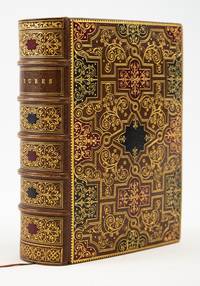
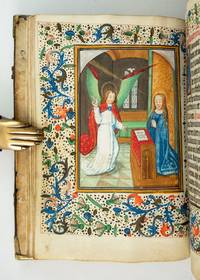
1470CLe2501Low Countries probably Bruges ca. 1470-80. 186 x 135 mm. 7 3/8 x 5 1/4". Single column 20 lines in a gothic book hand. i blank 108 i blank leaves bound too tightly for a close collation but APPARENTLY COMPLETE. Contents: Calendar f. 1r; Gospel Lessons f. 7r; Hours of the Holy Cross f. 11r; Hours of the Holy Spirit f. 15r; Mass of the Virgin 18r; "Obsecro te" f. 21r; "O Intemerata" f. 23r; Suffrages f. 24r; Hours of the Virgin f. 33r; Office of the Virgin as said throughout Advent f. 71r; Penitential Psalms f. 76r; Litany and petitions f. 81v; Office of the Dead f. 87r. <br/> HANDSOME RENAISSANCE ENTRELAC BINDING upper joint and parts of spine very skillfully repaired covers with a gilt floral border surrounding a central panel of gilt strapwork design with traces of original polychrome painting raised bands spine gilt in compartments original bosses and catchplates clasps renewed all edges gilt. Rubrics in red numerous one-line initials in blue with red penwork or gold with dark purple penwork many two-line initials in burnished gold on pink and blue ground with white highlights most of these with floral sprays extending into the margins 22 SMALL MINIATURES measuring approximately 45 x 37 mm. each with panel borders of colorful acanthus and flowers at the top and bottom of the page connected by a strand of gilt bezants and 14 FULL-PAGE MINIATURES each surrounded by a full border of acanthus flowers and bezants the facing pages also with full borders and a large six-line initial painted pink or blue filled with swirling vines and flowers on gilt and painted ground. Subjects of the large miniatures being: Crucifixion f. 10v; Pentecost f. 14v; Virgin and Child f. 17v; Annunciation f. 32v; Visitation f. 42v; Nativity f. 49v; Annunciation to the Shepherds f. 52v; Adoration of the Magi f. 55v; Presentation in the Temple f. 58v; Massacre of the Innocents f. 61v; Flight into Egypt f. 66v; Coronation of the Virgin f. 70v; David in Prayer f. 75v; Raising of Lazarus f. 86v. Front pastedown with a 16th century inscription see below; rear pastedown with a 17th century ownership inscription in ink signed François le Paige. Lower joint a bit rubbed margins with a little soiling and occasional wrinkle fore-edge border rule just grazed by binder in a few places the other borders quite ample miniatures with tiny chips light fading or rubbing in a couple places etc. but IN EXCELLENT CONDITION the attractive period binding very well preserved with boards showing virtually no signs of wear the vellum generally clean and bright and the miniatures fresh and richly colored.<br/> <br/> This is an extensively illustrated Book of Hours preserved in an especially attractive early binding with richly colored miniatures attributed to the Master of Philip of Cleves' "Book of the Hunt." Active in the Low Countries from approximately 1470-90 this artist was patronized by some of the area's wealthiest elite and is known to have collaborated with another important illuminator called the Bruges Master of 1482. Some trademarks of our painter include faces with subtle blue shading; high arched eyebrows; thin golden halos; and women with very straight shoulder-length hair highlighted with strands of gold. Outdoor scenes often contain narrative elements in the distance such as the figures of a young David and Goliath in the miniature of King David at Prayer or pagan idols dropping from a column in the Flight into Egypt recalling a popular apocryphal tale of pagan relics miraculously falling to pieces as the Holy Family passes by. Some miniatures of note in addition to these two are the Raising of Lazarus for the Office of the Dead--a popular alternative to funeral images particularly among Flemish illuminators--and the Massacre of the Innocents for the hour of Vespers a particularly violent episode in which King Herod commands his soldiers to slaughter the male infants of Bethlehem. Like other miniatures in this work the action in these scenes is spread out between the fore middle and background creating a multi-layered narrative that invites the eye to explore and meditate. The artist's color palette in this manuscript is quite memorable and includes a bright mustard yellow pale green and cherry blossom pink. The Coronation of the Virgin makes particularly strong use of color with a sunset-like gradient giving way to billowy blue clouds. The Annunciation miniature also demonstrates the Master's facility with color; here the Angel Gabriel's red and green wings are fully extended while the Virgin is radiant against a golden yellow wall covering. In addition to the large compositions we are treated to 22 smaller miniatures depicting the Evangelists and saints each of which is charming in its more confined presentation. Although the saints found in the Suffrages are quite typical for a Book of Hours the Calendar is another story. Despite being rather sparsely filled out the calendar here includes several feast days some of them unusual enough to provide additional insight into the manuscript's localization and use. For example there is St. Landoaldi 19 March a missionary to Northern France and Belgium and St. Winnoc 6 November the son of a Breton king with a former abbey in the far north of France. The calendar is idiosyncratic in other ways as well with saints' names that are repeated and others that are either extremely obscure or whose dates seem to be wrong. Whatever the case additional research into the calendar would undoubtedly prove revealing. We are fortunate to have some early provenance information written into this Book of Hours. The inscription on the front pastedown reads: "This last day of September 1590 we name erased but Claude le Paige lieutenant of the guards of his highness of Bar le Duc on the one hand and Alix de la Taxe on the other hand have married in front of the holy Catholic church at the place of Mirecourt." Below this inscription are notes indicating the ages of the bride and groom 17 and 36 respectively as well as the dates of their deaths: he died on 9 May 1610 and she on 14 September 1622. Located in the strategically important Meuse region in northeastern France the Duchy of Bar-le-Duc unified with Lorraine in 1480 and became extremely wealthy during the 16th century. Although we do not know for whom the manuscript was originally made it seems quite possible that it was commissioned for a forebear of the named Bar-le-Duc spouses and was perhaps passed down through later generations of the family. The signature on the pastedown indicates that François le Paige son of Claude and Alix inherited the book from his parents. This manuscript was lavishly and tastefully bound early in the 16th century and has survived in excellent condition to the present day. This binding would originally have been painted but even without its original colors it is still quite attractive perhaps even splendid. In excellent condition inside and out the manuscript is a fortunate survival and a testament to generations of careful stewardship. unknown
ST20295Northern France probably Paris third quarter of 15th century. 130 x 100 mm. 5 1/8 x 3 7/8". Single column 15 lines in an elegant gothic book hand. 280 leaves. First four leaves misbound lacking at least seven leaves five of which probably contained miniatures. Contents: Devotion to the Passion f. 1r; blank f. 4; Calendar f. 5r; Gospel Lessons f. 17r; "Obsecro te" and "O intemerata" f. 23r; blank f. 23; Hours of the Virgin lacking opening leaves for Terce Nones and Vespers f. 33r; Penitential Psalms and Litany f. 100r; Hours of the Cross lacking preliminary leaf f. 120r; Hours of the Holy Spirit p. 123r; Office of the Dead lacking preliminary leaf f. 127r; "Sept Vers de Saint Bernard" and Suffrages f. 176v; series of devotional prayers in Latin and French including the Hours of the Conception an indulgence devotional poems in French prayers for specific occasions such as when facing tribulations going to confession protection against storms and for friends abroad the Stabat Mater the Seven Joys of the Virgin Gospel sequences "Le chemin de paradis" and many others f. 199r; blank f. 280. <br/> ESPECIALLY BEAUTIFUL MID-19TH CENTURY LIGHT BROWN MOROCCO LAVISHLY GILT IN THE "FANFARE" STYLE BY CAPÉ stamp-signed in gilt on front turn-in covers with large green and red morocco inlaid panels gilt strapwork scrolling and small star tools raised bands spine compartments with red or green morocco inlay surrounded by gilt scrolling embellishments gilt lettering RED MOROCCO DOUBLURES gilt in the style of Duodo with repeating pattern of flowers encircled by vines marbled endleaves modern paper and vellum flyleaves all edges gilt. Housed in a fine suede-lined pebble-grained leather pull-off case with gilt lettering on spine. Light red ruling and rubrics numerous line-fillers in blue and pink with gilt embellishments many one- and two-line initials in burnished gold on pink and blue ground three four-line initials in pink or blue filled with ivy leaves on a burnished gold ground two of these with a gilt and painted baguette along the outer edge of text and all with a three-quarter border of hairline vines flowers acanthus and gold leaves the majority of the leaves with a panel border of hairline vines and flowers on one side one historiated initial painted blue on a burnished gold ground depicting the Virgin accompanied by a gilt and painted baguette and three-quarter border FOUR SMALL MINIATURES DEPICTING THE APOSTLES each with a gilt and painted baguette and surrounded by a three-quarter border and EIGHT LARGE ARCH-TOPPED MINIATURES above a three-line initial painted blue or pink on gold ground a gilt "L" shaped bar border incorporating colorful flowers and a full border of border of hairline vines flowers acanthus and gold leaves and A HALF-PAGE RECTANGULAR MINIATURE with a border along the lower half. The subjects of the large miniatures include: the Mass of St. Gregory f. 1r; Annunciation f. 33r; Visitation f. 57r; Nativity f. 70r; Adoration of the Magi f. 80v; Crowning of the Virgin f. 94v; David in Prayer f. 100r; Pentecost f. 123r; and a rectangular miniature of the Holy Wound or perhaps the Bleeding Host of Dijon f. 241v. Isolated light rubbing and negligible chips to miniatures the dark blue paint appearing slightly worn in places as is often the case occasional faint smudges to borders and other imperfections but all of these trivial. IN THOROUGHLY FINE CONDITION INTERNALLY--the paint fresh the vellum clean and the margins quite comfortable--AND THE EXTRAORDINARILY FINE BINDING FLAWLESS.<br/> <br/> In a spectacular 19th century binding this lovely thick little Book of Hours was executed by a talented follower of Maître François and the Master of Jean Rolin and contains a large number of prayers and devotional texts many of them in French. The manuscript includes a fine array of large and small miniatures executed with a colorful palette and careful attention to detail. Particularly noteworthy is the excellent molding of faces. Each figure--no matter their station or importance to the scene--displays unique characteristics that give us a sense of their age sentiments and demeanor. This is an impressive feat given the small scale of the compositions and this individualization adds a great deal of value to the miniatures as well as the viewer's emotional experience connecting to the images. Our artist owes much to the work of the so-called Maître François and slightly before him the Master of Jean Rolin the latter an eponym attached to the illuminator of missals done for Rolin cardinal-bishop of Autun d. 1483. Perhaps of Burgundian origin the Master of Jean Rolin completed his artistic education in Paris probably in the workshop of the Bedford Master and afterward established his own atelier in Burgundy. There he played a key role in the transition from the Bedford Master's slightly more gothic style to the more thoroughly Renaissance style of Maître François who ran the most successful Parisian workshop during the years between 1460 and 1480 producing illuminated manuscripts small and large sacred and secular. Characteristic of Maître François's style are richly colored scenes interiors depicted with considerable detail women and children with pale porcelain complexions and male figures with darker weathered flesh tones--all of which can be seen in the present work. The final miniature present in this work however seems to have been executed by a different artist altogether being rather more flat in appearance and without the detailed facial molding noted earlier. About two-thirds of the manuscript follows fairly regular arrangement of texts with the exception of the Mass of St. Gregory which is misbound at the beginning of the volume. Then following the Suffrages are approximately 80 leaves of devotional texts in Latin and French including popular verses such as the "Seven Joys of the Virgin" and the "Stabat Mater" as well as more unusual texts such as the Hours of the Conception prayers for specific occasions or protections--for example against storms "Contre tempeste" and when one passes over water "Quant on passe par eaue"--indulgences and other related texts. Two of the more interesting passages are "Le chemin de paradis" a French prayer beginning "Qui en paradis veult aller" and a series of Latin poems that claim to be copied from originals found at the church of St. Paul in Rome. These copious additional prayers suggest a high degree of customization for a client who may have been particularly religious or at least very concerned with self-preservation! and they present intriguing possibilities for further study. The manuscript was rebound sometime in the middle years of the 19th century by Capé d. 1867 one of the most distinguished binders in France in his day. He was especially well known for the delicacy of his work which can be observed to great effect in the present example. He was the binder to the Empress Eugenie and Béraldi calls him "the Bozérian of the second Empire." His work has always been highly sought after and it resides in all of the great collections where bindings are considered important. This volume seems to have been sold to bookseller Francis Edwards as lot no. 95 at Sotheby's sale on 3 April 1957 and has been in private hands ever since. The manuscript is a little jewel inside and out and has obviously been a treasured vessel of prayer and art for generations of owners. unknown
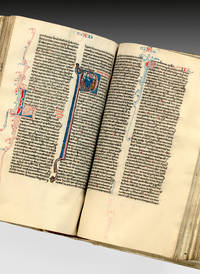
ABAA25-1<p>Northern France probably Paris 1230-1250.</p><p>12mo 140 x 93 mm of 1 658 ll.: 1-1524 1620 17-2224 2310 24-2524 2617 without the bl. l. xviii 2726 2828 295 without the bl. l. vi. <strong>Thus complete</strong>.</p><p>Double column of 47 lines written in brown ink in a very fine Gothic writing.</p><p>Justification: 92 x 60 mm.</p><p><strong>78 historiated initials</strong>. Quires numbered in Roman numerals at the foot of the back of the last ll. and signatures at the bottom corner of the text on each recto of the first half of a quire headings in red initials in red letters of running titles and chapters numbers alternately in red or blue initials of chapters on 2 lines alternately in red or blue with a decor of the opposite color initials of 5 to 7 lines at the beginning of the prologues of the same type but with decoration in two colors opening the prologues 78 historiated initials most decorated with foliage and dragons the extension of 29 of them forming borders decorating the margin painted in blue pink orange-red and yellow a few wormholes in the first l. a few running titles cropped last l. restored in the outer margin.</p><p>Stiff vellum gilt Greek roll-stamp around the covers flat spine decorated green morocco lettering piece gilt edges from the 19th century.</p><p>Superb Capetian manuscript from the School of Paris complete and of perfect freshness handwritten on vellum skin and illuminated with exquisite finesse between 1230 and 1250.</p><p><u>Text</u>: List of Books of the Bible: recto and verso of the first endpaper; the Vulgate with the preamble: ll. 1-599v; Interpretation of the Hebrew names: ll. 600-658.</p><p>Superb example of the small vulgate bibles produced in Paris in the 13th century.</p><p>It was in the 13th century in Paris that the masters of theology of the University established what was to become the standard form of the Latin Bible: the selection of the books their order and their division into chapters established by Stéphane Laugton still universally employed the insertion of the forewords of St Jerome and the interpretation of the Hebrew names.</p><p>All these characteristics are present in this very elegant Bible on very thin vellum skin.</p><p><u>Illuminations</u>: A masterpiece from Pierre de Bar's workshop active in Paris between 1230 and 1250 distinguishes itself by the particularly colored and bright shades of its illuminations; the usual whites pinks and blues are enriched with red orange and even more surprisingly by large areas of yellow.</p><p>This Bible contains 78 illuminations of great beauty and of amazing freshness.</p><p>The repertoire of decorative details is peculiar compared to other French illuminations of the time and the foliage contains small clover leaves.</p><p>Branner attributed the illustration of the manuscript to the Parisian workshop that illustrated the most outstanding illuminated manuscripts of the first half of the 13th century Bar's workshop with reference to Cardinal Pierre de Bar 1252 who gave to the Abbey of Clairvaux a Bible in four volumes issued from this workshop and preserved today under the reference Troyes Bibliothèque municipale ms. 106 108 110 and 111.</p><p>This manuscript can be dated from 1230-1250. Remarkable for its large and well-formed heads; the bodies are robust and covered with clothes with deep and dark folds R. Branner <em>Manuscript Painting in Paris during the Reign of Saint Louis</em> 1977 pp. 70-71. He dates the activity of Pierre de Bar's workshop between 1230-1250 and explains its specificities by suggesting the development of its style outside Paris.</p><p>The decoration of the manuscript consists of 78 historiated illuminated initials and a great number of capital letters rubricated in red or blue.</p><p>This very attractive bible seems to have been made in Paris; it represents an interesting addition to the production of a workshop producing according to Branner some of the most beautiful and refined Parisian illuminations of the first half of the 13th century.</p><p>We witness from the years 1220-1230 under the reign of Queen Blanche of Castile a concentration of illuminators in Paris at the expense of abbeys and provincial capitular schools. We can indeed attribute several manuscripts to Blanche of Castile who inaugurated the tradition of female patronage in the royal family. But the peak of these famous small Capetian bibles happened during the reign of Saint Louis.</p><p>The subjects of the historiated initials are the following:</p><p>l. l St Jerome Prologue; l. 4 The 7 days of Creation Genesis; l. 27 Moses leading his people across the Red Sea Exodus; l. 43 the Jews offering a sacrifice; l. 54 Moses preaching; l. 72 Moses receiving the Tablets of Stone; l. 89 God talking to Joshua; l. 99 Gideon holding his sword; l. 110 Elimelech and Naomi migrating to Moab Ruth; l. 112v Beheading of Eli; l. 128 Beheading of Amalekite before David; l. 141 David's servant bringing Abishag to him; l. 155v Ahaziah falling from a tower; l. 170v the Patriarchs; l. 185 Solomon enthroned; l. 202 The Construction of the Temple; l. 207 Nehemiah presenting the golden cup to Artaxerxes; l. 213v Spraying of the Temple; l. 220v Tobias; l. 225v Judith beheading Holofernes; l. 232 Ahasuerus being merciful to Esther; l. 238v Job on the manure heap; l. 251 David playing the harp; l. 256 anointing of David by Samuel; l. 258v David showing his mouth; l. 261 madman holding the stick and the bread Psalm 52; l. 264 God above David below in the water Psalm 68; l. 268 David ringing the bells Psalm 80; l. 271v Two Singers Psalm 97; l. 275 The Trinity Psalm 109; l. 283v Solomon whipping a young man; l. 294v Solomon teaching to a young man; l. 298 Madonna and Child Enthroned; l. 299v Solomon and a young man carrying a sword; l. 307v Ecclesia; l. 328 Isaiah being sawn in half; l. 353 Stoning; l. 381 Baruch writing; l. 384v Ezekiel in bed with the Tetramorph; l. 412 Daniel in the lions' den; l. 423v Hosea and Gomer; l. 427v Joel preaching to a group of Jews; l. 429v Amos offering the sheep; l. 432v God appearing to Obadiah; l. 433v Jonah in the mouth of the whale; l. 434v the teaching Prophet; l. 437 Nahum lamenting about the fall of Nineveh; l. 438v Habakkuk and the stones; l. 440 the Prophet with his scroll; l. 441v Two Prophets; l. 442v Prophet; l. 447 Two men talking; l. 449 Beheading of the idolatrous Jew; l. 466 the Messenger delivering the letter; l. 478v the Tree of Jesse; l. 494v Saint Mark with the lion; l. 505 Saint Luke with the angel; l. 521v Saint John; l. 535 Saint Paul carrying the cross; l. 541 Saint Paul carrying a sword; l. 546v Saint Paul carrying a sword and a scroll; l. 551 Saint Paul carrying a sword and a book; l. 555 Saint Paul carrying a sword; l. 556v Saint Paul carrying a sword and a book; l. 558 Saint Paul carrying a sword; l. 559 Saint Paul carrying a sword; l. 560 Saint Paul carrying a sword; l. 561v Saint Paul carrying a sword; l. 562v Saint Paul carrying a sword; l. 561v Saint Paul carrying a sword; l. 562v Saint Paul carrying a sword; l. 563v Saint Paul carrying a sword; l. 564 Two men talking; l. 568v. Ascension; l. 585 Jacob holding a book; l. 586v Saint Peter seated holding a book; l. 588 Saint Peter holding a key; l. 589 Saint John writing; l. 590v Saint John; l. 591 Saint John; f. 591 Saint Jude; l. 592 Saint John writing.</p><p>This complete bible dated from 1230-1250 is a masterpiece of Capetian illumination produced under the reign of Saint Louis.</p><p>Provenance:</p><p>- <em>Jean Tornone</em>: doctor from Burgundy: inscription on the verso of the endpaper mentioning his gifting of the book to <em>Stroyff</em>.</p><p>- <em>Assuerus Stroyff</em>: inscription mentioning his reception of the book by Tornone then his gift to <em>Johan Baron de Bronckhorst.</em></p><ul><li><em>Johan Baron de Bronckhorst</em> and <em>Batenburg de Guelders</em>: inscription dated from 1574 mentioning his receipt of the book.</li></ul><p><strong>FR</strong></p><p>Nord de la France probablement Paris 1230-1250.</p><p>In-12 de 1 658 ff. : 1-1524 1620 17-2224 2310 24-2524 2617 sans le f. blanc xviii 2726 2828 295 sans le f. blanc vi. <strong>Ainsi complet</strong>.</p><p>Double colonne de 47 lignes écrites à l'encre brune dans une très fine écriture gothique.</p><p>Justification : 92 x 60 mm.</p><p><strong>78 initiales historiées</strong>. Cahiers numérotés en chiffres romains au pied des versos des derniers ff. et signatures au pied du coin inférieur du texte sur chaque recto de la première moitié d'un cahier rubriques en rouge initiales en rouge lettres des titres courants et numéros des chapitres alternativement en rouge ou bleu initiales des chapitres sur 2 lignes alternativement en rouge ou bleu avec un décor de la couleur opposée initiales de 5 à 7 lignes au début des prologues du même type mais avec des décors des deux couleurs ouvrant les prologues 78 initiales historiées la plupart ornées de feuillage et de dragons le prolongement de 29 d'entre elles formant des bordures décorant la marge peintes en bleu rose orange-rouge et jaune qq. trous de vers ds. le premier f. atteinte à qq. titres courants dernier f. restauré ds. la marge extérieure.</p><p>Vélin rigide du XIXe siècle encadrement d'une roulette grecque dorée autour des plats dos lisse orné pièce de titre de maroquin vert tranches dorées.</p><p>140 x 93 mm.</p><p><strong>Superbe manuscrit capétien de l'école de Paris complet et de parfaite fraicheur calligraphié sur peau de vélin et enluminé avec une exquise finesse entre 1230 et 1250.</strong></p><p><u>Texte</u> : Liste des Livres de la Bible : recto et verso de la première garde ; la Vulgate avec le préambule : ff. 1-599v ; Interprétation des noms hébreux : ff. 600-658.</p><p><strong>Superbe exemple des petites bibles vulgates produites à Paris au XIIIe siècle.</strong></p><p>C'est au XIIIe siècle à Paris que les maîtres de théologie de l'Université établirent ce qui devait devenir la forme standard de la Bible latine : la sélection des livres et de l'ordre de ceux-ci et leur division en chapitres établies par Stéphane Laugton et encore universellement employée l'insertion des prologues de St Jérôme et l'interprétation des noms hébreux.</p><p>Toutes ces caractéristiques sont bien présentes dans cette très élégante Bible sur peau de vélin très fine.</p><p><u>Enluminures</u> : Chef-d'œuvre de l'atelier de Pierre de Bar actif à Paris entre 1230 et 1250 il se distingue par les teintes de ses enluminures particulièrement colorées et vives ; les habituels blancs roses et bleus sont enrichis de rouge orange et de manière plus surprenante encore par de larges zones de jaune.</p><p><strong>Cette Bible possède 78 enluminures d'une grande beauté et d'une étonnante fraicheur.</strong></p><p>Le répertoire de détails décoratifs est particulier en comparaison des autres enluminures françaises de cette époque et le feuillage comporte des petites feuilles de trèfle.</p><p><strong>Branner a attribué l'illustration du manuscrit à l'atelier parisien qui a illustré les plus remarquables manuscrits enluminés de la première moitié du XIIIe siècle l'atelier de Bar</strong> par référence au cardinal Pierre de Bar 1252 qui donna à l'abbaye de Clairvaux une Bible en quatre volumes provenant de cet atelier et conservés aujourd'hui sous les cotes Troyes Bibliothèque municipale ms. 106 108 110 et 111.</p><p>On peut dater le présent manuscrit de 1230-1250. Remarquable par ses têtes larges et bien formées ; les corps sont robustes et recouverts de draperies aux plis profonds et sombres. R. Branner <em>Manuscript Painting in Paris during the Reign of Saint Louis</em> 1977 pp. 70-71. Il date l'activité de l'atelier de Pierre de Bar entre 1230-1250 et explique ses spécificités en suggérant la formation se son style en dehors de Paris.</p><p><strong>La décoration du manuscrit comprend 78 initiales historiées enluminées et d'innombrables capitales rubriquées en rouge ou bleu.</strong></p><p>Cette bible très séduisante semble avoir été réalisée à Paris ; elle représente un ajout intéressant à la production d'un atelier considéré par Branner comme produisant certaines des enluminures parisiennes les plus belles et les plus raffinées de la première moitié du XIIIe siècle.</p><p>On assiste à partir des années 1220-1230 sous le règne de la reine Blanche de Castille à une concentration des artistes enlumineurs à Paris au détriment des abbayes et des écoles capitulaires de province. On peut en effet imputer plusieurs manuscrits à Blanche de Castille qui inaugura la tradition du mécénat féminin dans la famille royale. Mais l'apogée de ces célèbres petites bibles capétiennes se situe sous le règne de Saint Louis.</p><p>Les sujets des initiales historiées sont les suivants :</p><p>f. l St Jerome Prologue ; f. 4 Les 7 jours de la Création Genèse ; f. 27 Moïse conduit son peuple à travers la Mer Rouge Exode ; f. 43 les Juifs offrent un sacrifice ; f. 54 Moïse preche ; f. 72 Moise reçoit les tables de la Loi ; f. 89 Dieu s'adresse à Joshua ; f. 99 Gédéon tient son épée ; f. 110 Elimelech et Naomi migrent à Moab Ruth ; f. 112v Décapitation d'Eli ; f. 128 Décapitation d'Amalekite devant David ; f. 141 le serviteur de David lui amène Abishag ; f. 155v Ahaziah tombe d'une tour ; f. 170v Les trois juifs patriarches ; f. 185 Salomon intronisé ; f. 202 La Construction du Temple ; f. 207 Néhémie présentant la coupe d'or à Artaxerxès ; f. 213v Aspersion du Temple ; f. 220v Tobias ; f. 225v Judith décapitant Holopherne ; f. 232 Assuérus se montre clément envers Esther ; f. 238v Job sur le tas de fumier ; f. f. 251 David joue de la harpe ; f. 256 onction de David par Samuel ; f. 258v David montre sa bouche ; f. f. 261 fou tenant le bâton et le pain psaume 52 ; f. 264 Dieu au-dessus David dans l'eau dessous Psaume 68 ; f. 268 David sonnant les cloches Psaume 80 ; f. 271v Deux chanteurs Psaume 97 ; f. 275 La Trinité Psaume 109 ; f. 283v Salomon fouette un jeune ; f. 294v Salomon enseigne à un jeune ; f. 298 La Vierge et l'Enfant intronisé ; f. 299v Salomon et un jeune portant une épée ; f. 307v Ecclésia ; f. 328 Isaïe est scié en deux ; f. 353 Lapidation ; f. 381 Baruch écrivant ; f. 384v Ezéchiel au lit avec le Tétramorphe ; f. 412 Daniel dans la fosse aux lions ; f. 423v Osée et Gomer ; f. 427v Joel prechant à un groupe de juifs ; f. 429v Amos offre le mouton ; f. 432v Dieu apparait à Obadiah ; f. 433v Jonas dans la bouche de la baleine ; f. 434v le Prophète enseignant ; f. 437 Nahum se lamente sur la chute de Nineveh ; f. 438v Habakuk et les pierres ; f. 440 le Prophète avec son rouleau ; f. 441v Deux Prophètes ; f. 442v Prophète ; f. 447 Deux hommes en discussion ; f. 449 Décapitation du juif idolâtre ; f. 466 le Messager livre la lettre ; f. 478v l'Arbre de Jessé ; f. 494v Saint Marc avec le lion ; f. 505 Saint Luc avec l'ange ; f. 521v Saint Jean ; f. 535 Saint Paul portant la croix ; f. 541 Saint Paul portant une épée ; f. 546v Saint Paul portant une épée et un rouleau ; f. 551 Saint Paul portant une épée et un livre ; f. 555 Saint Paul portant une épée ; f. 556v Saint Paul portant une épée et un livre ; f. 555 Saint Paul portant une épée ; f. 556v Saint Paul portant une apée et un livre ; f. 558 Saint Paul portant une épée ; f. 559 Saint Paul portant une épée ; f. 560 Saint Paul portant une épée ; f. 561v Saint Paul portant une épée ; f. f. 562v Saint Paul portant une épée ; f. 561v Saint Paul portant une épée ; f. 562v Saint Paul portant une épée ; f. 563v Saint Paul portant une épée ; f. 564 Deux hommes en discussion ; f. 568v. Ascension ; f. 585 Jacob tenant un livre ; f. 586v Saint Pierre assis tenant un livre ; f. 588 Saint Pierre tenant une clef ; f. 589 Saint Jean écrivant ; f. 590v Saint Jean ; f. 591 Saint Jean ; f. 591 Saint Jude ; f. 592 Saint Jean écrivant.</p><p><strong>Cette bible complète datée de 1230-1250 est un chef-d'œuvre de l'enluminure capétienne réalisée sous le règne de Saint Louis.</strong></p><p>Provenance :</p><p>- <em>Jean Tornone</em> : docteur bouguignon : inscription au verso de la garde mentionnant son présent du livre à Stroyff.</p><p>- <em>Assuerus Stroyff</em> : inscription mentionnant sa réception du livre par Tornone puis son présent à Johan Baron de Bronckhorst.</p><p>- <em>Johan Baron de Bronckhorst</em> et <em>Batenburg de Guelders</em> : inscription datée de 1574 mentionnant sa réception du livre.</p> hardcover