153 résultats
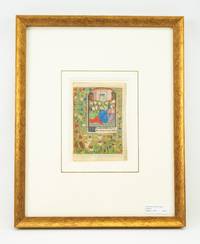
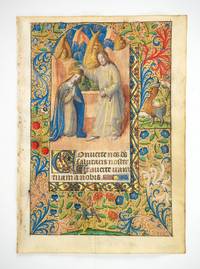
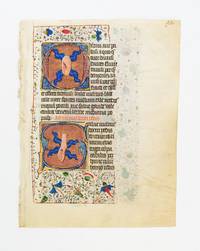
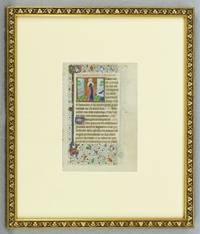
1465ST11151bBruges ca. 1465. 181 x 127 mm. 7 1/8 x 5". Single column 19 lines in a careful pleasing gothic book hand. <br/> In a very attractive new gilt wooden frame. Rubrics in pink or faded red one two-line initial in blue magenta and burnished gold two lines with undulating line fillers in blue and gold both sides of the leaf with a three-quarter panel border incorporating foliage blossoms and ivy leaves on hairline stems the vertical part of this frame with a bar border composed of colors and burnished gold terminating at top and bottom in colorful acanthus leaves and WITH TWO SMALL BUT VERY PLEASING MINIATURE PAINTINGS SAINT ELIZABETH ON THE RECTO AND SAINT GERTRUDE ON THE VERSO. ◆Tiny wormhole in fore edge where it has done negligible damage small portions of the blue paint in the Elizabeth miniature eroded gray paint slightly smeared as well but apparently at the time of painting otherwise in fine clean fresh condition.<br/> <br/> This leaf is characteristic work from the circle of Willem Vrelant the leading purveyor of books of private devotion in Bruges during the third quarter of the 15th century. His leading position among Flemish illuminators of the time is indicated by the considerable number of manuscripts illustrated in his manner by other miniaturists both in Bruges and in nearby cities in Flanders. The illuminator of our Book of Hours shows a number of distinctive stylistic traits. Among these are a preference for boldly patterned cloth backdrops tessellated flooring landscapes filled with stylized bushes and trees and persisting prominent architectural constructions that frame the subject frequently in a corner in these leaves it is a waist-high outdoor wall or an indoor feature resembling wainscoting. The inclination for strong geometrical patterning is manifested in the artist's angular treatment of human figures and their garments. Dressed in pink and blue Elizabeth is depicted with a sweet round face. She is saluted here as the woman worthy to be the mother of John the Baptist the forerunner of the Redeemer. Gertrude is dressed in monastic black although a pink undergarment is visible and her inky habit is trimmed in gold. This shimmering feature is a reminder that Gertrude 626-59 was the daughter of Pepin I of Landen Mayor of the Palace for the Frankish realm of Austrasia and the forebear of Charlemagne. Gertrude is a natural choice for illustration by an artist of Bruges since she was the patron of nearby Nivelles. The saint was routinely invoked for aid in coping with mice and is here shown surrounded by four animated rodents as black as her habit. No legend survives to explain why she had such power over the creatures who seem here to be more her pets one climbs her staff of office than her victims. unknown
1910ST14374England ca. 1910. 392 x 287 mm. 15 3/8 x 11 1/4". 32 leaves with text in an attractive italic hand all separated by tissue guards. <br/> SUMPTUOUS OLIVE GREEN STRAIGHT-GRAIN MOROCCO ELABORATELY GILT BY ZAEHNSDORF stamp-signed on front doublure and with their exhibition stamp on rear turn-in covers with densely stippled floral roll border enclosing a large frame formed by drawer handle tools and floral tools on a stippled ground; central panel with large cornerpieces rampant with flower tools circlets volutes and much stippling; raised bands spine compartments heavily gilt in a similar style gilt titling RED MOROCCO DOUBLURES with opulent dentelle frame surrounded by gilt-tooled green morocco turn-ins red watered silk endleaves with gilt edging all edges gilt.ma WITH 76 BLACK & WHITE PHOTOGRAPHIC REPRODUCTIONS OF PORTRAIT MINIATURES BY RICHARD COSWAY ANDREW PLIMER AND OTHERS mounted and enclosed by hand-painted burnished gold frames EACH PORTRAIT WITH HAND-ILLUMINATED TITLE in red blue green and burnished gold. Verso of front endleaf with book label of Thomas Agnew & Sons Old Bond Street Library. A bit of wear to front joint a little rubbing to extremities occasional mild rumpling to head or tail of vellum leaves isolated small marginal smudges otherwise a fine specimen the vellum creamy and bright the illuminations shining and the binding quite sound and lustrous with gold.<br/> <br/> Composed of vellum leaves this is a unique luxurious catalogue of a miniatures collection with delicate script lovely illumination and a stately binding by one of London's foremost workshops. State-of-the-art photographic reproductions of mostly 18th century miniatures are juxtaposed here with calligraphy and illuminations harking back to Medieval bookmaking. Each portrait is surrounded by a gold frame and accompanied by a hand-written description with an illuminated title giving biographical details of known subjects and a physical description of the miniatures whenever they are labelled simply "Portrait of a Lady" or "Portrait of a Gentleman." The scale of this production--which is nearly twice the size of most illuminated manuscripts of the early 20th century--and the splendor of the binding point to a patron of considerable means likely either the proprietors of or a client of the Agnew art dealers. The Agnew firm began as printsellers in Manchester in 1817 but over the course of the 19th century became one of the principal British galleries under the leadership of the founder's son William. A London branch opened in 1860 and the Bond Street flagship in 1875. William Agnew 1825-1910 did much to foster the careers of British artists Holman Hunt Frederick Leighton and Edward Burne-Jones and his clients included Henry Tate whom he encouraged to found the celebrated Tate Gallery. The binding here is a superb example of the work of the Zaehnsdorf firm long a top-ranked English bindery. Born in Pest Hungary Joseph Zaehnsdorf 1816-86 served his apprenticeship in Stuttgart worked at a number of European locations as a journeyman and then settled in London where he was hired first by Westley and then by Mackenzie before opening his own workshop in 1842. His son and namesake took over the business at age 33 when the senior Joseph died and the firm flourished under the son's leadership becoming a leading West End bindery. Over the years Zaehnsdorf employed a considerable number of distinguished binders including the Frenchman Louis Genth who was chief finisher from 1859-84 and trained a number of others including Roger de Coverly and Sarah Prideaux. A family-run business until 1947 the Zaehnsdorf bindery continued to produce consistently attractive and innovative designs executed with unfailing skill. It is generally understood that the firm reserved the use of its oval stamp showing a binder at work seen here for their finest bindings including those entered in exhibitions. unknown
1882ST12705Paris: A. Quantin 1882. UNIQUE COPY ON VELLUM printed for M. A. Werlé. 206 x 140 mm. 8 1/8 x 5 1/2". xxxii 247 pp. 1 leaf colophon.With a bio-bibliographical notice by Fernand Drujon. <br/> Pleasing burgundy Jansenist crushed morocco by Canape et Corriez stamp-signed in gilt on front turn-in dated 1930 on rear turn-in raised bands turn-ins richly gilt marbled endpapers all edges gilt on the rough. Decorative head- and tail-pieces throughout and eight engraved plates comprised of a frontispiece portrait in four states one on vellum three on paper and an allegorical vignette also in four states. Verso of front free endpaper with ex-libris of Jean Furstenberg. ◆Two small dark spots to upper cover a couple of leaves with naturally occurring minor discoloration to vellum but A FINE COPY--especially clean fresh and bright internally and in a lustrous unworn binding.<br/> <br/> Given its illustrious provenance and its singular status as the only copy printed on vellum this is a quintessentially bibliophilic copy of the poems of French cleric and diplomat Cardinal François-Joachim de Pierre de Bernis 1715-94. Admired as a witty epigrammist at the court of Louis XV where Madame de Pompadour presided Bernis composed poems on such conventional themes as love and the natural world but also verses contemplating manners and mores fashion independence and love of country. Since none of his poems was published before his death he was not widely known as a poet during his lifetime but in another sphere he performed important service to his country as France's ambassador to Rome. He provided shelter and succour there for refugees from the French Revolution earning the papal epithet "Protector of the Church of France." The present work was printed for Count Alfred Werlé whose father had inherited the Veuve Clicquot Champagne house from the Widow Clicquot. Alfred took over the operation in 1884 and greatly expanded the Veuve Clicquot-Ponsardin vineyards. The volume subsequently passed into the library of the great collector Jean or Hans Furstenberg 1890-1982 who put together one of the finest collections of 18th century books ever assembled. In 1974 the Furstenberg collection was sold en bloc to Dr. Otto Schäfer whose marvelous library had already become distinguished for its fine and historic bindings. A. Quantin unknown
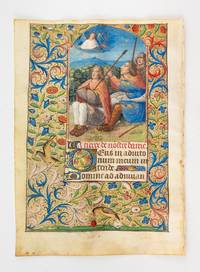
1500ST20810PParis ca. 1500. 165 x 117 mm. 6 1/2 x 4 5/8". Single column 18 lines in a gothic book hand. <br/> Rubrics in red line fillers in blue and pink with gold bezant five one-line initials in burnished gold on pink and blue ground one two-line initial in blue on gold ground with a flower in the center one three-line initial in blue filled with ivy on gold ground recto with panel border of colorful flowers vase and acanthus verso with A LARGE ARCH-TOPPED MINIATURE OF THE ANNUNCIATION TO THE SHEPHERDS surrounded by A FULL BORDER of acanthus flowers and two birds all on a painted gold ground. Slight soiling to vellum but a very well-preserved leaf in fine condition.<br/> <br/> From what was surely a costly Book of Hours this leaf features a charming and skillfully painted miniature of the Annunciation to the Shepherds attributable to the workshop of Jean Pichore fl. ca. 1502-20 a major figure among illuminators of the period and one of the most sought-after artists in France at the turn of the 16th century. Depicting the traditional subject associated with the hour of Terce our miniature portrays as usual an angel appearing to shepherds tending their flock bringing news of the birth of Christ. Although the biblical narrative suggests that the shepherds were startled by the angel's appearance the three figures in this miniature appear remarkably unmoved--in fact only one of them seems to take any notice at all. The first shepherd sits on the ground looking straight ahead; the second holds his hands in prayer but looks little more than well prayerful at the angel in the sky; and a third figure maintains a slightly aloof expression taking no particular interest in the unfolding miraculous event. What may seem to be indifference can be explained easily enough by the artist's successful portrayal of nighttime cold! All three shepherds are thickly dressed one with his arms pressed tightly against his chest another with a hood partly covering his face and the sheep are tightly huddled together into one woolly white cluster. Another manifestation of the artist's success here is seen in the particularly well done molding of the faces with subtle shading attractively rendered features and clear individuation. Moreover although the shepherds seem essentially unmoved their garments are dusted with a glistening gold radiance from above a further subtle touch revealing a high level of achievement on the part of the painter. Finally the borders are one last source of delight with a small bird shown in mid-flight and a second one investigating a single strawberry that seems to have been placed there just for him. All of these indications of sophistication suggest that the original manuscript must have been commissioned by a patron able to pay a premium for the work of a highly skilled atelier. unknown
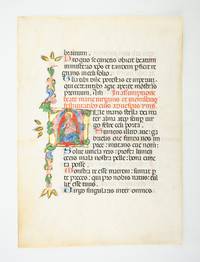
ST20973Italy 15th century. 364 x 260 mm. 14 3/8 x 10 1/4". Single column 22 lines in a rounded gothic book hand. <br/> Rubrics in red versal initials alternating red and blue with purple penwork one three-line initial in blue with purple penwork A SIX-LINE "A" DEPICTING THE ASSUMPTION OF THE VIRGIN the initial painted pink with red green and blue nodes and acanthus on a burnished gold ground with extensions running the length of the text column incorporating more acanthus and small gold embellishments with sprays of the gold leaves at the top bottom and center. A little rubbing to the paint negligible soiling and small spots to margins but in excellent condition overall.<br/> <br/> This very large handsomely preserved leaf features a strikingly attractive initial of the Virgin opening the beloved hymn "Ave Maris Stella" "Hail Star of the Sea". Dating back to at least the ninth century and traditionally associated with the hour of Vespers on Marian feast days as here the hymn praises the Virgin's purity meekness and mercy calling upon her as the "Nurturing Mother of God" to dispel evil and free us from our sins. Inside the gilt and painted initial is a lovely portrait of the Virgin who is depicted seated against a red mandorla dressed in pink and wrapped in a green and blue mantle--perhaps a reference to the colors of the ocean. Her hands are raised in prayer fingers lightly touching above her heart and her well-defined features appear both strong and serene. Judging from the size of the initial liberal use of gold and the wide margins of this leaf the original manuscript must have been a costly item produced for a wealthy church or monastery. unknown
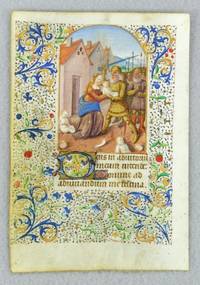
1450ST11774-85Paris ca. 1450. 159 x 108 mm. 6 1/4 x 4 1/4". Single column four lines of text on the verso 15 on the recto in a very pleasing gothic book hand. <br/> Attractively matted. Recto with a line filler in colors and gold verso with a one-line initial in burnished gold on a maroon and blue background with white tracery and a three-line "D" in blue and white enclosing a spray of violets in the same colors the capital on a burnished gold ground the same side WITH A FULL SWIRLING BORDER of acanthus leaves flowers and berries and many burnished gold ivy leaves ENCLOSING A BLOODY ILLUMINATED MINIATURE OF THE MASSACRE OF THE INNOCENTS measuring approximately 78 x 54 mm. Fore and lower margins on the side with the miniature a bit rubbed and with a faint patina reflecting frequent use also minor fading and loss of paint and gold in the same place otherwise in fine condition THE MINIATURE itself REMARKABLY WELL PRESERVED WITHOUT ANY EROSION OF PIGMENT.<br/> <br/> This leaf comes from a Book of Hours decorated by extremely skilled members of what must have been a first-class workshop. The Massacre of the Innocents cannot help but be a moving subject and the composition here as well as the painter's considerable ability add to the emotional impact in the present miniature. The center of the scene is dominated by the gold-armored gray-bearded soldier whose sword is raised over the head of a woman clinging to her son. The blood-spattered foreground is littered with the dismembered bodies of infants looking like so many broken dolls. On the left we see a row of modest cottages providing considerable depth as they recede toward distant hills. On the right stands a crowd of grim-faced soldiers all as elderly as their commander and seemingly following orders that are unwelcomed; it is perhaps the acute sadness in their faces that makes this scene especially memorable. The clear sky green fields and serene blue mountains in the distance contrast markedly with the horrific events unfolding. unknown
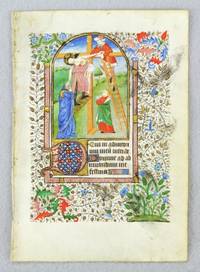
1420ST12005fFrance probably Paris ca. 1420. 210 x 146 mm. 8 1/4 x 5 3/4". Single column recto with five lines of text verso with 16 lines all in a very pleasing very regular gothic book hand. <br/> Attractively matted. Rubrics in red verso with a one-line and two two-line initials as well as a line filler in colors and burnished gold recto with a one-line initial and a line filler in the same style and with a quite large five-line "D" in pink and white with enclosed floral diapering all on a burnished gold ground the same side WITH A LOVELY FULL BORDER of swirling hairline stems bearing numerous leaves and berries of burnished gold and with sprays of acanthus leaves and flowers in multiple colors spilling from the corners this ENCLOSING A POIGNANT ARCH-TOPPED MINIATURE OF THE REMOVAL OF CHRIST FROM THE CROSS measuring approximately 85 x 60 mm. the miniature within a thin gold frame and enclosed in turn on three sides by bars in colors and gold the scene showing two men on ladders unfastening Christ's lifeless body from the cross while Joseph of Arimathea waits below clutching cloth to be used for a burial shroud as the Madonna at the lower left of the picture reaches up to clasp her son's bloody arm. With a small cross stitched in white thread in each upper corner. ◆A little soiling right along hinge edge a few smudges in the border a couple of tiny flakes of paint missing from the cross and the sky otherwise fine the vellum clean and fresh the colors rich and the gold lustrous.<br/> <br/> This is an especially sorrowful scene depicted with power grace and sensitivity by an artist demonstrating very considerable skill in composition and execution. The scene is well designed with the cross providing a device for focus at the center of the miniature. Nicodemus identified by his expensive attire is atop a ladder behind the cross lowering Christ's limp body onto the shoulder of another man probably a servant whose ladder is set against the front. Despite the fact that the corpse is more bones than flesh the artist has made it seem a heavy burden draped over the shoulder of the man as he walks backward down his ladder. Fully stretched out Christ's left arm is held for balance by Nicodemus at the top right while the other arm hangs down toward the Virgin. While we can only see her back her image evokes great pathos as she reaches up with both hands to grasp the mangled arm of her son his blood running from his hand onto hers. Joseph of Arimathea whose position anchors the right side of the picture looks on with concern tightly holding linen to shroud the body. St. John and Mary Magdalen conventional participants in the Deposition are not present in this miniature. While it is possible and even likely that the same artist produced this scene and the miniature of Christ Carrying the Cross this one is better as the faces are more deftly painted and the folds in the various garments are more clearly defined. unknown
1490ST20853France ca. 1490. 144 x 99 mm. 5 5/8 x 3 3/4". Single column recto with 14 lines in a gothic book hand. <br/> Attractively matted and framed. Rubrics in red two two-line initials one painted pink on blue ground with flowers the other painted blue and inhabited by a rampant lion on pink and gold ground recto with a panel border featuring long-stemmed flowers and owls on a pink ground verso WITH A HALF-PAGE ARCH-TOPPED MINIATURE DEPICTING PENTECOST WITH A FULL BORDER featuring a plethora of different flowers berries greenery songbirds an owl and a butterfly all ON A RICHLY PAINTED GOLD GROUND. Trimmed close on one side and just grazing a border on the opposite side very minor chipping to faces trivial signs of rubbing or wear otherwise a fine leaf--colorful bright and very pleasing to the eye.<br/> <br/> This leaf contains the customary Pentecost miniature associated with the Hours of the Holy Spirit but with several attributes that set it apart from other examples we have encountered. The miniature here depicts a densely crowded scene with the Virgin at the center surrounded by the apostles each of whom wears a burnished gold halo. Packed tightly together they gaze up at a white dove who emanates small red tongues of fire above their heads. According to biblical tradition this visitation by the Holy Ghost in the form of a dove enabled Christ's disciples to start preaching marking the beginning of the Christian Church. The artist favors an unusual pastel palette choosing pale pink for the walls and eggshell blue for some of the floor tiles as well as bright yellow muted lilac rose and lime green for the robes of the apostles. Looking more closely at the figures we see that each face is carefully individualized each with its own features and expressions. Although most crane their necks to get a view of the miracle unfolding one of the apostles looks directly out at the viewer as if surprised by our presence. Moving outside the miniature we note that the leaf features a particularly exuberant border with tangles of flowers fruit acanthus leaves and several birds including an owl in one corner. There is additional interest on the verso with another bright border painted an intense pink and filled with more flowers and owls. unknown
1500ST20810RParis ca. 1500. 163 x 115 mm. 6 1/2 x 4 1/2". Single column 18 lines in a gothic book hand. <br/> Rubrics in red line fillers in blue and pink with gold bezant six one-line initials in burnished gold on pink and blue ground two two-line initials in blue on gold ground with a flower in the center one three-line initial in blue filled with ivy on gold ground verso with panel border of colorful flowers and acanthus recto with A LARGE ARCH-TOPPED MINIATURE OF THE CORONATION OF THE VIRGIN with an "L" shaped frame of burnished gold and painted flowers and A FULL BORDER of acanthus flowers a man playing a bagpipe and a hybrid creature wearing a hat all on a painted gold ground. Very minor wrinkling to vellum but the leaf IN LOVELY CONDITION with the gold everywhere gleaming brightly.<br/> <br/> From a luxuriously appointed Book of Hours this leaf features a handsome miniature of the Coronation of the Virgin attributed to the workshop of Jean Pichore fl. ca. 1502-20 a major figure among illuminators of the period and one of the most sought-after artists in France at the turn of the 16th century. Executed with imagination and delicacy the miniature features the traditional subject associated with the hour of Compline showing the Virgin being crowned Queen of Heaven following her Death and Assumption. The composition here is quite intimate with the Virgin kneeling before her son as she accepts with humility the crown he lays upon her head. Christ is depicted barefoot and slightly bowed toward his mother in a gentle display of respect. The artist creates a wonderful backdrop for this scene composed entirely of seraphim painted gold blue light pink and green closely packed together. Two of the seraphim hold up light pink draperies behind the central figures as if to shield this tender moment from prying eyes. The borders here are a source of delight featuring a figure wearing a jester-like cap and playing the bagpipe as well as a creature with the body of a bird and the face of a human donning a rather fashionable bycocket cap. The illumination here is of high quality features a liberal use of gold and contains unique marginal details suggesting that the original manuscript must have been a costly commission for a wealthy patron. unknown
1059101350. Tuscany: c. 1350. <br /> <br /> Folio 430 x 308 mm. Single leaf. With four-line staves of music on both sides with five recto and six verso lines of text beneath. With a very fine initial 'A' in Tuscan colors. The top edge has been repaired perhaps at the time with a strip of vellum for unknown reasons perhaps a mark of ownership removed. Otherwise in very good condition generally clean and fresh and with ample margins.<br /> <br /> § A fine early Tuscan leaf being the responses and versicles for the first reading at Matins. The leaf opens: "Absterget Deus omnem lacrimam ab oculis." Provenance: Bernard M. Rosenthal 1995 with his notes; private collection San Francisco. unknown
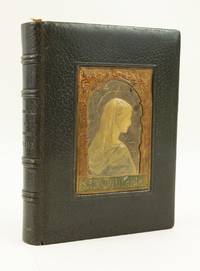
1909ST16339Paris: Bouasse-Lebel et Marrin ca. 1909. 188 x 140 mm. 7 3/8 x 5 1/2". 72 pp.; 1 leaf miniature; XXXII pp. <br/> Tasteful contemporary olive green crushed morocco each cover WITH A CENTRAL RECESSED PANEL OF MODELLED AND PAINTED LEATHER that on the upper cover with a portrait of the Virgin Mary within an arched frame of acanthus leaves that on the lower cover with the coat of arms of the Deburghgraeve family. With text and decorations lithographed featuring decorative borders and initials throughout those on 55 pages COLORED AND ILLUMINATED BY HAND many of these in a Medieval or Renaissance style others with Japanese or Greek motifs with a small hand-painted miniature of the Crucifixion against a golden sky and WITH A FULL-PAGE HAND-PAINTED MINIATURE showing the Flight into Egypt within a decorative border featuring vignettes of a peasant gathering wood and a knight in armor praying. With a hand-painted ribbon bookmark "Souvenir de ma 1ère Communion" dated 6 June 1909; carbon copy of a poem "A la Memoire de ma tres chere et regrettee cousine Mathilde Deburghgraeve-Canal" by Lucy Salze-Bouchet dated February 1945 this with short curving tear into one margin. Just the most trivial signs of wear but A VERY FINE COPY the vellum leaves quite clean and very bright with shining decorations and the binding lustrous and virtually unworn.<br/> <br/> Luxuriously lithographed on vellum handsomely bound and illuminated and painted by hand in vibrant colors this charming prayer book was obviously treasured by its owners--the first of whom may have been a young lady who received it on the occasion of her First Communion. The text and decorations here have been reproduced lithographically from a manuscript of the period being printed apparently by Bouasse-Lebel et Massin--a company specializing in devotional prints and books. The firm's name appears in very small letters at various places in the volume. Each leaf contains a different border design inspired by Medieval and Renaissance manuscripts as well as artwork from around the world in a pleasing pastiche of Western Egyptian Japanese Indian and Grecian motifs. Many of the borders have been hand-colored and present an array of distinct palettes usually richly hued which adds greatly to the book's appeal and the viewer's sense of discovery from page to page. The bespoke binding featuring the Madonna in profile beautifully modelled in leather adds another element of luxury to the book. The coat of arms suggests that it was made for a member of the Deburghgraeve family and the laid-in poem suggests that it remained with them through the death of the family's matriarch Mathilde Deburghgraeve-Canal in 1944. We know that Mathilde had three daughters all born around the turn of the century; based on the presence of a bookmark commemorating a First Communion in 1909 it is likely that the original recipient was among these three young ladies. Bouasse-Lebel was established in 1845 by Eulalie Bouasse-Lebel 1809-98 as a means of supporting herself and her children following the dissolution of her marriage. Though founded under difficult circumstances Bouasse-Lebel became a very successful enterprise and even earned a papal commendation in 1871 for consistently excellent work. The company was highly regarded for the quality and delicacy of their productions of which the present work is a choice example. Although individual religious cards printed by Bouasse-Lebel show up fairly frequently far scarcer are complete books in the estimable condition seen here--particularly those with the kind of deluxe upgrades that make this particular item so desirable. Bouasse-Lebel et Marrin unknown
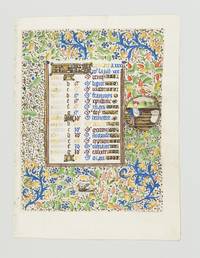
1460ST12835Paris ca. 1460. 195 x 143 mm. 7 3/4 x 5 1/2". Single column 16 lines in a gothic book hand. <br/> Minor feast days in red and blue major feasts in gold numerous gold and painted line fillers the five "A" initials and the "KL" highly decorative and painted pink and blue against a gold background gold and pink bar surrounding the text on three sides BOTH SIDES OF THE LEAF WITH EXTRAVAGANTLY DECORATIVE BOTANICAL FULL BORDERS with two small birds hidden within and INCORPORATING TWO MEDALLION MINIATURES DEPICTING THE LABOR OF THE MONTH SOWING AND THE SIGN OF THE ZODIAC SCORPIO FOR OCTOBER. ◆IN VERY FINE FRESH CONDITION with gold and paint extraordinarily bright.<br/> <br/> The extraordinarily lavish and animated full borders coupled here with extensive use of brushed and burnished gold--for major feast days for decorative border elements and even for the hundreds of seeds being sown!--suggests that this calendar folio comes from a Book of Hours that was commissioned for a person or persons of high rank since it would have been very costly. The leaf comes from a manuscript that included numerous roundels depicting the lives of St. Catherine and the more obscure St. Alexius and it is possible that the Book of Hours belonged to a husband and wife for whom these saints served as patrons. The style of the delicately painted figures especially in the roundels indicates an artist who was familiar with the early output of the Coëtivy Master who according to Avril and Renaud can be identified with Colin d'Amiens who made a great name for himself in Paris not as was previously thought with Henri de Vulcop who made a great name for himself in the Loire region. The master takes his name from the Book of Hours now in the Austrian national library that he painted for Olivier de Coëtivy and his wife Marie de Valois one of some 30 works that have been identified as his. Although there is considerable Flemish influence that can be seen in his work he has links for example with Simon Marmion Colin d'Amiens was active in Paris during the third quarter of the 15th century and with Barthélmy van Eyck and Jean Fouquet was among the three great artists of this period patronized by the French court--Avril and Renaud says flatly that our master was "the most important artist practising in Paris in the third quarter of the century from about 1450 to 1485." For more on the Coëtivy Master see Avril and Reynaud pp. 58-69. unknown
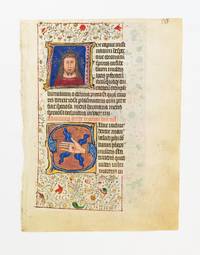
1465ST17243bBruges ca. 1465. 193 x 145 mm. 7 5/8 x 5 3/4". Single column 21 lines in a gothic book hand. <br/> Rubrics in red one two-line initial in gold filled with blue on pink ground WITH THREE LARGE HISTORIATED INITIALS: ONE FEATURING AN OVAL-SHAPED PIECE OF FLESH WITH A GASH IN THE CENTER AND TWO WITH CHRIST'S DISEMBODIED FOOT SHOWING THE PUNCTURE WOUND FROM THE CRUCIFIXION each initial in pink or blue with white tracery filled with dark pink and thin gilt lines and dots four wavy blue rays radiating from behind each appendage all within a thin gilt frame both sides with a three-quarter border consisting of hairline vines gold bezants and a few colorful flowers. ◆Vellum a shade less than bright faint marginal rumpling trivial paint transfer on one initial BUT IN FINE CONDITION the initials richly painted and extremely well preserved.<br/> <br/> From a manuscript probably produced in Bruges for the English market this leaf contains arresting initials that direct the viewer's attention to the wounds endured by Christ during the Passion. According to Roger Wieck Passion Cycle images enjoyed a particular vogue in 15th century Dutch Flemish and English Books of Hours including those that were exported to England. In the present example the strikingly unusual imagery includes the wounds of the left and right foot as well as the spear injury to Christ's side depicted as an oval piece of flesh with a laceration across the center. A sister leaf to the present item features three additional initials showing a portrait of Christ wearing the Crown of Thorns his gaze fixed directly at the viewer and in separate initials his left and right hands appear disembodied and displaying the stigmata. The parent manuscript containing the present leaf sold at Christie's on 15 November 2006 lot 16 the description for which gives us additional information about the book's contents and provenance: it was made for the Use of Sarum included a calendar with the English saint Thomas Becket and Popes Gregory and Silvester with their names crossed out indicating that it was in England through at least the time of the Reformation and contained an early ownership inscription of a woman named Bridget Lowe with a Middle English inscription on the pastedown. Christie's also attributed the parent manuscript to the workshop of William Vrelant with miniatures possibly by his chief assistant the Master of the "Vraie Cronique Descoce." They note that this work is "of higher quality than many of the works that satisfied the English demand for Netherlandish illumination" and that it "demonstrates why Vrelant appealed to the great bibliophiles of the Burgundian Netherlands." Vrelant was the leading purveyor of books of private devotion in Bruges during the third quarter of the 15th century and his prominent position among Flemish illuminators of the time is indicated by the considerable number of manuscripts illustrated in his manner by other miniaturists both in Bruges and in nearby cities in Flanders. Similar examples to the present leaf can be found in intact Books of Hours at the Philadelphia Free Library MS Widener 3 and the Huntington HM 1086--both of which were produced in Flanders or the Netherlands around the same time as the present work. The present leaf surpasses both of these examples in terms of excellence of the artistic hand and attention to detail. unknown
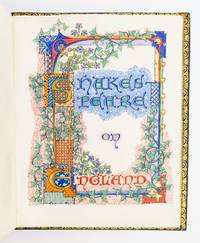
1944ST19310Sheffield England December 1944. 265 x 215 mm. 10 1/2 x 8 1/2". 6 leaves illuminated on rectos final leaf also illuminated on verso with colophon. <br/> VERY ATTRACTIVE DARK BLUE MOROCCO GILT stamped-signed "Bound by Slinn" on front pastedown upper cover with monogram of Edwin Goddard Stokes framed by gilt-ruled compartments containing gilt lettering elaborate gilt foliage and a gilt crown tool at top the panel surrounded by a double gilt rule frame and dogtooth roll border with additional foliate tools rear cover with quatrefoil design in floral tools and pointillé dogtooth roll border smooth spine with gilt-ruled compartments. In a rather worn felt-lined brown paper wallet case with handwritten titling on spine. Each recto with one or two large two- to three-line initials either painted or gilt TITLE PAGE WITH A FULL BORDER and others with a large complex border all of them elaborately painted with a variety of patterns styles motifs and with gilt embellishments one border incorporating three coats of arms AND ANOTHER PAGE WITH A QUARTER-PAGE MINIATURE OF A KNIGHT ON HORSEBACK. Trivial wear at top of front joint otherwise in pristine condition.<br/> <br/> This is a charming modern illuminated manuscript penned during WWII that contains two excerpts from Shakespeare in praise of "this other Eden demi-paradise" called England--specifically passages from John of Gaunt's dying speech in "King Richard II" and lines from "King John." As stated in the colophon the manuscript "was Designed Written out and Illuminated by John Wilfred Clarke of Ecclesall Sheffield for his great friend Edwin Goddard Stokes of Ringinglow Sheffield." Clarke d. 1954 was a municipal engineer and town planner by trade professions for which skill in the visual arts particularly draftsmanship is not only preferred but required. He was clearly a talented amateur with a flair for pattern and design. Though he incorporates elements found in Medieval manuscripts--trailing ivy leaves penwork decoration tessellation and line enders--the style is at the same time modern utilizing bold color combinations and layered shapes and patterns. Given the artist's location it is quite possible that he was involved with the Sheffield School of Art which was founded in 1843 and offered classes in fine arts and crafts. We know that the binder Walter Slinn d. 1964 was a staff member at the school as well as a prominent local bookbinder. Nationalistic sentiments are made clear in the choice of material celebrating England in Shakespeare's voice and this manuscript is all the more poignant when seen in the context of its time and place. Sheffield an industrial city was a major producer of steel and armaments during WWII --and thus a high-value target for German air raids. The so-called "Sheffield Blitz" of 1940 resulted in hundreds of deaths and nearly 80000 damaged homes. In December of 1944 when this manuscript was completed the end of the war was not yet in sight. Despite the bleak circumstances the manuscript radiates color light and hope. The recipient of Clarke's attractive manuscript was Edwin Goddard Stokes 1902 - ca. 1957 one of the sons of the prominent Sheffield businessman Robert James Stokes founder of R. J. Stokes & Co. a tile company that still flourishes in the city now. It is clear that this item was carefully looked after by this "great friend" of the artist. So far as we have been able to determine Clarke is an unrecorded artist except for the present Shakespeare work and one other similar manuscript featuring excerpts from Chaucer now in Stanford University Library. unknown
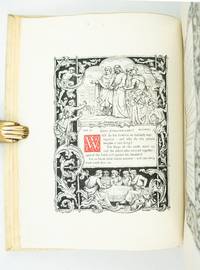
1862ST20857London: Edmund Evans for Sampson Low Son and Co 1862. ONE OF PERHAPS 10 COPIES PRINTED ON VELLUM. 260 x 195 mm. 10 1/4 x 7 3/4". vii 1 235 1 pp. <br/> Publisher's stiff vellum smooth spine with gilt lettering edges untrimmed. In a modern felt-lined blue buckram drop-back box. Decorative initials in red or blue title page and text leaves with full criblé border of vined foliation occasionally inhabited eight or 10 leaves with more extensive illustrations at head or foot all engraved by W. J. Linton after illustrations by John Franklin. Front pastedown with ex-libris of Marion Hope Rattey. A Large Paper Copy. McLean "Victorian Book Design" p. 184. Short thin cracks to head and tail of front joint spine vaguely soiled upper cover with two very small brown spots and one trivial red mark occasional mild rumpling or naturally occurring variations in the grain or thickness of the vellum as usual a couple of minor smudges but still a very agreeable copy the binding solid and without the splaying common in vellum books the interior clean fresh and bright and the margins extraordinarily wide.<br/> <br/> This is an infrequently encountered copy of a beautiful Victorian book on vellum issued by one of the era's top printers. The volume was printed by Edmund Evans 1826-1905 who is now best remembered for his illustrations and advances in color wood engravings. Relatively little is known about this book's production: Ruari McLean tells us that it was "entirely printed" by Evans but it is unknown whether he was responsible for the design as well McLean remarks that "if Evans was responsible for its design it shows his superiority in book-making". We also are unsure how many copies were printed on vellum although the general consensus is 10. Regardless as McLean tells us "it is one of the prettiest books of the 'sixties" with sharp deep impressions of the type on the rich creamy vellum jewel-like colored initials and elegant wood-engraved illustrations. These illustrations are the work of John Franklin ca.1800-68 a painter and draftsman who was highly respected in his own time. The precisely realized borders feature idealized human forms posed within a robust botanical largely acanthus context the figures posing with balletic grace their expressive faces often turned gently away from the reader. The size of the leaf here is significant: the untrimmed edges retain their tiny printing pinholes which would normally have been trimmed away with regrettable loss. And not surprisingly our vellum printing is almost never seen: we could trace just two copies at auction since 1924. Former owner Marion Hope Rattey 1922-97 was likely the daughter of bibliographer Clifford C. Rattey 1886-1970 whose impressive library featured incunabula and block prints. [Edmund Evans for] Sampson Low, Son, and Co unknown
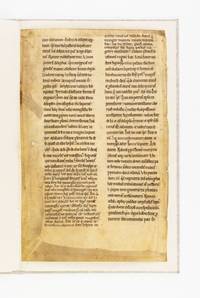
ST17768<p>England second half of 12th century but before 1180. 313 x 198 mm. 12 1/4 x 7 3/4. Double column 32 lines in a lovely late Caroline hand verso with some lines erased and corrected in a smaller hand. <br />Mounted in a fine tan cloth folder between sheets of textured acid-free paper. Front pastedown with book label of the Schøyen Collection with their shelf mark MS 237 written in ink. ◆Recovered from a binding and thus with overall toning and soiling recto somewhat browned from binder's glue but almost entirely confined to three margins and the verso virtually unaffected other trivial imperfections but in surprisingly good condition given its history the very rich ink especially dark and well preserved.<br /><br />This is an exceptionally lovely example of an early English book hand standing at the crossroads of the Caroline and proto-gothic calligraphic traditions. According to Thompson "In the twelfth century the scribes seem to have vied with each other in producing the best types of book-writing of which they were capable with the result that remarkable precision in the formation of the letters was attained and that the century may be named as excelling all others for the beauty of its MSS." "Greek and Latin Paleography" p. 436 The present leaf certainly lives up to this description being notable for its exceptionally neat and legible script written with uncommonly pretty and regular letter forms by a practiced and confident hand. The Caroline tradition is apparent in certain tendencies such as the use of "&" for "et" and the lack of biting curves between letters while a shift toward the proto-gothic can be seen in the vertical and compressed letter forms as well as the increased use of abbreviations and ligatures. Although the present work has often been credited to Haymo of Halberstadt due to a longstanding error in attribution reaching back to the 15th century modern scholarship now recognizes Haimo of Auxerre a monk at the Abbey of Saint-Germain in Auxerre d. ca. 875 as its true author. A prominent theologist and writer during the Caroline Renaissance Haimo produced a number of influential commentaries on various books of the Bible. The provenance on this leaf can be traced back as far as the mid-19th century when it was auctioned at Sotheby's on 21 August 1858 lot 119.2 sold as part of an album containing various leaves and fragments put together by Philip Bliss 1787-1857 registrar of the University of Oxford. It then went into the celebrated collection of Sir Thomas Phillipps 1792-1872 and was eventually sold by the Robinson Brothers on 24 April 1911 lot 390.3. This leaf has previously appeared in Quartich's catalogue 1036 "Bookhands of the Middle Ages" no. 79.5 and was most recently in the collection of Martin Schøyen his MS 237.</p>
1465ST17243aBruges ca. 1465. 193 x 145 mm. 7 5/8 x 5 3/4". Single column 21 lines in a gothic book hand. <br/> Rubrics in red WITH THREE LARGE HISTORIATED INITIALS: ONE WITH A PORTRAIT OF CHRIST WEARING THE CROWN OF THORNS AND TWO WITH DISEMBODIED HANDS SHOWING THE STIGMATA each initial in pink or blue with white tracery filled with dark pink or blue with thin gilt lines and dots hands with wavy blue rays radiating from behind the appendage all within a thin gilt frame both sides with a three-quarter border consisting of hairline vines gold bezants and a few colorful flowers. ◆Margins with a little light soiling BUT IN FINE CONDITION THE PAINT OF THE INITIALS ESPECIALLY RICH AND WELL PRESERVED.<br/> <br/> From a manuscript probably produced in Bruges for the English market this leaf contains arresting initials that direct the viewer's attention to the wounds endured by Christ during the Passion. According to Roger Wieck Passion Cycle images enjoyed a particular vogue in 15th century Dutch Flemish and English Books of Hours including those that were exported to England. In the present example the strikingly unusual imagery includes a portrait of Christ wearing the Crown of Thorns his gaze fixed directly at the viewer and in separate initials his left and right hands appear disembodied and displaying the stigmata. A sister leaf to the present item features three additional initials showing the wounds of the left and right foot as well as the spear injury to Christ's side depicted as an oval piece of flesh with a laceration across the center. The parent manuscript containing the present leaf sold at Christie's on 15 November 2006 lot 16 the description for which gives us additional information about the book's contents and provenance: it was made for the Use of Sarum included a calendar with the English saint Thomas Becket and Popes Gregory and Silvester with their names crossed out indicating that it was in England through at least the time of the Reformation and contained an early ownership inscription of a woman named Bridget Lowe with a Middle English inscription on the pastedown. Christie's also attributed the parent manuscript to the workshop of William Vrelant with miniatures possibly by his chief assistant the Master of the "Vraie Cronique Descoce." They note that this work is "of higher quality than many of the works that satisfied the English demand for Netherlandish illumination" and that it "demonstrates why Vrelant appealed to the great bibliophiles of the Burgundian Netherlands." Vrelant was the leading purveyor of books of private devotion in Bruges during the third quarter of the 15th century and his prominent position among Flemish illuminators of the time is indicated by the considerable number of manuscripts illustrated in his manner by other miniaturists both in Bruges and in nearby cities in Flanders. Similar examples to the present leaf can be found in intact Books of Hours at the Philadelphia Free Library MS Widener 3 and the Huntington HM 1086--both of which were produced in Flanders or the Netherlands around the same time as the present work--but the present leaf surpasses both of these examples in terms of excellence of the artistic hand and level of detail depicted. unknown
1460ST12839Paris ca. 1460. 153 x 110 mm. 6 x 4 3/8". Single column 14 lines of text in a fine gothic book hand. <br/> One-line initial in burnished gold on a pink and blue ground with white tracery a two-line initial and a three-line initial in pink with white tracery on a ground of burnished gold the center filled with twining blue vines bearing pink and scarlet flowers verso with a rinceau panel border featuring twining hairline stems bearing burnished gold ivy leaves and fruit blue and gold acanthus leaves and flowers recto WITH AN ARCH-TOPPED MINIATURE OF THE HOLY TRINITY SURROUNDED BY THE HEAVENLY HOST this and the accompanying text enclosed by a pink blue and burnished gold bar border on one side and a brushed gold bar border with pink lotus flowers on two sides the whole surrounded by A FULL RINCEAU BORDER DENSE WITH ACANTHUS LEAVES FOLIAGE FRUIT FLOWERS AND TINY GOLD BERRIES on hairline stems. ◆A little paint flaked from the book held by the Trinity a couple of small spots in the margin otherwise in fine condition--clean and smooth with comfortable margins and bright gold.<br/> <br/> The Trinity is shown here seated on a canopied throne with God the Son his hand raised in blessing to the left of the Father. The latter in a towering crown holds a gold orb and the Father and Son together support a large book opened between them. The dove of the Holy Spirit hovers above the book radiating golden beams. The Trinity is flanked on both sides by cherubim and seraphim in rich red and soft yellow. It is the rendering of this angelic ambiance that elevates the level of aesthetic achievement here: both red and yellow celestial beings are given a ghostly appearance as if appearing out of a filmy yellow or a densely red fog. The artistic qualities as a whole suggest that this leaf comes from a manuscript commissioned by a person of significant means. unknown
1626ST19298Antwerp: M. Snyders 1626. FIRST EDITION. 135 x 82 mm. 5 1/4 x 3 1/4". 39 of 40 leaves lacking C4. Two volumes one as issued the other a companion volume containing related plates without any title page. <br/> Very pretty late 18th or early 19th century red morocco covers bordered by delicate cresting roll with leaf cornerpieces smooth spine gilt in compartments with leafy centerpieces gilt lettering turn-in with gilt floral roll pale blue watered silk endleaves all edges gilt. Supplemental volume in late 19th century red half morocco over red paper boards similarly tooled spine. Housed together in a custom-made modern wooden box with sliding panel closure a heart mosaic in multi-colored hard-grain leather on its sides. Amoris Divini WITH engraved title page and 38 of 39; lacking plate XXXIV ENGRAVED PLATES 35 OF THEM ON VELLUM ALL DELICATELY COLORED AND HEIGHTENED IN GOLD plates 19 29 30 31 and 36 bound after text pages for plates 31 36 29 30 and 34 respectively; second volume with 45 plates on paper though without any text including many of these same emblems apparently from a later edition of this work ALL DAINTILY HIGHLIGHTED WITH GILT. Front pastedown of first volume with monogram book label in colors and gilt verso of front free endpaper with oval armorial bookplate "Ex Museo Van Der Helle" see below. De Vries "De Nederlandsche Emblemata" 121; Landwehr "Low Countries" 33; Praz p. 254; Brunet I 240 this copy; Delbergue-Cormont "Bibliothèque de M. Van der Helle" Paris 10 Février 1868 lot 69 this copy. Amoris spine very slightly dulled occasional hints of marginal thumbing but A LOVELY COPY clean and fresh internally with rich colors and glistening gold in a well-preserved binding; supplemental plates with faint marginal browning but excellent internally the engravings gently shimmering with gold and the binding with few signs of wear.<br/> <br/> The main volume here comprises a collection of emblems illustrating concepts of human and divine love; it is made all the more special by being printed on vellum beautifully hand colored and then delicately highlighted with gold. The emblems depict Divine Love as a beardless young man with nimbus who always represents love in its purest form. Human love or worldly love is variously embodied in a winged Cupid sometimes blindfolded who represents erotic love and who is accompanied by symbols of treasure or power that represent worldly desires. Landwehr Praz and De Vries make no mention of a vellum edition but Brunet describes one copy on vellum painted in colors and gold which he says sold at the Duriez auction. That book appeared as lot 3216 in "Catalogue des livres imprimés et manuscrits composant la bibliothèque de feu M. L.-M.-J. Duriez de Lille membre de la Société des Bibliophiles français" Paris J.-S. Merlin 1827 where its binding description matches our copy. Having uncovered no other hand-colored copies on vellum in auction records or in OCLC we think it quite likely that the present volume is in fact the Duriez copy. Louis Duriez 1753-1825 was a Lille lawyer of sufficient skill and cleverness to move without incident from serving as lieutenant provost for his district under King Louis XVI to becoming receiver of the district of Lille after the revolution 1791 and purchasing the estate of an aristocrat which had been seized by the state. He rose to successively more important and remunerative governmental positions and was named Knight of the Royal Order of the Legion of Honor in 1814. In 1820 he was one of the founding members of the Société des Bibliophiles français an elite group limited to 24 scholarly collectors. After his death his collection of more than 5000 carefully chosen works was dispersed at 59 auctions held between 22 January and 1 April 1828 at Maison Silvestre in Paris. A perusal of the lots on offer finds a strong emphasis on fine bindings works on vellum and illustrated books many noting hand coloring. The emblems in the second thinner book here on paper without coloring--but with gold highlighting allow the reader to experience the pleasure to be found in comparing the degrees of decoration and opulence of the two volumes. These illustrations likely come from one of the later printings of this title each of which added new emblems to the original 39 called for in Landwehr and Praz. It is not clear when or by whom this second volume was wedded to the first. After its presumed residence in the Duriez collection our copy of the 1626 edition and perhaps its sidecar volume moved to another distinguished library--that formed by the scholarly and erudite French collector M. Van Der Helle of Lille who amassed a collection particularly rich in illustrated books and works on vellum. In the catalogue for the sale of his library in 1868 Paris auction house Delbergue-Cormont described him as a bibliophile "of the school of Renouard . . . who only liked irreproachable copies." We bought this item without being warned that it is slightly defective but given its distinguished provenance and the many other features it has going for it we did not ask the seller to take it back. M. Snyders unknown
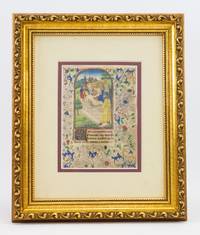
ST19540bSouthern Netherlands Bruges third quarter of 15th century. Matted leaf: 150 x 150 mm. 5 7/8 x 4 3/8". Frame: 307 x 258 mm. 12 x 10 1/4". Single column with four lines below the miniature and the obverse with 17 lines in a batarde hand. <br/> Attractively matted and framed the leaf slightly shifted in the mat revealing top and side edges but in no danger of damage. Rubrics in red four one-line initials and three three-line initials all but one in burnished gold on blue and red ground with white tracery the initial beneath the miniature painted pink on a burnished gold ground and filled with painted ivy vines AN ARCH-TOPPED LARGE MINIATURE DEPICTING THE ENTOMBMENT the body of Christ surrounded by seven other people depicted in an outdoor setting with the turrets of a walled city in the background the miniature in a double frame of gold and pink surrounded by A FULL BORDER composed of hairline vines acanthus colorful flowers and gilt bezants and inhabited by a small bird. Minor soiling and a faint thumb print to borders but IN VERY FINE CONDITION THE MINIATURE BEAUTIFULLY PRESERVED.<br/> <br/> This is a beautifully rendered and deeply touching scene depicting the entombment of the crucified Christ and the pathos experienced by those at his side. Holding the sheet on which the body is lowered into the sarcophagus are on the far left the richly clothed Joseph of Arimathea and on the far right Nicodemus who dons an especially lovely yellow garment with delicate embroidery. Between the two men in the foreground but behind the body are the Virgin Mary who presses the hand of her deceased son to her lips; John the Evangelist whose body is turned toward the Virgin in a gesture of support but whose gaze is focused on the Savior; and Mary Magdalene who holds a small ointment jar. Two other women with halos stand closely behind them consoling one another. The artist has done a masterful job at creating a composition that captures the emotional gravity of the scene: Christ's body gently cradled in a white sheet is on full display with blood still trickling from the wounds on his head and side. Despite there being seven people crowded around him our attention is drawn to the action between Christ and the Virgin who gently grasps his hand with motherly affection and bids him a final farewell. Flickers of different emotions appear on the faces of his followers including pity sorrow stoicism and disbelief--echoing perhaps the viewer's own range of feelings upon viewing this image. The level of detail excellence of composition care seen in the molded bodies and faces and the convincing setting suggest that the artist was quite practiced and that the original manuscript from which the leaf comes was of very high quality. unknown
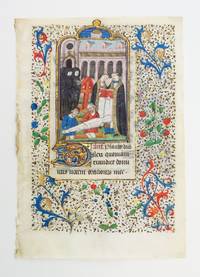
ST17060VFrance probably Besançon 3rd quarter of 15th century. 239 x 165 mm. 9 3/8 x 6 1/2". Single column 15 lines in an elegant gothic book hand. <br/> Rubrics in dark pink line-enders in dark pink and blue with a gilt bezant several one-line initials in burnished gold on dark pink and blue ground with white tracery one three-line initial in blue with white tracery filled with flowers painted pink or blue all on a gold ground verso with panel border of delicate hairline vines terminating in gilt bezants and ivy and with a spray of blue flowers and a red bud recto with A FULLY-REALIZED HALF-PAGE MINIATURE OF A BURIAL in an arch-topped gilt frame with two laymen lowering a shrouded corpse into the ground a small group of hooded monks to the left and two ecclesiastical figures reading from a book to the right all in front of a gothic church painted pink with a blue roof SURROUNDED BY A FULL BORDER consisting of hairline vines terminating in gold bezants and ivy colorful acanthus strawberries and blue flowers the text below the miniature further framed with a thin "U"-shaped line extending the full height of the miniature. A very few trivial imperfections quite minor wear to paint on clothing a little insignificant smudging one small light stain in the blank margin of verso but these defects not the least distracting and overall the miniature in fine condition with rich well-preserved color.<br/> <br/> This is a splendid miniature from a particularly large Book of Hours showing a detailed rendering of a scene from contemporary Medieval life--that of a burial in a churchyard involving clergy mourners and laymen. Apart from those relatively few copies with illustrated calendars the miniatures found in Books of Hours are almost entirely devoted to retrospective Bible scenes that are obviously outside the experience of the illuminator; it is only in the present kind of scene at the beginning of the Office of the Dead that we can see a contemporaneous image that would have come directly from the Medieval experience. While our painting is fairly typical in subject matter and design it offers a number of interesting details about the Medieval rites and rituals surrounding death. The present scene represents the final stage preceded by the funeral procession Requiem Mass prayers Absolution and the procession into the graveyard in which the body is actually laid to rest in the ground. Though the corpse would have been encased in a coffin during the aforementioned rites and processions it was customary to bury the dead in only a shroud in the present example the artist has even thought to show the stitching along the length of the shroud. Three groups of people each serving a different function appear in this miniature: in the foreground are two laborers lowering the body into an earthen grave a small group of mourners in black cloaks stand off to the left and a duo of clergy members stand to the right. The latter have tonsured heads and each wears a black cope donned prior to administering Absolution to the deceased; together they hold a manuscript containing the Rites for Burial. The background is composed of a grand church or cathedral containing a number of fine architectural details including several windows including a clerestory level an arched entrance a dome and decorative touches. Stylistically this leaf can be localized to the Franche-Comté region in eastern France and is closely related if not directly attributable to an atelier specializing in Books of Hours made for the Use of Besançon and most likely situated in that city see Avril and Reynaud p. 197. The similarities are especially apparent in the figures' faces which are slightly puffy in appearance and have distinct slit-like eyes. As noted by Avril and Reynaud the unnamed master of this atelier was deeply indebted to the Master of Morgan 293 a talented Burgundian illuminator active in the second quarter of the 15th century whose name derives from a particularly lovely Book of Hours made for the Use of Besançon. Whoever the artist responsible for the present miniature this work is an excellent representation of a distinct regional style extremely attractive and replete with interesting details that connect us to the Medieval experience. unknown
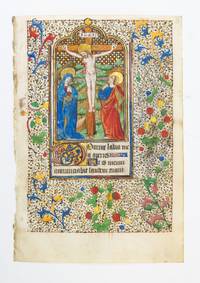
ST17060ZFrance probably Besançon 3rd quarter of 15th century. 239 x 165 mm. 9 3/8 x 6 1/2". Single column 15 lines in an elegant gothic book hand. <br/> Rubrics in dark pink line-enders in dark pink and blue highlighted with a gilt bezant several one-line initials and one two-line initial in burnished gold on dark pink and blue ground with white tracery one three-line initial in pink with white tracery filled with trefoils painted red or blue all on a gold ground verso with panel border of delicate hairline vines terminating in gilt bezants and ivy and with acanthus and flowers recto with A HALF-PAGE MINIATURE OF THE CRUCIFIXION in an arch-topped gilt frame Christ in the center of the composition with the mocking inscription "I N R I" "Iesus Nazarenus Rex Iudaeorum" on a banner above him the Virgin standing on the left and St. John on the right the landscape behind them filled with hills and trees under a tessellated sky SURROUNDED BY A FULL BORDER consisting of hairline vines terminating in gold bezants and ivy colorful acanthus strawberries and flowers the text and image further framed by a "U"-shaped bar of gold pink and blue extending the full height of the miniature. ◆Virgin's robe a little mottled and chipped minor chipping elsewhere borders with slight smudging to some of the hairline vines small marginal stain but in all in excellent condition with wide margins with the colors very bright and the miniature well preserved.<br/> <br/> Opening the Hours of the Cross a shorter text that is sometimes found in addition to the Hours of the Virgin this touching miniature of the Crucifixion is richly painted and features a particularly emotional depiction of Christ his head slightly bowed with an expression of pain. Blood flows freely from his wounds partly merging with the orange in the sky and partly forming rivulets at the base of the cross. This exsanguination stands in contrast to the more typically restrained indications in other Crucifixion scenes and serves to emphasize the cruel suffering of the execution. His mother stands to the left in a blue cloak hands knitted together and with a look of weary resignation on her face; to the right stands St. John whose lips are slightly parted as he looks directly at the crucified Christ as if searching his face for signs of life. Our artist has made an unusual choice for the background with the lower two thirds devoted to a naturalistic landscape with many hills and trees and the sky entirely tessellated with squares of red blue and gold. While the Virgin and St. John are both firmly situated within the earthy realm the body of Christ occupies both spaces perhaps emphasizing his dual nature as both human and divine. Stylistically this leaf can be localized to the Franche-Comté region in eastern France and is closely related if not directly attributable to an atelier specializing in Books of Hours made for the Use of Besançon and most likely situated in that city see Avril and Reynaud p. 197. The similarities are especially apparent in the figures' faces which are slightly puffy in appearance and have distinct slit-like eyes. As noted by Avril and Reynaud the unnamed master of this atelier was deeply indebted to the Master of Morgan 293 a talented Burgundian illuminator active in the second quarter of the 15th century whose name derives from a particularly lovely Book of Hours made for the Use of Besançon. In fact there are certain consonant details between this miniature and the Crucifixion in the Morgan manuscript: Christ's position and physicality are nearly identical as is the pattern of blood as it moves down the cross and both artists create a division in the landscape with the Morgan artist using gold rather than tessellation for his sky. Whoever the artist responsible for the present miniature the work here is clearly accomplished both quietly powerful and an excellent representation of a distinct regional style. unknown
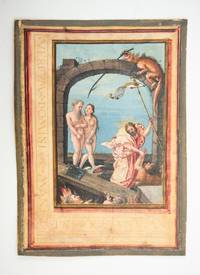
1540ST20622Germany ca. 1540. 183 x 133 mm. 7 1/8 x 5 1/4". <br/> WITH A FULL-PAGE MINIATURE DEPICTING THE HARROWING OF HELL featuring a naked Adam and Eve on the left and on the right Christ bending down to rescue John the Baptist the figures framed by a stone archway supporting a hairy creature who aims the point of a spear directly at Adam and Eve the miniature in a thin brown frame with gilt lines surrounded on two sides by the words "VERBUM DOMINI MANET IN ETERNUM" in gilt all framed in gray and red washes with double rules of black and gilt. Light soiling to frame a little flaking to the gray border and a couple of small scuffs and smudges elsewhere verso with spotting but the miniature vibrant and well preserved with only very trivial imperfections.<br/> <br/> A close copy of an early 16th century engraving by Albrecht Dürer this powerful miniature depicting the Harrowing of Hell is an intriguing artifact that ties together manuscript art print culture and the Reformation. The image depicts an apocryphal tale in the Gospel of Nicodemus in which Christ following his death but before his Resurrection descends into Limbo in order to save righteous souls who had passed away before him particularly figures from the Old Testament. Christ appears here in pale pink robes carrying a long staff with a cross and banner adorning the top. Having just brought down the gates of Hell he stoops to rescue John the Baptist here dressed in furs from its depths. A naked Adam and Eve covering their loins stand at the left of the composition--Adam now a gray-bearded old man as a reflection of sin and mortality but Eve still as she was at the Expulsion in keeping with the period's inclination to retain the classically idealized youthful feminine form. Above them is a stone arch upon which a dog-like demon perches stealthily aiming a spear directly at the oblivious couple. Another demon snaps its jaws at the feet of Christ and we can see a lick of flames below the broken gate as more captive souls clamor to escape. The painting is skillfully done showing the artist's facility with anatomy proportion and foreshortening. The bodies of Adam and Eve are particularly excellent with lovely skin tones and convincing molding. The composition is clearly based on an engraving by Dürer published in 1513 as part of a major series of 16 images known as the "Engraved Passion." In translating a black & white print into a full-color painting the artist here dispensed with a few details seen in Dürer's work such as the shadowy figure behind Adam and Eve and the stigmata on Christ's hand; however the overall composition deviates little from the original suggesting that the artist may have been working from an actual engraving. Although this leaf contains just a few words in the form of a border inscription--"Verbum Domini manet eternum" "the Word of the Lord endures forever"--they are monumentally important. This line from Isaiah 40:8 and 1 Peter 1:25 became the motto of the Lutheran Reformation appearing on art clothing coins and even armor of the 16th century. The Schmalkaldic League an influential group of allied Lutheran principalities in the Holy Roman Empire at the time also adopted it as their motto. Given the dominance of print materials during the Reformation period our hand-painted miniature--possibly produced as a frontispiece--must have been a very special commission. It is also an object that is prime for further study touching on aspects of book production religious art and the transmission of images and ideas in the early modern period. unknown
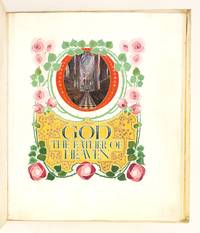
1907ST16456Birmingham 1907. 312 x 275 mm. 12 3/8 x 10 3/4". 16 leaves illuminated on rectos only. <br/> Pleasing original full vellum over bevelled boards covers ruled in gilt and with gilt crosses in each corner gilt lettering on upper cover smooth spine gilt rules dividing compartments with central gilt cross thick vellum turn-ins ruled in gilt bright purple silk endpapers front joint very expertly repaired. Calligraphic lettering mostly in black green and red a few one-line initials and many three-line initials in blue or purple with red penwork several slightly larger purple or blue initials infilled with ivy of various colors and dotted with gold EACH PAGE WITH A DIFFERENT ARTS & CRAFTS-INSPIRED FLORAL BORDER consisting of multi-colored blossoms and acanthus as well as meandering vine-stems and highlighted with gold bezants or stippled gold ONE LEAF WITH A 90 MM. INITIAL INHABITED BY A REALISTIC CATHEDRAL INTERIOR the large lettering below it on a gold ground with etched patterns and painted purple ivy leaves the text and the initial surrounded by pink roses green leaves and thorny vines. ◆Corners a bit bumped vellum with a few shallow scratches slightly soiled in a few places other minor signs of use but the binding still quite clean and attractive; perhaps a hint of thumb-soiling to margins of a couple leaves but the contents in nearly perfect condition.<br/> <br/> This is a beautiful and engaging manuscript with imaginative illuminations by the little-known but extremely talented illuminator calligrapher and cartographer Ernest Costain Clegg 1876-1954. The text here reproduces the Great Litany of the Church of England derived from the Book of Common Prayer and composed of short divine petitions. Each leaf contains a different and unique border featuring stylized floral motifs often with curving vines encircling the text and a cheerful color palette consisting of clear pastels that beautifully offset the darker inks used in the text. The generous use of gold on the first leaf of text and gilt details throughout the borders provide a dimension of luxury without overshadowing the prayers themselves. Clegg draws on the Medieval tradition of manuscript illumination but this work also shows the influence of the Arts & Crafts movement of the 19th century especially in the beautiful initial inhabited by a realistic Cathedral interior pierced with light--a feature that invites comparison with the superlative work of Alberto Sangorski. But Clegg's reliance on a variety of floral decoration in his borders makes this manuscript more feminine than the typical work of Sangorski. Ernest Clegg entered the military in his early twenties serving in the Boer War 1899-1902 then returned to England to train at the Birmingham School of Art. In 1909 he went to work for Tiffany's of New York as a jewelry designer. Clegg also served in the English forces during the First World War; afterwards in America his popularity in the veteran community led to more commissions and a thriving artistic career. Clegg is perhaps best known for illustrating the poem "In Flanders Fields" written by John McCrae but he also found success as a cartographer producing among other works a well-known map of Charles Lindbergh's flight across the Atlantic in 1927. unknown
1915ST17129-042Chicago: Written and Illuminated for The Renaissance Society ca. 1915. 216 x 153 mm. 8 1/2 x 6". ii 28 pp. 1 leaf colophon. Single column 18 lines in an attractive calligraphic hand. <br/> VERY PRETTY VIOLET CRUSHED MOROCCO GILT AND INLAID for The Renaissance Society stamp-signed in gilt on front doublure smooth spine with gilt titling FULL MOROCCO DOUBLURES consisting of a green morocco panel framed by purple morocco with gilt dots and scrolling floral motifs at each corner each with an inlaid white morocco flower cream-colored watered silk endleaves. In a lavender buckram chemise and matching purple morocco-backed slipcase with raised bands and gilt lettering. With many one-line initials in pink each leaf with a different two- to four-line initial in a different style with both painted and gilt elements and exuberantly decorated most leaves with a panel or "L"-shaped border ranging from simple lines to elaborate decorative bars a few borders with small landscapes and a total of FOUR FIGURAL SCENES decorative title page with colorful initials lettering and decorative flourishes text beginning with A HALF-PAGE MINIATURE OF ST. JEROME AT HIS DESK surrounded by A FULL BORDER of flowers gilt detailing and stylized heads of putti all by Louis Bauhan. Front free endpaper with bookplate of Phoebe Boyle. Leather with a slight chalky appearance silk endleaves starting to fray at fore edge a few leaves with a hint of waviness but THE MANUSCRIPT IN BEAUTIFUL CONDITION the vellum entirely clean and the paint especially bright and fresh.<br/> <br/> Exuberantly decorated by a major illustrator of the period this manuscript was commissioned and bound for The Renaissance Society of Chicago before making its way into the superb collection of American bibliophile Phoebe Boyle. The text here comes from a poem by "Atlantic Monthly" writer and editor Thomas Bailey Aldrich 1836-1907 imagining the agony and the ecstasy of St. Jerome as he sat down to write his translation of the Bible. The illumination though certainly inspired by the decorative programs of Medieval manuscripts is decidedly modern in appearance drawing on the Art Nouveau movement and utilizing bold color combinations and whimsical design motifs. It is not clear why the illustrator here Louis Bauhan 1855-1941 has used the ananym "Siuol Na-Huab" because there is no reason to hide responsibility for producing the clean elegant script the imaginative marginal decoration and the finished human and animal images that enliven the manuscript. Bauhan was a very successful painter and illustrator perhaps best known to the public as art editor of "Cosmopolitan Magazine" under John Brisben Walker who edited and published the magazine from 1889 to 1905. In 1881 Bauhan helped to found the Kit-Kat Club of New York a bohemian artists' and cultural association; he was persistently in demand as a book illustrator; and among other things he painted landscapes and portraits in oil. The colophon here states that the manuscript was written and illuminated for The Renaissance Society--an artistic group associated with the University of Chicago whose mission was to cultivate and promote modern art--and it was given an appropriately luxurious binding by the same organization. The manuscript was obviously valued highly enough to join the collection of Phoebe A. D. Boyle a client George Sutcliffe described as "rivalling the Medici in her patronage of the production of beautiful books." Shepherd "The Cinderella of the Arts" p. 63 Stephen Ratcliffe describes the Boyle collection as "unrivalled" for its jewelled bindings and modern illuminated manuscripts and any book from the Boyle collection which was put together with the greatest taste and discrimination is recognized as desirable beyond its intrinsic literary merit. Written and Illuminated for The Renaissance Society unknown