1 337 résultats
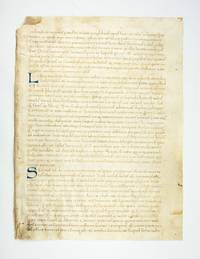
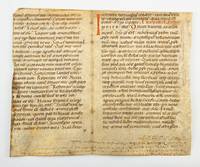
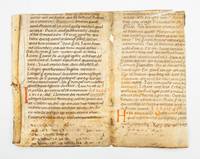
ST20509c-dGermany Late 11th or early 12th century. Larger bifolium measures 221 x 275 mm. 8 7/8 x 10 3/4".; smaller bifolium measures 207 x 275 mm. 8 1/8 x 10 3/4". Single column 25-27 lines in a late Caroline hand. <br/> Rubrics in orange each bifolium with one or more one-line initial in orange and one or more large four- to five-line initials in orange. With marginal notations in a later hand. Recovered from a binding and thus with some soiling abrasions glue residue and other small problems as well as limited loss of legibility in a few places; the pages nearly complete but with a couple of letters and/or lines cut away from one side of each bifolium; even with the problems very good specimens overall the letters on the better side quite clear and readable in each case.<br/> <br/> Once part of a Lectionary a collection of scriptural readings appropriate for Masses and other ceremonial occasions through the year these attractive mostly legible binding fragments display an excellent transitional script with both Caroline minuscule and proto-gothic characteristics. The present examples include short lessons or "lectiones" taken from the Old and New Testaments including among other passages excerpts from John in which Christ casts the sellers out of the temple and Daniel relating the prayers of the three men who refused to bow to Nebuchadnezzar's golden idol. The lovely script here shares much in common with the pure Caroline miniscule of earlier centuries--particularly in the overall legibility of the text the space between individual letters and the limited use of ligatures and abbreviations; also of note is the exclusive use of the long "s" unless at the beginning of a sentence and the ampersand as a general abbreviation for the letters "et" occurring anywhere in a word e.g. "propheta" written "proph&a" here. Evidence of a progression toward proto-gothic script can be observed here in the appearance of certain letter forms such as the closed "g" a more oval "o" and the use of two forms of "d" both upright and Uncial the latter with a sloping shaft. There is added interest here in the form of marginal notations in a later hand--probably dating from the time these bifolia were in situ as binding waste. The price given here is for one bifolium. unknown
Large 12mo (150 x 80 mm), xxviii, 306, [2]pp., ONE OF TWO COPIES PRINTED ON VELLUM, etched frontispiece by Felix Bracquemond, foliated initials and head-pieces, some light spotting to half-title, marbled endpapers, superbly bound in later full blue morocco by Reimann/Dormont, triple gilt fillet border to covers, with gilt supralibros of Isidoro Fernandez added to centre of both covers, gilt spine compartments exquisitely tooled with small flowers and stars, gilt turn-ins and edges, joints lightly rubbed otherwise in fine condition. Good edition of the works of Mathurin Regnier (1573-1613), French satirical poet. This being number one of two copies printed on vellum in a total limitation of 171. Provenance: Jean de La Fontaine Toqu? (bookplate); I. Fernandez (bookplate); purchased from Giraud, 1926 (pencil note to rear endpaper). Vicaire VI, 1002.
1954004698Paris Grasset 1954 In-8 Broché Ed. originale
1959004695(Paris) Falaize 1959 In-4 En feuilles, couverture ill. Edition originale
1962015771Paris Les Editions de Minuit 1962 In-8 Broché
015736Gallimard NFR 0 In-12 Broché
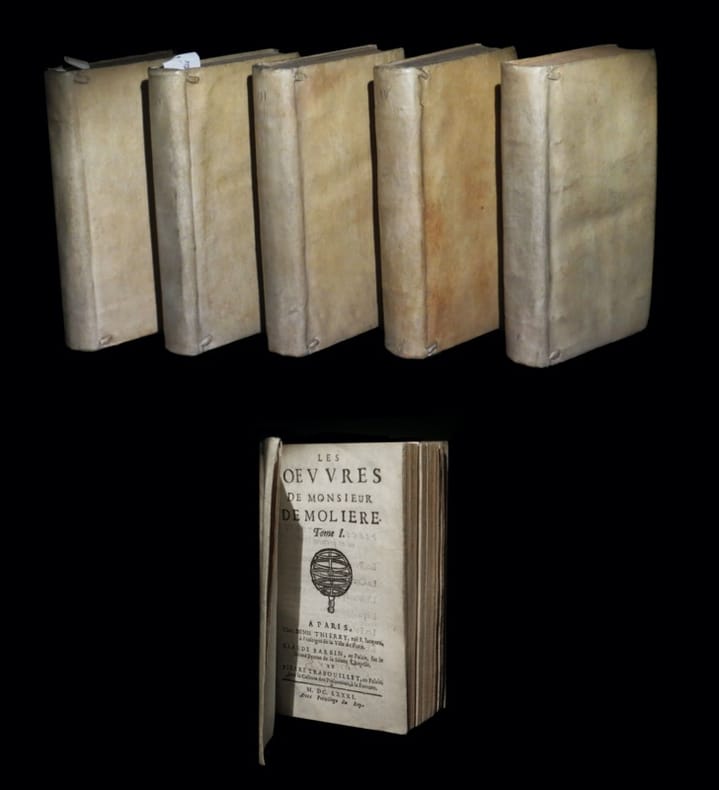
168127543A Paris, chez Denis Thierry / Claude Barbin et Pierre Trabouillet, 1681. 5 vol. au format pt in-12 (148 x 92 mm) de 428 pp. et 1 f. bl. ; 400 pp. ; 436 pp. ; 466 pp. ; 402 pp. et 2 ff. de Privilège n.fol. Reliures ''à la hollandaise'' uniformes de l'époque de plein vélin ivoire à rabats rempliés et coutures apparentes, plats jansénistes, dos lisses, indication de tomaison à l'encre anciennement calligraphié en tête, tranches mouchetées.
1617LCPCLIT-0044(Les Essais de Montaigne en reliure strictement de l'époque. L'exemplaire d'un membre de la famille De Calonne) MONTAIGNE MICHEL EYQUEM DE. (Bordeaux, 1533 - Saint-Michel-de-Montaigne, 1592) "LES ESSAIS DE MICHEL SEIGNEUR DE MONTAIGNE. EDITION NOUVELLE ENRICHIE DANOTATIONS EN MARGE : CORRIGEE ET AUGMENTEE D'UN TIERS...". 1617, Rouen, I. Osmont (N. L'Oyselet sur la dernière page). 1 fort volume in-8° (173x115 mm) (dimensions pages 166x107 mm) (1) titre frontispice gravé par E. Charpy, (2) pp. (avis), (3) pp. (table des chapitres), (7) pp. (biographie), (1) f. avec le portrait de Montaigne, non signé, gravé par Thomas de Leu, 1129 (i.e. 1087 pp.), (1) pp. (fautes et sauts de numération aux pp. 698-609 et 739-740), (17) ff. (table). (a8, A-Z8, Aa-Zz8, Aaa-Yyy8, Aaaa-Bbbb8, Cccc2) Reliure strictement de l'époque en vélin rigide à rabats. Rare et jolie édition, réimpréssion des éditions de Paris de 1608 et 1611. Tout petit manque de papier à l'angle inférieur du f. M1 sans atteinte. Cahier Aa très très légèrement et partiellement dérelié. Traces de lacets en soie sur les plats. Très bel exemplaire, frais et en reliure du temps. "Cette édition a été partagée entre plusieurs libraires rouennais" (Tvili, 421). Provenance : Un ex libris manuscrit "De Calonne" sur le premier f. de garde. Très probablement l'exemplaire d'un membre de la famille du célèbre ministre des finances de Louis XVI. (Tchémerzine, IV, 889)
ST12778-0082South Germany or more probably Austria second half of the 12th century. 429 x 304 mm. 16 7/8 x 12". Double column 36 lines of text in a fine proto-gothic hand. <br/> ◆Text a bit faded on one side an upper corner slightly defective minor soiling and with the grain of the vellum apparent on verso but with the beautiful text entirely legible and the leaf as a whole quite pleasing.<br/> <br/> The hand here is memorable featuring wide upright letters that could not be more regular. Elected pope in 590 Gregory ca. 540-604 was one of the most influential pontiffs in the history of the Church. In addition to revising liturgical worship he wrote extensively on theology offering homespun wisdom rather than esoteric debates. He was declared a saint immediately upon his death. unknown
ST20981Italy 15th century. 264 x 200 mm. 10 3/8 x 7 7/8". Single column 41 lines in a neat humanist hand. <br/> With two two-line initials in blue. One corner torn away not affecting text a few marginal wormholes vellum a bit soiled and with a few small stains but a very good example the text entirely legible and overall clean and presentable.<br/> <br/> Containing text by an author who was much admired during the Renaissance this leaf is a lovely example of the humanistic script that emerged in Italy during the 15th century. The elegance and legibility of humanistic script derives from Caroline miniscule the predominant style of writing in Western manuscripts from the ninth through 12th centuries. Both scripts favor clear rounded letter forms wider spacing between letters and few abbreviations resulting in manuscripts that are extremely attractive and easy to read. The text here comes from a work titled "De Opificio Dei" exploring the handiwork of God with a concentration on the marvels of the human body and soul. The present leaf includes chapters 8-10 which discuss the human head including especially the seats of the senses: eyes ears nose and tongue. Our author Lactantius ca. 260-340 was a late-in-life Christian who became one of the ablest defenders of the faith in its early centuries. He was held in high esteem by Renaissance intellectuals and was one of the earliest authors to be printed first appearing in 1465. unknown
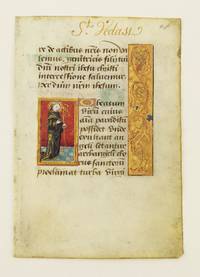
ST12668bKNortheastern France probably Arras late 15th century. 146 x 95 mm. 5 3/4 x 3 3/4". Single column 15 lines in a pleasing bâtarde hand. <br/> Rubrics in red one- and two-line initials in brushed gold on a red or blue ground EACH SIDE OF EACH LEAF WITH A BRUSHED GOLD PANEL BORDER WITH VERY PRETTY ILLUSIONISTIC FLOWERS and one panel with acanthus apparently unfinished; EACH LEAF WITH ONE SMALL MINIATURE measuring approximately 40 x 25 mm. DEPICTING SAINTS. Headlines written in French in a later 18th century calligraphic hand. ◆Light soiling otherwise excellent specimens generally clean and smooth with ample margins and attractive decoration.<br/> <br/> From a charmingly decorated 15th century prayer book these lovely leaves offer the opportunity to acquire a miniature andconsiderable gold ornamentation at an attainable price. One leaf depicts Sts. Peter and Paul in a single frame and the other shows St. Vedast or Waast--a saint that was particularly venerated in France especially in the Arras region whence we be believe these leaves originated. For other leaves from this same manuscript please check our website. unknown
ST20509a-bGermany Late 11th or early 12th century. Largest bifolium measures 221 x 275 mm. 8 7/8 x 10 3/4". Single column 25-27 lines in a late Caroline hand. <br/> Rubrics in orange each bifolium with one or more one one-line initial in orange and one or more large four- to five-line initials in orange. With marginal notations in a later hand. Recovered from a binding and thus with some soiling abrasions glue residue and other small problems; the pages nearly complete but with a couple of letters and/or lines cut away from one side of each bifolia with more extensive abrasions on one side affecting legibility but very good specimens overall the better side in each case quite clear and readable.<br/> <br/> Once part of a Lectionary a collection of scriptural readings appropriate for Masses through the year and other ceremonial occasions these attractive mostly legible binding fragments display an excellent transitional script with both Caroline minuscule and proto-gothic characteristics. The present examples include short lessons or "lectiones" taken from the Old and New Testaments including among other passages excerpts from John in which Christ casts the sellers out of the temple and Daniel relating the prayers of the three men who refused to bow to Nebuchadnezzar's golden idol. The lovely script here shares much in common with the pure Caroline miniscule of earlier centuries--particularly in the overall legibility of the text the space between individual letters and the limited use of ligatures and abbreviations; also of note is the exclusive use of the long "s" unless at the beginning of a sentence and the ampersand as a general abbreviation for the letters "et" occurring anywhere in a word e.g. "propheta" written "proph&a" here. Evidence of a progression toward proto-gothic script can also be observed here in the appearance of certain letter forms such as the closed "g" a more oval "o" and the use of two forms of "d" both upright and Uncial the latter with a sloping shaft. There is added interest here in the form of marginal notations in a later hand--probably dating from the time these bifolia were in situ as binding waste. unknown
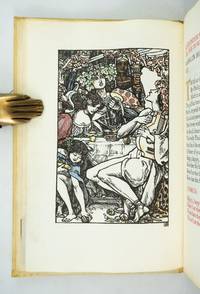
1904ST20796London: Essex House Press 1904. No. 1 OF 140 COPIES all on vellum. 195 x 131 mm. 7 3/4 x 5 1/8". 1 p.l. frontispiece 3-11 2 pp. <br/> Original stiff vellum over thin boards front cover with embossed rose design. In custom-made linen clamshell box with red morocco label on spine. Hand-colored woodcut frontispiece and final tailpiece both by Reginald Savage hand-painted initials in burnished gold red blue or green. Printed in black and red. Front pastedown with red morocco bookplate of William Andrews Clark Jr.; front endleaves with evidence of bookplate and inscription removal. Tomkinson p. 76; Ransom p. 268; Franklin p. 200. A VERY FINE COPY clean bright and free of the splaying that very frequently afflicts the boards of this work.<br/> <br/> This is a most appealing example of the luxurious hand-crafted volumes produced under the auspices of the Essex House Press with our copy coming from the library of a noted Dryden collector. The book is the 11th from the Essex House series of 14 "Great Poems in the English Language" a group of lovely little works all printed on vellum and with delightful colored illustrations and historiated initials. Generally considered to be the best example in English of the choric hymn the present work is set at a feast given by Alexander the Great who finds himself entranced by the poet and lyrist Timotheus. The great leader is lost in reveries of exploits and victory he sighs and cries over battles lost and warriors slain and he finds inspiration for new conquests. Our printer C. R. Ashbee founded the Essex House Press in 1898 by purchasing the presses and other production equipment though not the type formerly owned by the Kelmscott Press which had shut down at the death of William Morris. Ashbee printed books for 12 years with vellum ink and paper identical to that used by Kelmscott in an effort to carry on the tradition Morris had established. But the Essex House Press because it was conceived of and continued as part of a larger enterprise involving various artisans at work in a group of workshops at Ashbee's Guild of Handicrafts located at Essex House in London's Mile End Road always had its own special identity a fact which Cave reflects when he calls it the "Arts and Crafts press 'par excellence.'" The illustrator here Reginald Savage fl. 1886-1904 is deemed by Houfe "a talented and imaginative designer and woodcut artist" and Houfe notes that he was also commended by his fellow illustrator Walter Crane 1845-1915 for his "weird designs." Former owner William Andrews Clark Jr. 1877-1934 put together one of the most distinguished collections of English and French literature of his day. He had strong holdings in many areas but especially in Shakespeare and the other Elizabethans in Dryden in Oscar Wilde and in the French drama. After a fire in his home in 1923 Clark constructed a separate fireproof building to house his collection; in 1926 this library building with its distinguished collection was deeded to the University of California and now serves as a prominent center for literary research. Essex House Press unknown
1934013804Paris [Georges Hugnet] 1934 In-12 Broché
1969012911Paris N.R.F., Editions Gallimard 1969 In-8 Broché Ed. originale
16260044501626 Lyon, Barthelemy Vincent, 1626. Deux ouvrages reliés en un volume petit in-8 (115 X 179 mm) vélin souple à coutures apparentes, titre calligraphié au dos à l'encre noire (Reliure de l'époque); (4) ff. dont feuillet de titre, 342 pages (dont une planche à pleine page p. 338), (1) f. de planche et privilège au verso, (7) planches dépliantes - 313 pages, (4) pages de table. Petites restaurations à la reliure et au feuillet de titre.
162219912Paris, Jean Houzé, 1622 ; in 4°, vélin moucheté de l’époque ; [8], 514, [22] pp.
ST12668bLNortheastern France probably Arras late 15th century. 146 x 95 mm. 5 3/4 x 3 3/4". Single column 15 lines in a pleasing bâtarde hand. <br/> Attractively framed leaves with full borders showing one side only and the leaf with images of saints in double-sided glass frame showing both recto and verso. All leaves with rubrics in red and one- and two-line initials in brushed gold on a red or blue ground some leaves with three-line initials on orange or green ground. Each leaf WITH EITHER A FULL BORDER OR PANEL BORDER WITH BRUSHED GOLD GROUND AND VERY PRETTY ILLUSIONISTIC FLOWERS AND FRUITS the leaf with the panel border also FEATURING TWO SMALL MINIATURES OF SAINTS. Headlines written in French in a later 18th century calligraphic hand. ◆Brushed gold a little faded in places otherwise excellent specimens generally clean and smooth.<br/> <br/> From a charmingly decorated 15th century prayer book these beautifully framed leaves are ready to hang on the wall or give as a gift to a lucky recipient. Two types of leaves are offered here: the first consists of a full border with illusionistic flowers fruit and at least one insect or creature; the second contains a panel border and two small miniatures depicting St. Anthony often called the Father of all Monks and the lesser known St. Eligius patron saint of metalworkers. For unframed leaves from this same manuscript please check our website. unknown
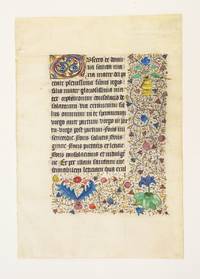
ST17060PFrance probably Besançon 3rd quarter of 15th century. 239 x 165 mm. 9 3/8 x 6 1/2". Single column 15 lines in an elegant gothic book hand. <br/> Rubrics in dark pink line enders in pink and blue with white tracery and gold bezant each leaf with a three- or four-line initial painted pink or blue with white tracery filled with pink and blue vines and flowers all on a burnished gold ground ONE SIDE OF EACH LEAF WITH A HALF OR THREE-QUARTER BORDER featuring hairline vines gold ivy and bezants colorful acanthus various flowers fleshy plants and vases with floral arrangements the other side of each leaf with a panel border similarly decorated. ◆Vellum slightly yellowed minor smudging to hairline vines and slight rubbing to paint on a few of the border decorations one leaf with some small stains in the border largely masked by the hairline vines but these issues quite minor and the leaves IN FINE CONDITION overall--very clean bright and well-preserved.<br/> <br/> From a large Book of Hours probably produced in Besançon these leaves feature exceptionally pretty borders each with unique decoration that includes vases of different shapes sizes and hues each containing a different flower arrangement fleshy vegetation and colorful floral accents. The large initials here coupled with the expansive border decoration indicate that these leaves marked the openings of major prayers including "Obsecro te" "O Intemerata" the "Joys of the Virgin" and the "Seven Requests to Our Lord." Luxurious touches such as the several dozen gilt bezants and ivy leaves in each border and the unusually wide margins point to this manuscript having been quite a costly production. For additional leaves from this same manuscript at different price points please check our website. unknown
190273377London: Edwin Arnold 1902. Limited to 165 numbered copies on vellum at the Essex House Press under C. R. Ashbee. Small octavo. 45 1 pp. Hand-colored frontispiece and two full-page hand-colored illustrations and eighty-five hand-colored ornamental letters by Edith Harwood. Tail-piece. Caslon type. Publisher's vellum with rose and gilt lettering to front cover. Bit of natural mottling to vellum. Custom folding cloth chemise and slipcase. A very good copy.Great Poems Series No. 6. "In 1886 C.R. Ashbee established the Guild of Handicraft at Essex House London. Around the same time Ashbee created the Essex House Press. The Essex House Press published its first book in 1898. The work of the press was very much a part of the Arts and Crafts Movement. Ashbee continually linked the aims of the press with those of John Ruskin and William Morris and described the object of the movement as “making useful things…making them well and…making them beautiful.†The critics however were not so sure about the work of Essex House Press calling it “articraftiness.†Later booklovers came to admire much of its work. Some of the presses and some of the workmen for Essex House Press came from the Kelmscott Press after its demise in 1897 following the death of William Morris. Ashbee designed his own typeface called “Endeavor†for the press. In 1902 the press moved to Glouscestershire. The Essex House Press closed in 1910 having produced more than seventy titles." Univ. of Utah Edwin Arnold hardcover
009682Aux Editions du Sagittaire, Chez Simon Kra 0 36 volumes in-12 brochés, couvertures rempliées
1931010380Paris Cahiers d'art 1931 In-4 Broché, couverture rempliée.
ST12083fItaly ca. 1150. 406 x 273 mm. 16 x 10 3/4". Double column 42 lines in a fine rounded early proto-gothic hand. <br/> With rubrics in red one three-line initial "I" and A PANELLED 13-LINE INITIAL "F" all of these on the very faded recto and consequently indistinct. Formerly used in a binding with text on the recto unreadable the verso with a narrow band of darkening along one edge not obscuring text edges very wormed but 90 percent of the worming in the margin with very little damage to the text; some obvious condition problems but the large and beautiful script on one of the sides entirely legible and certainly very pleasing.<br/> <br/> This leaf comes from a very large copy of one of the major texts by one of the great popes of the early Middle Ages and it is notable for the spaciousness and elegance of its script. The sermon here is based on the Gospel reading for Easter Sunday John 20:1-9 which reports Mary Magdalene's discovery of the empty tomb and her running to tell the apostles what she had--and hadn't--found. Given the fact that the passage under discussion celebrates the most critical event in Christianity the opening phrase "Fractus longa molestia stomachus" is unexpected who would have thought it appropriate to mention protracted gastrointestinal problems and probably more effective as a result. Gregory says he is so weakened that he had given up explaining the Gospel to his flock but now he must resume. He recounts how Mary Magdalene told John and Peter about the empty tomb how John arrived first but did not enter the sepulcher and how Peter the tardier one did. Gregory then gives an allegorical interpretation of this episode: John he says represents the Synagogue Peter the Church; the Jews were prior to the Christians but they hesitated on the brink of belief in the Son of God while the Christians entered into full belief. unknown
ST12668bDNortheastern France probably Arras late 15th century. 146 x 95 mm. 5 3/4 x 3 3/4". Single column 15 lines in a pleasing bâtarde hand. <br/> Rubrics in red one- and two-line initials in brushed gold on a red or blue ground EACH SIDE OF EACH LEAF WITH A BRUSHED GOLD PANEL BORDER WITH VERY PRETTY ILLUSIONISTIC FLOWERS; EACH LEAF WITH ONE SMALL MINIATURE measuring approximately 40 x 25 mm. Headlines written in French in a later 18th century calligraphic hand. ◆Light soiling a couple small stains in margins Trinity leaf with one initial a bit rubbed and a few very tiny chips of paint to miniature otherwise excellent specimens generally clean and smooth with ample margins and attractive decoration.<br/> <br/> From a charmingly decorated 15th century prayer book these lovely leaves offer the opportunity to acquire a miniature with considerable gold ornamentation at an attainable price. One leaf depicts an image of the Trinity in which God the Father holds the body of a crucified Christ in his arms; the other leaf depicts St. James patron saint of Spain shown in bright green and red robes and holding a long staff. For other leaves from this same manuscript please check our website. unknown
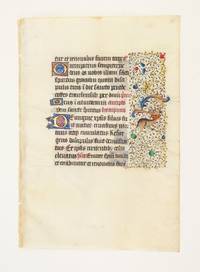
ST17060NFrance probably Besançon 3rd quarter of 15th century. 239 x 165 mm. 9 3/8 x 6 1/2". Single column 15 lines in an elegant gothic book hand. <br/> Rubrics in dark pink line enders in pink and blue with white tracery and gold bezant one- and two-line initials painted gold on pink and blue ground with white tracery each side with a panel border decorated with hairline vines gold bezants and ivy and colorful flowers and acanthus RECTO BORDER INHABITED BY A CHARMING DOG-LIKE CREATURE. ◆A small light stain in border decoration largely masked by dense hairline vines but IN FINE CONDITION--bright clean and well preserved.<br/> <br/> From a large Book of Hours probably produced in Besançon this leaf features very pretty panel borders including one with a particularly charming inhabitant in the form of a dog-like creature with no front legs wearing an orange collar and emitting an acanthus leaf from its mouth. Imaginative touches like this and luxurious elements such as the several dozen gilt bezants and ivy leaves in each border and the unusually wide margins point to this manuscript having been quite a costly production. For additional leaves from this same manuscript at different price points please check our website. unknown