1 337 résultats
1935015540Paris Glm 1935 Reliure
1930015758Paris Editions Kra - Collection «Club des soixante» n°1 1930 In-4 Reliure Edition originale Dédicacé par l'auteur
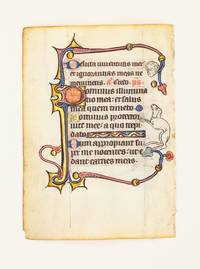
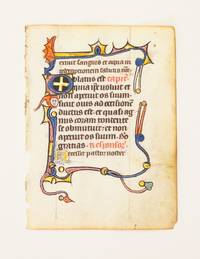
ST16985PFrance first half of 14th century. 110 x 82 mm. 4 3/8 x 3 1/4". Single column 12 lines in a gothic book hand. <br/> Line enders in pink and blue with gold accents each leaf with one or more one-line initials in blue with red penwork or gold with blue penwork each leaf with one two line initial painted pink or blue--filled with painted floral motifs or a gold cross and ONE INHABITED BY HUMAN FACE--all on a gold ground one side of each leaf with A FULL BORDER composed of pink and blue tendrils accompanied by spikey gold decoration and gold accents often terminating in ivy leaves and incorporating EXTRAORDINARILY CHARMING EXAMPLES OF MARGINALIA INCLUDING ANIMALS HUMAN HEADS AND HUMAN-BEAST HYBRIDS. ◆Occasional minor smudging vellum a little soiled and with a few small stains one leaf with noticeable staining affecting some of the text and decoration but with extremely appealing imagery making up for it another leaf with some marginal offsetting and the inhabited initial slightly rubbed but all other examples of marginalia VERY WELL PRESERVED.<br/> <br/> Though diminutive in size these leaves contain enormously appealing marginal decoration in the form of humans animals and hybrid creatures inventively incorporated into the lively borders in manners that range from adorable to bizarre. Especially popular in Flanders Northern France and England during the 13th and 14th centuries marginalia such as these comprise some of the most memorable and entertaining images to be found in any Medieval manuscripts. Despite being found largely in religious books such as Psalters and Books of Hours the images are often strange humorous or even outrageous and they provide us with consistent delight. Being by definition outside of the central text or miniature the margins seem to have been a place where illuminators felt more at ease to experiment resulting in highly imaginative and unique artistic expressions. The present specimens come from a fragmentary manuscript with many leaves either missing or rendered defective where portions of the vellum were cut away. Fortunately this group of leaves is intact and retains much marvelous imagery including two very alert hares an owl and a wonderful stork with a long beak grabbing the equally long beard emanating from a human-beast hybrid in the upper margin and the heads of humans some in the guise of a fool and storks with long beaks each holding a gold bezant incorporated into the border tendrils. One leaf shows more damage than the others here but contains some very desirable marginalia: a human-beast hybrid with an orange speckled body and a long tail in a stand-off with a snail in the upper margin and the torso of a trumpeter emerging from one of the border tendrils blowing into an extremely long gold instrument held vertically in the fore margin. For additional leaves from this same manuscript at different price points please check our website. unknown
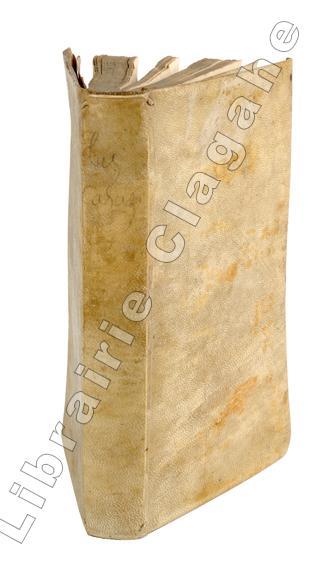
164219929Lyon, Jean Caffin et F. Plaignard, 1642 ; in 8, vélin rigide de l’époque ; [8], 299 pp, [5] pp. bl., (signatures : â4, A-T8) le dernier f. blanc est collé au contreplat de la reliure.
1944013801Paris (Seghers), Editions Poésie 44 1944 In-4 Reliure Dédicacé par l'auteur
ST18542England ca. 1375. 287 x 198 mm. 11 1/4 x 7 3/4. Single column 32 lines in a small rounded English gothic hand with rubrics in the margins. <br/> Rubrics in red running title in red paragraph marks in red or blue two initials measuring two lines in height and colored blue with red penwork. See: P. E. Beichner "Aurora Petri Rigae Biblia Versificata A Verse Commentary on the Bible." ◆Remnants of mounting tape in top margin of recto but a really excellent specimen the hand very clear the ink especially rich and the vellum extremely clean and quite bright.<br/> <br/> Written in a gothic hand heavily influenced by the English secretarial style this leaf comes from a copy of the "Aurora" a commentary on the Bible in verse form written in the late 12th century by French poet Petrus Riga 1140-1209 a canon of Rheims cathedral. Although little is known about the author's life Riga's text became immensely popular throughout Europe and was routinely studied in Medieval universities. According to Beichner "for those who could read Latin it supplied Scriptural lore in a popular form and it also served as a book of popular theology devotional reading moral instruction and entertainment. Its influence was propagated by teachers preachers and lexicographers by poets and other writers. It was studied imitated translated and quoted. Not only was it widely read in monasteries and convents but it was also recommended reading for the sons of nobles." It is interesting to note that although Riga's work was copied numerous times in the 13th century copies from the later Medieval period such as the present work are uncommonly rare. The parent manuscript containing our leaf was previously in the possession of the Dukes of Westminster and was sold at Sotheby's on 11 July 1966 lot 229 when it was advertised as having 267 leaves missing the first gathering plus 13 other leaves. Bookseller Francis Edwards acquired the manuscript at that sale removed three damaged leaves and sold the remainder. It was thereafter broken up and dispersed. Several sister leaves are now in the collections of Marquette University Lawrence University and the University of South Carolina. unknown
1833123235Small slim 4to. Paris: Techener 1833. Small slim 4to32ff printed in black letter on vellum woodcut illustration on t/p. Original full orange morocco backstrip gilt black label modern quarter red morocco box bookplate of Robert Hoe. A fine copy with some fading to the boards. § Unique copy printed on vellum Hoe's copy with his bookplate of this first facsimile reprint of the extremely rare French edition of 1530. This was one of several tales printed in the sixteenth century as a collection itself of the utmost rarity. We have not located a single copy in the US. Techener hardcover books
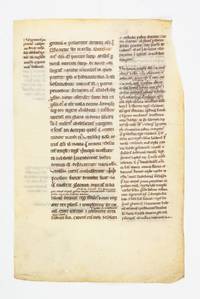
ST17586Abbey of St. Oyan at St.-Claude du Jura France ca. 1175. 245 x 158 mm. 9 3/4 x 6 1/4". Single column of text with two columns of gloss text column with 26 lines in a fine proto-gothic book hand. <br/> Verso with scant remnants of mounting tape in a couple of places along one edge. See Gwara Handlist no. 77. ◆Upper margin of fore edge unevenly trimmed away but no text lost a dozen-and-a-half small round wormholes touching just a couple letters light soiling to edges and other minor imperfections but still IN FINE CONDITION the vellum very clean and the ink dark and legible.<br/> <br/> The most important innovation in biblical scholarship during the 12th century was the development of the "Glossa Ordinaria" to the Bible. Drawing on the whole earlier tradition of biblical exegesis but especially that of Latin patristic writers like Augustine and Jerome scholars working in the French cathedral schools of Laon and Paris systematized this material in an apparatus of marginal and interlinear glosses arranged around the relevant biblical passages. The present leaf showing a particularly beautiful and regular script is a lovely example of one such work. The biblical text appearing in the center column is differentiated by larger lettering and gloss appears interlineally and in a column on either side of the main text all in smaller lettering by the same hand. Scott Gwara notes that the parent manuscript was formerly in the Medieval library of St. Oyan at St.-Claude du Jura a Benedictine monastery founded as the Abbey of Condat around 425 and later known as St. Oyen after an obscure saint who served as Condat's fourth abbot. In the 13th century it was renamed St.-Claude. By the 20th century the manuscript was in the collection of William L. Clements d. 1934 the bulk of which was sold by his estate between 1934-37. The manuscript was then acquired and dismembered by biblioclast Otto Ege around 1939. Gwara notes that the manuscript was incomplete by the time it reached Ege containing only 80 leaves but was "otherwise in excellent condition." The present leaf certainly attests to this assertion being extremely clean bright and with comfortable margins. unknown
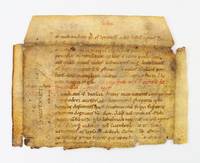
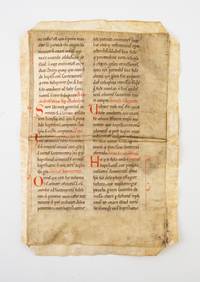
ST17587France late 12th century. 176 x 132 mm. 7 x 5 1/4". Single column 18 lines in a protogothic hand text on one side only. <br/> Rubrics in red "Liber" in upper margin in red. Recto and verso with scribblings by later hands the name "Simon Pivante" clearly visible on recto but the others illegible. ◆Recovered from a binding and thus with obvious staining folds and rubbing a couple lines at top and bottom and a few other words here and there too rubbed to make out but by and large still very legible and in a pleasing hand.<br/> <br/> This leaf is primarily of interest for its content containing a rare example of Anastasius Bibliothecarius' "Historia Ecclesiastica" of the Byzantine Church also known as the "Chronographia tripartita" compiled from the works of the near-contemporary Greek authors Theophanes Nicephorus and Syncellus. According to the Catholic Encyclopedia Anastasius Bibliothecarius ca. 810-79 "learned Greek from Greek monks and obtained an unusual education for his era so that he appears to be the most learned ecclesiastic of Rome in the barbaric period of the ninth century." He earned the moniker "Bibliothecarius" from his appointment as librarian of the Roman Church a position he held during the reign of popes Adrian II 867-72 and John VIII 872-82. It is possible that Anastasius was also the same figure elected antipope in 855 as recorded in at least one contemporary chronology but historians disagree on the validity of this identification. Anastasius' work appears to be extremely rare in the marketplace. unknown
ST16985NFrance first half of 14th century. 110 x 82 mm. 4 3/8 x 3 1/4". Single column 12 lines in a gothic book hand. <br/> Line enders in pink and blue with gold accents each leaf with one or more one-line initials in blue with red penwork or gold with blue penwork each leaf with one two line initial painted pink or blue filled with painted floral motifs and TWO INHABITED BY HUMAN FACES and on a gold ground one side of each leaf with A FULL BORDER composed of pink and blue tendrils accompanied by spikey gold decoration and gold accents often terminating in ivy leaves and incorporating EXTRAORDINARILY CHARMING EXAMPLES OF MARGINALIA INCLUDING ANIMALS HUMAN HEADS AND HUMAN-BEAST HYBRIDS. ◆Vellum a little soiled and with a few small stains one leaf with more obvious soiling varying degrees of smudging two leaves with more noticeable smudging affecting some of the text and decoration another leaf with two of the human heads slightly rubbed but all other examples of marginalia very well preserved and paint quite fresh and the gold sparkling.<br/> <br/> Though diminutive in size these leaves contain enormously appealing marginal decoration in the form of humans animals and hybrid creatures inventively incorporated into the lively borders in manners that range from adorable to bizarre. Especially popular in Flanders Northern France and England during the 13th and 14th centuries marginalia such as these comprise some of the most memorable and entertaining images to be found in any Medieval manuscripts. Despite being found largely in religious books such as Psalters and Books of Hours the images are often strange humorous or even outrageous and they provide us with consistent delight. Being by definition outside of the central text or miniature the margins seem to have been a place where illuminators felt more at ease to experiment resulting in highly imaginative and unique artistic expressions. The present specimens come from a fragmentary manuscript with many leaves either missing or rendered defective where portions of the vellum were cut away. Fortunately this group of leaves is intact and retains much marvelous imagery including several animals a dog a bird a squirrel and a large hare human and bestial heads capping the ends of border tendrils many with a memorable detail such as a bushy beard a massive gold horn or wearing a tall pointy hat including the torso of a person holding a long antler-like club and colorful human-beast hybrids. A couple of these leaves also have initials inhabited by charming little human faces. For additional leaves from this same manuscript at different price points please check our website. unknown
ST19578Northern Italy last quarter of 15th century. Each leaf measuring 250 x 164 mm. 9 7/8 x 6 3/8". Single column 24 lines in a handsome humanist hand. <br/> Each leaf with three to four large initials one measuring two lines all others three lines in burnished gold in-filled with pink and green paint with white embellishment on blue ground with white embellishments. See: Baldwin "Medieval Rhetoric and Poetic" pp. 216-23. ◆Insignificant wrinkling and a couple faint creases to vellum tiny snag along top edge of each leaf but IN VERY FINE CONDITION the vellum especially clean and bright the paint and ink fresh and the margins generous.<br/> <br/> Written in a beautiful humanistic script enclosed by wide margins and adorned with tasteful gilt initials these leaves come from what must have been a particularly fine manuscript made for a person of means. The text comes from the "Candelabrum" of Bene of Florence an early 13th century treatise on rhetoric and the art of elegant writing. The work consisted of eight parts instructing readers on word choice composition rhythm style and other important considerations in the construction of effective letters and prose. Apart from their enormous aesthetic appeal the present leaves are of great interest because few manuscripts of the text have survived. The style of the initials--elegant burnished gold on a ground of pale pink green and sapphire blue with whisps of white embellishments--suggest that the manuscript was executed in Northern Italy perhaps Milan Bologna or Florence by a craftsman of great technical skill. Fine examples of humanistic script are becoming increasingly difficult to find on the market and the present examples are among the loveliest we have ever acquired. unknown
First edition, large 8vo (240 x 155 mm), vi, 85, [1]pp., 200 copies printed, this being the only copy PRINTED ON VELLUM, title printed in red and black, marbled endpapers, bound in contemporary smooth light tan calf, both boards with gilt scrolled border in gilt and blind with central crest of Dawson Turner in blind, spine lettered in gilt direct with a decorative border, spine rubbed, joints cracked, all edges gilt. A unique copy specially printed on vellum and bound for the compiler Dawson Turner (1775-1858), banker, naturalist, patron of the Arts, antiquary and collector. In all these pursuits Dawson Turner excelled, he published usually at his own expense in very small editions, and on occasions had a special copy printed on vellum for himself, as here. There is a prefatory letter to the Rev. S. C. E. Neville Rolfe and Daniel Gurney, signed Dawson Turner, Yarmouth, September 1847. In this valuable work, the parishes are arranged in Deaneries, the data set out in tabular form. There are very full indexes of parishes, incumbents and patrons. The Rev. Strickland Charles Edward Neville Rolfe (1789-1852) was vicar of Heacham, and Daniel Gurney (1791-1880) was a well-known banker and antiquary of King's Lynn. It was these two gentlemen who obtained a transcript from the Episcopal Registers which made the present publication possible. Provenance: Sold as lot 2073 by Sotheby's at the auction of Dawson Turner's library in March of 1853.
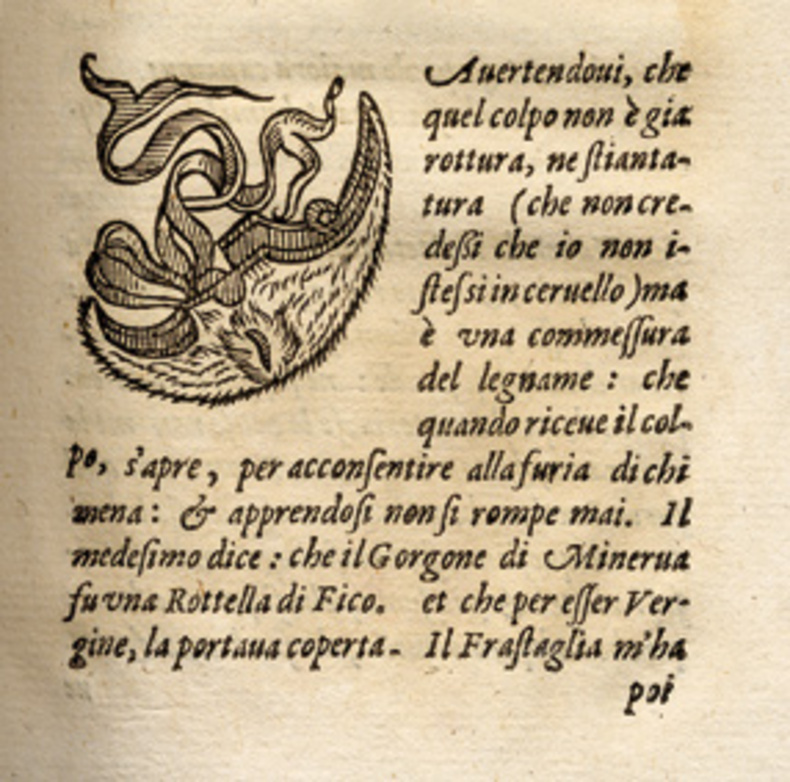
158414460Bengodi (fictive), s.n., 1584 (21 octobre) ; 3 tomes en un petit volume in-8 (157 x 100 mm) ; plein vélin ivoire à recouvrements de l'époque ; (12), 228 pp. (A-P 8) ; (8), le premier feuillet blanc, 401 pp., (1 bl.), (2) ff. blancs (A-Z 8, Aa-Cc 8) ; 142 pp. (Dd-Mm 8), (1) f. blanc et figure de la figue à fourrure p.107 de la 3e partie.
1949009094Paris Librairie Auguste Blaizot 1949 51 x 38 cm En feuilles, couverture illustrée, chemise et étui éditeur
1964011898Paris Le Club français du livre 1964 En feuilles, couverture muette.
1509Pharsale-Lucain-1509Édition rare et authentique de la Pharsale de Lucain, en format in folio, reliée en plein vélin blanc d’époque. Dos à 5 nerfs, reliure Janséniste, titré à la main au dos. Toutes tranches mouchetées, très frais. Petit trou d'envol au mors du plat supérieur arrière, trois dernières pages fendues en bas de marge, ainsi qu'un petit trou dans la marge. Rousseurs en marge sur le dernier cahier. Texte sur deux colonnes, lettrines.
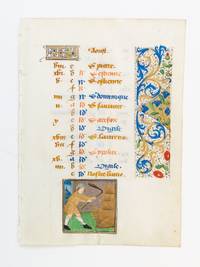
ST17245-02France probably Rouen second half of 15th century. 162 x 117 mm. 6 3/8 x 4 5/8". Single column 17 ruled lines text in a bâtarde hand. <br/> Text in gold blue and red "KL" in scrolling white letters on a gold ground with small blue and red blossoms both sides with panel border of acanthus flowers small ink dots and gold bezants WITH TWO SMALL MINIATURES showing the labor of the month Threshing on recto and the zodiac sign Virgo on verso. ◆Small wrinkle in lower margin just touching the lower edge of the miniatures trivial smudging but IN VERY FINE CONDITION the vellum especially clean and bright the paint quite rich and the miniatures extremely well preserved.<br/> <br/> With clean white vellum small but appealing miniatures and attractive lettering and decoration this is a desirable example of a calendar leaf from a high-quality Book of Hours likely made in Rouen. According to Roger Wieck far fewer than half the Books of Hours of the period contain illustrated calendars "even in manuscripts with otherwise lavish cycles of miniatures"; when they do appear they are invariably charming as is the case here. In the lower margin of the recto is a small miniature depicting the typical labor for August "Threshing" in which a young layman brings down his grain flail two hinged pieces of wood the longer one called a helve and the other a beater joined by a thong in an effort to separate the grain while neatly stacked unprocessed clumps of straw appear just behind it. On the verso we see a representation of Virgo as a young woman holding appropriately a long sheaf of grain in her hand. While most of the feast days that appear in the calendar are typical for the period the inclusion of St. Sauveur i.e. Transfiguratio Domini on 6 August is characteristic of a calendar for the use of Rouen suggesting that the parent manuscript may have been produced in that place or the region around it. unknown
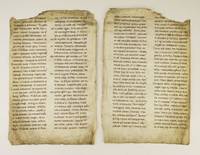
ST13657aFrance second half of the 13th century. Each leaf measures 330 x 240 mm. 13 x 9 3/8". Double column 38 lines of text in a proto-gothic hand. <br/> Rubrics in red running title and numerous paragraph marks in red and blue one leaf with one two-line initial in blue with red pen flourishes. Margins with several text corrections one leaf with a catch-word. Faint soiling and a few negligible stains touching text not affecting legibility but overall FINE SPECIMENS with very few flaws.<br/> <br/> Containing part of a popular treatise on the Vices these well-preserved and attractive large format leaves come from a manuscript that may have been contemporary to the life of the author William Perault ca. 1190-1270. Although the so-called "Seven Deadly Sins" that we still recognize today remained a popular moral paradigm throughout the Middle Ages it was by no means canonical. Authors were free to borrow manipulate and elaborate on the topic at will resulting in a profusion of treatises and competing systems of morality. This work by Perault Latin: Peraldus was a particularly prominent treatise that not only survived the Middle Ages but later went into print in several editions. The "Summa of Vice" expounds upon the Seven with which most of us are familiar--Pride Envy Anger Sloth Greed Gluttony and Lust--but it also includes an eighth sin which Perault called "peccatum linguae" or "the sin of the tongue." The present leaves consider the sin of Pride Superbia the most severe and dangerous of all the vices in Medieval imagery it is often depicted as the root of all other sins with some interesting discussion of garish dress make-up hair coloring and wigs. unknown
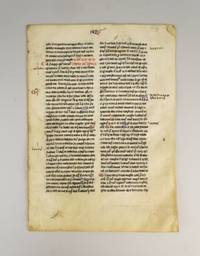
ST20837bGermany late 12th or early 13th century. 335 x 224 mm. 13 1/4 x 8 7/8". Double column 29 lines in an elegant proto-gothic book hand. <br/> Rubrics in red several two-line initials in red. Recovered from a binding and so the vellum a bit soiled creased and wavy recto with a lighter patch where a title label was once situated light stains and glue and paper residue on the verso but overall the leaf remarkably clean entirely legible and surprisingly well preserved.<br/> <br/> Once serving as a cover for a later book this leaf comes from a nearly contemporaneous copy of Peter Lombard's "Sentences" considered the most important theological book of the 12th century. Written between 1155 and 1158 and arranged topically Lombard's "Sententiae" summarize past learning about Christian doctrine by quoting authorities in an attempt to resolve textual disagreement by dialectical analysis. As a source collection that continued to spark discussion Lombard's great work enjoyed sustained success as a theological textbook until the 17th century and inspired numerous commentaries including those of Aquinas and Luther. This leaf comes from Book IV "On the Doctrine of Signs" which is primarily concerned with the seven sacraments: Baptism Confirmation the Eucharist Penance Extreme Unction Sacred Orders and Matrimony. The script is an upright and very legible proto-gothic book hand with a few distinctive letter forms and abbreviations that may help determine a more definitive point of origin these include a "g" with a downward cross on its tail and a conjoined "qe" for "que". It is unusual and very lucky that this leaf survives completely intact as Medieval manuscripts used in later bindings were often cut down in size to make smaller covers or used as waste paper for pastedowns or other binding elements. unknown
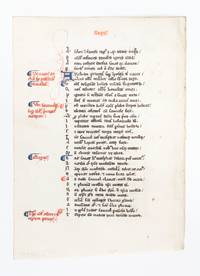
ST15769aPerhaps France mid-12th century. Each leaf measures approximately 370 x 240 mm. 14 1/2 x 9 1/2". Double column 32 lines in a fine proto-gothic hand. <br/> See: Thompson "An Introduction to Greek and Latin Paleography" p. 436. ◆Recovered from a binding and thus with one side of each leaf somewhat browned soiled and with a few creases one leaf with several small blotches of red paint in the text not affecting overall legibility one corner of each leaf torn away affecting running title and one to two lines of text other trivial defects but still very nice specimens with clear and legible script and one side of each leaf quite clean and well preserved.<br/> <br/> Once part of a large and elegant Romanesque Bible these leaves are excellent examples of a high quality proto-gothic book hand. Sometimes referred to as "praegothica" or "late Caroline" the proto-gothic script is characterized by letterforms that are more or less unchanged from Caroline minuscule but with a number of traits starting to show elements of gothic script--most notably the addition of feet appearing here as an upward flick of the pen on the bottom of minims but also including the use of more abbreviations the fusion of certain letter combinations a more elongated "o" and a straight-backed "a." Whatever the level of its evolution the script here has very pleasing rounded letterforms that are highly legible and generously spaced. Though the vellum is not unmarred by its former life as binding material the script here has not lost any of its beauty revealing a hand that is practiced regular and distinctly pleasing to the eye. As Thompson notes "In the twelfth century the scribes seem to have vied with each other in producing the best types of book-writing of which they were capable with the result that remarkable precision in the formation of the letter was attained and that the century may be named as excelling all others for the beauty of its MSS." Our leaves come from Deuteronomy the Old Testament book consisting primarily of three sermons made by Moses just before entering the Promised Land. One leaf contains brief summaries of chapters 2-18 with some chapters numbered in the margins while the other leaf contains part of the first of Moses' speeches in which he recalls the Israelites' 40-year journey through the wilderness. unknown
awd-106458 encres originales sur vélin au format 32/24 cm (dont 40 avec ajouts localisés aux crayons de couleur et 3 signées et datées 9-86) insérées dans un book en skaï gris texturé (35,5/29,2/3,8 cm).
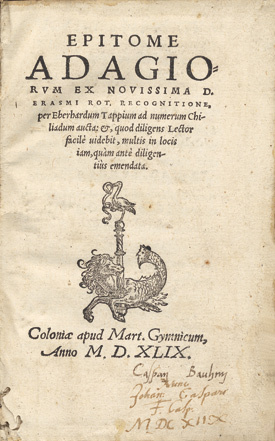
15499472Cologne, Mart. Gymnicus, 1549 ; in-8 ; plein vélin estampé sur ais de bois, dos à trois gros nerfs, fermoirs de cuivre (reliure de l'époque) ; (16) y compris le titre, 632, [634], (76) pp. index, (1) f. blanc (*, AZ, Aa-Xx - 8, Yy - 4).
8716German: c. 1500. Single leaf 132 x 155 mm. Very good matted. § An intriguing painting showing the instruments of the Passion a crowing cock the head of Judas the thirty pieces of silver &c. A somewhat surreal piece with the head and some of the instruments floating in the air against a rich blue background Christ standing before a tomb clad in loincloth and red cloak with a blue cloak on the tomb a ladder and pillar at each side. Some surface wear and damage within the image which is also cropped slightly but an interesting and unusual painting. c. 1500. Single leaf hardcover books
1891ST15049London: Seeley and Co 1891. No. 85 OF 160 COPIES ON LARGE PAPER. 382 x 275 mm. 15 x 10 3/4". 4 p.l. 111 1 pp. <br/> Publisher's gilt-stamped vellum upper cover with titling and the Tennyson coat of arms BOTH COVERS WITH LOVELY HAND-PAINTED DESIGN BY JOHN T. BEER upper cover with urn at foot and blooming rose branches emanating from a medallion bearing the date 1902 and curving around the title and escutcheon lower cover with branches of apple blossoms dividing the board into quadrants each inhabited by a bird in flight smooth spine with gilt titling edges untrimmed. With frontispiece photographic portrait of Tennyson 31 vignettes in the text and 14 copper-plate engravings after drawings by Edward Hull. Verso of title page and limitations page with ink stamp of Gloucester County Library. Weber "The Fore-Edge Paintings of John T. Beer" 195. Small scratch near head of front joint minor soiling and rubbing to edges of boards mild foxing mostly marginal and not affecting copper engravings otherwise an excellent copy clean and fresh internally with wide margins the binding especially bright the pretty decoration perfectly preserved. AN EXTREMELY ATTRACTIVE COPY.<br/> <br/> This very large format deluxe illustrated work describing the places associated with England's beloved Poet Laureate Alfred Lord Tennyson is enhanced by former owner John T. Beer's Arts & Crafts-style embellishments to the vellum binding. After retiring from a successful career as a clothier Merseyside book collector Beer ca. 1826-1903 occupied himself decorating books from his library mostly with fore-edge paintings but in a score of instances with painted bindings. Jeff Weber considers Beer "one of the most highly skilled artists of fore-edge paintings" noting that he was the first artist to put his signature to such works. Weber's catalogue raisonnée of Beer's works lists 189 fore-edge paintings 22 painted bindings including this one #195 and three bindings designed by Beer and executed by Fazakerley of Liverpool. The design here is clearly influenced by the Arts & Crafts movement and Beer owned several works by William Morris including a Kelmscott Press "Godefrey of Bologne" on the vellum covers of which he had painted a design of tulips and lilies. Among the locations discussed and pictured in the "The Laureate's Country" are Tennyson's childhood homes in Somersby and Bag Enderby Trinity College Cambridge where he matriculated and his estates Farringford on the Isle of Wight and Aldworth in West Sussex. Seeley and Co unknown
ST12668bHNortheastern France probably Arras late 15th century. 146 x 95 mm. 5 3/4 x 3 3/4". Single column 15 lines in a pleasing bâtarde hand. <br/> Rubrics in red one- and two-line initials in brushed gold on a red or blue ground EACH SIDE OF LEAF WITH A BRUSHED GOLD PANEL BORDER WITH VERY PRETTY ILLUSIONISTIC FLOWERS AND FRUITS and intricate strapwork design in colors; WITH TWO SMALL MINIATURES measuring approximately 40 x 25 mm. depicting John the Baptist and John the Evangelist shown with their attributes. Headlines written in French in a later 18th century calligraphic hand. ◆Light soiling a touch of paint loss to frames and background not very noticeable and not affecting the figures otherwise an excellent specimen generally clean and smooth with ample margins winning decoration and shining gold.<br/> <br/> From a charmingly decorated 15th century prayer book this leaf offers the opportunity to acquire two particularly nice miniatures each depicting an important saint. The recto shows St. John the Baptist with a lamb at his side and a book balanced on his knee; and the verso depicts St. John the Evangelist as a young man holding a chalice with what ought to be snakes emerging from it in reference to the poisoned cup he was invited to drink as a test of faith but which instead look more like tendrils of smoke. For other leaves from this same manuscript please check our website. unknown