1 336 résultats
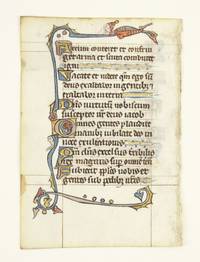
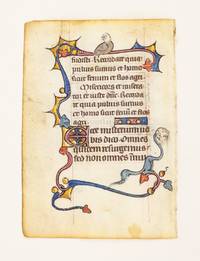
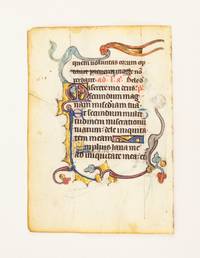
ST16985MFrance First half of 14th century. 110 x 82 mm. 4 3/8 x 3 1/4". Single column 12 lines in a gothic book hand. <br/> Line enders in pink and blue with gold accents each leaf with one or more one-line initials in blue with red penwork or gold with blue penwork each leaf with one two line initial painted pink or blue filled with painted floral motifs and on a gold ground one side of each leaf with A NEAR-FULL BORDER composed of pink and blue tendrils accompanied by spikey gold decoration and gold accents often terminating in ivy leaves and incorporating EXTRAORDINARILY CHARMING EXAMPLES OF MARGINALIA INCLUDING HUMAN-BEAST HYBRIDS. ◆Vellum a little soiled and with a few small stains one leaf with more noticeable smudging affecting some of the text and decoration another leaf with one of the heads a little rubbed but all other examples of marginalia very well preserved.<br/> <br/> Though diminutive in size these leaves contain enormously appealing marginal decoration in the form of humans animals and hybrid creatures inventively incorporated into the lively borders in manners that range from adorable to bizarre. Especially popular in Flanders Northern France and England during the 13th and 14th centuries marginalia such as these comprise some of the most memorable and entertaining images to be found in any Medieval manuscripts. Despite being found largely in religious books such as Psalters and Books of Hours the images are often strange humorous or even outrageous and they provide us with consistent delight. Being by definition outside of the central text or miniature the margins seem to have been a place where illuminators felt more at ease to experiment resulting in highly imaginative and unique artistic expressions. The present specimens come from a fragmentary manuscript with many leaves either missing or rendered defective where portions of the vellum were cut away. Fortunately this group of leaves is intact and retains much marvelous imagery including a beast with an exaggeratedly long body and horns and long-necked beasts with human heads--one who appears to be blowing smoke into the air one with a bearded face as its bottom and another with the body of a stork sporting a hat with a long pointy tendril. For additional leaves from this same manuscript at different price points please check our website. unknown
163011321Antverpiae, Joan Galle, (circa 1630) ; F. Ioannes Nys invenit, Peter de Jode figuravit, Theodor Galle sculpsit et excudit ; titre gravé, portrait et 32 planches légendées. SUIVI de 4 planches gravées par JOAN GALLE : I- Prudentia, II- Justitia, III- Fortitudo, IV- Temperantia (les 4 vertus cardinales). SUIVI de 14 planches de sujets religieux, gravées par CORNELIUS GALLE le Vieux : Silva sacra, Fugit familia sacra, S. Barbara, S. Ianvarius Neapolis patronis, S. Lucia, S. Leontius martyr miraculis gloriossus in Muris Helvetiorum, S. Iacobus Maior, Benedicite omnes bestiae et pecora domino, S. Hieromymus, Vierge à l'Enfant, etc. Soit en tout 52 planches, reliées en 1 volume petit in-4 ; plein vélin ivoire, titre au dos, tranches rouges (reliure du XIXe).
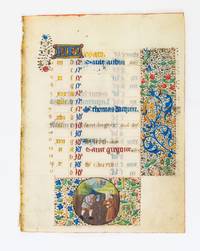
ST17245-04France possibly Rouen mid-15th century. 173 x 130 mm. 6 3/4 x 5 1/8". Single column 16 ruled lines text in a gothic book hand. <br/> Text in gold blue and dark pink "KL" in blue with white tracery on a gold ground decorated with dark pink baubles and leaves and with a floral spray extension both sides with panel border composed of densely packed acanthus flowers and hairline vines with gold bezants WITH A SMALL ROUNDEL MINIATURE at the bottom depicting the labor of the month Pruning set on a panel of flowers hairline vines and gold bezants. With numbering to the left of the golden numbers and a few calendar entries in a later hand. ◆Light soiling to vellum a few small smudges in the borders a little paint transfer affecting a couple lines of text and margins of the verso but these issues all very minor and on the whole in fine condition with a particularly well-preserved miniature with rich uneroded paint.<br/> <br/> With lovely panel borders and a particularly charming roundel miniature showing the labor of the month this leaf likely comes from a high-quality manuscript made for a person of means. Though miniatures depicting the labors of the month are often illustrated with just a single person performing the task here we are treated to two laypeople--a man and a woman--working together to prune and break ground in their field. The man appears to be carrying an axe for trimming branches while the woman carries a long stick to loosen dirt for spring plantings. The names of several saints have been added to the calendar by a later hand though it would appear that they were erroneously placed in March: St. Hugh belongs on 9 April Pope Leo on 11 April and St. Tiburtius on 14 April. While almost all of these feast days are commonly found in Books of Hours of this period Hugh Bishop of Rouen is slightly unusual suggesting that the manuscript may have been made in or at least ended up in Rouen. unknown
1415ST19350-056Germany and Low Countries 14th & 15th centuries. Smallest piece: 209 x 152 mm. 8 1/8 x 5 7/8"; largest piece: 372 x 235 mm. 14 3/4 x 9". <br/> Recovered from bindings and thus with uneven trimming and occasional small holes resulting in loss staining and toning to vellum some leaves with remnants of pastedowns obscuring the script but generally the leaves quite legible substantially complete and in presentable condition.<br/> <br/> This packet contains five vellum manuscript leaves all complete or nearly so all with musical notation and all serving as linings or covers of a binding when reused in their second lives. Prepared with an academic audience in mind the group presents an excellent opportunity for libraries teachers and students to develop or expand their teaching or personal collections. In addition to their obvious value as manuscripts containing the text and music of the Medieval period these leaves are also of educational importance as physical artifacts demonstrating the reuse of manuscript material in the production of later bindings. The shape of each binding is still easily discernable and a few of these specimens even include early spine labels and ink notations as well as paper remnants used in the bookbinding process. unknown
1918015759Paris Editions de la Sirène 1918 In-8 carré Reliure
1986010342Genève La Revue des Belles-Lettres n°3-4 1986 fort in-8 Broché, couverture rempliée
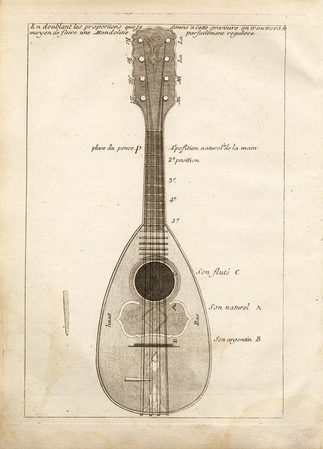
17688518A Paris, l'Auteur... chez Mr. Levinville, luthier ; gravé par Mme Vendôme, imprimé par Montuhai, sans date (circa 1768) ; in-folio ; plein vélin vert, grande pièce de titre de maroquin grenat entourée d'un large décor doré sur le premier plat (reliure de l'époque) ; (2) ff. (titre-frontispice, titre, dédicace au duc de Chartres, planche représentant une mandoline), 67 pp., imprimé sur vergé fort. Ouvrage entièrement gravé.
ST12083eItaly ca. 1150. 406 x 273 mm. 16 x 10 3/4". Double column 42 lines in a fine rounded early proto-gothic hand. <br/> Recto with a pleasing three-line red initial. ◆Formerly used in a binding and consequently a bit soiled and trimmed at the head with loss of the first line perhaps 100 or so small wormholes in the margin only a few causing trivial harm to the text a faint grayish stain affecting a couple of words in the top 20 lines of one column on each side but the entirety of the text completely clear and the stately leaf quite fresh and unusually well-preserved in general for a recovered specimen.<br/> <br/> This leaf comes from a very large copy of one of the major texts by one of the great popes of the early Middle Ages. Dealing in part with the central occurrence in the salvation of humanity the text here treats of John 20:19-31 which tells of the risen Christ's appearance to the Apostles. Doubting Thomas insists on touching the Lord's wounds before he will be convinced of the Resurrection. Gregory tells his audience that Thomas was healed of unbelief and so must they be although they cannot see Jesus in the flesh as did Thomas. Written ca. 593 Pope Gregory's 40 homilies on the Gospels enjoyed enduring popularity throughout Medieval times as they offered ordinary Christians practical guidance on applying the lessons of the Gospels to their own lives. Elected pope in 590 Gregory ca. 540-604 was one of the most influential pontiffs in the history of the Church. In addition to revising liturgical worship he wrote extensively on theology offering homespun wisdom rather than esoteric debates. He was declared a saint immediately upon his death. The script here is regular rounded and very pleasing--almost soothing--to the eye. Moreover the letters are so large and there is so little significant damage to the leaf that the text can be easily read from a considerable distance. unknown
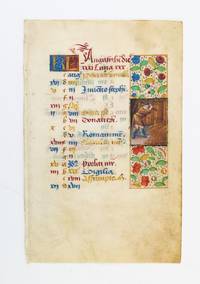
1470ST17245-09Northern France probably Rouen ca. 1470. 180 x 117 mm. 7 x 4 5/8". Single column 18 lines text in a bâtarde hand. <br/> Text in red blue and gold two-line "KL" in shell gold on blue and red ground both sides with panel border composed of flowers and ink dots WITH TWO SMALL MINIATURES each centered in the middle of the panel borders featuring the labor of the month Threshing and the zodiac sign a young woman for Virgo. Vellum a bit soiled and slight wrinkling in margins small area of rubbing at bottom of the Virgo miniature but in excellent condition overall the fine details in the miniatures well preserved.<br/> <br/> Situated among the flowers of the panel borders here are two small but charming miniatures depicting the labor of the month "Threshing" and the zodiac sign for August. According to Roger Wieck far fewer than half the Books of Hours of the period contain illustrated calendars "even in manuscripts with otherwise lavish cycles of miniatures"; when they do appear they are invariably charming as is the case here. In the threshing scene a young layman brings down his grain flail two hinged pieces of wood the longer one called a helve and the other a beater joined by a thong in an effort to separate the grain while neatly gathered bushels of straw appear just behind him. On the verso we see a representation of Virgo as a young woman holding appropriately two long stalks of grain in her hands. The rich palette used in these miniatures allows the delicate gold highlighting on the harvested crop and garments to shine through adding a fine sense of detail to each image. unknown
ST12668bJNortheastern France probably Arras late 15th century. 146 x 95 mm. 5 3/4 x 3 3/4". Single column 15 lines in a pleasing bâtarde hand. <br/> Rubrics in red one- and two-line initials in brushed gold on a red or blue ground EACH SIDE OF EACH LEAF WITH A BRUSHED GOLD PANEL BORDER WITH VERY PRETTY ILLUSIONISTIC FLOWERS; EACH LEAF WITH TWO SMALL MINIATURES measuring approximately 40 x 25 mm. depicting saints shown with their attributes. Headlines written in French in a later 18th century calligraphic hand. ◆Light soiling rubrics faded otherwise excellent specimens generally clean and smooth with ample margins attractive decoration and shining gold.<br/> <br/> From a charmingly decorated 15th century prayer book these lovely leaves offer the opportunity to acquire a miniature and considerable gold ornamentation at an attainable price. One leaf depicts St. Andrew holding an "X" shaped cross and St. Etienne i.e. St. Stephen here shown with three stones on his body and the other shows St. Remigius the so-called "Apostle of the Franks" and St. Quentin--a saint that was particularly venerated in France especially in the north whence we be believe these leaves originated. For other leaves from this same manuscript please check our website. unknown
14501058951450. Dutch school: c. 1450 or later. <br /> <br /> Single leaf 138 x 98 mm. Miniature without text image of Christ before Caiaphas being held by a soldier with a jester dancing behind him disciples and a cockerel seen through a doorway in the courtyard beyond within a three-sided border of simple flowers. In good condition.<br /> <br /> § Origin and provenance unknown; from a private California collection. unknown
87191250. Central Italy c.1250. <br /> <br /> Matted in fine condition.<br /> <br /> § A well-painted initial of a man in flowing blue and pink robes holding a book to which he gestures probably Saint Paul. Italian miniature paintings of this period are known to be difficult to localize with any accuracy but as the face is strongly drawn with well-proportioned features it might well hail from central Italy. unknown
105895Dutch school: c. 1450 or later. Single leaf 138 x 98mm. Miniature without text image of Christ before Caiaphas being held by a soldier with a jester dancing behind Him disciples behind Him with a cock sitting above the three-sided border of simple flowers. In good condition. § Origin and provenance unknown; from a private California collection. c. 1450 or later. Single leaf unknown books
8719Central Italy c.1250. Matted in fine condition. § A well-painted initial of a man in flowing blue and pink robes holding a book to which he gestures probably Saint Paul. Italian miniature paintings of this period are known to be difficult to localize with any accuracy but as the face is strongly drawn with well-proportioned features it might well hail from central Italy. unknown books
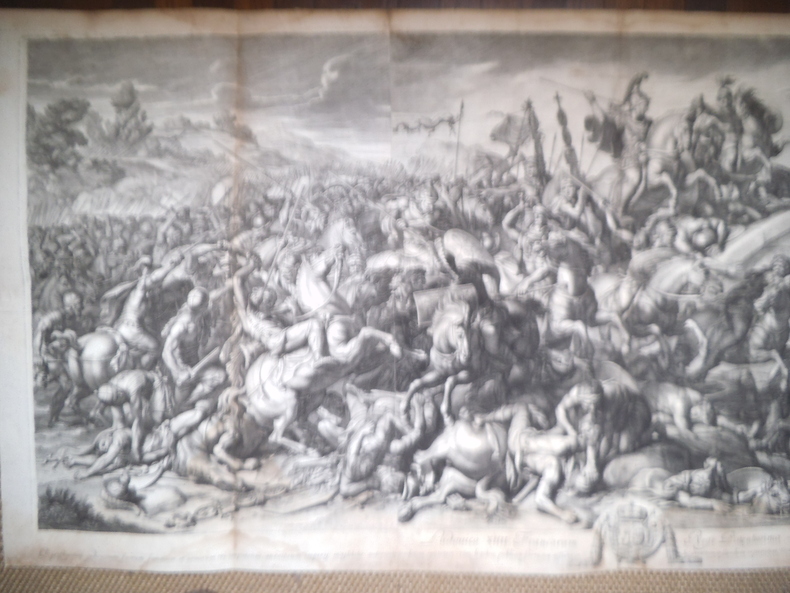
13379CONSTANTIN contre MAXENCE. La bataille du pont MILVIUS Estampe gravée au burin, à l’eau forte, en 4 feuilles, d’après le tableau de C. LE BRUN. Girard AUDRAN graveur. En marge inférieure Ludovico XIII Francorum rég à Potentssimo. C. LEBRUN cum priv. Regis 1666. Format 1640x7120mm et 1725x745mm avec marges Belle épreuve bien contrastée, sur vélin fort. Marge inférieure et pliures renforcées, pâle mouillure en marge inférieure. La victoire de CONSTANTIN consacre le début d’une nouvelle ère pour l’Empire, elle doit son nom au pont qui enjambe le Tibre à quelques kilomètres au nord-est de ROME.RARE. "Maxence aligne face à Constantin une armée comparable. Soit que le pont est en mauvais état soit qu’il est trop étroit ; les troupes de Maxence traversent le Tibre sur un pont provisoire constitué de bateaux accolés l’un contre l’autre, une fois de l’autre coté, elles se trouvent trop à l’étroit sur la plaine pour pouvoir manœuvrer. Constantin en profite, il lance sa cavalerie à l’assaut et désorganise les troupes ennemies. Dans la confusion, chacun tente de s’enfuir par le fleuve, Maxence le premier. Son corps est retrouvé le lendemain dans le lit du fleuve. Vainqueur, Constantin entre à Rome et s’impose comme seul maître de l’occident"
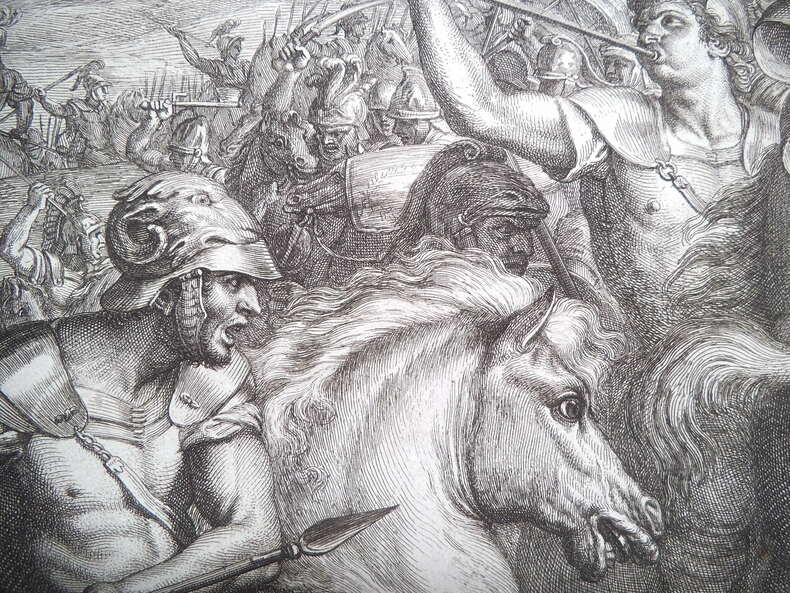
13373La bataille d’ARBELLE. La vertu est digne de l’Empire du Monde. Estampe gravée au burin, à l’eau forte et la pointe sèche, en quatre feuilles, d’après le tableau de Charles LE BRUN. 1674- format 710 x1587 mm à la cuvette. 1670 x730mm avec marges (courtes) Marge inférieure renforcée long. Belle épreuve, bien contrastée, sur vélin fort. Marge inférieure et pliures renforcées. RARE « DARIUS sur un char, Alexandre à cheval, environnés de gens d’élite. Soit illusion, soit réalité, ceux qui étaient près d’Alexandre crurent avoir vu un peu au dessus de la tête du Prince, un aigle voler paisiblement, sans être effrayé, ni du bruit des armes, ni du gémissement des mourants, dans le feu de l’action, le devin Alexandre revêtu de sa robe blanche et montrant une branche de laurier, montra –t-il cet oiseaux aux soldats comme un augure infaillible de leur victoire… l’ardeur et la confiance la plus grande renaît alors, elle redoubla surtout quand le conducteur de Darius ayant été percé d’une javeline, ni Perses, ni Macédoniens ne doutèrent que ce ne fût le Roi lui-même qui avait été tué… Ce n’était déjà plus un combat mais une boucherie, lorsque Darius tourna aussi son char pour prendre la fuite. » (Quint-Curse liv IV)
13394AUDRAN Gérard Le palais soleil d’après Charles LE BRUN. Estampe gravée à l’eau forte et au burin. 1680. Epreuve sur vélin fort, en 5 feuilles, une feuille pour le texte en latin,( 200x420mm), dans la partie inférieure, 1680 . 810mmx1050mm. G. AUDRAN sculpsit , en marge extérieure droite. C. Le BRUN jn. Et cum privil. Régis en marge extérieure droite ainsi qu’en marge inférieure et en marge extérieure gauche. Fragilité à la pliure inférieure, avec renforts. Pâle mouillure en marge inférieure, ainsi qu’en bordure de la marge extérieure. RARE. Belle et imposante épreuve, bien contrastée. "Apollon traverse sur son char l’année, les mois, les semaines, les jours et l’ensemble du zodiaque, entouré des différentes planètes et des vents. Le BRUN s’inspira de l’histoire de Phaêton dans les métamorphoses d’Ovide (symbole du désir ardent de FOUQUET) .Les personnages sont placés sur un immense serpent qui fait le tour de la gravure et qui se mord la queue. Il s’agit de la représentation de l’ourobos (sceau purificateur, il symbolise l’éternelle unité de toutes choses et le cycle de la vie, de la naissance à la mort)"
13370AUDRAN Gérard le plafond de la chapelle de Sceaux Estampe en tondo, gravée au burin, à l’eau forte et la pointe sèche, en cinq feuilles, d’après Charles LE BRUN 1681. Diamètre 1170mm. Marge courte. Pliures (estampe à l’origine dans une imposante reliure) Le peintre a représenté le triomphe du nouveau testament sur l’ancien. Le Père éternel porté sur les ailes des anges, venant de l’Arche d’alliance, le chandelier à 7 branches, et divers instruments de musique, une balustrade fit le tour de la composition Charles Brun 1681. En marge : peint à fraisque dans la voûte de la chapelle du chasteau de Sceaux par m. Le BRUN premier peintre du Roy et gravé par Girard AUDRAN 1681. Belle épreuve bien contrastée. Epreuve en cinq pièces se réunissant. L’épisode est relaté sur les évangiles de Matthieu, Marc et Luc. Alors qu’il vient d’être baptisé dans les eaux du Jourdain. Jésus voit le saint esprit descendre sur lui sous la forme d’une colombe. Symboliquement cette vision annonce la rédemption grâce au futur sacrifice du Christ soit la réouverture du royaume des cieux fermé aux mortes depuis le pêché original.
13371AUDRAN Gérard le plafond de la chapelle de Sceaux Estampe en tondo, gravée au burin, à l’eau forte et la pointe sèche, en cinq feuilles, d’après Charles LE BRUN 1681. Diamètre 1170mm. Marge courte. Pliures (estampe à l’origine dans une imposante reliure) Le peintre a représenté le triomphe du nouveau testament sur l’ancien. Le Père éternel porté sur les ailes des anges, venant de l’Arche d’alliance, le chandelier à 7 branches, et divers instruments de musique, une balustrade fit le tour de la composition Charles Brun 1681. En marge : peint à fraisque dans la voûte de la chapelle du chasteau de Sceaux par m. Le BRUN premier peintre du Roy et gravé par Girard AUDRAN 1681. Belle épreuve bien contrastée. Epreuve en cinq pièces se réunissant. L’épisode est relaté sur les évangiles de Matthieu, Marc et Luc. Alors qu’il vient d’être baptisé dans les eaux du Jourdain. Jésus voit le saint esprit descendre sur lui sous la forme d’une colombe. Symboliquement cette vision annonce la rédemption grâce au futur sacrifice du Christ soit la réouverture du royaume des cieux fermé aux mortes depuis le pêché original.
13378Estampe gravée au burin, à l’eau forte et la pointe sèche, en marge inférieure cum priviliegio regit 1666, belle épreuve, bien contrastée, en 4 feuilles sur vélin fort 740x1680 avec marges courtes marge inférieure et pliures renforcées. Constantin assis sur un char de triomphe est couronné par la victoire, il est entouré de licteurs, précédés de soldats portant les dépouilles opimes et suivi de prisonniers ;
13372AUDRAN Gérard. Le passage du GRANIQUE. La Vertu surmonte l’obstacle. Estampe gravée au burin, à l’eau forte et la pointe sèche, en quatre feuilles, d’après le tableau de Charles LE BRUN 1672. Format 710x1395mm. 1450x718mm Marges courtes. Dans la marge inférieure : LA VERTU Surmonte l’obstacle. Alexandre ayant passé le Granique, attaque les Perses a forces inégales et met en fuite leur innombrables multitude. Virtus omni obice maior. Marge inférieure gauche on lit Ger. Audran sculpt 1672. Gravé par Ger. Audran sur le tableau de M. Le Brun premier peintre du Roy. Le tableau est dans le cabinet de sa Majesté. Il a 16 pieds de hault sur 30 pieds de long. Marge inférieure et pliures renforcées, avec traces de mouillures, plus visibles au verso. Belle épreuve bien contrastée, sur vélin fort RARE« Alexandre traversant le Granique à la tête de son armée en vue des milliers d’hommes de cavalerie et d’infanterie qui couvraient le rivage opposé, parut le premier à l’autre bord. Les ennemis se précipitèrent sur lui et sur ceux qui l’avaient suivi, sans leur laisser le loisir de se mettre en bataille. Alexandre fut d’abord frappé d’un javelot qui ne traversa pas sa cuirasse. Deux capitaines Perses : Roesaces et Spithridates l’attrapèrent à la fois, s’apprêtant à lui fendre la tête d’un coup de hache, lorsque Clytus détourna le coup fatal et le tua. Alexandre, l’épée à la main, vient frapper Roesaces derrière Clytus, armé d’une hache par le coup que Spithridates va asséner sur le casque d’Alexandre. On aperçoit dans le fond l’armée Macédonienne qui traverse le fleuve à gué »
1955009647Paris (Gretry Wols) 1955 En feuilles, sous chemise cartonnée bleue éditeur.
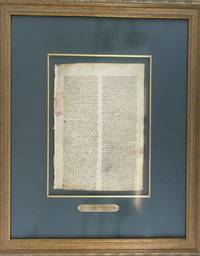
ST12778-0799Italy ca. 1275. 272 x 193 mm. 10 3/4 x 7 1/2". Double column 67 lines of text in a pleasing regular gothic hand. <br/> In a very attractive 21 1/2 x 17 1/2" walnut frame of antique design with the leaf in a sunken compartment with a gold lip a brass label below the compartment. Once purchased from Quaritch with their description on the back. ◆Formerly used as the flyleaf in a binding so slightly soiled text with minor fading a very small portion perhaps one or two lines of the text trimmed off at bottom half a dozen small round wormholes but still an attractive legible example of an unusual text.<br/> <br/> The Quaritch description says that the leaf is from "a Medieval medical work based on Galen concerned with fevers especially those that last a single day 'febres ephemerae'; the present leaf contains the text of chapters 4-7. The author speaks about bloodletting not . . . for the young or elderly baths honey the better kind is clean clear and of sharp odor and delicate Roman women. He cites Hippocrates and the 'Regimen Sanitatis' of Salerno as well as his own writings 'Quisquis igitur se non exercet in meis libris non poterit intelligere' 'Whoever then does not train himself in my own books will not be able to understand'. The text has a strong Galenic tone although it is not a translation of Galen's 'De Differentiis Febrium' and suggests a Medieval work based on Galen and possibly from the great Salerno medical school. The vocabulary includes post-classical words such as 'acetositas' acidity and even some words unrecorded in the massive 'Thesaurus Linguae Latinae' Oxford Medieval Latin Dictionary and Du Cange such as 'crapulositas' drunkenness and 'indigestabilitas.'" The leaf has obvious interest for its content and it is well presented in its attractive frame. unknown
ST16379-008France late 13th century. 125 x 88 mm. 4 7/8 x 3 1/2". Single column 15 lines in a gothic book hand. <br/> Attractively matted. Folio number in red several line enders in gold with blue penwork 10 one-line initials in gold on blue and pink ground one two-line initial painted pink and filled with blue and orange acanthus on gilt ground verso with a three-quarter border branching from the larger initial composed of pink and blue curling lines accentuated with gold spikes bezants and painted ivy leaves UPPER BRANCH TERMINATING IN A WONDERFUL HYBRID CREATURE WITH THE FACE OF A MAN AND THE BODY OF AN ORANGE BEAST AND THE LOWER BRANCH INCORPORATING ANOTHER FACE WITH A LONG BEARD. From the collection of Joseph Pope his MS Bergendal 116 about whom see below. ◆A little soiling and staining along edges of vellum and a couple of small marks in lower margin verso but in excellent condition overall the paint especially bright and fresh.<br/> <br/> From the distinguished collection of Canadian financier Joseph Pope 1921-2010 this charming leaf comes from a small-format Psalter intended for private use and features two amusing drolleries incorporated into the marginal design. Pope's collection was sold by Sotheby's on 5 July 2011 where this leaf appeared as part of lot 115; it was later listed in Quaritch Catalogue 1422 no. 88 which states that "according to Pope's note this leaf was found tipped in to a much later Book of Hours his MS Bergendal 64--produced in the southern Netherlands for a southern French patron during the first half of the 15th century--at f. 94 the middle of the Penitential Psalms; the manuscript was acquired by Pope at Sotheby's sale of 6 December 1983 lot 79.". unknown
ST16985LFrance first half of 14th century. 110 x 82 mm. 4 3/8 x 3 1/4". Single column 12 lines in a gothic book hand. <br/> Line enders in pink and blue with gold accents each leaf with one or more one-line initials in blue with red penwork or gold with blue penwork each leaf with one two line initial painted pink or blue filled with painted floral motifs and on a gold or blue ground one side of each leaf with A NEAR-FULL BORDER composed of pink and blue tendrils accompanied by spikey gold decoration and gold accents often terminating in ivy leaves and incorporating EXTRAORDINARILY CHARMING EXAMPLES OF MARGINALIA INCLUDING ANIMALS HUMANS AND HYBRIDS. ◆Vellum a little soiled and lightly stained and wrinkled in places some of the gold a bit rubbed one leaf with some noticeable smudging affecting some of the text and decoration including the head of one of the hybrids but the other examples of marginalia quite well preserved and still retaining much of their original charm.<br/> <br/> Though diminutive in size these leaves contain enormously appealing marginal decoration in the form of humans animals and hybrid creatures inventively incorporated into the lively borders in manners that range from adorable to bizarre. Especially popular in Flanders Northern France and England during the 13th and 14th centuries marginalia such as these comprise some of the most memorable and entertaining images to be found in any Medieval manuscripts. Despite being found largely in religious books such as Psalters and Books of Hours the images are often strange humorous or even outrageous and they provide us with consistent delight. Being by definition outside of the central text or miniature the margins seem to have been a place where illuminators felt more at ease to experiment resulting in highly imaginative and unique artistic expressions. The present specimens come from a fragmentary manuscript with many leaves either missing or rendered defective where portions of the vellum were cut away. Fortunately this group of leaves is intact and retains much marvelous imagery including a particularly annoyed-looking bird two human-beast hybrids with long necks and bushy tails and a trumpeter emerging from the border decoration blowing into a long instrument decorated with gold accents. For additional leaves from this same manuscript at different price points please check our website. unknown