1 336 résultats
3943Hardcover. Very Good. Published circa 1900 gift inscription dated 1908. 22 pp. Little book measuring apx. 5.5" x 3". Presumably very scarce. The binding is lovely: full vellum with both front and rear panels painted in colors and heightened with gold. Light wear. <br/><br/> hardcover
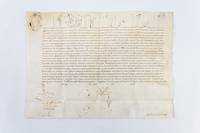
1502ST17895Rome 10 August 1502. 305 x 513 mm. 12 x 20 1/4". Single column 29 lines in a papal documentary script plus signatures at bottom. <br/> First line of text much larger and with elongated letters and calligraphic flourishes. WITH THE ORIGINAL LEAD SEAL AND HEMP TIES ATTACHED. Verso with several ink notations in different contemporary and later hands recto with a long ink line in one margin and the letter "A" in the other both by a later hand. Several folds to vellum as usual one-inch tear near where the hemp tie is attached a couple of small holes in the large "A" at the top of the document seal a little worn around edges and to the contours of the faces but overall in excellent condition with no major issues the vellum especially clean and bright.<br/> <br/> Issued to the overseer of a church in Frilingen probably modern Freilingen in Germany this bull orders the return of the vacated ecclesiastical seat and benefices of the church of St. James in Hergelzhausen in the diocese of Frilingen to two people. The church's rector Andrew Kuefuelz is to receive the position and things that once belonged to Leonard Walter the procurator while George Maltzel of Erding a priest of the same church is to receive the provisions and annual rents pertaining to the church. A member of the powerful Borgia family Rodrigo Borgia 1431-1503 served as vice-chancellor to five successive popes before being elected to the papacy in 1492 taking the name Alexander VI. One of two Borgias to ascend to the papacy the other was Callixtus III who died after just three years as pope Alexander held his own among a notorious family known for scandal. He led a sordid personal life--he was accused of participating in an orgy when he was a cardinal and openly admitted to fathering several children by his mistresses--and his reign was characterized by acts of nepotism and promoting his own family's interests above all else--especially with matters related to foreign policy. However he was also known as a patron of the arts having commissioned work by Raphael Michelangelo and Pinturicchio adopted a rather tolerant attitude toward Jews during this period and succeeded in cracking down on crime in Rome. The Papal Bull takes its name from the lead seals called "bullae" that were issued with official documents of the papacy as a way of ensuring their authenticity. Apart from the rare Solemn Privilege like Innocent III's famous granting of England in 1214 to his involuntary vassal King John there are three other categories of Papal Bulls: Simple Privileges also called Solemn Letters Letters of Grace which confirm privileges and rights and Mandates. The present item is of this final type differentiated by its use of hemp ties as opposed to silk. unknown
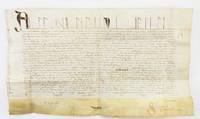
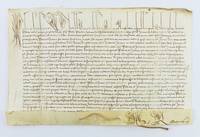
1740ST12778-0377Rome 1740. 180 x 312 mm. 7 x 12 1/4". Single column 18 lines in an arcane "scrittura bollatica." <br/> Elaborate lettering across top line of text and at lower right corner. Lower margin with several signatures in ink; verso with brief notes in ink; remains of hemp tie for appended seal which has been cut away. With faint folds a little natural yellowing to vellum but in fine condition.<br/> <br/> Appearing almost as a dancing musical score this is Papal Bull that leaves a lot to be deciphered. The document is written in the so-called "scrittura bollatica" which the Catholic Encyclopedia calls "an archaic and very artificial type of writing . . . with manifold contractions and an absence of all punctuation which was practically undecipherable by ordinary readers." The script was used from after the Reformation until it was discontinued through papal edict by Leo XIII in 1878. Apart from the name of the issuing pope and the date the only readily identifiable part of the text here is the name of the Archbishop of Naples the addressee on the top line. We acquired this document along with several other bulls addressed to this archbishop all having to do with marriage dispensations and we suspect that the present item probably contains similar content. The esteemed polymath Pope Benedict XIV born Prospero Lorenzo Lambertini 1675-1758 headed the Catholic Church from 1740 until his death. A scholar and reformer he worked to modernize church administration promote scientific study and improve relations with secular rulers. unknown
1622ST12778-0281Rome 1622. 295 x 410 mm. 11 5/8 x 16 1/8". Single column 23 lines in a papal chancery hand. <br/> Elaborate lettering across top line of text. Lower margin with several signatures in ink; verso with brief notes in ink; lacking the original hemp tie and lead seal. Two tears at bottom of the document where ties were removed not affecting text vellum lightly soiled but in excellent condition overall.<br/> <br/> Addressed to the Archbishop of Naples this Papal Bull grants a marriage dispensation between Fabritio Virgopia and Judith Cuono. An online search finds nothing about the couple named here but the document reveals that they were petitioning for a dispensation because they fell into the second and third degrees of consanguinity meaning that they shared at least one common ancestor. Although marrying within four degrees of consanguinity was prohibited by the church it was not uncommon for the Holy See to issue dispensations as here allowing such marriages to take place—particularly for the privileged classes. The Papal Bull takes its name from the lead seals called "bullae" lacking in the present example that were issued with official documents of the papacy as a way of ensuring their authenticity. Apart from the very rare Solemn Privilege like Innocent III's famous granting of England in 1214 to his involuntary vassal King John there are three categories of Papal Bulls: Simple Privileges also called Solemn Letters Letters of Grace which confirm privileges and rights but are somewhat smaller and Mandates which are differentiated by their use of hemp ties as opposed to silk as would have been the case here. Pope Gregory XV born Alessandro Ludovisi 1554-1623 ruled for just over two years from 1621-23. His brief papacy was marked by efforts to support the Catholic Counter-Reformation including the establishment of the Congregation for the Propagation of the Faith to oversee missionary work. He also played a key role in the election of Holy Roman Emperor Ferdinand II canonized notable saints such as Ignatius of Loyola and Francis Xavier and issued the last papal mandate concerning witchcraft. Documents issued by Gregory XV are unsurprisingly rare given the shortness of his rein: we could trace just one sold at auction since 1995. unknown
1614ST12778-0352Rome 1614. 203 x 319 mm. 8 x 12 5/8". Single column 25 lines in a papal chancery hand. <br/> With braided cloth tie for appended seal now gone. Elaborate lettering all across top line of text especially the first 8-line initial and at lower right corner. Lower margin with several signatures in ink behind the fold; verso with brief notes in ink; remains of hemp tie for appended seal which has been cut away. Three vertical and one horizontal fold creases faint overall yellowing to verso possible erasure correction in second line of text otherwise the page bright and the hand clear.<br/> <br/> Addressed to the Archbishop of Naples this Papal Bull grants a marriage dispensation between Pietro Palladino and Giovanna Cabalone. An online search finds nothing about the couple named in the present document but they were apparently high-ranking Neapolitan citizens who had the means to procure a Papal intercession. Likewise the particular impediment prohibiting the marriage is not apparent here. This type of document takes its name from the lead seals called "bullae" that were issued with official documents of the papacy as a way of ensuring their authenticity. Apart from the very rare Solemn Privilege like Innocent III's famous granting of England in 1214 to his involuntary vassal King John there are three categories of Papal Bulls: Simple Privileges also called Solemn Letters Letters of Grace which confirm privileges and rights but are somewhat smaller and Mandates which are differentiated by their use of hemp ties as opposed to silk as here. A member of the influential Borghese family Pope Paul V born Camillo Borghese 1550-1621 reigned as head of the Catholic Church for 16 years from 1605 until his death. As a staunch defender of the rights and privileges of the church he often came into conflict with secular leaders. He is perhaps best remembered for financing the completion of St. Peter's Basilica and for his involvement in the Galileo controversy in which he warned the scientist against advocating heliocentrism. unknown
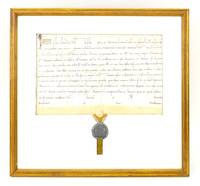
ST16379-036Rome 2 December 1210. 206 x 293 mm. 8 1/8 x 11 1/2". 12 lines in a papal documentary script. <br/> Attractively framed. Lead bulla suspended on silk threads. Very light rubbing to ink in places one horizontal and three vertical creases each with a tiny hole where the folds meet lead seal showing a bit of wear around edges and to protuberances of the faces but these faults all quite minor and on the whole an excellent specimen.<br/> <br/> Beautifully preserved and with the original lead bulla still attached this document issued by one of the most powerful popes of the Middle Ages resolves a dispute between the monastery attached to the Lateran Palace and the priory of Santi Quattro Coronati Four Holy Martyrs. The two groups seem to have been in conflict over their respective parish boundaries and the inclusion or exclusion of certain churches and therefore the tithes and legal dues stemming from those churches within their particular networks of influence. According to this bull the cardinal priest of Sts. Peter and Paul was charged with hearing their petitions; based on his report Pope Innocent III decrees that the boundaries of the priory's parish will extend to the church of St. Nicholas "de formis" on one side and the arch of John the Baptist "intra formis" on the other side with "de formis" and "intra formis" possibly referring to their relative position to certain aqueducts in the city. The document also notes that it does not alter parish boundaries as formerly defined by Pope Calixtus II r. 1119-24. The present item falls into a category of papal documents known as "litterae solemnes" comprising solemn letters and simple privileges. Though somewhat shorter and less formal than the so-called "Great Bulls" which were very large and included many marks and signatures for authentication "litterae solemnes" still followed strict rules in terms of format and appearance and included a lead seal displaying the pope's name on one side and the visages of Sts. Peter and Paul on the other as here. For a full overview of papal bulls and their various formats see Clemens & Graham "Introduction to Manuscript Studies" pp. 230-36. Innocent III born Lotario dei Conti di Segni 1160 or 1161-1216 was considered the most powerful person in Europe during his reign 1198-1216 having done much to consolidate the power of the Holy See and exert influence over the affairs of nations near and far. Notably he proclaimed the supremacy of the church over secular authority launched the Fourth Crusade which ended in the sacking of Constantinople presided over the Fourth Lateran Council excommunicated King John of England and nullified the Magna Carta and vigorously suppressed heretical sects such as the Cathars. Papal bulls issued by Innocent III seem to be of the utmost rarity on the market; we could find just one other example recorded by ABPC and RBH as sold in the past 100 years going for a hammer price of €9000 $10999 in 2013. unknown
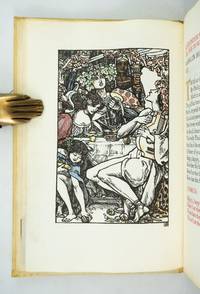
1904ST20796London: Essex House Press 1904. No. 1 OF 140 COPIES all on vellum. 195 x 131 mm. 7 3/4 x 5 1/8". 1 p.l. frontispiece 3-11 2 pp. <br/> Original stiff vellum over thin boards front cover with embossed rose design. In custom-made linen clamshell box with red morocco label on spine. Hand-colored woodcut frontispiece and final tailpiece both by Reginald Savage hand-painted initials in burnished gold red blue or green. Printed in black and red. Front pastedown with red morocco bookplate of William Andrews Clark Jr.; front endleaves with evidence of bookplate and inscription removal. Tomkinson p. 76; Ransom p. 268; Franklin p. 200. A VERY FINE COPY clean bright and free of the splaying that very frequently afflicts the boards of this work.<br/> <br/> This is a most appealing example of the luxurious hand-crafted volumes produced under the auspices of the Essex House Press with our copy coming from the library of a noted Dryden collector. The book is the 11th from the Essex House series of 14 "Great Poems in the English Language" a group of lovely little works all printed on vellum and with delightful colored illustrations and historiated initials. Generally considered to be the best example in English of the choric hymn the present work is set at a feast given by Alexander the Great who finds himself entranced by the poet and lyrist Timotheus. The great leader is lost in reveries of exploits and victory he sighs and cries over battles lost and warriors slain and he finds inspiration for new conquests. Our printer C. R. Ashbee founded the Essex House Press in 1898 by purchasing the presses and other production equipment though not the type formerly owned by the Kelmscott Press which had shut down at the death of William Morris. Ashbee printed books for 12 years with vellum ink and paper identical to that used by Kelmscott in an effort to carry on the tradition Morris had established. But the Essex House Press because it was conceived of and continued as part of a larger enterprise involving various artisans at work in a group of workshops at Ashbee's Guild of Handicrafts located at Essex House in London's Mile End Road always had its own special identity a fact which Cave reflects when he calls it the "Arts and Crafts press 'par excellence.'" The illustrator here Reginald Savage fl. 1886-1904 is deemed by Houfe "a talented and imaginative designer and woodcut artist" and Houfe notes that he was also commended by his fellow illustrator Walter Crane 1845-1915 for his "weird designs." Former owner William Andrews Clark Jr. 1877-1934 put together one of the most distinguished collections of English and French literature of his day. He had strong holdings in many areas but especially in Shakespeare and the other Elizabethans in Dryden in Oscar Wilde and in the French drama. After a fire in his home in 1923 Clark constructed a separate fireproof building to house his collection; in 1926 this library building with its distinguished collection was deeded to the University of California and now serves as a prominent center for literary research. Essex House Press unknown
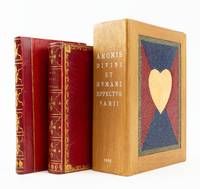
1626ST19298Antwerp: M. Snyders 1626. FIRST EDITION. 135 x 82 mm. 5 1/4 x 3 1/4". 39 of 40 leaves lacking C4. Two volumes one as issued the other a companion volume containing related plates without any title page. <br/> Very pretty late 18th or early 19th century red morocco covers bordered by delicate cresting roll with leaf cornerpieces smooth spine gilt in compartments with leafy centerpieces gilt lettering turn-in with gilt floral roll pale blue watered silk endleaves all edges gilt. Supplemental volume in late 19th century red half morocco over red paper boards similarly tooled spine. Housed together in a custom-made modern wooden box with sliding panel closure a heart mosaic in multi-colored hard-grain leather on its sides. Amoris Divini WITH engraved title page and 38 of 39; lacking plate XXXIV ENGRAVED PLATES 35 OF THEM ON VELLUM ALL DELICATELY COLORED AND HEIGHTENED IN GOLD plates 19 29 30 31 and 36 bound after text pages for plates 31 36 29 30 and 34 respectively; second volume with 45 plates on paper though without any text including many of these same emblems apparently from a later edition of this work ALL DAINTILY HIGHLIGHTED WITH GILT. Front pastedown of first volume with monogram book label in colors and gilt verso of front free endpaper with oval armorial bookplate "Ex Museo Van Der Helle" see below. De Vries "De Nederlandsche Emblemata" 121; Landwehr "Low Countries" 33; Praz p. 254; Brunet I 240 this copy; Delbergue-Cormont "Bibliothèque de M. Van der Helle" Paris 10 Février 1868 lot 69 this copy. Amoris spine very slightly dulled occasional hints of marginal thumbing but A LOVELY COPY clean and fresh internally with rich colors and glistening gold in a well-preserved binding; supplemental plates with faint marginal browning but excellent internally the engravings gently shimmering with gold and the binding with few signs of wear.<br/> <br/> The main volume here comprises a collection of emblems illustrating concepts of human and divine love; it is made all the more special by being printed on vellum beautifully hand colored and then delicately highlighted with gold. The emblems depict Divine Love as a beardless young man with nimbus who always represents love in its purest form. Human love or worldly love is variously embodied in a winged Cupid sometimes blindfolded who represents erotic love and who is accompanied by symbols of treasure or power that represent worldly desires. Landwehr Praz and De Vries make no mention of a vellum edition but Brunet describes one copy on vellum painted in colors and gold which he says sold at the Duriez auction. That book appeared as lot 3216 in "Catalogue des livres imprimés et manuscrits composant la bibliothèque de feu M. L.-M.-J. Duriez de Lille membre de la Société des Bibliophiles français" Paris J.-S. Merlin 1827 where its binding description matches our copy. Having uncovered no other hand-colored copies on vellum in auction records or in OCLC we think it quite likely that the present volume is in fact the Duriez copy. Louis Duriez 1753-1825 was a Lille lawyer of sufficient skill and cleverness to move without incident from serving as lieutenant provost for his district under King Louis XVI to becoming receiver of the district of Lille after the revolution 1791 and purchasing the estate of an aristocrat which had been seized by the state. He rose to successively more important and remunerative governmental positions and was named Knight of the Royal Order of the Legion of Honor in 1814. In 1820 he was one of the founding members of the Société des Bibliophiles français an elite group limited to 24 scholarly collectors. After his death his collection of more than 5000 carefully chosen works was dispersed at 59 auctions held between 22 January and 1 April 1828 at Maison Silvestre in Paris. A perusal of the lots on offer finds a strong emphasis on fine bindings works on vellum and illustrated books many noting hand coloring. The emblems in the second thinner book here on paper without coloring--but with gold highlighting allow the reader to experience the pleasure to be found in comparing the degrees of decoration and opulence of the two volumes. These illustrations likely come from one of the later printings of this title each of which added new emblems to the original 39 called for in Landwehr and Praz. It is not clear when or by whom this second volume was wedded to the first. After its presumed residence in the Duriez collection our copy of the 1626 edition and perhaps its sidecar volume moved to another distinguished library--that formed by the scholarly and erudite French collector M. Van Der Helle of Lille who amassed a collection particularly rich in illustrated books and works on vellum. In the catalogue for the sale of his library in 1868 Paris auction house Delbergue-Cormont described him as a bibliophile "of the school of Renouard . . . who only liked irreproachable copies." We bought this item without being warned that it is slightly defective but given its distinguished provenance and the many other features it has going for it we did not ask the seller to take it back. M. Snyders unknown
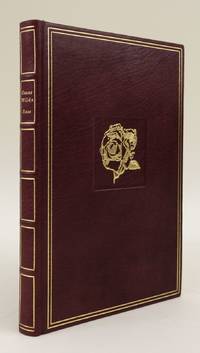
1982ST16482Bayreuth: Printed by Chr. Scheufele Offizin Stuttgart for Bear Press 1982. No. 1 OF 10 COPIES ON VELLUM plus a "special" edition of 25 copies and 185 copies on Kochi Japanese paper. 223 x 148 mm. 8 7/8 x 5 3/4". 50 pp. 2 leaves.Translated and with an afterword by Wolfram Benda. <br/> Publisher's fine burgundy morocco by Erwin Lehr upper cover with gilt rose in recessed square flat spine with gilt titling turn-ins with gilt fillet frame pale yellow silk pastedowns. In the original burgundy suede slipcase. With three large initials in burnished gold and four signed and numbered original etchings by Peter Klitsch. Printed in red and black. Signed in the colophon by the artist the binder and the publisher/translator. In mint condition.<br/> <br/> This is the splendid deluxe version of a finely crafted private press edition of Wilde's fairy tales "The Nightingale and the Rose" "The Happy Prince" and "The Selfish Giant." It is the third work issued by the Bear Press founded in 1979 by literary scholar Wolfram Benda and still in operation. According to the firm's website "at a time when the craftsmanship and ethos of the artisan in bookmaking have been damaged by ever-increasing industrialization and neglect . . . The Bear Press . . . tries to achieve the highest possible degree of technical and artistic perfection in its printed works." The font used to print the text and the artist chosen to illustrate each work are carefully selected to express "the individual author's personality and intention." Even the discriminating aesthete Wilde 1854-1900 would be pleased with the choices here especially for the luxurious vellum printing: the type is set in refined Walbaum Antiqua and shown off with special effect by the creamy leaves; the etchings by Austrian artist Peter Klitsch b. 1934 are meticulous detailed and reminiscent of the work of Wilde's friend Aubrey Beardsley; and the binding is the epitome of tasteful restraint flawlessly executed with premium materials. <br /> <br /> The three tales here first appeared in 1888 and are bittersweet in their themes of love and self-sacrifice. His stories for children were one of Wilde's early successes and DNB notes "Their permanent place in child affections refutes the vulgarism that Wilde's literary reputation arose from his legal notoriety. In all cases the fairy tales are on the child's side celebrating the courage and generosity of the poor and vulnerable while their satire mocks the kind of pomposity and hypocrisy children can recognize." We have been able to trace just two other copies of the vellum printing at auction in ABPC and RBH. [Printed by Chr. Scheufele Offizin, Stuttgart, for] Bear Press unknown
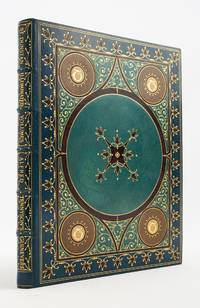
1902ST20771New Rochelle: Printed by the University Press for George D. Sproul 1902. No. 23 OF 30 COPIES 18 for America 12 for Europe; this copy illuminated for Herman A. Metz of the "St. Dunstan Edition" all of them PRINTED ON VELLUM. 270 x 210 mm. 10 5/8 x 8 3/8". 50 leaves last blank. <br/> SUMPTUOUS COBALT BLUE MOROCCO GILT AND INLAID TO AN ARABESQUE DESIGN BY TRAUTZ-BAUZONNET stamp-signed on front doublure covers framed in gilt and inlaid brown morocco blossoms central panel of azure blue morocco outlined in brown morocco large central medallion enclosed in brown morocco and inlaid with an eight-pointed inlaid and gilt fleuron each corner with tan and ivory morocco medallion with gilt "T" at center outlined in brown morocco the spaces between the medallions with curling gilt flourishes raised bands spine compartments with gilt lettering framed by sprays of gilt berries SKY BLUE MOROCCO DOUBLURES inlaid with darker blue squares containing an ivory morocco polygon these forming a frame around a central taupe morocco panel with inlaid blue morocco flowers at corners vellum free endleaves painted with a simple blue frame small flowers at each corner all edges gilt. BEAUTIFULLY ILLUMINATED BY ROSS TURNER the title page and final page with heraldic emblems and WITH 51 LOVELY INITIALS in a range of hues 22 with delicate extensions. Printed entirely in majuscules on rectos only. A couple of small faint water spots to upper board with slight dulling where someone tried to fix these naturally occurring variations in the grain and color of the vellum otherwise A FINE COPY--the vellum creamy and smooth the colors and gilt bright and the binding lustrous.<br/> <br/> A bookmaking tour-de-force this item is part of the remarkable St. Dunstan series of famous works of literature produced at the turn of the century in very strictly limited and particularly luxurious editions by publisher George Sproul. Named for the English bishop Dunstan 909-88 who was known for his skills as an illuminator the St. Dunstan volumes were printed on vellum illuminated by different artists and then put into bindings of striking design executed by Trautz-Bauzonnet one of the premier French binders of the period. While the physical properties of this volume announce themselves more emphatically than the text the narrative here is from Tennyson's "Idylls of the King" a work Day tells us in which the legend of King Arthur is used "to establish the Victorian virtues of marital faithfulness fair play gentlemanly conduct and useful action for self and society." "Guinevere" sets forth the consequences of marital infidelity presenting a penitent queen now withdrawn to a convent groveling for Arthur to pardon her affair with Lancelot. Although the injured king grants her forgiveness he does so with little grace appearing to modern readers as "insufferably self-righteous." Day Reminiscent of the designs used in 15th century illuminated books the painted initials in our volume are well executed and attractive combining fluid shapes and consonant combinations of colors and the binding is a singularly elaborate achievement. German-born binder Georges Trautz 1807-79 apprenticed in Heidelberg Stuttgart and Witemberg before arriving in Paris in 1803. There he trained in “dorure†with the skilled gilder Debès learning to create intricate gilt designs on bindings. In 1833 he was hired as a doreur by Bauzonnet the successor to the celebrated Purgold and soon achieved acclaim for his beautifully gilded bindings. According to Michon he was "the uncontested master of the luxury binding" in 19th century France celebrated for his "sumptuous moroccos" and "dazzling gilt." His bindings were so sought after that the term "Trautzolâtrie" was coined to describe the craze for his work. In 1869 he became the first bookbinder to be named a chevalier of the Legion of Honor. The culmination and termination of the St. Dunstan books was a planned edition of 15 sets of the complete works of Dickens projected to contain 130 large folio volumes—surely the most ambitious undertaking in the history of modern American fine printing. Five volumes only comprising most of "Pickwick" were produced before the grandeur of the project overwhelmed its sponsors. Potter says that in addition to the Dickens edition the St. Dunstan series comprised a dozen volumes of the works of various authors one of them the present Tennyson issued to subscribers at the spectacular amount of $12000 per set. One of the subscribers was our original owner New York chemical manufacturer and U.S. Congressman Herman A. Metz 1867-1934. Not surprisingly this strictly limited "Guinevere" is quite rare: We could trace just two copies at auction since 1975 one of them ours sold in 1998.  . [Printed by the University Press for] George D. Sproul unknown
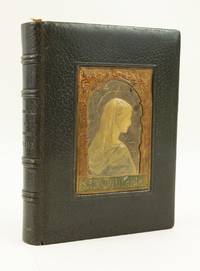
1909ST16339Paris: Bouasse-Lebel et Marrin ca. 1909. 188 x 140 mm. 7 3/8 x 5 1/2". 72 pp.; 1 leaf miniature; XXXII pp. <br/> Tasteful contemporary olive green crushed morocco each cover WITH A CENTRAL RECESSED PANEL OF MODELLED AND PAINTED LEATHER that on the upper cover with a portrait of the Virgin Mary within an arched frame of acanthus leaves that on the lower cover with the coat of arms of the Deburghgraeve family. With text and decorations lithographed featuring decorative borders and initials throughout those on 55 pages COLORED AND ILLUMINATED BY HAND many of these in a Medieval or Renaissance style others with Japanese or Greek motifs with a small hand-painted miniature of the Crucifixion against a golden sky and WITH A FULL-PAGE HAND-PAINTED MINIATURE showing the Flight into Egypt within a decorative border featuring vignettes of a peasant gathering wood and a knight in armor praying. With a hand-painted ribbon bookmark "Souvenir de ma 1ère Communion" dated 6 June 1909; carbon copy of a poem "A la Memoire de ma tres chere et regrettee cousine Mathilde Deburghgraeve-Canal" by Lucy Salze-Bouchet dated February 1945 this with short curving tear into one margin. Just the most trivial signs of wear but A VERY FINE COPY the vellum leaves quite clean and very bright with shining decorations and the binding lustrous and virtually unworn.<br/> <br/> Luxuriously lithographed on vellum handsomely bound and illuminated and painted by hand in vibrant colors this charming prayer book was obviously treasured by its owners--the first of whom may have been a young lady who received it on the occasion of her First Communion. The text and decorations here have been reproduced lithographically from a manuscript of the period being printed apparently by Bouasse-Lebel et Massin--a company specializing in devotional prints and books. The firm's name appears in very small letters at various places in the volume. Each leaf contains a different border design inspired by Medieval and Renaissance manuscripts as well as artwork from around the world in a pleasing pastiche of Western Egyptian Japanese Indian and Grecian motifs. Many of the borders have been hand-colored and present an array of distinct palettes usually richly hued which adds greatly to the book's appeal and the viewer's sense of discovery from page to page. The bespoke binding featuring the Madonna in profile beautifully modelled in leather adds another element of luxury to the book. The coat of arms suggests that it was made for a member of the Deburghgraeve family and the laid-in poem suggests that it remained with them through the death of the family's matriarch Mathilde Deburghgraeve-Canal in 1944. We know that Mathilde had three daughters all born around the turn of the century; based on the presence of a bookmark commemorating a First Communion in 1909 it is likely that the original recipient was among these three young ladies. Bouasse-Lebel was established in 1845 by Eulalie Bouasse-Lebel 1809-98 as a means of supporting herself and her children following the dissolution of her marriage. Though founded under difficult circumstances Bouasse-Lebel became a very successful enterprise and even earned a papal commendation in 1871 for consistently excellent work. The company was highly regarded for the quality and delicacy of their productions of which the present work is a choice example. Although individual religious cards printed by Bouasse-Lebel show up fairly frequently far scarcer are complete books in the estimable condition seen here--particularly those with the kind of deluxe upgrades that make this particular item so desirable. Bouasse-Lebel et Marrin unknown
1882ST12705Paris: A. Quantin 1882. UNIQUE COPY ON VELLUM printed for M. A. Werlé. 206 x 140 mm. 8 1/8 x 5 1/2". xxxii 247 pp. 1 leaf colophon.With a bio-bibliographical notice by Fernand Drujon. <br/> Pleasing burgundy Jansenist crushed morocco by Canape et Corriez stamp-signed in gilt on front turn-in dated 1930 on rear turn-in raised bands turn-ins richly gilt marbled endpapers all edges gilt on the rough. Decorative head- and tail-pieces throughout and eight engraved plates comprised of a frontispiece portrait in four states one on vellum three on paper and an allegorical vignette also in four states. Verso of front free endpaper with ex-libris of Jean Furstenberg. ◆Two small dark spots to upper cover a couple of leaves with naturally occurring minor discoloration to vellum but A FINE COPY--especially clean fresh and bright internally and in a lustrous unworn binding.<br/> <br/> Given its illustrious provenance and its singular status as the only copy printed on vellum this is a quintessentially bibliophilic copy of the poems of French cleric and diplomat Cardinal François-Joachim de Pierre de Bernis 1715-94. Admired as a witty epigrammist at the court of Louis XV where Madame de Pompadour presided Bernis composed poems on such conventional themes as love and the natural world but also verses contemplating manners and mores fashion independence and love of country. Since none of his poems was published before his death he was not widely known as a poet during his lifetime but in another sphere he performed important service to his country as France's ambassador to Rome. He provided shelter and succour there for refugees from the French Revolution earning the papal epithet "Protector of the Church of France." The present work was printed for Count Alfred Werlé whose father had inherited the Veuve Clicquot Champagne house from the Widow Clicquot. Alfred took over the operation in 1884 and greatly expanded the Veuve Clicquot-Ponsardin vineyards. The volume subsequently passed into the library of the great collector Jean or Hans Furstenberg 1890-1982 who put together one of the finest collections of 18th century books ever assembled. In 1974 the Furstenberg collection was sold en bloc to Dr. Otto Schäfer whose marvelous library had already become distinguished for its fine and historic bindings. A. Quantin unknown
1805ST21016London: Printed by T. Bensley 1805. APPARENTLY THE ONLY COPY PRINTED ON VELLUM. 260 x 152 mm. 10 x 1/4 x 6". 2 p.l. 146 pp. 1 leaf notes. Translated by Maria Henrietta Montolieu. <br/> Very pleasing contemporary straight-grain scarlet morocco gilt by Charles Hering binder's ticket on verso of front flyleaf covers bordered with a wide frame of multiple patterned rolls with rosette cornerpieces enclosing a delicate frame of a dotted roll cornered small floral tools raised bands spine gilt in compartments wide turn-ins sumptuously gilt cream silk endleaves with gilt borders and fleuron cornerpieces all edges gilt. WITH EIGHT ENGRAVINGS BY FRANCESCO BARTOLOZZI IN TWO STATES one on gold silk and the second on paper. EXTRA-ILLUSTRATED with two engravings depicting Princess Izabela Czartoryska and her daughter Zofia. A Large Paper Copy. Henrey 624. See also Clemens Alexander Wimmer "The Princess and the Poles" Historic Gardens Review no. 10 2002: 14-17. Spine slightly darkened joints and edges with minor barely noticeable wear vellum a bit and naturally rumpled and consequently the book yawning a bit a handful of light spots but still an extremely appealing copy with fine impressions of the plates vast margins and a special story to tell.<br/> <br/> Printed on vellum richly bound and illustrated with attractive plates on silk this is an extraordinarily luxurious copy of Delille's famous poem on gardens that almost certainly belonged to a noblewoman whose gardens are mentioned in the text. First published in 1780 our poem condemns formal gardens and broad promenades in favor of a gardening art which hides its artistry by reproducing the asymmetrical groupings of nature and careless bounty of the countryside. This view accords with the translation of Virgil's "Georgics" done by Delille 1738-1813 in 1769 a version that brought him great acclaim for its supple and sonorous versification. In fact it so pleased the Count of Artois the future Charles X that he named Delille abbot of Saint-Séverin; however revolution disrupted things and the poet for a time led a wandering life in Switzerland Germany and England where this updated and expanded version of "Gardens" was published in 1801. The present special edition includes the plates which had appeared as head- and tailpieces in the first edition but now used as stand-alone plates in two states. These were executed by Bartolozzi after originals by Portuguese neoclassical painter Francisco Vieira. In addition to the called-for suite of illustrations our copy includes two inserted plates portraits of Princess Izabela Czartoryska 1745-1835 and her daughter Zofia. Czartoryska was a major figure in the Polish Enlightenment as a writer and patron of the arts as well as an advocate for improving the lives of the poor. She is best remembered for the sprawling gardens at her palace in Pu awy which included a formal garden a "wild promenade" or landscape park and multiple structures including the neoclassical Temple of the Sibyl which became one of Poland's first museums. She made the acquaintance of the author while travelling through Paris in 1791 and the two struck up a friendship. She financially backed the second edition of the work in exchange for a mention of her gardens which duly appears in heightened verse on pp. 11-13: "Favoured Pulhavi! You from Heaven obtain / Each separate charm Earth's choicest scenes contain; / Bright glow thy features fresh from Nature's hand / Excite our wonder and our praise command." The presence of this poetic tribute--and especially the inserted plates showing the princess and her daughter-- clearly suggest that the our apparently unique luxury edition must have been a presentation copy to Czartoryska herself. The present copy is as striking outside as it is inside. Charles Hering was the most distinguished and influential English binder of the first decade of the 19th century and although his career was brief from about 1795-1812 Ramsden focuses on his work as representing the transition in binding styles from those of the German émigrés of the late 18th century to the new generation of binders headed by Charles Lewis. Dibdin states that until "the star of Charles Lewis rose above the bibliopegistic horizon no one could presume to 'measure business' with Hering. There was a strength squareness and a good style of work about his volumes which rendered him deservedly a great favourite." We have been unable to trace any other copies of the present edition on vellum. Printed by T. Bensley unknown
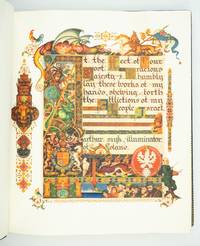
1939ST20331London: Beaconsfield Press 1939. No. 72 OF 125 COPIES SIGNED BY THE ARTIST AND THE EDITOR for sale in the British Empire. 292 x 248 mm. 11 1/2 x 9 3/4". xxvi pp. 46 leaves all leaves French fold. Edited by Cecil Roth. <br/> Elegant original blue crushed morocco by Sangorski & Sutcliffe signed on front turn-in covers with gilt French fillet border and large intricate central figure designed by Szyk of a patriarch holding a goblet and book raised bands spine gilt in double ruled compartments with ornate crown centerpiece gilt titling turn-ins with double gilt-ruled and scalloped border surrounding an illustrated silk doublure featuring a Szyk portrait of Moses with the Ten Commandments done in shades of gray within a frame of elaborate design. In an excellent velvet-lined box of blue half morocco over lighter blue cloth upper cover with central lion's head in gilt on blue morocco spine like that of the book. WITH 14 FULL-PAGE AND 32 SMALLER COLOR REPRODUCTIONS OF DESIGNS BY SZYK. English translation printed in black commentary printed in red. Front flyleaf inscribed in ink: "To Mr. and Mrs. Solomon Brachman / very cordially / Arthur Szyk / New York. April 1945." Very faint naturally occurring variations in the grain of the vellum otherwise a pristine copy.<br/> <br/> With an important Holocaust-related authorial inscription this is a very fine copy of what the London Times described as "a book worthy to be placed among the most beautiful of books that the hand of man has produced." Arthur Szyk 1894-1951 a Polish Jew is considered by scholars to be the greatest 20th century illuminator. Using the style of the Medieval illuminated manuscript artists he has here created a Haggadah for Passover that is at once a beautiful book of devotion a political protest against the rise of Nazism and a plea for England's help for the Jews of Europe. By 1939 Szyk's anti-Nazi cartoons had caused Hitler to put a price on his head forcing him to flee to England. His original illustrations for his "Haggadah" featuring the villains of the Exodus with the heads of Hitler Goebbels and other leading Nazis had to be toned down before publication. All 46 pages of the Hebrew text are illustrated with scenes from the Passover story as well as vignettes of Jewish life in modern Europe—sometimes Szyk mixes the two to great effect. Perhaps the most moving illustration in the book is the elaborately illustrated dedication to King George VI of England appealing for his mercy to European Jews. The great symbols of the British Empire—the lion and unicorn St. George defeating the dragon—surround Szyk's plea to the king: "At the feet of your most gracious majesty I humbly lay these works of my hands shewing forth the affliction of my people Israel." In the lower right corner of the painting we see Jewish refugees beside one of the ships which were usually turned away from British shores while Szyk depicts himself leaning against the painting his brush and easel in hand. The text here is enriched by the historical introduction and the commentary contributed by Cecil Roth 1899-1970 the preeminent British expert on Jewish history. This crowning achievement of Szyk's life was four years in the making and has proved to be an enduring treasure. Szyk presented this copy to Texas oilfield supply magnate Solomon "Sol" Brachman 1896-1974 and his wife Etta. The son of a Latvian Jew Brachman was the founding president of the Jewish Federation of Fort Worth in 1936 and helped arrange an emergency $100000 bank loan for Israel on the eve of statehood in 1948. His wife who served as president of the National Council of Jewish Women was known as "the mother of Hadassah." Szyk's 1945 inscription was no doubt especially meaningful to this devout family whose Latvian relatives were among the 90 percent of that country's Jews who perished in the Holocaust. Beaconsfield Press unknown
1882ST16453Glasgow: Printed by Robert Anderson for Private Circulation 1882. ONE OF ONLY 50 COPIES. 195 x 122 mm. 7 3/4 x 4 7/8". 1 p.l. x 103 1 pp.From George Bannatyne's manuscript compiled A.D. 1568. <br/> BEAUTIFUL CITRON CRUSHED MOROCCO ELABORATELY TOOLED IN GILT BY RAMAGE stamp-signed on front turn-in covers with six concentric frames--intricate filigree roll pointillé-tooled floral vine and alternating small ornaments--enclosing a central panel with cornerpieces semé with rows of fleurs-de-lys large oval medallion at center radiating ornate fleurons raised bands spine compartments with large central medallion containing a vase of flowers delicate tooling in corners gilt titling turn-ins framed by filigree roll and alternating small ornaments brown and tan silk jacquard endleaves patterned in a Medieval motif top edge gilt. Printer's device on title page decorative woodcut initials and headpieces. Spines evenly sunned to a warm honey brown corners lightly rubbed short faint scratch to lower board but the binding virtually unworn and happily free of the splaying that plagues vellum books. Leaves lightly rumpled but A VERY FINE COPY the vellum leaves creamy clean and bright and the binding glittering with gold.<br/> <br/> Printed on luxurious vellum and limited to just 50 copies presumably for private circulation among friends of the printer this is a lovely edition of 16th century poems by a mysterious author believed to have been a poet and musician associated with the court of Mary Queen of Scots. This work contains all 36 extant poems attributed to Scott ca. 1520-82/3 including what is considered to be his most historically important work "Ane New Yeir Gift to Quene Mary" 1562 written in support of the young Scottish queen caught between Catholic and Protestant agendas. His other poems consist largely of lyric verses on love and sexuality which DNB describes as possessing "exceptional metrical variety and vernacular directness" with "a musician's ear for rhythm and melody." Scott's poems are known to us via the Bannatyne manuscript now held in the National Library of Scotland which ranks among the most important documents of Scottish Medieval literature. Written by George Bannatyne in 1568 during a period of confinement due to an outbreak of plague it contains a mixture of both secular and religious material including the sole extant copies of several texts. In the preface to the present work the publisher notes that Scott's poetry has been faithfully reproduced from that manuscript and thus "for the first time accurately printed." Very little is known regarding the life of Alexander Scott but he seems to have been attached to the court of Mary Stuart through John Erskine a guardian and counselor to the queen. Given the very limited number of copies made it is not surprising that this work is extremely rare on the market. Printed [by Robert Anderson] for Private Circulation unknown
1862ST20857London: Edmund Evans for Sampson Low Son and Co 1862. ONE OF PERHAPS 10 COPIES PRINTED ON VELLUM. 260 x 195 mm. 10 1/4 x 7 3/4". vii 1 235 1 pp. <br/> Publisher's stiff vellum smooth spine with gilt lettering edges untrimmed. In a modern felt-lined blue buckram drop-back box. Decorative initials in red or blue title page and text leaves with full criblé border of vined foliation occasionally inhabited eight or 10 leaves with more extensive illustrations at head or foot all engraved by W. J. Linton after illustrations by John Franklin. Front pastedown with ex-libris of Marion Hope Rattey. A Large Paper Copy. McLean "Victorian Book Design" p. 184. Short thin cracks to head and tail of front joint spine vaguely soiled upper cover with two very small brown spots and one trivial red mark occasional mild rumpling or naturally occurring variations in the grain or thickness of the vellum as usual a couple of minor smudges but still a very agreeable copy the binding solid and without the splaying common in vellum books the interior clean fresh and bright and the margins extraordinarily wide.<br/> <br/> This is an infrequently encountered copy of a beautiful Victorian book on vellum issued by one of the era's top printers. The volume was printed by Edmund Evans 1826-1905 who is now best remembered for his illustrations and advances in color wood engravings. Relatively little is known about this book's production: Ruari McLean tells us that it was "entirely printed" by Evans but it is unknown whether he was responsible for the design as well McLean remarks that "if Evans was responsible for its design it shows his superiority in book-making". We also are unsure how many copies were printed on vellum although the general consensus is 10. Regardless as McLean tells us "it is one of the prettiest books of the 'sixties" with sharp deep impressions of the type on the rich creamy vellum jewel-like colored initials and elegant wood-engraved illustrations. These illustrations are the work of John Franklin ca.1800-68 a painter and draftsman who was highly respected in his own time. The precisely realized borders feature idealized human forms posed within a robust botanical largely acanthus context the figures posing with balletic grace their expressive faces often turned gently away from the reader. The size of the leaf here is significant: the untrimmed edges retain their tiny printing pinholes which would normally have been trimmed away with regrettable loss. And not surprisingly our vellum printing is almost never seen: we could trace just two copies at auction since 1924. Former owner Marion Hope Rattey 1922-97 was likely the daughter of bibliographer Clifford C. Rattey 1886-1970 whose impressive library featured incunabula and block prints. [Edmund Evans for] Sampson Low, Son, and Co unknown
1898110521898 P., Bibliothèque-Charpentier, 1898, 1 fort vol. in-12° (195 x 130) relié plein cartonnage moderne à la Bradel recouvert de papier anthracite à motifs noir, dos lisse orné d'une pièce de titre en maroquin noir souligné d'un filet doré, gardes de papier noir, de (2) ff. (faux-titre et titre) - 608 pp. Très bel exemplaire non rogné à grands témoins conservés.
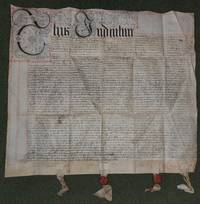
46663Kent 1663 . Large 17th century velum document with two horizontal folds and 5 vertical folds plus 3 of the original wax seals. 55cm length x 64cm width. Vellum lightly soiled and worn along the creases. Document begins with a large initial "C". English text in a contemporary hand rubbed in places. The document states that Henry Hills and Edward Gray are at Cliffords Inn London. Also that Harry Welles and Ralph Blundell are from East Greenwich Kent. Also that Ralph Blundell is a Chandler. Notes to verso of the document include an amendment in Latin dated 1664 and signed by "John Walker". Also another note in English signed by Robert Cheke; "Gills Master"; and "Thomas Bosboke Jn." Family history records show a Ralph Blundell was a churchwarden of East Greenwich in 1679. Kent, 1663 . hardcover
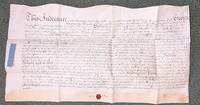
45375Kingston upon Hull: 24th December 1667 . Folded vellum ducument. 26" x 22". Between: John Legard Kingston upon Hull; George Newman Kingston upon Hull; & Christoper Bacon. With 3 old wax seals chipped and rubbed to base. Kingston upon Hull: 24th December, 1667 . hardcover
453861695. Small rubbed vellum document. 7.25" x 8.25". 25 lines of neat text rubbed on one side .Names identified include John Gladman and John Swichatt of Watford. On the verso is a further 7 lines of text dated 1695 and signed: "Samuell Anderson". 1695 hardcover
50799Polstead: 10th January 1783 . Large folded vellum document between William Beale Brand of Polstead and Reverend Thomas Cooke Of Semer. Yellowed and lightly soiled. 60cm x 90cm. All handwritten text clearly legible. . Family history records show that : "Anna Mirabella Henrietta baptized at St. James' Bury on Aug. 15 1738 was married in 1761 to William Beale Brand of Polstead in Suffolk. William Brand died in 1799 and his widow in Feb. 18 14. There was no family and after Mrs. Brand's death Polstead passed to Thomas William Cooke grandson of Thomas Cooke rector of Semer who had married William Brand's sister. Elizabeth Holworthy: baptised September 18 1753 Elsworth. Married Rev.Thomas Cooke of Elsworth clerk on May 13 1777 Elsworth. Thomas was from the small village of Semer in Suffolk where his family were the owners of the manor House and a great part of the estate in the parish.Elizabeth bore Thomas at least two children- Thomas Cooke who became the rector of Bildeston in Suffolk was born in Elsworth Cambridgeshire in 1778. He was schooled at Eton for eight years and then attended Cambridge University 1796-1798. He became Lord of the Manor at Bildeston in 1814 when he inherited the estate from his great-uncle William B. Brand Esq. He married Mary Ann Mathews daughter of Richard Mathews of Wargrave Berkshire on September 7 1803 and died without issue on July 27 1825 at Bentworth. Polstead: 10th January 1783 . hardcover
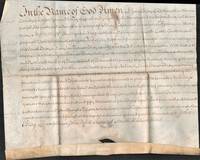
49914Clare Suffolk: 20th July 1729 . 1729 vellum Indenture. 37cm x 67cm. 2 horizontal folds and3 vertical folds. Clear English hand writing. An agreement for Samuel Ralling of Clare Suffolk occupation: Tanner to rent/lease a yard from William Wiseman of Stradishall Suffolk. Vellum with wax Seal27" x 15" Clare, Suffolk: 20th July 1729 . hardcover
45393Will dated 2nd May 1793 . Large folded sheet of vellum. 23" x 26". Clean English text throughout. Last Will And Testament William Haylock the Elder of Ashdon Essex. Born 30th September 1697 - Died 30th December 1793. William Haylock was a carpenter and had built a windmill. The will was proved on 20th September 1794 and the receipt and seal are also attached. Will dated 2nd May 1793 . hardcover
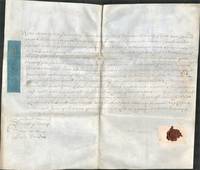
47160Bibury Gloucestshire: 1723 . Original vellum folded and creased document with blue seals. 28.5cm x 32cm. The document begins. "Know all men by these present that I Katherine Sackvlle of Bibury in the County of Gloucester have given and granted and do hereby give and grant unto William Easter of Arlington in the County of Gloucester Shoemaker leave and. to grant bargainand fill onto Richard Hall of Northlath in the County of Gloucester the Cottage and that part of the garden which was given and bequeathed by William Cooke Susannaht he wife of the said William Easter. Dated 1723. In the presence of Thomas Williams and Henry Boulton and the wax seal of Katherine Sackville. "Elizabeth Sackville was born in 1689 in Bibury Gloucestershire the daughter of Hester and Henry. She married Edmund Warneford on 18 July 1713 in London. They had one child during their marriage. She died on 17 May 1756 at the age of 67 and was buried in her hometown." - See Family History Records Bibury, Gloucestshire: 1723 . hardcover
47162Leicester: 1750. Original Vellum Document. Landscape format. 26cm x 32cm. Note to verso: "Probate of the Will of John Bray late of Bitteswell." Document reads: "in The Name of God Amen. John Bray of Bitteswell in the County of Leicester Yeoman being of Sound and perfect mind. I bequeath all goods. to my wife Sarah Bray and my son Thomas Bray. To my sisters Sarah Bray of Lutterworth and Ruth Wood the wife of Thomas Wood of Bitteswell the sum of �5.00. Attested by John Fosell Richard Smith William Wood. G Leicester: 1750. hardcover