[LEEDS THEATRE]Biblio.com
1 094 résultats
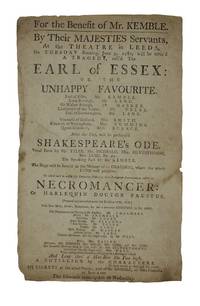
1781AQ31604Leeds: s.n. 1781. Single leaf broadside. Browned and creased some marginal chipping/tearing. An apparently unrecorded playbill advertising a benefit night of John Philip Kemble 1757-1823 at the provincial Theatre in Leeds in 1781. This appearance pre-dates Kemble's London debut by two years. At this time he was touring as a member of Tate Wilkinson's Company on the Yorkshire circuit; indeed it was Wilkinson who had constructed the Leeds theatre in 1771. Kemble son of actor-manager of a strolling theatrical troupe Roger Kemble and younger brother of actress Sarah Siddons took to acting in 1776 joining Wilkinson in 1778. Later in 1781 he moved to the Smock Alley theatre in Dublin before joining his sister at Drury Lane in September 1783. At Leeds he played the titular role in the tragedy of The Earl of Essex after which 'Shakespeare's Ode' was performed in which the majority of the players took vocal parts but with Kemble himself taking the speaking role. The evening concluded with the 'New Pantomime Entertainment' of Necromancer: of Harlequin Doctor Faustus an imaginative retelling of Christopher Marlowe's Doctor Faustus by pantomimist and theatre manager John Rich 1692-1761 first performed in 1723. . Dimensions 190 x 300 mm. [s.n.] unknown
AQ21437Valetta: s.n. s.d. Single leaf broadside edges uncut. several horizontal folds lightly creased manuscript title to verso. An apparently unrecorded late Victorian playbill advertising an evening's entertainment starring members of the British armed forces held at the lavish Theatre Royal in Malta's capital Valetta. The venue was constructed in 1866 after designs by Edward Middleton Barry 1830-1880 the architect of Covent Garden Theatre. A mere six years after completion the building's interior was ravaged by fire forcing closure; performances would not resume until restoration works concluded in 1877. The theatre was destroyed during Luftwaffe bombings in 1942. The ruins today serve as an open-air performing arts venue. . Dimensions 210 x 310 mm. [s.n.], [s.d.] unknown
17437Drafts without place or date. Covering letter to Poke dated 20 January 1951 without place . ONE: The earlier of the two drafts titled 'It Was Top of the Bill The Story of Music Hall. by W. Macqueen-Pope.' 14pp. 4to. Paginated 1-12 with two further pages carrying material to be inserted. With a few autograph emendations including an addition to the ending. Macqueen-Pope writes knowledgeably and with a passion for his theme which is that 'Music Hall reflected public taste even more accurately than did the "legitimate" Theatre because it was created by the people themselves. The basis of the Drama of the Theatre - was religion. The origin of Music Hall was the public house and the Tavern.' Among those discussed are Marie Lloyd Herbert Campbell Dan Leno Harry Champion George Robey. The article begins: 'Music Hall - real Music Hall - is dead. There is something called Variety which appears to flourish today but it bears no more resemblance to true Music Hall than "Othello" bears to "Oklahoma". It takes place on a stage it has a succession of "turns" but there the likeness ends.' TWO: Later version of the two drafts incorporating the emendations in the first. Same title. The ending reads: 'And there in the words of one of the remaining members of that class of real Londoners who made the Music Hall - the type that Chevalier Alec Hurley and Gus Elen showed on the Music Hall stage is the chief reason today why Music Hall is dead. Yet in a few artists it lingers on like its melodies refusing to die whilst there remains sic some individuals with their own style and not just truants from the Radio Studios - and there is still Gracie Fields . . . . she is Music Hall.' THREE: Typed carbon copy of letter to 'Dear Greville' from Macqueen-Pope: 'Here is the story of "Music Hall". It looks a bit long but it is a big subject and I hahve packed it full of stories. It is in a sense an epitome of my book "The Melodies Linger On" recently published by W. H. Allen Ltd - and so is in the news. I dont think anyone has told the real truth about Music Hall before - and why it died.' In a postscript he assures him that 'The bit about the bus conductor is the solemn truth.' Drafts without place or date. Covering letter to Poke dated 20 January 1951 [ without place ]. unknown
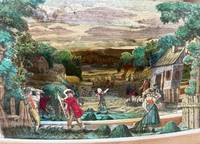
BB110295Paper theater or diorama made up out of several sheets representing different scenes. Together they form a three-dimensional view. Windows have been cut into the individual sheets to reveal details of the scene. The prints have been hand colored. Etchings and watercolor. Size of the sheets: 9 x 14 cm.This theatre spectacle consists of 6 sheets numbered on the back from 1 to 6. The set shows a typical summer setting with a village in the back in the sun. In the front people work in the fields. The hay is brought in and other harvest is coming in by horses and carriages. One sees cornfields and farmers.<pre id=""tw-target-text"" class=""tw-data-text tw-text-large tw-ta"" dir=""ltr"" data-placeholder=""Vertaling"" data-ved=""2ahUKEwj7z67a8ayMAxWp-AIHHWxQEH4Q3ewLegQICBAV"" aria-label=""Vertaalde tekst: the hay is brought in""></pre>The sheets are in good condition the little figures are very fragile and one misses a head. Not harming the complete view. Very attractive decorative paper art object.NL Papieren theatertje met een zomer scene op het platteland. Met ziet een dorp met veel zon het hooi dat binnen wordt gehaald op een kar met paarden en andere oogst die naar binnen wordt gehaald. De korenvelden staan er goed bij en diverse boeren staan op het veld. Decoratief stukje papierkunst. Op de originele omslag staat ' de Zomer'. unknown
BN104040Canopé - CRDP de Reims. Softcover. L'enfant debout : Pratiques artistiques et coopération à l'école - Quel théâtre <br/><br/>L'enfant debout : Pratiques artistiques et coopération à l'école - Quel théâtre Canopé - CRDP de Reims paperback
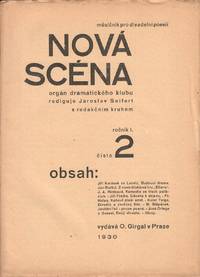
P5666Prague: Otto Girgal 1929-1930. Small quartos 24.5 × 17.5 cm. Original printed wrappers; consecutive pagination 135 6 pp. Occasional illustrations. Small loss to lower right corner of first issue not affecting text; the other issues in fine condition in protective mylar. Complete run of this Czech avant-garde theatre journal which arose as a polemical forum for a less conservative more visually inventive and experimental theatre and was edited by the poetist writer Jaroslav Seifert. As the surrealist poet Vítězslav Nezval writes in his manifesto "The avant-garde stage" from the first issue: "Forget all theatres that don't implement the most furtive needs of your bodies and souls forget them all" p. 9. With theoretical essays and manifestos by F. X. Šalda Jan Bartoš E. F. Burian Arnošt Dvořák Karel Teige Jiří Karásek ze Lvovic Vítězslav Nezval; poetry by Halas and Hora; excerpts of plays by Nezval Bartoš Alfred Jarry and others. Also contains shorter glosses about cultural events related to theatre. With drawings by Toyen Jaroslav Král František Muzika and Arch. Heythum and appealing understated typographic design throughout to both front and rear wrappers. KVK OCLC show copies at the British Library Bayerische Staatsbibliothek Cambridge Deutsche Nationalbibliothek Getty Harvard Herder-Institut and Oxford. unknown
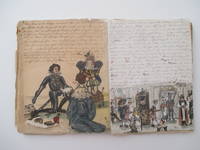
190010277AB1900. O.O 1900. 16 : 12 cm. Einführungstextblatt 10 aquarellierte Federzeichnungen mit darunterstehenden Text. Zehn lebhafte Szenen meist mit König Freier und Tochter alle in alten Kostümen. Handelt von einem König der 7 Töchter jeweils an einen Mann namens Mayer verheiratet. Am Schluß die Bemerkung über den Namen Mayer ".So möge den der Himmel den holden Namen Maier und die ganze Mayerei immer weiter verbreiten.und möge sie blühen bis in ewige Zeiten". - Jeweils 2 Blatt zusammengeklebt und alt aufgezogen in Leporelloform. - Bei einer Zeichnng fehlt die linke untere Ecke. unknown
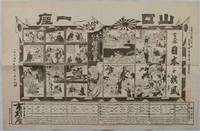
1902214563Japan. Meiji 35 1902. Striking black and white woodblock theatre poster depicting 18 dramatic scenes accompanied by a list of actors. Folded a few closed tears repaired on the reverse with archival washi red chop on reverse causing a little show-through at lower right. Overall very good. 45.5 x 71cm. Attractive black and white 1902 theatre poster advertising two performances on the 1 January 1902 of the Yamaguchi Theatre Group . The matinee performance starting at 9am was a patriotic play of five acts titled "Flag Fluttering Wind of Japan". The evening performance comprising six acts began at 5pm and appears to feature various kabuki plays under the title "Actors' Temperaments". <br> <br>The Yamaguchi Theatre Group was a part of the Shinpa 新派Theatre movement which incorporated both modern and traditional theatrical themes during Meiji period. This style and theme remains popular up till present day. Interestingly in this theatre group actors were all male playing both male and female roles. . unknown
1824AQ25374London: J. Tabby 1824. Single bifolium. 2pp. Separated into two leaves. Stab-stitch holes to gutter margins lightly creased and spotted. An apparently unrecorded playbill advertising an evening of entertainment at the New Theatre Royal Drury Lane including a performance of an anonymous adaptation of Sir Walter Scott's 1771-1832 Waverley novel Kenilworth 1821 and Harlequin and the Flying Chest 'the most successful pantomime ever produced' with elaborate scenery including views of Fonthill Abbey and 'a moving diorama intended to illustrate by a succession of perfectly novel and mechanical panoramic views that great national undertaking the Plymouth breakwater' - a coastal sound then under construction and not completed until 1848. . J. Tabby unknown
1817AQ33185London: s.n. 1817. Single leaf broadside. Some creasing and browning. Inked '65' to head of recto. An early playbill - marking the eighth performance - for Charles Edward Horn's 1786-1849 'Serio-Comick Opera' The Persian Hunters which was first staged just nine days earlier on August 13 1817. Based upon a Persian tale in which a Sultan conceives of the notion of romantic love seeking a partner who was ignorant of his royal station and attracted to him for what the La Belle Assemblee described in a contemporary review as 'his mere person'. The periodical notes that the 'scenery is peculiarly good pleasing and characteristic; the music is appropriate accordance with the scenery characters and story'. The building which later housed the English Opera House had been used to stage exhibitions and performances of various types including at different points those of the Royal Academy and Madam Tussauds since 1765 but was not licensed as a patent theatre until 1809. Rebuilt in 1816 by Arnold it re-opened and operated under this name until 1830 when it burned down and later replaced by the Lyceum Theatre. The summer of 1817 marked a time of great innovation for the London stage; both the Theatre Royal Drury Lane and the English Opera House introduced gas lighting throughout replacing candles - changing the atmosphere of the production and theatre ownership a somewhat safer proposition. The proud inclusion of 'The GAS LIGHTS are now introduced over the whole Stage' as the headline of this playbill demonstrates the marketing emphasis that was put on the endeavour. . Dimensions 190 x 305mm. [s.n.] unknown
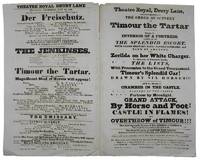
1831AQ22321London: J. Tabby 1831. Single bifolium. 2pp. A trifle creased to extremities some marking to gutter split at head. The highlight of this double-page playbill is the detailed 'order of scenery' included for the popular Regency hippodrama Timour the Tartar by Matthew Gregory 'Monk' Lewis' 1775-1818 Gothic novelist and dramatist. Timour which debuted at the Royal Opera House Covent Garden in late April or early May 1811 is believed to be the first play expressly written to feature horses. This performance featured horses from Cooke's Circus which appeared in several different performances at the Theatre Royal in May 1831 and their involvement in three scenes is explicitly detailed here. . J. Tabby unknown
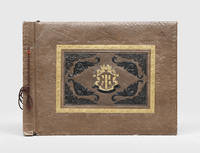
1940182459Manila: 1940s. A graphic album showing fighting in the Philippines the Marshall Islands Papua New Guinea Guam the Solomon Islands and Palau. The compiler chose to include violent images displaying the brutality of the campaign. The album opens with portrait shots of individual Marines or groups along with photographs of American encampments and ships. The scenes then turn more distressing with images of dead locals including children lying on the beach or next to tanks. The photographs were taken across the Pacific theatre: one shows an American soldier holding a flame-thrower on Kwajalein Atoll another shows a beach landing at Luzon and a third shows a Marine posing next to a sign in Bougainville. Most were taken in the final years of the conflict including at Guadalcanal and Peleliu. There are also shots of the end of the war one showing a Japanese soldier surrendering with a white flag and another showing Japanese prisoners of war in a camp in Guam. The final photograph is the most famous "Raising the Flag on Iwo Jima" showing six Marines raising the US flag on Mount Suribachi during the Battle of Iwo Jima. This photograph won the 1945 Pulitzer Prize for Photography. The majority of the photographs are commercial with a few opening portrait shots of the unidentified compiler. Oblong folio 286 x 390 mm. With 55 gelatin silver photographs one lacking approximately 90 x 130 mm landscape or portrait corner-mounted with tape recto and verso on 7 leaves remainder blank. With 2 additional gelatin silver photographs loosely inserted. Contemporary brown sheep commercial album tied through punched holes with brown cord front board stamped with central armourial panel in blind gilt and black. Boards chipped at extremities especially front board bottom left corner rear board rubbed leaves nicked at fore edge photographs moderately toned and creased some slightly torn and abraded: a good example. hardcover
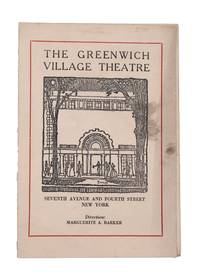
1924345886New York 1924. Single leaf wrapper folded; two typescript leaves; one handbill. 4to. Illustrated unbound pamphlet wrapper folded with toning and some soiling along edge on recto two spots on verso and small tear near center at edge of page on verso; two typescript leaves folded in: Anna Cora Mowatt's prologue to Fashion and Count Jolimaitre prologue from the Provincetown Player's production; a typescript leaf with a subscription handbill laid in; overall a very good copy of a scarce program and novel piece of New York and theatre history. Single leaf wrapper folded; two typescript leaves; one handbill. 4to. The Greenwich Village Theatre playhouse opened on November 15 1917 on Sheridan Square at Christopher Street where W. 4th Street and 7th Avenue meet and was designed by Herman Lee Meader in a Dutch Colonial style. Actor Frank Conroy was integral in its development and ran the theatre. As early cinema became popular in 1921 The Greenwich started showing films between play engagements. The theatre caused controversy with some residents of Greenwich Village who took offense at the Bohemian lifestyles the space cultivated and promoted and many complaints were lobbied against it over incidents such as a "lewd poster" for an Audrey Munson film Heedless Moths.<br /> <br /> In May 1926 the theater management announced that it had merged with the Actors' Theatre. The name Actors' Theatre was retained and while its permanent home had not been decided upon the announcement made one thing clear: "It will not be the Greenwich Village." <br /> <br /> In January 1928 N. Brewster Morse signed a five-year lease with owner Marguerite A. Barker. Marguerite Abbott Barker b.1893 - d.1930 was a woman of wealth through her father who was president of Eastman Kodak. She was very active in the Greenwich Village theatre scene and hoped to provide a more experimental approach to the theatre experience that included "musical dramatic and motion picture features with a change of program every two weeks." In the lounge area art exhibitions were to be held "where tea coffee and cigarettes will be served during the intermissions." Among the first films screened was Paul Fejos's The Last Moment described by one critic as an "impressionistic picture." She intended to show "unusual films at popular prices" beginning on April 9 1928. <br /> <br /> Fashion was the first play produced by a woman playwright Anna Cora Mowatt in 1845 and revived by the Provincetown Players the original Players included George Cram Cook Susan Glaspell Eugene O'Neill John Reed Louise Bryant Floyd Dell Ida Rauh Edna St. Vincent Millay and Djuna Barnes who maintained residence The Provincetown Playhouse at 133 MacDougal Street. This production for The Greenwich Village Theatre ran from April to July 1924 and in the program here states Eugene O'Neill among it's directors.<br /> <br /> On February 4 1930 The New York Times announced "Demolition of the Greenwich Village Theatre on the northwest corner of Christopher and Fourth Streets.will begin early in March." The article explained that developers George and Edward Blum had filed plans for a 19-story apartment building the tallest in Greenwich Village. The demolished theater was replaced with the two-story Art Deco style Stewarts Cafeteria building that survives significantly altered at street level. unknown
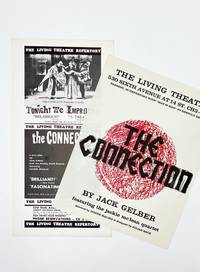
195940873New York: The Living Theatre 1959. Near fine. Two original flyers for Jack Gelber's THE CONNECTION directed by Judith Malina and designed by Julian Beck. A hit production of The Living Theatre and one that helped cement its reputation as the premier company for avant-garde theater. The play centered on Jazz musicians and junkies waiting on their dealer was an early realistic portrayal of heroin addiction at the end of a decade beset by drug hysteria. 11'' x 8.5'' and 13.25'' x 6.75''. Offset printed recto only in black and red. Minor toning to both. The Living Theatre unknown
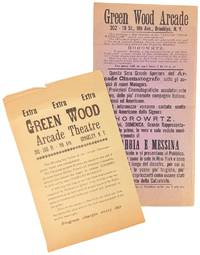
190833033Brooklyn NY: Green Wood Arcade Theatre 1908. Very Good. Brooklyn NY: Green Wood Arcade Theatre n.d. but 1908. Two promotional broadside flyers 30.5x16 & 24.5x15cm the larger printed on purple newsprint the smaller on cream newsprint. Light toning and minor wear and wrinkling from handling small closed tear at top edge of smaller flyer else a Very Good pair overall. The larger of the two broadsides printed bilingual in English and Italian.<br /> <br /> Two promotional flyers issued by the Brooklyn-based Italian-American Arcade featuring their new Chinematograph sic an early term for a film projector. Both flyers make reference to "a big rappresentation sic of the first truth and unique stages of the Earthquake in Calabria and Sicily just arrived and presented to the public." The footage referred to would have been taken shortly after the devastating earthquake in Sicily and Calabria which killed nearly 80000. Between film projections the audience could enjoy the music of Madames Mildred Ward and Horowitz as well as tenor Gaetano Maresca.<br /> <br /> Neither example separately catalogued in OCLC as of May 2025. Green Wood Arcade Theatre unknown
1940625434New York New York: Ellison Greenstone 1940. 16 unpaginated pp. 31 x 23 cm. Playbill for The Theatre Guild Inc.'s presentation of The Taming of the Shrew performed February 5-10 1940 at the Alvin Theatre starring Alfred Lunt and Lynn Fontanne. Two-color decorative cover with blue tinted photographs throughout. This is an exceptionally lovely copy of this scarce playbill which also happens to be signed on the first page by Alfred Lunt Lynne Fontanne Richard Whorf and Francis Compton. Sydney Greenstreet has also signed the fifth page under a photo of himself with Lunt and Fontanne. Mild soil to covers and faint signs of rusting to staples else near fine. . Signed By Actors. Staplebound. Near Fine. Ellison Greenstone Paperback
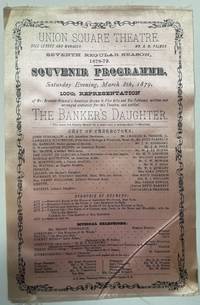
187939629New York: A.S. Seer Theatrical Printer 26 Union Square 1879. Broadside 7-1/4" x 11." Printed on pink silk within a decorative border. Light old crease spot at lower right corner. Very Good.<br /> <br /> The play opened at the Union Square Theatre on 30 November 1878 and closed on 16 April 1879 after 137 performances internet Broadway database on line. A.M. Palmer was the manager and lessee of the theatre. <br /> The broadside lists the cast the synopsis of scenery musical selections and the names of the stage and theatre crew. A.S. Seer, Theatrical Printer, 26 Union Square unknown
1958ZB573418London: International Federation for Theatre Research 1958-1974. volumes 1-14 complete volumes all published; bound ex library well illustrated most paper wrappers bound in. - If you are reading this this item is actually physically in our stock and ready for shipment once ordered. We are not bookjackers. Buyer is responsible for any additional duties taxes or fees required by recipient's country. Photos available upon request. London: International Federation for Theatre Research unknown
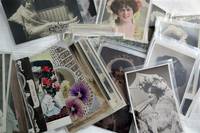
190019150United Kingdom. Very Good with no dust jacket. 1900. Non-Book. A COLLECTION OF 76 X POSTCARDS OF EDWARDIAN SINGERS AND ACTORS - These postcards are all in very good condition and the subject is Edwardian singers and actors c1900. Most are franked and used some are not. A few of the postcards are signed by the subject. We will not be separating this collection. Please message us for details. ; 6" x 4" . unknown
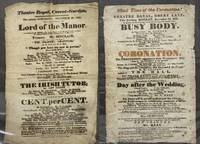
192134215London: Various 1921. First Edition. Very good Plus. First Edition. Printed playbills on thin paper each approximately 8½ × 13 inches. One printed in red and black The Coronation the other in black only. Both on fragile period paper with light age toning small edge chips and minor creases; overall in relatively good condition for their age being over 200 years old.<br /> <br /> An appealing pair of original early nineteenth-century London theatre playbills:<br /> <br /> Theatre Royal Covent Garden - December 20 1823<br /> Featuring the evening's performances of Lord of the Manor The Irish Tutor and Cent. per Cent. Printed in black only.<br /> <br /> Theatre Royal Drury Lane - December 31 1821<br /> Advertising The Busy Body The Coronation its 92nd time and A Day after the Wedding. Printed in red and black. The Coronation was a staged theatrical representation of King George IV's coronation held on July 19 1821. The real coronation was a lavish spectacle costing an estimated £238000.<br /> <br /> These types of historic playbills were printed on fragile thin paper for single-day use and few have survived. They provide a vivid glimpse into London's theatrical and social culture when royal ceremony and public entertainment often overlapped.<br /> <br /> A rare and attractive pair of early 19th-century theatre ephemera well-preserved. Various unknown
19638584Ely Cambridgeshire: W Jefferson and Son 1963. Broadside programme from the estate of former Python Eric Idle which he describes as marking his 'professional comedy debut'. Directed by Steven Frears no less at the Edinburgh Festival in 1963 this was also the British premier of Miller's surreal and only play. A single sheet 25x15cm printed on both sides; a little browned otherwise fine. Recently sold by Eric Idle to a US bookdealer and thence to us. Otherwise unrecorded. Frears' Edinburgh production was mounted on a specially built revolving state which sometimes didn't! Idle went on to achieve comic immortality with Monty Python's Flying Circus and the rest is history. Please contact Christian White Rare Books Ltd for more information or images of this item 1963 W Jefferson and Son unknown
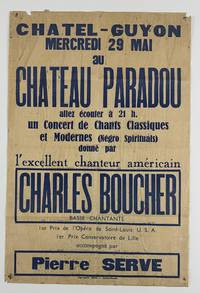
19004945Chatel-Guyon France: Imprimerie SUAU 1900. About very good. Broadside 23.5 x 15.75 inches. Old folds light wear and soiling. Slight loss to corners pinholes. A woodblock-printed poster advertising a "Concert of Classical and Modern Songs Negro Spirituals" by the "excellent American singer" Charles Boucher. Charles Boucher is further described here as the winner of the first prize at the St. Louis Opera and also the first prize at the Lille Conservatory. We could locate no historical information on him. Chatel Guyon where the present concert took place is located in central France and is known today as a spa town. Imprimerie SUAU unknown
1960131291New York: Self published 1960. Archive of two pieces from one of the New York Underground's most creative and charismatic orators Spencer Holst. Includes Holst's self-published first book "25 Stories" 1960 and a flyer from a reading shortly after publication at The Living Theatre in New York on February 1 1961. <br /> <br /> Holst was already a well-known and gifted speaker by the time "25 Stories" was published with the help of his wife abstract expressionist painter Beate Wheeler. He frequently held audiences with his psychedelic and surrealistic tales and would give performances at Judith Malina and Julian Beck's The Living Theatre selling copies of "25 Stories" at the show. Holst's work continued to fascinate audiences and "25 Stories" was reprinted in 1993 by Station Hill Press as the better part of a career-spanning collection "The Zebra Storyteller."<br /> <br /> Book: tall handbound perfect-bound wrappers 4.5 x 14 inches. Spine ends chipped cracked front hinge dampstains and soiling overall Good plus and still serviceable surviving copies of this fragile book are scarce in any condition. <br /> <br /> Flyer: 8 x 12.5 inches. Very Good plus with one vertical fold and minimal toning along the fold. Self published unknown
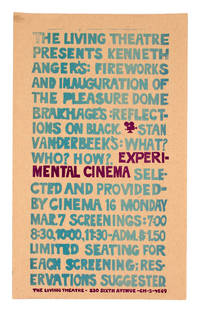
196017742New York: Living Theatre 1960. Silkscreen poster 36 x 21.5 cm.; printed cyan and red on pink-flecked yellow sheet. Slight scuff to top left corner; otherwise Fine. Poster for a Living Theatre programme of experimental cinema as curated by Amos and Marcia Vogel's pioneering film society Cinema 16. Comprised of short films from Kenneth Anger Fireworks and Inauguration of the Pleasure Dome Stan Brakhage Reflections on black and Stan VanDerBeek What Who How. Hosted on March 7th 1960 at the Living Theatre loft at 14th and 6th. Living Theatre unknown
22239From the Adelphi and Haymarket in London and the Theatre Royal in Liverpool. 20 August August 1839 November 1839 29 April 1840 29 November 1842 and undated. See the appreciative entry on Buckstone by Donald Roy in the Dictionary of National Biography. Interesting and informative letters shedding vivid light on the day-to-day workings of early-Victorian theatre written by a leading London actor-manager and dramatist and sent to a provincial actor-manager regarding the arrangement of engagements benefits and plays. Of particular interest is the fourth letter which refers to Mrs Fitzwilliam Fanny Frances Elizabeth Fitzwilliam née Copeland 1801-1854 with whom Buckstone toured New Orleans and the South c. 1840-1841. Five items. Total of 7pp 4to. Each on a bifolium. Aged and worn each with a central spike-hole and all with traces of mount adhering along one edge. ONE: 20 August 1839; Theatre Royal Haymarket. Reverse of second leaf with broken seal in red wax postmark King Street Covent Garden and address to 'M. H. Simpson Esq Theatre Royal Birmingham'. 1p. Presumably referring to a Birmingham benefit he states that although there is no person he would 'rather endeavour to serve than Mr. Monro' 'Friday the 30th is unfortunately one of the days or rather nights on which “Single Life†is fixed to be acted and Mr. Webster the actor Benjamin Nottingham Webster 1797-1882 lessee of the Haymarket cannot give permission for my absence'. He even 'waited till to-day to see Mr. W & be certain of public arrangement'. He reports that 'We are doing greatly here comedy nights and all' and ends in the hope that 'things are flourishing at Brummagem'. He ends with regards 'to Mr. Monro and Mrs. Simpson'. TWO: Undated on paper with watermarked date 1839; 'Theatre Royal Liverpoo'l. 2pp. Closely written. He begins by explaining that Webster 'brings out a new play of Bulwers on Wednesday in which I am not concerned' and that 'there is not the shadow of a doubt that he will refuse me further leave of absence'. He 'would rather play for Simpson's benefit on Friday the 22nd. which I have no doubt I shall be able to do'. He states that he will arrange with Simpson before he leaves Birmingham adding: 'I enclose you books of the Melodrama of Peter Bell which I think would act well at Birmingham. It will require getting up and can't be too soon put in hand – if you can do it we shall want a waggon and horses'. He enjoins him to 'read it attentively' and give his opinion of a detailed itinerary for the purpose of Simpson making up playbills for four days ending in 'Friday Benefit – Mr Buckstones last new comedy of Single Life and Peter Bell perhaps'. The itinerary features two of Buckstone's plays premiered in London in 1838 and 1839: 'The Duchess de la Vaubaliere - I think I called it The Dukes Bride†- you can refer to the bills and ascertain and “Weak Pointsâ€'. Also 'for this night only “The Lottery Ticketâ€'. He continues: 'What do you say to this arrangement - I shall write positively on Wednesday – but I am so sure of being able to be with you that you may be getting the Duchess and Peter Bell ready.' Postscript: 'My part in Peter Bell will be “Martin†The Tinker'. THREE: 29 April 1840; 'Theatre. Royal. Adelphi'. 1p. Addressed with broken seal in red wax and 1840 postmark to 'M. H. Simpson Theatre Royal Birmingham'. The letter begins: 'Mr. Yates has only this morning decided that he will close on Wedy the 6th. May on Saty. the 9th. at the latest – in which case I can act with you if the time will agree with your arrangements or Monday the 11th. May for 5 nights – or commence Monday the 18th.' He gives a preference explaining that he is 'in treaty with another Theatre for the 18th. or thereabouts'. If his suggested date is agreeable he will send 'the Manuscript of “Poor Jack†premiered at the Adelphi 3 February 1840 and arrange my pieces for the week.' Simpson writes on the cover: 'Engaged for the 11th of May 1840 M. H. Simpson terms as before'. FOUR: 29 November 1842; 'Theatre. Royal. Haymarket. 2pp. 4to. On bifolium with ANS by Simpson on recto of second leaf: 'Accepted. Decr. 3./42 on the terms proposed – except that they are to pay their share of Authors fees on the benefit nights M. H. S.' Begins: 'As I have a long rehearsal of a New Comedy to-day I find I cannot get to Broad Court: i.e. the London street where Simpson was staying at the Wrekin Tavern see Letter Four I have seen Mrs. Fitzwilliam as to an arrangement conjointly with me at Birmingham'. He proceeds to put his proposal regarding arrangements including 'a clean half of the Friday for her benefit or mine whichever we may decide may be most advantageous for all parties … We have plenty of Novelty of a high order – 2 pieces quite new – viz – The Belle of the Hotel or American Sketches and The Snapping Turtles – which I think will run almost through the engagement: Mrs. F has also her own Copyright pieces – Foreign Airsi.e. 'Foreign Airs and Native Graces' by W. T. Moncrieff a play which 'Mrs. Fitzwilliam J. B. Buckstone and others from the Ludlow-Smith company from New Orleans' performed in May 1841 – Out of Place &c. & will play her original part in “Single Life†- indeed I think we can make it of mutual advantage. She will also play “Rosalind†“The Country Girl†&c. as I think we can make a very strong arrangement for the 10 nights – giving you the option if it answers all purposes of taking us on our return to London at a future period'. He ends with reference to 'several Benefits at the Haymarket at which we have been solicited to act'. FIVE: Undated; 'Theatre. Royal. Haymarket. 1p 4to. Bifolium addressed on reverse of second leaf with broken seal in red wax to 'W. sic Simpson Esqr Wrekin i.e. the Wrekin Tavern Broad Court Bow Street London'. A short letter in which Buckstone states: 'After the 2d. Act of The School for Scandal – I have a boy wait – could I see you in my Dressing room – or I shall be at the Theatre tomorrow & every day this week from 12 till 2 – let me know.' Postscript: 'If you call send up your name – or come in at once'. From the Adelphi and Haymarket in London, and the Theatre Royal in Liverpool. 20 August August 1839, [November 1839], 29 April [ unknown