SAGRAMOSO, Michele.MareMagnum

105 167 résultats
in-4, pp. (8, compr. frontesp. inc.), 311, leg. coeva p. perg. Magnifico frontesp. inc. in rame da Girolamo Viscar Orefice con figure allegoriche e stemmi del ''Prencipe di Rossano'' Gio. Giorgio Aldobrandini, cui l'opera è dedicata; testatine, finaletti ed iniz. silogr. Prima edizione di questa rappresentazione di cinque atti in versi e lungo prologo, la cui ''scena si finge in Manarre isoletta nella costa di Paravi Popoli Orientali, dove è la pescaria delle Perle''. Il Sagramoso, nato e vissuto a Verona nel XVII secolo, fu Accademico Filarmonico, detto il Preparato, autore anche di una canzone in onore di Luigi XIII di Francia per celebrare ''L'Assedio della Roccelle felicemente intrapreso''. Ottimo esempl. (ex-libris Mimbelli e Sordelli).. Allacci 284. Clubb 748. Cat. Vinciana 4109. BMC, XVII sec., 810. Michel-Michel VII, 67..
In 8° (mm 190x125), pagg. 162, (1); 194, (1). Mezza pelle coeva con angoli di pergamena; decorazioni e titolo impresso in oro al dorso. Tagli a spruzzo celeste. Prima edizione non comune della traduzione italiana di queste celeberrime tragedie shakespeariane. Il traduttore, Michele Leoni (1776-1856), fu collaboratore del "Giornale Enciclopedico" di Firenze con un'attività molto intensa di traduzione, e fu il primo traduttore dall'inglese di alcune opere di autori come Shakespeare e Byron, fornendo un importante contributo al movimento culturale degli "antologisti". Leoni fu un convinto sostenitore della necessità di aprire la cultura italiana alle letterature europee. Bell'esemplare. Integrazione a mancanza di un angolo inferiore della quarta carta. Lievi aloni marginali solo alla prima parte del tomo.Brunet V, 35; Graesse VI, 393; Salvioli 201: "Il Leoni fu il primo che fece conoscere all'Italia i capilavori di Shakespeare. Le prime edizioni delle sue traduzioni sono anche oggi ricercate e non comuni...".
Elenco completo della raccolta, in vendita al prezzo complessivo di euro 650,00: 1) Joyce James – Esuli (1918) pp. XI + 146 + 1 2) Strindberg August – Pasqua (1901) pp. XV + 113 + 5 3) Gatto Alfonso – Il duello: due quadri e due cuori (1942) pp. XIII + 51 + 5 4) Synge Jonhn Millington – Il furfantello dell’Ovest (1907) pp. XIV + 132 + 6 5) Kaiser Georg – Da mezzogiorno a mezzanotte (1916) pp. XXIV + 130 + 4 6) Strindberg August – La sonata dei fantasmi (1907) pp. XVII + 85 + 7 7) Kaiser Georg – Il cancelliere Krehler (1922) pp. XXIV + 106 + 4 8) Strindberg August – L’incendio (1907) pp. XV + 89 + 5 9) Synge Jonhn Millington – La fonte dei Santi (1902); Cavalcata a mare (1904) pp. 6 + 114 +1 10) O’ Casey Sean – Il falso repubblicano (1923) pp. VIII + 99 + 5 11) Strindberg August – Lampi (1907) pp. XIV + 93 + 7 12) Synge Jonhn Millington – L’ombra della vallata (1902); Le nozze dello zingaro calderaio (1907) pp. 6 + 86 +4 13) Wedekind Frank – La morte e il diavolo: danza macabra in tre scene (1909); La censura: teodicea in un atto (1908) pp. 8 + 122 + 2 14) Strindberg August – Il pellicano (1907) pp. XVI + 87 + 5 15) Yeats William Butler – Visioni di maggio (1894); Sull’acque tenebrose (1900); La poverella (1902) pp. 8 + 106 +6 16) Garcia Lorca Federico – Yerma (1934) pp. VIII + 106 +2 17) Crommelynck Fernand – Il magnifico cornuto (1922) pp. XIII + 147 +5 18) Saroyan William – I giorni della vita (1939) pp. 6 + 191 + 4 19) Yeats William Butler – Lady Cathleen (1892); L’oriolo a polvere (1903) pp. 8 + 118 + 6 20) Synge Jonhn Millington – Deirdre l’addolorata (1910) pp. XII + 96 + 6 21) Hofmannsthal Hugo von – La leggenda di ognuno o la morte del ricco (1911) pp. XV + 90 + 2 22) Kaiser Georg – Giorno d’ottobre (1928) pp. XII + 130 + 2 23) Wedekind Frank – Lo spirito della terra (1893) pp. XVI + 207 + 5 24) Wedekind Frank – Il vaso di Pandora (1904) pp. XI + 161 + 2 25) Brecht Bertolt – L’opera da tre soldi (1927) pp. XV + 192 + 4 26) Toller Ernst – Uomo massa: dramma della rivoluzione sociale del secolo XX (1919) PP. XI +105 + 4 27) Toller Ernst – Oplà, noi viviamo! Un prologo e cinque atti (1927) pp. XIII + 239 + 2 28) Majakovskij Vladimir Vladimirovic – La cimice (1929) pp. XVI + 94 + 2 29) Ivanov Vsevolod Vjaceslavovic – Il treno blindato n. 1469 (1922) pp. XVI + 158 + 2 30) Kaiser Georg – Il soldato Tanaka (1940) pp. XII + 164 + 4 31) Kaiser Georg – L’incendio del teatro dell’opera: commedia notturna in tre atti (1919) pp. XII + 81 + 3 32) Cocteau Jean – I parenti terribili (1938) pp. XI + 260 + 4 33) Schnitzler Arthur – Il pappagallo verde: (grottesco in un atto) (1899) pp. VIII + 126 + 2 34) An-Ski Shelomoh – Dibbuk: leggenda drammatica in tre atti pp. VIII + 117 + 1 35) Kaiser Georg – Mississippi: dramma in tre atti (1930) pp. XIII + 115 + 3 36) Bompiani Valentino – Paura di me: tre atti in cinque quadri (1948) pp. X + 150 + 2 37) Majakovskij Vladimir Vladimirovic – Il bagno: dramma in sei atti (1930) pp. XIV + 112 + 2 38) Williams Tennessee – Estate e fumo Ed. La Fiaccola Il 38° volume della raccolta, pur non essendo più edito da Rosa e Ballo, viene pubblicato dalle Edizioni La Fiaccola e rappresenta l'ultimo volume curato ancora dallo stesso Grassi.
Cm. 19,6, cc. (7) 66. Grande impresa tipografica al frontespizio, testate e capolettera istoriati. Legatura d'inizio '800 in cart. rigido ricoperto in carta dipinta. Manca l'ultima carta preliminare (bianca). Esemplare genuino e ben conservato. Edizione originale ed unica, piuttosto rara di questa tragicommedia del padovano Giovanni Battista Leoni. Opera da quest'ultimo dedicata a Giovanni de' Medici.
"Comédie de moeurs ( mauvaises) en un acte en prose représentée pour la première fois à Paris en 1875"Commedia - farsa libertina scritta da Maupassant e messa in scena nello studio di Leloir, con lo scrittore e altri amici nella parte di attori e attrici. La commedia scandalizzò Edmond de Goncourt e divertì invece Flaubert, Turgueniev e altri importanti personaggi della scena letteraria / artistica parigina. Questa rara edizione di 225 esemplari fu autorizzata nel 1945 dall'unica erede di Maupassant. Questa n.ro 101. In ottavo, brossura cucita,copertina con titoli e decoro al piatto. 3 illustrazioni, una adiacente il frontespizio,doppia: sipario a due alette che si apre su una scena.Una terza a pagina 55. La copertina presenta una ondulazione sul lato sinistro. Ottima copia.
2602420 of Brassington’s 21 letters from between 1899 and 1902 and on letterheads of Shakespeare Memorial Stratford-upon-Avon; the other is from 1910. Among the other items are ones dated from between 1899 and 1928. The Shakespeare Memorial Theatre was founded through the efforts of local brewer Charles Edward Flower 1830-1892 after whose death its management was taken over by his brother Edgar Flower 1833-1903 also Chairman of the Shakespeare Birthplace Trust. On Edgar’s death these duties fell to his son Archibald Flower 1865-1950 several times mayor of Stratford-upon-Avon. The present correspondence concerns a gift to Shakespeare Memorial Association by the appropriately-named anatomist Evan Marlett Boddy. Between 1899 and 1901 Boddy donated at least twelve portraits to be hung in the Shakespeare Memorial reading room from the correspondence wood carvings also appear to have been donated. Details of the first seven portraits are contained in a letter of 11 December 1899 from Boddy to the Shakespeare Memorial librarian the archaeologist W. S. Brassington for which see below. The paintings included supposed works by Henry Fuseli ‘The Fuseli Macbeth’ and Sir Peter Lely Nell Gwynne Henry Wyatt Coleridge and a portrait said to be by Romney of a young Percy Bysshe Shelley five letters by Brassington relating to which are offered separately one of Alexander Pope ‘attributed to Hogarth’ as well as a ‘Garrick portrait’ one of Nell Gwynne and a ‘Spanish Lady’. In 1916 Boddy demanded their return on discovering that the Archibald Flower had broken the condition that Boddy had arranged in 1900 with the then librarian W. S. Brassington: ‘The Portraits were to be hung together and remain so.’ The present collection of 37 items is in good condition lightly aged apart from a couple of items are creased and worn both being repaired with archival tape. The 20 of Brassington’s 21 letters dating from the years 1899 to 1902 totaling 39pp 12mo; and 1p 4to convey his enthusiasm with regard to the donation. In the first letter 9 December 1899 Brassington acknowledges receipt of a letter from Boddy ‘respecting portraits of Shakespeare’ noting with pleasure Boddy’s ‘kind proposal to present the pictures to the Shakespeare Memorial’. Three days later 12 December 1899 he arranges to ‘come over and view’ ‘the pictures which you so generously propose to bestow upon the Shakespeare Memorial’. On 16 December arrangements are made for the removal of the pictures by ‘stage carpenter’ Henry Mann with Brassington reporting that ‘Mr Flower our Chairman who is at present away from home . thinks it most kind of you to make this very handsome present’. And a week later 19 December 1899 he acknowledges receipt of ‘the seven portraits which you so generously bestow upon the Shakespeare Memorial’ adding ‘Now that the portraits are in a good light I am more than ever delighted with them and I think you will be so when you see them in the Gallery.’ On the same day 19 December 1899 Edgar Flower writes to Boddy from The Hill Stratford-on-Avon as ‘Chairman of the Council’ to report ‘how greatly the gift is approved’. He continues: ‘In due course you will receive an official acknowledgment but in the meantime allow me to say personally that I consider each of the portraits as of great merit and interest and that they wil be conserved as your gift in the gallery to which they are a magnificent addition’. Six months later the works have been properly hung and on 23 June 1900 he writes that the ‘beautiful pictures have been much admired to-day by our London visitors many of whom had not seen Stratford before’. Four days later he informs Boddy that his ‘beautiful pictures reached here in safety. The “lady†is before me in a good north light and looks magnificent.’ Shortly afterwards 10 July 1900 he goes into some detail with regard to the hanging: ‘The “Spanish Lady†and other pictures now adorn the walls of the Memorial and are being very greatly admired. Mr Flower is unwell and I have not been able to obtain his signature to a card of thanks but at the monthly committee meeting great satisfaction was expressed at your generosity. The Grinling Gibbons’ carving now stands upon the carved oak mantle shelf of the Reading Room. It is most handsome and suitable since it represents the arms of London where Shakespeare lived for the greater part of his life. Moreover the carving hides an ugly modern Dutch bronze portrait of Shakespeare now well out of sight! / The Seven ages of Man adorn the staircase. And the “Spanish Lady†hangs over-against Nell Gwynne above the other portraits in the end gallery.’ The letter continues with speculation about the subject’s identity. On 23 July 1900 he reports: ‘The two valuable additions to the collection of paintings so kindly presented by you to the gallery are now placed on the walls. The Fuseli hangs near another example by the same master in the 1st gallery the Sir Peter Lely is placed with the other portraits between Nell Gwynn and the Spanish Lady’ which is ‘one of the most beautifully painted pictures I have ever seen’. He is so struck by it that he ‘went to the Dulwich Gallery last week to make notes but found nothing like this picture there’. A letter of 1 November 1900 begins by commending Boddy’s gift of the proof of his ‘brochure’ ‘Shakespeare’s Garden’. Brassington then discusses his holiday ‘in a cottage on the quay at Minehead. We had a good time at that old-world place and I ventured to Stratford refreshed. I had found the summer season with its crowd of Americans rather trying.’ He is relieved that Boddy was well treated by the staff in his absence: ‘they all take the greatest interest in the work of the memorial . Unfortunately of late there has been a discordant note sounded by Miss Corelli but people here are now aware that a great fuss is being made about a little matter.’ Turning to Boddy’s gift he writes: ‘I am glad you approve of the arrangement of the portraits. We expect next week to receive a portrait and a bust of Miss Mary Anderson and possibly a bust of Ellen Terry so you see we are adding to the collection and to the interest of the place.’ On 27 November 1900 he reports that he has been told by ‘Elliott’ that ‘the portrait of the boy with a dog which you recently presented to the Memorial appears to me to be more like the work of Vandyck than of any other artist. I sincerely hope it may be so’. And on 18 January 1901 he writes: ‘The two paintings reached here safely - they are beauties.’ On 3 June 1901 Brassington writes on the wider question of ‘Memorial Picture Gallery’ reporting that he has had ‘a call from Mr Frank Richards 1863-1935; Newlyn School an artist late of Birmingham now of No. 6 Addison Studios West Kensington. / Mr Richards has painted a large picture of “Hamlet†which he wishes to place in the Memorial Picture Gallery. Sir Henry Irving and Mr Flower have offered £10. each towards a subscription to buy the picture for the Memorial and it is possible that Mr Richards may write to you on this subject.’ He gives further details of appeal reporting Edgar Flowers’ opinion that that painting is ‘a fine work of art though in his opinion the face of Hamlet is too old looking’. He discusses the difficulties involved in dealing with such a ‘large Shakespearian picture’ two or three of which have been offered to the Memorial there being ‘no fund for the purchase’ and a reluctance on the part of the governors ‘to make an appeal either to the Governors or the public. The Committee feel that any suggestion of begging for donations should be avoided at the same time they dont like the idea of refusing a good and suitable picture’.Fifteen years later the mood has drastically worsened. Seven items from 1916 mostly carbon copies of TLsS dealing with a complaint by Boddy regarding the handling of a collection of historic portraits presented by him to the Shakespeare Memorial Association in 1900. Boddy states in a TLS copy to Steward Dick from Ashted Row Birmingham 17 June 1916: ‘I was certainly more than surprised to find my pictures scattered about the building in a most indiscriminate manner. I presented them to the Memorial on the distinct understanding that they were to be kept together’. Edgar Flower’s son Archibald replies in an undated carbon from The Hill Stratford on Avon: ‘I am indeed sorry that there should have been any misunderstanding and that you who have been a govener sic so long should have been caused pain by the rehanging of these pictures / At the time you gave these my father was chairman and I had no knowledge of your having expressed any special wish as to the grouping.’ The other five items relating to this complaint are a copy of a letter of complaint from Boddy to W. S. Brassington ‘being that you were Librarian at the Memorial Theatre when I presented my collection of pictures’ stating that he has ‘demanded the return of all my pictures’ and two copy letters from W. S. Brassington to Boddy one referring to ‘these tiresome people at Stratford’ and copies of a memorandum ‘Suggestion for Inscription / Collection of Historic Portraits’ and note to Stewart Dick see below stating that the matter is in the hands of Boddy’s solicitor. Other material comprises: ONE: ALS copy from Boddy to Brassington Ashted Row Birmingham 11 December 1899. Giving details of seven portraits he would be ‘pleased to present’ and suggesting that he visit to view them. ‘Though the portraits do not relate to Shakespeare I think when you see them you will agree with me that they will be a valuable and most interesting addition to your collection.’ TWO: An ALS from Brassington 31 August 1910 hinting at trouble to come with regard to ‘the circumstances connected with your suggestion for a tablet’: ‘Your wishes were clearly expressed to the committee when the pictures were received & would be recorded in the Minute book. / It seems to me that the words quoted by Mr Archibald Flower constitute a condition & that the gift was accepted on those terms - certainly that is what I understood.’ THREE: Two ALsS to Boddy from Stewart Dick one 22 July 1916 on letterhead of the Old Brewery House Stratford-upon-Avon the other undated on same letterhead cancelled in favour of Shakespeare Memorial Theatre. He begins the dated letter: ‘Mr Lowndes has handed me the letter from Messrs Philip Baker & Co regarding your pictures. Dont you think that the best plan will be for me to run up to you one day next week . I am sure after meeting you the other day that we can arrange the matter quite amicably without troubling the lawyers further.’ On the reverse of the letter is a pencil draft of Boddy’s reply informing him that ‘the matter is now entirely in the hands of my solicitors’ for typed carbon of which see above. Dick’s second undated letter is a longish one 4pp 12mo 67 lines apparently from the time of the donation commenting enthusiastically on the pictures and asking for information about them. FOUR: Transcription by Brassington of ‘Suggestion for Inscription’ by Edgar Flower dated April 1900. States that the collection of twelve paintings was ‘presented to the Shakespeare Memorial Association by Evan Marlett Boddy Esqr. F.R.C.S. on condition that the pictures be kept together and not removed from the Memorial Buildings at Stratford on Avon.’ FIVE: An ALS to Boddy from Charles Lowndes 26 April 1900 on Shakespeare Memorial letterhead apologising for spelling Boddy’s name wrongly. SIX: Signed receipt for ‘Black & gold frame’ from J. Morgan of Stratford-upon-Avon 12 January 1901 on his letterhead. SEVEN. Printed notice by ‘Edgar Flower / Chairman’ Shakespeare Memorial Stratford-upon-Avon dated 20 June 1900 regarding ‘Presentation of William Page’s Bronze Bust of Shakespeare’ to the Whitefriars’ Club City of London. EIGHT: Printed ‘Fifty-second Report of the Council to be submitted to the General Meeting of the Governors of the Shakespeare Memorial Theatre Stratford-upon-Avon convened for Monday April 23rd 1928.’ 4pp folio. With long list of officers and governors statement of expenditure and receipts and report of executive council. 20 of Brassington’s 21 letters from between 1899 and 1902, and on letterheads of Shakespeare Memorial, Stratford-upon-Avon; th unknown
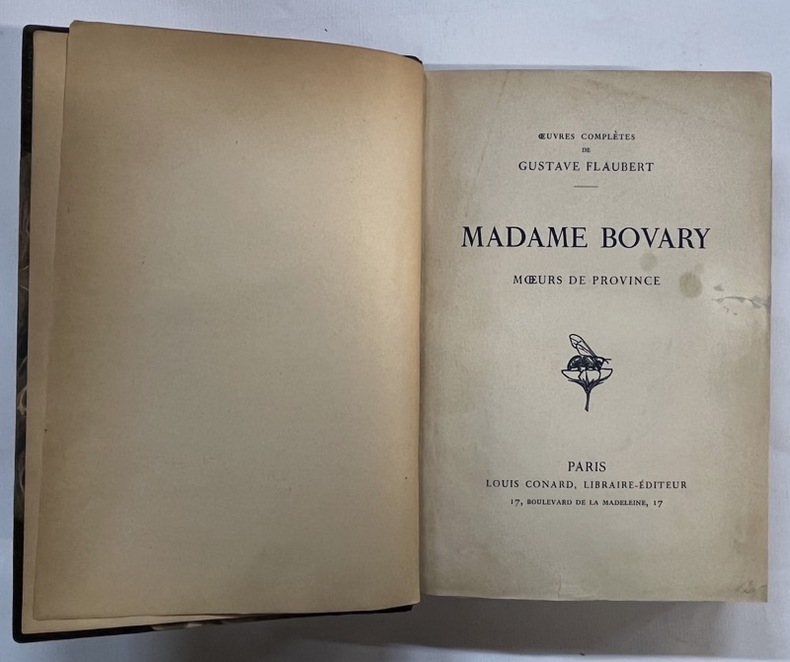
1923131394Paris, Louis Conard, impr. Imprimerie Nationale 1923 18 volumes. In-8 21,5 x 14 cm. Reliures demi-maroquin filé brun à coins, dos lisses richement ornés, pièces de titre maroquin grenat, têtes dorées, couvertures et dos conservés, XXVI-630-506-704-734-247-452-477-546-281-365-521-405-367-475-456-572-469-576 pp., 3 portraits de l’auteur et quelques fac-similés, notes, variantes, appendices, tables. Très bon ensemble.
19425895Bln., 1942. 4to. 2 orig. full cloth and 3 clothbacked boxes all in atractive slip-case. 2 boxes with tears in top of spines. XXII,588,474 pp., 1 facs. of music and 250 fine facsimeles of letters (lichtdruck). No. 489.
Bln., 1942. 4to. 2 orig. full cloth and 3 clothbacked boxes all in atractive slip-case. 2 boxes with tears in top of spines. XXII,588,474 pp., 1 facs. of music and 250 fine facsimeles of letters (lichtdruck). No. 489.
200815129Paris, Chez l advocat librairie , 1823 ; in-12, demi basane ornés. Les 25 volumes. Les 25 volumes traduits en francais par aignan, andrieux,membres de l academiqe francaise ; le baron de barante , berr, bertrand , campenon membre de l academie francaise; benjamin constant , chatelain, cohen, a.denis , f.denis, esménard, guizard, guizot, lbeaumelle, lebrun malte-brun, mennéchet, lecteur du roi; merville, charles nodier, pichot, abel rémusat , membre de l institut ; charles de rémusat, le comtte de sainte-aulaire, le comte alexis de saint-priest jules saladin, le baron de stael, trognon, villemin membre de l academie francaise vincens de saint-laurent , vsconti.
31950The Overture and Music Composed Selected and Arranged by Mr R. B. Stewart. The whole produced under the entire direction of Mr J. W. Kimber and Personal Supervision of Mr W. Paterson . . Edinburgh : s.n. 1864 5 - 30 January. Playbill 760 x 255 mm; lithograph printed recto only with an illustration by J. F. Coullie of a scene from the pantomime behind the large-lettered title; old central fold small tear at bottom right corner loss of a few words of text relating to opening times but otherwise clean and very well preserved. A large format playbill for the 1864 Edinburgh production of a grotesque pantomime based on Henry J. Byron's popular Robinson Crusoe; or Harlequin Friday and the king of the Caribee Islands. Byron had adapted his work from a much earlier pantomime of the 1780s and 1790s Robinson Crusoe; or Harlequin Friday: a grand pantomime which was penned by none other than the great Irish satirist Richard Brinsley Sheridan. For each of the ten scenes in the play a description is given of the setting characters and elaborate scenery devices and the performing cast is named in full. One of the main attractions in the pantomime is staged in Scene 9: this is the 'Grand Aboriginal Ballet - a New Zea-land Maori Festival' which would have been a fantasy pastiche of imagined South Sea rituals. unknown
179819505Mauritius August 3 1798. Some slight loss from the seals; a little browned and soiled; in very good condition. 3 pages on a folded sheet plus integral address 12.5 x 8 inches approx. 480 words. Scandal and affairs of the heart from the remote outposts of American commerce. The American consul to the French colony in the Indian Ocean here writes back to New York "I have to inform you of having dispatched your Ship Huron Capt. Brown for Newport R. Island she left this Colony on 26 May for Bourbon to complete her chargement & sailed from thence about 15 days after for America ñ I must add the malconduct of your Capt. here has been very injurious to the Voyage by forming a connection with a bad woman who came passenger with him from Bordeaut sic ñ with the greatest difficulty he was made to sail without taking this person with him however the whole Island interfered against it & prevented her leaving the Colony because she was a favourite Actress & much wanted on the Stage however she is placed here at the expence of Capt. Brown who has placed funds in the hands of Mr. Roussell Manssell to be appropriated for her benefit and althoà Mr. Roussell is not ignorant that he has a family near Boston in the town of Marblehead he has become the confident & friend in this vile business. Capt. Brown on his arrival addressed himself to me & after finishing a part of his business because I declined the propositions made me respecting the Woman I explained to him with candour his Faults he after placed his property with Mr. Roussell who has engaged to pay her expences until Capt. B. returns to marry her. . . . This favourite woman in question was bound jointly with the other players in the sum of Ten Thousand dollars that she would tarry three years in the Colony in that Company of course these persons opposed her departure. Capt. Brown in order to effect it in my presence offered to destroy a bill of exchange of Ten Thousand dollars which was the amount of the passage money for the same persons. Since that transaction I have been kept in the dark for having found fault with Capt. BÃs conduct & threatening to put him in prison therefor - he did not choose to consult me thereafter." Lewis a Boston merchant had been appointed consul to Å’le de France by Adams and arrived in February 1798--but owing to the Quasi-War and the interruption of commerce betwen the United States and France arrived back in Boston with his family in June 1799. See the National Archives annotation to the summary memorial of Lewis to Thomas Jefferson March 20 1801. Captain Brown of the Huron is certainly Elias Brown; a notice in the Halifax N.C. Journal of October 15 1798 dated Newport September 15 reports the arrival of Brown and the Huron and news that he had prior to his adventures in love been boarded somewhere east of the Cape by the British frigate Garland on June 28--seven of his seamen were impressed and Brown was detained before escaping under cover of a squall. Brown further reports "that the national soldiers were all sent from the Isle de France but that the reports of it being declared independent are false." The first theatre troupe had been established in Port Louis in 1790 by a M. Laglaine though there was a hiatus after the smallpox epidemic of 1792 and one presumes the colonists were not likely to take kindly to seeing a keystone of their local entertainment whisked away by a Yankee merchant captain. For a glance at theatre in Mauritius and some sense of the upheavals on the island in 1798--though this affair does not seem to merit mention--see the 1840 memoir by Andre Maure Souvenirs d'un vieux colon de Maurice. Samuel Ward 1756-1832 the owner of the merchant brig Huron was a Revolutionary War veteran from a prominent Rhode Island family. Neat contemporary arithmetic problems in contemporary ink on the cover page. August 3, unknown books
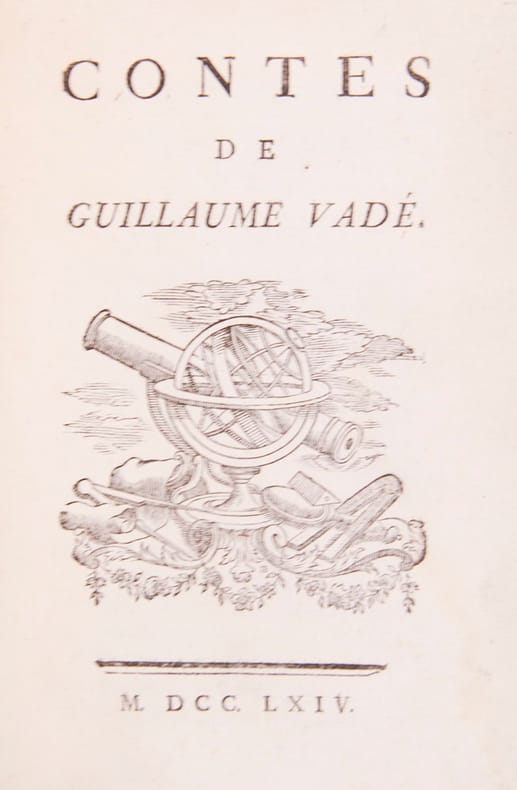
50306aafSans lieu (Genève, Cramer), M. DCC. LXIV., (1764), in-8vo, XVI, grande vignette gravée sur bois au titre, figurant des instruments d'astronomie, et signée "I.B." + 386 p. + 1 f. non chiff. (table), non rogné, tache d'encre dans un coin de p. 63, entièrement non rogné, reliure en d.-parchemin, pièce de titre en maroquin rouge au dos, plats papier dominoté. Tranches rouges. (rel. Créola Bern).
47254aaf(Frankfurt Am Main), Suhrkamp, 1967, in-8vo, 113 p., handgebunden, Original-Umschläge miteingebunden. Mit im Vorderdeckel montiertem ‘Hologramm’ mit Spiralmotiv mit Farbeffekten (Vera Creola, Bern).
60103aafParis, Urbain Canel, Imprimerie de David, 1830, in-8vo, VIII + 236 p. (de 238, sans 2 ff. = faux-titre avant le dernier poème); 288 p. + 2 ff., qqs rares rousseurs, pages brunies ou brunissures, reliure en demi veau à coins et à nerfs plus récente, dos richement orné en or, deux tranches non rognées, tranche supér. rouge.
17814873CBGeneve, 1781. 12°. 448 (2) S. Lederband der Zeit mit verblasster Rückenvergoldung und dreis. Goldschnitt.
128965aafZürich, Art Institut E,. A. Wüthrich 1894, 26x37 cm, (Fotogr. Abb.) Fotogr. Abb. mit Orig.-Rahmen, beschriftet links u. rechts, unten in gold aufdruck und farb. Zürcher-Wappen, Original zustand. (46x62 cm.).
Quarantaquattro volumi di cm. 15, pp. 10.000 ca. complessive. Solida legatura coeva in mezza pelle verde, dorsi lisci con titoli e filetti in oro. Esemplare genunino e molto ben conservato. Raccolta completa di questa buona edizione ottocenesca di tutte le commedie del Goldoni. Vi appare un totale di 125 commedie. I tre volumi finali contengono con proprio autonomo frontespizio: Memorie... per servire alla storia di sua vita e del suo teatro.
Quindici volumi (di sedici!) di cm. 17, pp. 5000 ca complessive. Frontespizio inciso a ciascun volume con vignetta centrale, ritratto dell'autore all'antiporta del primo volume e moltissime incisioni fuori testo, poste all'inizio di ciascun atto ed altrettante testate ad un terzo di pagina. Il tutto finemente inciso in rame. Legatura strettamente coeva in caroncino alla rustica ricoperto in carta dipinta con titoli su etichette a stampa ai dorsi. Esemplare genuino, marginoso e ben conservato. PRIVO DEL SECONDO VOLUME. Edizione stimata e fra le più complete della vasta produzione bibliografica di Metastasio. L'ampio apparato iconografico è opera di Zuliani, Damiotti, Dall'Acqua e Coratti e conta del ritratto all'antiporta del primo volume e di 118 tavole fuori testo. Cfr. Lapiccirella (n. 190): "...eccezionale edizione artistica..."; Morazzoni p. 243.
Cm. 23,5, pp. 104. Con bella vignetta al frontespizio e 6 tavole ripiegate fuori testo. Il tutto finemente inciso in rame. Legatura di poco posteriore in mezza pelle con punte, dorso liscio con fregi e titoli in oro su tassello. Esemplare genuino, marginoso ed in ottimo stato di conservazione. Bell'edizione di quest'interessante monografia storica ed artistica sul teatro. Cfr. Cicognara (765) e Schlosser Magnino, p. 683.
Cm. 19,5, pp. 84 (4), Con 5 belle tavole incise in rame e ripiegate fuori testo. Legatura coeva in piena pelle, dorso a nervi con titoli e fregi in oro. Sguardie marmorizzate e tagli rossi. Esemplare privo (dall'origine?) del ritratto di Palladio. Una piccola mancanza alla cuffia superiore, peraltro in ottimo stato di conservazione. Non comune edizione originale. Cfr. Cicognara, 767: "Opera grandemente commendevole.".
Due volumi in-folio (cm. 42), pp. (8) xxxii, 254; 252. Frontespizi in rosso e nero con vignette centrali, eleganti capolettera, oltre 150 incisioni nel testo (ad un terzo di pagina) ed a piena pagina. Solida ed elegante legatura d'inizio '800 in mezza pelle con punte, dorsi lisci con fregi e titoli in oro su tasselli. Esemplare genuino e ben conservato. Celebre ed affascinante edizione illustrata delle commedie di Terenzio. Comprende: l'Adria, la Suocera, l'Eunuco, gli Adelphi, il Formione e il Punitore si se stesso. Testo latino e traduzione in italiano. Non comune, soprattutto quando completo e ben conservato come il presente esemplare.
184019931Par Victor Hugo. Edition originale du premier tirage à 1500 exemplaires, avec la couverture bleue à la bonne date. Elle est constituée par le tome VII de la 1ère édition collective des oeuvres complètes de Victor Hugo. Ouvrage rare et recherché.Paris, Delloye - 1840 - xiii et 389 pages.Belle reliure demi veau rouge de l'époque signée F. Saulnier. Dos à nerfs orné et doré avec titre et auteur dorés. Couverture d'origine conservée restaurée en coins. Tête dorée. Petites taches sur le 1er plat de la reliure. Menus frottements. Pas de rousseur. Très bon état. Format in-8°(23x15).
192019418Édition décorée de compositions dessinées et gravées sur bois par Louis Jou et d'un portrait de l'auteur gravé par Paul Baudier. Préface et Notes de Ad. van Bever.Édition tirée à 848 exemplaires numérotés. Celui-ci (N°475) sur vélin de Rives.Paris, Georges Crès et Cie. - 1920 - XIV et 346 pages.Très belle reliure plein maroquin vert de Kieffer. Dos à 4 gros nerfs, aux titre et auteur dorés. Filet et fleurons à froid. Plats ornés à froid d'un bouquet de fleurs. Tête dorée sur témoins, non rogné. Couverture illustrée et dos conservés. Aucun frottement. Pas de rousseur. Parfait état. Format in-4°(29x24).
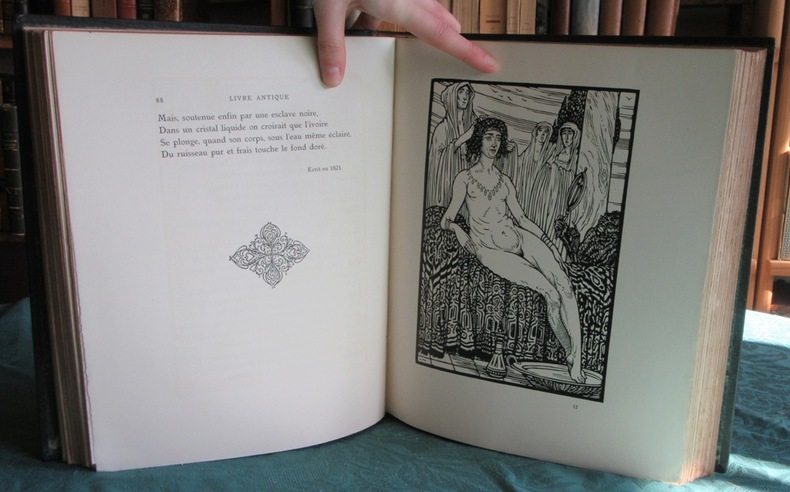
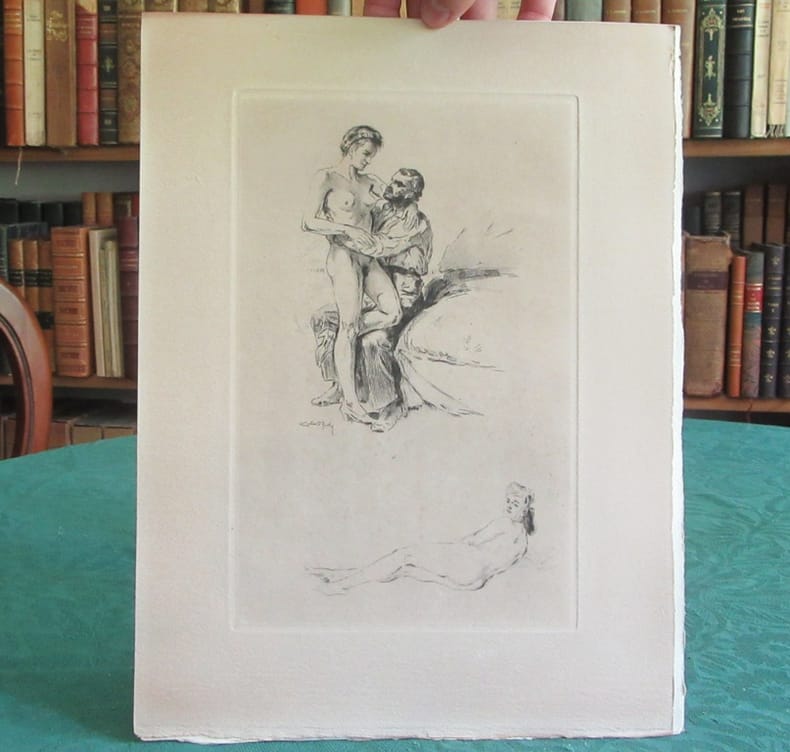
194519928Pointes sèches du peintre graveur Lobel-Riche.Paris, sans lieu, ni éditeur en 1945.Edition tirée à 260 exemplaires. Celui-ci (n°39), un des 60 comprenant une suite en noir avec remarque, l'état terminé dans le texte, un croquis original, et truffé d'un dessin original supplémentaire non prévu dans la justification.Pages volantes sous couverture rempliée illustrée en couleurs. Chemise avec titre au dos et étui cartonnés. Quelques rousseurs éparses sur le texte. Très bon état. Format in-folio (35x26).