16 722 résultats
1958145327Mexico: Producciones Barbachano Ponce 1958. Draft script for the 1959 film. Presentation copy belonging to director Luis Bunuel and SIGNED by Bunuel on the front wrapper. Also laid in is a program from the film's American premiere on May 18 1960 also SIGNED by Bunuel. Blue ink holograph annotations in the same hand to the verso of the last page of the script. Also laid in are two vintage photographs: one of Bunuel getting a haircut on the set of the film and another with Bunuel seated next to cinematographer Gabriel Figueroa composing a shot in his viewfinder. All items housed in a red quarter-leather clamshell box with gilt titles. <br/><br/>Based on the 1895 novel by Benito Perez Galdos. A priest with radical but very philosophical notions leaves his order to go on a pilgrimage learning much about the nature of human suffering as his life mimics that of Jesus Christ all the way through to his untimely end. One of the mostly highly regarded films from Bunuel's Mexican period one of director Andrei Tarkovsky's ten favorite films and one of 15 religious films selected by the Vatican for their list of 45 great films celebrating the 100th anniversary of cinema. Nominated for the Palme d'Or.<br/><br/>Set in Mexico and shot there on location. <br/><br/>Green titled wrappers dated 1958 with credits for screenwriters Luis Bunuel and Julio Alejandro novelist Benito Perez Galados and director Luis Bunuel. Title page present noted as copy No. 3 in holograph pencil dated 1958 with credits for screenwriters Bunuel and Alejandro novelist Perez Galados and director Bunuel. 106 leaves with last page of text numbered 105. Mimeograph duplication rectos only. Pages Fine wrapper Very Good plus housed in a Near Fine red leather presentation binding with a few tiny bruises at the extremities.<br/><br/>Photograph 8 x 10 inches archive stamp and several holograph annotations to the verso. Near Fine.<br/><br/>Rosenbaum 1000. Producciones Barbachano Ponce unknown books
1962147016N.p.: N.p. 1962. Draft script for the 1962 film. With director Luis Bunuel's holograph pencil and ink annotations throughout noting changes and additions to dialogue and the name of Russian-American director Victor Stoloff in holograph ink to the front of the folder housing the script. Stoloff was associated with Bunuel during Bunuel's brief sojourn in America and is interviewed in the 2000 documentary "Bunuel in Hollywood." <br/><br/>Included with the script is an English translation of Bunuel's revisions.<br/><br/>An impossibly rare script for Bunuel's masterpiece and the penultimate film the director made in Mexico. An incisive eerie surrealist comedy about a group of bourgeois guests at a dinner party who realize they inexplicably cannot leave the house. Nominated for the Palme d'Or at Cannes.<br/><br/>Set and shot on location in Mexico.<br/><br/>Tall lacking wrappers and title page housed in a light blue folder. 94 leaves with last page of text numbered 94. Mimeographed rectos only. Pages Near Fine very lightly foxed to the first leaf unbound.<br/><br/>Criterion Collection 459. Ebert I. Rosenbaum 1000. N.p. unknown books
16-2806Moscow: 1926. Original color lithograph poster from the collection of Alma Law. Repaired by Sasha Mosolov and mounted on a support sheet. No losses. 102 x 71.5 cm. The best and rarest of the Stenberg posters. From CineMaterial:The Stenberg brothers Vladimir 1899-1982 and Georgii 1900-1933 were Soviet artists and designers. While born in Moscow both remained Swedish citizens until 1933 because their father was a Swede.The innovative visual aspects of their posters included a distortion of perspective elements from Dada photomontage an exaggerated scale a sense of movement and a dynamic use of color and typography. Their artwork was frequently based on stills from the films.Radical even today the posters by the brothers working together were realized within the nine-year period from 1924 to 1933 the year Georgii died at age 33. His motorcycle hit a truck a few months after the brothers had become Russian citizens. Vladimir continued to work on film posters and organized the decorations of Moscow's Red Square for the May Day celebration of 1947._______________Directed by Ivane Perestiani Maria Shirai Maria Shirai . Princess Shirvanskaya as M. Shirai Cinematography by Aleksandre Digmelovi Film Editing by Lev Push as L. PushiProduction Design by S. Gubin-guni Fiodor Push as P. Pushi Moscow: 1926. unknown
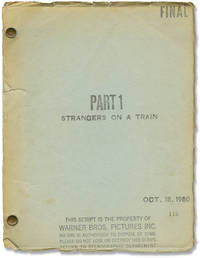
1950156756Burbank CA: Warner Brothers 1950. Final Draft script for the 1951 film dated October 18 1950. Although the front wrapper and the first distribution page identify the script as Part I the script presented here is the complete Final Draft divided into four parts Parts I-IV each with its own distribution page. Laid in are twelve call sheets dating from October 31 1950 through December 23 1950 with all but one heavily annotated in manuscript pencil.<br /> <br /> Based on Patricia Highsmith's 1950 novel. A Hitchcock classic following a psychotic socialite and tennis pro who meet on a train and promptly form a partnership to "exchange murders." The plan seems infallible until one person shirks his end of the deal. <br /> <br /> Shot on location in New York Los Angeles Washington DC and Connecticut.<br /> <br /> Blue titled wrappers noted as FINAL on the front wrapper rubber-stamped copy No. 115 dated OCT. 18 1950. Four distribution pages present one for each Part with the first receipt removed all others intact. 158 leaves with last page of text numbered 153. Mimeograph duplication rectos only with blue revision pages throughout dated variously between 10/30/50 and 11/20/50. Pages Near Fine wrapper Very Good plus with edgewear and a closed tear to the center left front wrapper bound with two gold brads.<br /> <br /> Call sheets: 8.5 x 11 inches. Near Fine overall.<br /> <br /> Grant US. Selby Masterwork. Silver Classic Noir. Spicer US. Warner Brothers unknown
19755110Inscribed by Bertolucci in Italian to Walter Alferol on title page. Full green morocco faded to brown with debossed decoration to front cover. Marbled endpapers. 36 original tipped-in silver gelatin prints 1 color print of the film crew and 1 loose silver gelatin print. All beautifully printed. Occasional creases and warping to photographs but in very good condition otherwise. Loss to tail of spine and its leather is detached from back cover board. Discoloration to spine edge. Unpaginated. 12 1/2 x 13 3/4 inches. hardcover books
1965149987N.p.: N.p. 1965. Final Draft script for the legendary 1966 film under the original Swedish title "Kinematografi." In Swedish.<br/><br/>"Persona" was in 2020 called "the greatest film ever made" by filmmaker and essayist Paul Schrader a distinction he has considered probably as thoroughly as any cinema thinker of his generation. Schrader went on to note the ." . . the stunning feminine politics and the visual genius" of the film.<br/><br/>Two known copies of this script exist: one at the Svensk Film Institute and one at the University of San Francisco Archives. This version of the script was called Script II by Bergman was retitled Kinematografi by him and has a prefatory note by him that is not included in the published screenplay for the film a later revision the content of which differs substantially from this example.<br/><br/>Some notable distinctions between this draft and the final script the filmed version include:<br/><br/>1 A prologue consisting of only a short film strip with rapidly shifting images of nature clouds trees moon landscape followed by atmospheric sounds of words after which Nurse Alma's face emerges followed by the main narrative.<br/><br/>2 There is no boy and no hospital morgue <br/>where he wakes up and the script does not mention the famous merging of Alma's and Elisabeth's face.<br/><br/>3 There is no reference later on in the script that the film breaks during the confrontation between Alma and Elisabeth though there is a meta-filmic insert just before the two women move to the doctor's house in Scene 13.<br/><br/>4 Additional dialogue notably a fairly long passage in which Elisabeth talks about her happy and hermetically close relationship with her husband.<br/>The final script a revision that followed the one offered here was published in several languages in 1966 and has been reprinted in various forms in perpetuity ever since. This draft remains unpublished.<br/><br/>Criterion Collection 701. Ebert I. Rosenbaum 1000. Godard Histoires du cinema. Schrader Canon Fodder 9. Vogel "Film as a Subversive Art. N.p. unknown books
1946147477Culver City CA: RKO Radio Pictures 1946. Estimating script for the 1947 film dated April 3 1946. James M. Cain's ultimately uncredited rewrite of Geoffrey Homes' early draft based on Homes' 1946 novel "Build My Gallows High" which was at that time still unpublished. <br/><br/>A rare script which confirms a claim still listed as unsubstantiated by the AFI Catalog which notes: "The working title of this film was Build My Gallows High. In September 1945 RKO outbid Warner Bros. for the rights to Geoffrey Homes' . unpublished novel according to a Los Angeles Times article. . Modern sources also claim that James M. Cain rewrote Homes' script with Frank Fenton. Fenton is credited as a contributing writer by SAB but Cain's contribution has not been confirmed by contemporary sources."<br/><br/>Ultimately sole credit for the script went to Homes who would make a permanent switch from novels to screenplays after the success of the film later under his real name Daniel Mainwaring. Cain would also spend many years in Hollywood though he only received screenwriting credits on two films "Stand Up and Fight" 1939 and "Gypsy Wildcat" 1944. <br/><br/>A former private detective lives a quiet life in a small town until his past catches up with him forcing him to return to the world of crime. An unimpeachable high spot of the genre. <br/><br/>Set in Bridgeport California shot in the High Sierra Mountains of Nevada and Reno as well as locations throughout California. <br/><br/>Red titled wrappers noted as ESTIMATING SCRIPT on the front wrapper rubber-stamped copy No. 1495 dated April 3 1946 with credits for screenwriter Cain and novelist Homes. Title page integral with front wrapper. 120 leaves with last page of text numbered 120. Carbon typescript on onionskin stock. Pages Near Fine wrapper Very Good plus bound with two gold brads. <br/><br/>National Film Registry. Grant US. Hardy The BFI Companion to Crime. Selby Masterwork. Silver and Ward Classic Noir. Spicer US Classic Noir. RKO Radio Pictures unknown books
1989148416N.p.: Untitled Productions 1989. Draft script for the 1989 film belonging to and heavily annotated throughout by actor Martin Landau here under the working title "Brothers." Bound in a spring binder with "Kraft Music Hall" and Landau's name in gilt on front "The Kraft Music Hall" was a revival of the NBC variety television show with various hosts and performers from 1967 to 1971 which Landau and Woody Allen had both appeared on. <br/><br/>Front wrapper has Landau's name boldly written and whimsically illustrated with "Filmed New York CIty" and shooting months and re-shooting months all written in holograph marker and pen. Title page has Landau's name ornately illustrated at top margin followed by credits for Allen working title and cast all in holograph marker with "Release Title: Oct 13th 1989 'Crimes and Misdemeanors'" below in holograph ink all in Landau's hand. Script contains copious annotations of strikes character motivations and dialogue changes on nearly every page of dialogue or action of Landau's character Judah. Following script is a six page cast list annotated in holograph pencil.<br/><br/>Laid in are 32 pages of script revisions six of which contain annotations striking scenes dating when scenes were shot as well as character motivations by Landau in holograph ink. <br/><br/>Also laid in is Landau's contract with Untitled Productions for "Woody Allen Fall Project 1988" signed and dated March 3 1989 by Landau in holograph ink with a cover sheet dated March 1 1989 signed by associate producer Helen Robin. Lastly laid in are two call sheets with annotations in holograph ink and marker a four page Reshoot Schedule annotated in holograph marker and a five page Crew List lightly annotated in holograph marker.<br/><br/>From the estate of Martin Landau. <br/><br/>One of Allen's finest films a dark drama with comic elements interweaving two opposing stories. In one ophthalmologist Judah Rosenthal's Landau mistress Angelica Huston threatens to reveal their affair unless he leaves his wife Miriam Claire Bloom. Responding to the threat his gangster brother Jack Jerry Orbach offers to have her killed. In the other documentary filmmaker Clifford Stern Allen is hired by his pompous television producer brother-in-law Alan Alda to make a documentary about him and begins to fall in love with producer Halley Reed Mia Farrow.<br/><br/>Nominated for three Academy Awards including Best Director Best Screenplay and Best Supporting Actor for Martin Landau. <br/><br/>Set in and shot on location in New York and New Jersey. <br/><br/>Blue untitled wrappers. Title page present with a credit for screenwriter Woody Allen. 108 leaves with last page of text numbered 100. Xerographic duplication rectos only with blue and pink revision pages throughout dated 1/9/89. Pages Near Fine with silverfish damage to right side of title page wrapper Very Good plus bound with two gold brads.<br/><br/>Spring binder 10.5 x 12.5 inches Near Fine.<br/><br/>Laid in Revisions Contract and Call Sheets 8.5 x 11 inches Very Good plus to Near Fine six revision leaves extremely faded with bright holograph annotations to four.<br/><br/>Schrader Canon Fodder 39. Ebert III. Untitled Productions unknown books
1958147154Beverly Hills CA: Metro-Goldwyn-Mayer MGM 1958. Draft script for the 1959 film belonging to actor Martin Landau with his signature in holograph pencil on top of first page and annotations in holograph ink and pencil throughout primarily making note of action and dialogue for Landau's character Leonard. <br/><br/>Martin Landau's second film role and a memorable early one as James Mason's sadistic henchman.<br/><br/>Considered to be one of Hitchcock's best films the last of four the director made with Cary Grant with a score by Bernard Hermann and a famous title sequence by Saul Bass. Nominated for three Academy Awards including Best Original Screenplay. <br/><br/>Shot in Hollywood and in various locations across the United States. <br/><br/>Title page integral with first page dated 8-12-58. 174 leaves with last page of text numbered 179. Mimeographed rectos only with pink revision pages throughout dated variously between 8-27-58 and 10-27-58. Pages very good plus with some creasing chipping and closed tears to first page and eight 10-27-58 revision pages which appear to have been originally paper clipped and later bound in.<br/><br/>National Film Registry. Godard Histoires du cinema. Grant US. Rosenbaum 1000. Penzler 101. Metro-Goldwyn-Mayer [MGM] unknown books
1981142842N.p.: N.p. 1981. Handmade vernacular conceptual journal documenting the shooting of Robert Frank's 1981 film "Energy and How to Get It" circa 1980-1981. <br/><br/>Includes tipped in ephemera drawings business cards and 46 Polaroids of Wurlitzer Robert Frank June Leaf and "Lightning" Bob. Annotations and captions throughout by Wurlitzer. Also included are 4 reference photos all likely unique from the shooting of the film: two showing both Wurlitzer and Frank one showing Wurlitzer and one of the "Enola Gay" aircraft in the film. <br/><br/>Mead Memo notebook spiral bound. Green wrappers. 4.25 x 6 inches Very Good overall tipped in photos Near Fine. Reference photos 8 x 10 inches Near Fine. N.p. unknown books
1974011575NY: Privately published 1974. Private edition. Hardcover. Near Fine. Bound musical score as performed on the opening night of February 25 1973 at theSchubert Theatre. Bound musical scores are privately published a project usually undertaken by the music preparation supervisor and then presented to producers and creative principals as a momento or official record of the music as presented opening night. This copy is legendary producer and director Hal Prince's who both produced and directed A LITTLE NIGHT MUSIC inscribed to him by Mathilde Pincus and Al Miller whose company was responsible for music supervision: April 12 1974 To Hal Price Another one to add to your collection of 'greats!' Our greatest esteem respect admiration - and love. Sincerely Mathilde and Al." It is also inscribed by composer and lyricist Stephen Sondheim: "Wyth lots of Luv - Steve" which wittily Sondheim has written with Swedish grammatical notations this musical being based on Ingmar Bergman's Smiles of a Summer Night. Typically there are about 12-18 bound musical scores per production. Never commercially sold only for private presentation. This copy especially rare in that along with Sweeny Todd it represents a highpoint in Prince and Sondheims collaboration besides being one of the highpoints in Sondheim's cannon. Squarish folio green cloth gilt titles front and spine. Privately published hardcover books
19755110Inscribed by Bertolucci in Italian to Walter Alferol on title page. Full green morocco faded to brown with debossed decoration to front cover. Marbled endpapers. 36 original tipped-in silver gelatin prints 1 color print of the film crew and 1 loose silver gelatin print. All beautifully printed. Loss to tail of spine and its leather is detached from back cover board. Discoloration to spine edge. Unpaginated. 12 1/2 x 13 3/4 inches. hardcover
19622409180259xbvkJamaica, Island Worcester [and Things] - Ceramics, 1962. Material: Ceramic / Total height (Pot with lid): ca. 39 cm; diameter at foot: ca. 15 cm, largest diameter (open top of 'pot'): ca. 24 cm. / Colour: lightbrown-rosé with white partly gilt-lined embossments and partly gilt inscriptions; foot and pineapple-top: white. / Weight: ca. 3 kg.
51-04331975-1977. 48 16mm films thirty minutes to ten minutes 48 Synchronized sound tracks one tape and transcript . Various loose 16mm filmstrips editing. These are the masters and outtakes of the films directed by Richard O. Moore for The Writer in America Series 1975-77.A few of the audios have been converted to MP3 files. Sample MP3 snippets available. 1975-1977 unknown
51-04321975-1977. 27 16mm films thirty minutes to five minutes 29 Synchronized sound tracks one tape and transcript. These are the masters and outtakes of the films directed by Richard O. Moore for The Writer in America Series 1975-77. A few of the audios have been converted to MP3 files and one of the films to a digital file. Sample MP3 snippets available. 1975-1977 unknown
L3 box713 b2First Monday at Jordan Hall Thirty Years 1985 - 2015. New England Conservatory. By Laurence Lesser Founder and Artistic Director et al. Cloth hardcover 174 pages. Laurence Lesser presented this book to Terry Decima and signed in title page. New England Conservatory. hardcover
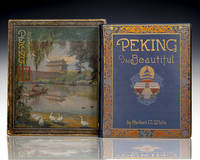
1927149511Shanghai China: The Commercial Press Limited 1927. First edition of White's fine photographic study of the monuments of Shanghai. Folio original royal blue embroidered silk pictorial boards illustrated with seventy mounted color and monochrome photographic plates of the celebrated monuments of China's Northern Capital and its environs complete with descriptive and historical notes by Herbert C. White Art Director of Signed of the Times Publishing House Shanghai. Introduction by Hu Shih Ph.D. Professor of Philosophy at the National University of Peking. In fine condition. Housed in the original publisher's box. Very rare in such fine condition. Herbert C. White 1896-1962 arrived in China in 1922 together with his twin brother James H. White 1896-1954. They opened a language school in Beijing. Attracted by Chinese landscapes and civilization they used their vacations to travel around the country and took large numbers of photographs. This album is a selection of photographs of the city gates and walls the Temple of Heaven the Forbidden City and the temples and monasteries of Beijing. It presents a realistic view of the city's appearance during the early Republican era. From the preface: "For a long time there has been a recognized need for an album on historic Peking that would embody a representative set of all the important monuments of the capital. The very fact that so many of the ancient landmarks . are being torn from their foundations and ruthlessly destroyed makes an album of this kind not only interesting as an art volume but a work of immeasurable value to China and to the world as an authentic record of picturesque Peking." The Commercial Press, Limited hardcover
1960143066Tokyo: Kurosawa Production Company 1960. Shooting script for the legendary 1961 Japanese film. Working copy belonging to Omura Senkichi who played a small role as a traveling servant in the film with his name on the front wrapper and his annotations throughout. <br/><br/>Though not credited as such based thematically on Dashiell Hammett's 1929 novel "Red Harvest" and subsequently the basis for many other films including "A Fistful of Dollars" Sergio Leone 1964 "Django" Sergio Corbucci 1966 and "Last Man Standing" Walter Hill 1996. Director Kurosawa has been quoted as saying that many plot elements from another Hammett novel "The Glass Key" make up the film. <br/><br/>All titles and text in Japanese. <br/><br/>White perfect bound wrappers with purple and black titles. 164 pages printed on recto and verso right to left in the Japanese style with last page numbered "d-33." Mechanical duplication. Light foxing and age toning to both pages and wrapper else Very Good condition. <br/><br/>BFI 505. Criterion Collection 52. Ebert III. Grant Japan. Kurosawa Production Company unknown books
142842N.p.: N.p. 1981. Handmade vernacular conceptual journal documenting the shooting of Robert Frank's 1981 film "Energy and How to Get It" circa 1980-1981. <br /> <br /> Includes tipped in ephemera drawings business cards and 46 Polaroids of Wurlitzer Robert Frank June Leaf and "Lightning" Bob. Annotations and captions throughout by Wurlitzer. Also included are 4 reference photos all likely unique from the shooting of the film: two showing both Wurlitzer and Frank one showing Wurlitzer and one of the "Enola Gay" aircraft in the film. <br /> <br /> Mead Memo notebook spiral bound. Green wrappers. 4.25 x 6 inches Very Good overall tipped in photos Near Fine. Reference photos 8 x 10 inches Near Fine. N.p. unknown
1994140620Burbank CA: Fox Broadcasting Company / Warner Brothers Television / Sweet Freedom Productions / Main Sequence Productions 1994. Archive of original scripts for all 27 episodes of "The George Carlin Show" which ran on Fox for two seasons in 1994 and 1995 with multiple drafts of each episode totaling 196 scripts. Also included are several key pieces of ephemera relating to the development and writing of the show. Altogether a thoroughly comprehensive and researchable archive detailing a writing process that attempted to digest and reconstruct the persona of one of the most iconoclastic and influential not to mention foul mouthed standup comics for mainstream viewing. From the estate of series co-creator Sam Simon. <br/><br/>One of the most important and influential television producers and directors of the last 30 years Sam Simon is best known along with Matt Groening and James L. Brooks as the co-creators of "The Simpsons." Simon won a remarkable nine Emmy Awards seven for "The Simpsons" and two for "The Tracy Ullman Show" and was nominated another ten times for his work on both those shows as well as his contributions to "Cheers" "Taxi" and "The Gary Shandling Show." <br/><br/>Created by Simon and George Carlin "The George Carlin Show" ran for two seasons on Fox from 1994 to 1995. Carlin played New York cabbie George O'Grady who when not haranguing fares spent most of his time at a bar modeled on Carlin's real life Morningside Heights haunt haranguing his fellow patrons which characteristically of the post-"Seinfeld" boom in sitcoms created around standup comics allowed the writers to incorporate elements of Carlin's stage routines into the show. In his posthumously published autobiography "Last Words" Carlin said of the show "I had a great time. I never laughed so much so often so hard as I did with the cast members" but did not get along with co-creator Simon a view Simon attributed in an interview to the show's "cancellation affecting George's attitude towards the work in retrospect" and he considered the show "a very special period of my life."<br/><br/>The majority of scripts are housed in 27 generic black ring binders with one binder per episode each containing between three and nine scripts. Binders for each episode may contain First or Writer's Drafts Table Read scripts Blue Pink Yellow Green and Goldenrod revised scripts Final Collated scripts compiled from the various revisions and As Broadcast scripts reflecting the script as it aired. <br/><br/>Also included are 18 scripts for various episodes many of which are working copies with holograph annotations edits and corrections throughout including a script for an unproduced episode co-written by cast member Anthony Starke and most importantly six drafts of the pilot episode dating from 1993 with holograph annotations and changes in several hands throughout including Carlin's giving a detailed look at the development of the pilot. <br/><br/>Several pieces of ephemera also related to the writing of the show are also part of the archive including five pages of typed and holograph notes dated 3/16/93 a Treatment script for Season One Episode Eight "George Destroys a Way of Life" dated 9/17/93 with substantial holograph annotations a treatment dated 9/17/93 for an unproduced episode titled "George Proves Something" with holograph annotations and three pages of ideas for episodes none of which were produced from staff writers Darrell Vickers and Andrew Nicholls dated 7/5/94. <br/><br/>Also included are a fax from fellow comedian Richard Lewis to Carlin dated 4/14/92 recommending two writers for the show a faxed noted signed from Carlin to Sam Simon followed by faxed two typed pages of thoughts on "creeping niceness" which Carlin has circled the "most useful" portions two packets of photocopied press clippings about the show assembled by Warner Brothers Television dated 2/1/94 and 6/6/94 respectively several holograph marker draft sketches of the show's logo and a one page faxed memo from Standards and Practices at Fox to Simon regarding the Season One episode "George Speaks His Mind" here and elsewhere in the archive referred to by the working title "George Says Fuck" an episode built around Carlin's famous "Seven Words You Can Never Say on Television" routine. <br/><br/>Finally the archive contains several pieces of physical media including five U-matic and one D2 video cassettes for various aspects of post-production on five episodes including a "Fuck Beep Test" reel from the "George Speaks His Mind" episode a one inch reel-to-reel video tape labeled "George Carlin Buttefly Logo" a 1/2 inch reel-to-reel audio tape DAT transfer of music and audio cues and a laser disc of Season One Episode Two "George Sees an Airplane" produced by Main Sequence Productions likely made to promote the show to affiliates or advertisers. <br/><br/>For further details please inquire. Provenance available on request. <br/><br/>Scripts and other paper material generally Near Fine or better. Scripts are first generation photocopies with no copied holes. Physical media appearing Fine on visual inspection. Fox Broadcasting Company / Warner Brothers Television / Sweet Freedom Productions / Main Sequence Productions unknown books
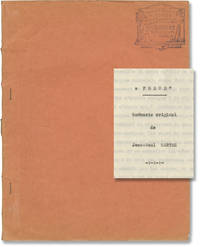
1965158800N.p.: N.p. 1965. Archive of vintage treatments scripts and other ephemera from the 1962 film.<br /> <br /> Archive includes: <br /> <br /> Two carbon typescript treatment scripts by Jean-Paul Sartre one in English and one in French both dated December 15 1958 with annotations in Sartre's hand.<br /> <br /> An early xerographically duplicated draft of Sartre's voluminous three-part script a later reproduction made for internal use with copied annotations throughout. <br /> <br /> A working script used during the film's production with revision pages.<br /> <br /> A film program. <br /> <br /> Three telegrams a telefax and a letter regarding the release of the film the return of Sartre's treatments and script and a deposition reminder all from agent Paul Kohner to director John Huston. <br /> <br /> A copy of the 1984 posthumous publication of Sartre's script The Freud Scenario.<br /> <br /> Huston announced his intention to make a film about a young Sigmund Freud in 1958 and asked Sartre whom he had met on the set of his 1952 film Moulin Rouge to submit a screenplay. The partnership quickly soured however due to Sartre's refusal to shorten his script which had ballooned to the colossal 472-page script on offer. Huston and Sartre would meet in Galway but Sartre continued to reject the director's proposed cuts wryly noting "We can make a film of four hours in the case of Ben Hur but the Texas public couldn't stand four hours of complexes." The film was ultimately finished and released in 1962 and although many elements of Sartre's script remain in the film the philosopher went uncredited. <br /> <br /> Set in Vienna shot on location in Austria and Germany.<br /> <br /> French Treatment:<br /> <br /> Salmon untitled wrappers. Title page present dated 15 Décembre 1958 noted as Scénario original with credits for author Jean-Paul Sartre. 95 leaves with last page of text numbered 95. Carbon typescript copy on onionskin rectos only. Pages Near Fine wrapper Near Fine saddle-stapled with two staples.<br /> <br /> English Treatment:<br /> <br /> Tan untitled wrappers with a titled label noted as Original Outline on the front wrapper with credits for author Jean-Paul Sartre. Title page present dated December 15 1958 noted as 1. Draft with credits for author Jean-Paul Sartre. 61 leaves with last page of text numbered 60. Carbon typescript copy on onionskin rectos only. Pages Near Fine wrapper Near Fine bound with three screw brads.<br /> <br /> Xerographically duplicated Sartre Script:<br /> <br /> White untitled wrappers. 472 leaves with last page of text numbered 181. Xerographic duplication rectos only. Pages Near Fine wrapper Very Good plus with light soiling overall bound internally with three gold brads.<br /> <br /> Working Script:<br /> <br /> Brown untitled wrappers. Title page present. 162 leaves with last page of text numbered 168. Mimeograph duplication rectos only with blue buff and yellow revision pages throughout dated variously between 9/8/61 and 12/19/61. Pages Near Fine wrapper Very Good lacking rear wrapper and much of the spine bound with a prong binding.<br /> <br /> Telegrams telefax and letter: 6.5 x 4.5 to 8.5 x 11 inches. Very Good plus to Near Fine.<br /> <br /> Program: 7 x 8.5 inches bi-fold. Very Good plus.<br /> <br /> Book: Near Fine and unread in a lightly rubbed Very Good plus dust jacket. N.p. unknown
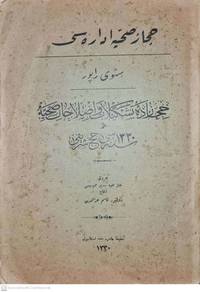
1914000179Ottoman Turkish official report about the Hijaz health rules and organizations with several illustrations of Jeddah and Mecca. Amira , government press paperback
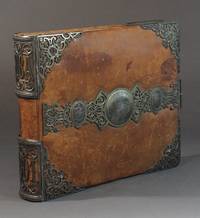
190158762Matanzas Cuba 1901. Oblong folio approx. 12" x 16" overall original padded leather with elaborate filigreed silver corner-pieces and central band bearing two engraved shields Cuban and American and a central medallion bearing the name of the school and the Buffalo Exposition a.e.g. silk moiré endpapers; leather a little scuffed the endpapers loosening but in all the binding is very good and sound; internally fine. Containing an autograph leaf signed by the director and 20 instructors and professors 7 printed leaves of text within red borders describing the Institute's curriculum professors natural history museum gymnasium etc. and 37 original photographs on printed mounts with decorative borders depicting professors benefactors alumni classrooms views of buildings both interior and exterior library and museum. The photographs are by C. Ruiz de Castro of Matanzas of whom there seems to be scant information. Photographs measure 7½" x 10" on mounts 11½" x 14". The Institute exists to this day. Started in September 1839 it went through many transformations over the years. By the mid-1860s the school was offering degrees in "Reasoned Arithmetic Algebra Topography Geometry Trigonometry History Physics Line Drawing Bookkeeping Applied Chemistry Geography and Commercial Statistical Geography Industrial Mechanics Natural History Political Economy and in terms of languages: English and French." Shortly thereafter were added "Grammar Latin Greek Sacred History and Religion Psychology Logic and Morals." By 1895 two chairs were added "Linear Drawing and Natural Drawing and it also had a Museum of Natural History with collections of snails and invaluable plants and specimens of the fauna and flora of Cuba." See a good history of the Institute online at dcubanos.com/rinconcuba/instituto-de-segunda-ensenanza-de-matanzas. unknown
1945149147Culver City CA: RKO Radio Pictures 1945. Draft script for the 1945 film with an additional seven page addendum on pink stock with alternate endings written out in a treatment form. <br/><br/>In addition to containing an alternate ending the date on the script coincides with the takeover of the project by RKO from original producer David O. Selznick in July 1945 making it one of the earliest possible drafts to bear the RKO label. Selznick who was never happy with the film's script or casting sold it to RKO after the disastrous production of "Duel in Sun" began absorbing most of his time and money. <br/><br/>Nominated for two Academy Awards including Best Original Screenplay and Best Supporting Actor for Claude Rains.<br/><br/>Set in and shot on location in Brazil with Los Angeles County Arboretum & Botanic Garden and Santa Anita Park & Racetrack. <br/><br/>Red titled wrappers front wrapper dated July 16 1945 and rubber-stamped production No. 1490 credited to both Hecht and Hitchcock. Title page integral with the first page of text. 167 leaves with last page of text numbered 160 followed by 7 pages on pink stock numbered A-G and titled "ALTERNATIVE ENDING."<br/><br/>Mimeograph duplication all pages on white and pink onionskin stock. Pages Near Fine wrapper Very God plus with some tiny closed tears bound with three gold brads. <br/><br/>National Film Registry. Criterion Collection 137. Ebert l. Grant US. Penzler 101. Rosenbaum 1000. Selby US Canon. Selby US Masterwork. Silver and Ward Classic Noir. Spicer US. RKO Radio Pictures unknown books
1966152582N.p.: N.p. 1966. Autograph letter signed from Francois Truffaut to Alfred Hitchcock on Truffaut's personal letterhead circa 1966 on many issues but mostly regarding the reception to the French publication of the pair's landmark book "Le cinema selon Hitchcock" published the following year in the US as "Truffaut/Hitchcock". In French.<br/><br/>A meaty enthusiastic celebratory letter broadly discussing the success of Truffaut's groundbreaking 1966 book "Le Cinema selon Alfred Hitchcock" its release in English and their respective film projects. Truffaut opens the letter by noting that he has heard news of Hitchcock working on the screenplay for his 51st film "Topaz" released in 1969 and congratulates the director on the effort. <br/><br/>He quickly shifts to descriptions of the reception of their book in France favored with unilaterally good reviews: "elogieux tous sans exception" "laudatory all without exception" save what some saw as the book's excessive price-50 francs or approximately $10. Truffaut also addresses the forthcoming English and American editions of the book reassuring Hitchcock that he will be able to take a last look at the translation before publication. Regarding the English edition Truffaut notes he has made good progress with publishers Secker and Warburg including a profitable advance guarantee of 3000 pounds more than double the amount offered by American publisher Simon and Schuster. <br/><br/>As a result of the book's publication Truffaut registers a recent proliferation of Hitchcock film festivals in Paris and the French countryside but notes that Paramount appears to no longer rent Hitchcock's older films including "Rear Window" "Vertigo" and "Psycho" to distributors in France and expresses his hope that the films have not been removed from circulation in Europe. <br/><br/>Truffaut also succinctly describes his latest film "The Bride Wore Black" stating that filming will begin at the end of May in Cannes and offering to send the English translation of the script to Hitchcock. Tangential to this Truffaut mentions that he is taking another round of English classes "car je ne desespere pas d'avoir un jour une conversation directe avec vous" "because I haven't given up on having a direct conversation with you one day" in spite of the helpful mediation of their shared interpreter Helen Scott. <br/><br/>Truffaut closes the letter with a heartfelt tribute to Hitchcock: "Lorsque le livre a ete fini et que je l'ai vu imprime j'ai ressenti le meme sentiment de vide et la meme tristesse que lorsqu'on livre au public un film acheve. J'avais vecu plus de quatre ans avec et comme il s'agit de vos propros et de vos idees sur le cinema je peux dire qu'il s'agit la pour moi du meilleur livre de cinema avec les ecrits d'Eisenstein" "When the book was finished and I saw it in print I felt the same mixture of sadness and emptiness as when a completed film is released. I'd lived with the book for over four years and since it is about your words and ideas regarding film I can say that to me it is the best book about film ever written alongside the writings of Eisenstein". <br/><br/>"Hitchcock/Truffaut" remains the definitive study of Hitchcock's method a transcription of a series of interviews held by Truffaut in 1966 covering in depth every film made by Hitchcock up through "Torn Curtain" and ultimately revealing the importance of Hitchcock and Truffaut alike as evenly matched auteurs and pioneers of cinema. Altogether the letter presents a detailed and warm look into the beautiful friendship between two giants of twentieth century film.<br/><br/>Eight leaves. Varying sizes. Fine. N.p. unknown books